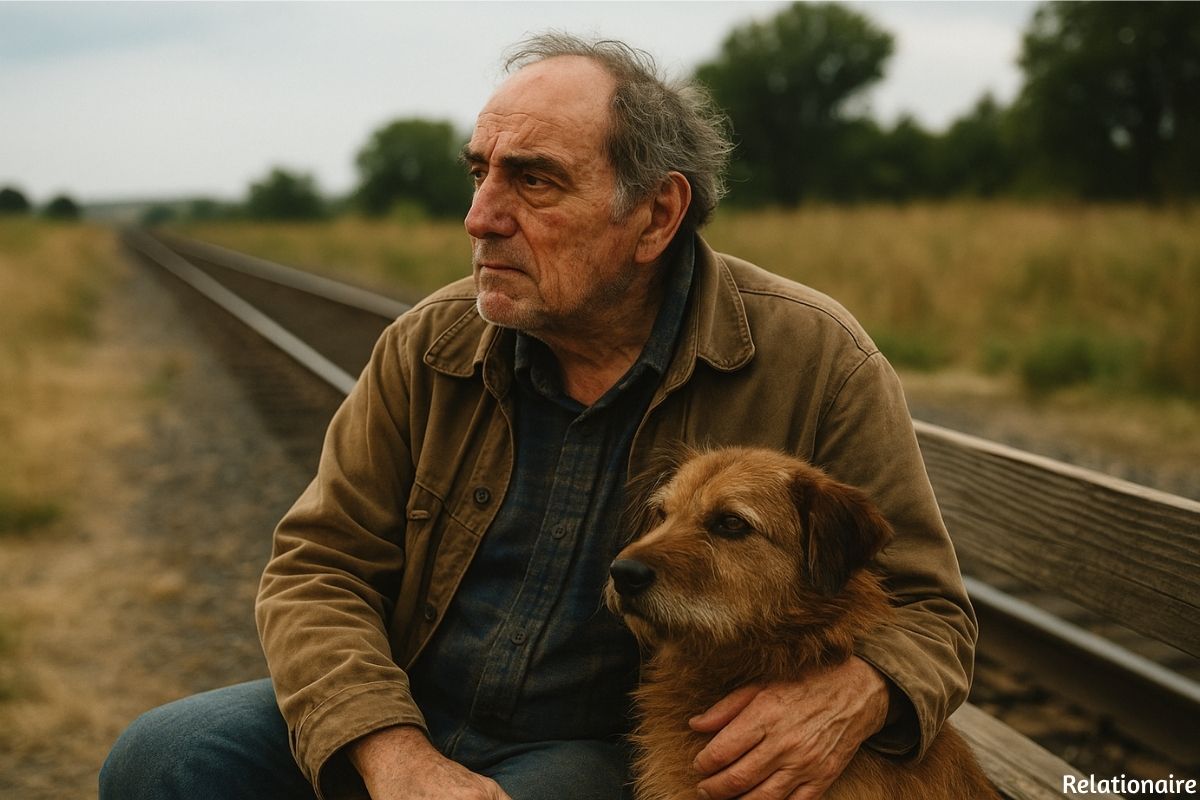
She said the train stopped running in ’82.
But every Tuesday at noon, she still heard it.
So did the dog—ears up, tail still, waiting.
Her grandson thought it was memory playing tricks.
Until he heard the whistle, too.
PART 1: The Tuesday Whistle
Dottie Lawrence didn’t believe in ghosts.
But she believed in trains.
And every Tuesday at exactly noon, she heard one.
She’d sit by the window—pane cracked like a spider web, frame bowed from seasons of freeze and thaw—and wait.
Beside her, a mutt with wiry ears and a half-gone tail would lift his head just seconds before the sound came.
Today, like every Tuesday, she was ready.
The wind came in sharp from the west. North Dakota June still had its teeth. The depot-turned-house, perched just outside the near-forgotten town of Medora, creaked in its bones. Peeling red paint flaked off the siding like old skin. A single track once ran past the edge of the property, now rusted over and buckled with prairie grass.
She could feel it coming before she heard it.
A tug in her chest. A pressure behind her eyes.
And then, soft as breath: that whistle.
Long. Low. Mourning.
The sound of something that shouldn’t still be moving.
“Tuesday,” she whispered, pressing her knotted fingers around her chipped teacup. “Right on time.”
The dog, Rusty, didn’t move—just stared out through the broken glass like always. Ears alert, nose twitching.
She wasn’t crazy. Not entirely.
She’d lived here since 1983. A year after they shut the line down. Her husband, George, had begged her to move back to Bismarck, to “somewhere sane,” but Dottie had refused. Said she liked the quiet. Liked the way the wind sang through the tracks. Liked that it still felt like something was coming.
George had died in ‘95. Cancer. Quick and ugly.
Now it was just her, Rusty, and a house full of stories no one asked about.
Until last week.
Until he showed up.
A dented gray pickup rumbled up the dirt road six days ago. Dottie knew the truck before she saw who was behind the wheel. It had been George’s. Sold after the funeral, but she’d never forgotten the growl of its engine.
When the door opened, it wasn’t a ghost. Just her grandson.
“Hey, Grandma,” he said, sheepish, hands shoved deep in the pockets of his flannel.
“Tommy Lawrence,” she muttered. “Thought you were too busy for the middle of nowhere.”
“Got laid off,” he said, eyes on his boots. “Again.”
She hadn’t said anything. Just nodded once and pushed the screen door open wider.
Now he was here. Sleeping in the attic under a quilt stitched from shirts she barely remembered sewing. Trying not to meddle. Failing at it.
Tommy came down late, still smelling like sleep and detergent.
“Morning,” he mumbled.
“Afternoon,” she corrected, glancing at the clock. Eleven fifty-eight. Almost time.
He poured coffee, black and bitter. “You really gonna do it again?”
“Do what?”
He nodded toward the window. “This… ghost train thing.”
She didn’t answer.
Rusty lifted his head.
Tommy raised an eyebrow. “Dog too, huh?”
“Tuesdays,” Dottie said. “He knows.”
“You ever think maybe you want to hear it? Like, some memory loop in your brain is stuck playing the same old soundtrack?”
She gave him a look sharp enough to cut rope. “I’m not hearing voices, Thomas. I’m hearing a whistle.”
He opened his mouth, but the sound stopped him.
Low. Long. Haunting.
It filled the room. Not loud, but real.
Rusty’s ears perked, body rigid.
Tommy froze.
“You hear that?” she whispered.
He didn’t answer.
Because he did.
The silence after was heavier than the sound itself. It hung in the air like fog.
Tommy set his mug down slowly. “Okay… that was weird.”
Dottie didn’t say I told you so. She just stood up, her knees popping like old floorboards, and shuffled to the window.
Rusty followed.
“It’s the same every week,” she said quietly. “Same time. Same whistle. No train.”
“Could be something else. Wind in the grain silo maybe.”
“Wind doesn’t follow a schedule.”
He came up beside her, eyes scanning the horizon. Just prairie. Miles of it. Yellow grass and empty sky.
“It stopped running in ’82,” she said again. “But it’s still coming.”
Tommy looked at her then—not like a confused grandson, but like a man standing on the edge of something he couldn’t quite explain.
“You ever follow it?” he asked.
Her hand touched the glass, fingertips to cold. “No.”
“Why not?”
“Because whatever it’s bringing back…”
She looked down at the dog.
“…might not want to be found.”
Rusty’s tail thumped once against the floor.
The old woman stepped back.
“Next Tuesday,” she said, her voice a breath.
“We’ll go.”
Tommy said nothing. But he nodded.
And for the first time in twenty years, the old station didn’t feel quite so empty.
PART 2: Tracks in the Grass
Tuesday came again like it always did.
And this time, they were ready.
Dottie stood on the depot porch with her coat buttoned all the way to her chin, even though it was June and the sun had some teeth in it today. She wore her husband’s old railroad cap, the one with the faded “BN” badge sewn crooked on the front, and a satchel slung over one shoulder. Inside: a canteen, a notepad, and a photo. Just one.
Tommy was already by the tracks—or what was left of them. Rusted rails disappeared into grass that hadn’t been trimmed in years. Only one rail was still intact; the other had split apart in a frost heave back in the late ’90s and no one ever came to fix it.
Rusty bounded ahead, nose to the dirt, tail flicking like a metronome.
Tommy looked over his shoulder. “You sure it’s safe?”
Dottie smirked. “What’s gonna kill us—memories?”
They walked slow. Dottie knew the land better than most people knew their own kitchens. Every dip and patch of burr grass, every white rock that looked like a dropped tooth. The line used to connect Medora to Dickinson. These tracks hadn’t seen steel wheels in forty years.
But they still held something.
The further they walked, the quieter it got. Even the wind seemed to hush. There were no power lines, no cars, no farmhouses. Just the breath of the prairie and that strange tension—like the sky was holding its breath.
At exactly noon, it came.
The whistle.
Low and distant, but unmistakable.
Rusty stopped dead in his tracks. Ears forward. Body frozen.
Tommy froze, too.
“There!” he said suddenly, pointing.
Something flickered down the line—just beyond the next rise. Not a shape exactly. More like… motion. A shimmer. Like heat off asphalt, but it danced like a rhythm they couldn’t quite place.
Dottie stepped ahead. Her boots cracked old cattails. Her breathing came louder now.
“Grandma,” Tommy said, “I think—”
But she raised a hand. “Shhh.”
And then they saw it.
A tie plate.
Half-buried. Rusted. But there.
Dottie knelt, bones groaning, and brushed the dirt off it with the sleeve of her coat.
She ran her fingers along the side. Numbers stamped into the iron:
1943.
She swallowed hard.
“That was the year George shipped out,” she murmured. “He said he rode this line all the way to Billings, then hopped a troop train to California.”
She looked up at Tommy. “He didn’t talk much about the war. But he always said that train ride felt like the real goodbye.”
Tommy crouched beside her, brushing more dirt aside.
“That’s when he gave you the photo?”
Dottie nodded and pulled it from her satchel.
It was creased at the edges and yellowing. George Lawrence in uniform, standing next to a train car, grinning. In one hand: his duffle. In the other: a small dog. Not Rusty, of course—but close. Same ears. Same look in the eye.
“He found the pup at the station. Said it followed him all the way onto the train.”
She blinked. “I’d forgotten that part.”
Rusty sniffed the photo gently. Then he trotted ahead, past the tie plate, toward the next bend in the track.
They followed.
The shimmer was gone now. So was the whistle.
But something else had appeared.
A clearing, just beyond the curve. Dottie hadn’t remembered this space. Flat, worn down, ringed with cattails and cottonwoods. And in the center—a small wooden bench, half-rotted but upright, with initials carved deep into the side.
Tommy walked over. “D.L. + G.L.,” he read aloud. “You and Grandpa?”
Dottie stared at it like it had risen from the earth overnight.
“I haven’t seen this since…” She paused. “We carved that our second summer together. 1959.”
She reached out, ran her fingers over the grooves.
“I thought the wind took it.”
Tommy looked around. “How’d it end up all the way out here?”
She didn’t answer.
Because just then, Rusty started barking. Not a warning. Not fear. Just sharp, excited bursts.
They turned.
The dog stood at the far end of the clearing, pawing at something buried in the tall grass.
Tommy moved first, parting the stalks.
What he uncovered made him stumble back.
A boot. Leather. Cracked.
And inside it—bone.
Dottie’s breath caught in her throat.
Tommy crouched, pale-faced. “Jesus.”
She knelt beside him. No panic. No scream. Just a slow, solemn nod.
Something in her had known they’d find something.
Tommy cleared more grass.
There was a full skeleton under there. Tattered scraps of uniform clung to the ribs. The remains of a canteen. A rusted chain. A badge.
He reached down and pulled up the dog tag.
Pvt. Silas Hartman. 194th Infantry.
Dottie’s eyes went wide.
“Silas Hartman,” she whispered. “That’s not George.”
“No,” Tommy said quietly. “But he was on the same train.”
She sat back, stunned.
Then she pointed at something caught in the chain—tangled in the links.
A dog collar.
Too small for Rusty.
Old. Faded.
But the name was still readable.
Buddy.
They didn’t speak on the way back.
Rusty trotted between them, tail low, ears alert.
Back at the depot, Dottie took the collar out and set it on the kitchen table beside the photo.
Two dogs.
Two men.
One train that never made it to Billings.
She looked at Tommy. “That dog followed him off the train.”
Tommy nodded. “Looks like it.”
She stared out the cracked window.
The tracks were silent now. But her chest still felt heavy. Like she hadn’t finished something. Like the whistle hadn’t either.
Tommy said it first.
“We should find out who Silas Hartman was.”
Dottie didn’t move.
But her fingers curled tight around the collar.
“Next Tuesday,” she said.
PART 3: The Name in the Ledger
The collar sat on the kitchen table for six days before either of them touched it again.
Dottie didn’t need more ghosts in her house. But this wasn’t a ghost, exactly. It was something real. Tangible. A name stamped into cracked leather. A story someone had lost track of.
On Monday night, she pulled out George’s old filing crate from the hallway closet—the one he used to call the command center.
It still smelled like dust, old tobacco, and engine grease. Inside were maps, train logs, timetables, and dozens of yellowed ledgers from the Medora depot.
And tucked behind a stack of unpaid bills from 1974, Dottie found it.
The Departures Register. March 1943.
Tuesday morning came with a low sky and the smell of rain.
Dottie laid the ledger open flat on the kitchen table, smoothing out the creases. Tommy hovered beside her, sipping burnt coffee.
“Do you know what you’re looking for?” he asked.
She didn’t answer right away.
Then she said, “Not what. Who.”
Her finger slid down the inked columns. Each row marked a name, a time, a ticket number. Soldiers. Farmers. A few schoolteachers.
Then, on page seven—there it was.
Hartman, Silas. Private First Class. Ticket No. 1487. Destination: Billings, MT.
Tommy leaned closer. “Same day as Grandpa?”
“Same train,” she murmured.
But something else caught her eye. A faint note in the “remarks” column, scribbled in the margins:
Delayed boarding. Dog would not leave side. Cleared by depot agent.
She stared at it. Heart thumping like it hadn’t in years.
“George told me once,” she whispered, “that a young man in line ahead of him got held up because of a stray dog. He laughed about it for years. Said the pup had more loyalty than most men.”
Tommy looked at Rusty, curled under the table, his tail thumping softly in his sleep.
“He never mentioned a name?”
“No,” Dottie said. “But it was Silas. It had to be.”
That afternoon, they made a call to the North Dakota Veterans Cemetery in Mandan.
Dottie hadn’t touched a landline in months, but her voice was steady.
“Private Silas Hartman,” she told the clerk. “194th Infantry. Died… well, that’s the thing. We don’t think he made it to the front.”
She gave the dog tag number. She read the serial aloud, twice.
There was a pause. Then the clerk said, “Ma’am… we don’t have a record of burial. Not here. Not anywhere.”
Tommy’s eyebrows rose.
“Next of kin?” Dottie asked.
Another pause.
“His mother filed an inquiry in 1944,” the clerk said. “But the Army eventually declared him MIA. Presumed dead in combat.”
“But he died here,” Tommy said. “On the prairie.”
“Ma’am,” the clerk continued gently, “if what you’re saying is true, then someone needs to notify his family. Or what’s left of it.”
Dottie’s fingers gripped the receiver.
“Let me do it,” she said.
That night, she wrote the letter by hand. The way she’d done in ’43, when George was gone and every day felt like a question mark.
Dear Mr. or Mrs. Hartman,
I may be writing to ghosts. But in case you’re still here, or if you’ve passed this name down, I want you to know: we found him.
His name was Silas.
He didn’t make it to war. But he wasn’t alone.
He had a dog.
And a bench.
And now—he has a name again.
Respectfully,
Dottie Lawrence
Medora, ND
She sealed it, added a photo of the dog collar, and slipped it into an envelope addressed to the last known address from the depot records.
The next Tuesday, noon came like always.
And so did the whistle.
But this time, it sounded different.
Not louder. Not closer.
Just… softer.
Like something exhaling.
Dottie stood on the porch, the wind curling her white hair. Rusty sat at her feet.
Tommy joined her with a printout from the county archives.
“Guess what?” he said, holding up the page. “Silas Hartman had a sister. Her name was Lillian. Born 1925. Married a mechanic named Joe Montrose. They had two kids.”
“Still living?”
“One of them is. A granddaughter. Schoolteacher in Fargo.”
Dottie looked out across the tracks.
“Then we go next week.”
That night, Tommy stayed up late. Couldn’t sleep. He kept hearing that whistle, even long after it had faded.
He wandered down the hallway and stopped by the photo wall.
Old black-and-whites. George in his depot uniform. Dottie holding a baby. A Christmas in 1962. A birthday in 1979. All frozen.
Then, at the end of the row, he noticed a frame he hadn’t paid attention to before.
A candid shot:
Dottie, maybe nineteen, sitting on a bench in a cotton dress. George beside her. Between them: a small dog. One ear flopped. One straight.
Behind them: railroad tracks. Blurry. Endless.
Tommy stared at the photo for a long time.
Then he whispered, “We’ve been chasing a train that already came.”
But he was wrong.
It hadn’t come yet.
PART 4: The Woman in Fargo
They drove east just after dawn.
Fargo was five hours if you didn’t stop, but they stopped twice—once for coffee, once to let Rusty run.
Dottie wore the same coat and cap, though the sun was warm. Her fingers clutched a small wooden box on her lap, the kind that once held cigars but now cradled Silas Hartman’s dog tag and collar. Tommy drove with both hands tight on the wheel, jaw set like he was preparing for something they couldn’t name.
“Think she’ll believe us?” he asked.
“She doesn’t have to,” Dottie said. “She just has to listen.”
June Montrose lived on the south side, in a blue single-story house with a wide porch and two lawn chairs that hadn’t been used in years. A wind chime rang soft above the door as they stepped up. Rusty sat obediently on the bottom stair.
Tommy cleared his throat and rang the bell.
A pause.
Then the door creaked open.
She was in her mid-50s. Shoulder-length hair going gray. A smudge of chalk dust on her blouse. Schoolteacher, no doubt.
“Yes?”
“Ms. Montrose?” Tommy asked. “We came about Silas Hartman.”
The name stopped her cold.
She looked at Dottie.
“You knew my great-uncle?”
Dottie opened the cigar box.
Inside was the collar. The tag. A photo of the bench. The note from the ledger. All placed with quiet care.
June studied the tag first, lips parting.
“My grandmother used to say he never came home. She always hoped she was wrong.” She looked up. “Where did you find this?”
“Near the old rail line,” Dottie said. “Outside Medora.”
June’s eyes welled. She sank into one of the porch chairs like her legs gave out.
“Please,” she said. “Tell me.”
They sat with her for an hour, unraveling the story thread by thread.
The Tuesday whistle.
The clearing.
The dog who wouldn’t leave.
The bone.
The photo.
The collar.
When Dottie finished, June held the tag like it was glass.
“I teach history,” she said quietly. “And I’ve told my students that memory matters. That names matter. But I never thought I’d get his back.”
She stood, wiped her eyes, and looked at Rusty.
“You know,” she said, voice breaking, “my grandma used to say Silas had a way with dogs. Like they just understood him.”
Rusty trotted over and laid his head on her shoe.
That night, June served them leftover lasagna and a fresh peach pie. They sat at the kitchen table like old friends who hadn’t seen each other in years, though they’d just met.
Before they left, June asked to keep the collar.
“Not for me,” she said. “For him.”
Dottie hesitated, then nodded. “He was never really mine.”
Tommy added, “We’re planning a marker. Out where he was found.”
June placed her hand over Dottie’s.
“Let me help.”
They drove back under a moon so big it looked close enough to touch.
For the first hour, neither of them spoke. The road rolled beneath them like a ribbon unfolding.
“You did good today,” Tommy finally said.
Dottie didn’t respond right away.
Then she said, “I don’t think the train was calling for me.”
Tommy looked at her.
“I think it was calling for him.”
She closed her eyes. “And now that someone heard it…”
“…maybe it can stop,” Tommy finished.
Rusty let out a soft huff in his sleep.
The next Tuesday, they returned to the bench.
June came, too, with flowers. They laid them in the clearing where they’d found the body. No big ceremony. No headlines. Just the three of them. And a dog who understood more than most people ever would.
They placed a simple wooden marker:
PVT. SILAS HARTMAN
1943
NO LONGER MISSING
As the whistle rose—soft, faint, but real—Dottie felt her shoulders loosen for the first time in years.
June whispered, “He made it home.”
And for once, no one argued.
PART 5: The Story Beneath the Tracks
The marker stood quietly in the prairie grass.
No flag. No ceremony. Just wood, wind, and the sound of cottonwoods rattling like bones.
They visited each week—Dottie, Tommy, Rusty, and sometimes June. Always on Tuesdays. Noon. Like clockwork.
But after they placed the marker, the whistle changed. It wasn’t gone, not yet, but it grew fainter. Like the memory was fading—released, not erased.
Tommy said it sounded more like breath now. Like someone letting go.
Back at the depot, Dottie kept the departure ledger open on the kitchen table. She’d been sleeping less, eating less, thinking more.
“What else are you looking for?” Tommy asked one evening, as she ran her fingers down a list of names again.
She didn’t look up.
“Patterns.”
He waited.
Dottie tapped a row with her index finger.
“Ticket No. 1491. William Grady. He boarded after Silas. No remarks. Destination: Spokane.”
“And?”
“He was George’s bunkmate in training. George used to talk about him sometimes. Said he was a good man.”
Tommy nodded slowly. “Okay.”
Dottie turned the page.
“Here’s what’s strange. Grady never made it to Spokane.”
Tommy frowned. “You sure?”
“Checked the Army archives. No record of William Grady arriving at his assigned post. Just a letter home, dated March 26, 1943: ‘We were delayed outside Medora. Lost a man. Didn’t feel right after that.’”
Tommy leaned back. “So… he saw Silas die?”
“Maybe. Maybe more.”
Dottie stood. “Come on. We’re going back out there.”
They returned to the clearing as the sun fell low.
Rusty raced ahead, sniffing, ears perked like radar.
Tommy brought a metal detector he borrowed from the local VFW hall. It beeped every few feet—old nails, tin cans, bottle caps—but nothing worth remembering.
Then, just past the marker, near a low patch of dirt along the rail bed, it shrieked.
Tommy dug.
Three inches down, he found a rusted pocketknife.
Then a pin—an Army insignia. Bent.
Then—a bullet casing.
Dottie knelt. Picked it up with shaking hands.
“This wasn’t just exposure,” she murmured. “Silas didn’t get lost. He was shot.”
Tommy’s eyes met hers. “You think someone did this?”
She nodded once. “And they covered it up.”
Back at the depot, Dottie opened George’s war box.
Inside: medals, letters, photos. But more than that—maps, troop placements, notes written in his blocky handwriting.
Tommy read over her shoulder as she pointed.
“Grady had guilt he couldn’t shake,” she whispered. “George wrote that in a letter home. He drank. Didn’t sleep. Said he saw something he never should have seen.”
Tommy looked stunned. “You think George knew about Silas?”
“I think he suspected,” she said. “But war has rules. And silence is one of them.”
She tapped the map. “But we’re not at war anymore.”
The next morning, they drove to Dickinson.
The county courthouse held the archived logs from the Medora sheriff’s office, now long shuttered. They flipped through decades of blotters, reports, incident cards. Most were mundane—livestock thefts, bar fights, missing tools.
Then, dated March 23, 1943, barely legible on a yellowed card:
Report: Gunfire near depot. Unfounded.
Responding deputy: W. Raines.
No further action taken.
Dottie exhaled sharply. “Gunfire. The same day.”
Tommy read it twice. “So someone heard it.”
“But they didn’t investigate.”
They went looking for the name: Deputy Walter Raines.
Still alive. Ninety-nine years old. Living in a veterans’ care home outside Glendive.
They called first. Explained only what they had to. The voice on the other end said, “Come now. He doesn’t remember much. But he remembers that day.”
Walter Raines sat in a chair by a window that didn’t open.
His hands trembled, but his eyes were clear.
When Dottie mentioned the train line, his gaze snapped into focus.
“I was twenty-three,” he said, voice dry but steady. “First week on duty.”
She showed him the photo of the clearing. Then the collar.
Raines shut his eyes.
“I heard the shot,” he said. “But they told me not to file it. Said the Army would handle it.”
“Who told you that?” Tommy asked.
Raines opened his eyes again.
“Grady,” he whispered. “Said it was a fight. Said it was over a damn dog.”
Silence.
Then he added, “He cried. I’d never seen a soldier cry like that. Said he didn’t mean to.”
Back in the truck, Dottie sat silent for a long while.
Tommy finally said, “So it was Grady.”
She nodded slowly.
“He shot Silas. Probably in a panic. Maybe an argument. The dog got in the way. I don’t know. But then he lied.”
Tommy looked back toward the road.
“And George carried that silence the rest of his life.”
She closed her eyes. “And now we don’t have to.”
That night, the whistle didn’t come.
The wind was still. The tracks quiet.
Dottie stood by the window long after the clock struck noon.
Rusty sat beside her, head on her foot.
Tommy asked gently, “You think it’s over?”
“No,” she said.
“But it’s different now.”
She looked at the collar, the ledger, the photo.
“We’re not chasing the train anymore,” she said.
“We’re riding it home.”
PART 6: The Last Conductor
The next morning, Dottie found something unexpected at the depot’s front door.
A package.
Wrapped in brown paper, no return address. Just her name, carefully written in slanted pen:
Dottie Lawrence.
She brought it inside, heart tapping like a clock.
Tommy watched from the kitchen, still in his flannel, one boot unlaced.
“Well?” he asked.
She peeled the paper slowly.
Inside: a notebook, black, leather-bound.
A name etched in faded gold on the front cover:
George R. Lawrence.
The first page held a date: March 1943.
Beneath it, in George’s tidy handwriting:
“There are things I never said.
I suppose it’s time.”
Dottie’s breath caught.
The journal was full. Over 80 pages.
Not of war stories—but of train stories. Depot stories. Men he’d seen off and never seen again.
But in the middle—tucked between reports of snowfall and a recipe for flapjacks—was a story she didn’t expect.
“Silas Hartman was a boy trying to be a soldier.
He boarded with a dog under his arm and eyes too soft for war.
Grady didn’t like that. Said animals were weakness.
I think Grady already had the war in him.
The rest of us were still boarding.”
“We lost Silas that day.
I didn’t see it, but I heard the shot.
I remember the quiet that followed more than anything.”
“Grady told me it was an accident. Said Silas went into the grass with the dog and didn’t come back.
I wanted to tell the sheriff. But Grady had stripes. I didn’t.”
“I’ve carried it since.
And every Tuesday, I still hear that train.
Not the one we lost—
The one we never finished.”
Dottie closed the journal.
The whistle hadn’t come yesterday. But today, as the clock neared noon, she felt something deeper.
Not a sound.
A presence.
She sat by the window.
Rusty stood.
And for a moment—just a moment—she swore she saw it.
A shape. Out past the cottonwoods.
A blur of light. A glint of iron.
Then nothing.
“I think he finished it,” she said.
Tommy looked up from the notebook. “Who?”
“George.”
She tapped the cover. “This is a confession. But it’s also… a relay. He passed the story to us. And now we carry it.”
Tommy sat beside her. “What do we do with it?”
“We do what railmen always do,” she said.
“We lay down track.”
They mailed a copy of the journal to June Montrose, who called them crying.
She said she’d read it to her students next Memorial Day.
They gave another copy to the Dickinson library. The librarian put it under “Local History,” next to a dusty binder on grain prices.
They donated Silas’s dog tag to the Veterans Museum in Bismarck, under a new display titled:
“The Lost Rider of Medora.”
And each Tuesday, even without the whistle, they still walked the track.
One Tuesday, weeks later, Tommy stopped mid-step.
“Hey,” he said.
He crouched by the edge of the path and pulled something from the dirt.
A rail spike. Old. Rusted. But strong.
He handed it to Dottie.
“Souvenir?”
She shook her head.
“No,” she said. “It’s a start.”
That weekend, they began rebuilding the bench. The original was rotted, splintered from sun and wind, but the carving remained.
D.L. + G.L.
Tommy sanded the wood. Dottie stained it. Rusty slept under the sawhorse like a foreman on break.
When they finished, they carried it out to the clearing together. Set it exactly where it had stood all those years ago.
She ran her fingers over the letters.
Then, beneath the old carving, Tommy added a new one:
S.H.
Gone But Heard.
That night, they lit a fire outside the depot. A quiet celebration.
Dottie sipped coffee. Tommy read aloud from George’s journal. Rusty chewed a stick like it was the most important job in the world.
When the stars came out, she leaned back in her chair and whispered:
“Sometimes I think the train wasn’t a ghost.”
Tommy looked at her.
“I think it was a message,” she said. “It didn’t stop in ’82. It just waited.”
He smiled. “Waited for you?”
She shook her head.
“For us.”
The wind picked up.
From somewhere far beyond the tracks came a sound—not a whistle, not exactly.
But close.
Low. Faint.
A breath of iron and memory.
And then it was gone.
PART 7: Whistles Fade, Names Remain
The town of Medora hadn’t seen a new plaque in over a decade.
But that summer, one appeared on the side of the old depot.
Tommy mounted it himself with borrowed tools and careful hands.
A brushed steel square, just beneath the window where Dottie always sat.
It read:
In Memory of Pvt. Silas Hartman (1922–1943)
Lost in silence. Found in memory.
“The train never stopped—only waited.”
—Dedicated by the people of Medora, 2025
People stopped to read it. Tourists. Locals. Kids on bikes.
No one asked why it took so long.
Most of them just nodded.
Some left flowers.
Dottie stood back from the wall and stared at it for a long time.
Rusty sat beside her, tail sweeping dust back and forth across the platform boards.
“It’s not about ghosts,” she said softly.
Tommy, standing behind her, asked, “Then what’s it about?”
She turned, her eyes lined with sleep and sunlight.
“It’s about not forgetting.”
On the last Tuesday of August, something strange happened.
For the first time in years, the whistle didn’t come.
Not faint. Not fading.
Nothing.
Dottie didn’t move from her window. She just sat, hands folded in her lap, face calm.
Tommy brought her coffee but didn’t speak.
When the clock struck twelve, the room stayed still. Quiet.
Not empty.
Just finished.
That night, they cooked dinner together. Fried potatoes, leftover roast, a peach cobbler Dottie insisted on burning the edges of “for crunch.”
Tommy did the dishes. Dottie dried.
And then she pulled an envelope from her apron pocket and handed it to him.
“For you,” she said.
He opened it. Inside: a deed transfer, notarized and signed.
“You’re giving me the depot?”
She nodded.
“It’s just wood and roof,” she said. “But it’s also track. And you know how to keep laying it.”
He laughed once, surprised. Then stopped.
“You sure?”
“I’m tired,” she said simply. “But you… you’re just getting started.”
That weekend, Tommy began turning the attic into a writing room.
The first story he worked on was Silas’s.
The second was George’s.
The third was Dottie’s.
And all of them were the same story, really—just different whistles along the same line.
He wrote in longhand, with George’s old pen. Let the ink smear, let the paper soak memory.
Rusty sat beside him most mornings, paw on his foot, the two of them quietly guarding the past.
In late September, June Montrose returned.
She stood before the new plaque in the morning sun, tracing each word with her fingers.
“I told my students about him,” she said. “They cried.”
“They should,” Dottie said. “He was worth crying for.”
June brought a tiny brass bell with her—an old train car bell her grandmother had kept in a drawer.
She placed it on the depot windowsill.
“For the days we forget to listen,” she said.
And no one touched it again.
October brought frost.
The grass around the marker in the clearing began to yellow, then brown. The bench turned a shade grayer. But the carving held.
D.L. + G.L.
S.H.
Gone But Heard.
Dottie visited once a week now. She brought a thermos. Sat quietly.
Sometimes she spoke. Sometimes she didn’t.
Rusty always listened.
One morning, she woke early.
Earlier than usual.
The kind of early that felt like a beginning, not an ending.
She pulled on her coat, made coffee, and went outside.
The prairie was still. Cold. Beautiful.
And as the sky turned from blue to pink, she whispered:
“Thank you for waiting.”
Then she sat down on the bench. Rusty at her feet.
And she closed her eyes.
Tommy found her an hour later.
Smiling.
Still.
He knelt beside her, took her hand.
It was cool, but not cold.
Rusty laid his head in her lap and didn’t move.
Not for a long, long time.
They buried her next to George, beneath the cottonwoods.
June read from George’s journal. Tommy read from her favorite book.
Rusty stayed curled beside the casket like a second shadow.
When it was over, and the wind picked up across the field, Tommy stood by the grave and whispered:
“She heard the train again.”
And no one doubted it.
PART 8: The Man Who Stayed
After the funeral, the depot felt different.
Not empty. Not haunted. Just… quiet.
Tommy moved slowly through each room that week. Let the dust settle. Let the silence breathe.
Rusty followed him everywhere, more solemn than usual. No barking. No tail-wagging. Just quiet companionship, like he understood the weight of it all.
Tommy sat most mornings by the cracked window Dottie had loved, coffee in hand, her train whistle still in his ears—even if it didn’t come anymore.
She was gone.
But her watch remained.
That weekend, Tommy cleared out the attic. Not to erase her—but to make space for the story she’d left behind.
The first thing he found: a shoebox of letters.
Each one addressed in Dottie’s careful handwriting:
- To George, when he was deployed
- To herself, when she didn’t know who else to write to
- And one, unopened, with no envelope—just a folded page labeled:
“For Tommy, when I’m not sitting at the window anymore.”
He opened it slowly.
Dear Thomas,
You didn’t have to stay, you know.
But I’m glad you did.Some people run from silence. You listened to it. That’s what made all the difference.
I believe places remember us. Especially when we leave something behind—love, grief, truth. The depot has all of that now. So do you.
Tell the story. That’s your work now. I’ll be watching.
Love,
Grandma Dottie
Tommy cried for the first time in weeks.
Not loud. Just quiet tears that rolled without permission.
He set the letter on the desk and looked out the attic window.
The tracks were still broken.
But they felt… connected.
Over the next few weeks, Tommy transformed the depot.
He cleared the clutter. Left her favorite chair by the window. Installed a small bookshelf where the wood stove used to be.
He framed the original departure ledger and hung it beside George’s cap.
Above the bench outside, he mounted a weatherproof plaque that read:
“This station still listens.”
And people started coming.
It began with June.
She brought her students for a walking history tour.
Then came a man from Bismarck whose father had worked for Burlington Northern.
Then a Vietnam vet who heard about the story from his niece on Facebook.
Then, somehow, the local paper.
Then the regional.
And one morning, a woman showed up from Minneapolis with a notepad and a recorder.
“I heard this depot knows names the wind forgot,” she said. “Mind if I write a piece?”
Tommy simply pointed to the bench.
“Start there.”
In December, they hosted the town’s first candlelight memorial.
Thirty-four people came.
Most didn’t know Silas.
Some didn’t even know Dottie.
But they stood in the cold anyway. Held candles. Stared at the stars.
Tommy read aloud:
“Names are just breath, shaped into memory.
We forget them when we stop listening.
But if we stay quiet—
sometimes they come back on the wind.”
Rusty barked once at the end.
Someone swore they heard a whistle.
No one questioned it.
On New Year’s Eve, Tommy climbed into the attic one last time before midnight.
He sat at the desk. Opened a fresh notebook. And wrote:
“The Train Still Whistles – A Memoir.”
He stared at the title for a long time.
Then he added:
This is not a ghost story.
This is a story about staying put. About hearing what others ignore.
About how the past doesn’t haunt us—
It calls us home.
He closed the notebook. Blew out the lantern.
And somewhere, faint and warm in the distance—
a whistle rose through the snow.
Not from the tracks.
From within.
And he smiled.
PART 9: Echoes Carry
By spring, the depot had become something new.
Not a museum. Not quite a memorial.
Just… a place where stories landed.
Tommy didn’t advertise. He didn’t need to.
Word traveled—quietly, steadily—like a train making its way down a line no longer shown on maps.
Veterans came.
Descendants.
Railroad workers.
A girl who said her grandfather disappeared from a troop train in ’45.
A man who carried his father’s conductor badge like it still opened doors.
They came, not looking for answers—just witnesses.
And Tommy listened to every one.
He kept a guest book by the front door.
People didn’t sign it with names.
They signed it with stories.
“He left in 1951. I think he meant to come home.”
“My great-aunt always said she heard voices on Tuesdays.”
“There was a dog like that in my father’s photographs.”
“The train still runs in my dreams.”
“Thank you for hearing what most of us forgot.”
Tommy read them all. And added a few of his own.
Rusty, aging now, moved slower. He no longer sprinted to the clearing but walked there like a sentry—head high, steps steady.
Tommy started placing a small treat by the bench every Tuesday.
“From Dottie,” he’d whisper.
And Rusty would sit beside it like he was guarding something sacred.
In May, wildflowers bloomed around the marker. Someone—he never found out who—left a folded American flag tucked behind the bench’s leg.
It wasn’t from a funeral.
It was a gift.
That summer, Tommy got a letter.
From Washington, D.C.
The Department of the Army.
They’d reviewed the case file. The skeletal remains. The journal pages. The local records.
They confirmed:
Pvt. Silas Hartman’s status would be changed from MIA to KIA—Killed in Action.
Seventy-nine years late.
But not too late.
He framed the letter.
Placed it in the depot beside Silas’s dog tag.
Beside the bell June had left.
Beside George’s pen and the original train ledger.
Visitors often paused at the letter the longest.
Some wept.
Some saluted.
Some said nothing, just closed their eyes for a few seconds like they were catching something on the wind.
Tommy didn’t call himself a historian.
He said he was a keeper.
Of sounds.
Of stories.
Of things that don’t belong in museums, but still deserve a home.
Once, a journalist asked him what it felt like to “solve a mystery from the past.”
Tommy shook his head.
“We didn’t solve it,” he said. “We just heard it.”
One evening in August, just before sunset, he walked out to the clearing with a small stack of books.
He placed one copy of his memoir on the bench. Left another tucked under a rock by the marker.
The third he set at the base of the tree where Dottie used to rest her back.
On the inside cover, he wrote:
If you found this, the story found you.
Sit a while.
And listen.— T.L.
The wind kicked up just after he finished.
A soft gust.
Then, somewhere between the trees and the tracks, that old sound came again.
Not a whistle. Not exactly.
More like a harmony.
As if something far away had been given peace—and decided to hum its thanks.
Rusty lifted his head.
Tommy didn’t flinch. Didn’t turn.
He just smiled.
And said, “She’s still keeping time.”
PART 10: The Line Never Ends
By autumn, the depot had a rhythm.
Mornings belonged to the sunlight on the wood floors, the slow rise of the coffee kettle, the soft click of Rusty’s nails across the kitchen tile.
Afternoons were for visitors—some expected, most not.
Tommy welcomed them all with the same line:
“We don’t sell tickets. Just stories.”
Evenings were for writing.
Or remembering.
Or sitting with silence and letting it speak.
And Tuesdays—Tuesdays still belonged to the tracks.
On the first frost of October, Rusty didn’t wake.
He lay curled in his usual spot, beneath the bench by the window.
No pain. No sound.
Just… stillness.
Tommy buried him near the clearing, under the cottonwood where Dottie once read to him.
He carved a small wooden marker, plain and steady:
RUSTY
Loyal to the end.
Always heard it first.
And then, for the first time since Dottie passed, Tommy cried like a boy who’d just watched his last anchor float away.
But he stayed.
That winter, the snow came early.
The depot became a hush of wind and creaking beams.
Sometimes, late at night, Tommy swore he heard faint footsteps or the rattle of a dog’s collar in the hallway.
He never questioned it.
He just said, “Evening,” and let the house breathe.
In December, he received a package.
No name. No note.
Just a brass key inside a small tin, wrapped in an Army-issue handkerchief.
He recognized it instantly:
It was from George’s old station locker. The one that had been sealed after the depot closed in 1982.
Tommy hadn’t known it still existed.
He drove to Dickinson that same week.
The rail yard manager walked him to a rusted corner of the old warehouse.
“Been here untouched for decades,” the man said. “Some things just wait for the right hands.”
The key fit.
Inside:
- A rolled-up conductor’s map, hand-annotated by George.
- A copy of the 1943 train manifest.
- A single leather-bound notebook, labeled: “If She Ever Comes Back.”
Tommy didn’t open it there.
He took it home.
Lit a fire.
And read.
It was a love letter.
Eighty pages.
From George to Dottie.
From a man who never said much—but wrote everything.
“I wanted to build you a line with my hands.
A track that never stopped.
A whistle only you could hear.”
“I saw what happened to Silas. I wanted to stop it. But I froze.
I thought silence was protection.
I was wrong.”
“Every Tuesday, I sat with that mistake.
And somehow, you sat with me.”
Tommy read every word.
Then carefully placed the notebook in the display beside the dog collar.
And whispered:
“They’re all home now.”
That spring, the town of Medora officially renamed the depot.
A bronze sign was mounted above the door.
THE LAWRENCE-HARTMAN STATION
“Where memory boards and silence speaks.”
On the station’s 100th anniversary, Tommy gave a short speech.
He stood under the overhang, wind brushing his face, his notes fluttering in his hand.
“Some say the tracks ended here,” he told the crowd.
“They didn’t. They just dipped underground for a while. Into the soil. Into the hearts of the people who stayed.”
He paused.
“Sometimes the most important journeys don’t have destinations. Just echoes.”
He looked toward the clearing.
Toward Dottie.
Toward George.
Toward Rusty.
“Thank you,” he said simply. “For waiting.”
That night, he walked the rails alone. No flashlight. No map.
The stars were enough.
At the clearing, he sat on the bench. Cold wood. Familiar carving beneath his fingers.
And at exactly 12:00 midnight, he heard it.
The whistle.
Not loud. Not sad.
Not from the past.
It sounded like a beginning.
Like a train just arriving, one you’d waited your whole life for.
Tommy smiled.
Closed his eyes.
And whispered:
“I’m still listening.”
The End.