A Little Girl Grabbed My Hand in the Frozen Foods Aisle and Called Me Mom—By Nightfall, the Family Papers Said She Was the Daughter My Sister Never Told Us About
I looked down and saw a tiny hand wrapped around mine.
“Can we go home now, Mommy?”
For one strange second, I thought she was talking to someone behind me.
Then I realized there was no one behind me.
Just me.
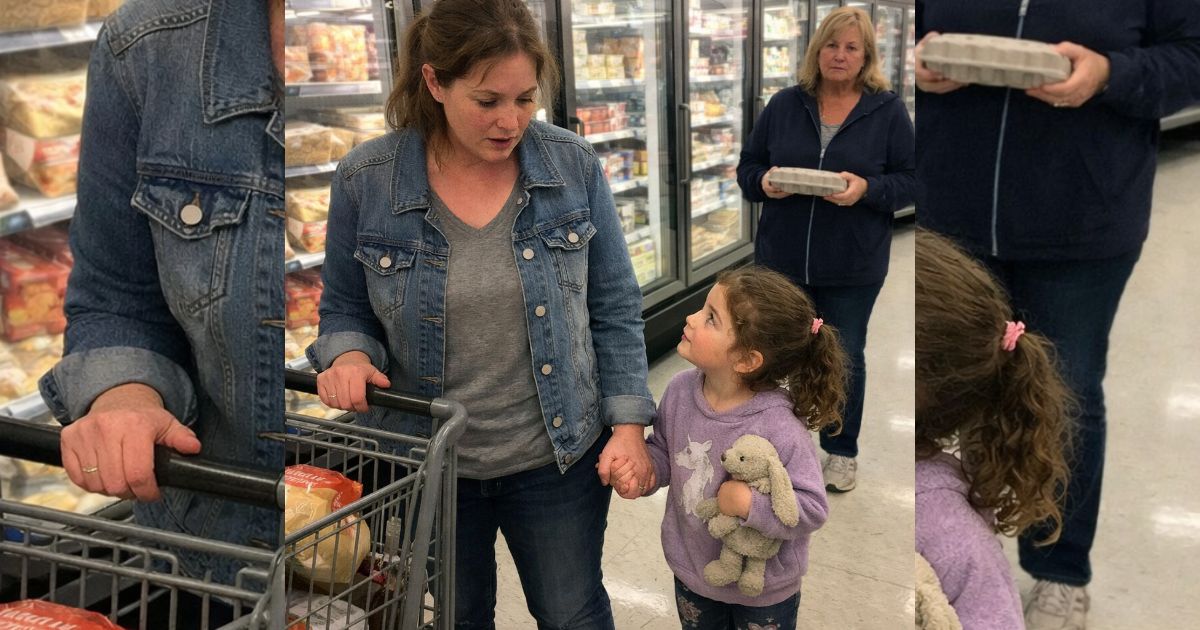
Just a little girl in a faded purple sweatshirt, brown curls pulled back with a stretched-out scrunchie, and a stuffed bunny hanging from one hand by its long ears.
Her fingers were warm.
Steady.
Like this was the most natural thing in the world.
I could still hear the hum of the freezer doors behind us.
Still smell cold air and bread from the bakery section.
Still feel my phone in my coat pocket where I’d been texting my mother that I was almost done.
Everything around me looked normal.
That was the part that made it feel unreal.
A woman I had never seen before stood a few feet away with a carton of eggs in her hand and worry all over her face.
“She’s been following you since the park,” she said softly. “I thought she was yours.”
My stomach dropped so fast it felt like I had missed a step in the dark.
I looked back at the girl.
She looked right up at me with big brown eyes and the kind of quiet patience you don’t expect from a child that small.
Not scared.
Not crying.
Not wild.
Just certain.
“I think you have the wrong person, sweetheart,” I said, keeping my voice low and calm even though my pulse had started pounding in my throat. “I’m not your mommy.”
She nodded once.
Like she heard me.
Like she did not believe me.
And then she tugged my hand a little.
Not hard.
Just enough to say she was waiting on me.
I had gone into the store for chicken, apples, eggs, almond milk, and my mother’s favorite dark chocolate.
That was it.
A plain Sunday list.
A plain Sunday mood.
I was thirty-eight years old, lived alone in a small suburb outside Dayton, worked from home designing websites for local businesses, and had built my life around routines that made sense.
My house was quiet.
My fridge was organized.
My bills were on autopay.
My mother, Denise, lived twelve minutes away and had been recovering from hip surgery, so most of my Sundays lately belonged to her and the kind of errands that come with loving someone who hates needing help.
I had no husband.
No kids.
No mystery child with a purple sweatshirt and a stuffed bunny.
A couple passing by slowed down.
The woman with the eggs looked from me to the girl and back again.
I could feel the heat rising in my face.
Every instinct in me split in two.
One part wanted to kneel down and soothe the child.
The other part knew exactly how bad this could look from the outside.
I crouched to her level.
“What’s your name?”
She didn’t answer.
“Do you know where your mom is? Or your dad? Grandma? Anybody?”
Nothing.
She was close enough now that I could see the frayed cuff of her sweatshirt and a little patch sewn onto the bunny’s side where someone had fixed it by hand.
She leaned into me.
Like she had done it before.
“Sweetheart,” I said again, gentler this time. “I’m Lena. Can you tell me your name?”
Her eyes moved over my face slowly.
Then, in a voice so soft I almost missed it, she said, “Eliza.”
It should have made me feel better.
A name.
Something solid.
Instead it made the whole thing feel even stranger.
“That’s a beautiful name,” I said. “Eliza, are you here by yourself?”
She shook her head.
“Did someone bring you here?”
A pause.
Then the tiniest nod.
“Who brought you?”
She looked straight at me.
“You did.”
The woman with the eggs drew in a breath.
I stood up too quickly and nearly bumped my cart.
My legs had gone weak.
I pulled my phone out of my pocket and called the customer service desk at the front of the store.
I kept my voice as even as I could.
“There’s a little girl here who says I’m her mother,” I told the clerk. “I have never seen her before in my life. I need somebody to come help right now.”
Eliza did not let go of my hand.
Not while we walked to the front.
Not while the assistant manager came around the counter.
Not while a young security guard with a clipped badge and a serious face led us to a small office near the back.
She stayed beside me the whole time, shoulder brushing my coat, bunny in one hand, my fingers in the other.
Inside the office, the security guard offered her a juice box.
She didn’t even look at it.
The assistant manager asked me to explain everything from the beginning.
I did.
From the text I was sending my mother.
To the tap on my shoulder.
To the stranger from the park.
To the words that were still ringing in my ears.
Can we go home now, Mommy?
They pulled up the camera feed from the store entrance.
There I was pushing a cart past produce.
And there she was behind me.
Silent.
Watching me.
Keeping the same distance.
Not grabbing candy.
Not wandering off.
Just following.
Frame after frame.
Like a shadow that had chosen me.
“Did you come in with her?” the security guard asked.
“No.”
“Have you seen her before today?”
“Never.”
He clicked back through another angle.
Then another.
He frowned.
“She really did come in after you,” he said. “Whoever she was with isn’t obvious.”
The assistant manager called the police.
The longest ten minutes of my life passed inside that little office.
Eliza sat in the chair beside me and leaned against my arm.
Not once did she cry.
Not once did she ask for another grown-up.
Not once did she look toward the door like she was waiting for someone else to appear.
She was waiting on me.
That was the part I couldn’t get past.
Two officers arrived.
A man first, then a woman with kind eyes and a notebook already in her hand.
They asked the same questions the store had asked.
Where did I park.
What time had I come in.
Had I been at the park before the store.
That one made sense once they said it out loud.
The grocery store sat just off the town square, across from a small public park with a walking path and benches under old maple trees.
I had cut through the edge of it after parking because the lot closer to the entrance was crowded from the late church crowd and I didn’t feel like circling twice.
I remembered passing a bench.
A stroller.
Two teenage boys throwing a football.
Nothing else.
No child attached to my side.
No one calling after me.
The woman officer knelt down in front of Eliza.
“Hi there. I’m Officer Ramirez. Can you tell me where you live?”
Eliza’s gaze slid past her and landed on me.
“She’s right here,” she said.
The officer stood back up slowly.
The male officer asked for my ID.
I handed it over.
I watched him study the photo, then my face, then the child.
I knew what he was doing.
Looking for a clue that would make this make sense.
I almost wanted him to find one.
Something obvious.
Same chin.
Same eyes.
Something that could explain why this girl had wrapped herself around my life in the middle of aisle nine.
But if he saw anything, he didn’t say it.
They radioed in.
No missing child report.
No emergency notice.
No call from a frantic parent.
Nothing.
That silence felt wrong in a way I still can’t fully explain.
Because if a little girl like Eliza had gone missing from my world, I would have torn every door off every building looking for her.
A caseworker from the county family services office came next.
Her name was Jackie.
She wore flat shoes, a navy cardigan, and the kind of careful expression people wear when they spend their working lives stepping into other people’s worst days.
She talked to the officers.
Talked to the manager.
Talked to me.
Then she crouched in front of Eliza and softened her voice.
“Hi, honey. I’m Jackie. I’m here to help.”
No answer.
“Would you like to come with me so we can figure out where your family is?”
Eliza turned and pressed both arms around my waist.
It was not dramatic.
No screaming.
No tears.
That made it hit even harder.
It was trust.
Simple and complete.
A child’s body saying what her mouth would not.
Please don’t hand me to someone else.
My hand went to her back without me thinking.
Jackie looked up at me.
“Would you be willing to stay a little longer?” she asked.
“Yes.”
I didn’t even need to think.
“Yes, of course.”
So I stayed.
For one hour.
Then two.
Then three.
Every official question led to almost nothing.
Eliza gave them her first name once.
Then nothing more.
No last name.
No address.
No school.
No parent names.
She colored on a sheet of printer paper someone found in the office.
Purple house.
Blue door.
Three flowers out front.
A swing.
A sun in the corner with the kind of wide, uneven smile children give the sun when they want the world to behave.
At the bottom of the page, she drew two stick figures holding hands.
One small.
One tall.
The tall one had a triangle dress.
When Jackie asked who they were, Eliza touched the bigger figure.
“Mom.”
She touched the smaller one.
“Me.”
I looked away.
Not because I was cold.
Because I suddenly wasn’t sure I could keep my face steady.
At some point Jackie stepped into the hall with one of the officers.
When she came back, she sat across from me and folded her hands.
“I need to ask you something unusual,” she said.
“Okay.”
“Is there any chance you’re related to her?”
“No.”
The word came out too fast.
Too automatic.
And then, because Jackie kept watching me, I looked at Eliza again.
Really looked.
She had Angela’s mouth.
Not all the time.
Not in every expression.
But when she pressed her lips together and tilted her face a little to the side, something in my chest went tight.
My sister had done that when she was thinking.
Or when she was trying not to cry in front of our mother.
Or when she was about to say something reckless and honest.
I had not spoken Angela’s name out loud in weeks.
Maybe months.
Not because I had forgotten her.
Because grief changes shape if you let it sit long enough.
At first it is loud.
Then it becomes furniture.
Something heavy in the room that you learn how to walk around.
Angela had been two years older than me.
Brilliant.
Restless.
Funny in a way that made adults forgive her too easily when we were kids.
By the time we were grown, we were no longer built for the same kind of life.
I liked schedules.
She liked open roads and fresh starts.
I liked lists.
She liked instincts.
She could make an ordinary Tuesday feel like the first page of a new story.
It was part of what made people love her.
It was also part of what made her hard to hold onto.
Six years earlier, she had passed away suddenly while living out west.
That was the clean version.
The one we used when people asked.
The true version was messier.
She had drifted for years.
Seasonal jobs.
Short leases.
Phone numbers that changed too often.
Postcards with no return address.
Promises to come home when she had things figured out.
Then one winter there was a call.
Then paperwork.
Then a small package with a silver ring and her driver’s license and a silence that never quite left us.
No child.
No mention of a child.
No hint that she had left something unfinished in the shape of a little girl with a stuffed bunny.
Jackie’s voice pulled me back.
“I know this is a lot. But she is only responding to you. In situations like this, if there is even a chance of family connection, we can sometimes request a temporary kinship hold while we verify information.”
I stared at her.
“You mean take her home?”
“Just for tonight to start,” Jackie said carefully. “Temporary. Supervised. Paperwork. Background checks. You would not be doing anything permanent today.”
Eliza’s arms tightened around my waist.
Then she whispered, right against my coat, “Please don’t leave me again.”
Again.
That word went through me like ice water.
I looked down at her.
She still wasn’t crying.
That almost made it worse.
There are some things children say in a normal tone that shake you harder than any scream ever could.
“Again” was one of them.
I swallowed and looked at Jackie.
“What do you need from me?”
The next hour passed in fingerprints, forms, phone calls, signatures, and questions asked in the plain language of county offices and tired people doing their best.
Had I ever been arrested.
No.
Did I have room for a child.
Technically yes, though my guest room mostly held storage boxes and a folding desk.
Did I understand this was temporary pending court review.
Yes.
Did I have family nearby.
My mother.
And that answer alone felt strange because until that moment, my life had not been arranged around the possibility of any child needing anything from me at all.
When I buckled Eliza into the back seat of my car that night, my hands shook so hard I had to redo the chest clip twice.
She watched me quietly.
The grocery bags sat in the trunk.
My mother’s eggs.
My mother’s chocolate.
My mother’s almond milk.
An entire ordinary Sunday reduced to background props in the strangest day of my life.
“Do we live far?” Eliza asked as I closed the door.
We.
I stood there for a second with my hand on the roof of the car.
“No,” I said finally. “Not too far.”
On the drive home, she hummed to herself.
Low.
Soft.
Almost under her breath.
I gripped the steering wheel harder.
Angela used to hum when she read.
When she painted her nails.
When she rode in the passenger seat and watched the road slip by like she had somewhere better to be but didn’t mind waiting one more mile.
By the time I pulled into my driveway, my heart felt bruised.
My house looked the same as it always had.
Small porch.
Blue front door.
Potted mums that had lasted longer than expected because the fall had been mild.
One porch light on.
Nothing magical.
Nothing child-ready.
Nothing that said come in and build a whole new life here.
And yet Eliza looked at it through the car window with the kind of stillness people use in church.
Inside, I moved through the rooms seeing everything with new eyes.
The glass coffee table corners.
The loose charging cable by the couch.
The sharp scissors in the kitchen junk drawer.
The cat food bowl by the laundry room.
Penny, my gray tabby, came around the corner, took one look at the child, and decided this required no urgency at all.
She blinked.
Eliza blinked back.
Then Penny walked over and sat at her feet.
“Well,” I said quietly, mostly to myself, “that’s one approval.”
I made grilled cheese because it was the only child-friendly thing I could think of on short notice.
I cut the crusts off without asking why.
It just felt right.
Eliza ate slowly, watching me between bites as if I might disappear if she looked down too long.
I asked if she wanted milk.
She nodded.
I asked if she liked books.
Another nod.
I asked if she was tired.
She looked at the couch and then back at me, like she was asking permission to trust it.
I found the softest blanket I owned and spread it over the cushions.
I put her bunny by her arm.
She curled around it instantly.
Children can go from rigid to asleep in less than a minute when exhaustion finally wins.
I sat in the armchair across from her and did not turn the lamp off until after midnight.
At 1:12 in the morning, I texted my mother.
Something happened. Please don’t panic. I need to explain in person tomorrow.
She texted back immediately because mothers do not sleep when they sense trouble, even after surgery.
Are you okay?
I stared at the screen.
No.
Yes.
I don’t know.
I typed: I’m safe. I’m not alone.
Three dots appeared.
Then disappeared.
Then appeared again.
Finally she sent: Come by in the morning.
I barely slept.
Around three, Eliza made a small sound in her sleep and reached one hand out into the dark.
I stood before I was even fully awake.
The moment my fingers touched hers, she settled.
That should not have mattered as much as it did.
But it did.
At eight the next morning, my phone rang.
Detective Carson.
One of the officers from the store.
He asked if I could come to the station for follow-up questions.
There was something in his tone that made my stomach tighten all over again.
Not danger.
Not exactly.
But something.
I packed animal crackers, apple slices, and a juice box into a paper bag like I had been doing it for years instead of twelve hours.
At the station, Carson led us to a small room with a table, two chairs, and a box of tissues shoved to one side like a permanent fixture.
Eliza climbed into the chair beside me and tucked one foot under her.
Carson opened a folder.
“We ran an emergency kinship screening,” he said. “That’s standard when a child is only attached to one adult and there may be a family connection.”
I didn’t say anything.
He looked down at the paper, then back at me.
“You are not her mother.”
My breath caught anyway.
“But there is a close match,” he went on. “Strong enough that our working assumption is aunt.”
The room did not tilt.
That would have been too dramatic.
It did something quieter.
It narrowed.
Like the edges of the world pulled inward and left only me, the child, and the sentence I could not fit inside my own head.
Aunt.
I looked at Eliza.
She had opened the animal crackers and was lining them up by shape.
Bear.
Lion.
Elephant.
As calm as a child in a waiting room.
As if she had known this all along.
“As in my sister’s child?” I asked.
Carson gave one small nod.
“There’s more. We found an old hospital registration tied to a delayed social security application. Mother listed as Angela Mercer.”
I pressed my hand flat against the table.
Angela.
Not somebody with her face.
Not some branch cousin.
Angela.
My sister.
The sister we buried without ever knowing she had left part of herself in the world.
The room got very quiet after that.
Not because nobody had anything to say.
Because there are moments when language feels too small for the job.
Carson slid a copy of the paperwork toward me.
The handwriting on the form was familiar in a way that made my throat close.
Angela had always slanted her capital A’s a little to the right.
Even on school notes.
Even on postcards.
Even, apparently, on a hospital line next to MOTHER’S NAME.
“No father listed,” Carson said. “No formal adoption records. The trail is thin, but there is enough to keep going.”
“Where has she been?”
He turned another page.
“With a couple in Eugene, Oregon. Harold and June Whitaker. Friends of your sister. It appears they cared for Eliza off and on from infancy, then full-time after your sister’s death. Harold passed away in the spring. June had a major stroke last month and moved into a rehab facility. Her niece came to Ohio this weekend to meet with an attorney and transfer a box of personal papers tied to guardianship questions.”
Ohio.
I stared at him.
“How did she get here?”
“The niece lives in Indiana. She brought Eliza with her because she didn’t have anyone else to leave her with during the trip. Yesterday morning she stopped at the park across from the grocery store to take a call from the attorney. She looked away too long. Eliza slipped off.”
He paused.
“By the time the niece found the store and started asking around, officers were already involved. Once Eliza had attached herself to you and the possible family connection came up, everything shifted toward verification.”
My mouth felt dry.
“So this woman is looking for her?”
“She is,” he said. “And she’s on her way in now. From everything we know, she was overwhelmed, not careless. But the legal situation is a mess.”
Of course it was.
Angela had left us grief.
And now paper.
Always paper.
Forms.
Unsigned plans.
Half-finished intentions.
That was the thing people do not tell you about family secrets.
They don’t stay secret in a dramatic way.
They leak out through envelopes, intake sheets, storage boxes, old cards, and names written in the margins of things.
Carson cleared his throat.
“There’s one more item.” He reached into an evidence bag and took out a folded photograph. “This was sewn inside the lining of the stuffed bunny.”
My fingers shook when I took it.
It was old.
Creased down the middle.
A color photo from some county fair years earlier.
Angela and me on a Ferris wheel seat, sun in our eyes, laughing so hard our heads leaned together.
I remembered the day instantly.
I had been twenty-one.
Angela twenty-three.
We had spent six dollars on lemonade and argued about whether life got easier after thirty.
Neither of us knew enough to answer.
On the back, in Angela’s handwriting, were four words.
My girls will find each other.
I stopped breathing.
I am not saying that for effect.
My chest literally forgot how to do its job for a second.
Carson looked away and gave me the privacy of pretending to rearrange papers.
Eliza reached for the photo.
I handed it to her.
She touched Angela’s face with one finger.
Then mine.
Then placed it carefully in her lap like she had done that many times before.
“She used to show me,” she said.
It was the first full sentence she had given me that wasn’t about going home.
My eyes snapped to hers.
“Who did?”
She looked down at the picture.
“My other mama.”
I did not correct her.
I did not ask if she meant Angela.
I knew she did.
Because in that moment the past had already risen around us like a room.
Carson left us alone for a while after that.
When he came back, he said the Whitakers’ niece was downstairs with a family services worker and wanted to speak with me if I was willing.
I was.
Her name was Claire.
She looked exhausted in the way only decent people do when something has gone badly on their watch and they cannot forgive themselves fast enough.
She was in her mid-forties, dressed in jeans and a cardigan, with both hands wrapped around a paper cup of coffee she clearly was not drinking.
The first words out of her mouth were, “I am so sorry.”
I believed her.
Sometimes you can tell.
Not by the words.
By how much shame a person is trying not to spill all over the floor.
She told me Harold and June had loved Eliza.
That Angela had known them from a church meal program in Oregon years ago.
That June had been the one person Angela trusted when everything else in her life felt shaky.
That Angela had promised she was coming back for Eliza when she could offer something steadier.
Then Angela died before she got the chance.
June and Harold kept waiting for the right time to tell our family.
Then too much time passed.
Then it felt impossible.
Then they were old.
Then Harold died.
Then June got sick.
And “later” became a cliff everyone had walked straight off.
“I found a memory box in June’s hall closet after she went into rehab,” Claire said, voice cracking. “Photos. Birthday cards. A few letters. Your mother’s Christmas card from 2019 with your family picture on the front. Eliza kept asking who the lady in the blue sweater was.”
“The blue sweater was me,” I said.
Claire nodded.
“She studied that card for weeks. June told her that was Aunt Lena, that family was in Ohio, that one day maybe they’d go. I think she built you in her mind from scraps.”
The image of that crushed me in a clean, silent way.
A little girl piecing together home from holiday cards and one Ferris wheel photo hidden in a stuffed bunny.
Claire reached into her bag and handed me a large brown envelope.
“These came with me because the attorney wanted copies made. They’re hers. Or yours. I don’t know. But you should have them.”
Inside were papers held together with a fading rubber band.
A preschool art project with Eliza’s name on it in block letters.
A faded hospital bracelet.
A birthday card in Angela’s handwriting.
And a sealed white envelope with my name on the front.
Just Lena.
No last name.
No address.
Like my sister had written it only to see if she could.
I looked up.
Claire’s eyes filled.
“June said Angela wrote letters when she got scared,” she said. “Not always to send. Sometimes just to survive the night.”
I did not open it there.
I could not.
I tucked it back into the envelope and drove to my mother’s house in a daze.
Denise was waiting in her recliner with her walker parked beside her and a blanket over her knees.
The moment she saw Eliza, her whole face changed.
Not because she recognized her.
Because something in the child’s face hit the same ancient place in her that had once held both her daughters.
Eliza stood close to me.
My mother looked from her to me and back again.
Then she said, very quietly, “She has Angela’s eyes.”
That was all it took.
I sat down on the sofa and told her everything.
The grocery store.
The office.
The fingerprints.
The station.
The DNA screening.
The Ferris wheel photo.
The words on the back.
By the time I finished, my mother had one hand pressed over her mouth.
For a long time she said nothing.
Then she looked toward the window, out at the little strip of front yard where she still hated that I had hired a teenager to rake leaves instead of letting her try it herself.
“I have something,” she said.
My whole body went alert.
“What do you mean, you have something?”
She did not answer right away.
She pushed herself up, took the walker, and went slowly down the hall to her bedroom.
I sat frozen.
When she came back, she was holding an old recipe tin I had seen all my life.
The blue one with cherries on the lid.
The one that used to hold index cards for casseroles and pie crusts.
She set it on the coffee table and opened it.
Inside, under folded recipes and expired coupons, was a postcard.
Then another envelope.
My name was on that one too.
Only I had never seen it.
I looked up at her.
“What is this?”
Her eyes filled before mine did.
“About four years ago,” she said, “I got a postcard from Angela. No return address. Just one of those scenic cards from Oregon. On the back she wrote that she was all right, that she had made mistakes, and that someday I might hear from someone about a little girl. She said not to come looking until she reached back out herself.”
My voice came out thin.
“You never told me?”
Denise’s shoulders sagged.
“I wanted to. I picked up the phone three times that week. But you had finally started to sleep through the night again. You had finally stopped jumping every time an unknown number called. I told myself Angela was spinning stories because she was lonely. I told myself if there really was a child, she would write again with details. Then she didn’t.”
She touched the envelope.
“This came after she died. It was forwarded with a small packet of her things. I didn’t open it. I couldn’t. I put it away because I was angry and heartbroken and I did not know what was inside. Then time kept moving, and every month that passed made me more ashamed.”
I wish I could tell you I was generous in that moment.
I was not.
I was tired.
Scared.
Holding the edges of a brand-new life together with both hands.
“You let me grieve her without telling me there might be a child,” I said.
My mother flinched.
“I know.”
“You let me think there was nothing left.”
“I know.”
There was no raised voice.
No slammed door.
Nothing television-worthy.
Just two women in a living room full of old furniture and old pain, looking at each other across the wreckage of what had been hidden.
Eliza sat on the rug with Penny, who had made herself at home on my mother’s carpet as if she had always owned both houses.
After a minute, Eliza looked up at Denise.
“Are you Nana?” she asked.
My mother broke.
Not loudly.
Not theatrically.
Just the kind of breaking that happens when a person has held too much in one place for too long.
She covered her face and cried.
Eliza, still on the rug, looked at me for permission.
I nodded.
She walked over and rested one small hand on my mother’s knee.
That was how my mother met her granddaughter.
With a paper secret on the coffee table and a child offering grace no adult in the room had earned.
I opened the envelope that night after Eliza fell asleep in my guest room.
The guest room was no longer a guest room, even though all I had managed to do was move out the folding desk and stack the storage boxes in the hall.
I had found a nightlight at the drugstore on the way back from my mother’s.
A moon that glowed soft yellow.
That tiny light made the room look gentler than it deserved.
I sat at my kitchen table and unfolded Angela’s letter.
Her handwriting was hurried but clear.
Lena,
If this gets to you, it means I ran out of courage or time.
I’m trying not to do either, but I have never been as strong as you think I am.
Her name is Eliza June. She hums when she is tired. She likes crusts cut off toast and hates scratchy socks. When she was born, I looked at her and knew I could not keep pretending tomorrow would make me into a different person.
June and Harold are kind. I told myself they were temporary. Everything in my life was temporary back then. I thought once I got steady, once I had a real place, once I stopped waking up scared, I would come home and explain everything to you.
Then a month passed. Then six. Then shame got louder than good sense.
I kept your pictures. I kept Mom’s cards. I told Eliza about you the way people talk about porch lights. I said you were the person who never left the room when things got hard. I said if she ever stood in front of you, you would make the world feel organized again.
If you are reading this, I need you to know I loved her. Not in a confused way. Not halfway. I loved her completely. I just did not trust myself to be the place she landed.
If there is still time, tell her I was trying.
Tell Mom I was always trying.
Tell yourself I knew you would understand this even if you hated me for it first.
Love,
Angela
I read it three times.
Then a fourth.
Then I put my face in both hands and cried so hard my cat left the room.
Not because I had never cried for Angela before.
Because grief is one thing when it points backward.
It is something else when it suddenly turns and points forward.
The next few weeks moved in two directions at once.
On paper, everything was procedure.
Home visits.
Court dates.
Interviews.
Safety checklists.
Proof of income.
Reference calls.
A family investigator named Ms. Rawlins who spoke in gentle, efficient sentences and noticed everything from the loose stair runner by my hallway steps to the fact that Eliza relaxed the moment I entered a room.
In real life, nothing felt procedural.
Real life was learning that Eliza liked strawberry jam but only a little.
That she hated the vacuum cleaner and would sit on the bottom stair with both hands over her ears while I used it.
That she did not like closed bedroom doors unless she closed them herself.
That she had three pairs of socks she would actually wear and thirteen she would reject on sight.
That she laughed hardest when Penny flicked her tail and pretended not to care about being followed.
That she asked important questions without warning.
“Do people always stay dead?”
“Why do judges wear serious faces?”
“Can homes get mad and make you leave?”
Some nights she slept all the way through.
Some nights she came to my doorway at 2:00 a.m. with her bunny under one arm and said only, “Can I be where you are?”
So I bought an extra pillow.
I learned how to share a bed with a small child lying sideways like a starfish.
I learned that exhaustion can coexist with tenderness so fierce it surprises you.
My mother came over more often after that first day.
She still used her walker.
Still insisted she was “just dropping something off” even when the something was a full dish of baked ziti and enough cut fruit for an elementary school party.
She and Eliza developed their own rhythm quickly.
Books on the porch swing.
Old songs while Denise shelled peas at the kitchen table.
A secret handshake made up mostly of missed timing and laughter.
Sometimes I would catch my mother watching Eliza when the child was coloring on the floor and see both joy and regret on her face at once.
Regret is a hard thing to witness in a parent.
You realize they are still human long after you hoped they had become something steadier than that.
Three weeks after the grocery store, Claire came to visit from Indiana.
I had not known how I felt about her before that.
Grateful.
Resentful.
Protective.
All three, probably.
She brought a box from June’s house.
Inside were Eliza’s books, a sweater, a framed photo of Harold holding her on his shoulders, and a yellow folder thick with papers.
“I thought these should stay with family,” Claire said.
The word family still startled me every time somebody used it about us.
We sat at my dining table while Eliza drew at the other end with markers.
Claire told me June had wanted to keep Eliza close, but after the stroke she could barely manage a conversation, much less a child.
“She keeps asking if Eliza is safe,” Claire said. “That’s the first clear thing she says every day.”
I swallowed.
“She is.”
Claire nodded hard, like she had been waiting to hear it from the one person who mattered.
From the yellow folder came more fragments of Angela.
A lease application.
A church bulletin with notes scribbled in the margins.
A library card.
Receipts for children’s shoes.
A list titled Things Eliza laughs at.
Bubbles.
Dogs in sweaters.
Grandpa voices.
Aunt Lena in the Christmas card because she looks like she tells the truth.
I sat back in my chair.
Claire stared at the same line.
“She wrote that after June told her about the card,” she said softly.
So that was how Eliza had known me before she knew me.
Not as a whole person.
As a story.
A blue-sweater woman from a Christmas card who looked like truth.
No wonder she had followed me from the park.
She had not been walking toward a stranger.
She had been walking toward the one face she had been promised would make sense.
Ms. Rawlins came for the home study the next day.
Eliza had insisted on wearing a headband with little felt stars on it.
She sat at the kitchen table swinging her legs while Ms. Rawlins asked me the kind of questions meant to reveal what paper cannot.
How did I manage work.
Did I have childcare support if needed.
What discipline did I believe in.
What did I know about trauma, transitions, attachment.
I answered honestly.
I worked from home.
My hours were flexible enough to rearrange.
My mother could help sometimes once she recovered more.
I did not believe in yelling.
I believed in routine, consistency, clear rules, and repair after mistakes.
And no, I did not know everything about raising a child who had been passed from one adult arrangement to another, but I was learning fast because she deserved fast.
Ms. Rawlins looked around the room.
At the stack of library books.
At the cereal bowl still on the counter.
At the construction paper sun taped to the fridge.
At Eliza’s sneakers lined up by the back door next to mine.
This was not a polished house.
Not a magazine house.
Not even an especially child-ready house.
It was real.
Lived in.
Trying.
That mattered more than I had expected.
At the end of the visit, Ms. Rawlins asked Eliza if she liked living here.
Eliza looked at her for a long moment.
Then she pointed toward the hallway.
“My moon light is there,” she said.
Ms. Rawlins smiled.
“And do you feel safe here?”
Eliza nodded.
Then, after a pause, she looked at me.
And because children say the biggest things like they are asking for water, she added, “This is where my body rests.”
I had to bite the inside of my cheek to keep from crying in front of everyone.
The first real bump came at the preliminary hearing.
Not a villain.
Nothing that tidy.
Just the hard fact that courts do not hand children over because of feelings, photographs, and the way a child relaxes in your kitchen.
Claire testified first.
She explained June’s condition, the lack of formal adoption paperwork, the memory box, the family photos, Angela’s letters.
The county attorney asked careful questions about why our family had not been contacted sooner.
There was no good answer.
Only a true one.
Shame.
Delay.
Fear of making things worse.
And then, by the time everyone realized delay had become its own form of damage, it was too late for a graceful version.
Ms. Rawlins testified next.
Then Jackie.
Then me.
I had never sat in family court before.
It felt both more ordinary and more sacred than I expected.
Plain walls.
Hard benches.
Stacks of files.
And inside them, whole lives flattened into dates and signatures.
The county attorney asked if I had planned to become a parent.
“No,” I said.
“Then why do you believe you are the right person now?”
Because the truth was not cute.
The truth was not destiny in a glowing movie way.
The truth was simple.
“Because she came to me,” I said. “Because every piece of paper we find says my sister meant for family to matter, even when she didn’t know how to bridge the distance herself. Because this child deserves more than temporary arrangements and delayed decisions. And because when Eliza looks for safety, she looks for my face. I don’t take that lightly.”
The judge wrote something down.
Then asked one final question.
“What do you believe this child needs most?”
I looked over at Eliza sitting with Jackie and Penny’s shed fur still on the sleeve of the sweater she had borrowed from my house that morning.
“She needs fewer maybes,” I said.
That was the truth of it.
Children can survive a lot.
But they should not have to build their whole inner life around maybe.
Maybe this adult stays.
Maybe this house lasts.
Maybe next month brings another bag, another ride, another explanation too soft or too late.
When the hearing adjourned, the temporary placement remained in effect pending final review.
Which meant I walked out holding Eliza’s hand and wanting simultaneously to collapse and to buy her ice cream.
We settled for pancakes at the diner near the courthouse because it felt more like a reward for surviving adult paperwork.
She got chocolate chip.
I got coffee I forgot to drink.
Halfway through her pancakes, she looked at me and asked, “Were you my aunt before the store?”
The question nearly took me out.
“Yes,” I said.
“Even when I didn’t know you?”
“Yes.”
She thought about that.
Then nodded, satisfied.
“Okay.”
That was all.
That was enough.
A week later, Claire called and said June was having a good day and wanted to speak to me over video.
I expected awkwardness.
Instead I got an elderly woman in a rehab room with pale blankets and tired eyes who lit up the moment Eliza climbed into my lap in front of the screen.
“Sweet pea,” June whispered.
Eliza smiled.
Not huge.
But real.
June cried quietly.
Then she looked at me and said, “Angela wanted to come home. She talked about you like you were a safe house built out of a person.”
I did not know what to do with that sentence, so I kept it.
Some words do not ask to be answered.
They ask to be carried.
By late November, the house had changed.
There were crayons in the junk drawer.
A booster seat at my kitchen table.
Tiny mittens drying over the heat vent.
A cup with a bent straw in my sink every night.
The guest room had become Eliza’s room in ways no inspector could measure.
We painted one wall pale yellow on a Saturday afternoon while my mother shouted color advice from a dining chair like a queen supervising a kingdom she still intended to run from a distance.
Eliza chose star stickers for the ceiling.
I let her place them wherever she wanted.
None of them were straight.
The room was perfect.
Work got messier.
Sleep got shorter.
My old life did not vanish all at once.
It simply stopped being the center.
I answered client emails while oatmeal cooled on the counter.
I took calls during napless quiet time.
I learned the soundtrack of cartoons I never meant to memorize.
I learned that being needed at random, inconvenient, unglamorous times is what love looks like most days.
Not speeches.
Not holidays.
Not even the big milestones.
Just showing up when someone needs their orange peeled a certain way.
One cold evening, after my mother had gone home and Penny was asleep in a laundry basket she technically hated, I sat on the front porch wrapped in a blanket reading the last of Angela’s letters from the yellow folder.
They were all unfinished.
That was the kind of person she had been in the end.
Not careless.
Overwhelmed by beginning.
One letter started with:
Mom, I know you will say come home before I finish the second sentence.
Another began:
Lena, if I tell you the truth, you will drive across three states and pretend it isn’t hard.
She had loved us.
That was suddenly clear in every line.
She had also distrusted her own place in the world so deeply that love had turned into distance.
I hated that for her.
I hated it for us.
I hated it for Eliza most of all.
But hate is not a plan.
A child still wakes up hungry in the morning no matter what you hate about the past.
That was the other thing parenting taught me faster than anything else.
The past can ache all it wants.
Breakfast still has to be made.
The final hearing came six months after the grocery store.
By then, Eliza had started kindergarten.
She was still quiet the first ten minutes at drop-off every morning.
Still checked twice that I would be there at pickup.
Still slept with the stuffed bunny.
But she laughed more.
Talked more.
Colored with her whole body leaned over the page like the world might enter through the marker tip if she worked hard enough.
She covered our fridge with purple houses and cats that looked like potatoes with whiskers.
Sometimes there were three stick figures.
Sometimes four when she included Nana.
At the final hearing, there were fewer surprises.
That did not mean there were fewer nerves.
Ms. Rawlins recommended permanent guardianship.
Claire supported it.
June submitted a written statement through her therapist saying she loved Eliza enough to want her where she felt rooted, even if that was no longer Oregon.
My mother testified too.
She spoke slowly and clearly.
She admitted she had hidden the postcard.
Admitted she had thought silence might protect us and had been wrong.
Then she looked at the judge and said, “My younger daughter has never confused comfort with love. She understands that love is the thing you do every morning whether you are rested or not. This child is already hers in every way that matters.”
I did cry then.
Quietly.
Into a tissue.
No elegance at all.
The judge reviewed the file, asked a few final questions, and signed the order.
Permanent legal guardianship.
The paper itself was plain.
A few pages.
Official language.
Stamps.
Signatures.
Nothing on it captured what it really meant.
No form has a box for the first time a child sleeps through the night without checking the doorway.
No legal order can record the way a house sounds different when someone small is singing badly in the bathtub down the hall.
No court file can explain what it feels like to go from a woman with a quiet life and a grocery list to a mother-shaped person because a child believed in you first.
On the courthouse steps, Claire handed me the stuffed bunny.
Freshly mended.
She had restitched the side where the photo had once been hidden, but tucked inside the new seam was a little pocket.
“For keepsakes,” she said.
Inside it was the Ferris wheel photo.
And a copy of Angela’s letter.
Eliza held the bunny to her chest.
Claire looked at her and smiled through tears.
“June says you should send drawings.”
“I will,” Eliza said.
Then she waved with the seriousness of a tiny diplomat concluding important business.
That night, my mother brought over lasagna and store-bought cupcakes because recovery had not returned her pie-crust strength and she resented it.
We ate at my kitchen table.
Penny walked across the judge’s copy of the order like she wanted to sign too.
Eliza laughed so hard milk came out her nose.
My mother laughed until she had to dab her eyes.
For the first time in years, the room felt full in a way grief had not made impossible.
Just different.
That is the thing I wish more people understood.
Love after loss does not replace what was missing.
It grows around it.
It builds new walls and sets new plates on the table and keeps going with the hole still there.
The hole does not close.
The house simply becomes livable again.
Months passed.
Then a year.
Life settled, not into perfection, but into pattern.
School pickup.
Library visits.
Saturday pancakes at the diner.
Dentist appointments with brave stickers and apple juice afterward.
Porch chalk in spring.
A little backpack by the mudroom door.
Penny tolerating doll tea parties with the patience of a saint who used to be selfish.
Some days were hard.
Some days I snapped because I was tired, then knelt down and repaired it because repair matters more than pretending adults never get it wrong.
Some days Eliza shut down for no reason I could see and needed space, soft voice, and no sudden changes.
Some nights she still asked, “Tomorrow is here, right?”
And I would say, “Yes. Tomorrow is here. And so am I.”
I stopped trying to become the mother I thought a court would want.
I became the mother my actual child needed.
That is a different thing.
Less polished.
More repetitive.
Mostly built of presence.
One rainy Sunday, almost exactly a year after the grocery store, Eliza sat at the kitchen counter coloring while I made grilled cheese.
The same meal I had made on her first night.
The same crusts cut off.
The same little diagonal halves.
The rain tapped the windows.
Penny slept on a chair.
My mother had gone home with leftovers and a new reason to complain that I never let her wash dishes.
I set the plate in front of Eliza.
She looked up.
“Thanks, Mom.”
It was quiet.
Casual.
No drumroll.
No swelling music.
Just two words dropped into an ordinary kitchen.
I stood there with the spatula in my hand.
Not because I did not understand what she had said.
Because I understood it too well.
“Your sandwich is getting cold,” she added.
So I laughed.
And I sat down.
And we ate lunch like that word had always belonged between us.
Later that week, while I helped her zip up her coat before school, I asked the question that had been living in me since the store.
“Can I ask you something?”
She nodded.
“Why did you follow me that day?”
She looked at me like I had asked why the sun came up in the morning.
“You looked like home,” she said.
There are answers so simple they leave you defenseless.
That was one.
Because all my life I had thought home was built from choices.
Square footage.
Mortgage payments.
Street names.
Locks.
Routine.
But home, to a child who has had too little of it, is often much smaller and much more exact.
A face that does not lie.
A hand that does not let go.
A room where your body finally unclenches.
A person who stays after the hard question.
You can spend years preparing for the wrong thing.
I thought motherhood, if it ever came at all, would arrive with plans and certainty and maybe a crib built on purpose.
It came instead in the frozen foods aisle holding a stuffed bunny.
It came with court dates and old letters and family shame and my mother’s blue recipe tin and a child who had learned my face from holiday cards.
It came with grief still in the room.
It came with fear.
It came with paperwork.
And then, slowly, it came with bike lessons, bedtime stories, lost mittens, school pictures, pancake syrup, and a voice from the back seat asking if we could listen to the same song again.
So no.
She was never really a stranger.
Not to my sister.
Not to my mother.
Not to the porch-light version of me Angela had carried in her mind even while she stayed away.
And finally, not to me.
She was family before I knew her.
She was mine before any judge wrote it down.
I just needed a little girl in a purple sweatshirt to walk up behind me in a grocery store and trust me enough to say it first.
Thank you so much for reading this story!
I’d really love to hear your comments and thoughts about this story — your feedback is truly valuable and helps us a lot.
Please leave a comment and share this Facebook post to support the author. Every reaction and review makes a big difference!
This story is a work of fiction created for entertainment and inspirational purposes. While it may draw on real-world themes, all characters, names, and events are imagined. Any resemblance to actual people or situations is purely coincidenta