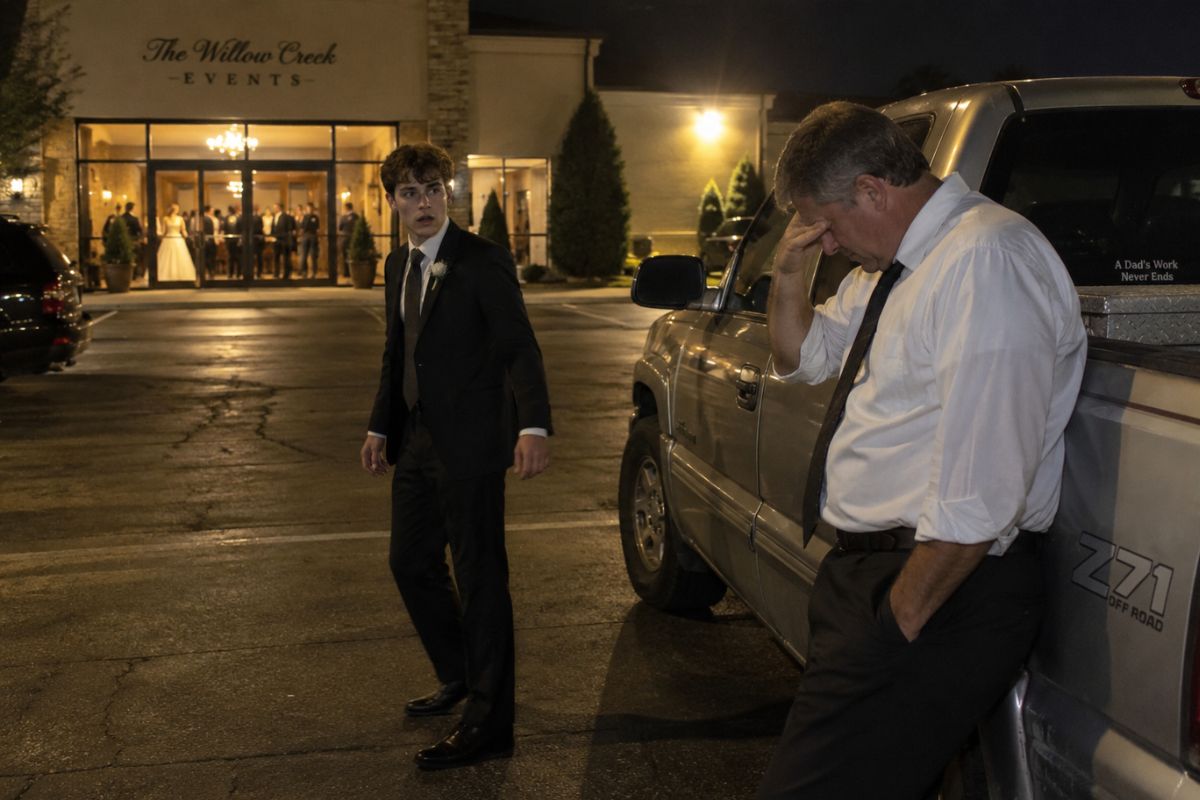
At My Ex’s Wedding, the Bride Raised a Glass and Called Me the Broken Woman He Escaped—Then a Young Server Walked Into the Lights, Took Off Her Cap, and Said, “I’m His Daughter.”
“I saved him from that broken woman.”
The bride said it with a smile.
Not a nervous smile. Not the kind people wear when they know they have gone too far and want to soften the landing. This one was polished. Bright. Practiced.
And the room laughed.
Not everybody.
But enough.
Enough to make the sound echo under the chandeliers like something alive.
A few people lifted their glasses. A few leaned into each other and smiled as if she had delivered the line of the night. The band had gone quiet between songs, so there was nothing to cover it. No violin. No clatter of plates. Just laughter spreading through a ballroom dressed up in cream roses and gold light.
My face burned.
I did not stand up.
I did not cry.
I did not give anyone the satisfaction of watching me fall apart.
I sat at the back of the room with my hands folded so tightly in my lap that my nails pressed half moons into my skin. I could feel every old memory I had spent years trying to tame rise all at once, hot and sharp and restless.
Then movement caught my eye.
A waitress had stopped near the kitchen doors.
She stood so still at first that she looked like part of the wall, just another young woman in a black apron and white shirt waiting for her cue. But then she stepped forward.
Slowly.
Steadily.
Like she had made a decision that was bigger than fear.
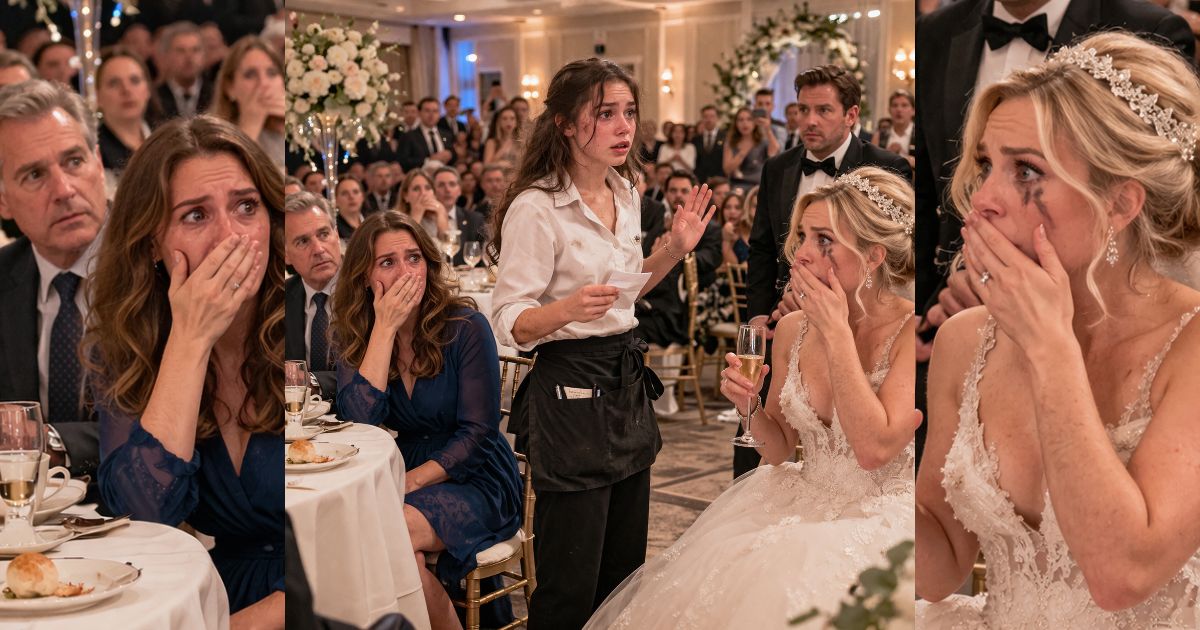
She crossed the dance floor while the last of the laughter died in people’s throats. She reached the center of the room, took off her server’s cap, and looked straight at the bride.
Then she said, clear as a bell, “I’m his daughter. And I have something to say.”
The silence that followed was so sudden it felt like the air had been pulled out of the room.
The bride’s face went blank.
The groom turned in his chair.
And my whole life split in two.
Again.
Only this time, it split open in public.
Only this time, I was not the one left speechless.
Her name is Lily.
She was sixteen that fall, all long limbs and quiet fire, with dark curls she never fully tamed and eyes that missed almost nothing. She was standing under a crystal chandelier with a tray stand still parked near the wall behind her, looking younger than she should have and stronger than anyone in that room deserved.
I knew the second I saw her step forward that nothing about the night was going to stay pretty.
There are moments in life when your body understands something before your mind does.
Sitting there in that ballroom, my stomach turned over before my thoughts could catch up. I remember the feel of the chair under me. The cold water sweating against the glass near my hand. The distant smell of butter and garlic and icing from the kitchen.
I remember Uncle Joe shifting beside me.
I remember him inhaling once through his nose, slow and sharp, the way he did when he was trying hard not to say exactly what was on his mind.
I remember thinking, Please, not her. Please don’t let her carry this.
And then I remember thinking something else.
No. Let her speak.
Because the truth was, she had been carrying it for years.
The invitation had arrived a month earlier.
Heavy ivory cardstock. Gold trim. My name written in looping calligraphy by a hand I did not recognize. No note inside. No explanation. Just the details of the wedding and the reception, the kind of expensive paper that tells you somebody wants an event to feel important before it even happens.
I stood in my kitchen in socks and an old gray sweatshirt and stared at it for a long time.
At first, I thought it had to be a mistake.
Then I thought maybe it had been sent by a planner who had no idea who I was.
Then I knew the truth.
It was not a mistake.
It was a message.
My ex-fiancé, Ethan Hale, was getting married at a hotel outside Franklin, Tennessee, and somehow, in the middle of building his polished new life, he had made sure I would know about it.
Not just know.
See it.
Witness it.
Sit still and watch the final version of his story get told without me.
Maybe he thought it would prove something.
Maybe he thought I had disappeared enough to stay quiet.
Maybe he thought time had made me small.
He never understood me nearly as well as he thought he did.
I had not seen Ethan in three years.
Not once.
Not since the night he stood in our apartment with one hand on a duffel bag and the other on the doorknob and told me he could not live inside sadness anymore.
I can still hear the exact shape of his voice.
Flat. Tired. Almost annoyed.
As if my grief had become bad lighting.
As if the life we had built together had turned inconvenient.
As if loving me had become one more thing he could leave unfinished.
He did not yell.
That would have been easier.
He did not accuse me of anything ugly.
That would have been cleaner.
He just did what cowards do best.
He made abandonment sound reasonable.
When he left, the apartment stayed full of him.
His coffee mug on the counter.
His running shoes by the door.
The jacket he forgot in the hall closet.
And the silence.
That was the worst part.
Not the big dramatic silence people talk about in movies.
Not some heavy, noble hush.
This one was plain.
A kitchen chair not pulled out anymore.
A toothbrush cup suddenly too empty.
A couch cushion that no longer sank on the right side.
Tiny ordinary absences that built a house inside my chest and stayed there.
But Ethan had not just left me.
That was the part people never seem to understand when they hear a story like mine and try to sort it into neat boxes.
Heartbreak.
Betrayal.
Starting over.
Those are easy words. They fit nicely on greeting cards and daytime talk shows. They are simple. Clean.
My life was not clean.
Because Ethan left her too.
Lily.
His daughter from a relationship that had fallen apart long before I met him. Her birth mother had moved away when Lily was five. There had been calls at first. Promises. A few cards with stickers inside. Then less. Then almost nothing.
By the time Ethan and I got engaged, Lily was living with us full-time.
She was all knees and missing front teeth and bright questions back then. She wore cartoon pajamas year-round and never remembered where she left her shoes. The first night she slept at our place for good, she came padding down the hallway at two in the morning carrying a blanket almost as big as she was.
She stood in our bedroom doorway and whispered, “Can I sleep by your bed?”
Not your dad’s bed.
Not his bed.
Mine.
Something inside me moved that night and never moved back.
The next week, she grabbed my hand in the grocery store because she hated the automatic doors and called me “Mom” by accident.
Then she froze.
She looked up at me with those huge eyes and waited to see if she had done something wrong.
I squeezed her hand and said, “You can call me whatever feels right.”
She did not let go for the rest of the shopping trip.
After that, I was hers in the way that matters most.
Not by blood.
By showing up.
We built our life in pieces.
Weeknight tacos at the chipped kitchen table.
Spelling words on sticky notes across the fridge.
Little dance breaks while folding laundry.
Saturday mornings at a pancake place off the highway where the waitress called everybody honey and poured coffee like she had known us for years.
Lily liked the chocolate chip stack and the lemon slices in her water. Ethan liked to act like he hated old country songs, then sing the chorus louder than anybody when one came on in the car.
If you had seen us then, you would have thought we were solid.
Maybe we were.
Maybe that is what made the crack so shocking.
The truth is, there had been strain before he left.
The kind you only understand clearly when you look back.
Bills stacking up after he switched jobs twice in one year.
His temper not loud, but withdrawn.
My own exhaustion after a family loss I still cannot talk about without feeling the floor tip under me.
We had been sad people in a hopeful house.
Then one day the sadness stopped looking temporary to him.
That was the difference between us.
I thought pain was something you walked through together.
He thought pain was a room he should not have to stay in.
After he left, I stopped recognizing my own life.
There were mornings I woke up and forgot for one blessed second that he was gone. Then I would hear only two sets of footsteps in the apartment instead of three, and it would come back all at once.
I got thin without trying.
I missed calls.
I let dishes sit too long.
I stared at walls.
There were days I moved through the world like somebody borrowing my own body.
But Lily was still there.
She still needed lunches packed and homework signed and socks matched and hair braided and forms filled out for school. She still needed someone to ask how her math test went and whether the lunchroom pizza was as terrible as usual.
And maybe this will sound strange to people who have never been loved by a child who did not have to choose you but did anyway, but she saved me a hundred times without ever making a speech about it.
Once, I was sitting on the bathroom floor because I had opened the mail and seen another notice with red print across the top, and I simply could not make my legs work.
Lily knocked once and then pushed the door open a little.
She was ten.
She came in carrying half a peanut butter sandwich on a paper towel.
“You forgot to eat,” she said.
That was it.
No drama.
No tears.
Just a little girl who had already learned how to read a room too early, handing me food like she was reminding me I still belonged in the land of the living.
I took the sandwich.
I ate it.
And for some reason, that simple act broke the spell of helplessness more than any pep talk ever could.
People love stories where healing comes in one big cinematic moment.
Mine did not.
Mine came in tiny humiliating, ordinary pieces.
A freelance design job for a local contractor whose logo looked like it had been made in 1998.
A church thrift store dresser that cost twenty dollars and leaned slightly to the left but held all our towels just fine.
A neighbor who slipped homemade soup onto our porch once a week and never asked for details.
A used car that rattled at stoplights but got us where we needed to go.
A school counselor who looked at me one afternoon and said, “She’s doing well because you’re steady.”
I almost laughed when she said it.
Steady.
I had never felt less steady in my life.
But maybe steadiness is not about never shaking.
Maybe it is about staying anyway.
Two years passed like that.
Then three.
Lily grew taller than my shoulder. Her voice changed. Her taste in music changed. Her handwriting got sharper, then prettier. She started wearing hoop earrings some days and old sneakers with permanent marker doodles on the soles. She rolled her eyes at me over laundry and then came back ten minutes later to ask if I wanted tea.
She got part-time jobs and saved money in a shoebox before finally opening her first bank account.
She learned how to watch people closely.
Too closely, maybe.
Children who have been left do that.
They become experts in tone. In pauses. In what is said and what is swallowed.
By sixteen, Lily had the kind of self-control most adults only pretend to have. But every now and then, her hurt still flashed across her face when something caught her off guard.
A father-daughter dance at school.
A classmate complaining that her dad would not stop texting her.
A Father’s Day display near the checkout line.
She never made scenes.
She just got quiet.
That kind of quiet will break your heart if you know how to hear it.
When the invitation came, I left it on the kitchen counter for four days.
Lily was the one who finally opened it.
She read it standing under our buzzing overhead light, one elbow on the counter, like she was looking over a menu.
Then she slid the card back into the envelope and looked at me.
“You should go,” she said.
I laughed.
Not because it was funny.
Because it sounded impossible.
“For what?” I asked. “To watch him smile for pictures and act like none of it ever happened?”
She leaned back against the sink and crossed her arms.
“No,” she said. “So he sees you.”
I was drying dishes. I remember setting down a plate very carefully.
“He’s seen me.”
“No,” she said again, firmer this time. “He saw you when you were tired and grieving and trying to hold everything together. He has not seen you now.”
I did not answer.
She walked over, touched the envelope with one finger, and said the thing that finally broke through.
“You still talk about yourself like you’re the woman he left behind.”
I looked at her.
She was sixteen.
She should have been worrying about chemistry quizzes and prom dresses and whether her best friend was mad at her over something dumb. Instead, she was standing in our kitchen handing me a truth I had been ducking for years.
“That woman is gone,” she said quietly. “You built somebody stronger.”
It is one thing to hear encouragement from friends.
It is another thing entirely to hear it from the child who watched you survive.
That night, I told Uncle Joe.
He had been my mother’s younger brother. After she died, he became the person who knew how to show up without crowding you. He fixed things when they broke. Changed my tires. Brought tomatoes in brown paper bags every summer from his garden. He could say more in one nod than some people say in a whole sermon.
When I told him about the invitation, he let out a long breath through his nose.
“Want my honest opinion?” he asked.
“I already know it.”
“Good,” he said. “Because I never trusted that man. Smiled too easy. Eyes never warmed up.”
I smiled despite myself.
That was Uncle Joe. He had a way of cutting right to the center and still somehow making you feel held instead of judged.
“I think I need to go,” I said.
He nodded.
“Then I’ll drive.”
Lily got a job with the catering company two weeks later.
She swore it was coincidence.
I let her say that.
“Lots of venues use them,” she told me, way too casually while pretending to study at the kitchen table.
“Mhm.”
“And they needed extra weekend staff.”
“Mhm.”
“And the pay is decent.”
“Mhm.”
She looked up.
“You are impossible.”
I looked right back.
“You are transparent.”
She tried not to smile and lost.
But I knew what she was doing.
She was making sure she could be there without sitting at a table under her father’s name.
She was making sure she had a job to do, a reason to move, a way to watch.
That was Lily all over.
Tender.
Strategic.
Loyal in ways that made me proud and worried me at the same time.
The day of the wedding, I almost did not go.
I had dressed and undressed twice before settling on a deep blue dress I had bought the year before for a dinner I ended up skipping. It fit well. It was simple. It made me look like someone who understood herself.
That should have been enough.
But standing in my bedroom, holding one earring in my hand, I felt twenty versions of myself crowding in all at once.
The girl who believed Ethan when he said forever.
The woman on the bathroom floor.
The exhausted mother trying to turn discount groceries into full meals.
The freelancer sending invoices at midnight.
The one who had not yet learned that survival counts as success.
I almost sat back down on the bed and texted Uncle Joe that I was sick.
Then Lily knocked and cracked the door open.
She was already dressed in her catering uniform, hair pinned up, face clean and serious.
“You look beautiful,” she said.
I laughed once, softly.
“That feels dramatic.”
“It’s not.”
She came inside, walked over, and fixed the strap on my dress where it had folded in. Then she stepped back.
“There,” she said. “Now you look like yourself.”
It is hard to explain what those words did to me.
When somebody has spent years reducing you in your own memory to a hurt version of yourself, being seen clearly becomes a kind of rescue.
By the time Uncle Joe pulled into the hotel lot, the sun had dipped low enough to turn the windows bronze.
The place was the kind of venue built to impress people before they even entered. Long drive. White columns. Landscaping so perfect it looked staged. A fountain out front. Valet attendants moving like theater extras.
I sat in the car with the invitation in my lap and watched guests sweep in wearing silk and navy and beige.
My hands were cold.
Uncle Joe killed the engine and looked straight ahead.
“You don’t owe anybody performance in there,” he said. “You hear me?”
I nodded.
“If you want to leave, we leave.”
I nodded again.
“And if anybody says one foolish thing to you,” he said, finally turning to look at me, “I am old enough to claim I lost my hearing and misunderstood their tone.”
I laughed.
A real one.
Not because the night felt light.
Because he knew exactly how to loosen the knot in my chest without pretending it was not there.
Inside, the ballroom was already glowing.
White orchids framed the aisle. Every table held low candles in glass bowls and arrangements so big you had to lean around them to see the people across from you. A string quartet played in one corner, all polished wood and patient faces.
It was expensive in the way that wanted you to know it.
I stood in the doorway longer than I should have.
Lily touched my arm once as she headed toward the service hall.
“Back row,” she said. “Near the exit. That’s your seat.”
“Yes, ma’am.”
She smiled, then vanished through the doors with the other staff.
Uncle Joe and I took our places near the back.
From there, I could see almost everything without being seen first.
The groom’s side had more people than I expected. Men slapping shoulders. Women in stiff dresses with careful hair. The kind of crowd that likes polished stories and clean narratives. The kind that can accept almost anything if it is presented with enough confidence.
Then I saw Ethan.
Three years had changed him less than I wanted them to.
He was still broad-shouldered, still carrying himself like a man who had learned that charm could smooth over whatever character left unfinished. His hair was a little shorter. His jaw a little sharper. He wore a tuxedo like he had been born in one.
If you did not know him, you would have thought he looked warm.
That was always his talent.
He knew how to appear open without actually letting anyone in.
Then I saw the bride.
Madison.
Tall. Blond. beautiful in a way that required effort and wanted witnesses. Her dress shimmered when she moved. Her smile was a half second too slow, as though she had practiced it in a mirror enough times to know exactly which angle worked best.
She leaned into Ethan at the altar like she was accepting an award.
It was not that she looked cruel.
Cruelty often arrives in prettier wrapping than people expect.
The ceremony itself was almost unbearable in its normalcy.
Vows.
Music.
Laughter at the right places.
A few damp eyes in the front row.
Words about partnership and future and standing beside each other through life.
I stared at a candle for most of it.
I could not make myself watch his face when he promised to stay.
After they kissed, the room rose in applause.
I clapped once because it would have been stranger not to.
Then I stopped.
At the reception, the volume turned up.
Music. Silverware. Linen. Ice in glasses. The whole room breaking into clusters of conversation. People greeting one another like the evening was exactly what it should be.
I sat where I had planned to sit.
Back table.
Good view of the room.
Easy path to the exit.
Uncle Joe beside me. Water in front of me because I knew champagne would not help.
Lily passed our table three times in the first half hour.
Each time, she kept moving.
The second time, she brushed my shoulder lightly with the back of her hand as she set down a tray for another table.
The third time, she leaned just enough to murmur, “You doing okay?”
I nodded.
She nodded back.
We had built a whole language out of small gestures over the years.
Ethan came over once before dinner was served.
I should say he drifted over.
That was more accurate.
As if he had only just noticed me despite the fact that I was clearly the most charged object in the room.
“Claire,” he said.
That was my name in this version of my life. Claire Morgan. Not the name he used to say into my hair when we were younger and thought tenderness was enough to prove commitment. Just Claire. Flat. Controlled. Public.
I looked up.
“Ethan.”
“You came.”
“Yes.”
He glanced at Uncle Joe, who did not stand and did not smile.
Then Ethan looked back at me and said the kind of sentence only a man like him would think sounded gracious.
“I’m glad.”
I wanted to ask him what part.
Glad I showed up to witness the final edit of his life?
Glad I could confirm he had made it into the future without visible dents?
Glad he could watch me react and measure whether I still hurt?
Instead I said, “Congratulations.”
He nodded.
“Thanks.”
That was all.
He did not ask how I had been.
He did not ask about Lily.
He did not ask anything that would have required him to stand inside the truth for longer than a few seconds.
He moved on.
And in that moment, strangely, I felt calmer.
Because the man who had haunted so much of my healing was suddenly just a man in formalwear avoiding the only questions that mattered.
Dinner was served.
Salad first. Then chicken with some glossy sauce I could not taste. Rolls in baskets. Butter curled into little stamped squares. People talked and laughed and lifted glasses.
From the stage, someone gave a toast about how Ethan had “finally found the woman who brought him back to life.”
A few people cheered.
I looked down at my plate and breathed through my nose.
Then Madison stood.
She did not stand like someone overcome with gratitude.
She stood like someone who knew the room would follow her.
She took her champagne flute from beside her plate and tapped it once with a knife. The sound rang out clean and high.
Conversations faded.
Heads turned.
The photographer moved closer.
Madison smiled.
“I just want to say one thing,” she said.
There is a kind of danger that does not announce itself with raised voices.
It arrives wrapped in sweetness.
That is how her tone sounded.
Sweet.
Playful.
Measured.
She spoke about love.
About second chances.
About how sometimes people meet each other at exactly the right time.
Then she turned her head just slightly.
Toward me.
And something in my body went cold.
“When I met Ethan,” she said, “he was carrying so much from the past. He’d been through a lot. He’d been with someone who didn’t know how to love a good man.”
A few people gave those little sympathetic half laughs some folks use when they think a speech is getting juicy.
My pulse started climbing.
Madison tilted her glass and smiled wider.
“But I guess that’s life, right? Some people break things. Some people build. I’m just thankful I got the chance to save him from that broken woman and show him what peace looks like.”
The room cracked open.
Not with shock.
With laughter.
Real laughter.
Open-mouthed.
Comfortable.
People who did not know me and did not care to.
Someone near the front clinked his glass against someone else’s. A woman at a nearby table lifted her brows at me and then looked away too fast, embarrassed on my behalf but not enough to say anything.
My skin went hot all over.
I heard Uncle Joe exhale beside me.
I felt the old reflex rise up in me.
Shrink.
Stay small.
Take the hit quietly.
That reflex had kept me alive once.
But before I could decide what to do with it, Lily stepped into the middle of the room.
She did not rush.
That was what made it powerful.
She did not storm the dance floor like somebody in a movie.
She moved with a stillness that made people notice her one by one.
Table by table.
Face by face.
Until every eye in that room followed the young server carrying no tray at all.
She stopped near the head table.
She removed her cap.
Her curls fell loose around her face.
Then she looked directly at Madison.
“I’m his daughter,” she said. “And I have something to say.”
No microphone.
She did not need one.
The room went silent the way rooms only do when everybody realizes the script just got torn in half.
Madison blinked once.
Twice.
“Excuse me?” she said.
Lily did not look at her again right away.
She turned to the guests first.
To the people who had laughed.
To the people who had toasted.
To the ones who had been so eager to accept a tidy villain.
“She’s not some broken woman from his past,” Lily said, and now her voice shook only a little. “She’s the woman who raised me.”
No one moved.
Not the band.
Not the photographer.
Not even the servers near the kitchen doors.
Madison’s smile collapsed.
Ethan stood up so fast his chair scraped the floor.
“Lily,” he said.
And there it was.
Her name in his mouth after years of silence.
She turned to him then.
“Oh, now you remember my name.”
A murmur moved through the room.
Small.
Sharp.
Like wind in dry leaves.
Ethan glanced around, suddenly aware of all the witnesses he had been so comfortable in front of just minutes earlier.
“This isn’t the time,” he said.
Lily laughed once.
A short, stunned sound.
“No,” she said. “You already decided this was the time. She was sitting quietly. She wasn’t bothering anybody. Then your wife stood up and called her broken to a room full of strangers.”
Madison found her voice again.
“I didn’t know,” she said. “Ethan never—”
“Didn’t tell you he had a daughter?” Lily asked.
The question hung there.
Madison looked at Ethan.
The answer was written all over her face before he said a single word.
He had not told her.
Or he had told her some version so thin it barely counted.
I sat frozen.
My heart was beating so hard I could feel it in my throat, but I could not look away from Lily. She stood there in her work shoes and borrowed apron, all sixteen years of her lit up with something larger than anger.
Truth, maybe.
Truth does that.
It gives ordinary people a strange kind of size.
“My dad left when I was eleven,” she said to the room. “Not just her. Me. He stopped calling. Stopped writing back. I sent birthday cards. They came back unopened. I sent emails. Nothing. And while he was gone, she worked and cooked and helped me with homework and made sure I had what I needed.”
Her voice cracked on that last line.
Not because she was weak.
Because she cared.
Because the truth had weight.
I stood up then without deciding to.
The room blurred around the edges.
Lily looked at me, and in that instant I understood something that had taken me years to learn: love is not always the person who chooses you first. Sometimes it is the person who stays after someone else leaves.
Madison’s face had turned a strange pale color.
She looked less angry now than stunned.
Less triumphant than exposed.
She looked, for the first time all evening, like someone who had just discovered she had been performing on a stage built over a sinkhole.
Ethan said my name next.
“Claire.”
Just that.
No apology attached.
No ownership of the mess.
Just my name, as if saying it might calm what he had started.
I turned toward him.
He looked older suddenly.
Not in the face.
In the posture.
There is a kind of aging that happens in a moment when your carefully managed image gets dragged into daylight.
Lily stepped closer to me.
Then she did something I still think about when I cannot sleep.
She reached for my hand.
In front of everyone.
Not in private.
Not later in the car.
There, in the middle of the ballroom, while the candles burned and the cake waited and the flowers tried their best to keep pretending beauty was enough.
She took my hand and held it up just slightly, not for drama but for clarity.
“This is my mother,” she said.
No one laughed after that.
No one lifted a glass.
No one pretended not to understand.
It was the simplest statement in the world.
And somehow it was louder than any speech Madison had made.
Madison stared at our joined hands.
Then at Ethan.
Then back at me.
I think she wanted to say something cutting. Something sharp enough to regain the room. But cruelty depends on confidence, and hers was draining out by the second.
“This is insane,” she whispered.
Lily heard her.
“No,” she said. “It’s just inconvenient.”
A sound moved through the guests then. Not laughter. Not exactly. More like the collective release that comes when a room realizes it bet on the wrong version of events.
One of Ethan’s cousins, a man I vaguely remembered from a barbecue years ago, lowered his phone slowly. An older woman at a front table set down her fork and looked at Ethan like she was taking his measure for the first time. The best man stared at the centerpiece in front of him as though suddenly fascinated by roses.
Nobody rushed to defend him.
That told me everything I needed to know.
A lie can survive a long time on charm.
But not once witnesses start doing math in their own heads.
Ethan came around the table.
“Lily,” he said, softer now. “Please. Not here.”
She laughed again.
“I spent five years hearing ‘not now’ from you in different forms.”
Her hand tightened around mine.
“When I needed school papers signed, it wasn’t the time. When I wanted to know why you stopped showing up, it wasn’t the time. When I sent a message on my birthday, it wasn’t the time. Funny how it only becomes the right time when somebody embarrasses you.”
The room stayed still.
I could not have spoken if I tried.
Everything inside me felt raw and clean at the same time.
Not rage.
Not revenge.
Something better.
Recognition.
Of myself.
Of her.
Of what we had built in the years nobody was clapping for.
Madison’s voice came out thin.
“If I had known—”
Lily cut in.
“Did you ask?”
Madison went quiet.
That was the question, wasn’t it?
Did you ask where he had been?
Did you ask what the old story cost the people left holding it?
Did you ask why a man so eager to start over had so little to say about what he started before?
Or did you settle for the version that made you feel special?
A lot of adults live on stories they never bother to inspect.
That night, inspection arrived in sensible shoes and an apron.
Lily looked back at the room one last time.
“She did not break him,” she said. “He walked away from people who loved him, and then he let someone else turn that into a joke.”
Then she turned to me and said, “We’re leaving.”
It was not a question.
I nodded.
Uncle Joe stood up so fast his chair almost tipped.
The three of us started toward the doors.
Nobody tried to stop us.
The crowd opened the way it does for truth after it has finally been spoken out loud.
Halfway across the ballroom, I heard Ethan behind us.
“Lily!”
She did not turn.
Neither did I.
We reached the hallway outside the reception room, where the sound dropped all at once.
The carpet swallowed our footsteps. The lighting was dimmer there. Softer. Hotel-quiet.
For a second, I thought we might actually make it out untouched.
Then Madison came after us.
“Wait.”
Her heels clicked hard against the tile as she crossed from ballroom carpet into the hall. Her dress trailed behind her in a pool of white silk and hurt pride.
Up close, she looked younger than I had first thought.
And more frightened.
Not frightened of us.
Frightened of losing control of how the room had seen her.
“You can’t just do that,” she said, breathless.
Lily turned first.
“Do what?”
“Humiliate us at our wedding.”
I felt something inside me go very still.
There it was again.
That little word.
Us.
The safest place in the world for people who want to avoid responsibility.
I stepped forward before Lily could answer.
“No,” I said. “You humiliated yourself when you decided a stranger’s pain was a good punchline.”
Madison’s eyes snapped to mine.
“I didn’t know the whole story.”
“That did not stop you from telling one.”
She opened her mouth.
Closed it.
Looked at Lily.
Looked back at me.
For one flashing moment, I thought she might apologize.
A real apology. Uneasy. Human. Late, but real.
Instead she said, “He told me his ex was unstable.”
The word hit the hall and fell flat.
Lily let out a breath that almost sounded like pity.
“Did you ever notice how people who do the leaving love that word?” she asked. “Unstable. Complicated. Too emotional. Anything that makes their exit sound brave.”
Madison flinched.
Then Ethan appeared in the doorway behind her.
His tie was loosened now. His tuxedo jacket hung open. He looked like somebody who had been running from table to table trying to keep the floor from collapsing.
“Madison,” he said quietly.
She spun toward him.
“You said she was your ex,” she said. “You did not say she raised your daughter.”
He said nothing.
“You said your daughter lived with relatives for a while.”
Still nothing.
“You did not say you stopped talking to her.”
He swallowed.
Silence can be the loudest confession in the world.
Madison’s shoulders dropped.
Not out of grace.
Out of realization.
The room behind Ethan was still bright with reception light. Beyond him, I could hear only scraps of sound now. Chairs shifting. Voices starting up in low uncertain threads. The party trying to decide whether it still existed.
Lily looked at Ethan.
He met her eyes for maybe one second before looking down.
That hurt me more than if he had shouted.
Cowardice is such a quiet thing up close.
“I never meant for tonight to become this,” he said finally.
Lily tilted her head.
“Which part?”
He looked up.
Her face was calm now. That was the remarkable thing. Not cold. Not cruel. Calm.
“Me having to stand in a ballroom to remind people I exist?” she asked. “Or you getting caught?”
“Lily.”
“No,” she said. “You don’t get my soft voice right now.”
Uncle Joe, standing just behind me, made a sound deep in his throat that could have been approval.
Ethan looked at me then.
Not as an audience.
Not as a shadow from his past.
As a person he had wronged and could no longer reduce.
“Claire,” he said, and his voice cracked on the name in a way I had never heard before. “I was not okay back then.”
I stared at him.
I believed him, actually.
I believed he had been overwhelmed and sad and selfish and scared and deeply not okay.
But pain does not become virtue just because it is sincere.
Lots of people are not okay.
Lots of people still stay.
“So was I,” I said. “And I didn’t leave.”
It landed between us with more force than if I had screamed.
He closed his eyes for a second.
Just one.
When he opened them again, he looked like a man who had run out of places to hide inside himself.
Madison stepped back from him then.
A small movement.
But final in feeling.
I could almost see her replaying every conversation, every vague answer, every polished sentence he had offered in place of truth. I felt no triumph watching it happen.
Only distance.
Because this was never really about her.
She had been cruel, yes.
But she had also been useful.
Her toast had forced everything into daylight.
Some people do not know they are carrying matches until they set their own lives on fire.
Lily looked at Ethan for a long time.
Long enough that I wondered if this was the moment she had been building toward in her head all these years. The speech after the speech. The question only daughters ask men who disappear.
When she finally spoke, her voice was quiet.
“You know what I told myself when I was younger?” she said. “I used to pretend something terrible had happened to you. That you were lost somewhere. That there was a real reason. Because the truth was harder.”
He swallowed hard.
“What truth?” he asked.
“That you were alive,” she said, “and still chose not to show up.”
Nobody moved.
The entire hallway seemed to contract around that sentence.
Ethan leaned against the wall.
For the first time all night, he looked stripped of everything he usually relied on. No crowd. No jokes. No performance. Just a man facing the exact shape of the harm he had left behind.
His eyes filled.
I noticed.
I also noticed it changed nothing.
People think tears are always proof of depth.
Sometimes they are just what happens when the bill finally arrives.
“I was ashamed,” he said.
Lily blinked.
“Of what?”
“Of how much I’d messed up. Of not knowing how to fix it. Every month that passed, it got harder to call. Harder to explain.”
“That wasn’t shame,” she said. “That was convenience wearing shame’s coat.”
Uncle Joe looked at the ceiling and muttered, “Lord help me, she is her mother’s child.”
I almost smiled.
Almost.
Madison had gone very quiet.
She stood with both hands gripping the fabric of her dress near her hips as though she needed to hold on to something physical to stay upright. She looked from Ethan to Lily to me and back again.
The whole hotel hallway suddenly felt too bright.
Too revealing.
I thought of every night Lily had asked indirect questions because she had stopped expecting direct answers.
Do you think some people are better at loving from far away?
Do you think grown-ups know when they’ve done something unforgivable?
Can people just decide to be different one day?
Questions like that do not come from nowhere.
They come from children building their own maps through adult wreckage.
And yet here she was.
Standing steady.
Breathing.
Not begging.
Not collapsing.
She had become the kind of person who could speak truth without turning it into theater.
That was not Ethan’s gift to her.
That was earned.
Mostly by her. Some, maybe, by me. By the long ordinary years of showing up.
“I’m not here because I need anything from you,” she told him. “I’m not here for money. I’m not here for explanations. I’m not here so you can finally feel like a good father in public.”
His face tightened.
Every line of him said he knew she was right.
“I came because she was sitting in that room being disrespected by people who didn’t earn the right to say her name. And I’m done letting other people tell our story like we’re the lesson and they’re the reward.”
The words settled into me like warmth.
Our story.
Not his.
Not hers.
Ours.
Then, to my complete surprise, Lily did something even braver.
She stepped closer to him.
Not lovingly.
Not cautiously.
Just clearly.
“I forgive you,” she said.
Ethan stared at her.
Madison stared at her.
I stared at her.
Because forgiveness is one of those words people throw around so casually that they forget how heavy it really is.
He shook his head a little, almost in disbelief.
“Lily—”
She raised a hand.
“Don’t misunderstand me. I’m not saying what you did was okay. I’m not saying you get to come back and act like this never happened. I’m saying I don’t want to carry your absence like it’s mine to explain anymore.”
Tears slipped down his face then.
He did not wipe them.
Again, it changed nothing.
But it did clarify everything.
She was not giving him peace.
She was taking hers back.
“There’s a difference,” she said. “I know that now.”
Nobody spoke.
The hotel’s air system hummed softly overhead. Somewhere far down the hall, an ice machine dropped a tray with a harsh clatter and then went quiet again. Strange what you notice when life changes shape in front of you.
Ethan looked at me one last time.
I saw in his face something I had once begged for and would not have known how to receive anymore if it were handed to me.
Recognition.
Not of my pain.
Of my value.
Late recognition is a poor gift.
Still, there it was.
“You were good to her,” he said.
The sentence was so small compared to what it covered that I almost laughed.
Good to her.
Like I had watered a plant while he was out of town.
Like I had babysat for a while.
Like what I had done could be summarized without breaking open every year that followed.
But I let the sentence sit.
Because I did not need a better one from him.
I already had the life itself.
Lily answered before I could.
“She’s why I’m okay,” she said.
And that was the end of it.
Not because everything was healed.
Because nothing else in that hallway could compete with the truth once she said that.
We left.
This time nobody followed.
The air outside had turned cool. A light mist had started falling, the kind that beads on your arms before you fully realize it is there. The parking lot lights cast everything in a soft yellow glow.
Uncle Joe clicked the car open from halfway across the lot.
When we reached it, he turned around and looked at both of us carefully.
“You girls hungry?” he asked.
The question startled a laugh out of me.
Only Uncle Joe would respond to emotional collapse, public truth-telling, and the implosion of a wedding reception by asking if we wanted food.
Lily started laughing too.
“I could eat,” she said.
“Good,” he said. “Because there’s a twenty-four-hour diner off the interstate and I am too old to process feelings on an empty stomach.”
So we went.
Still dressed for the wedding.
Me in navy.
Lily in her white button-down and black apron she had not yet taken off.
Uncle Joe in his suit jacket with his reading glasses perched on top of his head because he could never keep track of them.
We slid into a booth beneath a buzzing light in a diner that smelled like coffee and pie crust and grease that had lived a hundred lives. A waitress named Denise with silver hair and kind eyes did not ask questions. She set down menus, looked at our faces, and said, “Honey, you all need fries before you need anything else.”
She was right.
We ordered burgers and fries and pie nobody needed.
And then, sitting under that dull light while country music hummed low from the speakers and truckers came and went with mud on their boots, we began to come back to ourselves.
Lily finally untied her apron and folded it beside her.
Her hands shook once.
Then stopped.
Uncle Joe stirred too much sugar into his coffee and asked absolutely nothing for a while, which was its own form of mercy.
I looked at Lily across the booth.
“You didn’t have to do that,” I said.
She met my eyes.
“Yes,” she said. “I did.”
I opened my mouth to argue, and she shook her head.
“No. Listen to me. I spent years watching you protect me from things I was old enough to feel but too young to name. Tonight, I got to protect you back. I needed that.”
My throat tightened.
“You shouldn’t have had to.”
“Maybe not,” she said. “But I wanted to.”
Then she reached across the table and took my hand again.
The same way she had in the ballroom.
Only now there were no witnesses except a tired waitress, a man wiping down the pie case, and my uncle pretending to study the creamers near the register.
“You never made me feel left behind,” she said softly. “Not once.”
I cried then.
Not hard.
Not dramatically.
Just tears slipping out while the fries cooled and the coffee steamed and the whole world, for once, felt honest.
We got home after one in the morning.
I kicked off my shoes in the kitchen.
Lily left her apron on the back of a chair.
Uncle Joe hugged me at the door in that brief, firm way of his and said, “Proud of both of you,” then drove home through the mist.
I thought I would not sleep.
I slept like somebody who had finally set down a box she did not realize she was still carrying.
The next morning, the videos started moving.
Not everywhere.
Not all at once.
Just the way things travel now when strangers smell a story.
Short clips.
Blurry angles from the back of the room.
A caption here. A repost there. A hush of attention spreading across people’s phones and breakfast tables and break rooms.
A young server at a wedding tells the truth.
A daughter stands up for her mother.
Bride’s toast backfires.
I did not watch most of them.
I did not need proof of what happened. I had lived it in my own skin.
But messages began arriving.
Women I had not spoken to in years.
An old coworker from Nashville.
A neighbor from our first apartment.
A cousin of Ethan’s who wrote only three words: You were right.
That one made me laugh.
Not because it was funny.
Because after all that time, that was the best truth some people could manage.
Lily watched one clip and then threw her phone onto the couch like it was mildly offensive.
“I sound calmer than I felt,” she said.
“You were calm.”
“I was furious.”
“Yes,” I said. “And you were calm.”
That was the miracle of it.
She had not lost control.
She had reclaimed the room without becoming what they expected.
Ethan never called.
Not that day.
Not that week.
Not that month.
A part of me had wondered if he might send flowers or some long tortured email full of late remorse and careful phrasing. He did not.
Maybe he knew better.
Maybe he was ashamed.
Maybe Madison had finally started asking questions he could not smooth over.
People later told me they separated within weeks. I cannot confirm that. I did not go looking. What happened inside their house after that night was no longer mine to carry.
Some endings do not need front-row seats.
What I do know is that something changed in ours.
The house felt different after the wedding.
Lighter, yes.
But also more grounded.
Like a window had finally been opened in a room we had both learned to function inside without enough air.
Lily stood straighter.
That sounds like a small thing until you see it.
Her shoulders stopped folding inward in rooms full of adults. She raised her hand more in class. She stopped apologizing when she spoke too directly. She did not shrink when forms at school asked for “mother” and “father.” She filled them out in her own clean handwriting, then moved on.
One night I walked past the bathroom and saw her standing at the mirror practicing her speech again.
Not from vanity.
From ownership.
She caught me watching and laughed.
“I’m thinking about starting something,” she said.
“What kind of something?”
She leaned on the sink.
“A podcast, maybe. Or a page online. For girls who think they have to stay quiet because the adults around them are uncomfortable.”
I looked at her.
“You’d be good at that.”
She smiled.
“I know.”
That confidence would have sounded arrogant on somebody else.
On her, it sounded earned.
As for me, the wedding did something I did not expect.
It took the shame out of my own story.
Not all at once.
But enough.
For years, I had spoken about Ethan’s leaving like it was a private failure I needed to keep cushioned and hidden. As if being left said something embarrassing about me. As if grief should be folded small and stored where company would not see it.
After the wedding, that changed.
Because once a room full of people watched the truth arrive and side with me, I understood something that should have been obvious much sooner:
Being abandoned is not the same as being worthless.
Being publicly dismissed is not the same as being small.
And being the one who stayed does not make you weak.
It makes you durable.
I began writing again.
Not for money at first.
For clarity.
At our kitchen table after Lily went to bed, with tea going cold beside me and the old laptop humming like it might finally retire any day. I wrote about quiet women. About rebuilding. About how the world treats people who have been left, especially if they are still soft enough to love after it.
I wrote one essay and sent it to a small parenting site.
They published it.
The comments that followed came from women in Ohio, Arizona, Georgia, Michigan. Grandmothers. Stepmothers. Aunts who raised kids that were not theirs on paper but became theirs in every way that counted. Daughters who had watched one adult leave and another stay.
Thank you for saying this.
Thank you for naming it.
Thank you for telling the truth without turning bitter.
I read those comments at midnight with my hand over my mouth.
Not because I was surprised there were others.
Because I had forgotten how much healing lives in being understood by strangers.
That essay led to another.
Then another.
Within six months, I had a modest online community of women trading stories about endings that did not end them.
Lily helped me name it.
We sat at the kitchen table tossing ideas back and forth while spaghetti boiled on the stove and the smoke alarm threatened to go off because I had forgotten the garlic bread under the broiler.
“Second Bloom,” I said.
“Too floral.”
“Open Door.”
“Sounds like real estate.”
“New Thread.”
She looked up from her notebook.
“Second Thread.”
I smiled.
That was it.
Not a new life.
Not a total reinvention.
Just the next strand. The one you stitch with after everything rips.
A year later, Second Thread became a real local support circle that met twice a month in the back room of a community center near downtown. Folding chairs. Store-bought cookies. Coffee in paper cups. Women walking in guarded and walking out softer around the eyes.
No one there needed saving.
Most of them just needed language.
A place to put the things they had been carrying without turning them into spectacle.
I understood that.
Because the opposite of silence is not noise.
It is being safely heard.
Lily came to the second meeting and sat in the back at first, legs crossed, taking everything in. By the fourth meeting, she was speaking. By the sixth, she was helping younger girls who tagged along with mothers or grandmothers and did not yet know where to put their own feelings.
She had a gift for saying hard things plainly.
Not cruelly.
Not dramatically.
Plainly.
That kind of honesty can change a room.
Sometimes late at night, after dishes and laundry and all the thousand tiny chores of a shared life were done, I would sit on the porch with a blanket around my shoulders and think about how strange families really are.
How the people who fail you are not always the ones who leave first.
How the people who save you are not always the ones who gave you their names.
How love, real love, is not proven in speeches or vows or flowers taller than a child.
It is proven in lunches packed.
In hair braided.
In bills paid late but somehow paid.
In saying, “I’m here,” and meaning it over and over until the words are no longer necessary because your presence has become the proof.
That winter, on a cold January night, Lily sat at the counter doing homework while I washed dishes.
The kitchen smelled like soup and dish soap and the orange candle she liked to light even though I told her it gave me a headache if it burned too long.
She flipped a page in her notebook and said, almost casually, “You know, I used to wish my birth mom had stayed.”
My hands stopped in the sink.
I turned the water down.
She was not crying.
Not even close.
She was thinking.
That was often how her deepest truths arrived. Dressed like passing thoughts.
“I know,” I said.
She tapped the edge of her pencil against the page.
“But now I think maybe some people leaving makes room for who’s really meant to stay.”
There are sentences that crack you open quietly.
That was one of them.
I dried my hands.
Walked over.
And pulled her into my arms.
She let herself fold into me even though she was almost grown.
“I got lucky,” she murmured against my shoulder.
“No,” I whispered. “We both did.”
And I meant it.
Because for all the pain, for all the years that looked impossible while I was living them, I would not trade away the life built afterward.
Not the tiny apartment with the loud pipes.
Not the diner fries after public heartbreak.
Not the folded apron on the chair.
Not the essays written at midnight.
Not the women who found me because one ballroom finally heard what should have been obvious.
Not the daughter who chose me in front of everybody.
People still ask sometimes what that night was really like.
They want the dramatic version.
The wedding version.
The viral clip version.
They want to know what Madison looked like when the room turned on her. What Ethan said exactly. Whether everyone gasped. Whether the music stopped. Whether somebody dropped a plate.
I tell them the truth.
The most powerful part was not the bride being exposed.
Not the groom being cornered.
Not the crowd going silent.
It was the moment Lily took my hand.
That was the point of no return.
Because in that one small gesture, the whole false story fell apart.
The story where I was just an ex.
The story where she was some hidden inconvenience.
The story where he was merely misunderstood.
The story where cruelty passed for confidence because nobody challenged it.
One hand. One sentence. One room forced to see us clearly.
After that, everything else was details.
I still think about Madison sometimes.
Not often.
But enough to wonder whether she learned anything real from that night. Whether she looked back and understood how eager she had been to step into a role she had not earned. Whether she ever asked herself why she wanted so badly to be the woman who “saved” someone instead of asking what exactly needed saving and who had already paid the cost.
I do not hate her.
That surprises some people.
But hate is expensive, and I had already spent enough on other people’s choices.
Besides, if I am honest, she gave me something no kind person ever could have.
She pushed the truth into public so hard there was no way to tuck it back into shame.
Sometimes grace arrives looking nothing like grace.
As for Ethan, the story people want there is redemption.
An apology letter.
A reunion.
A father-daughter coffee shop conversation where everybody cries and starts over.
That is not our story.
Real life rarely lines up so neatly.
He sent one email eight months later.
It was short.
Said he was sorry. Said he had been afraid. Said he understood if Lily did not want contact but hoped one day she might.
She read it at the kitchen table while eating cereal.
Then she looked at me.
“What do you think?”
“I think what matters is what you think.”
She nodded.
Then she closed the laptop.
“I think some people confuse wanting relief with wanting relationship,” she said.
That was her answer.
Not forever.
Not necessarily.
Just then.
And then she went to school.
That was another lesson motherhood taught me.
Healing does not always arrive as reunion.
Sometimes it arrives as boundaries so clean they let you breathe.
Years have a way of polishing even the hardest memories if you survive them long enough.
But I do not want to polish that night.
I want to remember it accurately.
The sting.
The embarrassment.
The way laughter can cut deeper than shouting when it lands on old wounds.
The way truth can arrive in a young woman’s steady voice and clear a room better than any storm.
The way Uncle Joe asked if we were hungry like hunger itself was a rope back to earth.
The way fries and diner coffee can taste like mercy when you have just watched a whole false narrative collapse.
The way a child who has been hurt can still grow into someone who protects without becoming cruel.
Those are the details worth keeping.
If there is any lesson in all of this, it is not that karma shows up at weddings.
It is not that public humiliation teaches the best lessons.
It is not even that people eventually get exposed.
Sometimes they do. Sometimes they do not.
No, the lesson is simpler.
You do not have to be chosen by the person who left in order to matter.
You do not need the room’s permission to belong in it.
And the love that saves us most often is not loud, glamorous, or center stage.
It is the love that stays after the applause has moved on.
The love that packs lunch.
The love that notices you forgot to eat.
The love that takes off its cap in a bright room full of strangers and says, with a shaking voice and a steady spine, You do not get to rewrite us.
That is the kind of love I built my life on.
That is the kind of love that built me back.
And if you had asked me years ago, sitting on a bathroom floor with unpaid bills and a peanut butter sandwich in my hand, whether anything beautiful could possibly come from being left behind, I would have said no.
I would have been wrong.
Because some stories do not get better when somebody returns.
They get better when the people who stayed finally understand what they survived.
That is what happened to us.
Not in the ballroom.
Not really.
That was just where the truth got introduced.
What happened to us happened in all the years before it.
In the mornings I kept going.
In the nights she kept trusting me.
In the ordinary stubborn love that turned two abandoned people into a family nobody could dismiss anymore.
And once I understood that, once I really understood it, the wedding stopped feeling like the place where I was humiliated.
It became the place where I stopped agreeing to disappear.
Thank you so much for reading this story!
I’d really love to hear your comments and thoughts about this story — your feedback is truly valuable and helps us a lot.
Please leave a comment and share this Facebook post to support the author. Every reaction and review makes a big difference!
This story is a work of fiction created for entertainment and inspirational purposes. While it may draw on real-world themes, all characters, names, and events are imagined. Any resemblance to actual people or situations is purely coincidenta