If you’ve already read part 1 of this story on Facebook, go here for Part 2!
The first time I noticed the second sandwich, I told myself it was a mistake.
By the fourth morning, I knew it wasn’t.
“Two apples too, Daddy,” my daughter said, standing on a kitchen chair in her socks, watching me wrap turkey slices in the last two pieces of bread that weren’t stiff around the edges. “And the little bag of crackers.”
I looked at her over the lunchbox.
“Why?”
She shrugged, too fast. “Just because.”
Just because.
People who have enough money can afford “just because.”
People like me count yogurt cups in the fridge and stand in grocery aisles doing math in their heads with a cart that never feels full enough. People like me know exactly how many slices of bread are left before payday.
“Ellie,” I said, trying to keep my voice even, “you need to eat what I pack. Not ask for extra and throw it away.”
“I don’t throw it away.”
“You did last month.”
Her cheeks pinked. “That banana got squishy.”
“It still cost money.”
The second I said it, I hated the sound of my own voice.
She looked down at the zipper on her backpack. It was broken on one side, so she always tugged it carefully with both hands. Her mother used to say Ellie treated broken things like they had feelings.
“I’ll eat it,” she whispered.
I packed the extra sandwich anyway.
That’s the kind of father grief had made me.
Hard in the wrong places. Soft where it didn’t help.
My wife, Mara, had been gone eighteen months. Brain aneurysm. One minute standing barefoot in our kitchen, laughing because Ellie had tried to teach the cat to sit. The next minute on the floor.
People say widowed like it’s a fact.
Like male. Like thirty-eight. Like brown hair.
They don’t tell you it changes the temperature of your whole life.
After Mara died, mornings became a narrow bridge I crossed half-awake: coffee, missing socks, unpaid bills, signed spelling tests, lunch money I didn’t have, a sink that never emptied. I drove a delivery truck until my shoulders burned, and by the time I picked Ellie up from aftercare, we were both running on fumes.
So no, I did not have patience for mystery sandwiches.
By Thursday, I started checking her lunchbox when she got home.
Empty.
Every compartment.
Apple gone. Crackers gone. Sandwich gone.
She wasn’t wasting it.
That should’ve relieved me.
It didn’t.
Because now I pictured her sitting alone somewhere, stuffing food into herself too fast. Eating from nerves. Eating because she missed her mom. Eating because I wasn’t home enough. Eating because children found strange little ways to survive things adults couldn’t fix.
At dinner, I made spaghetti with jar sauce and the last of the ground beef.
Ellie twisted noodles on her fork and asked, “Do you think people can feel hungry and not say it?”
The question landed strangely.
I looked up. “What people?”
She took too long to answer. “Just people.”
“Everybody feels hungry sometimes.”
“No.” She pushed one noodle around her plate. “I mean the kind where they pretend they’re not.”
I set my fork down.
“Are you talking about somebody at school?”
Her eyes flicked to me, then away. “Maybe.”
“Is someone taking your lunch?”
“No.”
“Are you giving it away?”
Her silence was so small I almost missed it.
“Ellie.”
She looked at the sauce stain on the table instead of at me. “I don’t know.”
That answer irritated me more than a lie would have.
“You do know.”
Her mouth trembled, and for a second she looked so much like Mara at seven years old in the photos her mother kept in old albums that my irritation ran straight into grief.
“I just think,” Ellie said quietly, “some people say things that aren’t true because they don’t want you to feel bad.”
I leaned back in my chair.
“Who?”
But she shook her head.
That night, after she was asleep, I stood in the doorway of her room and watched her breathe. Her blanket had twisted around one leg. One hand was tucked under her cheek. Kids could look so peaceful sleeping it made you forget how much they carried while they were awake.
On her nightstand sat a folded paper with crayon hearts on the edge.
I shouldn’t have opened it.
I knew that.
But I did.
Inside was a drawing of two stick people sitting on an upside-down bucket. One big, one small. Between them was a red apple the size of a basketball.
Above their heads she had written, in careful second-grade print:
You can have mine because I still get dinner.
I stared at it until the words blurred.
The next morning, I almost kept her home.
Instead, I packed one lunch.
Just one.
When she saw it, she went very still.
“Where’s the rest?”
“That’s enough food for one person.”
She looked at me like she didn’t know who I was for a second.
Then she whispered, “But I need—”
“No, you want.”
Her chin shook.
“It’s not for me.”
There it was.
The truth, finally, except it only made me angrier.
“Then for who?”
She pressed her lips together.
“For who, Ellie?”
Her eyes filled. “I can’t tell you because then it’ll make it weird.”
“Weird for who?”
She grabbed the edge of the counter with both hands, little knuckles pale.
“You’ll make a face,” she said. “Adults always do.”
I nearly laughed at that, not because it was funny, but because I was so tired and so ashamed and so close to snapping that something in me went brittle.
“Get your shoes on,” I said.
The school called at 1:40.
I was unloading boxes behind a pharmacy when my phone buzzed with the office number. My stomach dropped so hard I had to lean against the truck.
Every parent knows that kind of fear.
The voice on the other end was polite in that careful school way that means something has happened.
“Mr. Lawson? This is Maple Grove Elementary. We need you to come in this afternoon regarding Ellie.”
Regarding Ellie.
I drove there with every bad possibility lined up in my head.
Maybe she’d stolen food from another child.
Maybe she’d lied to a teacher.
Maybe she’d had a meltdown because I sent her with half of what she wanted.
Maybe I had missed something big while standing in grocery lines and folding tiny socks and pretending we were okay.
The office smelled like pencil shavings and old coffee.
Ellie sat in a plastic chair outside the principal’s office, backpack in her lap. She wasn’t crying. That scared me more.
Her teacher, Mrs. Bennett, stood by the doorway with a face I couldn’t read.
I crouched in front of Ellie.
“What happened?”
She looked at me, eyes red-rimmed but steady.
“I’m sorry I didn’t tell you,” she whispered. “I knew you’d think it was bad.”
My chest tightened.
Mrs. Bennett touched my arm lightly. “Mr. Lawson, there’s something you need to see.”
She led me down the back hallway past the art room, past the gym storage closet, toward the service door near the cafeteria dumpsters. The fluorescent lights hummed overhead.
I could hear my own footsteps. Hers. The squeak of her sensible shoes.
Then she stopped beside a cracked little window in the custodial room door and said, very quietly, “Before you go in… I should tell you Ellie has been doing this for weeks.”
Doing what?
My mouth went dry.
Mrs. Bennett looked at me with something close to pity.
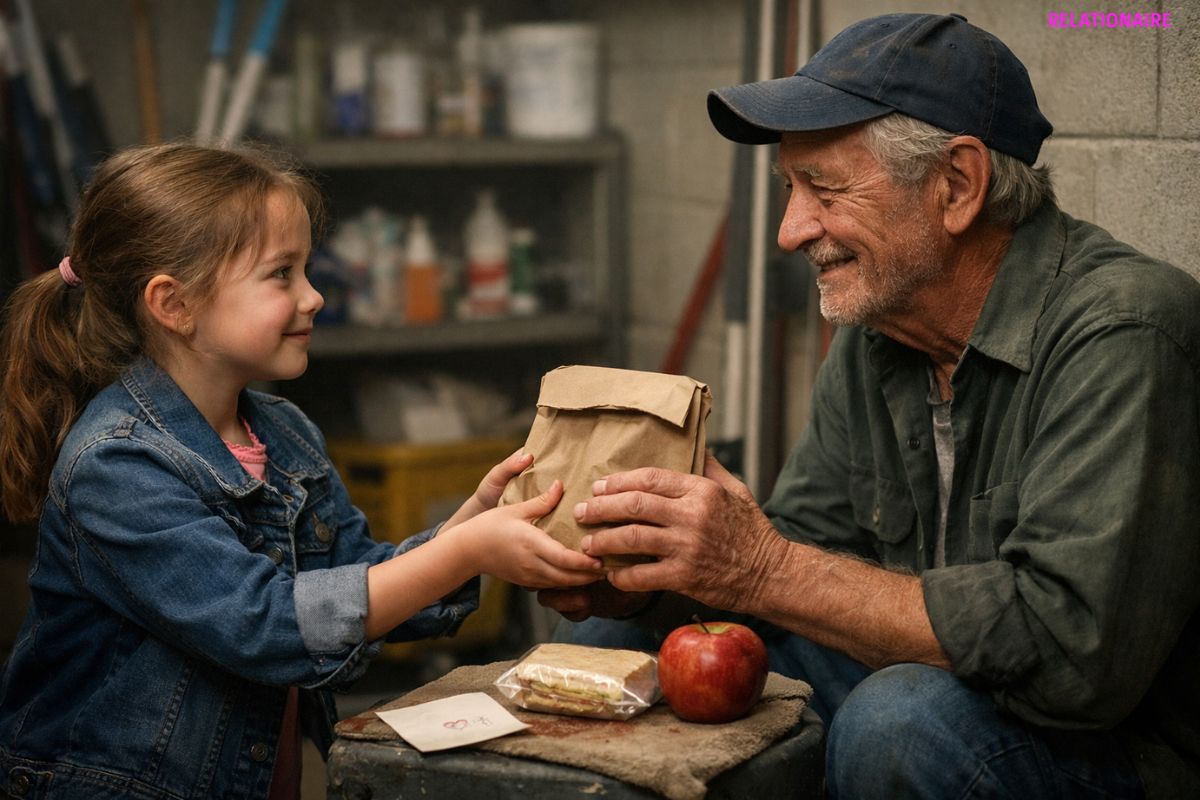
Inside the room, sitting on an overturned bucket with his lunch pail still closed beside him, was Mr. Ortega, the school janitor.
And in his hands—
in his rough, shaking hands—
was the folded note from Ellie’s nightstand.
PART 2
For a second, I didn’t move.
I just stood there staring through that little wired-glass window while the hallway hummed around me.
Mr. Ortega was an older man. Sixty maybe. Maybe more. The kind of face hard work writes itself into slowly, one line at a time. He always nodded at parents in the pickup lane. Quiet. Sweeping leaves. Carrying salt bags in winter. Fixing the loose gym door handle before anyone had to ask.
Inside the room, he held Ellie’s note like it might break.
His shoulders were hunched. His gray work shirt was damp at the collar. Beside him sat a red apple, a sandwich in wax paper, and a zip bag of crackers.
An untouched thermos.
Mrs. Bennett kept her voice low.
“She started eating lunch with him in there about three weeks ago.”
I turned to her. “What?”
“We didn’t know at first. Ellie is quick. She’d finish the first half of her lunch in the cafeteria, ask to use the restroom, then slip down here during recess or cleanup time. Mr. Ortega kept sending her back.” She paused. “Then she started leaving food without staying.”
My face burned.
The kind of burn that starts in your chest and goes all the way up.
“Why didn’t anyone call me?”
Her expression tightened, not unkindly. “He begged us not to.”
I looked back through the window.
Mr. Ortega had unfolded the note all the way now. I could see his lips move as he read the words again.
You can have mine because I still get dinner.
I swallowed hard. “He’s hungry?”
Mrs. Bennett let out a breath.
“He says he’s fine. Says he eats later. Says Ellie misunderstood.” She folded her arms. “But one of the cafeteria aides noticed him taking discarded milk cartons for coffee creamers. And yesterday, he nearly fainted while changing the light bulbs in the music room.”
The shame hit me so clean and sharp I almost stepped back.
I had spent a week angry at my daughter for kindness.
Worse than that.
I had made her defend it.
“Why him?” I asked, though the question already sounded foolish in my own ears.
Mrs. Bennett glanced toward Ellie, still waiting down the hall on the plastic chair.
“Because children notice who looks at food,” she said.
That line broke something in me.
I thought of Ellie at our kitchen table, asking if people could feel hungry and not say it.
I thought of her saying adults always make a face.
I had made exactly that face.
Mrs. Bennett opened the door gently.
Mr. Ortega looked up too fast and swiped at his eyes with the heel of his hand.
“Sorry,” he said immediately, standing halfway. “I was just— she leaves things in here sometimes. I keep telling her not to.”
His voice had the crackly softness of someone who didn’t speak much unless he had to.
I stepped inside.
The room smelled like lemon cleaner, dust, and old mop water. Shelves lined the walls. Paper towels. Floor wax. A radio with a broken antenna. One metal locker with a dent in the door.
Mr. Ortega folded Ellie’s note once, then again, like he needed his hands busy.
“I’m sorry,” I said, and the words came out rougher than I meant. “I didn’t know.”
“No,” he said quickly. “No, sir. This is not on you.”
But it felt like it was.
Because I knew what it meant to be seen and still not helped.
I had seen him. I had smiled at him. I had handed him a signed field-trip form once when the office was locked and he happened to be there. I had said, “Long day, huh?”
And that was all.
“Why didn’t you eat your own lunch?” I asked, nodding at the closed pail.
He looked embarrassed. Not guilty. Embarrassed.
“Saving it.”
“For later?”
He gave a tiny shrug. “For my grandson.”
Mrs. Bennett looked down.
I stared at him. “Your grandson?”
He nodded. “My daughter’s boy. He stays with me now, some afternoons. Eleven years old. Eats like three wolves.”
The room went very quiet.
“His mama is in treatment,” he said after a moment. “Good girl. Bad stretch. She’s trying.” He cleared his throat. “I get by fine. Really. But kids, they’re always hungry after school.”
Something inside me folded in on itself.
He wasn’t just skipping lunch.
He was carrying food home.
Same way I stretched soup another night. Same way I told Ellie we’d have pancakes for dinner because breakfast food sounded fun and not because eggs were cheaper.
He looked at the apple on the shelf.
“That little girl,” he said softly, “she watches too much.”
I almost smiled through the ache in my throat. “Yeah.”
He gave a breath that might have been a laugh. “First day she came in here, I told her I already ate.”
“What did she say?”
He looked down at the note in his hand.
He hesitated.
Then he said, “She said, ‘Grown-ups who are full don’t look at apples like that.’”
I closed my eyes.
There it was.
The line that made everything else look small.
I heard Mara then, in memory, saying Ellie misses nothing. Not a storm coming. Not a fake smile. Not when the cat limps on his back leg. She used to say it with a kind of wonder, like observation itself was a talent.
I had forgotten to wonder.
When I opened my eyes, Mr. Ortega was looking at me with something gentler than I deserved.
“She wasn’t trying to be sneaky to be bad,” he said. “She was trying to spare both of us.”
Both of us.
Me from the cost.
Him from the shame.
There are children who disobey because they want something.
And there are children who disobey because their heart got there first.
I sat down on the folding chair against the wall because my knees suddenly felt weak.
“I yelled at her this morning,” I said.
No one answered.
Maybe because there was nothing to say to that.
After a moment, Mrs. Bennett spoke quietly.
“There’s more.”
I looked up.
She hesitated the way people do when they know the next sentence might hurt.
“Ellie has also been putting things into the lost-and-found box.”
“What things?”
“Her own things.”
I frowned.
“Hat. Gloves in January. The scarf your wife knitted— I recognized it from family reading night last fall.” Mrs. Bennett’s eyes softened. “Last week, a nearly new pair of rain boots showed up. Too small for Ellie now, but cleaned and tied together. She told another student that sometimes people need to ‘find’ things without being watched.”
I could not speak.
The scarf.
Mara’s scarf.
Blue yarn with one uneven stripe where she’d laughed and said she dropped a stitch but Ellie wouldn’t care because love covered mistakes.
Ellie had given it away?
Not carelessly.
Tenderly.
To protect someone’s dignity.
I pressed my hand over my mouth.
Mrs. Bennett touched the doorframe. “Mr. Ortega’s grandson has been wearing it.”
The tears came then, sudden and hot and humiliating and impossible to stop.
I nodded like a fool, like nodding could hold anything together.
Mr. Ortega looked away to give me privacy in a room too small for dignity.
When I finally stepped back into the hallway, Ellie was still on the chair, feet not touching the floor.
She looked up fast.
Children always know from your face whether you’re still angry.
I knelt in front of her.
“I’m sorry,” I said.
Her eyes searched mine the way people test ice before stepping on it.
“I wasn’t being bad,” she whispered.
“I know.”
“I didn’t want him to feel looked at.”
I had to stop and swallow before I could answer.
“I know that too.”
She twisted one strap of her backpack around her fist. “And I didn’t tell you because there’s already a lot.”
There’s already a lot.
Not because she was afraid of punishment.
Because she had seen the bills on the counter. My silence at the grocery store. The way I sometimes said, “Maybe next week,” when she asked for fruit snacks shaped like dinosaurs instead of the plain kind.
She had been protecting me too.
That was the part I wasn’t ready for.
I put my forehead against hers.
“You are a good kid,” I said, voice breaking. “You are such a good kid.”
She breathed out shakily, like she’d been holding that breath all day.
I thought that was the hardest part.
It wasn’t.
The hardest part came when we got home and I found her lunchbox on the counter and opened the front pocket.
Inside was one more folded note in her careful print.
Not for Mr. Ortega.
For me.
I opened it with trembling hands.
It said:
I know Mom would share too. That’s why I thought maybe it was okay.
PART 3
I sat at the kitchen table with Ellie’s note in my hand until the room went dark around me.
No lamp on.
No TV.
Just the refrigerator humming and the blue hour sinking itself into every corner of the apartment.
Ellie had gone to her room after dinner. She said she was tired. That was all. No tears. No dramatics. Just tired in the way children get when they’ve carried too much adult feeling inside a small body.
The note stayed on the table between my hands.
I know Mom would share too. That’s why I thought maybe it was okay.
Grief can make you protective in ugly ways.
It can make you clutch what’s left so tightly you forget the shape of the person you lost.
Mara would have shared.
Of course she would have.
Not in a grand, movie-scene way. In the quiet way she did everything. Cutting her sandwich in half before anyone asked. Sending extra soup in mismatched containers. Pretending she had already eaten when one of our nieces wanted seconds at Thanksgiving. Making generosity feel ordinary.
Ellie hadn’t broken from her mother.
She had become more like her.
And I, in my fear, had mistaken that for waste.
The next morning I called out of work for the first time in eight months.
My supervisor was not thrilled. I didn’t care.
I got Ellie ready for school without rushing her once. Brushed her hair slower. Found the other sneaker without snapping. Toasted both slices instead of one because she liked them “the same on both sides.”
Then I packed lunch.
Two sandwiches.
Two apples.
Crackers.
A yogurt.
And because payday had finally hit overnight, a pudding cup with the cartoon rabbit on it.
Ellie stood beside me, silent.
I zipped both lunches into one insulated bag and handed it to her.
Her eyes widened.
“You can tell him,” I said, “that this is from both of us now.”
She didn’t take the bag right away.
“Are you sure?”
No child should ask that way about food.
I crouched so we were eye level.
“I’m sure.”
She threw her arms around my neck so fast I had to catch myself against the counter. She still smelled like baby shampoo and the grape toothpaste she hated but tolerated.
“Daddy?”
“Yeah?”
“You don’t have to make a face anymore.”
I laughed then, but it came out broken.
“No,” I said into her hair. “I really don’t.”
That afternoon, I went to the school early.
Not to spy.
Not to check on her.
To do what grown men sometimes avoid for too long: admit they need help and offer it at the same time.
Mrs. Bennett helped me find the school social worker, who knew the pantry hours, the district meal forms, the backpack program for weekends, the church two blocks over that gave grocery cards with no sermon attached. She said Mr. Ortega had refused every suggestion so far because there were always “families worse off.”
That sounded familiar too.
Pride and love wear the same coat sometimes.
I asked if she would let me sit in when she talked to him.
At first he said no.
Then he saw Ellie standing beside me, hugging her lunchbox like it mattered, and he said yes without looking at anyone.
We met in the same custodial room.
Same shelves.
Same dented locker.
Different air.
Mr. Ortega looked uncomfortable from the first second. Not angry. Just cornered by kindness, which can feel its own kind of dangerous when you’ve gone too long without it.
“I don’t want charity,” he said.
The social worker nodded. “I understand.”
“I work.”
“I know you do.”
“I’m not asking for handouts.”
Before anyone else could answer, Ellie stepped closer and put the lunch bag on the shelf beside the apple.
“It’s not a handout,” she said softly. “It’s lunch.”
Every adult in that room went still.
She wasn’t trying to be profound.
That was the power of it.
To her, the whole grown-up machinery of pride and explanation meant less than the simple truth in front of her: somebody was hungry. Lunch existed. Share it.
Mr. Ortega blinked hard and looked away.
“My grandson’s name is Mateo,” he said after a long moment, as if that were somehow the real surrender.
Ellie smiled. “That’s a nice name.”
And just like that, the room changed.
Not fixed.
Changed.
Over the next few weeks, things moved the way real things move—slowly, awkwardly, with paperwork and hesitation and moments of backsliding.
Mr. Ortega accepted grocery cards, but only after the social worker framed them as support for Mateo, not him.
The church pantry sent food home “for the family,” which gave him enough distance to take it.
The cafeteria manager, pretending not to be generous, started setting aside the untouched fruit cups and milks that would have been tossed.
Mrs. Bennett created a classroom “share basket” so no one had to be singled out for needing a snack.
And Ellie, once she realized adults were finally seeing what she had seen, relaxed into being seven again. Mostly.
Mostly.
One Friday, I picked her up and found her sitting on the curb outside the school with a boy I didn’t know.
He had the blue scarf wrapped twice around his neck even though the weather had turned warm.
Mateo.
He was thin and serious-looking, with careful hands like his grandfather’s.
Ellie was showing him how to draw a cat using only circles.
“This is my dad,” she said when I walked up. “He knows how to make grilled cheese without burning it now.”
Mateo nodded like this mattered.
“Hi, sir.”
His sneakers were too big.
His backpack had duct tape on one corner.
I knew those details too well.
“Hi, Mateo.”
He looked at Ellie, then back at me.
“She gave me the scarf because she said it was from her mom, and moms still count if they’re not here.”
The world went quiet around that sentence.
Ellie didn’t look up from the drawing.
Maybe because she didn’t know she’d said something enormous when she gave it to him.
Maybe because to her, it was obvious.
I took a breath that hurt.
“Yeah,” I said. “They do.”
A month later, the school held its spring family night.
Paper art on the walls. Fold-out cafeteria tables. Brownies on wax paper. Children yanking adults from one display to another like joy had a schedule.
Ellie pulled me down the second-grade hallway to a bulletin board titled WHAT KINDNESS LOOKS LIKE.
Most of the pages had the usual things.
Helping my friend zip her coat.
Giving my grandma a hug.
Letting my brother pick the TV show.
Ellie’s page had a drawing taped to it.
An upside-down bucket.
A red apple.
Two people sitting side by side.
Below it, in her careful handwriting, were the words:
Sometimes kindness is noticing before somebody has to ask.
I stood there longer than I meant to.
Other parents drifted past. A little girl dropped a cupcake. Someone laughed from the gym. A baby cried in the distance.
Ordinary sounds.
Ordinary place.
But my throat burned all the same.
Mr. Ortega came up beside me in his clean work shirt instead of his custodial one. Mateo stood tucked close to his side, wearing the blue scarf though it was definitely too warm for it now.
“Thought you should know,” Mr. Ortega said, voice low, “I started taking my break in the cafeteria.”
I looked at him.
He gave the smallest smile. “Your daughter says food tastes better when people stop pretending.”
I laughed, and then, because life is merciful in strange ways, so did he.
Ellie looked from him to me to Mateo and seemed satisfied by what she saw.
No applause.
No speech.
No grand ending tied up with a ribbon.
Just people standing in a school hallway, a little less alone than they had been before.
That night, after I tucked Ellie into bed, she asked, “Do you think Mom saw?”
The room was dim except for the hall light spilling through the cracked door.
I sat on the edge of her bed and smoothed her hair back.
“I think,” I said carefully, “your mom knew who you were before either of us did.”
Ellie thought about that.
Then she smiled the sleepy, lopsided smile she got from Mara.
“I think Mr. Ortega looks less hungry in his eyes now.”
Kids.
They tell the truth in places adults stopped checking.
When I turned off her lamp and stood in the doorway, I looked back once more.
At the child who had seen hunger, dignity, pride, grief, and love more clearly than I had.
At the daughter who had not become hard, even when life gave her reasons.
And I understood something I wish I had learned sooner.
Sometimes the people we think we’re raising are the very ones teaching us how to stay human.