If you’ve already read part 1 of this story on Facebook, go here for Part 2!
The first time I saw him do it, I thought, Well, here we go.
It was raining hard enough to turn the gravel shoulder into soup.
The kind of rain that makes the wipers sound angry. The kind that blurs mailboxes and porch lights and the world beyond the windshield.
Every kid on my bus had run for cover that afternoon except one.
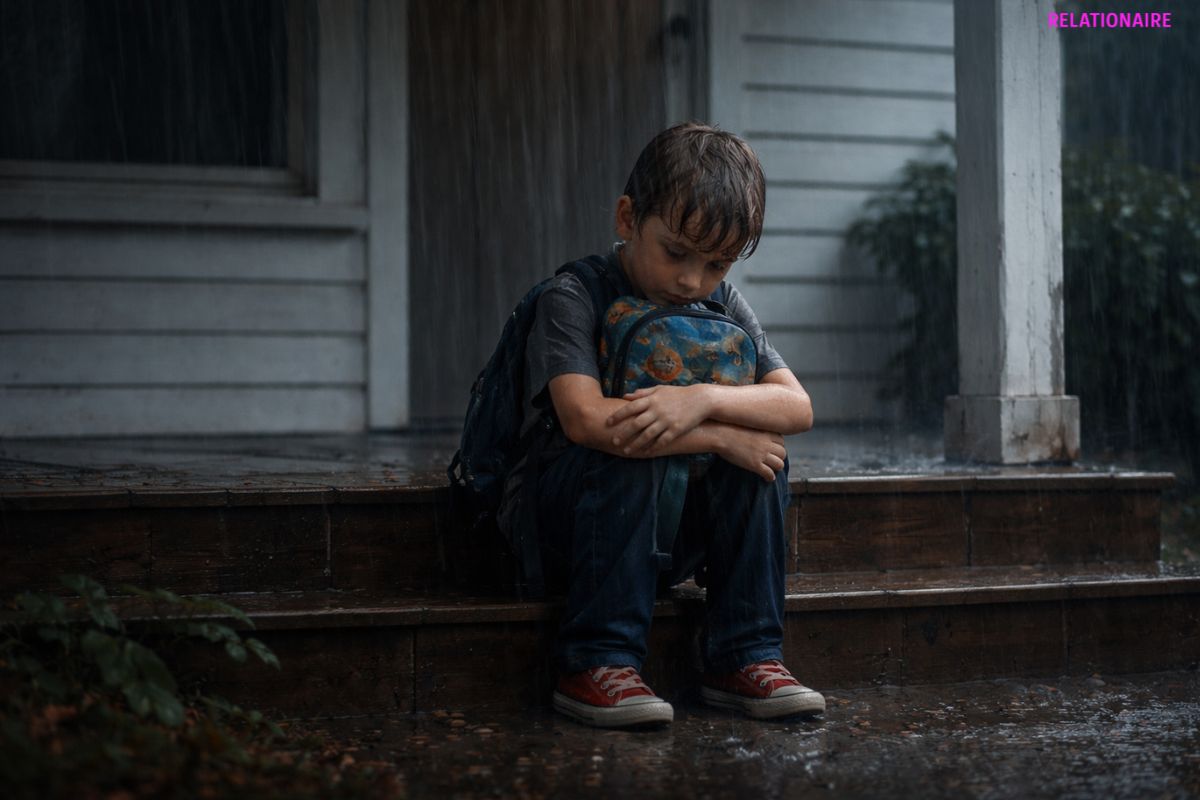
Eli Mercer climbed down the steps, pulled his too-big backpack tight against his chest, walked up to his porch, and sat down in the rain.
Just sat there.
Didn’t knock.
Didn’t try the door.
Didn’t even look back at the bus.
I remember leaning across the steering wheel, waiting for him to wise up and go inside.
He was eight, maybe nine. Skinny little thing. Brown hair plastered to his forehead. Red sneakers dark with water. His backpack had cartoon planets on it, faded from too many washes or too much sun. He held it like it had bones in it.
“Go on, honey,” I muttered through the glass, like he could hear me. “Get inside.”
But he didn’t move.
Behind me, one of the older girls said, “He’s weird.”
Another kid snorted. “He got in trouble again.”
That sounded about right.
I’d heard Eli’s name over the radio before. Nothing terrible. Talking too much. Wandering. “Daydreaming.” Once he’d hidden a cafeteria roll in his pocket for later and gotten caught. Once he’d come to the bus with no homework folder and cried like the end of the world had come. He was one of those children adults described with tired voices. Sensitive. A handful. Too much in his feelings.
His mother usually met him at the door.
That was part of what made it strange.
Every afternoon at the same stop, she’d open the front door before he even reached the porch. She was always neat, even when she looked worn out. Hair pulled back. A cardigan. One hand on the knob, the other lifted in a little wave.
Not that day.
The porch light was off.
The door stayed shut.
Eli sat in the rain like he had all the time in the world.
A horn sounded behind the bus. I checked the mirror. Pickup truck. Impatient. I put the bus in gear and moved on.
But the image stayed with me all afternoon.
A little boy on wet steps.
Not crying.
Not pounding on the door.
Just waiting.
The next day, the sky cleared. The roads steamed. The children were louder when the weather was good, sugar-high and half wild.
At 4:13, I turned onto Willow Creek Road.
At 4:14, Eli got off the bus.
At 4:15, he sat on the porch again.
Dry day this time.
Same backpack in his lap.
Same stillness.
The front door stayed closed.
I watched longer than I should have. The bus idled. A few kids craned their necks to look.
“Maybe he’s locked out,” one of the twins said.
“He does it every day,” said a fifth grader from the back. “My sister said so.”
I turned around. “Every day?”
The girl shrugged. “Sometimes.”
But kids notice things adults don’t tell each other.
I drove on with a bad feeling under my ribs.
By Thursday, I was paying attention.
He got off the bus with the same careful little nod he always gave me. “Thank you, Miss Janine.”
That was another thing about Eli. Polite. Soft-spoken. The kind of boy who said thank you even when he was distracted, even when the other kids didn’t.
He walked up the steps.
Sat down.
Looked at the door, then down at his shoes.
4:15.
Exactly.
That evening, I mentioned it in the staff lot while I was locking up.
“Mercer kid?” said Darlene, one of the aides. “He probably likes the drama. Some kids do.”
“He’s not making a scene,” I said.
She shrugged. “Silent drama is still drama.”
Coach Bell, loading gym bags into his trunk, laughed. “Maybe Mom’s teaching him a lesson. My daddy would’ve left me out there till dark.”
Nobody meant harm by it. That’s what bothered me later.
How easy it was, all of us standing there in our dry clothes, filling in the blanks with the usual tired guesses.
Troublemaker.
Attention-seeking.
A stubborn child trying to win something.
The next Monday, the rain came back.
A cold spring rain. Steady. Gray. Mean.
By the time I reached Willow Creek Road, my shoulders were tight.
Eli stepped off the bus and paused at the bottom of the steps.
For a second, I thought maybe the weather would change his mind.
Instead, he pulled the hood of his jacket over his head, ran to the porch, sat down, and tucked his backpack under his chin to keep it dry.
He looked so small out there that something inside me snapped.
I opened the bus door.
“Everybody stay seated,” I called back.
A chorus of groans.
I ignored them, grabbed my umbrella from behind the seat, and climbed down into the rain.
My shoes sank into the mud at the edge of the drive. Water rolled off the umbrella in sheets. Eli looked up when he heard me, but he didn’t look startled. Almost like he’d known one day I might come.
“You can’t sit out here soaking wet, baby,” I said when I reached him.
He gave me a polite little smile that didn’t belong on a child’s face. Too careful. Too practiced.
“I’m okay, Miss Janine.”
“No, you’re not. You’ll catch your death.”
He shifted his backpack higher in his lap. “I won’t stay long.”
I glanced at the front window. Curtains drawn. No movement inside.
“Is your mom home?”
He nodded.
“Then why aren’t you going in?”
He looked at the door.
Then at the rain sliding off the umbrella.
Then back at me.
His mouth pressed together the way children do when they’re deciding whether grown-ups can handle the truth.
“Did you get in trouble?” I asked, softer now.
“No, ma’am.”
“Are you locked out?”
He shook his head.
I lowered myself a little so I wasn’t towering over him. Rain blew against my skirt. The bus engine rumbled behind me.
“Eli,” I said, “help me understand.”
He swallowed.
I thought he might cry.
Instead, he leaned closer so the kids on the bus wouldn’t hear and said, almost in a whisper, “Mama cries in the kitchen every day at 4:15.”
I didn’t speak.
The rain hit the umbrella like handfuls of gravel.
Eli kept his eyes on the door.
“She thinks I don’t know,” he said. “But I know.”
Something cold moved through me.
I looked at the house again, really looked. The small rental with the peeling white trim. The potted fern gone brown on the porch. The toy truck tipped on its side near the railing. The kind of place you pass a hundred times without seeing the life inside it.
“She cries before I come in,” he said. “Just for a little bit.”
His voice stayed calm, but his fingers tightened around the strap of his backpack until his knuckles paled.
“So I wait out here.”
“Eli…”
He finally looked at me then.
Not embarrassed.
Not defiant.
Just honest.
“I give her five extra quiet minutes,” he said. “Before she has to smile again.”
I forgot the rain.
I forgot the bus.
I forgot every lazy thing I had thought about him.
My throat closed so fast it hurt.
Inside the house, somewhere beyond the shut door, something fell. A pan maybe. Or a cup. Then silence.
Eli turned his head toward the sound.
The front doorknob moved.
And for the first time, I understood that whatever was on the other side of that door was not what any of us had imagined.
Part 2
The door opened slowly.
Not the quick, cheerful swing of a mother greeting her child.
Slow. Careful. Like whoever stood behind it needed one more second to become someone else.
Then Laura Mercer stepped onto the porch with a dish towel in her hand and a smile that arrived too late.
“Oh,” she said when she saw me. “Miss Janine. I’m sorry. I didn’t realize”
Her eyes dropped to Eli.
Then to the umbrella over both of us.
Then to the rain soaking the hem of my skirt.
She understood something immediately. I saw it happen. The smile trembled. Just once.
“Come inside, baby,” she said to him.
Eli stood at once, like he had been waiting for permission all along. He never complained. Never accused. He just got up, slung on his backpack, and brushed rain from his knees.
He passed her quietly.
As he slipped by, he touched her elbow with two fingers.
A tiny gesture.
Barely there.
But she closed her eyes like it had gone straight through her.
I should have left then. Any decent person would have.
But Laura looked at me with that awful mixture of shame and exhaustion I had seen before in hospital waiting rooms, at funerals, outside principal offices, in women trying not to cry at the grocery store when the card reader says declined.
“I’m sorry,” she said again. “He’s usually in by now.”
Usually.
That word stayed with me.
Usually meant this had become a system.
A routine.
A child measuring out mercy in five-minute pieces.
I cleared my throat. “It’s all right.”
But it wasn’t all right, and both of us knew it.
Behind me, the bus honked once. The older kids were getting restless.
Laura tucked the damp dish towel over her shoulder. Up close, she looked younger than I had thought and older than she should have. There were shadows under her eyes. Her wedding ring was gone, but the pale band where it had been was still there.
“Thank you for bringing him home,” she said.
It sounded like an ending.
But her face looked like a beginning.
That night I couldn’t sleep.
I kept seeing Eli on the porch steps, sitting straight in the rain like a little guard posted outside his own front door.
I kept hearing him say it.
Before she has to smile again.
Not before she stops crying.
Not before she feels better.
He knew better than that.
He knew his mother was putting something away before he came inside. He knew she was dressing a wound before she opened the door. And instead of running to be comforted, he gave her room to break in private.
A child shouldn’t know how to do that.
A child definitely shouldn’t need to.
The next afternoon I watched the clock the whole route.
At 4:14, Eli stepped off the bus.
At 4:15, he sat down.
No rain this time. Just a thin wind and a sky the color of old tin.
I didn’t get off the bus.
I just sat there with my hands on the wheel and watched.
After exactly five minutes, the door opened.
Laura stepped out smiling.
She looked down at Eli, said something I couldn’t hear, and he stood up and followed her in.
Five minutes.
Not six.
Not three.
Five.
He had timed his kindness into a ritual.
The next week, I stopped by the school office and asked if everything was all right at home.
They gave me the careful answer schools give.
“No current concerns.”
“Eli is fed, clean, and usually on time.”
“His mother is responsive.”
But one of the secretaries, who had known every family in that district for twenty years, lowered her voice after the others moved away.
“His father died in November,” she said.
I felt my stomach drop.
“How?”
“Work accident. Highway crew.”
That explained nothing and everything.
The wedding ring.
The tired face.
The boy who watched the door like he was standing watch over grief itself.
“He talks about his dad?” I asked.
She shook her head. “Not much. His teacher says he’s very sweet. Drifts off a lot. Draws trucks and clouds. Sometimes rain.”
On the drive home that day, Willow Creek Road looked different.
So did the Mercer house.
There was no tragedy visible from the shoulder. No sign hung out front announcing heartbreak. Just the same peeling trim. The same bent screen door. The same child’s toy left beside the porch.
That was the hard part about grief.
From the road, it looks like laundry and mail and dinner and ordinary houses.
You don’t see the exact hour it comes alive every day.
Thursday afternoon, a yellow envelope slipped from Eli’s backpack when he climbed off the bus.
“Wait,” I called.
He turned, and I picked it up before the wind could take it.
The paper was damp at one corner. His name was written across the front in his teacher’s handwriting: ELI.
He came back for it fast. Too fast.
“Sorry,” he said, reaching.
But not before I noticed the top edge was already opened.
Inside was a folded drawing on white construction paper.
I held it out to him. “Almost lost it.”
He took it and pressed it flat against his chest. “Thank you.”
Something in his face changed.
Not fear exactly.
More like the dread of a child carrying something fragile through a rough world.
“Is that for your mom?” I asked.
He nodded.
“For Mother’s Day?”
He looked down. “Kind of.”
There was no reason for my heart to beat harder, but it did.
“Looks important.”
He gave the smallest shrug.
“She gets more sad in May.”
I stood still.
The bus engine hummed under me. A mockingbird called from somewhere down the road.
Eli shifted from one foot to the other. “It’s okay. I made her something.”
Then he turned and walked to the porch.
But he didn’t sit right away.
He stood there holding the envelope, looking at the door like he was deciding whether today was a porch day or a courage day.
Then he sat.
At 4:15 exactly.
That evening, I found out why May mattered.
Coach Bell’s wife mentioned it while we were waiting in line for coffee before a school fundraiser.
“Wasn’t Laura Mercer’s husband killed right before Mother’s Day?” she said, not unkindly, just remembering aloud. “I only know because the county put flowers near the site.”
Right before Mother’s Day.
I pictured Eli making a card in school while his mother moved through the first anniversary of losing the man who should have been there helping him write it.
No wonder the month had teeth.
The next afternoon, thunder rolled in early.
By the time I turned onto Willow Creek Road, the sky had gone nearly black. Branches bent low. The first drops hit the bus in heavy, separate smacks.
Eli got off with the yellow envelope tucked carefully inside his backpack.
“Go on quick,” I said.
He nodded and ran.
He sat on the porch anyway.
Lightning flashed white behind the house.
I opened the door before I had fully decided to.
“Eli!”
He looked back.
“Inside. Now.”
He hesitated.
Actually hesitated.
Not because he was disobedient.
Because he was weighing his mother’s need against the storm.
That was the moment that undid me.
I stepped down from the bus, not even bothering with the umbrella this time, and crossed the yard fast.
By the time I reached him, the rain had started in earnest.
“Baby, no. This is too much.”
He hugged his backpack. “I just need a minute.”
“No.”
My voice came out sharper than I meant.
He flinched, and guilt hit me hard.
Then the front door cracked open.
Laura stood there, one hand still on the knob, eyes red, face bare of any smile at all.
For one second none of us pretended.
Not her.
Not him.
Not me.
Her gaze dropped to Eli’s backpack.
To the yellow envelope peeking out of the top.
And something in her face broke open.
“What is that?” she asked.
Eli looked down.
Then back up at her.
His voice was very small.
“It’s the picture I made for the day Dad left.”
The rain seemed to stop in my ears.
Laura took one step onto the porch barefoot, gripping the doorframe so hard her knuckles went white.
Eli slowly pulled the folded paper from the envelope.
He didn’t open it.
He just held it out between them with both hands.
And Laura, shaking now, reached for the drawing she had not known he was carrying all week.
Part 3
For a second I thought Laura might not take it.
That’s how grief works sometimes. It makes even paper feel dangerous.
But Eli kept holding it out with those two small hands, rain dripping from his sleeves, sneakers dark on the porch boards.
So she took it.
Carefully.
Like it might fall apart.
Like she might.
I should have gone back to the bus.
Instead I stood at the edge of the porch in the storm, wet through, while a mother unfolded a page that had clearly cost her son more courage than most grown people ever manage.
The drawing was simple.
Crayon sky.
Crayon grass.
A stick-figure road crew truck with orange cones beside it.
Three people holding hands near the bottom of the page.
A man in a yellow vest.
A woman in a blue dress.
A little boy with a red backpack.
Above them, in wobbling block letters, Eli had written:
THIS WAS BEFORE.
Laura pressed her hand over her mouth.
Eli watched her the way children watch adults near the edge of something. Alert. Ready. Wanting to help, even though they don’t know how much helping will cost.
“There’s more inside,” he said softly.
She looked down again.
At the bottom corner, barely visible where the crayon had smudged, was another picture. The same little boy. The same mother. No father this time.
The boy was standing on the porch.
The mother was in the kitchen window, crying over a sink.
And above that picture, in smaller letters, he had written:
I WAIT SO YOU CAN FINISH.
Laura made a sound I will never forget.
Not loud.
Not dramatic.
The kind of sound that comes out when someone has been holding themselves together with threads and one kind hand finally snaps the knot.
She sank onto the top porch step right there in the rain.
Eli didn’t move away.
He stepped closer.
Close enough that their shoulders touched.
“I didn’t want you to be embarrassed,” he told her.
His voice trembled now. It was the first time I had heard it do that.
“You always wipe your face before you open the door. I know you don’t want me to see. So I wait.”
Laura lowered the paper to her lap and looked at him like she was seeing both the little boy he was and the burden he had been carrying alone.
“Oh, baby,” she whispered. “Oh, sweetheart.”
“I’m not scared when you cry,” he said quickly, as if that were the part he most needed her to understand. “I just thought maybe if I stayed out here, then you didn’t have to hurry.”
At that, Laura pulled him into her so fast the backpack thumped against her shoulder.
He went willingly, all elbows and wet sleeves and quiet bravery.
She held the back of his head and cried into his hair.
Not hidden now.
Not turned toward a sink.
Right there on the porch, with the storm around them and the bus behind me and every last false assumption I’d made washed clean off me.
“I’m sorry,” she said into his hair. “I am so sorry.”
Eli wrapped his arms around her neck. “You don’t have to be.”
“Yes, I do.”
She drew back enough to look him in the face. Her cheeks were wet with rain and tears. “You should never have felt like you had to protect me from my own sadness.”
He frowned a little, thinking.
Then he said the most childlike thing and the wisest thing.
“But that’s what families do.”
Laura closed her eyes.
I put a hand over my own mouth.
Because there it was.
Not a speech.
Not some polished miracle line.
Just the plain truth from a boy who had been standing watch over his mother’s dignity day after day, not because anyone told him to, not because he wanted praise, but because love had made him attentive.
Families do that.
They carry corners for each other.
They hold doors.
They wait on porches.
They learn the hour grief comes to the kitchen and they make room for it.
Laura looked over at me then, maybe remembering I was still there.
There are moments when people would rather die than be witnessed.
This should have been one of them.
Instead she gave me a look that was raw and tired and strangely relieved.
Like maybe being seen was no longer the worst thing.
“I didn’t know he knew,” she said.
I nodded, because my throat wouldn’t work.
“He knows,” I managed.
Eli leaned back from her. “I know you miss Dad at 4:15 because that’s when my bus comes. And he used to be home before me.”
Laura stared at him.
That had been the clock. Not random at all.
Not a daily sadness drifting in from nowhere.
4:15 was the hour when three people used to be a family in one room.
The hour that now arrived missing someone.
The hour she had been bracing for every single day.
And Eli, in his child’s way, had figured out exactly what that meant.
She looked at the drawing again.
At THIS WAS BEFORE.
At I WAIT SO YOU CAN FINISH.
Then she turned to him and said, “Come inside with me.”
He studied her face. “Even if you’re still sad?”
“Yes,” she said, and her voice steadied. “Especially then.”
He nodded once.
Like a deal had been struck.
Like some burden was finally being put down.
Laura stood, then reached a hand toward me. Not to shake. Just in gratitude, I think. Just because there are moments when another human being standing nearby matters more than words.
“Thank you,” she said.
I looked at Eli. “You’re a good boy.”
He gave me a serious little expression. “My mom is good too.”
That nearly finished me.
Because that was it, wasn’t it?
Even now, even after all his careful watching, he was still protecting her.
Not from weather.
Not from grief.
From being misunderstood.
I went back to the bus and drove the rest of the route with wet clothes and blurred eyes.
That would have been enough story for one life, but it didn’t end there.
The next afternoon when I turned onto Willow Creek Road, I looked up out of habit.
Eli stepped off the bus.
He walked to the porch.
And there, before he reached the top step, the front door opened.
Laura came out without a smile fixed on too soon.
No hurried mask.
No wiped face pretending.
Just her.
Sad, maybe. Tired still. But honest.
Eli stopped in front of her.
For half a second they just looked at each other.
Then she sat down on the porch beside him.
Not inside.
Not hiding.
Just sat.
He sat too.
They stayed there together while I watched from the bus.
No umbrellas.
No performance.
Just a mother and son on worn wooden steps under a clearing sky.
When I saw Eli the next morning, he climbed onto the bus and handed me something folded from notebook paper.
A drawing.
Three people again.
The father in the yellow vest.
The mother in blue.
The little boy with the red backpack.
But this time there was a fourth figure at the edge holding an umbrella too big for her.
Underneath, in his crooked handwriting, he’d written:
NOW YOU KNOW TOO.
I kept that drawing.
Still have it.
Because every now and then the world hands you a moment so small nobody else would notice it if you tried to explain.
A bus stop.
A porch.
A child in the rain.
And then you get close enough to see what it really is.
Not defiance.
Not drama.
Just love wearing the only shape it knew how to wear.
Sometimes the people we think need the most care are the ones already giving it away.
And sometimes a child sees grief more clearly than the adults standing in the dry, making guesses from the road.