She Paid for a Stranded Biker’s Gas While the Whole Town Laughed at Her—Three Days Later, a Line of Motorcycles Rolled to Her Broken Shelter, and Nobody in Briar Glen Could Look Away
“I said I’m not asking for anything free.”
The man’s voice was calm, but the whole gas station had gone quiet around it in that hungry way small towns do when they smell a scene coming.
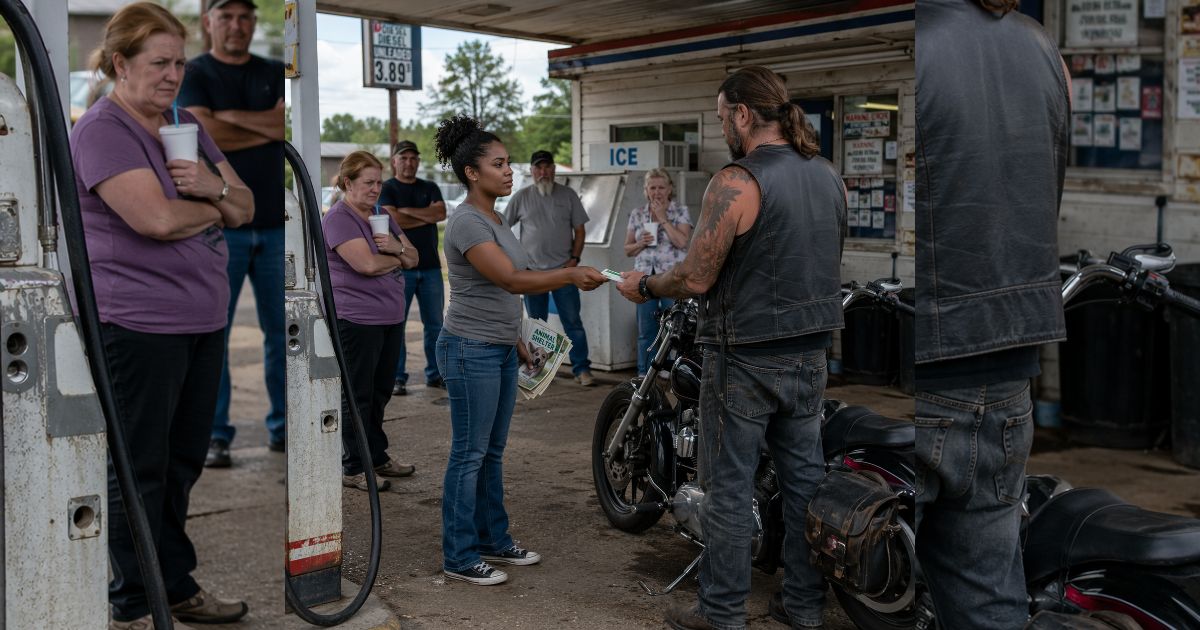
Alicia Bennett had one hand on the pump and the other wrapped around a stack of flyers already soft at the corners from sweat and too many rejections. She turned her head just enough to see the trouble.
Tall.
Broad shoulders.
Weathered leather vest.
Tattooed arms.
A heavy black motorcycle stood beside him like some loud, gleaming animal that had wandered into the wrong place. The patch on the back of his vest read Iron Saints, a local biker club from two counties over, the kind of name folks in Briar Glen said carefully, usually with lifted brows and lowered voices.
Across from him stood Dale Mercer, who ran the gas station and enjoyed two things almost equally: coffee and humiliation when the target wasn’t him.
“Cash only means cash only,” Dale snapped. “You can wave that phone around all day. It still ain’t money.”
The few people loitering near the ice freezer shifted closer.
Nobody in Briar Glen rushed home from the corner station.
Not when embarrassment was free entertainment.
The old men from the feed store were there with their lidded coffee cups. Mrs. Talbot from the beauty shop stood with one hand on her hip and her purse tucked hard under her arm. A boy in a baseball cap leaned against a rusty soda machine, already grinning like he had paid admission.
The biker exhaled once through his nose.
“I get that,” he said. “I didn’t know this station still didn’t take card tap or phone pay. I filled the tank before I realized. I’ve got money in the bank. I can transfer it, call somebody, do whatever you need. I’m just trying to get back on the road.”
Dale laughed, mean and thin.
“That what you tell people all the time?”
A couple folks chuckled.
Alicia’s jaw tightened.
She knew that laugh.
She knew what happened when a town decided what kind of person you were before you had even finished your sentence.
The biker glanced around at the circle forming around him. His eyes were gray, not cold exactly, but tired. The kind of eyes that looked like they had gone too long without sleep and too long without good news.
“My mother’s sick,” he said. “I’m trying to get to her.”
Dale folded his arms.
“That sounds sad. Still doesn’t fill my register.”
“I’m not arguing with you.”
“Looks like arguing to me.”
Alicia looked down at her flyers.
MERCY HOUSE
A safe home for abandoned and disabled children.
Donations needed. Volunteers needed. Hope needed.
She had printed them on cheap paper at the copy machine in the library annex. The ink had already started to blur on a few pages because the machine ran hot and dragged.
She should have been thinking about the shelter.
About the pantry.
About the leaking back room ceiling.
About the little girl inside Mercy House who needed braces for her legs adjusted before winter.
Instead she was listening to the crowd sharpen itself against a stranger.
“Call the sheriff,” somebody muttered.
The boy in the baseball cap snorted. “Bet that bike’s worth more than my truck.”
Mrs. Talbot said, loud enough to carry, “Men like that always have a story.”
Alicia closed her eyes for half a second.
Men like that.
Women like her.
Children like the ones at Mercy House.
In Briar Glen, people loved labels because labels let them skip kindness.
The biker looked like he was choosing his next words with care.
“I can leave my license,” he said. “You can take a photo of the plate. I’ll come back with cash or send somebody.”
Dale stepped forward.
“No.”
His voice had that ugly little thrill in it now.
“Or maybe I just call the sheriff and let him sort out why an Iron Saint is trying to walk off without paying.”
The boy in the baseball cap pulled out his phone.
Not to help.
To record.
Alicia felt something hot move through her chest.
Not anger exactly.
Recognition.
Because three years earlier, when she had stood in the county office trying to ask why Mercy House had been skipped again for a supply grant, the woman behind the desk had smiled the same smile Dale wore now.
Patient.
Dismissive.
Certain Alicia would eventually go away if enough people looked at her like she was the inconvenience.
The biker spread his hands.
“I’m not walking off.”
Dale took out his phone anyway.
That was the moment Alicia moved.
“I’ll cover it.”
The words landed so hard the whole place seemed to blink.
Dale turned first.
Then the woman from the beauty shop.
Then the boy with the phone.
Then the biker.
Alicia stepped away from her pump, flyers tucked tight under her arm.
“I said I’ll pay for his gas.”
Dale barked out a laugh.
“With what?”
“With my money.”
“That’s your business,” he said. “Still a foolish one.”
“It usually is,” Alicia said quietly, “when you decide to act like a decent person in front of an audience.”
A few heads turned.
Nobody liked being told what they were doing while they were doing it.
The biker stared at her, almost like he thought he had misheard.
She walked straight past the little crowd and into the station store.
The air conditioner inside rattled like it might give out at any second. The floor smelled like old mop water and stale chips. Alicia set her flyers on the counter, opened her worn wallet, and counted what she had.
There went the money she had set aside for poster board and milk.
There went the extra she had hidden behind her license in case one of the children needed medicine before payday.
There went the part of her that was tired of always being the one to bend.
But there was another part of her that had survived on less.
She slid the bills across the counter.
“His pump and mine.”
Dale took the cash with a look like he hoped she would feel stupid before the day was done.
From outside, she could still feel the eyes on the windows.
Briar Glen had a way of making one kind act feel like a public confession.
The receipt spit out with a dry mechanical chirp.
Dale tore it off and handed it over.
“Your choice.”
Alicia folded the receipt once and tucked it into her pocket.
“The only thing worse than being broke,” she said, “is being cruel on purpose.”
She picked up her flyers and walked back out.
The crowd had already started to break apart, disappointed the scene had ended without handcuffs or shouting. That was the thing about people who gathered for spectacle. The second kindness ruined their script, they lost interest.
The biker stood by his motorcycle with one hand resting on the handlebar.
Up close, he looked older than she first guessed. Maybe late thirties. Not old, but worn. His dark hair was tied back at the nape of his neck. A scar cut faint and pale through one eyebrow. His face held itself carefully, like a man used to being judged before he ever got to become known.
“You didn’t have to do that,” he said.
“I know.”
“At least let me pay you back.”
“You can.”
He blinked once.
“By helping somebody else when it’s your turn.”
For the first time, something softer moved through his expression.
Not a smile exactly.
More like surprise with the edges taken off.
“What’s your name?”
“Alicia.”
“Alicia,” he repeated, as if he meant to remember it. “I’m Jake.”
Before she could answer, a gust of wind slipped through the open passenger side of her old sedan and tugged one of the flyers from under her arm. It skipped across the pavement like a pale bird with a broken wing.
Jake caught it against his boot and bent to pick it up.
His eyes lowered to the page.
His face changed.
It wasn’t dramatic.
Just stiller.
“Mercy House,” he read.
Alicia reached for the paper, suddenly embarrassed by the cheap print and faded ink and the tiredness of it all.
“Just a shelter.”
Jake didn’t hand it back right away.
He read the smaller line under the title. The one that said they took in children the system kept running out of places for.
Children with mobility needs.
Children with speech delays.
Children with sensory struggles.
Children left too long in hospital wings and temporary rooms because nobody wanted the hard cases.
“Just a shelter,” he repeated.
Then he looked at her car, at the stack of flyers, at the circles under her eyes she knew she hadn’t hidden.
“That where you’re headed?”
“That’s where I live,” she said. “And work.”
Something tightened in his jaw.
He handed the flyer back carefully, like it mattered more now than it had thirty seconds earlier.
“Thank you,” he said.
She gave one tired shrug.
“Drive safe.”
He nodded once.
Then he climbed onto the bike, settled his helmet, and with a low burst of engine sound that rolled across the cracked lot, he pulled out onto the county road and disappeared past the sagging diner sign.
Alicia watched him go for all of two seconds.
Then she got in her car and drove back to the place that needed her more than a stranger ever could.
Mercy House sat at the edge of Briar Glen where the pavement gave up and the trees started closing in.
It had once been a boarding home for mill families, back when the textile plant still hummed and folks still talked about the town like it had a future. By the time Alicia took it over with borrowed hope and secondhand furniture, the porch leaned, the gutters sagged, and the windows rattled when trucks passed on the county road.
But it was still standing.
And inside were children who had learned the difference between being housed and being wanted.
Miss Edna was in the kitchen when Alicia came in, setting out bowls for supper with the careful rhythm of a woman who had been making do for so long she made scarcity look almost graceful.
“Well,” her grandmother said without turning around, “that face says either the radiator gave up or somebody said something foolish in town.”
“Why not both?”
Miss Edna clicked her tongue.
“That place still breathing?”
“Barely.”
“That town?”
“Also barely.”
Miss Edna finally turned, one silver brow raised.
She was seventy-six, straight-backed despite her arthritis, with strong hands and a voice that could warm soup or stop nonsense with equal skill. She had raised Alicia after the funeral, after the couch-hopping, after the relatives who always said they wished they could do more and never did.
To Alicia, Miss Edna had never felt old.
She felt permanent.
The kitchen smelled like beans, cornbread, and dish soap.
From the next room came the sound of Theo humming under his breath while he lined up crayons by color. Lily laughed at something one of the volunteers had said. Ava’s walker thumped softly against the hall wall in that pattern Alicia could pick out from any other sound on earth.
Home.
A hard one.
A fragile one.
But home.
“You’re late,” Miss Edna said, though gently.
“Gas station.”
“That explains the look.”
Alicia set the flyers down on the table.
“They’re not taking,” she said. “I handed out twenty-six. I think three people actually read them. One folded one into a coffee coaster while I was still talking.”
Miss Edna made a face that said her opinion of humanity remained low but consistent.
Alicia leaned against the counter.
“Also I paid for a stranger’s gas.”
Miss Edna stopped with a spoon in her hand.
“You what?”
Alicia told her.
Not the dramatic version.
Just the truth.
The crowd.
The mockery.
The biker.
The way it had all felt too familiar not to step into.
By the end, Miss Edna was staring at her with that deep mix of exasperation and pride Alicia had known since childhood.
“We needed milk,” Miss Edna said.
“I know.”
“And poster board.”
“I know.”
“And common sense every now and then.”
Alicia laughed despite herself.
“There it is.”
Miss Edna set the spoon down.
“Baby, generosity is a beautiful thing. So is rent. So is keeping food in this house.”
Alicia looked at the flyers.
“I know.”
Miss Edna’s voice softened.
“But if you hadn’t done it, it would have sat in your spirit all day.”
Alicia met her eyes.
“Probably all week.”
Miss Edna nodded like that settled it.
“Then we’ll stretch supper.”
They did.
That was the thing about Mercy House.
It had been built as much from stretching as from love.
Stretching groceries.
Stretching paychecks.
Stretching sleep.
Stretching grace toward children who had learned too early to brace themselves whenever an adult voice changed tone.
Alicia washed up and went room to room before dinner.
Theo, ten, severe and brilliant, was reorganizing puzzle pieces that did not belong to the same box because he liked the colors better that way.
Lily, seven, sat cross-legged with one of the therapy dolls, explaining patiently why the doll needed a blanket over her feet because “sometimes being little makes the world feel drafty.”
Ava, nine, grinned at Alicia from her walker and asked whether they could paint the front sign next weekend, because if it looked nicer maybe “people would know we’re real.”
That nearly broke her.
Not because children should not hope.
Because they did anyway.
That night after the children were fed and bathed and settled, Alicia sat at the old desk in the front office with a yellow legal pad, a calculator that kept sticking on the eight button, and the shelter ledger open in front of her.
She went through the numbers twice.
Then a third time because panic always made her suspicious of math.
Roof patch needed before fall.
New batteries for the backup hearing devices.
Transportation fund for therapy appointments.
Heating bill estimate.
Pantry shortfall.
She rubbed at the ache between her eyes.
On the wall above the desk hung a framed photograph of Mercy House from years ago. Fresh paint. Full flower boxes. Volunteers on the porch. A ribbon tied across the front gate for an opening ceremony nobody in Briar Glen talked about anymore.
Somewhere between then and now, the town had stopped seeing the shelter as a mercy and started seeing it as a burden.
Too expensive.
Too far out.
Too complicated.
Too sad.
Too full of children who reminded people what kind of world they had allowed.
Miss Edna came in carrying two mugs of weak tea.
“You’re glaring at paper again,” she said.
“The paper started it.”
Miss Edna set the mug down.
“Any word from the county?”
Alicia shook her head.
“I called twice last week. Still nothing on the accessibility support request.”
“Funny how they always find the papers late when they belong to you.”
Alicia didn’t answer.
Because that was the truth with the skin left on it.
Twice in the past two years, Mercy House had applied for county support programs and been “missed in the review process.”
Once the email had supposedly gone to spam.
Once a signature page had gone missing.
Alicia had long ago stopped asking whether it was personal and started asking whether that even mattered.
The effect was the same.
The children went without.
She lifted her tea.
“I’m tired, Nana.”
“I know.”
“No, I mean tired in the bones.”
Miss Edna looked at her the way only someone who had loved you through every version of your face could look at you.
“You’re not quitting.”
Alicia laughed softly.
“That obvious?”
“Baby, when you’re thinking about quitting, your chin goes up and your shoulders fall. You look brave and defeated at the same time.”
Alicia stared at the ledger.
“What if this place only survives because I keep begging harder than most people can ignore?”
Miss Edna pulled out the chair across from her and sat.
“What if it survives because love is stubborn and God has a strange sense of timing?”
Alicia smiled without meaning to.
“You always say that when you don’t know what’s coming.”
“That is exactly when it applies.”
The next three days were more of the same.
Morning meds.
Breakfast trays.
Laundry loads.
Phone calls nobody returned.
One donated bag of clothes that smelled like mothballs and another filled with things nobody at Mercy House could use.
Alicia drove into town with her flyers and came home with fewer, but not because people were helping. Just because paper disappeared faster than indifference.
At the post office, Mrs. Talbot asked whether Alicia had “looked into smaller goals,” which was town language for maybe stop trying so publicly.
At the hardware store, Mr. Wilkes said he admired what she did, then suggested perhaps the county would take the children somewhere “better equipped” if Mercy House couldn’t keep up.
At the diner, a waitress Alicia had known since high school slipped her a free slice of pie in a to-go box and whispered, “I wish I could do more,” which was kind, but also the sentence Alicia had come to hate most in the English language.
By the third afternoon, she was sitting on the front steps of Mercy House watching the sun drag long shadows across the gravel drive when she heard it.
Not one engine.
Many.
Deep.
Layered.
Steady.
The sound rose from the county road like thunder that had learned how to move in formation.
Alicia stood.
Miss Edna looked up from her rocking chair.
From inside, Theo came to the screen door. Lily appeared under his arm. Ava pressed both palms to the glass.
The sound grew louder.
Then the first motorcycle came around the bend.
Black paint.
Chrome flashes.
Then another.
And another.
And another.
Alicia counted without meaning to.
Five.
Eight.
Eleven.
Behind them rolled two pickup trucks with strapped-down boxes filling the beds.
Dust curled around the tires as the convoy turned off the road and came straight down Mercy House’s long cracked driveway.
Miss Edna gripped the arm of her chair.
“Oh my.”
Alicia’s heartbeat kicked against her ribs.
Because whatever this was, Briar Glen would see it.
And Briar Glen always saw the wrong thing first.
The line of motorcycles slowed and fanned out across the gravel.
Engines cut off one by one.
The sudden quiet that followed felt almost ceremonial.
Jake swung off the lead bike and took off his helmet.
Same gray eyes.
Same scar through the brow.
Same worn leather vest.
Only now he was on Alicia’s ground, with half a dozen men and several women in biker cuts behind him, and enough supplies in those truck beds to change a month of bad numbers into one good breath.
He walked forward until he stood a few feet from the porch.
Then he held something out.
Her flyer.
Smoothed flat.
Fold marks still visible.
“You dropped this,” he said.
Alicia stared at the page.
Then at the trucks.
Then at the line of riders.
“You found me.”
Jake’s mouth tipped slightly at one corner.
“Wasn’t impossible. Small towns love to talk.”
Miss Edna rose carefully from the rocker and came to stand beside Alicia with her cane planted firm, not unfriendly, but not conceding a thing.
Jake noticed.
His posture shifted.
Respectful.
Not defensive.
“Ma’am,” he said with a nod.
Miss Edna gave him one in return.
“What is all this?”
Jake glanced back over his shoulder.
“My club took up a collection.”
Alicia looked past him again.
Now that the adrenaline had settled a little, she could make out the boxes.
Canned food.
Paper towels.
Diapers.
Blankets.
Cleaning supplies.
Art bins.
A folded wheelchair ramp.
And toward the back of one truck, what looked like neatly bundled lumber.
Her throat tightened so suddenly it hurt.
“You didn’t have to do this,” she said.
Jake gave her back her own line with no smile at all.
“I know.”
One of the riders climbed down from the second truck carrying a crate marked in black marker: sensory tools.
Another held up a stuffed elephant.
Lily made a sound at the screen door so soft it was almost a gasp.
Jake rubbed one hand over the back of his neck.
“I got to my mother’s place that night. She’s got nurses helping now. My sister came in from Tulsa. Mama’s weak, but she’s hanging on.”
Something in his face changed when he said the word mama.
Not smaller.
Truer.
“I told her what happened at the station,” he went on. “About you. About that flyer. She asked me one question.”
Alicia swallowed.
“What?”
He looked at the shelter, then back at her.
“She asked what kind of man accepts kindness from a stranger and does nothing with it.”
Silence sat between them for a moment.
Then Miss Edna, who had always had more sense than ceremony, said, “Well. Standing out here won’t unload those trucks.”
That broke it.
A few riders smiled.
Jake let out a breath that might have been relief.
And then Mercy House, which had been sagging beneath scarcity for so long it had almost started to believe in it, opened its doors to an invasion of usefulness.
The children forgot caution first.
Children almost always do when adults arrive carrying color.
Theo went straight for the puzzle bins and asked one of the riders whether he knew the difference between organizing by pattern and organizing by feeling.
Lily accepted the stuffed elephant from a woman named Rosa who wore a leather vest over a sunflower-print dress and had laugh lines deep enough to prove she had earned them.
Ava, who did not trust new people quickly, watched Jake drag a boxed mini-fridge up the porch steps by himself and said, “He looks grumpy.”
“He does,” Alicia said.
Ava considered.
“Maybe helpful grumpy.”
“Maybe.”
Word spread through Briar Glen in the way it always did, except this time it had an engine soundtrack.
By sunset, people had started appearing at the edge of the property.
Not walking up the drive.
Just lingering.
Watching.
The old men from the diner came first, hands in pockets, brows high.
Then Mrs. Talbot.
Then two teenage boys on bikes.
Then a teacher from the elementary school.
Then three women from a church circle that had donated canned green beans exactly twice in two years and spoken of it for months like they had rescued the Republic.
They all stood there staring at the sight of tattooed bikers unloading supplies for disabled children under the supervision of Miss Edna Bennett, who pointed with her cane like a field marshal and did not look impressed by anyone’s mythology.
Nothing confuses prejudice like seeing the wrong people behave beautifully.
Alicia caught Jake noticing the crowd.
“They’re waiting for a problem,” she said.
Jake lifted a box of wipes from the truck bed.
“Then I hope they’re disappointed.”
They were.
The riders worked.
That was what they did.
No speeches.
No posing.
No loud performances for the town.
Just work.
One man named Curtis fixed the back gate latch in under ten minutes.
Rosa and another rider, Mae, sorted pantry goods by expiration date with such ruthless order Alicia nearly cried.
A quiet giant called Boone measured the broken porch rail and said, “I can have this safer before dark.”
Jake carried, lifted, tightened, stacked, checked, listened.
Once, Alicia caught him crouched beside Theo, letting the boy explain at length why symmetry was not the same thing as fairness.
Jake listened like a man receiving instructions that mattered.
Miss Edna noticed too.
That night, after the convoy left with a promise to come back Saturday, Miss Edna and Alicia sat in the kitchen in the kind of silence that comes after a shock too kind to mistrust but too large to absorb all at once.
On the table lay a written inventory one of the riders had made before leaving.
Alicia ran her fingers over the list.
Food staples.
Bedding.
Mobility aids.
Toiletries.
A portable therapy chair.
Roof tarps.
Lumber.
Gift cards for groceries and pharmacy needs.
And an envelope with cash inside, collected from club members and friends.
She still had not opened that one fully because every time she looked at it, tears started pressing behind her eyes in a way she did not have energy to manage.
Miss Edna sipped tea.
“Well,” she said at last, “I take back some things I have thought about leather vests.”
Alicia laughed into both hands.
“It doesn’t fix everything.”
“No.”
“It doesn’t change what this town is.”
“No.”
“It doesn’t make me less tired.”
Miss Edna reached across and patted her wrist.
“But it proves the Lord is not limited by the people who disappoint you.”
Saturday came bright and sharp.
The Iron Saints returned.
This time not with one pickup behind them, but three.
And not just with supplies.
With tools.
The kind that turned intentions into visible change.
By nine in the morning, the Mercy House yard sounded like measuring tape snaps, cordless drills, children laughing, and the occasional low rumble of motorcycles arriving late down the drive.
Jake had brought a contractor friend.
Rosa had somehow convinced a bakery in the next town to donate muffins.
Mae had printed a sign-up sheet for volunteer shifts.
Boone arrived with a trailer of reclaimed wood and said, “It’s clean and it’s sturdy, and if anybody asks, tell them old porches deserve second chances too.”
Even Briar Glen could not pretend not to notice now.
The town did what towns do when confronted with something that threatens its favorite assumptions.
It split.
Some people stayed wary and said so with their mouths tight.
Some softened in private before they ever softened in public.
Some wanted to help but were ashamed it had taken outsiders to embarrass them into motion.
And some, maybe the saddest group of all, were angry that goodness had shown up wearing the wrong clothes.
By noon, the whispers had turned into conversations.
At the grocery store, people were saying Alicia had “connections.”
At the diner, someone suggested the bikers must be getting publicity out of it, even though there was no newspaper there, no cameras, no speeches, nothing but work and gravel and sweat.
At the gas station, Dale reportedly told customers he had “always been willing to support the shelter,” which was such nonsense the story reached Mercy House by supper and made Miss Edna laugh so hard she had to sit down.
But not all resistance was ridiculous.
Some of it came dressed in paperwork.
On Monday morning, Alicia received a letter from the county office.
She recognized the envelope before she even tore it open because official threats always came on heavier paper.
Inside was a notice of inspection.
Building safety review.
Occupancy compliance.
Accessibility standards update.
A mandatory hearing to evaluate whether Mercy House remained fit for licensed operation.
Alicia read it twice.
Then once more slowly, feeling the blood drain from her face.
Miss Edna took the paper from her hand.
“Well, would you look at that,” she said softly. “Now that this place is visible, suddenly they remember it exists.”
Alicia sank into the nearest chair.
“I knew this would happen.”
“Maybe.”
“They’re going to say the porch is outdated. The back room windows don’t meet current code. The bathroom bars need replacing. The wheelchair entry still needs the grade adjusted. We don’t have the budget for a hearing fight, Nana.”
Miss Edna folded the letter once, neat and controlled.
“Then we don’t fight messy. We fight organized.”
That night Alicia barely slept.
Because kindness had opened a door, but visibility always carried a price.
All her life, Briar Glen had been content to ignore Mercy House as long as it stayed quiet and underfunded and grateful for crumbs. But now strangers had rolled in on motorcycles and reminded the town that the shelter existed, and a place that once could be dismissed had become something harder to explain away.
So the county had done what institutions often do when they feel embarrassed.
They hid behind procedure.
Jake came the next afternoon.
He found Alicia on the porch with three years of binders spread around her and a legal pad full of notes she had crossed out so hard one page had torn.
He took in the scene and said, “That letter hit hard.”
She looked up.
“How did you know?”
“Rosa’s cousin works at the county clerk annex in Mason Hollow. Heard talk.”
Alicia rubbed her forehead.
“Of course there was talk.”
Jake sat on the top step, not too close.
“What do you need?”
She laughed once, exhausted.
“A miracle with references.”
“Anything more realistic?”
She hesitated.
Then, because he had already shown up once without needing the performance of gratitude from her, she told him the truth.
About the inspection notice.
About the repairs still unfinished.
About prior applications that had disappeared or stalled.
About how Mercy House had somehow never landed on the list for county charitable support even though Alicia had filed on time and followed every instruction twice.
Jake listened all the way through.
No interruptions.
No heroic promises too early.
When she finished, he asked one question.
“You got copies?”
Alicia blinked.
“Of what?”
“Every application. Every email. Every follow-up.”
She stared at him.
“I keep everything.”
“Good.”
“Why?”
He leaned forward, forearms on his knees.
“Because my sister spent ten years dealing with hospital billing departments and assistance offices while my mama got sicker. The only thing that ever scared those people was a paper trail somebody could read out loud.”
Something in Alicia settled.
Not the fear.
But the spinning.
“You think this is deliberate?”
Jake shrugged carefully.
“I think some folks are lazy. Some folks are biased. Some folks hope you’ll get tired. Doesn’t matter which one it is if the end result keeps landing on your back.”
That was the truest thing anybody had said to her all week.
For the next ten days, Mercy House became two things at once.
A shelter.
And a case file.
Alicia pulled records from cabinets and banker boxes.
Original charter documents.
Inspection reports.
Donation logs.
Grant applications.
Email chains.
Letters mailed certified.
Letters mailed regular.
Copies of forms she had hand-delivered with date stamps on the back.
Mae came over one evening with a color-coded folder system and the kind of practical brain that made chaos feel embarrassed for itself.
Rosa built Alicia a timeline on a tri-fold board because “people trust dates more when they can point at them.”
Jake called his sister, Angela, who had once fought three billing appeals at the same time while caring for their mother and now worked in the front office of a rehab clinic. She drove down one Thursday in a sensible sedan, hugged Alicia like they had known each other longer than forty seconds, and spent four hours teaching her how to present neglect without sounding emotional enough to be dismissed.
“Never go in there sounding furious first,” Angela said, tapping the file stack. “Go in sounding precise. Save the heat for after the facts are sitting in their laps.”
Miss Edna approved of Angela immediately.
“She talks like a woman who has had to repeat herself to fools,” Miss Edna said after dinner.
“Repeatedly,” Angela said.
The club kept working on the building in between all that.
Ramp adjusted.
Bathroom grab bars replaced.
Porch railing rebuilt.
Roof patched where the worst leak had spread a brown stain over the quiet room ceiling.
Boone re-leveled the side walkway with two town volunteers who had finally decided being seen helping was less painful than being seen not helping.
That was how change came to Briar Glen.
Not like lightning.
Like shame learning to become usefulness.
One volunteer led to another.
Then another.
A retired shop teacher offered to rebuild shelves for the therapy room.
The elementary librarian donated books with larger print and sensory-friendly pages.
The waitress from the diner came every Wednesday evening to read aloud to the younger children.
Even Mrs. Talbot, after circling the matter like a cat around a closed bag, arrived one afternoon with three handmade lap quilts and the sentence, “I had extra fabric,” which was her way of apologizing without surrendering style.
Dale from the gas station never came.
Nobody missed him.
The hearing was set for a Tuesday at ten in the morning in the county building thirty-five miles away.
Alicia wore the one navy dress she owned and the cardigan Miss Edna said made her look “too kind to be underestimated.”
Jake wore jeans, boots, and a clean button-down that looked almost unnatural on him.
Rosa and Mae came too.
Angela drove separately with two banker boxes of documents and enough sticky tabs to wallpaper a narrow hall.
Miss Edna stayed with the children but pressed Alicia’s hand at the door before she left.
“They are going to expect you to sound grateful,” she said. “Sound informed instead.”
The county hearing room was colder than it needed to be.
The kind of cold designed by people who liked feeling official.
At the table across from Alicia sat three board members, one county compliance officer, and a woman from administrative services whose smile never reached her eyes.
Alicia knew her.
Not personally.
But by type.
Polished.
Pleasant.
Professionally unavailable.
The hearing began as Alicia expected.
Words like concern.
Words like capacity.
Words like community fit.
Words like sustainability said in tones that suggested the real problem was not the county’s neglect but Alicia’s insistence on surviving it.
They referenced outdated infrastructure.
Seasonal staffing instability.
Questions about resource allocation.
Not once in the first fifteen minutes did anyone say children in a tone that sounded like love.
Alicia kept her hands folded.
Angela’s voice sat steady in her head.
Precise first.
Heat later.
When the chair asked whether Mercy House had, in fact, been late or incomplete in prior county support applications, Alicia opened the first folder.
“No.”
She slid copies forward.
Date stamps.
Emails.
Follow-up calls.
Receipts for certified mail.
She walked them through the first missed grant.
Then the second.
Then the supply assistance request that had supposedly never been received, despite the signed intake sheet from the clerk counter.
By the time she reached the transportation stipend application, the room had changed.
Not dramatically.
Just enough.
People sat straighter when lies started to need maintenance.
The polished administrative woman cleared her throat.
“There may have been processing delays—”
Alicia lifted the next paper.
“This email from your office said the application was incomplete because page four was missing. Here is page four, time stamped with the rest of the packet when I hand-delivered it.”
Silence.
Jake did not smile.
Rosa almost did.
Angela stared at the board like she was giving them a chance to behave better than their habits.
The compliance officer flipped through a set of documents with growing discomfort.
Alicia moved to the next folder.
“And this is the list of other facilities that received emergency supply support in the same review window.”
She set it down gently.
“Mercy House was not listed. But we serve twelve children with mobility, developmental, and medical support needs. We met the written criteria.”
One board member frowned.
“Where did you get that list?”
“From the county transparency records portal,” Angela said before Alicia had to. “Publicly available.”
The polished woman’s face tightened.
It was a small movement.
But Alicia saw it.
All her life she had been told to lower her voice, be patient, be realistic, be less difficult, be more strategic, be less emotional, be thankful for consideration, grateful for review, hopeful for future opportunities.
Nobody had ever warned these people what happened when a tired woman finally arrived with receipts.
By the end of the hearing, the language had shifted again.
From concern to review.
From limitations to corrective process.
From whether Mercy House should continue to how county support mechanisms might have failed to engage equitably.
That last phrase nearly made Alicia laugh in disbelief.
They could bury neglect in prettier words all day.
It was still neglect.
When the chair finally called for a recess, Jake touched Alicia’s shoulder lightly.
“You did good.”
She looked at him.
“I’m still furious.”
“That’s because you can count.”
The board reconvened after twenty minutes.
The decision came in official language, but the meaning was plain.
Mercy House would remain licensed.
The county would issue a corrective review of the prior support application process.
An emergency maintenance stipend would be released pending final inspection of already completed updates.
A second review team would visit within thirty days.
And the administrative office would conduct “internal evaluation regarding communication and intake consistency.”
It wasn’t justice.
Not all the way.
But it was movement backed by paper, and sometimes that was how justice first entered the room.
Outside the county building, Alicia stood in the parking lot with the decision packet in her hand and cried so suddenly she had to laugh at herself through it.
Not polished tears.
Not cinematic ones.
Just tired tears from a body that had been braced for loss too long.
Rosa hugged her first.
Angela second.
Jake waited until she had caught her breath and said, “Want the honest version?”
Alicia wiped her face.
“When do you not give that?”
He nodded toward the building.
“They weren’t ready for you to be organized.”
That stayed with her.
Not because it was flattering.
Because it was revealing.
Briar Glen had always treated her like a woman asking for too much with too little. The county had expected the same.
They were prepared for desperation.
They were not prepared for documentation.
When Mercy House won that emergency stipend, the town heard about it before Alicia got back from the county line.
By supper, people were saying the shelter had “beat the county.”
By evening, they were saying Alicia had “made them answer.”
By morning, those same people had made the story small enough to live with.
They said maybe the county had simply been overwhelmed.
Maybe things had slipped.
Maybe nobody meant any harm.
That was the favorite song of comfortable people: Maybe nobody meant it.
Alicia had stopped caring what they meant.
She cared what the children had lived without.
Still, something had shifted.
You could feel it.
The old wall of certainty around Mercy House had cracked.
Now when people came, they came farther up the drive.
Not just to stare from the road.
To knock.
To ask.
To bring.
A local electrician offered two weekends of free work because his niece used a chair and he had “been meaning to do more around here.”
The florist donated potted mums for the front walk.
The church ladies, suddenly remembering the shelter was full of children who might enjoy a fall fair, asked whether they could set up a pumpkin painting day.
Miss Edna said yes, but only after making them carry folding tables from the shed first.
Jake kept coming.
Not every day.
That would have been a story Briar Glen could have twisted into romance before it had time to become trust. And Alicia had no interest in letting the town narrate her private life for sport.
But enough.
Enough that the children looked for his bike when they heard engines.
Enough that Theo had started saving engineering questions for him.
Enough that Ava once announced, while Jake was fixing the latch on the sensory room cabinet, “You look less grumpy now,” and Jake had replied, deadpan, “That is serious defamation.”
Enough that Lily began setting aside the blue crayons because “Mr. Jake likes storm-cloud colors.”
Alicia saw it too.
Not just that he was kind.
But that he was careful.
There were men who helped in ways that took up all the air and expected applause for breathing. Jake helped like somebody who knew he was not the hero of the room.
Once, while repainting the front hall, Alicia found him standing alone in the doorway to the quiet room, looking at the line of children’s art taped along the wall.
One picture showed a lopsided house with six stick figures and a giant red sun. Another was all green spirals. Another was a wheelchair with wings.
Jake kept his eyes on the drawings.
“My mama used to foster,” he said.
Alicia paused with the paint tray in her hand.
“She did?”
“For a few years when I was young. Emergency placements mostly. Kids nobody else wanted short notice for.”
That explained something in him.
Maybe many things.
“I didn’t know that.”
“Most people don’t.”
He pointed at the winged wheelchair drawing.
“That one’s good.”
“Ava made it.”
He smiled very slightly.
“She sees better than most adults.”
Alicia leaned against the doorframe.
“You ever think about why people trust the rumor before the person?”
Jake looked at her then.
“Every day.”
She nodded once.
“Me too.”
The town’s first real public turning point came in October.
Mercy House held a fall open house partly because Rosa insisted the town needed a reason to show up that wasn’t guilt, and partly because Miss Edna said if people were going to act newly interested, they could at least bring pie.
So Alicia agreed.
There were paper leaves on the windows.
A cider table on the porch.
Pumpkin painting in the yard.
A display board with before-and-after photos of the repairs.
And, at Angela’s suggestion, a community wall where people could sign up for volunteer shifts instead of making vague promises that evaporated by Monday.
The Iron Saints parked along the outer fence and kept respectfully to the edges until the children dragged them inward.
Boone ended up running the beanbag toss.
Mae taught three little boys how to stencil stars.
Rosa somehow had half the church circle laughing under one tent within twenty minutes.
Jake stood near the gate at first, hands in his jacket pockets, looking like a man more comfortable in motion than in gatherings. Then Theo recruited him to hold a measuring tape for a cardboard ramp experiment, and that was that.
People came.
Slowly.
Cautiously.
Then fully.
Alicia watched Briar Glen walk through Mercy House like it was seeing a hidden room in its own house for the first time.
They saw the therapy corner.
The accessible bathroom updates.
The calm-down room with soft lights and weighted blankets.
The pantry shelves that had once stood mostly empty.
The children’s bedrooms, modest but warm.
They saw not a sad little dump, but a place held together by intelligence, care, and a kind of bravery most of them had never named because naming it would require admitting they had ignored it.
The mayor came too.
Not because mayors are naturally brave, but because news of the county hearing had reached enough ears that absence might now be noticed.
He walked the property with careful civic concern written all over him and finally said, “Ms. Bennett, the town should have recognized this work earlier.”
Alicia held his gaze.
“Yes.”
He blinked, perhaps expecting a softer answer.
Then, to his credit, he nodded.
“Yes,” he repeated.
That evening, after the last car left and the lanterns on the porch had been blown out one by one, Alicia sat on the top step with aching legs and a paper cup gone cold in her hands.
Jake sat two steps below, elbows on knees, looking out over the dark yard.
Crickets sang in the brush.
A distant truck moved along the county road.
Inside, Miss Edna was telling Lily that yes, stuffed elephants deserved blankets too.
Alicia let the quiet stay a while before speaking.
“When you first showed up here, I was scared.”
Jake laughed softly.
“I know.”
“I don’t mean of you exactly. I mean of what it would cost. This town doesn’t like surprises. Especially not the kind that make it see itself.”
Jake nodded.
“That part I know too.”
She looked at him.
“Why did you really come back?”
He was quiet long enough that she thought maybe he would let the question pass.
Then he spoke.
“When I was thirteen, my mama took in a boy for six weeks. He had a brace on one leg and a speech stutter so bad folks kept finishing his sentences wrong. He used to line up toy cars on our porch and cry if anybody touched them.”
Theo, Alicia thought immediately.
Jake went on.
“One Sunday after church, a woman stopped by and told my mama she had a generous heart but that some children were just born too difficult for families. She said it with pie in her hands.”
Alicia closed her eyes.
Of course she did.
“My mama took the pie,” Jake said, “set it on the counter, and told that woman difficulty was not the same thing as inconvenience. Said people confuse the two when they don’t want to be bothered.”
He looked up toward the lit window where Theo’s shadow moved.
“I guess when I saw your flyer, I heard my mama.”
Alicia’s chest tightened.
“How is she now?”
He leaned back on his hands.
“Some days good. Some days not. She asks after this place every time I call.”
“Tell her the kids like the elephant.”
He smiled.
“I will.”
She held the paper cup between both palms.
“I spent years thinking this town would never really see me. Maybe tolerate me. Maybe use me. Maybe pity me when it was convenient. But see me? No.”
Jake was quiet.
Then he said, “Maybe towns are like people. Some don’t change until their version of the story gets interrupted hard enough.”
Alicia looked out over the yard.
The fresh-painted sign at the gate caught the porch light just enough to glow.
MERCY HOUSE
A place for every child.
“Maybe,” she said.
Winter came cleaner than expected.
Not easy.
Mercy House never became easy.
There were still budget scares.
Still staffing gaps.
Still hard nights when one child cried for a mother who would not be coming, or another refused food because too many previous meals had ended in uncertainty.
But there was less panic in the bones of the place.
The county stipend came through.
A local foundation from the next town over, having heard about the hearing and the open house, offered matching funds if Mercy House could raise the first half through community support.
And that was when Briar Glen faced its last real test.
Would it clap for Alicia and then go back to old habits?
Or would it put skin in the game?
The fundraiser happened in the school gym because the church fellowship hall was “already booked,” which everybody knew was nonsense, but the school principal stepped up before anyone could sulk about it.
There were folding chairs.
Homemade desserts.
A silent auction table full of donated baskets.
Children’s drawings clipped along one wall.
A small stage with two borrowed microphones that squealed if you breathed wrong.
The Iron Saints came in clean jeans and plain shirts, looking almost alarmingly ordinary without their road dust. Rosa brought three pies. Boone carried tables. Mae organized bidder sheets like a military operation.
The whole town seemed to fit into that gym.
Not because everyone had changed all the way.
But because everybody now understood that staying home would say something too loud.
The principal opened.
Then the mayor, who had wisely learned brevity.
Then, unexpectedly, Dale from the gas station stood and shuffled toward Alicia with an envelope in his hand.
The room went still.
He looked red around the ears.
Not noble.
Uncomfortable.
As men like him usually do when apology finally corners them.
“I was not fair to you,” he said, eyes fixed somewhere near Alicia’s shoulder because real humility often struggles with eye contact. “At the station. Or before. I’ve said things I shouldn’t have said. Thought things I shouldn’t have thought. This is from me and my sister.”
He held out the envelope.
Alicia took it.
Inside was a check that made her inhale sharply.
Not enough to solve everything.
Enough to matter.
Dale cleared his throat.
“My niece uses a chair,” he said. “Didn’t use to think much beyond my own porch. Guess that’s on me.”
He walked back to his seat before the room had fully processed what had happened.
Miss Edna whispered, “Well, stars do fall after all.”
Then Alicia was called to the microphone.
She hated microphones.
They made sincerity sound staged.
But she went.
Looked out.
Saw Briar Glen.
The same town that had watched her hand out flyers like a woman asking permission to care.
The same town that had crossed streets, lowered eyes, made comments, offered pity instead of partnership.
And also the town where the waitress had slipped her pie.
Where the librarian had saved books.
Where the electrician had come.
Where children were now known by name instead of category.
People are rarely one thing.
Towns even less.
Alicia unfolded the small note she had prepared and then folded it again without reading it.
She chose truth.
“When I was eight years old,” she said, “I learned that losing a home does not always begin with a fire or a storm. Sometimes it begins with adults deciding your life is too complicated to hold.”
The gym went completely still.
“At Mercy House, we care for children who have been handed that message in a hundred different ways. Some quietly. Some with paperwork. Some with silence.”
She saw Angela at the back, nod once.
Precise first.
But tonight the precision was already in the room.
So Alicia let the heart come too.
“I used to think this shelter survived because a few of us refused to quit. And maybe that was true for a while. But that is not enough anymore. Children do not need one exhausted woman and one stubborn grandmother to keep proving they deserve tenderness. They need a town. A real one.”
A few people wiped their eyes.
Jake stood near the side wall, arms folded, gaze steady.
Alicia’s voice strengthened.
“This place is not charity. It is responsibility. It is not a burden on Briar Glen. It is one of the clearest chances this town has ever had to decide what kind of people we are when nobody is making us look.”
By the time she stepped away from the microphone, the room rose.
Not all at once.
But enough.
Enough to feel.
The matching fund was met that night.
Then exceeded.
Not by miracles.
By people finally understanding that goodness was supposed to cost them something.
In the months that followed, Mercy House changed shape.
Not in its soul.
That had always been strong.
In its breathing.
It could breathe easier.
The therapy room got proper flooring.
The accessible van fund began.
The pantry stopped looking like a countdown clock.
Volunteer rotations became real instead of hopeful scribbles.
And on the first warm evening of spring, the town council voted to designate Mercy House as a protected community care site, which was bureaucratic language for we cannot pretend not to see this anymore.
A celebration was planned for early May.
Not flashy.
Briar Glen was not a flashy town.
But real.
String lights over the yard.
Music from the high school quartet.
Long folding tables with casseroles and pies and tea.
A new sign at the gate with carved letters dark against polished wood.
A plaque presentation the mayor insisted on and Alicia tried twice to refuse.
“You are taking it,” Miss Edna told her. “People need rituals when they are trying to become better versions of themselves.”
So she took it.
That evening the sky over Briar Glen turned gold in the slow, forgiving way spring skies do when they want everyone to look a little kinder than they were in winter.
Children ran through the grass.
Theo had a clipboard because he had appointed himself assistant coordinator of everything.
Ava wore a yellow cardigan and informed three separate adults that ramps should not have “stupid angles.”
Lily carried the stuffed elephant under one arm and told Rosa it was his first gala.
The Iron Saints lined their bikes along the road outside the fence, a quiet row of chrome and black catching the light.
No intimidation in it now.
Just presence.
Alicia stood near the porch steps with Miss Edna on one side and Jake on the other, watching townspeople fill the yard.
Some faces still carried old habits.
Some still looked uncertain.
But they were there.
And sometimes showing up is the first honest confession a place can make.
When the mayor stepped up with the plaque, he kept it shorter this time.
Maybe growth was contagious.
He spoke of courage.
Of Mercy House.
Of children.
Of a town learning late what it should have known early.
Then he called Alicia forward.
She took the plaque in both hands.
Simple wood.
Brass plate.
Her name.
A few lines about compassion, leadership, and the heart of Mercy House.
The applause rolled over her warm and strange.
She thought of the gas station.
Of the laughter.
Of the receipt in her pocket.
Of stretching supper because kindness had cost milk money.
Of the hearing room.
Of Boone’s lumber.
Of Rosa’s pies.
Of Angela’s tabs.
Of Miss Edna’s hands.
Of Jake holding her flyer like it was worth following.
When the applause settled, Alicia looked out at the yard.
At the children.
At Briar Glen.
At the motorcycles beyond the fence.
At the people who had once reduced one another to skin, patches, jobs, rumors, burdens, accents, neighborhoods, mistakes.
Then she spoke.
“Mercy House was never invisible,” she said. “People just got used to looking past it.”
The quiet deepened.
“This plaque has my name on it, but the truth is, this place survived because a lot of people finally decided that looking away was more embarrassing than helping.”
That got a few soft laughs.
Even the mayor smiled.
Alicia turned slightly and gestured toward the children on the grass.
“These kids are not projects. They are not tragedies. They are not lessons for adults. They are children. Bright, stubborn, funny, complicated children who deserve safety without having to perform gratitude for it.”
Miss Edna’s chin lifted.
Jake’s eyes stayed on her.
Alicia went on.
“People talk a lot about hope like it’s some soft thing. Something fragile. Something pretty you hang in a window and admire. But hope is not soft. Hope is work. Hope is paperwork. Hope is hauling lumber. Hope is showing up again after people have already decided who you are. Hope is a woman at a gas station saying yes when cruelty would have been cheaper.”
She paused there.
Not for effect.
Because the truth of it pressed hard through her chest.
“And sometimes,” she said more quietly, “hope sounds like engines coming up a gravel road when you thought nobody was coming.”
Nobody clapped right away.
Not because they didn’t want to.
Because some lines need a second to find the place they’re landing.
Then the applause rose again.
Louder.
Longer.
Not polished.
Honest.
Alicia stepped down from the small stage area and found herself face-to-face with Jake near the porch rail.
For a second neither of them said anything.
Then Jake reached into his jacket pocket and pulled out something folded and worn.
Her old flyer.
The first one.
He had laminated it.
Alicia stared at him.
“You kept it?”
He looked almost sheepish.
“Thought maybe one day it might belong in a frame.”
Her throat tightened.
“In the office,” he added. “Not, you know, as a weird personal shrine.”
She laughed so suddenly she nearly cried again.
“That clarification was necessary.”
“I felt it was.”
Miss Edna, passing behind them, said out of nowhere, “He’s grown on me like ivy on brick.”
Jake turned.
“Is that good?”
“It depends whether you keep behaving.”
He nodded solemnly.
“Fair.”
Later, when dusk had settled and the string lights were doing their quiet magic over the yard, Alicia slipped away to the gate for a moment.
The new sign stood solid under her fingertips.
MERCY HOUSE
A place for every child.
Below it, smaller:
Supported by the people of Briar Glen
She read that line twice.
Because she knew exactly how hard-earned those words were.
Jake came up beside her after a minute, not crowding the space.
Inside the yard, the children laughed.
Plates clinked.
Somebody started singing badly on purpose and others joined in.
A town sounding less careful around joy.
Alicia looked down the road where, months earlier, motorcycles had first appeared through dust and suspicion.
“I used to think home was where people stopped making you prove you belonged,” she said.
Jake leaned one shoulder against the fence post.
“And now?”
She looked through the gate at Mercy House lit warm against the dark.
“At best,” she said, “home is where they finally notice how long you’ve been carrying the place on your back and come take a corner.”
Jake smiled.
“That sounds right.”
She turned to him.
“Your mama still asking after us?”
“Every Sunday.”
“Tell her we painted the therapy room.”
“I will.”
“And tell her her question changed more than one life.”
He nodded slowly.
“I think she’d like hearing that.”
They stood there a while longer.
No big declarations.
No staged ending.
Just the kind of quiet two tired people can share when they have both seen what labels do and what kindness can undo.
Inside, Theo’s voice rang out over the yard.
“Mr. Jake, the beanbag target is structurally dishonest!”
Jake sighed.
“That sounds urgent.”
“Very.”
He pushed off the fence post.
Then paused and looked back at Alicia.
“Hey.”
“Yeah?”
“You still have that gas receipt?”
She blinked.
“In a box somewhere, I think.”
“Keep it.”
“Why?”
He smiled, small and certain.
“Because not everything that changes a town looks important when it first happens.”
Alicia watched him head back toward the yard where Lily was waving one-handed, Ava was issuing instructions from her chair like a foreman, and Theo was already launching into an explanation of angles.
She looked once more at the sign.
At the lights.
At the home that had almost slipped through her fingers more than once.
At the road where people came now not just to stare but to help.
Then she rested her palm against the wood and let herself feel what had once seemed impossible.
Not that Briar Glen had become perfect.
It never would.
Not that pain had vanished.
It hadn’t.
Not that every cruel thought had been washed clean from every heart.
That was not how people worked.
No.
What felt impossible was smaller, and maybe because of that, more sacred.
The town had changed enough to matter.
The shelter was no longer invisible.
The children were no longer an afterthought.
And Alicia Bennett, orphaned at eight, doubted at eighteen, exhausted at twenty-eight, standing under spring lights beside a house full of laughter at the edge of a town that had once tried so hard not to see her—
she was no longer merely tolerated.
She was trusted.
She was needed.
She was known.
And at last, in the very place that had once mistaken her resilience for something it could use without honoring, she was home.
Thank you so much for reading this story!
I’d really love to hear your comments and thoughts about this story — your feedback is truly valuable and helps us a lot.
Please leave a comment and share this Facebook post to support the author. Every reaction and review makes a big difference!
This story is a work of fiction created for entertainment and inspirational purposes. While it may draw on real-world themes, all characters, names, and events are imagined. Any resemblance to actual people or situations is purely coincidenta