She Put a Plate of Eggs in Front of a Tired Biker and Told Two Officers to Leave Him Alone—By Sunset, the Same Town That Shunned Her Was Standing in Her Diner Crying
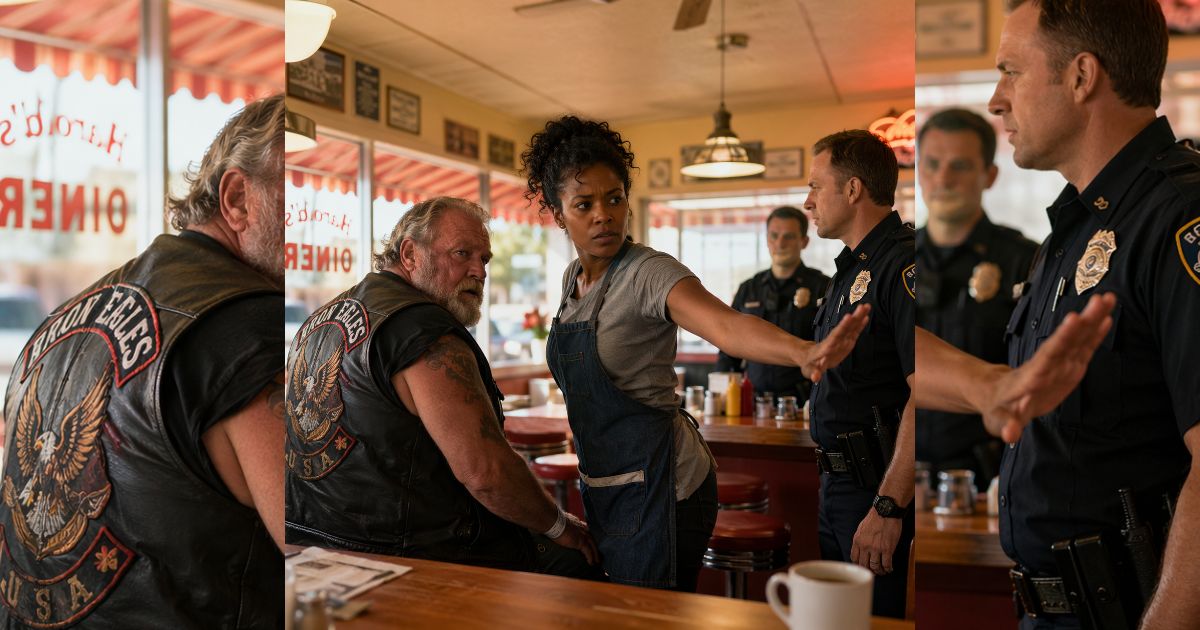
“You really want to lose this whole town over a man in that jacket?”
Officer Dean Harper’s voice cut across Carter’s Diner so hard even the coffee spoons seemed to stop moving.
Naomi Carter did not look at him right away.
She set the plate down first. Two eggs, toast, hash browns, and the last strip of bacon from the warming tray. Then she slid the coffee mug a little closer to the man at the counter, because his hand was shaking and he was trying not to let anyone see it.
Only after that did she turn.
“I’m not losing a town, Dean,” she said. “I’m serving breakfast.”
The diner went still.
Not quiet. Still.
There was a difference, and Naomi knew it.
Quiet was what Carter’s Diner had become over the past year, after the feed mill closed, after the hardware store went dark, after half the storefronts on Main Street got papered over with FOR LEASE signs that turned yellow in the sun.
Still was something else.
Still was fear.
Still was Mrs. Worthington freezing with her crossword pencil in the air.
Still was Joe Larkin lowering his mug so carefully it barely made a sound.
Still was Deputy Laura Miles standing half a step behind Dean like she already knew this was wrong but not enough to stop it.
Still was the man in the black leather vest sitting alone on the end stool, broad shoulders curved inward as if he had spent the last few days trying to take up less space in the world.
Naomi had seen that kind of posture before.
Not in bikers.
In waiting rooms.
In hospital corridors.
In family members who had run out of strong.
Dean gave a short laugh that carried no warmth at all.
“That’s one way to put it,” he said. “Another way would be you’re picking a side.”
Naomi folded her arms over her apron.
“Breakfast isn’t a side.”
A few people shifted in their booths.
Dean’s smile thinned.
The man on the stool kept his eyes on his plate, but Naomi saw his jaw tighten. Saw the red rims around his pale blue eyes. Saw the hospital wristband he had tried to keep hidden under his cuff. Saw the dusty miles baked into his boots and the exhaustion in the set of his mouth.
She had noticed all of it the moment he walked in.
Before Dean. Before the whispers. Before the whole room decided what kind of man he must be.
Naomi knew what that felt like.
Not the leather vest. Not the silver patch stitched over his chest that read HIGHWAY SAINTS RIDING CLUB.
But the being-sized-up part.
The being-decided-for part.
She knew that before a word was spoken, some people made a story about you in their heads and then treated you like their version was the truth.
Dean leaned against the counter like he owned the place.
“Folks in this town don’t want trouble at their breakfast table.”
The biker finally looked up.
His voice, when it came, was low and worn down to the grain.
“I didn’t come in here to bother anybody.”
“That right?”
“Yes, sir,” the man said.
Not mocking. Not sharp.
Just tired.
Dean glanced at the patch on his vest, then back at Naomi.
“You know who you’re feeding?”
Naomi looked right at him.
“A hungry man.”
The silence cracked wider.
Mrs. Worthington’s pencil finally dropped onto her puzzle.
Dean straightened.
“You think that’s all he is?”
Naomi did not answer right away, because if she did, her temper would get ahead of her mouth, and she did not have the money to be reckless.
Not this month.
Not with the electric bill folded in her bag, stamped FINAL NOTICE in angry red.
Not with the pharmacy receipts tucked behind it.
Not with her father in a rehab room across town and her savings leaking out one tiny payment at a time.
Not with Carter’s Diner hanging by a thread so thin she could feel it every time she opened the register drawer and heard more empty air than bills.
But then she looked at the man’s wrist again.
The hospital band.
The tired eyes.
The untouched food that he had been too tense to eat.
And Naomi heard her father’s voice the way she always did when life pressed her into a corner.
If a person walks through that door hungry, you feed them first and ask your fear to wait outside.
Isaiah Carter had said that so many times while she was growing up, it had become part of the walls.
He had said it to travelers.
To preachers.
To mechanics.
To grieving widowers.
To women with crying babies.
To people who could only afford toast and coffee.
To people who could not afford even that.
He had said it until Carter’s Diner became less of a business and more of a witness.
Now he lay in a hospital bed, half his body refusing to cooperate, his speech caught behind damage and effort.
But the lesson still stood.
Naomi lifted her chin.
“I think he sat down, ordered coffee, and minded his own business,” she said. “That’s what I think.”
Dean let out a breath through his nose.
“This town’s already on edge.”
“Then maybe it could use less edge and more eggs.”
Joe Larkin made a sound into his mug that might have been a cough and might have been a laugh he did not want anyone to notice.
Dean heard it too.
That made his face harden.
He moved his attention back to the man on the stool.
“What’s your name?”
“Hank Morrison.”
“What are you doing in Willow Creek?”
“Visiting my daughter at the medical center.”
That landed in the room with more force than shouting would have.
Even Dean paused.
Hank swallowed once before continuing.
“She’s in treatment.”
No one said anything.
Naomi didn’t know who in the diner looked down first, but several people did.
Because illness had a way of leveling a room when pride failed.
Dean recovered before the decency could stick.
“For all I know, that’s a story.”
Naomi’s hand flattened against the counter.
“For all you know,” she said quietly, “it’s the truth.”
Dean turned to her again, and this time there was warning in it.
“You keep putting yourself in the middle of things that aren’t your business.”
“This is my business,” Naomi said. “My diner. My counter. My customer.”
The last word seemed to bother him most.
Customer.
Not suspect. Not outsider. Not problem.
Customer.
Equal.
Dean glanced around the room, probably expecting the town to back him on sight.
Some of them did. Naomi could see it.
A few worried frowns.
A few tight mouths.
A few people already imagining how this would sound by lunchtime.
But no one spoke.
Because everybody in Willow Creek knew Carter’s Diner.
They knew Isaiah.
They knew Naomi had come back from Atlanta six months earlier, packed up her tiny apartment, walked away from a decent hospital job, and returned home when the stroke knocked her father flat and the diner started slipping under.
They knew she worked fourteen-hour days, then sat by her father’s bed at night reading the paper to him because the doctors said familiar voices mattered.
They knew she never let the coffee pot go empty, even on mornings she had tears drying at the corners of her eyes.
They knew all of that.
And knowing that made it harder to shout over her.
Dean seemed to realize it too.
He pointed at Hank’s vest.
“You can wear whatever costume you want,” he said, “but people know what this kind of thing means.”
Hank’s face changed.
Not much.
Just enough for Naomi to see hurt move under discipline.
He looked like a man who had spent years learning how not to answer cruelty with more cruelty.
“My daughter is upstairs fighting for her life,” he said. “I’m trying to eat two eggs before I go back in there.”
That did it.
Naomi took the twenty-dollar bill Hank had laid near his plate and pushed it back toward him.
“Breakfast is on me.”
Hank stared at her.
“You don’t have to do that.”
“I know.”
Dean made a disgusted sound.
“You’re making a mistake.”
Naomi met his eyes.
“Then it’s mine to make.”
For one moment, Dean just stood there, jaw working, all that authority with nowhere clean to go.
Then he looked at Laura.
“Come on.”
Deputy Laura Miles hesitated.
Not long. Barely a heartbeat.
But Naomi saw it.
Saw the apology in her face before Laura lowered her eyes and followed him out.
The bell over the door gave a sad little jingle behind them.
Nobody moved for a second after that.
Then Hank reached for his fork.
His hand shook again.
He tried to hide it.
Naomi pretended not to notice, because dignity was a kind of kindness too.
“You should eat while it’s hot,” she said.
He nodded once.
“Thank you.”
She turned away before the whole room could see her throat tighten.
By ten-thirty, the story had already outrun the truth.
That was Willow Creek for you.
A place where bad news moved faster than rain and good intentions showed up late to their own funeral.
By noon, Naomi had heard three versions without leaving the diner.
In one, she had thrown the officers out.
In another, she had invited a biker gang to take over Main Street.
In a third, she had announced to the whole county that Carter’s Diner was now a hangout for trouble.
Small towns did not need facts to get started.
They just needed a sentence with enough sting in it.
By one o’clock, the lunch rush that wasn’t much of a rush on good days became almost nothing.
Two high school boys came in for fries to split.
A retired mail carrier drank a coffee and kept looking like he wanted to say something kind but was worried somebody might see him do it.
Mrs. Worthington left early without finishing her pie.
Joe Larkin stayed longer than usual, then stood up, put cash on the counter, and said, “You did what you thought was right.”
Naomi looked at him.
“That sound like a compliment?”
He scratched the side of his neck.
“Sounds like trouble, mostly. But it also sounds like your daddy.”
That was the closest thing to support she got all afternoon.
After closing, she counted the register twice because she thought maybe she had done it wrong the first time.
She had not.
The number sat there ugly and small.
Not enough for the electric bill.
Not enough for next week’s supplier order.
Not enough for the rehab co-pay she had to make on Friday.
She lowered herself into a booth and pressed the heels of her hands into her eyes until bright shapes flashed against the dark.
A lot of people thought courage arrived like thunder.
They thought it felt bold.
Clean.
Victorious.
They were wrong.
Sometimes courage felt like sitting alone in a nearly empty diner that still smelled like bacon grease and coffee, wondering if your principles were about to get your father’s lights shut off.
Sometimes courage felt almost exactly like fear, except you stayed anyway.
When she finally got up to lock the front door, she saw the sign taped to the glass.
White poster board.
Red marker.
Crooked letters big enough to read from the parking lot.
IF YOU LOVE OUTSIDERS SO MUCH, LET THEM FEED YOU.
Naomi stared at it.
Not because it was clever.
It wasn’t.
But because somebody had taken the time.
Somebody had stood outside the diner her father built with his bare hands, pressed tape to the glass, and tried to turn kindness into shame.
She ripped it down so hard the tape snapped.
Then she crumpled it in both fists and stood there breathing through her nose until her hands stopped shaking.
“Not tonight,” she whispered to the empty room.
But fear didn’t leave because you told it to.
It just got quieter and followed you home.
Willow Creek Medical smelled like antiseptic, microwaved soup, and tired hope.
Naomi had worked in hospitals long enough to know every building had its own version of that smell.
This one carried an extra note of old floor wax and pine cleaner.
She walked the familiar hallway toward Room 214 with her purse on one shoulder and the paper bag of sugar-free pudding balanced against her hip. Her father didn’t always want it. Some nights he ate half. Some nights he only took two bites.
Some nights he turned his face away and shut the whole world out.
Stroke recovery was not a staircase.
It was a room full of locked doors.
Isaiah Carter lay propped slightly on one side when she entered, the television murmuring low in the corner. He had always been a large man. Not tall enough to be imposing, but solid enough to feel like shelter when Naomi was little.
The stroke had made him look narrowed.
As if the strongest parts of him had been folded inward.
Still, when she came to the bedside, his eyes found her right away.
That mattered.
“Hey, Daddy.”
She kissed his forehead, then set the pudding on the tray table.
“I brought the good kind tonight. Which means hospital good. So don’t get too excited.”
One corner of his mouth moved.
Not a full smile.
But enough.
Naomi pulled the chair close and sat.
She took his hand carefully, mindful of the stiffness that still came and went.
“It was rough today.”
His fingers twitched once inside hers.
“That’s putting it polite.”
She exhaled and leaned back.
“There was a man in the diner this morning. Older biker. Looked like he had slept in his truck and forgotten how. Everybody saw the vest before they saw anything else. Dean Harper came in with Laura and decided breakfast needed a public trial.”
Her father’s eyes sharpened.
Even now, laid flat by a body that wouldn’t obey him, he could still listen with his whole face.
Naomi smiled sadly.
“Yeah. I know. You can already tell where this is going.”
She looked down at their joined hands.
“He had a hospital band on. Said his daughter’s upstairs in treatment.” Her voice softened. “He sounded like somebody holding on with both hands.”
A slow blink.
Isaiah’s way, lately, of telling her he understood.
“I stood up for him.”
This time her father’s fingers squeezed. Faint. Brief.
But real.
Naomi swallowed against the sudden ache in her throat.
“Everybody’s mad,” she said. “Or disappointed. Or suspicious. Or all three. Business dropped off by lunch. Somebody left a sign on the door.”
His brow creased.
She laughed once, with no humor in it.
“Exactly. Childish.”
She leaned forward.
“But here’s the thing. I knew what they wanted me to do. They wanted me to step back. Smile politely. Let Dean do his little performance so nobody would think I was siding with the wrong person.”
She shook her head.
“And I just couldn’t.”
Her father’s eyes filled then.
Not with tears exactly.
With something older.
Pride, maybe. Pain. Recognition.
Naomi looked away for a second because if she stared too hard she would cry, and she was tired of crying where machines could witness it.
“You’re the one who did that to me,” she whispered. “You and your rules.”
She counted them off with her free hand.
“Feed people while the food is hot. Don’t let the coffee burn. Never humiliate anybody in public. And judge by what they do, not what they wear.”
His thumb moved against her skin.
One small drag.
Naomi closed her eyes.
“It’s expensive being your daughter.”
The sound that came out of him was not a word.
More of a breath with meaning in it.
But she knew it anyway.
Sorry.
And because she knew him, she also knew the rest.
Still right.
She stayed an hour.
Read him the local paper.
Skipped the gossip column.
Told him Malik Reed still had the same crooked grin he wore at sixteen.
Told him Mrs. Worthington was back to doing the Sunday crossword in pen because apparently she had decided she earned the right.
Told him the azaleas outside the front window had finally quit trying to impress anybody and just bloomed.
Then, when visiting hours nudged toward ending, she stood and touched the blanket near his arm.
“I’ve got the diner,” she said. “Even if the diner doesn’t seem too sure about me.”
His eyes held hers.
And that time, slowly, carefully, painfully, he made the shape of a word.
Proud.
It came out in pieces.
Barely sound.
Mostly effort.
Naomi put both hands over her mouth and cried anyway.
The next morning was worse.
Not dramatic.
Worse.
No shouting.
No confrontation.
Just absence.
The breakfast regulars did not show.
Not the retired brothers who split an omelet and argued about baseball from opposite sides of the same booth.
Not Mrs. Worthington.
Not Joe Larkin.
Not the county road crew.
Not even the church secretary who always picked up biscuits for the office on Thursdays.
Naomi turned on the OPEN sign at six and by nine had served exactly three people.
A salesman from Macon who had never been there before.
A nurse from the medical center still in scrubs.
And a teenage boy with earbuds who asked for pancakes to go and never looked up from his phone.
At ten-thirty the coffee was old, the grill was too clean, and the silence had started sounding personal.
At eleven, the produce supplier called.
Naomi braced herself before answering.
“Morning, Eddie.”
There was a pause.
Then a careful voice.
“Naomi, I just wanted to check on this week’s order.”
Her grip tightened on the phone.
“That bad already?”
Another pause.
“You know how folks talk.”
“I do.”
“You still need the usual?”
Naomi stared out the window at a Main Street so empty it looked staged.
The right answer was yes.
The true answer was she did not know if she could move enough food to justify the invoice.
“If I’m being honest,” she said, “I should probably cut it down.”
Eddie sighed softly.
“That’s what I figured.”
Naomi swallowed.
“Can I call you back by noon?”
“Sure.”
When she hung up, she stood very still behind the counter.
This was how things died sometimes.
Not all at once.
Not with fire.
With reductions.
With smaller orders.
With fewer pies.
With booths staying empty long enough for the vinyl to cool.
With a daughter making practical decisions until one day the place her father built no longer had enough shape left to be called the same thing.
The bell over the door jingled.
Naomi almost didn’t turn.
She expected another stranger.
Maybe someone wanting directions.
Instead, an older couple stepped inside together.
The man was tall and weathered, all lean angles and patient eyes. His denim shirt was neatly buttoned. Over it he wore a black vest with a small winged-road emblem stitched above the pocket.
The woman beside him had silver hair in one thick braid over her shoulder and the kind of calm face that made people tell her the truth even when they hadn’t meant to.
She wore the same emblem.
No swagger.
No performance.
Just the same club as Hank.
Naomi felt her spine go careful.
The woman smiled first.
“Naomi Carter?”
“That’s me.”
“I’m Linda Morrison,” she said. “This is Roy. Hank’s older brother.”
Roy tipped his head.
“Ma’am.”
Naomi stepped out from behind the counter before she even realized she was doing it.
“How is he? How’s his daughter?”
The softness in Linda’s face changed.
Not vanished. Changed.
The way kindness does when grief lives under it.
“Still in treatment,” she said. “Rough morning, from what he told us. But he wanted us to come by.”
Naomi glanced between them.
“I’m sorry. Did he forget something?”
Roy let out the faintest huff of amusement.
“No. Hank doesn’t forget much. Especially not people.”
Linda rested her fingertips on the counter.
“He told us what happened yesterday. Said you were the only person in town who looked at him and saw a father instead of a problem.”
Naomi dropped her eyes for half a second.
“It wasn’t that big a thing.”
Roy and Linda exchanged a look that said they had lived long enough to know exactly how false that sentence was.
Roy said, “Sometimes the biggest things look small from the outside.”
Naomi motioned toward the stools.
“Can I get you coffee?”
“We’d like that,” Linda said.
Naomi poured two fresh mugs.
As she set them down, Roy looked around the empty room, and his eyes missed nothing.
He saw the cold pie case.
The clean grill.
The untouched stack of menus.
The too-neat dining room of a place that should have been busier by then.
He did not comment on it.
That made Naomi like him immediately.
Linda wrapped both hands around her mug.
“Hank said your daddy built this place.”
“He did.”
“Still around?”
“In rehab across town.” Naomi tried a smile. “Bossing people from bed with his eyebrows.”
Linda laughed softly.
“Then he and my mother would’ve gotten along.”
For a moment, they just drank.
The kind of quiet that settled between them did not feel awkward. It felt earned.
Then Roy reached into his vest pocket and laid an envelope on the counter.
Naomi stared at it.
“What’s that?”
“Something to hold you through the week.”
She did not touch it.
“I can’t take money.”
Roy shook his head.
“It isn’t charity.”
Linda added, “It’s trust. Hank asked us to make sure you had room to breathe.”
Naomi pushed the envelope back toward him.
“I appreciate that, I do, but I don’t know you.”
Roy smiled a little.
“That’s fair.”
Then he slid the envelope into his shirt pocket again without argument.
No wounded pride. No insistence.
Just respect.
Naomi noticed that too.
Linda glanced toward the front windows.
“How many people you got helping in the kitchen today?”
Naomi frowned.
“Just me and Marisol after noon. Why?”
Linda smiled over her coffee.
“You might want to start calling in favors.”
Naomi blinked.
“What kind of favors?”
Roy checked his watch.
“The kind that show up loud.”
At first Naomi thought it was thunder.
Low and distant.
A gathering roll somewhere beyond the feed store and the old tire shop.
Then the sound built.
Layered.
Many engines, not weather.
She stepped toward the window before her mind caught up.
From both ends of Main Street, motorcycles came into view.
Not two.
Not ten.
Dozens.
Chrome flashing in the midday light. Windshields glinting. Helmets, denim, leather, boots.
Men and women.
Gray-bearded riders and younger ones.
A woman with white hair tucked under a navy bandana.
A huge man with glasses and a careful posture.
A rider with one arm in a sling, riding pillion behind someone else, laughing at something Naomi couldn’t hear through the glass.
They turned off the road in patient rows, engines rumbling deep enough to shake the front windows, and lined both sides of Carter’s Diner without blocking traffic or crowding the sidewalk.
They parked with astonishing order.
One after another.
No revving for show.
No yelling.
No chaos.
Just presence.
Naomi’s mouth fell open.
“Oh my Lord.”
Linda’s smile widened.
“Hank made a few calls from the hospital.”
“A few?”
Roy stood and looked out with her.
“I’d say this is what affection looks like in our world.”
The first rider through the door was an older woman with deep laugh lines and a small bouquet of grocery-store carnations tied with curling ribbon. She wore a faded vest and orthopedic sneakers.
She walked straight up to Naomi and held out the flowers.
“Heard you fed one of ours when he looked like the world had forgotten him,” she said. “Thought we’d return the favor and remember you.”
Naomi took the bouquet with both hands.
“Thank you.”
Then came a man in his twenties with a sunburned nose and a baby photo tucked into his clear phone case.
Then a couple from Columbus.
Then two riders from Savannah.
Then three from Alabama who said they had been nearby for a memorial ride and rerouted after hearing Hank’s story.
More and more filled the doorway.
Every one of them polite.
Every one of them paying.
Every one of them asking what the house special was.
Within fifteen minutes, every booth was full.
Within thirty, there were people standing along the wall waiting for to-go plates.
Within forty-five, Naomi was on the phone with Marisol so fast she forgot to breathe between sentences.
“I need you to come in now. And call your cousin if she can carry plates. And if your brother’s free, tell him I’ll pay him cash to bus tables. No, I’m not kidding. No, don’t laugh. Marisol, I have maybe sixty bikers in here.”
She listened.
Then corrected herself as she looked around.
“Eighty. Maybe more.”
Roy was already helping move boxes when the first emergency supply truck pulled up.
Naomi nearly dropped a stack of plates.
“Wait. What is that?”
Linda, who was tying her braid back with a rubber band like she planned to work, said, “Food.”
“From where?”
“From your suppliers.”
Naomi turned so fast she almost lost her footing.
“I didn’t order that.”
Roy opened the back door as two delivery men started unloading crates.
“Linda called around last night. We covered the first round.”
Naomi stared at him.
“You what?”
Linda came over and touched Naomi’s arm.
“Breathe first. Then argue.”
Naomi tried.
It did not work particularly well.
“You can’t just—”
“We can,” Roy said gently. “And before you worry, nobody’s trying to buy your place.”
“That’s exactly what I’m worrying.”
Linda nodded.
“I know. Which is why this matters. We’re not here to take anything from you. We’re here because Hank said a woman in a coffee-stained apron gave him one decent moment in a terrible day and reminded him there are still places in this country where a person can sit down and be treated like a human being.”
Naomi looked at the crates.
Eggs.
Bread.
Potatoes.
Coffee.
Lettuce.
Tomatoes.
Bacon.
Enough to keep the grill moving through the evening.
Her eyes stung.
“I don’t know how to thank you.”
Linda smiled.
“Feed people. You seem good at that.”
So Naomi did.
She tied her apron tighter, pulled her curls back, and went to work.
The next three hours moved like a living thing.
Orders flew.
Coffee poured.
The grill hissed and spat and filled the diner with the smells she had grown up inside.
Bacon.
Onions.
Toasted buns.
Butter hitting hot bread.
Fresh pie crust warming near the pass-through.
Marisol arrived breathless, then stopped dead in the middle of the room.
“Naomi.”
“I know.”
“You got a parade in here.”
“I know.”
Marisol took one quick look around, rolled up her sleeves, and shouted, “Who ordered six cheeseburgers and three grilled cheese?”
A cheer went up from the back booth.
The whole diner laughed.
And that, more than anything, broke the tension.
It turned something strange into something shared.
Outside, townspeople gathered along the sidewalks.
At first they only watched.
From across the street.
From parked trucks.
From the doorway of the pharmacy.
From porch steps.
The word had spread again, but this time it moved with curiosity.
Carter’s Diner had been nearly empty that morning.
Now motorcycles lined Main Street like silver beads on black string, and every few minutes another rider walked in holding flowers or a card or cash or nothing at all except an appetite and gratitude.
Naomi saw Mrs. Worthington first.
She was standing under the awning of the closed dress shop, one hand on her purse strap, lips pressed tight in thought.
Naomi could almost see the battle happening in her.
Pride versus interest.
Judgment versus manners.
Then Malik Reed came striding across the street in grease-stained coveralls from his garage, glanced once at the bikes, and pushed right through the door.
“You still got biscuits?”
Naomi laughed before she meant to.
“Somehow, yes.”
“Then I’m staying.”
He slid into an open seat across from a broad-shouldered woman with a shaved sidecut and kind eyes. She moved her basket of fries to make room and introduced herself before he’d even gotten settled.
Two minutes later they were arguing cheerfully about college football.
After Malik came Joe Larkin.
Then the retired mail carrier.
Then one of the church ladies.
Then, very carefully, as if crossing a line painted only in her own head, Mrs. Worthington herself.
The room quieted just a little when she entered.
She ignored it.
Naomi did not know whether to be amused or touched when Mrs. Worthington walked directly up to the counter, set down a glass pie dish still warm through the towel wrapped around it, and said, “Peach. I had already baked it. It seemed wasteful not to bring it.”
Naomi bit back a smile.
“That was thoughtful.”
Mrs. Worthington lifted her chin.
“It was practical.”
Then she leaned closer and lowered her voice.
“And the gentleman near the window asked very nicely whether I would consider teaching him how to make proper cobbler, so apparently I’m in demand.”
Naomi looked toward the window.
An older rider with a snowy beard gave a small wave and an embarrassed smile.
Naomi looked back at Mrs. Worthington.
“Seems you are.”
Mrs. Worthington straightened.
“Well. Don’t let it go to my head.”
By midafternoon, Carter’s Diner no longer felt split between locals and outsiders.
It felt like a room of people who had all walked in carrying assumptions and were slowly setting them down beside their plates.
One rider showed pictures of his grandsons.
A woman in a vest with a tiny enamel angel pin told Marisol about caring for her husband through heart surgery.
A man from Birmingham admitted he had not eaten pie this good since his grandmother died.
Two teenagers asked for pictures sitting on parked motorcycles only after the riders insisted on wiping the seats down first.
Nobody postured.
Nobody bragged.
Nobody demanded to be feared.
They just showed up.
And the town, faced with the stubborn ordinariness of their humanity, began to soften in spite of itself.
Around four, Deputy Laura Miles slipped in quietly out of uniform.
Jeans. Plain blue blouse. Hair down.
Naomi almost did not recognize her at first.
Laura took the last stool at the counter and wrapped both hands around the menu without reading it.
“What can I get you?” Naomi asked.
Laura looked up.
“Coffee, if that’s okay.”
Naomi poured it.
Laura watched the dark stream fill the mug.
Then she said, “I’m sorry.”
Naomi held the pot in midair a beat too long before setting it down.
“For what part?”
Laura gave a tight, unhappy smile.
“That I stood there yesterday and let Dean make a man’s worst day worse.”
Naomi said nothing.
Laura nodded once, like she had expected that.
“My dad looked like that when my sister was in treatment,” she went on softly. “Same eyes. Same shaking hands. Same trying-not-to-fall-apart in public.”
Naomi’s expression shifted.
“Then why didn’t you say something?”
Laura stared into the coffee.
“Because Dean’s been riding fear hard ever since the layoffs started. He thinks if he keeps control of every little thing, the town won’t notice how much is slipping. And I—” She exhaled. “I got used to stepping around him.”
Naomi leaned one hip against the counter.
“That’s not a good habit.”
“I know.”
Laura looked up then, and there was no defensiveness left in her face.
“I just wanted you to know that what you did yesterday? Not everybody in town thinks it was wrong.”
Something in Naomi loosened.
Not all the way.
But enough.
“You want pie with that apology?”
Laura blinked.
“Am I earning pie?”
“No. But I’ve got extra peach now.”
For the first time, Laura laughed.
And that small laugh, in that packed diner, with engines cooling outside and Main Street watching itself become a little more honest, felt like a hinge turning.
Near five o’clock the bell over the door rang again.
This time the room quieted on its own.
Not because people were afraid.
Because respect arrived with him.
The man who stepped inside looked to be in his sixties, built like an old oak, white beard trimmed close, reading glasses hanging from the front of his shirt beneath a black vest. He carried himself with the calm of someone who had spent a long time learning where his strength was useful and where it was not.
The winged-road emblem on his vest was larger than the others.
Below it, stitched in clean block letters, were the words:
MARCUS TURNER
STATE RIDE COORDINATOR
He removed his cap before taking another step inside.
Naomi noticed that.
A lot of men did not know how much a small gesture could reveal.
He did.
“You must be Miss Carter.”
Naomi wiped her hands on her apron and came around the counter.
“Naomi’s fine.”
Marcus took her hand in both of his and shook it gently, as though it mattered to him not to overwhelm.
“Hank told me you’ve got steel in your backbone and grace in your hands.”
Naomi blinked.
“That sounds nicer than I usually look by five in the afternoon.”
Marcus smiled.
“Most people worth admiring are tired when you meet them.”
A few heads in the diner bobbed at that.
Marcus turned, took in the room, and lifted one hand.
The conversations faded.
Not snapped off.
Settled.
Like everybody understood this was a moment they would remember later.
Marcus looked at the riders first.
Then at the townspeople.
Then at Naomi.
“I’m not much for speeches,” he said.
That got a laugh, because clearly some people knew better.
He smiled and went on.
“But every now and then, a story deserves to be spoken aloud while the people in it are still standing there to hear it.”
He gestured toward Naomi.
“Yesterday, one of ours walked into this diner carrying the kind of fear that empties a person out from the inside. He was worried about his daughter. He was tired. He was trying to keep himself together. And instead of giving him one quiet meal, the world decided to remind him what it thought it saw when it looked at his vest.”
The room stayed silent.
Marcus nodded slowly.
“A woman behind this counter chose not to join in.”
He did not raise his voice.
He did not need to.
“She chose decency in public. That’s rarer than people admit.”
Naomi felt heat climb her face.
She wanted very badly to disappear into the pie case.
Marcus went on.
“This riding club was built by people who know something about being misread. Veterans. Mechanics. Grandmothers. Nurses. Retired teachers. Single dads. Former truckers. Caregivers. Folks who found each other on long roads and decided to keep each other company.”
Several riders smiled down at their plates.
“We are not perfect people,” Marcus said. “Nobody in this room is. But we know gratitude when we see it earned.”
He turned toward Naomi again.
“So I want to say this where your whole town can hear it.”
He took a folded paper from his back pocket and opened it.
Not dramatically.
Just carefully.
“We hold an annual charity ride every fall for families carrying medical burdens they never asked for. Lodging, gas cards, meal support, the little ugly expenses that pile up when somebody you love gets sick.”
Naomi stared at him.
The whole diner did.
Marcus smiled.
“This year, the ride ends here.”
The room burst.
Not with shouting first.
With surprise.
Then came the applause.
Real applause.
Tables thumping. Boots stomping. Local hands and rider hands making the same sound together.
Naomi looked like she had forgotten how to stand.
Marcus waited for the room to settle.
Then he added, “Every chapter in the state will stop at Carter’s Diner. We’ll pay for our meals. We’ll tip hard. And every rider who signs in will put something in the family relief fund jar by the register.”
He held up the paper.
“And if Miss Carter agrees, the first fund beneficiary this year will be the patient wing upstairs at Willow Creek Medical.”
There were people in the room blinking hard now.
Naomi included.
Marcus folded the paper again.
“You showed one father mercy,” he said softly. “We’d like to turn it into momentum.”
Naomi put her hand over her mouth.
Marisol was openly crying by the pie case.
Mrs. Worthington had taken her glasses off and was cleaning them with a napkin even though they were not dirty.
Laura Miles looked down at the counter and shook her head like she was ashamed of how wrong she had helped the town be.
Naomi found her voice on the second try.
“I don’t know what to say.”
Marcus’s smile gentled.
“Say yes if it sits right in your spirit.”
Naomi laughed through the tears building in her eyes.
“Yes.”
The room cheered louder than before.
Marcus nodded once as if something had just been made official in more than paperwork.
Then he stepped aside.
And standing in the doorway behind him was Hank.
Naomi had not heard the bell.
Maybe because the whole diner had been listening too hard.
He looked a little steadier than the day before and a little more broken too, which Naomi would not have thought possible until she saw it.
That was what hope did sometimes.
It gave pain a place to sit beside relief.
He had a small paper sack in one hand.
His vest was dusty again.
His hospital band was still on.
When Naomi saw him, her eyes filled immediately.
Hank gave the room a crooked half smile.
“Hope y’all don’t mind. I came hungry this time.”
The whole diner laughed, and just like that the emotion in the room tipped into warmth.
Naomi came around the counter.
“I can manage that.”
They met halfway between the stools and the front door.
For a second neither of them seemed sure what came next.
Then Hank looked around the diner, at the riders, at the locals, at the flowers now tucked into syrup bottles on the tables, at the overfull tip jar, at the line still waiting for takeout.
He shook his head slowly.
“You didn’t have to do all this,” Naomi whispered.
Hank’s face changed.
Deepened.
“I didn’t,” he said. “You did.”
He lifted the little paper bag.
“My daughter sent this.”
Naomi took it carefully and opened the fold.
Inside was a drawing done in colored pencil.
Not fancy. Not careful.
Hospital-bed art.
A diner with a bright red sign.
A woman with curls behind a counter.
A man in a black vest sitting with a coffee mug.
Across the top, in shaky handwriting:
THANK YOU FOR FEEDING MY DAD
Naomi stopped breathing for a second.
“She made that this afternoon,” Hank said, voice thick. “I told her about you.”
Naomi looked up.
“How is she?”
He swallowed.
“They think the new treatment might be doing something. Too early to promise. But for the first time in a while, they used the word encouraging.”
The diner, already full of feeling, somehow made room for one more wave.
Naomi stepped forward and hugged him.
Not delicately.
Not halfway.
The kind of hug that comes from relief with no plan.
Hank froze for the briefest instant, then hugged her back with one arm and closed his eyes.
When they let go, both of them were embarrassed enough to smile.
Marisol wiped her face with a dish towel and yelled toward the kitchen, “Somebody plate the man a double burger before I start crying into the onions again.”
That made the whole room laugh harder than the joke deserved, which was exactly what everybody needed.
The rest of the evening spilled outward.
A portable speaker appeared somewhere near the curb and played old soul songs, classic country, and the kind of rock everybody knew the chorus to whether they admitted it or not.
Children from the neighborhood wove up and down the sidewalk on scooters and bicycles, getting stern but affectionate reminders from riders to watch for kickstands.
The medical center’s evening nurse supervisor came by in scrubs to pick up two slices of pie and ended up staying an hour.
A retired shop teacher fixed a loose hinge on the diner’s screen door while waiting for his meatloaf special.
Somebody started a list on a legal pad near the register of volunteer drivers willing to take families to medical appointments when gas money ran short.
Nobody had told them to do that.
The idea just rose out of the room like bread.
By sunset, Main Street did not look like the same place.
Not because the buildings had changed.
Because the people inside them had.
Right around dusk, a van from the rehab center pulled into the lot.
Naomi was on the front steps when she saw it.
Her heart leaped so hard she had to grip the railing.
Marisol came out behind her carrying a tray of sweet tea.
“What?”
Naomi pointed.
The van door opened.
An orderly stepped out first.
Then another.
Then, very carefully, they lowered a wheelchair to the pavement.
Isaiah Carter sat in it.
Blanket over his knees.
Light jacket on despite the warmth.
Face thinner than she remembered from before the stroke.
Eyes sharp as ever.
Naomi covered her mouth.
“I didn’t know they were bringing him.”
Roy, standing a few feet away with Linda, smiled.
“We asked if he was up for a supervised visit. The therapist said if we could guarantee pie, the answer improved considerably.”
Naomi laughed and cried at the same time.
Then she was moving.
Down the steps.
Across the sidewalk.
Kneeling in front of her father’s chair.
“Daddy.”
His good hand lifted slowly.
Touched her cheek.
Inside, people had started noticing.
The sound on the sidewalk changed.
One by one, conversations fell away.
Riders turned.
Locals straightened.
The whole street seemed to recognize instinctively that something sacred was happening and got out of its way.
Naomi put her forehead against her father’s hand.
“I’m sorry,” she whispered. “I would’ve cleaned up if I knew you were coming.”
A breath of a laugh moved through him.
Then his gaze shifted past her shoulder toward the diner.
Toward the packed windows.
Toward the people spilling onto the sidewalk.
Toward the motorcycles lined in neat rows.
Toward the open door and the hand-painted sign above it that still said CARTER’S DINER, same as it had for decades.
His eyes filled.
Naomi turned so he could see better.
“This is yours,” she said softly. “Still yours.”
Isaiah looked at the riders. Looked at the townspeople. Looked at Hank standing near the steps with his hospital band and tired smile.
Then he looked back at Naomi.
With painful slowness, he drew in a breath and shaped two words.
Full.
Home.
Naomi broke.
Not loudly.
But completely.
She buried her face in his shoulder and sobbed into the cotton of his jacket while he held on as best he could with one good arm and a thousand unsaid things.
And because human beings are built to answer tenderness with tenderness if you give them half a chance, more than one person on that sidewalk cried with her.
Mrs. Worthington openly did.
She made no effort to hide it.
Joe Larkin looked furious at his own eyes.
Laura Miles stood with both hands over her mouth.
Marcus Turner removed his glasses and pretended to polish them.
Hank looked away toward the street, blinking hard, then reached into his pocket and pressed Naomi’s daughter’s drawing a little flatter so it would not crease.
Later, once Isaiah had been wheeled inside and settled at the end booth where he used to hold court on Saturdays, Naomi moved like she was working inside a dream.
She brought him mashed potatoes thinned with gravy the way speech therapy recommended.
Hank sat nearby for a while and told him, in a low respectful voice, that his daughter Ellie wanted to meet the woman who made the best eggs in Georgia.
Isaiah listened, eyes moving from Hank to Naomi and back again.
At one point he squeezed Hank’s hand.
It startled them both.
But not as much as what came next.
Isaiah looked at Hank’s vest.
Then at Naomi.
Then, with effort, made a tiny circling motion in the air.
Naomi frowned.
“Him?”
A blink.
“Yes.”
“You’re asking if he can come back?”
Another blink.
Hank laughed softly and wiped at his eyes with the heel of his hand.
“I’ll take that as an invitation.”
By the time the last bikes rumbled out, night had folded over Willow Creek.
The street smelled faintly of hot engines, sugar, coffee, and summer dust.
Inside the diner, plates were stacked everywhere, chairs were being turned upside down onto tables, and Marisol was threatening to quit if Naomi ever turned a Thursday into a miracle again without warning.
Naomi laughed too hard to answer.
Roy and Linda waited until the room had thinned.
Then Roy set a long narrow box on the counter.
Naomi eyed it warily.
“If that’s money again, we’re fighting.”
Linda smiled.
“It isn’t.”
Naomi lifted the lid.
Inside was a black denim vest, softer than it looked, with a simple patch stitched over the back in cream and gold thread.
CARTER’S DINER
HONORED STOP
HIGHWAY SAINTS HOPE RIDE
Below it, smaller:
ALL ARE WELCOME
Naomi stared at it so long Linda finally reached over and touched the edge.
“We had it made this evening at a shop in Macon,” she said. “One of our people drove out and begged a favor.”
Roy added, “Not so folks will think you belong to us. So folks will know we belong with you.”
That nearly undid Naomi all over again.
Tucked in the vest pocket was a folded note.
Hank’s handwriting was heavy and uneven, like a man writing while standing up.
Thank you for seeing the father before the vest. Ellie smiled today. I haven’t had many reasons to believe in strangers lately. Now I do.
Naomi held the note against her chest.
“I don’t know what I did to deserve today.”
Linda’s face softened.
“You opened a door and didn’t let fear decide who got fed.”
Naomi looked toward the booth where her father sat half-asleep in borrowed happiness, the empty pudding cup from rehab still on the table beside the remains of a slice of peach pie.
Maybe deserving had nothing to do with it.
Maybe goodness just worked like that.
Passed hand to hand until it looked bigger than where it started.
When the last of the riders left and the last of the locals drifted home carrying leftovers and new opinions, Carter’s Diner grew still again.
But not the same still as yesterday.
This still was full.
The next morning, Naomi found a line outside before she had even unlocked the door.
Not a mob.
A line.
Truckers.
Nurses.
Two women from the church.
Malik.
Joe Larkin with his grandson.
Mrs. Worthington, pretending she just happened to be passing by at seven-fifteen with a casserole dish.
And behind them, parked along the curb, three motorcycles.
Then five.
Then seven.
Word had spread farther than Willow Creek.
Not the ugly version this time.
The true one, or something close enough to it that the truth could breathe.
By ten, the family relief jar Marcus had mentioned sat by the register with twenty-dollar bills folded beside handwritten notes.
For gas.
For motel nights.
For cafeteria food.
For whoever needs a little less worry this week.
No one told the town to do that.
They just did.
Dean Harper came in around noon.
The whole diner noticed.
He stood just inside the door for a moment, hat in hand, face set in that stubborn expression men get when they have practiced not looking ashamed and failed.
Naomi was refilling ketchup bottles.
She did not rush to him.
“Coffee?” she asked, same as if he were anybody else.
Dean nodded.
“Yes, ma’am.”
That caught a few eyebrows in the room.
Naomi poured the cup and slid it across.
Dean wrapped his hands around it like he needed something warm to hold while he thought.
He looked tired.
Smaller, somehow.
Town authority could shrink fast when it ran headfirst into public decency.
After a long minute, he said, “I was wrong yesterday.”
The room went so quiet Naomi could hear the hum of the pie fridge.
She kept her expression even.
“About what part?”
Dean exhaled.
“About the man. About you. About what I thought I was protecting.”
No one moved.
Dean looked around the diner then, at the mix of faces, the riders beside locals, the relief jar by the register, Isaiah Carter visible through the back doorway where he was doing hand exercises with a therapist at a corner table.
Finally Dean looked back at Naomi.
“I let my fear turn into arrogance,” he said. “And I used my badge to dress it up nicer than it was.”
Laura, seated in a booth with a grilled cheese, lowered her eyes.
Naomi studied Dean for a long moment.
An apology did not erase everything.
But it mattered when it was real.
She nodded toward the coffee.
“Drink it while it’s hot.”
It was not forgiveness exactly.
But it was a seat at the table.
And in Carter’s Diner, that meant something.
The days that followed developed a rhythm Naomi had almost forgotten was possible.
Busy, yes.
But not frantic.
Alive.
The Hope Ride announcement spread across counties.
Local papers picked it up with headlines about community and care and a diner at the center of both.
Naomi insisted on keeping things simple.
No souvenirs with her face on them.
No attention she had not earned.
Just food.
Strong coffee.
Open doors.
The jar by the register filled and emptied and filled again as money got routed through the hospital social worker’s office to families who needed help with all the small expenses illness dragged in behind it.
Laura came by on her days off and sometimes helped bus tables if things got wild.
Malik repaired the diner’s old neon sign for half his normal rate and acted offended when Naomi tried to pay more.
Mrs. Worthington began bringing one pie every Sunday “strictly because the peach sales numbers justify continuation.”
Joe Larkin’s grandson developed a deep admiration for motorcycles and an even deeper admiration for mashed potatoes.
Roy and Linda stopped in every week they were nearby.
Always courteous.
Always hungry.
Always asking after Isaiah first.
And Hank came whenever he could leave the hospital.
Sometimes only for fifteen minutes.
Sometimes long enough to eat.
Sometimes just long enough to stand at the counter with both hands around a mug and breathe like he had found a place where his shoulders were allowed to come down.
He never asked for free food again.
Naomi never charged him for coffee.
They settled into that argument without speaking it.
One Tuesday evening, about three weeks after the first showdown, Naomi walked into Ellie Morrison’s hospital room carrying a small container of banana pudding and feeling inexplicably nervous.
Hank stood when she came in.
“You made it.”
“I said I would.”
Ellie was nineteen and all eyes.
Big, bright, tired eyes in a face made delicate by treatment. Her hair had thinned, but she wore a headscarf patterned with tiny yellow flowers and held herself with a kind of dry wit that made the whole room feel less tragic than it had any right to.
“So,” Ellie said, “you’re the diner lady.”
Naomi laughed.
“I was hoping for something a little grander.”
Ellie shook her head.
“Nope. Diner lady feels correct. Dad says you saved him from eating vending-machine crackers for dinner.”
“I object,” Hank said. “I had beef jerky.”
Ellie looked at Naomi.
“This is how he flirts with health. By almost trying.”
Naomi laughed harder.
And just like that, the room changed.
Not into something carefree.
Into something human.
That mattered more.
Naomi set the pudding down.
“Your father also forgot to mention you draw.”
Ellie brightened.
“You liked my picture?”
“It’s hanging by the register.”
Ellie’s face went still in the sweetest way.
“Really?”
“Right next to a newspaper clipping about the Hope Ride and a photo of my dad opening the diner in 1987.”
Ellie turned to Hank as if to make sure this was not one more adult kindness padded for comfort.
Hank nodded.
“She means it.”
Ellie looked back at Naomi, eyes shining.
“I’ve never had something in a restaurant before.”
“You do now.”
They talked for an hour.
About diner food.
About small towns.
About bad hospital coffee.
About Isaiah and the way he had once banned anybody from bringing kale into his kitchen because “leaves belong outside unless a sandwich specifically requests otherwise.”
Ellie laughed so hard she had to stop and catch her breath.
Naomi saw then what Hank had seen all along.
Not a patient.
A young woman with life still reaching for her in all directions.
As Naomi got up to leave, Ellie said, “Can I tell you something?”
“Of course.”
Ellie twisted the edge of her blanket.
“When Dad came back after meeting you, he looked different.”
Naomi glanced at Hank, who had gone very still.
Ellie continued.
“Not happier exactly. Just less alone. Like somebody had finally said, ‘You can sit down. You don’t have to hold all of this standing up.’”
Naomi felt tears prick behind her eyes.
Ellie smiled.
“That’s a big thing to do for a person.”
Naomi reached out and squeezed her hand.
“So is making him laugh when he looks like he forgot how.”
When she stepped into the hallway, Hank followed.
For a moment they just stood there under the fluorescent lights while nurses passed and carts rolled and life in all its tired machinery kept moving around them.
Then Hank said, “I’m not good at owing people.”
Naomi leaned against the wall.
“Then stop thinking of it that way.”
He looked at her.
“It’s hard not to.”
Naomi nodded slowly.
“I know.”
Then she told him something she had not told many people.
“When my mom died, I was twelve. My dad didn’t know how to be soft in public after that. He loved hard, worked hard, provided hard. But soft? That was private. And one day, a waitress at a diner off I-75 sat a piece of pie in front of him and said, ‘You don’t have to talk. Just eat.’”
Hank listened without interrupting.
Naomi smiled faintly.
“He cried over pie in a booth and never forgot her. Sometimes I think Carter’s exists because a stranger gave my father permission to be human when he needed it.”
Hank swallowed.
“That sounds about right.”
They stood there in the hospital hall with all that truth between them.
Not romantic.
Not flashy.
Just clean.
The kind of connection adulthood rarely promised and almost never staged.
The first Hope Ride happened on a Saturday in October.
By sunrise, Main Street was full.
Not packed in a reckless way.
Organized.
Volunteers in reflective vests directed parking.
The high school band played two songs and one of them, according to half the town, was too loud and according to the other half not nearly loud enough.
The church ladies set up folding tables with sheet cake and iced tea.
Laura Miles coordinated a toy drive box for the pediatric wing.
Malik fixed a loose chain on a rider’s bike in under six minutes and acted smug about it for the next hour.
Marcus Turner arrived early with a clipboard and the expression of a man determined to prevent chaos by sheer decency.
Riders signed in chapter by chapter.
Each one dropped money in the jar.
Cash.
Checks.
Gift cards.
Notes.
By noon, the total had gone past anything Naomi could have imagined.
By two, families from three counties had gathered on Main Street, some because they needed help, some because they wanted to help, some because they were curious how the diner on the corner had become a small-town landmark overnight.
Carter’s Diner ran out of biscuits twice.
That was how Naomi measured success.
Isaiah, stronger now, sat near the window in his wheelchair and greeted people with the dignity of a man who had not built a place to be forgotten inside it.
His speech had improved enough that single words came easier.
Names hardest, oddly enough.
Emotion easiest.
Proud still came clear.
So did home.
So did more pie.
Ellie arrived in the early afternoon wearing a yellow knit cap and carrying a little more strength in her face than she had the month before.
When she came through the door, the diner somehow made room for her the way hearts do when a person matters to a story everybody has been carrying.
Naomi saw her first and lit up.
“You made it.”
Ellie lifted a shoulder.
“They let me out for the day under strict orders not to do anything exciting.”
“You came to the wrong place.”
Hank followed behind her with a look on his face Naomi would remember for the rest of her life.
A parent’s hope was a painful thing to witness up close.
So much joy. So much fear.
So much daring to love the moment without asking what came next.
Ellie looked around the diner, then at the framed drawing by the register, then at the vest hanging on the wall, then at Isaiah in the booth near the window.
“That’s him?” she whispered.
“That’s my dad.”
Ellie walked over slowly.
Isaiah looked up.
She smiled.
“Thank you for teaching your daughter how to feed people.”
Isaiah blinked once, then lifted his hand toward hers.
Ellie took it carefully.
He looked at her yellow cap, then at Hank standing behind her, then back at Naomi.
And with all the concentration in the world, he said, “Good girl.”
Ellie’s eyes filled instantly.
“Sir,” she said softly, “you have no idea how badly I needed somebody’s dad to say that to me today.”
Hank looked away fast and rubbed his jaw.
Naomi put a hand over her own heart.
Around them, people pretended very badly not to cry.
Later that afternoon, Marcus climbed onto the small wooden platform Malik had built out of borrowed lumber and cleared his throat into a microphone that squealed once and then behaved.
He held up the final tally sheet.
The crowd gathered.
Locals.
Riders.
Hospital staff.
Families.
Children on shoulders.
Elderly men leaning on canes.
Teenagers holding paper plates.
Everybody.
Marcus smiled out at them.
“When one woman served one tired father breakfast, she did not know she was starting this.”
He looked toward Naomi.
“But she did.”
Naomi shook her head, already embarrassed.
Marcus ignored that.
“This year’s Hope Ride raised enough to support twenty-three local families with travel costs, meal assistance, and emergency lodging during medical treatment.”
For one second, the whole street seemed unable to respond.
Then sound came all at once.
Applause.
Crying.
Laughter.
People hugging people they had not known six weeks earlier.
Naomi stood rooted to the pavement.
Twenty-three families.
Because of one breakfast.
Because she had refused to let fear run the room.
Marcus lifted a hand for quiet again.
“And one more thing,” he said.
He motioned to Ellie.
She blinked in surprise, then let Hank help her onto the platform.
Marcus handed her the microphone.
She looked out over the crowd, over the bikes, over the diner, over the jar still sitting by the register inside the front window, and smiled the kind of smile that had survived hard seasons and therefore meant more.
“My dad always says roads are for finding out who comes when you call,” she said. “Looks like y’all came.”
A ripple moved through the crowd.
Ellie glanced at Naomi.
“Thank you for feeding him the day he forgot how to ask for help.”
Naomi pressed her lips together.
Ellie went on, voice shaking only a little.
“And thank you for reminding this town that a table can be bigger than people’s fear.”
That was the line that broke them.
Not everybody.
But enough.
Enough that Mrs. Worthington gave up and cried openly into a napkin.
Enough that Joe Larkin reached over and squeezed Malik’s shoulder for no reason except feelings required witnesses.
Enough that Dean Harper, standing at the far edge of the crowd in plain clothes, bowed his head and wiped his face with the back of his hand before anybody could point it out.
Enough that Naomi had to laugh through her tears because otherwise she would not have been able to stand.
That night, after the crowd thinned and the town exhaled and the last rider had rolled out under a pink-and-gold sky, Naomi locked the front door and leaned against it.
Not from exhaustion.
From fullness.
The vest Roy and Linda had given her hung on the wall beside Isaiah’s old stained apron and the framed article about the Hope Ride.
Ellie’s drawing hung below them.
The relief jar, emptied for counting and recording, sat upside down to dry by the sink.
The diner smelled like coffee, soap, and pie crust.
A holy perfume, as far as Naomi was concerned.
Isaiah sat in the corner booth half-dozing.
Hank stood at the counter finishing the last of a reheated burger.
Ellie, wrapped in a blanket, was teaching Marisol how to improve the shading on a sketch of a motorcycle.
Laura was stacking chairs.
Mrs. Worthington was labeling peach pie leftovers with painter’s tape like she had appointed herself Minister of Practical Distribution.
Naomi looked around and thought, very clearly:
This is what my father meant.
Not just a business.
Not just survival.
A place where people laid down their guard long enough to remember who they were under it.
Hank looked up from his plate.
“You okay?”
Naomi smiled.
“Yeah.”
He glanced around too.
Then back at her.
“Funny thing about roads,” he said. “Sometimes you think you’re just trying to get through somewhere, and it turns out you were being led to it.”
Naomi looked at Ellie laughing softly with Marisol, at Isaiah sleeping under the diner’s old clock, at the wall where past and present now hung side by side.
“Funny thing about diners,” she said. “Sometimes you think you’re just serving coffee.”
Hank smiled.
“And?”
She looked at him.
“And sometimes you’re building a town a second chance.”
Outside, Willow Creek had gone quiet.
Inside, Carter’s Diner glowed.
And for the first time in a very long time, Naomi Carter did not feel like she was holding everything together alone.
She felt held too.
By memory.
By community.
By the old lessons that had refused to die when her father got sick.
By strangers who had become regulars.
By regulars who had become kinder than habit had first allowed.
By one tired father who came in hungry and left carrying hope.
Long after midnight, when the chairs were stacked and the lights dimmed and the last goodbyes had been said, Naomi paused by the wall before going home.
She touched Isaiah’s apron first.
Then the Hope Ride vest.
Then Ellie’s drawing.
Three pieces of cloth and paper.
Three forms of proof.
What people choose in one hard moment can travel farther than they know.
She switched off the front light and stood a second in the dark, listening to the old diner settle around her.
Then she smiled into the quiet and whispered the words her father had built a life around.
“All are welcome.”
And in the little town that had nearly let fear decide who belonged, those words finally sounded true.
Thank you so much for reading this story!
I’d really love to hear your comments and thoughts about this story — your feedback is truly valuable and helps us a lot.
Please leave a comment and share this Facebook post to support the author. Every reaction and review makes a big difference!
This story is a work of fiction created for entertainment and inspirational purposes. While it may draw on real-world themes, all characters, names, and events are imagined. Any resemblance to actual people or situations is purely coincidenta