If you’ve already read part 1 of this story on Facebook, go here for Part 2!
By the third Monday, Principal Elena Ward had decided she did not like the sight of him.
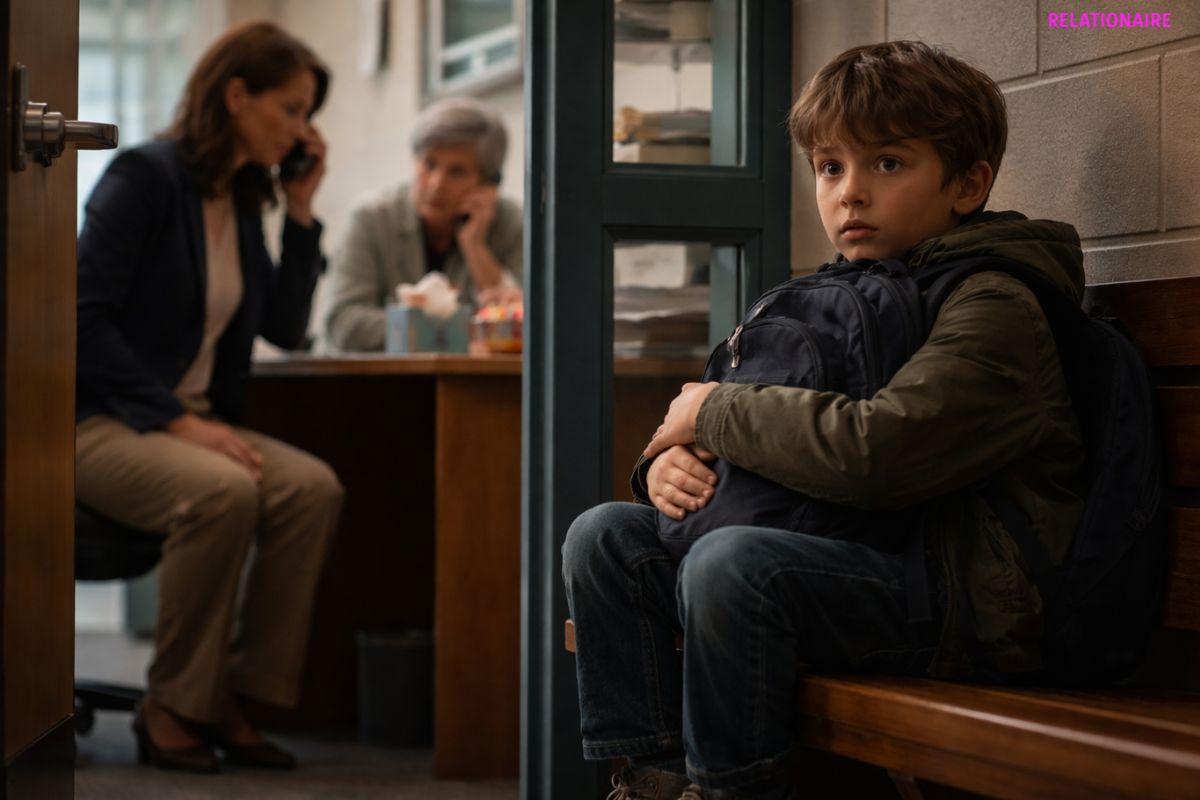
Every morning, just after the first bell and just before the hallway emptied, the same boy sat on the bench outside her office with his backpack in his lap and his shoulders pulled in tight, like he was waiting to be sent somewhere no child wanted to go.
He never knocked.
He never asked for anything.
He just sat there.
At first, Elena assumed what everyone else assumed.
That he was hiding.
Avoiding class. Dodging a test. Looking for attention. Maybe trying to build a reputation as one of those quiet little hallway kids who learned early how to disappear without technically breaking a rule.
Teachers noticed him.
The counselor noticed him.
Even Mr. Givens, the janitor, who noticed everything and almost never said much, glanced at the bench one morning and muttered, “That boy again.”
His name was Eli Torres. Fourth grade. Nine years old. Neat writing. Decent grades. No behavior referrals. No cafeteria incidents. No fighting, no stealing, no cursing, no dramatic meltdowns. Nothing that usually explained a child lingering near the principal’s office like a moth circling a porch light.
Which made it stranger.
It was October, and October had already worn Elena down.
The school year had barely settled, and she felt tired in the bones. Not sleepy tired. A deeper kind. The kind that sat behind her eyes and made every ringing phone feel personal.
Two teachers were out with the flu.
The boiler in the west wing was making a noise like a dying lawn mower.
A parent had stood in the front office on Friday, jabbing a finger at the secretary because the bus route changed by six minutes.
And Elena’s own mother had left her a voicemail three nights ago that she still hadn’t returned, because every time she listened to the first two words—“Honey, listen”—she heard the softness in her mother’s voice and knew it was about the biopsy.
So she did what tired adults do.
She narrowed the world down to what she could control.
Schedules.
Attendance.
Paperwork.
The sound of her own shoes moving with purpose.
And the small mystery of the boy on the bench became, in her mind, one more thing to fix.
“Has anyone asked Eli why he keeps sitting there?” she said one morning, standing at the front counter while the copier spat out field-trip forms.
Mrs. Alvarez, the school secretary, looked up from her desk. “I told him he needs to go to class.”
“And?”
“He smiles and says, ‘Yes, ma’am.’ Then the next morning he’s back.”
Mrs. Alvarez was sixty-two, quick with attendance reports, quicker with Band-Aids, and somehow always the first person to know when a family needed meal vouchers, winter coats, or a quiet place to sit after getting hard news. She kept peppermints in one drawer, extra pencils in another, and tissues everywhere.
She also had the face of a woman who made everyone feel steadier than they were.
Elena had worked with her for six years and couldn’t remember a single day the office felt calm without her in it.
“Maybe he likes the air conditioning,” one of the fifth-grade teachers joked as she signed in late.
Nobody laughed much.
The bell rang. Doors slammed. The hallway thinned.
And there he was again.
Small for his age. Brown hair that looked like somebody had tried to smooth it with wet hands. Sneakers with one frayed lace. A jacket too light for the cold snap that had settled in over the weekend. He sat very straight, backpack hugged against his stomach, eyes on the office door.
Not fidgeting.
Not restless.
Waiting.
Elena stood in the doorway a second longer than she meant to.
He looked up and immediately got to his feet.
That, more than anything, irritated her.
Like he had been expecting to be corrected.
“Eli,” she said. “Why aren’t you in class?”
His fingers tightened around the top handle of his backpack. “I’m going.”
“You say that every day.”
He lowered his eyes.
Behind Elena, the office printer hummed. Someone on the phone in the nurse’s room laughed too loudly, the brittle kind of laugh adults use when they’re trying not to sound scared.
“I don’t want to start my mornings by chasing you away from this bench,” Elena said. “If there’s a problem, use your words. If you’re trying to skip class, that ends today. Do you understand me?”
He nodded.
But he didn’t move.
Elena felt her patience go thin.
“What is so important about sitting out here?”
His mouth opened, then closed. His face changed in a way she almost missed—not guilt, not defiance. Something closer to panic. Like he had been carrying a glass thing inside him and someone had reached for it too fast.
Mrs. Alvarez spoke gently from her desk. “Go on, sweetheart. Mrs. Ward asked you a question.”
Eli looked at her then.
Not at the principal.
At the secretary.
And something quiet passed over his face. A kind of hurt.
“I know,” he said.
He left after that, head down, walking so carefully it looked like he was trying not to step on cracks.
Elena went back into her office annoyed with him, and then, a little more annoyingly, with herself.
The rest of the morning moved like spilled marbles.
A parent wanted to argue about dress code.
A teacher needed approval for a behavior plan.
The district office called about testing compliance.
At 9:17, Elena heard the front phone ring.
Mrs. Alvarez answered in her usual steady voice. “Front office, good morning, this is Marisol.”
A pause.
Then another.
Elena couldn’t hear the words on the other end, only the silence growing around them.
When she stepped out of her office a minute later, Mrs. Alvarez was still holding the receiver. Her face had changed.
It was subtle. So subtle most people would have missed it.
But Elena saw the color leave her mouth.
Saw her left hand grip the edge of the desk.
Saw the way she turned her chair just slightly away from the glass office window, like instinct had taken over before dignity could catch up.
“Elena,” she said softly, covering the phone. “Can you—”
Then she stopped.
Because a small hand had already appeared beside her.
Eli.
He had come back.
No one had seen him step into the office.
He wasn’t speaking. He wasn’t staring. He had simply crossed the room with a tissue box held in both hands and set it by Mrs. Alvarez’s elbow like he’d done it a hundred times before.
Mrs. Alvarez looked at him, and for one naked second, whatever she was trying to hold together broke open in her eyes.
Not loudly.
Not dramatically.
Just enough.
Enough for Elena to understand she was witnessing something she did not understand at all.
Eli reached into his pocket and pulled out one of those terrible strawberry candies from the bowl on the front counter—the kind children always took and never finished.
He placed it beside the tissues.
Then he whispered, so quietly Elena almost thought she imagined it, “You don’t have to talk okay right away.”
Mrs. Alvarez made a sound that was almost a laugh and almost a sob.
Elena took the phone from her hand.
It was the hospital.
Mrs. Alvarez’s younger brother had collapsed at work.
They were taking him into emergency surgery.
The woman on the other end was asking whether there was someone who could come get her.
Elena answered what needed answering. She wrote down the hospital name. She called Mrs. Alvarez’s daughter. She found her car keys. She said practical things in a practical voice.
But under all of it, her mind stayed fixed on one impossible fact.
The boy had known.
Not about the brother.
About her.
About this.
About the way bad news arrives at a front desk first and must be swallowed before the building sees it.
When Mrs. Alvarez left, trembling and apologizing even then, Eli stood by the door with his backpack still on, his eyes fixed on the floor.
Elena waited until the office was quiet again.
Then she crouched in front of him.
“All this time,” she said carefully, “were you sitting out here because of Mrs. Alvarez?”
He nodded.
Elena stared at him.
“Why?”
He hesitated. His throat moved.
And when he finally answered, it changed everything Elena thought she knew about the silent boy on the bench, the secretary at the desk, and the grief children notice when adults think they’ve hidden it well.
He looked toward the empty chair Mrs. Alvarez had just left behind and said, very softly:
“Because last spring, when my mom got the call about my dad, she was the only one there to catch the phone before it hit the floor.”
Part 2
The first thing Elena felt was shame.
Not the clean kind that comes and goes in a moment.
The hot, slow kind. The kind that makes every assumption you made feel ugly in hindsight.
Eli still stood there in his thin jacket, backpack hanging from one shoulder now, his hand curled around the strap so tightly his knuckles had gone pale. Nine years old, and he was watching Elena with the guarded stillness of a child who had already learned adults sometimes get softer after the truth—but not always.
Elena rose too quickly, then softened her voice.
“Your dad,” she said. “Was that when he…?”
Eli nodded once.
No tears. No dramatic collapse.
Just a nod.
The office seemed to get smaller around them. The hum of the fluorescent lights. The smell of paper and coffee gone cold. The abandoned mug on Mrs. Alvarez’s desk with a lipstick mark on the rim. The little square of sunlight on the floor no one had stepped into.
“She was there?” Elena asked.
Eli looked at the empty secretary’s chair. “My mom came to bring him his lunch. He forgot it at home.”
His words came slowly, as if he was stepping across stones in water.
“They called the school because she used to be hard to reach when she cleaned houses. She had her phone in the car. Mrs. Alvarez answered. Then she came outside to the bench where me and my mom were waiting because she said my dad left his medicine bottle in the office at work and maybe it was nothing.”
He swallowed.
“But when she came out, she was already crying.”
Elena felt something pinch hard in her chest.
Children remembered details adults could barely survive.
The bench.
The medicine bottle.
The shape of someone’s face right before the truth landed.
“She sat next to my mom,” Eli said. “Not too close at first. Just enough. And when my mom couldn’t breathe right, Mrs. Alvarez breathed slower so my mom could copy her.”
Elena pressed her lips together.
“She took me inside,” he went on. “Because my mom started making sounds I never heard before. She gave me crackers from her drawer. She said grown-ups cry with their whole body sometimes, and it looks scary, but it just means the love is too big to stay in.”
He looked down at his shoes.
“She stayed until my aunt came.”
Elena had known about Eli’s father only in the thin official sense. Bereavement packet. attendance flexibility. reduced homework for two weeks. counseling offered. counseling declined.
The file version of grief.
Not the real one.
Not a little boy with crackers in his lap while his mother came apart in a plastic office chair.
Not a secretary matching her breathing to a stranger’s so she would not drown in one phone call.
“And after that,” Elena said quietly, “you started sitting outside the office.”
Eli nodded again. “Not every day at first.”
“Why every day now?”
He gave a tiny shrug, but it wasn’t casual. It was a child’s shrug, trying to hold up something too heavy.
“Because calls don’t ask if it’s a bad time.”
Elena closed her eyes for one second.
Then opened them and asked the question that had begun to matter more than the others.
“Did Mrs. Alvarez know why you were out there?”
He shook his head. “No, ma’am.”
“Why not tell her?”
His answer came so fast it had clearly lived in him for months.
“Because then she’d have to thank me.”
Elena stared.
He shifted his weight, embarrassed now, as if that sounded foolish out loud.
“And if she thanked me,” he said, “then maybe she’d also tell me to stop. And I didn’t want her to have to choose between being embarrassed and being alone.”
It was such a small sentence.
So plain.
And it went through Elena like a blade.
Adults liked to think children were oblivious unless pain was spoken in full sentences. But children lived in the weather of a room. They could feel the drop in air pressure before the storm. They noticed the fake laugh, the too-fast smile, the hand that paused before answering the phone.
They noticed who held everybody else up.
And sometimes, they noticed when that person had no one holding them.
Elena looked toward the hallway. First period was halfway gone. Somewhere, multiplication tables were being recited. A teacher was probably marking Eli absent. The normal machinery of school was grinding forward, indifferent as ever.
“Come in my office,” she said.
His eyes widened. “Am I in trouble?”
“No,” she said, and hated that he had to ask.
He followed her in and perched on the edge of the chair across from her desk. His feet didn’t touch the floor. He kept his backpack on.
She offered to call his teacher and explain. He asked if he could still turn in his spelling sheet before lunch. Elena almost laughed, but it caught in her throat.
She called Mrs. Bennett in fourth grade and said only that Eli would be late because she needed him.
Mrs. Bennett’s pause on the other end told Elena what had already spread quietly through the building.
That Eli again.
That bench again.
That boy’s up to something.
By lunchtime, Elena had heard three versions of the story from adults who knew nothing. One teacher thought Eli liked office attention. Another thought he was anxious and “performing attachment behavior.” A classroom aide said maybe he just wanted to get out of morning work.
Elena said nothing.
For once, she wanted the building to sit in its ignorance a little longer.
That afternoon, after school let out and buses pulled away in coughing blue clouds, Elena drove to the hospital with a tote bag of clean clothes and a phone charger for Mrs. Alvarez.
She found her in a vinyl chair outside surgery, hands clasped so tightly the veins stood out like blue cords beneath her skin.
When Elena sat down beside her, Mrs. Alvarez managed a tired smile. “You shouldn’t have come.”
“Yes, I should have.”
They spoke quietly. About the brother. About the doctors. About practical things.
Then Elena told her.
Not all at once.
Just enough.
About the bench.
About the tissues.
About the candy.
About the reason.
Mrs. Alvarez covered her mouth with both hands and stared at the opposite wall for so long Elena thought maybe she had said too much.
Finally she whispered, “That child.”
Not as a complaint.
As if she had been handed something fragile and holy and did not know where to set it down.
The next morning, Mrs. Alvarez did not come to work.
Her daughter texted Elena just after dawn. Surgery went well. He was stable. Marisol would stay another day.
Elena unlocked the office early and stood for a moment in the dim quiet.
The bench outside her door was empty.
At 8:03, students started arriving in bursts of sound and cold air.
At 8:11, Eli appeared in the hallway.
He slowed when he saw Elena standing there, as if bracing for a new rule.
She could have told him to go straight to class.
She could have said the office was not a waiting room. That children should not carry adult sadness. That boundaries matter. That schools run on procedures.
All of that would have been partly true.
Instead, she said, “Mrs. Alvarez is at the hospital with her brother. He made it through surgery.”
Eli let out a breath so deep it seemed to empty him.
“Okay,” he whispered.
He turned to leave.
“Elí.”
He looked back.
“Sit for one minute,” Elena said.
He frowned. “Why?”
Because the bench looked wrong without him there.
Because maybe there are some kinds of loyalty adults should witness before they rush to correct them.
Because she wanted, for just one minute, to understand the shape of what he had been doing.
But what she said was, “Because I think she’d want someone keeping watch anyway.”
So he sat.
The hallway buzzed around them.
A kindergarten class passed holding a rope with little loops.
A teacher hurried by with dry-erase markers in her teeth.
The phone inside the office rang once, then stopped.
Eli looked at the secretary’s empty desk through the glass.
“Do you think,” he asked carefully, “that when people are the one everyone comes to, sometimes nobody sees when they’re sad?”
Elena leaned against the wall beside the bench.
“Yes,” she said. “I do.”
He nodded as if that confirmed something important.
Then he reached into his pocket and pulled out a folded square of paper, worn soft at the corners.
“I made this for her yesterday,” he said. “But I didn’t finish.”
Elena took it gently.
It was a drawing in pencil and red crayon. Mrs. Alvarez behind her desk. A phone. A tissue box. A bowl of candy. And beside her, on the bench outside the office door, one very small boy with dark circles under his eyes and his backpack in his lap.
Above them, in careful block letters, he had written:
SO YOU DON’T HAVE TO BE THE FIRST SAD PERSON ALONE
Elena looked up too fast, and Eli saw her eyes change.
“Don’t show her yet,” he said quickly. “Not till her brother gets better. I don’t want it to feel like one more thing she has to cry about.”
That was the moment Elena realized the story was still not finished.
Because now she knew what Eli had been carrying.
But she still did not know who, if anyone, had been carrying Eli.
And when she asked, very softly, “Who takes care of you when you get bad news, sweetheart?”
he looked toward the school doors, where parents usually waited and fathers usually stood and ordinary mornings usually began.
Then he said, “Mostly nobody.”
Part 3
After that, Elena started noticing the absences.
Not on attendance sheets.
In the spaces around Eli.
No one waiting at pickup most afternoons because he rode the late bus to an after-school program three blocks from his apartment.
The same jacket, even when the weather turned colder.
Forms signed in rushed handwriting by an aunt named Daniela.
A lunch account that hovered near zero, then got covered, then drifted down again.
His teacher, Mrs. Bennett, said he was bright but tired. Kind to other children. Too quick to say, “I’m fine,” in the same careful tone adults use when they are not.
“His mom works mornings and nights,” Mrs. Bennett told Elena. “Housecleaning, then stocking shelves at the grocery store. Aunt picks him up when she can. Since his dad died, he’s been… older.”
Older.
Adults said that like praise.
Often it was just grief wearing a smaller body.
Elena called his mother in the evening and expected hesitance, defensiveness, maybe even shame. What she heard instead was exhaustion so complete it sounded almost polite.
“Yes,” Ana Torres said softly. “He talks about the secretary. Says she is nice.”
There was clattering in the background, maybe dishes, maybe a bus stop, maybe life refusing to pause for sorrow.
“He has been sitting outside the office in the mornings,” Elena said. “Not to avoid class.”
A long silence.
Then, quieter: “I know.”
Elena sat up straighter. “You knew?”
“He thought I didn’t,” Ana said. “But one morning I walked him in because his asthma was bad, and I saw him wait until the first bell, then sit where he thought nobody could see. When I asked later, he cried. He said Mrs. Alvarez had once caught our whole world when it fell, and he didn’t want her to ever have to catch hers by herself.”
Elena pressed her hand to her forehead.
“Why didn’t you say something?”
Another pause.
“Because,” Ana said, and now her voice broke a little, “I didn’t know if stopping him would be protecting him… or teaching him not to be who he is.”
That stayed with Elena all night.
Schools were built on rules for good reason. Children should not carry adult burdens. But compassion did not always arrive in tidy, approved ways. Sometimes it showed up on a hallway bench in worn sneakers, ten minutes before math, with a tissue box in mind and no witness needed.
Mrs. Alvarez returned two days later.
Her brother would recover. Slowly, but he would recover.
When she walked into the office, the whole front staff rose like a small grateful congregation. There were hugs, casseroles, questions, the clutter of welcome.
Eli was not there.
He had gone straight to class.
Elena knew why.
He did not want her first day back to become about him.
At 10:30, when the hallway had quieted, Elena closed the office door and handed Mrs. Alvarez the folded drawing.
“He made this before the hospital,” she said.
Marisol opened it carefully.
She looked at the picture for a long time.
Then she sat down in her chair like her knees had stopped working right.
“Oh,” she whispered.
Not crying at first. Just breathing differently.
Elena left her alone for a minute, then two.
When she came back out, Marisol had the drawing pressed flat on her desk beneath both hands.
“Go get him,” she said.
Eli arrived from class looking terrified.
Elena almost smiled despite herself. Some children could be carrying the emotional scaffolding of an entire building and still think they were in trouble when called to the office.
Mrs. Alvarez stood before he reached the doorway.
He stopped short.
The room held still around them.
The copier was silent. The phones were quiet for once. Even the traffic noise beyond the glass doors felt far away.
Mrs. Alvarez lifted the drawing.
“You made this for me?”
Eli looked at Elena, then at the floor. “It wasn’t supposed to make you sad.”
That did it.
Marisol crossed the room in three quick steps and knelt in front of him.
“Oh, baby,” she said, voice shaking. “It didn’t make me sad.”
He finally looked at her.
“It made me feel seen.”
There are moments when children don’t know what they’ve done because they expected so little from it.
This was one of them.
Eli blinked, confused.
Mrs. Alvarez took a breath. “Do you know how many years I have sat at this desk answering calls nobody wants, greeting people on the hardest day of their week, sometimes the hardest day of their life?”
He said nothing.
“A long time,” she answered for him. “And I cannot remember anyone ever thinking to wait for me.”
His face changed then. A tiny, painful softening. Like relief had finally found the correct door.
“I just didn’t want you to be by yourself,” he said.
Marisol put a hand against his cheek.
“I wasn’t,” she said. “I just didn’t know it.”
Elena stepped back. Something in her throat had gone too tight for speech.
The thing about kindness from children is that it embarrasses adults in the holiest possible way. It reveals how often we walk past each other defended, efficient, professionally composed. How rarely we say the simple thing. I see you carrying this. Let me stand nearby.
After that, the school changed in ways no district memo could have produced.
Not dramatically.
Quietly.
The teachers started checking on office staff after difficult parent meetings.
Mr. Givens fixed the loose leg on the bench outside the office and varnished it on a Saturday.
The nurse began bringing Marisol tea in the afternoons.
Mrs. Bennett started a class project called “Who Helps the Helpers,” and though no names were mentioned, half the drawings that came in had tissue boxes and front desks and small bowls of candy.
And Elena, who had spent years becoming efficient at the cost of softness, began to ask one more question than she used to.
Not “What happened?”
But “Who was there when it happened?”
Sometimes the answer was no one.
Sometimes that answer could still be changed.
In December, just before winter break, the fourth graders held a small holiday assembly in the multipurpose room. Paper snowflakes drooped from the ceiling. A microphone squealed every five minutes. Children forgot lyrics and sang too loudly and waved at relatives from the risers.
At the end, Mrs. Bennett invited students to read short notes about people in the school who made them feel safe.
The notes were anonymous.
One child thanked the cafeteria manager for remembering no pickles.
Another thanked the crossing guard for waving like every morning mattered.
Then Mrs. Bennett unfolded one last paper and smiled in that strained way teachers do when they are trying not to cry in public.
“This one says,” she read, “‘Some people answer the phone when life changes. Some people hand out papers. Some people unlock doors. Some people clean up when kids throw up. Some people notice when your mom can’t talk. Some people put stickers on your test. Some people wait on benches. A school is mostly people catching things before they hit the floor.’”
The room went very still.
In the second row, Mrs. Alvarez put her hand over her mouth.
Across the aisle, Ana Torres sat in a borrowed church coat, eyes shining so hard Elena had to look away for a moment.
Eli was on the risers with the other fourth graders, cheeks red, trying very hard to look like he had nothing to do with that note.
He failed.
Beautifully.
After the assembly, families crowded the room with phones and hugs and coats and children darting everywhere like released birds.
Elena found Eli near the back wall, holding a paper cup of melted punch.
“You wrote it,” she said.
He shrugged, then smiled a little.
“Mrs. Bennett helped with spelling.”
Elena laughed.
Then she bent slightly so she was eye level with him.
“You know,” she said, “I was wrong about you.”
He looked wary for half a second, then curious.
“I thought you were trying to avoid something.”
He stirred the melted ice with one finger against the side of the cup.
“I was,” he said.
Elena waited.
He glanced across the room to where Mrs. Alvarez stood talking with his mother.
“I was trying to help somebody not have to be brave all by themselves.”
It was such a child’s sentence.
Plain. honest. exact.
The kind adults spend years making complicated because saying it simply would require too much tenderness.
Elena watched him run back toward the crowd then, too young still for the wisdom he carried, yet somehow exactly old enough to offer it.
And she thought of the bench outside her office.
How easily it had been mistaken for a place where a child went to avoid responsibility.
When all along, it had been a place where he went to practice it.
That is the quiet miracle of some children.
They do not arrive with speeches.
They arrive with small hands, a folded drawing, a crumpled tissue, a seat taken early in the morning where no one thinks to look.
And if we are lucky, they remind us that the strongest people in a building are often the ones everyone assumes don’t need anybody.
And that love, sometimes, is nothing louder than waiting nearby in case someone’s whole world reaches for the floor.