If you’ve already read part 1 of this story on Facebook, go here for Part 2!
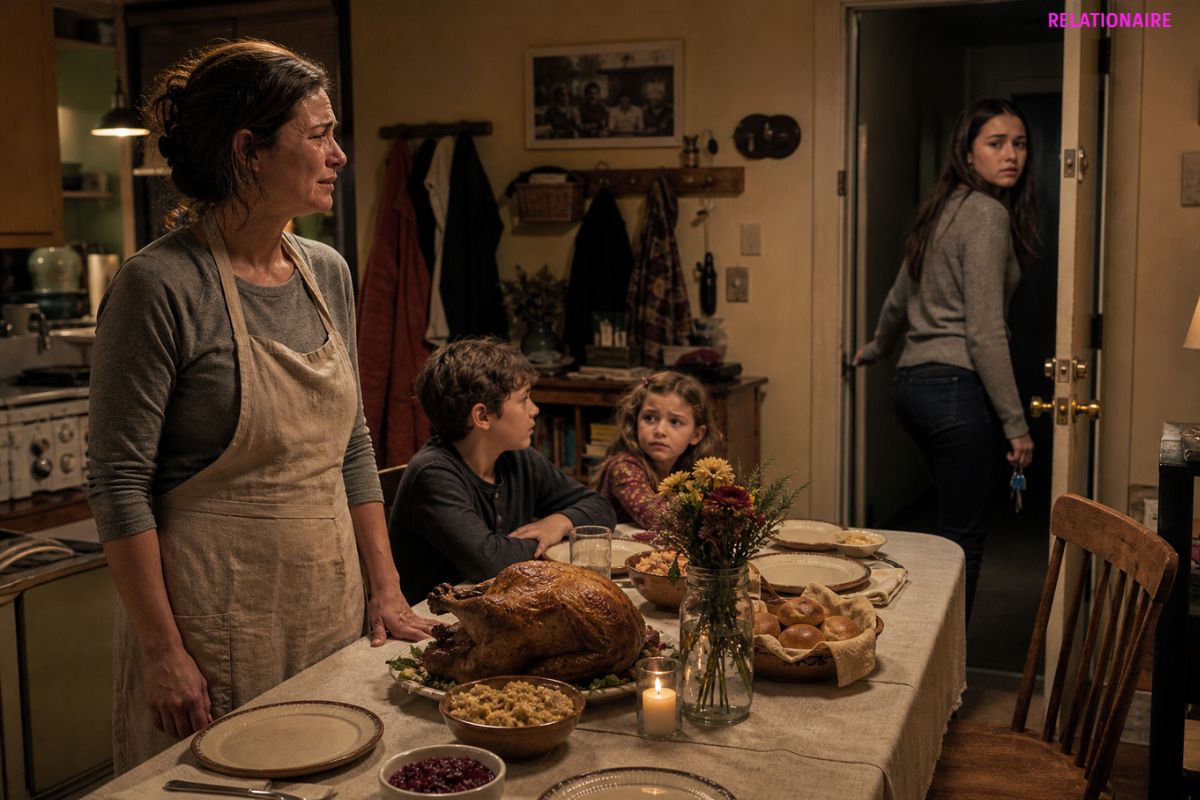
Mara had spent three weeks trying to make a Thanksgiving dinner good enough to make her children forget their father had a fireplace now.
That was the part she hated most about herself.
Not the jealousy.
Not the tiredness.
Not even the way she stood in the grocery aisle comparing the price of butter like it could decide whether she was a decent mother.
It was that she wanted one meal: one warm, golden, perfect meal to prove her little apartment was still a home.
The turkey was too big for her oven.
The folding chairs did not match.
The good plates were not really good plates, just the white ones without chips around the edges.
But Mara ironed a tablecloth anyway. She lit a cinnamon candle by the sink. She tucked grocery store flowers into an old mason jar and set them in the middle of the table like they had always belonged there.
By four o’clock, the apartment smelled like sage, onions, and worry.
“Mom,” nine-year-old Caleb said from the hallway, “do I have to wear this sweater? It itches like punishment.”
“You look handsome,” Mara called from the stove.
“I look like a grandpa.”
Her youngest, Sophie, sat cross-legged on the floor near the coffee table, carefully drawing little place cards with crayons.
MOM.
CALEB.
SOPHIE.
AVA.
She made one for herself twice because she did not like the first heart.
And then there was Ava.
Sixteen years old. Long dark hair. One earbud always in. A face that had learned too early how to look bored when she was really hurting.
She came out of the bedroom wearing black jeans and a gray sweater, holding her phone like a shield.
Mara looked up from basting the turkey.
“You look beautiful.”
Ava didn’t look at her.
“Dad said his dinner starts at two tomorrow,” she said.
Mara’s hand paused over the pan.
Tomorrow was their father’s Thanksgiving. The new house Thanksgiving. The one with the fireplace and the guest bathroom with tiny soaps and the woman named Elise who made her own pie crust.
“That’ll be nice,” Mara said.
Ava gave a tiny shrug. “They’re doing smoked turkey.”
Caleb groaned. “And mashed potatoes with cheese in them.”
“And a chocolate fountain,” Sophie added, because she had been talking about it since Sunday.
Mara smiled too quickly.
“Well,” she said, “tonight we have regular turkey and very regular mashed potatoes.”
No one laughed.
She turned back to the oven before they could see her face.
The divorce had been final for eleven months, but it still lived in all the small places. In the empty hook by the door where Daniel’s coat used to hang. In the second toothbrush cup she had thrown away but still noticed every morning. In the way the children said “Dad’s house” with a kind of brightness they never used here.
Mara didn’t blame them.
Daniel’s house had a yard.
Mara’s apartment had a radiator that clanked at night and a kitchen drawer that stuck unless you pulled it just right.
Daniel took them to trampoline parks and pancake places.
Mara counted gas money before school pickup.
Daniel had remarried a woman who sent the kids home with clean laundry folded in perfect squares.
Mara had once pulled Caleb’s damp jeans from the dryer five minutes before the bus came and told him they were “warm on purpose.”
She knew children noticed.
Even when they tried not to.
Especially then.
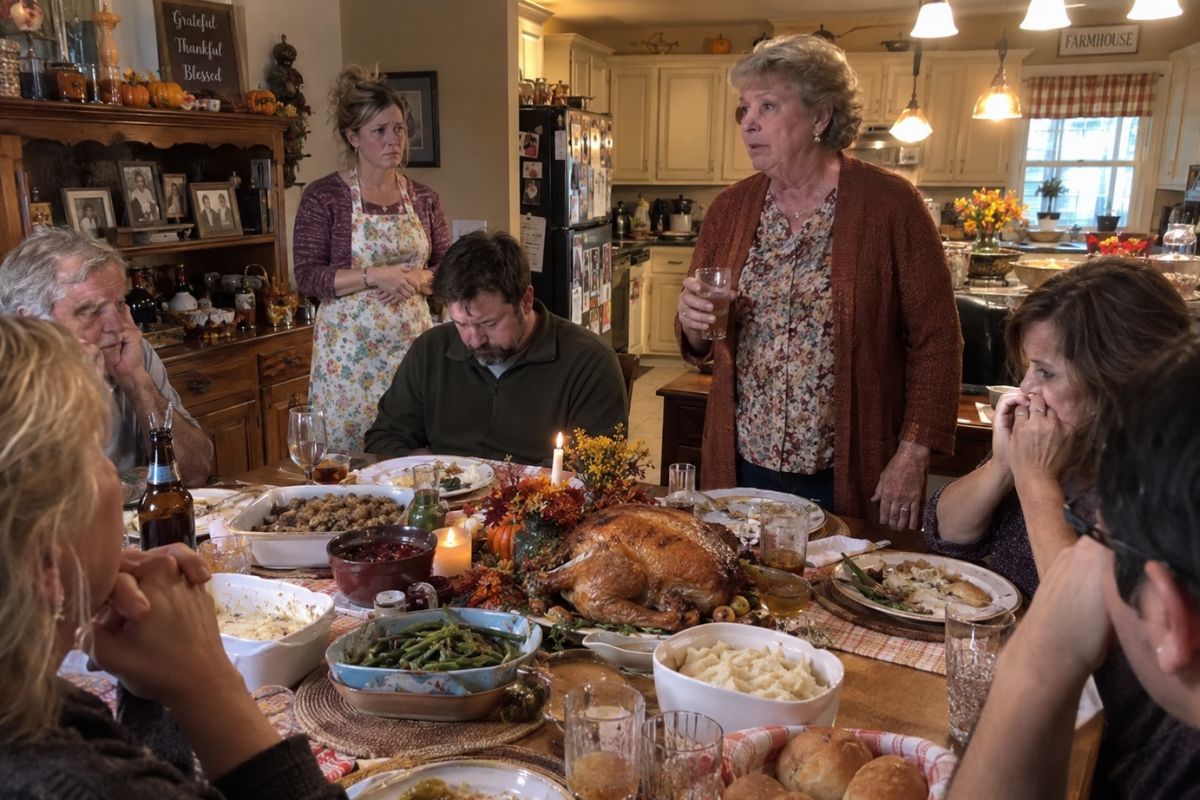
At five-thirty, Mara set the food on the table.
Turkey. Stuffing. Green beans with almonds because Elise had made green beans with almonds last year and Ava had said they were “actually good.” Cranberry sauce from a can, sliced carefully so the ridges showed. Rolls, slightly burned on the bottom but soft on top.
The table looked full.
That helped.
For a moment, standing at the edge of the kitchen with her apron wrinkled and her hair falling out of its clip, Mara let herself believe she had done it.
Sophie clapped when Mara brought out the turkey.
Caleb said, “Whoa,” which from him was almost poetry.
Even Ava looked up from her phone.
“It smells good,” she said quietly.
Mara’s throat tightened.
“Thank you.”
They sat.
Mara took the folding chair closest to the kitchen because she expected to keep getting up. Caleb sat beside Sophie. Ava sat near the window, where the November sky had already gone dark.
There was one extra chair at the end of the table.
It was the old wooden one with the loose rung. Mara had put it there without thinking, then noticed it right before dinner and almost dragged it away.
Almost.
Sophie pointed at it with her fork.
“Who’s that for?”
Mara glanced at the chair.
“No one, baby. I just needed the space.”
Caleb grinned. “Maybe the turkey gets a seat.”
Sophie giggled.
Ava didn’t.
She looked at the chair for a long second, then looked at her mother.
Mara pretended not to notice.
They prayed because Mara still did on holidays, even when her faith felt like a coat she had outgrown but could not throw away.
“Thank you for this food,” she said, holding Sophie’s small hand and Caleb’s sticky one. “Thank you for keeping us together.”
Her voice broke on together.
Barely.
But Ava heard it.
Mara knew because her daughter’s eyes lifted.
She ended the prayer fast.
“Amen,” Caleb said, already reaching for a roll.
The first ten minutes were almost perfect.
Caleb told a story about a boy in his class who sneezed milk out of his nose. Sophie announced that her teacher said gratitude was “when your heart says thank you before your mouth does.” Ava actually smiled at that.
Mara carved slices from the turkey and passed plates around.
For one soft, impossible minute, it felt like before.
Not completely.
But close enough to hurt.
Then Sophie said, “At Dad’s house, Elise lets us use real napkins.”
Caleb added, “And they have those cups with the tiny pumpkins on them.”
Mara kept spooning stuffing.
“That sounds nice.”
“They have a dining room,” Sophie said.
“We have a dining corner,” Caleb said, not meanly. Just honestly.
Ava kicked him under the table.
“Ow.”
“What?” Caleb snapped.
“Stop,” Ava said.
Mara forced a smile. “It’s okay.”
But it wasn’t.
The words were small, harmless, childish.
Still, each one landed in the tired place Mara had been trying to cover with gravy and candlelight.
She reached for her water.
Her hand shook.
Ava saw that too.
The room changed after that.
Caleb went quiet because he knew when a grown-up was almost sad. Sophie kept touching her place card with one finger. Ava pushed her food around but did not eat much.
Mara hated herself for ruining the air. She had wanted warmth. She had made everyone careful instead.
“So,” she said brightly, “what’s everyone thankful for?”
Caleb mumbled, “Food.”
Sophie said, “My purple blanket and my family and pumpkin pie.”
Mara looked at Ava.
Her daughter stared down at her plate.
“Ava?”
“I don’t know.”
“Just one thing.”
Ava’s jaw tightened. “I said I don’t know.”
Caleb rolled his eyes. “You’re thankful for Wi-Fi.”
“Shut up.”
“Ava,” Mara said gently.
Ava pushed back her chair.
The sound scraped across the small room.
“I can’t do this.”
Mara blinked. “Do what?”
“This.” Ava waved a hand at the table. At the candle. At the flowers. At the too-big turkey and the extra chair and her mother’s hopeful face. “Pretending.”
The word hit harder than yelling.
Mara stood slowly. “We’re not pretending.”
Ava’s eyes shone, but her voice stayed sharp.
“Yes, we are.”
Sophie’s lip trembled.
Caleb stared at his plate.
Mara felt heat rise in her face. Shame first. Then hurt. Then the kind of anger that only comes when you have been carrying too much and someone touches the sorest place.
“I worked very hard on this dinner,” she said.
“I know.”
“Then sit down.”
Ava looked toward the empty chair again.
Something passed across her face.
Not anger.
Not exactly.
Pain, maybe.
But Mara was too wounded to read it.
“I have to go,” Ava said.
Mara laughed once, not because anything was funny, but because the alternative was crying in front of the children.
“Go where? It’s Thanksgiving dinner.”
Ava grabbed her keys from the counter.
Mara’s heart lurched.
“No. Absolutely not.”
“Mom—”
“You are not walking out in the middle of dinner because it isn’t fancy enough.”
Ava flinched.
For a second, Mara wished she could pull the words back.
But they were already there, sitting between them like broken glass.
Ava’s face closed.
“That’s what you think this is?”
“What else am I supposed to think?”
Ava looked at Caleb and Sophie.
Then back at Mara.
Her eyes filled, but she swallowed it down.
“You don’t understand.”
“Then explain it.”
“I can’t.”
Mara stepped between her and the door.
“You can’t just leave.”
“I have to.”
“Why?”
Ava’s hand tightened around the keys.
The apartment was so quiet they could all hear the radiator knock in the bedroom.
Then Ava said, in a voice so low it barely sounded like hers:
“Because someone is missing from this table, and you’re the only one pretending not to know.”
Mara froze.
Ava slipped past her, opened the door, and walked out into the cold hallway.
By the time Mara reached the window, her daughter was already crossing the parking lot, wiping her face with her sleeve, heading toward the old blue Honda Daniel had helped her buy for her birthday.
“Mama?” Sophie whispered.
Mara stood at the window with one hand against the glass.
The turkey cooled on the table.
The candle burned low.
The empty chair waited at the end.
And Mara suddenly realized she had no idea who her daughter had gone to find.
PART 2
For the first five minutes after Ava left, nobody moved.
Mara kept her hand on the window like she could stop the car by wanting hard enough.
The Honda’s taillights disappeared around the corner, two red dots swallowed by the dark.
Caleb was the first to speak.
“Is Ava in trouble?”
Mara turned around.
Her son sat stiffly in his itchy sweater, his fork still in his hand. Sophie had crawled into his side, her little face pale, her place card bent in one corner.
Mara wanted to say yes.
Yes, Ava was in trouble.
Yes, walking out was selfish and dramatic and cruel.
Yes, after everything Mara had done, after three weeks of coupons and planning and pretending not to hear the children compare houses, Ava had ruined it.
But Ava’s last words kept circling back.
Someone is missing from this table.
Mara looked at the empty chair.
Her stomach dropped.
No.
She knew.
She had known the second Ava said it.
She just didn’t want to say his name.
“Mom?” Caleb asked.
Mara wiped her hands on her apron. They smelled like onions and butter.
“I’m going to call her.”
Ava didn’t answer.
Mara called again.
Straight to voicemail.
The third time, the phone rang once and went silent.
Caleb whispered, “She declined it.”
Mara shot him a look, then regretted it immediately.
“I’m sure she’s safe,” she said, though she wasn’t sure of anything.
She opened the Find My app with trembling fingers.
Ava’s little circle moved slowly across town.
Past the pharmacy.
Past the church where Mara and Daniel had once brought the children in Easter clothes.
Past the grocery store with the cheap turkey.
Then the dot turned onto Willow Road.
Mara’s breath caught.
Willow Road led to only a few places.
The old library.
A closed bakery.
And Evergreen Manor.
A nursing home with a cracked sign and yellow light in the windows.
Mara sat down hard in the chair Ava had left behind.
“Mom?” Caleb said again.
But Mara was somewhere else now.
She was twenty-six years old, standing in the doorway of her father’s kitchen with newborn Ava asleep against her chest.
Her father, Henry, was rinsing coffee mugs in the sink, acting like the silence between them was normal.
Mara had come hoping he would apologize.
He had not.
Instead, he had placed a folded twenty-dollar bill on the counter and said, “For diapers.”
Just that.
For diapers.
No hug.
No “I’m proud of you.”
No “I’m sorry I said Daniel would leave when things got hard.”
Mara had taken the money because she needed it.
Then she had cried in the car because needing help from someone who did not know how to love softly felt like losing twice.
Henry had never been an easy man.
He had worked at the rail yard for thirty-eight years. His hands were scarred. His voice was rough. He loved through oil changes, full gas tanks, and envelopes of money pushed across tables.
He did not say, “I miss you.”
He said, “Your tires are low.”
He did not say, “I was wrong.”
He said, “I fixed the step.”
When Mara’s mother died, Henry went quiet in a way that made the whole house cold.
Mara was seventeen then, angry and grief-soaked. She needed a father who could hold her while she fell apart. Henry gave her chores.
“Keep busy,” he’d said the morning after the funeral.
She had hated him for it.
Later, when she married Daniel, Henry came to the wedding in a navy suit that didn’t fit anymore and stood alone near the back. He danced once with Mara, awkwardly, his hand stiff at her shoulder.
“You okay?” he had asked.
Mara had waited for more.
There was no more.
When the divorce happened, she expected him to say he told her so.
Instead, he called once and asked if the kids needed winter coats.
Mara had said no too quickly.
They did need coats.
Pride can be a very expensive thing when you are a mother.
After that, the calls became fewer.
Then Henry fell in his driveway one icy morning and spent two nights in the hospital. He moved to Evergreen Manor “temporarily,” then never moved out.
Mara visited at first.
Then less.
Then not at all.
Not because she didn’t care.
Because every visit left her feeling like a little girl standing beside a closed door.
He never asked her to stay.
She never asked him to come home.
And somehow, years passed that way.
“Mom.”
Caleb’s voice pulled her back.
Mara looked down at her phone.
Ava’s dot had stopped.
Evergreen Manor.
Sophie whispered, “Where is she?”
Mara closed her eyes.
“The nursing home.”
“Why?” Caleb asked.
Mara didn’t answer.
Because the truth was too tender.
Because last night, after the children had gone to bed, Mara had stood in the kitchen peeling potatoes over a dented bowl, and something inside her had cracked.
She had thought she was alone.
She had not been.
Ava must have been in the hallway.
Mara remembered it now—the floor creaking near the bathroom, the shadow under Ava’s door.
Mara had been on the phone with her sister, Lena.
“I know he’s difficult,” Mara had whispered, pressing the phone between her shoulder and cheek. “I know he wouldn’t even enjoy it. He’d complain about the stuffing. He’d sit there like he wanted to leave.”
She had laughed softly, but it broke in the middle.
Then she had said the words she never meant for her children to hear.
“But he’s still my dad. And it’s Thanksgiving. And I hate that he has nowhere to go.”
There it was.
The truth Ava had carried all day.
The reason she kept staring at the chair.
The reason she looked at her mother’s shaking hands.
Mara’s eyes filled.
“She heard me,” she said.
Caleb frowned. “Heard what?”
Mara took off her apron.
“I have to go.”
Sophie grabbed her wrist. “Don’t leave too.”
The words split Mara open.
She knelt beside the table and pulled both younger children close.
“I’m not leaving. I’m going to get your sister.”
“And yell at her?” Caleb asked.
Mara looked at the door.
Her anger had already changed shape.
“No,” she whispered. “I think I’m going to thank her.”
Evergreen Manor sat fifteen minutes away, though that night it felt farther.
Mara drove with both hands on the wheel, Caleb and Sophie buckled in the back seat because she could not leave them alone and could not explain enough to leave them with a neighbor.
The streets were wet from a late afternoon drizzle. Porch lights glowed. Families moved behind windows. Men carried pie boxes. Women stood in kitchens. Grandparents stepped carefully from cars, holding casserole dishes wrapped in towels.
Every house looked warm from the outside.
Mara wondered how many were not.
When they pulled into Evergreen Manor, Ava’s Honda sat crooked near the entrance.
Mara parked beside it.
The lobby smelled like disinfectant, coffee, and reheated gravy.
A paper turkey hung crooked on the wall. Someone had taped a sign beside it: HAPPY THANKSGIVING FROM OUR FAMILY TO YOURS.
Mara signed in with a hand that would not stop trembling.
The nurse at the desk looked up.
“Can I help you?”
“I’m looking for my daughter. Ava Collins. She came to see Henry Whitaker.”
The nurse’s face softened.
“Oh,” she said. “Room 114.”
That softness scared Mara more than anything.
She led Caleb and Sophie down the hall.
A television played football somewhere. A walker squeaked. A woman in a lavender sweater slept in a chair by the nurses’ station with a half-finished cup of tea beside her.
Room 114 was at the end of the hall.
The door was partly open.
Mara stopped before stepping inside.
She heard Ava’s voice first.
Small.
Careful.
“I know it’s weird. I know you and Mom don’t talk much.”
Then an older man’s voice, dry and rough.
“She sent you?”
“No.”
Silence.
Then Henry said, “Then why are you here?”
Mara put a hand over her mouth.
Ava took a breath.
“Because she made a chair for you.”
Mara’s knees weakened.
Inside the room, her father sat in a wheelchair near the bed, thinner than she remembered, a plaid blanket over his legs. His white hair was combed too neatly, like someone else had done it. Ava stood in front of him holding Sophie’s crayon place card.
The extra one.
The one Mara hadn’t noticed.
It said GRANDPA HENRY in purple letters.
Henry stared at it.
Ava’s voice cracked.
“She didn’t say your name. She probably couldn’t. But she put the chair there, and she kept looking at it like it hurt.”
Henry’s hand trembled when he reached for the card.
Mara stepped into the doorway.
Her father looked up.
For the first time in years, she saw the old hardness leave his face.
And in its place was something worse.
Fear.
“Mara,” he said.
Ava turned around, startled.
Her eyes were red.
Mara tried to speak, but no sound came.
Then Henry looked down at the place card again and whispered:
“I thought she stopped needing me.”
PART 3
Mara had spent half her life thinking her father did not care whether she needed him or not.
Hearing him say those words felt like finding a door in a wall she had leaned against for years.
I thought she stopped needing me.
Ava stood between them, still holding her keys, looking suddenly younger than sixteen. Caleb and Sophie hovered behind Mara in the hallway, quiet for once, sensing they were standing inside a grown-up pain too old for them to understand.
Henry cleared his throat.
It was the sound he made when feelings got too close.
“I didn’t mean—”
“Yes, you did,” Mara said softly.
Not angry.
Just tired.
Her father looked at her.
His eyes were pale now, watery at the edges. His hands rested on the blanket, knuckles bent, nails neatly clipped by a nurse. Mara remembered those hands lifting paint cans, changing brake pads, carrying boxes when she moved into her first apartment.
She also remembered those hands not reaching for her at her mother’s funeral.
Both things were true.
That was the hardest part.
Ava wiped her face.
“I’m sorry I left,” she said to Mara. “I just heard you last night, and then you put out the chair, and nobody said anything. And I kept thinking… what if he was sitting here alone while we had all that food?”
Mara looked at her daughter.
All evening she had thought Ava was judging her.
The apartment.
The dinner.
The life Mara could not make shiny enough.
But Ava had not been comparing homes.
She had been listening to the hurt under her mother’s voice.
“Oh, honey,” Mara whispered.
Ava’s chin trembled. “I wasn’t trying to ruin dinner.”
“I know.”
“I just didn’t want you to be sad.”
That broke her.
Not loudly.
Not dramatically.
Mara simply stepped forward and pulled Ava into her arms, and her daughter folded in like she had been waiting all day to be forgiven.
For a moment, they held each other in the nursing home doorway while football noise echoed faintly down the hall and Sophie sniffled into Caleb’s itchy sleeve.
Henry looked away.
Maybe to give them privacy.
Maybe because love shown openly still embarrassed him.
Mara released Ava and faced her father.
“You could’ve called,” she said.
Henry’s mouth tightened.
“You could’ve answered.”
It might have turned sharp once.
Years ago, it would have.
But tonight, there was no room left for pride to stretch out.
Mara nodded.
“You’re right.”
Henry blinked, as if he hadn’t expected that.
“I was angry,” Mara said. “For a long time. I kept waiting for you to say things the way I needed to hear them.”
Henry looked down at his blanket.
“I was never good at that.”
“No,” she said. “You weren’t.”
Ava held her breath.
Caleb stared at the floor.
Sophie whispered, “Mom,” as if warning her not to hurt the old man.
But Henry gave one small nod.
“No,” he said. “I wasn’t.”
Mara’s throat tightened.
“I thought you didn’t want us around.”
Henry’s fingers curled around the crayon place card.
“I thought I was one more thing for you to carry.”
The room went still.
Mara looked at the narrow bed, the walker, the plastic water cup, the framed photo on his dresser.
It was old.
Ava as a toddler sitting on Henry’s lap, gripping his thumb with her whole hand.
Mara had forgotten that picture existed.
Henry followed her gaze.
“She used to fall asleep on me during baseball games,” he said.
Ava looked at the photo, surprised.
“I did?”
“You drooled on my shirt,” he said.
Caleb made a tiny laugh through his nose.
Sophie stepped into the room.
“Grandpa Henry?”
Henry looked at her.
She was holding the edge of Mara’s sweater with one hand.
“Yes, ma’am.”
“Do you like pumpkin pie?”
His face changed.
Just a little.
“I’ve been known to tolerate it.”
Sophie considered this.
“We have some.”
Mara closed her eyes.
There are moments in a family when nobody fixes everything.
No apology reaches all the way back.
No hug erases the years.
But something opens anyway.
A small space.
Enough for one chair.
The nurse helped Henry into his coat.
He complained that the hallway was too warm, then that the night air was too cold. He told Mara her front tire looked low. He asked Ava if she had checked her oil lately.
Ava looked at Mara.
Mara smiled through tears.
“That means he’s glad you came.”
Henry grumbled, “Means the oil needs checking.”
Ava smiled for the first time that night.
It took fifteen careful minutes to get him into Mara’s car. Caleb held the door. Sophie carried the plaid blanket like it was something royal. Ava followed in her Honda because Henry insisted one teenage driver in the family was enough danger for one evening.
When they returned to the apartment, the food was cold.
The candle had burned out.
The gravy had formed a skin.
The rolls were hard on the bottom.
And somehow, it was the most beautiful table Mara had ever seen.
Henry paused in the doorway.
His eyes went to the chair at the end.
The old wooden one with the loose rung.
Sophie ran ahead and placed the purple card carefully in front of it.
GRANDPA HENRY.
Henry stared at it for a long time.
Then he cleared his throat.
“You made that?”
Sophie nodded.
“I spelled Grandpa wrong first, but Ava helped.”
Henry touched the card with two fingers.
“Looks right to me.”
Mara reheated plates in the microwave one at a time. The turkey dried out a little. Caleb spilled cranberry sauce on the tablecloth. Ava burned her finger on the gravy bowl and Henry told her to run it under cold water, “not that lukewarm nonsense.”
It was not perfect.
Nobody mentioned the fireplace at Daniel’s house.
Nobody mentioned the chocolate fountain.
For once, Mara did not feel like she was competing with anything.
She watched her children pass rolls across the table. She watched her father cut his turkey into small pieces with slow, stubborn care. She watched Ava glance at him when she thought nobody noticed, as if trying to memorize the shape of a man she had almost lost to silence.
Halfway through dinner, Henry set down his fork.
“Mara.”
She looked up.
He seemed to wrestle with the words before forcing them out.
“Your mother used to make stuffing like this.”
Mara froze.
Her mother’s stuffing.
Onion, celery, too much sage. The recipe Mara had tried to remember from childhood and never written down.
“Did she?”
Henry nodded.
“Little wetter, maybe.”
Caleb coughed into his napkin to hide a laugh.
Mara laughed too, but tears came with it.
Henry’s face shifted, alarmed.
“I didn’t mean—”
“I know,” she said. “It’s okay.”
He looked back at his plate.
After a moment, he added, very quietly, “She’d have liked seeing this.”
Mara pressed her fingers to her mouth.
This.
The tiny apartment.
The mismatched chairs.
The children still learning where to put their hurt.
The old man who had not known how to come back until a teenage girl drove into the cold and brought him home.
After dinner, Sophie fell asleep on the couch under Henry’s plaid blanket. Caleb loosened his sweater collar and leaned against Mara without asking. Ava stood at the sink washing plates beside her mother.
For a while, they worked in silence.
Then Ava said, “Were you really mad?”
Mara handed her a dish.
“At first.”
Ava looked down.
“I thought you left because you were embarrassed,” Mara said. “Because this wasn’t enough.”
Ava’s eyes filled again.
“Mom.”
“I know,” Mara whispered. “I was wrong.”
Ava rinsed the plate slowly.
“I like it here.”
Mara looked at her.
Ava shrugged, trying to act casual and failing.
“Dad’s house is nice. But here feels like us.”
Mara had to grip the counter.
There were things a mother needed to hear only once to survive a whole season.
Across the room, Henry sat in the old chair, Sophie asleep nearby, Caleb showing him something on a handheld game. Henry pretended not to understand it, though Mara could tell he was trying.
Later, when Ava drove him back to Evergreen Manor, Mara went too.
At his room, Henry folded the plaid blanket over his chair.
Ava handed him the purple place card.
“You should keep it,” she said.
Henry took it like it was fragile.
At the door, Mara hesitated.
The old habit rose between them.
Leave before it gets awkward.
Say something practical.
Make it easier.
Instead, she stepped forward and hugged her father.
At first, Henry went stiff.
Then, slowly, one hand came up and rested against her back.
It was not the hug she had needed at seventeen.
It was not the apology she had imagined at twenty-six.
It was an old man doing what he could, late but not too late.
“I still need you,” Mara whispered.
Henry’s breath shook.
“Well,” he said roughly, “then check your tire pressure tomorrow.”
Mara laughed into his shoulder.
And this time, she understood him.
The next Thanksgiving, there was still no fireplace.
The tablecloth still had a cranberry stain.
The chairs still didn’t match.
But at the end of the table sat Henry’s chair, with a purple place card saved carefully in a kitchen drawer and brought out only for holidays.
And every year after that, when Mara set the table, she remembered that families do not always heal in grand speeches.
Sometimes love comes late.
Sometimes it comes awkwardly.
Sometimes it arrives in an old car, with cold turkey waiting at home, because one child noticed the empty chair everyone else was trying not to see.