If you’ve already read part 1 of this story on Facebook, go here for Part 2!
By the third week of October, everybody in Room 214 had a story about Mateo Ruiz stealing pencils.
Not expensive things.
Not phones, not lunch money, not headphones.
Just pencils.
He asked for them with the same quiet voice every time, like he already knew what people were thinking.
“Can I borrow one?”
At first, kids shrugged and handed one over.
Then they started rolling their eyes.
Then came the jokes.
“Hide your pencils. Mateo’s here.”
“Better give him the cheap one.”
“He eats them or something.”
By the time Ms. Gable went out on emergency leave and the substitute took over for the week, Mateo had a reputation that walked into the room before he did.
He was twelve, skinny in a way that made his hoodie hang wrong, with hair that always looked like he’d fallen asleep before it dried. He sat near the window, close enough to the radiator to warm his hands when the mornings came in cold.
He never made trouble.
That was the strange part.
He didn’t talk much, didn’t clown around, didn’t shove people in the hallways, didn’t throw paper or snap rubber bands. He just never had a pencil when class started.
And every day, before first period was halfway through, he would lean sideways and ask someone.
“Can I borrow one?”
The substitute’s name was Mrs. Daniels.
She was the kind of woman who looked strict before she ever opened her mouth. Crisp blouse. Silver watch. Hair pinned back so neatly it seemed to make the air around her behave. On Monday morning, she wrote her name on the board in careful block letters and told the class she expected respect, order, and responsibility.
By second period, she had already noticed Mateo.
“Again?” sighed a girl named Tasha when he asked.
“I’ll give it back,” he said.
“You always say that.”
A few kids snickered.
Mrs. Daniels looked up from attendance.
“Is there a problem?”
“No,” Tasha said, but she dropped a pencil on Mateo’s desk instead of handing it to him.
It landed with a sharp little clack.
Mateo picked it up and murmured thanks.
Mrs. Daniels kept teaching.
But she watched him after that.
At lunch, two boys at the next table started a whole performance about it.
One clutched his chest and whispered, “My number two pencil… gone too soon.”
The other said, “Search his backpack.”
A couple kids laughed louder than the joke deserved.
Mateo sat with his tray untouched, staring at the little plastic cup of peaches shaking in the syrup every time someone bumped the table.
He didn’t defend himself.
He never did.
That afternoon, Mrs. Daniels stopped him before he left.
“Mateo.”
He froze the way some kids do when they’ve heard their name too many times in warning.
“Yes, ma’am?”
She held out a yellow pencil from the desk supply cup.
“This is yours for the week. Keep track of it. No more borrowing.”
His fingers closed around it like it was fragile.
“Yes, ma’am,” he said again.
For one second, she thought she saw embarrassment flash across his face.
Then he tucked it into his notebook and hurried out.
The next morning, he asked for another pencil.
The room erupted.
“Oh my gosh.”
“See?”
“He literally got one yesterday!”
Mrs. Daniels set down her marker.
“Mateo. Come here.”
His face went red before he even stood.
He walked to the front of the class slowly, one hand gripping the strap of his backpack.
“Didn’t I give you a pencil yesterday?”
“Yes, ma’am.”
“And where is it now?”
He swallowed.
“I don’t have it.”
A few kids exchanged looks.
Mrs. Daniels lowered her voice, but the room had gone quiet enough for everyone to hear anyway.
“You’re old enough to keep track of a pencil for one day.”
He stared at the floor.
“I know.”
“Then help me understand.”
His throat moved, but nothing came out.
And that silence, more than anything, seemed to confirm what everybody already believed. Careless. Irresponsible. One of those kids who never brought what he needed and expected the world to fill in the rest.
Mrs. Daniels felt irritation rise in her chest, clean and righteous.
She had taught long enough to know the difference between a child in trouble and a child who refused to try.
At least she thought she had.
She reached for the classroom supply caddy and pulled out a half-used pencil with a chewed eraser.
“This is the last one I’m giving you.”
He took it with both hands.
“Thank you.”
It should have ended there.
But during silent writing time, while the rest of the room bent over grammar exercises, Mrs. Daniels noticed something odd.
Mateo wrote with quick, tight movements. Then he stopped, looked at the pencil, and did something strange.
He snapped the tip on purpose.
Not loudly.
Not enough for anyone else to notice.
Just a small twist against the metal edge of his desk, a practiced motion.
Then he raised his hand.
“Tasha,” he whispered to the girl beside him. “Do you have a sharp one?”
She made a face.
“You’re kidding.”
“Please.”
With exaggerated annoyance, she handed him a newly sharpened pencil.
Mateo took it, wrote three lines, then passed that sharp pencil back to her.
He kept the broken one.
Mrs. Daniels frowned.
A few minutes later, he borrowed another pencil from the boy behind him, used it briefly, returned it, and slipped the dulled stub into his pocket.
He wasn’t hoarding good pencils.
He was collecting the broken ones.
When the bell rang, the students flooded into the hallway in a storm of backpacks, gossip, and slamming lockers. Mrs. Daniels stayed behind by the window, watching Mateo at his desk.
He thought he was alone.
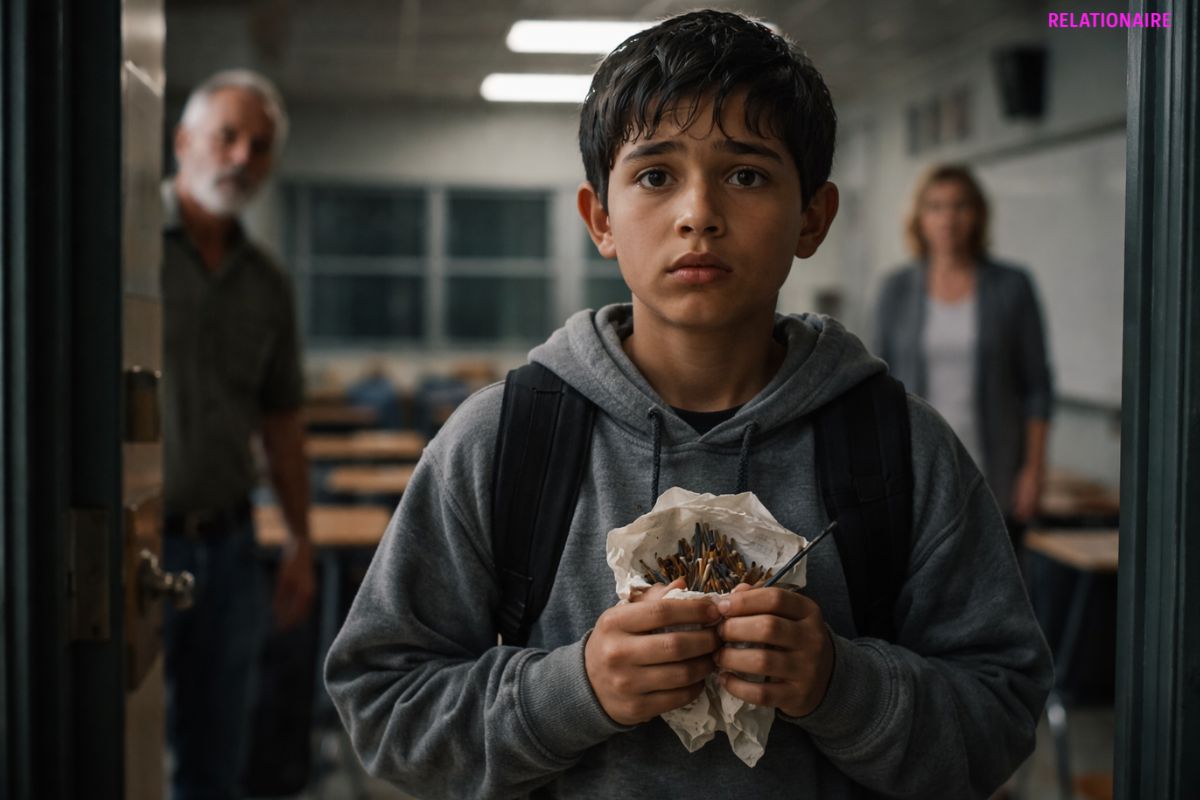
He took the stubs from his pocket—three today, maybe four—and lined them up carefully on the desk. Tiny pieces. Barely enough wood left to hold between two fingers.
Then he wrapped them in a napkin.
Not thrown away.
Protected.
He slid the bundle into the front pouch of his backpack and left.
Mrs. Daniels stood still for a moment.
The empty room felt different now.
Smaller.
Meaner.
At dismissal, rain tapped the classroom windows. The sky had gone the color of dirty cotton, and kids ran toward buses with jackets over their heads. Mrs. Daniels was gathering worksheets when she noticed the janitor in the hallway.
His name tag read Mr. Henry.
Tall, broad-shouldered, maybe in his sixties, with a gray beard trimmed close and a limp that made his left foot drag softly when he walked. The students barely seemed to see him most days. He moved through the building like part of it, pushing his cart, changing trash liners, buffing floors that were muddy again within an hour.
He paused at Room 214’s door and looked in.
“You the sub?”
She nodded.
“For Ms. Gable, yes.”
He tilted his head toward the hallway where Mateo had disappeared.
“You noticed the pencil boy.”
It wasn’t a question.
Mrs. Daniels felt a little defensive.
“I noticed he’s been taking supplies from other students.”
Mr. Henry let out a breath through his nose. Not quite a laugh.
“That what you think he’s doing?”
She folded a stack of papers sharper than necessary.
“It’s what I saw.”
“No,” he said gently. “It’s what everybody sees.”
Rain ticked harder against the windows.
Mrs. Daniels looked at him fully then.
He leaned one forearm on the handle of his mop cart and said, “You ever stay late enough to see where he goes after the last bus pulls out?”
Something in his voice made the room go cold.
She said nothing.
Mr. Henry reached into the deep pocket of his work jacket and pulled out a small bundle wrapped in a clean cafeteria napkin.
He set it on the nearest student desk and unfolded the corners.
Inside were dozens of pencil stubs.
Some worn to the paint.
Some split down the wood.
Some sharpened so many times they looked too small to belong to a child anymore.
At the center of the bundle sat something else.
A folded piece of notebook paper.
Mrs. Daniels stared.
“What is that?”
Mr. Henry looked toward the rain-dark hallway.
“It’s what he makes with them,” he said quietly. “And if you read it before he gets back, you’re going to understand exactly how wrong this school has been.”
He pushed the folded note toward her.
Mrs. Daniels reached for it with suddenly unsteady fingers.
And just before she opened it, footsteps splashed back up the hallway toward Room 214.
PART 2
The footsteps stopped outside the doorway.
Mateo stood there dripping rainwater onto the tile, breathing hard, one hand on the strap of his backpack. He looked from Mr. Henry to the napkin on the desk to Mrs. Daniels’ hand resting on the folded note.
For the first time all week, there was panic on his face.
Not embarrassment.
Not guilt.
Fear.
“Please,” he said, voice cracking. “Please don’t read that.”
Mrs. Daniels froze.
The paper was so thin she could feel the ridges where it had been folded and unfolded too many times. Something in the way he said please made it sound less like a request and more like the last board someone grabs before going under.
Mr. Henry stepped back from the desk.
“It’s all right, son.”
But Mateo shook his head hard enough to fling rain from his hair.
“No, it’s not.”
He rushed into the room and scooped up the pencil stubs with both hands, almost dropping them. He stuffed them back into the napkin, then clutched the whole bundle against his chest.
Mrs. Daniels slowly pulled her hand away from the note.
“I’m sorry,” she said.
He didn’t answer.
Up close, she could see his hoodie was damp all the way through at the shoulders. His sneakers were soaked. The left toe had peeled open enough for the wet sock underneath to show.
Mr. Henry gave her a look she understood immediately.
Not now.
So she only said, “Did you miss your bus?”
Mateo stared at the floor.
“I wasn’t on it.”
“Then how are you getting home?”
A pause.
“I walk.”
“In this weather?”
Another pause.
“It’s okay.”
But nothing about him looked okay.
Mr. Henry shifted his weight. “Storm’s getting worse. I’m mopping the front hall another ten minutes, then I can walk him partway.”
“No,” Mateo said too fast.
The word snapped through the room.
All three of them heard how sharp it was.
His face changed right after, folding in on itself. “I mean… you don’t have to.”
Mrs. Daniels had been teaching long enough to recognize when a child was protecting something bigger than the moment.
Or someone.
She picked up her bag. “I parked on Maple. I can drive you home.”
Mateo’s whole body went still.
Mr. Henry didn’t speak, but his eyes flicked once toward the boy, then back to her.
Again, she understood.
Not now.
“No,” Mateo whispered. “I can’t.”
“Why not?”
He squeezed the napkin bundle tighter.
“Because if someone from school comes there, she’ll get scared.”
The room went quiet except for the rain.
Mrs. Daniels asked carefully, “Who’s she?”
His mouth trembled before he answered.
“My mom.”
Mr. Henry took off his work gloves finger by finger and tucked them into his back pocket. He spoke the way people do around wounded animals—soft, steady, leaving room.
“Tell her what you tell me, Mateo.”
The boy shut his eyes for a second.
Then he said it in one rush, like he’d been holding the sentence in all week.
“She doesn’t like anyone knowing where we stay.”
Mrs. Daniels felt the air change.
“Where do you stay?” she asked.
His fingers tightened around the bundle so hard the napkin tore.
“At the motel by the highway,” he said. “The one with the red sign. Room twelve. But we’re only there if she has enough.”
Mrs. Daniels knew the place.
Everybody in town knew the place.
Half-lit vacancy sign.
Ice machine that rattled all night.
Thin curtains.
Police there often enough that people locked their car doors at the intersection without thinking.
“How long?” she asked before she could stop herself.
Mateo shrugged, which was somehow worse than a number.
“Since summer, I guess.”
Mr. Henry looked at the wet floor for a moment, jaw tight.
“She cleans rooms there some mornings,” he said quietly. “Cleans tables at the truck stop other nights.”
Mateo shot him a look—not angry, just exposed.
Mr. Henry nodded once as if to say, I know.
Mrs. Daniels sat down in the nearest student chair because suddenly her legs felt unreliable.
“And the pencils?”
Mateo looked confused for a second, as if that part were too obvious to explain.
“We don’t have any,” he said. “And if I bring home the good ones, my sister uses them all the way down and cries when they get too small to hold.”
His voice softened when he said sister.
“How old is she?”
“Six.”
He glanced at the folded paper still lying on the desk.
Then, reluctantly, he added, “She likes to draw at night when Mom’s at work. It keeps her quiet.”
The shame that went through Mrs. Daniels was swift and clean.
All week she had watched him like a problem to be managed.
All week the class had joked about a boy who couldn’t hold onto a pencil.
He hadn’t been losing them.
He had been bringing home what everybody else was throwing away.
Mr. Henry pulled out the chair by the door and sat, his bad leg stretching stiffly.
“Tell her the rest.”
Mateo looked at him a long moment. Then he unwrapped the napkin again and laid the pencil stubs out with surprising care, almost tenderness. He separated the ones with erasers from the ones without.
“I sharpen them with the pocketknife from the motel desk,” he said. “Real slow, so I don’t waste them.”
Mrs. Daniels pressed a hand to her mouth.
He kept going, eyes fixed on the desk instead of either adult.
“I give Sofia the better ones first. The ones with erasers. The littler ones are for me because I can still use them in my hand if I do it like this.”
He demonstrated, pinching a stub between thumb and bent knuckle.
“It hurts after a while,” he admitted. “But it still works.”
Mrs. Daniels had no words.
The folded paper lay between them like a heartbeat.
“What’s on the note?” she asked softly.
Mateo flinched.
Mr. Henry answered for him. “A list.”
“A list of what?”
The janitor looked at Mateo before he spoke. “Things his mama needs.”
Mateo swallowed hard. “Not for money.”
“I know.”
“It’s just…” His voice thinned. “It’s stuff she forgets because she’s tired.”
He unfolded the paper halfway, then stopped as if even that much exposure hurt.
Mrs. Daniels saw only a few words in a child’s cramped handwriting.
laundry soap
Sofia cough medicine
ask front desk for more toilet paper
don’t let sink drip
Mom likes coffee with two sugars if she cries
That last line went through her like a blade.
He folded it again immediately.
“She cries a lot?” she asked.
He shrugged, eyes shiny.
“Only when she thinks we’re asleep.”
The rain had slowed to a hush now, but the room felt louder than a storm.
Mrs. Daniels thought about Tasha dropping the pencil on his desk like he was beneath touching. Thought about the boys joking in the cafeteria. Thought about her own clipped voice: You’re old enough to keep track of a pencil for one day.
She had been wrong in the ugliest ordinary way people are wrong every day—by thinking she understood a child because his trouble was inconvenient.
“What does Mr. Henry mean,” she said carefully, “when he says what you make with them?”
Mateo and the janitor exchanged a look.
Mr. Henry leaned forward, elbows on his knees.
“Show her the notebook, son.”
Mateo hesitated long enough for her to think he wouldn’t.
Then he slowly slid off his backpack, unzipped the front pocket, and pulled out a composition book so swollen with damp pages it barely closed. The black-and-white cover was peeling at the corners. A faded sticker on the front said SCIENCE, though the pages inside were clearly for something else.
He set it on the desk but kept his hand on top of it.
Mrs. Daniels could see how hard he was breathing.
“This is why I borrow them,” he said. “Not just for Sofia.”
Mr. Henry stood.
“I’m going to finish the hallway.”
He moved toward the door, then stopped beside Mrs. Daniels.
Quiet enough that Mateo wouldn’t hear, he said, “When you open that book, don’t talk right away.”
Then he left.
The old hinges sighed shut behind him.
For a long second there was only the sound of water dripping from Mateo’s sleeve onto the floor.
Finally, he lifted his hand from the notebook.
Mrs. Daniels opened it.
The first page held a child’s careful drawing of a motel room.
A lamp.
A bed.
A little girl asleep curled toward the wall.
And in the chair by the window, a woman in a work apron, crying into both hands.
On the page beneath it, in pencil so short and pressed so hard it had nearly cut through the paper, Mateo had written one line.
This is what it looks like when somebody is trying not to fall apart.
Mrs. Daniels turned the page.
Then the next.
And halfway through the notebook, she realized why Mr. Henry had told her not to speak.
Because page after page, stub by stub, Mateo had drawn the hidden life no one in the school had seen.
And on the last filled page, there was a picture of Room 214.
His classmates laughing.
His own empty desk.
And a woman at the front of the room—her face unmistakably Mrs. Daniels—holding out a pencil like a warning.
Underneath it, he had written six words that made her go cold.
I wish grown-ups looked longer first.
PART 3
Mrs. Daniels did not trust herself to speak for a full minute.
She stood at the desk with Mateo’s notebook open in her hands while the fluorescent lights buzzed softly overhead. Outside, a late bus groaned away from the curb. Somewhere down the hall, Mr. Henry’s mop bucket wheels squeaked and faded.
But inside Room 214, there was only the boy and the pages.
Each drawing said what he never did out loud.
A little girl eating saltine crackers on a motel bed and pretending it was dinner.
His mother asleep sitting up, still wearing her sneakers.
A school bathroom stall where Mateo sat with his backpack on his knees during lunch, not because he was in trouble, but because it was the quietest place to sharpen pencils with the tiny knife wrapped in a sock at the bottom of his bag.
A front desk clerk at the motel handing him extra shampoo bottles with his eyes turned away, pretending not to notice he was taking more than one.
Mr. Henry emptying classroom trash and setting half-used pencils aside in his pocket before anyone could throw them out.
Mrs. Daniels turned pages with both care and shame.
The drawings weren’t childish, not really.
Not because they were polished. They weren’t.
Some lines shook. Some faces were only half-finished. Some hands had too many knuckles. But every page had truth in it. The kind that lands harder because it isn’t trying to impress anyone.
“How long have you been drawing like this?” she asked finally.
Mateo shrugged.
“A while.”
“Why didn’t you tell anyone?”
He looked honestly puzzled by the question.
“Tell them what?”
That stopped her.
Because to him, this wasn’t a secret shaped like a confession.
It was just life.
Something to get through.
Something to organize with lists and pencil stubs and a six-year-old sister who liked erasers and a mother who cried with two sugars in her coffee.
Mrs. Daniels closed the notebook gently.
“Mateo,” she said, “does anyone at school know?”
He shook his head.
“Not even Ms. Gable?”
“No.”
“Counselor?”
Another head shake.
“Why not?”
He answered in a voice so matter-of-fact it hurt more than if he’d cried.
“Because if people know too much, they start looking at you like you already broke.”
That was what undid her.
Not the motel.
Not the drawings.
Not even the note.
That sentence.
Because it was too old for him. Too practiced. Too true.
She sat back down and pressed her palms together.
“We’re not going to let that happen.”
He gave a tiny, tired shrug, the kind children do when adults make promises they don’t expect to survive contact with the real world.
Mrs. Daniels knew then that the next thing mattered more than anything she could say.
Not comfort.
Proof.
She asked, “Can I call someone who knows how to help without making this worse?”
He hesitated.
“For my mom too?”
“Yes.”
He looked at the notebook.
Then at the napkin of pencil stubs.
Then finally at her.
“Okay,” he whispered.
What happened next was not dramatic in the way movies lie about.
No music.
No speeches.
No whole hallway gathering to witness goodness.
Just one substitute teacher borrowing the classroom phone because her cell signal kept dropping in the rain. One school counselor staying late. One principal called back from the parking lot. One janitor standing in the doorway with his cap in both hands like he’d been waiting years for someone else to see what he saw.
Mrs. Alvarez, the counselor, arrived first.
She didn’t crouch down and perform softness.
She just sat across from Mateo and asked, “Do you want water or crackers before we talk?”
He picked crackers.
That made Mrs. Daniels love her a little.
The principal, Dr. Bell, came next, tie loosened, face already set in the tight look of a man realizing his building had missed something important.
He saw the notebook.
He saw the pencil stubs.
He saw Mateo’s shoes.
And to his credit, he did not start with policy.
He started with, “I’m sorry.”
An hour later, with Mateo’s permission and Mrs. Alvarez beside her, they called his mother at the truck stop.
She answered on the third ring, breathless and suspicious.
When Mrs. Alvarez said Mateo was safe, the woman made a sound Mrs. Daniels would never forget. Not quite a sob. Not quite a gasp. More like the body giving way after bracing too long.
Her name was Elena.
She arrived forty minutes later in a diner apron under a wet coat, hair twisted into a falling bun, eyes red from more than the rain.
The second she saw Mateo, she crossed the office in three steps and pulled him against her like she was checking he was still solid.
“I’m sorry,” she kept saying into his hair. “I’m sorry I was late, I’m sorry, baby, I’m sorry.”
He just held on.
Then Sofia came in behind her.
Tiny. Sleepy. Coughing into the sleeve of a pink sweater too big for her.
She had one of Mateo’s sharpened pencil stubs tucked behind her ear like treasure.
Mrs. Daniels had to look away.
The school moved quickly after that, though not perfectly.
Perfection is for stories that don’t understand institutions.
Real help came in clipboards, phone calls, donated uniforms, emergency housing contacts, gas cards, backpack vouchers, a nurse checking Sofia’s cough, forms translated into Spanish, and Mrs. Alvarez sitting beside Elena while she filled them out because exhausted people should not have to decode paperwork alone.
Mr. Henry did something smaller.
Which was also bigger.
The next morning, before first bell, he placed a shoebox on Dr. Bell’s desk.
Inside were pencils from half the classrooms in the building. New ones from supply closets. Half-used ones from teacher drawers. Fancy mechanical ones kids had left in lost-and-found. Eraser caps. A sharpener. Two sketch pads still wrapped in plastic.
On top he put a note in block letters:
FOR THE BOY WHO KNEW EVERY INCH OF A PENCIL MATTERED
Dr. Bell turned that into something else.
By Friday, the school had a “Take What You Need” station in the library.
No permission.
No questions.
Pencils, notebooks, socks, granola bars, deodorant, mittens, toothbrushes, all in plain bins anyone could use without asking an adult to witness their need.
Mrs. Daniels came back, though her week as substitute was nearly over, and spent her own money on a set of drawing pencils she worried might be too much.
When she handed them to Mateo, he looked alarmed.
“I can’t.”
“Yes, you can.”
“They’re expensive.”
“They’re yours.”
He stared at the metal tin like it might disappear if he blinked.
Then he opened it carefully.
Not one pencil.
A whole row.
Different softnesses. Different shades. Tools meant for art, not survival.
His thumb hovered over them without touching.
“I’ve never had ones like this,” he said.
“I know.”
He looked up at her.
And because children are rarely sentimental when adults expect them to be, he didn’t say thank you right away. He said the truer thing.
“Are you still mad at me?”
The question landed heavy between them.
Mrs. Daniels crouched so she was eye level with him.
“No,” she said. “I’m ashamed I didn’t see you sooner.”
He studied her face, deciding whether to believe that.
Then he nodded once.
A beginning.
Months passed.
Ms. Gable came back. Winter settled in. The motel room became an apartment through a local housing program Mrs. Alvarez helped Elena access. It was small and drafty and had a stove that clicked too many times before lighting, but it had a door that locked and a kitchen table where Sofia could draw without balancing paper on a bedspread.
Mateo stopped borrowing pencils.
That wasn’t the miracle.
The miracle was that he stopped needing to hide why.
In the spring, the middle school held a district art show in the library. Parents came in work boots and nurse scrubs and church clothes. Kids pretended not to care if their drawings were chosen while checking every five minutes to make sure they were still on the wall.
Mateo had three pieces displayed.
One was the motel window in rain.
One was Mr. Henry’s mop cart under the fluorescent hallway lights.
The last one stopped people where they stood.
It showed a classroom desk near a window.
On the desk lay a single pencil stub, no bigger than a finger joint.
Beside it was a hand reaching toward it.
Not taking it away.
Not pointing.
Just reaching, carefully, like it understood that even the smallest thing might be carrying more than it seemed.
The title card underneath read:
LOOK LONGER
Mrs. Daniels found Mr. Henry standing in front of it with his hands in his pockets.
“You knew,” she said softly.
He nodded.
“I knew enough.”
“Why didn’t you report it sooner?”
He took his time answering.
“I did what I could do from where I stood. Saved the stubs. Kept an eye on him. Slipped him sandwiches sometimes.” He looked at the drawing. “But some doors only open when the right person finally feels ashamed enough to knock.”
It wasn’t comfortable to hear.
Which was why she knew it was true.
Across the room, Elena was helping Sofia count the colored dots on another student’s painting. Mateo stood a little apart from them, taller now somehow, though only months had passed, accepting awkward praise from teachers who had once only known him as the boy always asking for a pencil.
He caught Mrs. Daniels looking and gave her a small smile.
Not huge.
Not movie-made.
Just real.
The kind that says I remember, and I know you do too.
Later, when the library emptied and the folding chairs scraped back into storage, Mrs. Daniels paused one last time in front of Mateo’s drawing.
A pencil stub.
A reaching hand.
That was all.
But she understood then that some children don’t need adults to save them in grand, shining ways.
Sometimes they need one person to notice what they’ve been making out of scraps.
Sometimes they need someone to stop calling survival a character flaw.
And sometimes the difference between being shamed and being seen is no bigger than a pencil someone almost threw away.