
If you’ve already read part 1 of this story on Facebook, go here for Part 2!
By the time Lena missed the last ferry, her legs were shaking so badly she almost didn’t trust herself to walk down the dock.
She had been on her feet for sixteen hours in the emergency department, first because the day shift had come in short, then because a pileup on the highway had sent in three ambulances almost back to back, then because one of the newer nurses had burst into tears in the supply room and Lena had quietly covered another hour for her too.
By the end of it, the skin under Lena’s eyes felt hot and raw. Her ponytail was half fallen out. There was a coffee stain on the cuff of her pale blue scrub top, and the rubber soles of her shoes made that tired, dragging sound against the wet wood.
She ran the last twenty feet anyway.
“Wait!” she shouted, breath catching. “Please—”
But the ferry was already pulling away, its engines churning dark water into white froth. The deckhand lifted one hand in a helpless apology. The boat horn gave one low mournful blast, and then it was moving farther into the black water, toward the island where Lena rented a tiny basement room above a retired couple’s garage.
Home.
Or what passed for it.
Lena stopped at the edge of the dock and folded over, hands on her knees, trying to breathe without sobbing in public.
Around her, people reacted the way tired strangers do.
A couple dragging rolling suitcases looked at her, then away.
A man in a windbreaker muttered something about “should’ve gotten here earlier.”
Two teenagers in hoodies laughed too loudly at something on one of their phones.
The ticket booth window had already been shut, the little metal grate rolled down. A handwritten sign taped to the glass said NEXT FERRY: 6:15 A.M.
It was only 10:42 p.m.
Lena stared at the sign until the numbers blurred.
She reached into the pocket of her scrubs and pulled out her wallet. Inside was a debit card she knew was nearly maxed, a folded receipt from the pharmacy, nineteen dollars in cash, and an old photo booth strip of her and her younger brother Mateo making stupid faces two summers ago. On the back, Mateo had written in messy black ink: At least one of us looks normal.
She pressed her thumb over his grin.
A motel near the harbor would cost more than she had. A rideshare to the hospital parking lot wouldn’t help; her car had been in the shop for eight days waiting on a repair she still hadn’t figured out how to pay for. She could maybe sit in the terminal until morning, except the lights inside were already going off one row at a time.
She checked her phone.
3%.
No missed calls.
No one to call anyway.
Her mother was gone three years now. Mateo was halfway across the state and working nights at a warehouse. The one friend she might have asked for help had a baby with an ear infection and enough on her plate already. Lena had spent so long being the reliable one that the thought of calling someone just to say I can’t fix this felt humiliating.
A hard wind came off the water. She crossed her arms over herself and sat on the edge of the dock beside a rusted bollard, trying to look like someone simply waiting instead of someone quietly falling apart.
That was when she realized she still had the hospital bracelet in her pocket.
Not hers.
A little boy’s.
She had taken it off him that afternoon before they transferred him upstairs, because he kept picking at it with frightened little fingers. Four years old. Asthma attack. Spider-Man backpack. His mother had been crying so hard she couldn’t get the inhaler cap off. Lena had knelt by the bed and made her voice steady for both of them.
You’re okay. He’s breathing better now. Stay with me.
Now the paper bracelet was crumpled in her hand, tiny and weightless.
Lena closed her fist around it and finally let one tear slip free.
Then another.
She wiped them away fast, embarrassed even though nobody was really looking.
Except someone was.
“You planning to sleep out here?”
The voice was rough, older, not unkind.
Lena looked up fast.
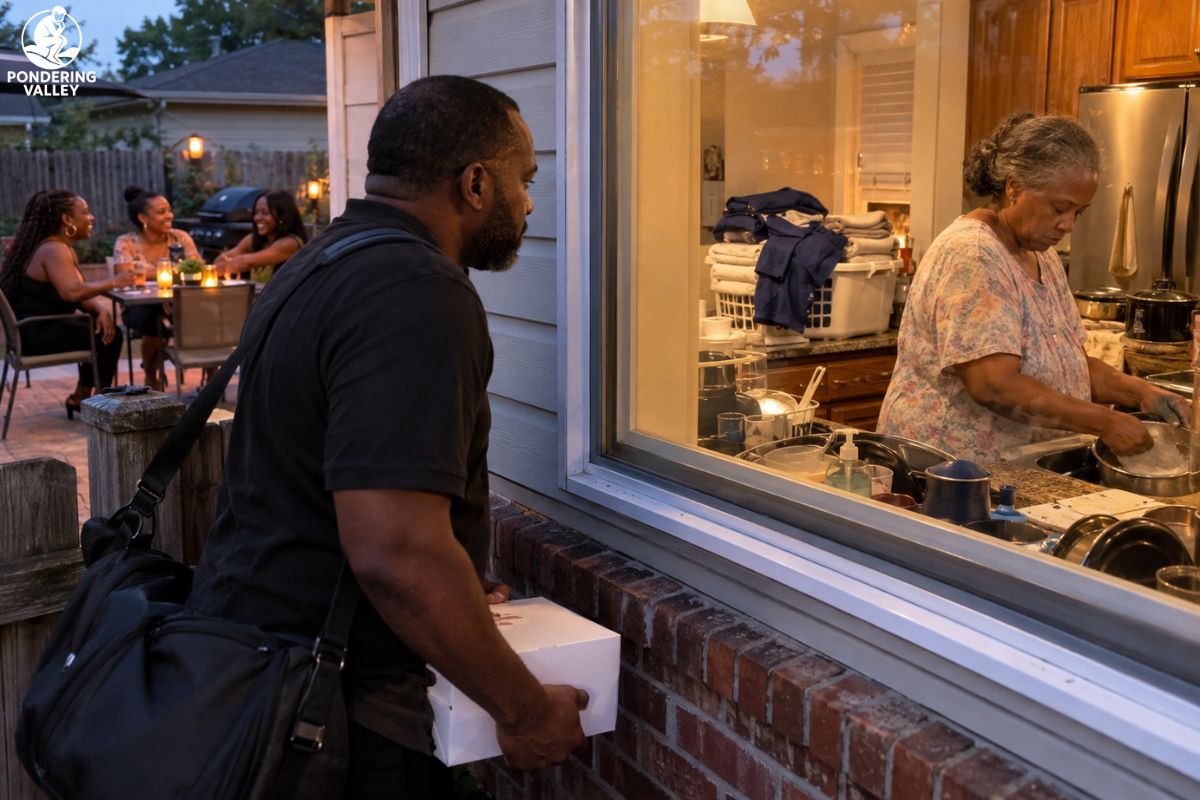
A man stood a few feet away carrying a dented white lunch cooler with a cracked blue handle. He was broad through the shoulders, maybe late sixties, with a gray beard gone uneven at the chin and a faded knit cap pulled low. His rubber boots were wet to the ankle. One sleeve of his heavy canvas jacket had been stitched at the elbow by hand with thick dark thread.
He looked like he smelled faintly of salt, diesel, and fish.
He also looked, Lena thought in one tired defensive flash, like exactly the kind of man a woman alone at night should not trust.
“I’m fine,” she said quickly.
The man glanced at the ferry schedule sign, then back at her face. His eyes lingered there, not in a creepy way, but in a way that made her want to look away first.
“No,” he said. “You’re not.”
A couple walking past slowed down just enough to take in the scene.
Lena straightened. “I said I’m fine.”
The man gave a small nod, like he’d expected that.
“Alright.”
He set his cooler down near his boots and hooked both thumbs into the pockets of his jacket. He didn’t move closer.
“The motel on Harbor Road won’t take nineteen dollars,” he said.
Heat rushed into Lena’s face.
She shoved the wallet back into her scrub pocket. “Were you watching me?”
“Wasn’t trying to,” he said. “Hard not to notice someone counting the same bills three times.”
One of the teenagers glanced over again. Lena could practically feel the shape of the scene from the outside: exhausted woman in scrubs, dock at night, old fisherman talking to her while she cried. It was the kind of moment people misread in a second.
She stood up, hugging herself tighter. “I don’t need money.”
“Didn’t say you did.”
“Then what?”
The man looked toward the black water for a beat before answering.
“I’ve got a spare cabin on my boat.” He spoke the words plainly, like he was offering a chair, not something loaded and dangerous. “Not fancy. Clean enough. Locks from the inside. You can sleep there and catch the morning ferry.”
Lena actually laughed once, sharp and humorless.
“No.”
“Fair.”
“You think I’m getting on a boat with a stranger?”
“No,” he said. “I think you’re cold, dead tired, and about ten minutes from trying to sleep on a bench.”
His bluntness stung because it was true.
She shook her head. “I don’t know you.”
“Name’s Russell.”
“That doesn’t help.”
“No,” he said again. “Probably doesn’t.”
A security guard near the terminal doors looked over, noticed them, then looked away. Lena hated that more than if he’d come over. It felt like the whole world had decided not to get involved.
Russell nudged the cooler with his boot.
“You can say no,” he said. “Wouldn’t blame you. But I’m tied up at slip fourteen. My sister’s got a cabin on the boat too, technically. She’s not on island this week. Bed’s narrow. Blanket’s ugly. Door locks. That’s the offer.”
Lena didn’t answer.
The wind lifted loose strands of hair off her damp forehead. Her body felt so heavy it seemed separate from her mind.
Russell bent, opened the cooler, and pulled out a foil-wrapped sandwich and a thermos. He set them on the dock between them, then stepped back.
“Ham and mustard,” he said. “Coffee’s gone lukewarm, but it’s still coffee.”
“I can’t take your food.”
“You can if I’m offering.”
She stared at the sandwich. Her stomach betrayed her with a painful twist. She hadn’t eaten since a vending-machine granola bar at 2:15.
“I’m not—” Her voice broke. She swallowed. “I’m not a charity case.”
Russell’s face changed then. Not softer exactly, but quieter.
“No,” he said. “You’re not.”
Something in the way he said it made her eyes sting again.
She hated that he could see this. Hated that her whole life lately seemed to be happening one small humiliation at a time. The rent increase. Mateo asking if she was okay in that too-careful voice. The mechanic saying he needed half up front. Her landlord texting a reminder about late fees. The way she’d smiled through all of it like smiling counted as coping.
The sandwich sat unopened between them.
The ferry lights were gone now, swallowed by distance.
Russell looked at Lena’s hand, at the crumpled hospital bracelet still trapped in her fingers.
Then he looked back at her face and said, very gently, “It wasn’t the missed boat, was it?”
That did it.
Lena turned away, covering her mouth.
She didn’t sob. It was worse than sobbing. It was that sound a person makes when they have been holding too much for too long and something inside them slips.
Russell didn’t step forward. Didn’t touch her. Didn’t tell her not to cry.
After a minute, he said, “I had a daughter once who came home from shifts looking just like that.”
Lena froze.
Slowly, she turned back.
Russell was staring out at the water now, jaw tight, one weathered hand wrapped hard around the cracked handle of the cooler.
“She missed things,” he said. “Meals. Sleep. Birthdays. Chances to ask for help.”
His voice had gone distant, scraped hollow by something old and sharp.
Then he looked at Lena fully for the first time and said, “And the last night I saw her alive, she had that same look on her face.”
Lena forgot the cold.
Forgot the ferry.
Forgot to breathe.
Russell reached into his jacket pocket, pulled out a small brass key on a faded float tag, and held it out in his open palm.
“Slip fourteen,” he said. “You can come with me… or not. But if you want to know why I noticed, I’ll tell you when the door’s locked behind you.”
Part 2
Lena stared at the key in Russell’s hand so long that he finally lowered it a little, as if to relieve her of the pressure.
The dock had thinned out. The teenagers were gone. The security guard had disappeared inside. Somewhere beyond the terminal, a truck backfired, and gulls startled up from a piling with harsh cries. The night felt bigger now, emptier.
“You don’t have to decide because of what I said,” Russell told her.
“That’s exactly why I can’t decide,” Lena said.
Her voice came out thin and tired.
He nodded once, accepting that too.
Lena looked at the brass key again. She looked at the sandwich. She looked at the dark row of slips and the masts rocking beyond them. Every alarm she had ever been taught was going off in her head. Don’t get in cars with strangers. Don’t follow men to second locations. Don’t mistake vulnerability for safety.
But another truth sat beside it, colder and more immediate.
She had nowhere to go.
Not really.
And something in Russell’s face when he’d mentioned his daughter hadn’t felt rehearsed. It hadn’t felt manipulative. It had felt like stepping accidentally onto a floorboard and hearing it crack under old weight.
Lena picked up the sandwich first.
Then the thermos.
Then, after one more long second, she took the key.
Russell didn’t smile. He just picked up his cooler.
“Slip fourteen,” he said. “Walk behind me till you’re comfortable. Ahead of me if that makes you more comfortable.”
That, more than anything, made her go.
They walked in silence past the locked bait shop and a row of sleeping boats. The harbor smelled like salt and rope and old wood soaked a thousand times over. A single yellow floodlight buzzed over the slips, throwing everything into hard edges and deep shadows.
Russell stopped beside a modest fishing boat with peeling blue paint and a name on the side that had been repainted so many times the letters looked thick and layered.
MARIBELLE
Lena looked at the name before she could stop herself.
Russell noticed.
“My daughter’s name was Mary Belle,” he said. “Boat used to be my wife’s idea. Name was hers.”
Used to be.
Was.
Every word sat heavy.
He climbed aboard first, slow and careful, then stepped aside so Lena could follow without him reaching for her. The deck was cleaner than she expected. Coiled rope hung neatly. Nets were stacked in order. A lantern glowed near the wheelhouse, casting warm light through a salt-fogged window.
He led her to a small cabin door and pointed.
“Inside there. Bunk on the left. Bathroom’s barely worthy of the name, but it works. There’s a lock. Window sticks unless you shove it.”
Lena stepped in, half expecting the space to confirm every fear she’d had. Instead it smelled faintly of cedar soap and detergent. The bunk was narrow, yes, but neatly made with a folded quilt at the foot. A tiny shelf held a paperback novel, a box of tissues, and a ceramic mug with a chip in the handle full of wrapped peppermints. There was even a clean towel laid across the pillow.
This had not been thrown together.
This had been kept.
“For your sister?” Lena asked before she thought better of it.
Russell stood in the doorway, one hand braced against the frame.
“It was Mary Belle’s when she came out with me some mornings,” he said. “Then my sister used it after.” A pause. “Now mostly nobody does.”
Lena set the thermos down.
“You let strangers sleep in your daughter’s cabin?”
“Not strangers. Just people who need it.”
The answer unsettled her and moved her in equal measure.
Russell cleared his throat. “Lock works. I’ll be in the wheelhouse. You need anything, knock hard. You don’t need anything, I’ll still be up at four. Ferry starts at six-fifteen. There’s bottled water under the shelf.”
He started to step away.
“Wait.”
He stopped.
Lena wrapped both arms around herself. “What happened to her?”
For a second she thought he might not answer.
Then he leaned his shoulder against the doorframe and looked not at her, but at the little mug of peppermints on the shelf.
“Mary Belle was a nurse aide first,” he said. “Then an EMT. Then back in school nights because she wanted to do more. She was twenty-six and running on grit and caffeine.” A small exhale. “Good at taking care of everybody except herself.”
Lena sat on the edge of the bunk without meaning to.
Russell kept going, voice low.
“One winter she worked three doubles in five days. Didn’t tell me how bad money had gotten. Her boyfriend had left. Rent was up. She was driving that old road past Miller’s Point half asleep most nights.” He rubbed at his beard. “One night she called me. Said she was tired. Said she might pull over.”
Lena had gone completely still.
“I told her she was tough. Told her she could make it home.” His eyes closed once. “Thought I was encouraging her.”
The silence after that was brutal.
“Oh,” Lena whispered.
Russell gave one short nod.
“They found her truck in the ditch just before dawn. Not right away. Snow had come down hard.” He swallowed. “If she’d stopped somewhere warm… if she’d asked for help… if I’d told her to sleep wherever she was and I’d come get her…” He shook his head like the sentence had no end and he had lived inside that no-end for years.
Lena looked down at the hospital bracelet still looped around her wrist now, where she’d absently slid it.
“I’m sorry,” she said.
“So am I.”
The words sat there, plain and insufficient.
After a moment Russell straightened. “Get some sleep.”
Lena did lock the door after he left. She leaned against it for a second, listening to the creak of the boat and the soft wash of water against the hull.
Then she sat back on the bunk and finally opened the sandwich.
It was simple. Cheap white bread, mustard, ham, a slice of cheese gone a little sweaty inside the foil.
It tasted like the first decent thing that had happened to her all week.
She cried while eating it, quietly and without drama, one hand over her eyes.
Later, she brushed her teeth with toothpaste from a tiny travel tube she found near the sink. She folded her scrubs neatly over the chair because nurses and tired women and daughters of no one all still needed some order somewhere. Then she crawled under the quilt and stared at the low ceiling while the boat rocked gently around her.
She thought she would never sleep.
Instead she woke to pale gray light and the sound of a kettle whistling somewhere nearby.
For one confused second, she didn’t know where she was.
Then the cabin. The dock. The ferry. Russell.
Lena sat up too fast. Her phone was dead. Her neck ached. But she had slept. Real sleep. More than she’d had in weeks.
When she opened the cabin door, Russell was already on deck pouring coffee into two mismatched mugs. The harbor looked washed clean in the dawn light. Gulls wheeled above the pilings. The air was sharp enough to sting.
“Morning,” he said.
Lena hesitated. “Morning.”
He handed her a mug without comment.
She took it in both hands. It was hot and bitter and wonderful.
“Thank you,” she said.
Russell nodded toward the cabin she’d slept in. “There’s a drawer under the bunk. Meant to tell you last night.”
Lena frowned. “Okay?”
“You should look before you go.”
Something in his face had changed. Not harder. More decided.
She set the mug down and went back inside.
The drawer stuck halfway, just like the window, and then came free with a scrape.
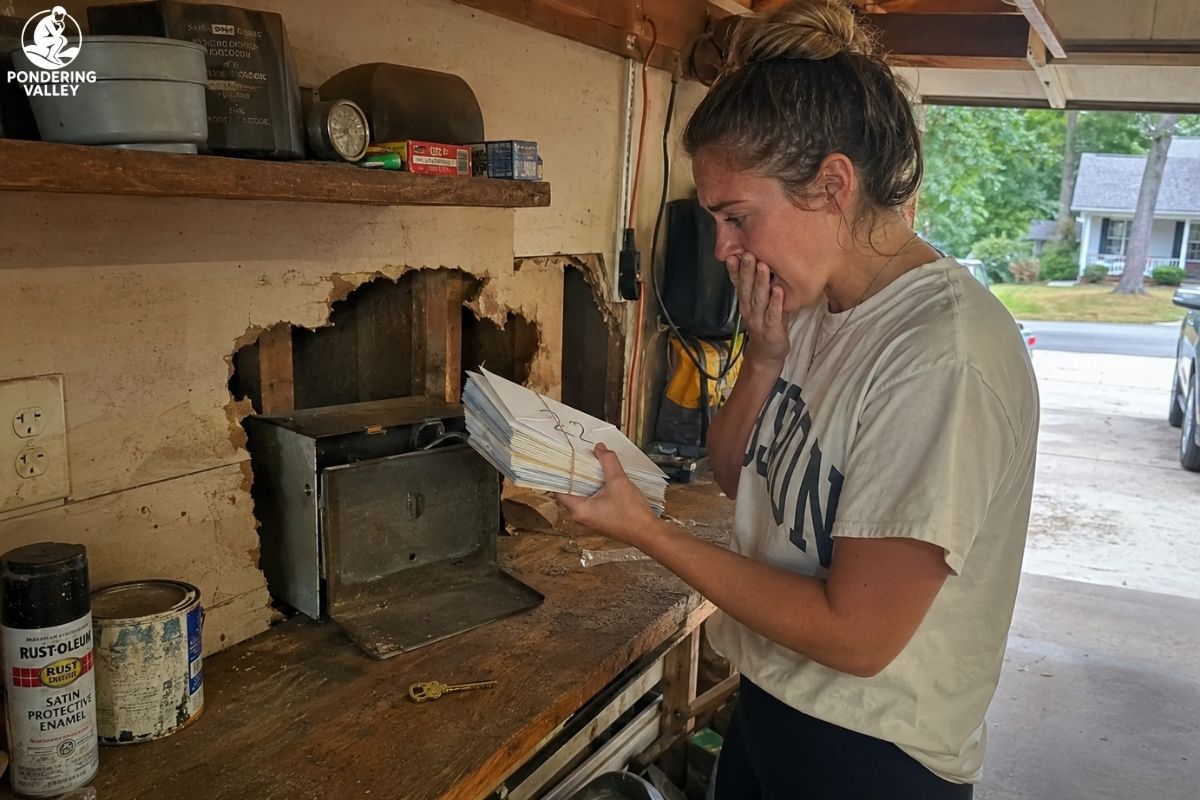
Inside were a few folded sweaters, a pack of hair ties, an old ferry timetable rubber-banded together, and beneath them, a stack of envelopes tied with faded blue ribbon.
On top of the stack sat a photograph.
A young woman in navy scrubs leaned against this same boat, laughing at whoever stood behind the camera. Wind had caught her dark hair across one cheek. She looked tired even in the photo, but alive with it. Behind the tiredness was something Lena knew instantly because she saw it in mirrors and break-room microwaves and ambulance bay reflections.
Keep going. Keep going. Keep going.
On the back of the photo, in blocky black ink, someone had written:
For the next one who says they’re fine.
Lena’s throat closed.
She carried the photograph out to the deck with both hands.
Russell didn’t look surprised to see it. He just stared past her at the horizon and said, “Those are Mary Belle’s letters. She wrote them during night classes. Never mailed them. Didn’t know she had until I cleaned this cabin out after…” He stopped, then started again. “Most of them are to nobody in particular. Just whatever she couldn’t say out loud.”
Lena looked down at the stack in the drawer, then back at him.
“Why are you showing me this?”
Russell’s jaw tightened.
“Because there was one letter,” he said, “that made me start keeping this cabin ready. And if I’m right about the look on your face, you need to read it before you decide what comes next.”
Lena went cold despite the coffee warming her palms.
“What comes next?”
Russell finally turned to meet her eyes.
“The part where you tell the truth,” he said, “about why missing the ferry scared you so much.”
Part 3
Lena stood on the deck with the photograph in one hand and the coffee cooling in the other.
The harbor had fully woken up around them now. Engines coughed to life. A gull landed on a piling and screamed at nothing. Somewhere across the slips, someone laughed.
It felt obscene that the morning could look so ordinary.
Russell lifted the blue ribbon-tied letters from the drawer and handed her the top one.
The envelope had never been sealed. On the front, in the same thick black handwriting as the note on the photograph, were the words:
To whoever is too tired to admit how bad it is.
Lena sat on the edge of the bunk and unfolded the paper carefully.
The handwriting slanted hard to the right, quick and messy in places, as if the person writing had been trying to outrun her own exhaustion.
It wasn’t a long letter.
It said that sometimes the most dangerous lie in the world was I’m fine.
It said being needed could turn into a kind of trap if you forgot you were a person too.
It said there would come a night when pride would sound noble and really just mean lonely.
It said: If somebody offers you a safe place to land, take it before your body chooses for you.
And near the end, written darker, as though the pen had been pressed harder into the page, it said:
If my dad ever meets someone with my face on theirs, I hope he does better by them than he did by me.
Lena lowered the letter very slowly.
The cabin blurred.
She pressed her fingers to her mouth, but it didn’t stop the sound that escaped her.
Outside, Russell gave her the privacy of not looking in.
For a long minute she just sat there breathing around the ache in her chest. Then another ache rose under it, one she had been stepping over for weeks.
She brought the letter out to him with shaking hands.
“She knew,” Lena said.
Russell nodded once, but his eyes were wet. “Yeah.”
“She forgave you.”
He looked down at the deck boards. “Maybe.”
Lena clutched the letter tighter. “She did.”
Russell let out a breath that sounded like it had been trapped inside him for years.
Then he said, quietly, “Now you.”
Lena tried to laugh, but it turned into nothing.
“I’m just tired.”
Russell didn’t argue. He only waited.
And because he waited, because he didn’t fill the silence with comfort or questions or easy words, the truth finally broke loose.
“It wasn’t just the ferry,” Lena said.
She stared at the rope coiled by her feet so she wouldn’t have to watch his face.
“My landlord texted this morning. If I’m late again, he’s giving the room to someone else. My car needs nine hundred dollars I don’t have. My brother keeps asking if I’m okay, and I keep telling him yes because he already works two jobs.” Her voice thinned. “Yesterday I almost fell asleep at a red light.”
Russell stayed still.
Lena kept going because once the confession started, it didn’t seem possible to stop.
“And last week, after a shift, I pulled over at Miller’s Point because I couldn’t keep my eyes open.” Her whole body went cold saying it. “I sat there with my forehead on the steering wheel and thought, just for one second, that if I didn’t wake up for work tomorrow maybe that would be easier than figuring everything out.”
The harbor noise seemed to drop away.
Russell’s face went white under the weather and beard.
Lena shook her head fast, tears running now. “I didn’t mean I wanted to die. I just… I wanted everything to stop pressing on me for five minutes. I was so tired. I’m so tired.”
Russell looked out over the water and shut his eyes.
When he opened them again, grief and relief were mixed together so tightly Lena couldn’t separate them.
“Thank you for saying it right side up,” he said.
Lena frowned through tears.
He pointed gently at the letter in her hand.
“Before it turned into something nobody could fix.”
That broke her open all the way.
She cried standing there on the deck of a fishing boat that smelled like salt and bait and old wood, while an almost-stranger stood a respectful distance away and let her tell the truth she had been choking on.
When she could finally breathe again, Russell said, “You got anybody who loves you enough to be inconvenienced?”
Lena gave a wet laugh. “That’s a mean way to put it.”
“It’s an honest one.”
She thought of Mateo. Twenty-three, stubborn, always pretending he wasn’t worried when he was. The photo booth strip still in her pocket. His last text from two nights ago: You good? Don’t give me your nurse answer.
Lena nodded.
“My brother.”
“Call him.”
“My phone’s dead.”
Russell reached into the wheelhouse and came back with a charger brick held together by black electrical tape.
“Then charge it.”
She stared at the thing. It was absurdly ugly.
She took it anyway.
By the time the ferry horn sounded in the distance, Lena’s phone had enough power to turn on. Three texts from Mateo came through at once.
You awake?
You okay?
Lena, answer me.
Her thumb hovered over the screen.
Russell was coiling a line, giving her privacy again without theatrics.
She typed: I’m not okay. Can you talk?
The response came before she could lower the phone.
Yes. Always. What happened?
Lena pressed call.
She expected to need to be composed. Expected to smooth it out, manage it, make it sound smaller.
Instead the minute she heard Mateo say, “Len?” she started crying again.
And because of that, maybe for the first time in months, she told the truth fast enough that it couldn’t be edited.
Mateo listened.
Then he said, “I’m coming over after shift. I don’t care if I have to borrow a truck and sleep in a chair. You are not doing this alone.”
Lena closed her eyes.
“Okay,” she whispered.
After she hung up, Russell handed her the photo of Mary Belle.
“Keep that,” he said.
“I can’t.”
“You can.”
Lena looked down at the young woman frozen in laughter against the side of the boat.
“For the next one who says they’re fine,” she read softly.
Russell gave a small nod. “That’s you.”
She folded the photo carefully into her wallet behind the strip of Mateo.
When they walked to the ferry together, the dock looked different in daylight. Smaller somehow. Less final. The same sign. The same booth. The same water. But not the same woman standing on the planks.
At the terminal gate, Lena turned to Russell.
“I don’t know how to thank you.”
He shrugged one shoulder. “Sleep. Ask for help sooner next time. That’d be enough.”
She swallowed. “Was it really just because of my face?”
Russell looked toward the boat named for his daughter.
“No,” he said. “It was the bracelet in your hand, the way you kept apologizing without words, and the fact that tired people all think they’re hiding it better than they are.” Then he met her eyes. “But mostly, yeah. I knew that look. And I wasn’t going to send it back into the dark.”
Lena cried again at that, but only a little.
The ferry arrived with its usual groan and churn of water. People lined up. Suitcases rolled. Someone complained about the wind. Life moved forward with shocking indifference.
Before she boarded, Lena turned back one last time.
Russell lifted two fingers from the handle of his cooler.
That was all.
Weeks later, after Mateo had helped her move into his tiny apartment for a while, after her supervisor had quietly connected her with an emergency assistance fund for hospital staff, after she finally admitted to a counselor that burnout had teeth, Lena took the ferry again on her day off.
She brought coffee in a paper tray and a new thermos because Russell’s old one leaked from the lid.
She found him at slip fourteen, mending a net.
He looked up, squinted, and said, “You look less haunted.”
“Rude,” Lena said.
He smiled then, the first real smile she’d seen on him.
The cabin door was open behind him.
On the little shelf inside, beside the chipped mug of peppermints, sat a framed copy of Mary Belle’s photograph.
And next to it, propped carefully against the wall, Lena had brought something new: a handwritten note on white cardstock.
It said:
If you’re reading this, sit down. Eat something. Charge your phone. Then call the person who loves you enough to be inconvenienced.
Russell read it twice and had to clear his throat before he could speak.
“That’s a good one,” he said.
Lena looked out at the water, bright and cold and moving.
“Yeah,” she said. “I know.”
Some people think being saved has to look dramatic to count.
A siren. A speech. A hand pulling you back from an edge everyone can see.
But sometimes it is only a dented cooler on a dark dock. A narrow bunk with a clean quilt. A man who once answered wrong and decided to spend the rest of his life answering differently.
And sometimes that is enough to get a person home.