If you’ve already read part 1 of this story on Facebook, go here for Part 2!
PART 1
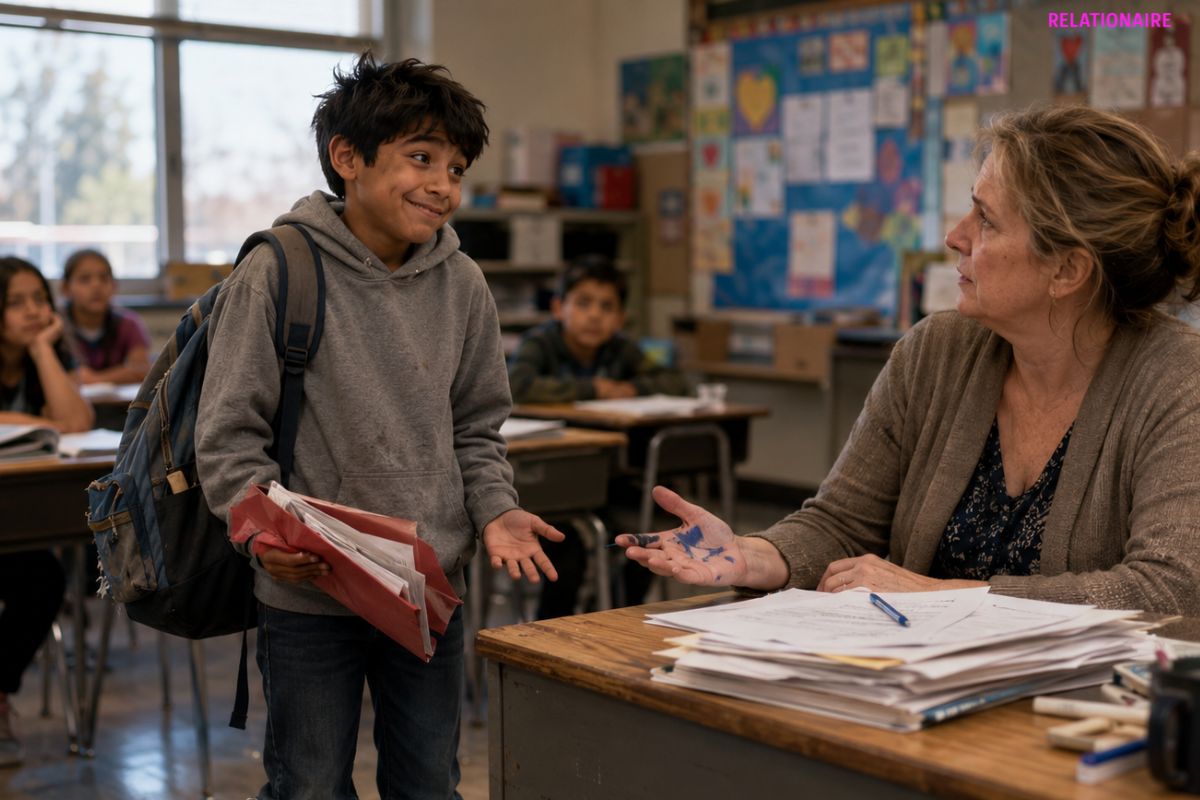
The third time Mateo Ramirez “forgot” his field trip form, he made the whole class laugh.
Again.
He stood by Mrs. Callahan’s desk with his backpack hanging off one shoulder, one sneaker untied, and that bright, troublemaking grin he used whenever he was trying not to look afraid.
“Honestly, Mrs. C,” he said, loud enough for the back row to hear, “I’m allergic to museums.”
The room cracked up.
Even Mrs. Callahan almost smiled.
Almost.
She was too tired that morning to smile all the way. Her coffee had gone cold before the first bell. A dry erase marker had exploded blue ink across her palm. And the stack of permission slips for the fifth-grade history museum trip sat on her desk like a quiet accusation.
Twenty-two forms returned.
One missing.
Mateo’s.
Again.
“Mateo,” she said softly, “you had the whole weekend.”
“I know.” He shrugged. “But my backpack ate it.”
Laughter again.
He bowed like he was onstage.
Mrs. Callahan looked at him for one second longer than usual.
He had always been funny.
Too funny sometimes.
Funny when he forgot homework. Funny when he got a low score. Funny when kids asked why his grandmother came to conferences instead of his parents. Funny when the cafeteria cashier reminded him his lunch account was empty.
Jokes were Mateo’s jacket.
He wore them everywhere.
“Check your folder,” Mrs. Callahan said.
He sighed dramatically and pulled out his red homework folder. It was bent at the corners, soft from too many months of being shoved into a backpack with broken zippers.
He opened it.
Inside were crumpled math pages, a wrinkled spelling test, a library notice, and three old snack wrappers.
No permission slip.
“See?” Mateo said. “Backpack digestion. Very serious condition.”
A few kids giggled.
Mrs. Callahan didn’t.
The field trip was Friday. Four days away.
The museum fee was twelve dollars.
It wasn’t much to some families. Less than pizza. Less than a streaming subscription. Less than the fancy coffee one parent carried into the front office every morning while complaining about pickup line traffic.
But Mrs. Callahan knew twelve dollars could be heavy.
She knew because she had paid it before.
Quietly.
Many times.
From the same wallet she used to buy extra glue sticks, replacement headphones, granola bars, winter gloves, and the little birthday cupcakes no one’s parents remembered to send.
Still, Mateo had not asked.
He had joked.
He had dodged.
He had “forgotten” three times.
And that morning, with twenty-six children restless before announcements, Mrs. Callahan let her patience slip.
“Mateo,” she said, a little sharper than she meant to, “this isn’t funny anymore.”
The class went quiet.
His grin stayed up, but something behind it dropped.
“I know,” he said. “That’s why I’m using new material.”
Nobody laughed this time.
Mrs. Callahan lowered her voice. “You need to bring the form tomorrow. Signed. With the fee. Or you won’t be able to go.”
Mateo looked past her shoulder at the bulletin board where construction paper leaves still framed October essays about gratitude.
Then he gave a careless little salute.
“Yes, ma’am.”
He walked back to his seat like nothing had touched him.
But Mrs. Callahan saw his ears turn red.
That was the first crack.
The second came at lunch.
She was passing through the cafeteria to drop off attendance sheets when she saw Mateo at the end of the table, pretending to trade carrot sticks for chips.
He had no chips.
His tray held plain milk, half a scoop of mashed potatoes, and a fruit cup he hadn’t opened.
Beside him, two boys were talking about the museum gift shop.
“My mom said I can bring twenty dollars,” one said.
“My dad said I can get one of those fossil kits,” another said.
Mateo leaned back in his chair.
“Gift shops are scams,” he announced. “I’m boycotting capitalism.”
The boys laughed.
Mrs. Callahan stopped near the trash cans.
Mateo looked down at his tray and pushed the potatoes around with a plastic fork.
He didn’t eat much.
That afternoon, during silent reading, he asked to go to the nurse.
“My stomach is conducting a protest,” he whispered.
Mrs. Callahan signed the pass.
When the nurse sent him back ten minutes later, his eyes looked damp.
“Everything okay?” Mrs. Callahan asked.
“Great,” he said. “Nurse said I’m too handsome to be sick.”
There it was again.
The joke before anyone could ask a real question.
After dismissal, Mrs. Callahan stayed late.
The hallway emptied slowly. Sneakers squeaked. Lockers slammed. The lost-and-found bin overflowed with one pink mitten, three gray hoodies, and a coat no one had claimed since Thanksgiving.
She straightened desks. Picked up pencil shavings. Pulled a glue stick cap from under the reading rug.
Then she noticed Mateo’s red folder sticking out of the side pocket of his backpack.
He had left it hanging on his chair.
Again.
She should have put it in the front office.
She knew that.
But the corner of a paper was poking out of the folder.
The permission slip.
Her chest tightened.
So he had it.
He had lied.
Mrs. Callahan sat down slowly at his desk.
The room was quiet now, except for the hum of the old heater and the distant thump of a basketball in the gym.
She pulled the folder free and opened it.
There it was.
The museum permission form, folded in half.
Signed.
For one relieved second, she thought maybe this was all just Mateo being Mateo.
Then she looked closer.
The signature line read: Elena Ramirez
His grandmother.
But the handwriting was wrong.
Too shaky in some places.
Too careful in others.
Like a child pretending to be an adult.
Mrs. Callahan’s stomach sank.
Attached to the form was a blank envelope for the twelve-dollar fee.
Empty.
She stared at the forged signature.
She should have felt angry.
A forged permission slip was serious. There were rules. Policies. Calls home. Documentation. A conversation with the principal.
But underneath the form, folded into the very back pocket of the folder, was another piece of paper.
Not school paper.
A grocery receipt.
On the back, written in pencil so hard it nearly tore the paper, were five words.
Don’t tell my abuela. Please.
Mrs. Callahan stopped breathing for a second.
The classroom suddenly felt too still.
Then she heard the front door buzz in the office down the hall.
A tired woman’s voice floated faintly through the intercom speaker.
“I’m here for Mateo’s backpack.”
Mrs. Callahan looked at the note in her hand.
And for the first time all week, she understood she had been wrong.
PART 2
Mrs. Callahan folded the grocery receipt exactly the way she had found it.
Not because she was hiding evidence.
Because she was holding someone’s shame.
There is a difference.
She sat in Mateo’s chair, her knees pressed against the little desk, the permission slip in one hand and the note in the other.
Don’t tell my abuela. Please.
The words were crooked. The “please” was darker than the rest, traced over more than once.
She pictured Mateo writing it while everyone else packed up. His head low. One arm curved around the paper. That grin nowhere in sight.
The office called her classroom.
“Mrs. Callahan? Mrs. Ramirez is here for Mateo’s backpack.”
“I’ll bring it,” she said.
Her voice sounded too normal.
She slipped the permission slip and note back into the folder, then zipped the broken side of Mateo’s backpack as best she could. It caught halfway. She tugged once, gently.
The backpack was heavier than it looked.
A child’s whole life usually was.
In the front office, Elena Ramirez stood beside the attendance counter in a faded navy work shirt. Her gray hair was pulled into a bun that had started to loosen. Her hands were red at the knuckles, dry from soap and winter air.
She looked smaller than Mrs. Callahan remembered from conferences.
Not weak.
Just worn thin.
“I’m sorry,” Elena said immediately. “He forgot it. He forgets everything. I tell him, Mateo, your head would roll away if God didn’t attach it.”
She smiled, but it didn’t reach her eyes.
Mrs. Callahan held out the backpack.
“No trouble.”
Elena took it with both hands.
For a moment, neither of them moved.
Behind the counter, the school secretary answered a phone call about an early pickup. A child in the nurse’s office coughed. Someone’s sneakers squeaked down the hall.
Ordinary sounds.
Ordinary day.
Extraordinary weight.
“Elena,” Mrs. Callahan said carefully, “I sent home another museum form last week. Did Mateo show it to you?”
The grandmother blinked.
“The museum?”
“Yes. Friday.”
“Oh.” Elena’s face changed so fast Mrs. Callahan wished she could take the question back. “He told me the trip was canceled.”
Mrs. Callahan felt the lie settle between them.
Not cruel.
Not careless.
A little boy’s shield.
“No,” she said softly. “It’s still happening.”
Elena looked down at the backpack.
“How much?”
“Twelve dollars.”
It was one of those numbers that sounded small until it landed in the wrong room.
Elena nodded once.
“Okay.”
She said it the way adults say things when they have no idea how to make them okay.
“I can send it tomorrow,” Elena added. “I get paid Thursday night. Maybe Friday morning before school. I can—”
“Elena,” Mrs. Callahan said, “please don’t worry about it tonight.”
The grandmother’s eyes sharpened.
Not suspicious.
Proud.
“Mrs. Callahan, I don’t want charity.”
“I know.”
“I mean that.” Elena’s fingers tightened around the backpack strap. “I am raising him. Maybe not perfectly. But I am raising him.”
“I know you are.”
“My daughter—” Elena stopped.
Her mouth trembled once, then firmed. “His mother is not able to be here right now. His father never was. Mateo knows too much about bills for a child. I try to keep things from him, but he listens at doors.”
Mrs. Callahan said nothing.
Sometimes silence is the kindest chair you can offer.
Elena looked toward the hallway, where children’s artwork hung in crooked rows.
“He makes jokes when he is scared,” she said. “Just like my son did. Mateo’s uncle. He died laughing, that one. Cancer at twenty-nine and still teasing the nurses.”
Her laugh broke halfway.
Mrs. Callahan felt something in her own chest pull tight.
She knew grief that wore a professional face.
Her husband’s picture still sat in the drawer of her desk because she could not bear to keep it on top anymore. Three years gone. Car accident in March rain. She had taken two weeks off and then come back to twenty-six children who needed fractions explained, shoes tied, tears noticed.
No one had clapped for that, either.
They had simply expected her to keep teaching.
And she had.
“Elena,” Mrs. Callahan said, “Mateo is trying to protect you.”
The grandmother closed her eyes.
There it was.
The wound.
Not that he lied.
That he thought he had to.
“When his grandfather was alive,” Elena whispered, “we never missed anything. Trips. Shoes. Pictures. I always had a little money hidden in the sugar jar.”
She opened her eyes again.
“Now the sugar jar is empty.”
Mrs. Callahan wanted to reach for her hand, but she didn’t.
Some dignity needs space around it.
Instead, she said, “Can I ask you something?”
Elena nodded.
“Would you be willing to sign a new form tonight if I send one home?”
“Yes. Of course.”
“And would you let Mateo earn his trip fee here at school?”
Elena frowned.
“Earn?”
“Helping me organize the classroom library after dismissal tomorrow. Straightening the lost-and-found. Nothing big. Real work. I have a small classroom supply fund I can use for student helpers.”
That was not exactly true.
There was no fund.
There was just Mrs. Callahan’s wallet, already thin until payday.
But there were times when truth and dignity had to meet each other gently.
Elena studied her face.
“You would do that?”
“Mateo would do that,” Mrs. Callahan said. “He can pay his own way.”
For the first time, the grandmother’s eyes filled completely.
She looked away quickly, wiping under one eye with her thumb.
“I don’t want him embarrassed.”
“Neither do I.”
“And the form?”
“I’ll tell him I found it damaged and need a clean one signed.”
Elena let out a breath that sounded like she had been holding it for months.
“Thank you,” she said.
But Mrs. Callahan shook her head.
“Don’t thank me yet. I still have to talk to him.”
The next afternoon, Mateo was the last one out of the room.
He moved slowly on purpose, sharpening a pencil that was already sharp, rearranging books in his desk, tying and retying his shoe.
Mrs. Callahan waited until the hallway quieted.
“Mateo,” she said.
He froze.
Not turned.
Froze.
“I found your folder yesterday.”
His shoulders rose.
The class clown disappeared so quickly it almost hurt to watch.
When he turned around, his face was pale.
“I can explain,” he said.
Mrs. Callahan held up the clean permission slip.
“Good,” she said softly. “Because I need you to explain something important.”
His eyes dropped to the paper.
Then to her face.
Then to the floor.
“I didn’t want her to know,” he whispered.
And Mrs. Callahan knew the next words would matter more than any lesson she had taught all year.
PART 3
Mrs. Callahan did not ask Mateo why he forged the signature.
Not first.
First, she pulled out the chair beside her desk.
“Sit with me a minute.”
He sat on the very edge, like he might need to run.
His hands were stuffed deep in the front pocket of his hoodie. One knee bounced fast under the desk.
Mrs. Callahan placed the new permission slip between them.
No principal.
No lecture.
No shame.
Just paper.
Just a boy.
Just the truth trying to come out without breaking him.
“I know you were trying to protect your grandmother,” she said.
Mateo’s eyes filled instantly, which seemed to embarrass him more than being caught.
He looked at the ceiling.
“I wasn’t stealing,” he said quickly. “I wasn’t going to go. I just wanted people to stop asking.”
“I know.”
“I signed it because I thought if you saw it, you’d stop sending it home. Then I was going to say I was sick Friday.”
His voice cracked on Friday.
Then the words spilled out.
“She already works at the laundry place in the morning and cleans offices at night. She falls asleep sitting up sometimes. Last week she cried because the electric bill came pink. She thought I didn’t see, but I saw.”
He wiped his face with the heel of his hand, angry at his own tears.
“And everyone keeps talking about the gift shop and snacks and bringing money. I don’t even care about the museum. It’s just old stuff behind glass.”
Mrs. Callahan waited.
Mateo swallowed hard.
“I care a little,” he admitted.
That one small sentence nearly undid her.
“I know,” she said.
He looked at her then.
Really looked.
“Are you going to tell Dr. Benson?”
The principal.
The office.
The serious voice.
The permanent feeling of trouble.
Mrs. Callahan took a breath.
“I’m not going to pretend what you did was okay,” she said. “Forging a signature is serious. It’s unsafe. Permission forms matter because the adults who love you need to know where you are.”
Mateo nodded, eyes down.
“But I also know why you did it,” she continued. “And that matters too.”
He looked confused.
Children are used to rules being loud.
Mercy often surprises them.
“So am I suspended from the field trip?”
“No.”
His head snapped up.
“You’re going.”
“I can’t.”
“You can.”
“I don’t have—”
“You’re going to earn the fee.”
He blinked.
Mrs. Callahan pointed to the classroom library.
“The nonfiction shelf looks like a raccoon organized it. The lost-and-found bin needs sorting. And someone has to test all these markers and throw away the dead ones.”
Mateo stared at her.
“You’re paying me to throw away markers?”
“I’m paying you for after-school help.”
“That’s not a real job.”
“It is if you do real work.”
He studied her face the way children do when they are checking for pity.
He didn’t find any.
Only steadiness.
So he nodded once.
“Okay.”
For forty minutes, Mateo worked harder than Mrs. Callahan had ever seen him work.
He sorted books by topic. He lined up bins. He found three missing library cards, a petrified cheese stick wrapper, and one permission slip from September.
He tested markers on scrap paper.
“Dead,” he said, tossing one into the trash.
“Alive.”
“Barely alive.”
“Zombie marker.”
Mrs. Callahan smiled despite herself.
At 4:15, she handed him a small envelope with twelve dollars inside.
His name was written across the front.
“Your wages,” she said.
He took it slowly.
His thumb rubbed over his name.
“This is for the trip?”
“You earned it.”
He nodded, but he didn’t move.
Then he whispered, “Can I tell Abuela I helped you?”
“Yes.”
“Can I not tell her the other part?”
Mrs. Callahan paused.
“You need to tell her you were scared to show her the form,” she said gently. “You don’t have to hurt her with every detail tonight. But she deserves the truth that you love her enough to worry.”
Mateo thought about that.
Then he tucked the envelope carefully into the folder, not loose in the backpack where things disappeared.
The next morning, he came in without jokes.
That was how Mrs. Callahan knew it mattered.
He walked straight to her desk and handed her the form.
Signed properly.
Twelve dollars sealed inside the envelope.
At the bottom of the form, Elena had written one line.
Thank you for letting him stand tall.
Mrs. Callahan had to look away for a second.
The field trip was cold and gray and wonderful.
The bus smelled like vinyl seats and orange crackers. The children fogged the windows with their breath. Mateo sat beside Jordan and pretended not to be excited when the museum came into view.
But inside, he was the first one to raise his hand in the dinosaur hall.
He read every plaque.
He stood in front of a glass case holding old coins and whispered, “Imagine losing one of those in your couch.”
At lunch, Mrs. Callahan watched him unwrap a sandwich from foil.
No gift shop bag.
No extra snacks.
Just a boy sitting with his class, laughing for real.
Not as armor.
As joy.
When they reached the gift shop, Mateo stayed near the door.
Mrs. Callahan noticed.
So did Elena, in her own way, even though she wasn’t there.
Because tucked inside Mateo’s lunch bag was a folded napkin with five dollars in it.
For something small, she had written.
Mateo picked a pencil shaped like a dinosaur bone.
It cost $1.75.
He kept the change.
“For Abuela’s sugar jar,” he told Mrs. Callahan quietly.
That evening, after the buses left and the classroom emptied, Mrs. Callahan found something on her desk.
The dinosaur pencil.
Beside it was a note in Mateo’s blocky handwriting.
You can use this for grading. It is historic. Also thank you for not making me small.
Mrs. Callahan sat down.
The heater hummed. The hallway lights buzzed. Somewhere, a custodian rolled a trash bin past the door.
No applause.
No announcement.
No one would write that moment into a curriculum map.
But Mrs. Callahan held that pencil like it was made of gold.
Because some days teaching was fractions and spelling and forms signed on time.
And some days it was noticing the child behind the joke.
Protecting the grandmother behind the pride.
Finding a way for the truth to stand up without crushing anyone underneath it.
Years later, Mateo would not remember every exhibit from that museum.
He would not remember the worksheet.
He might not even remember the dinosaur pencil.
But he would remember this:
There was one day he lied because he was ashamed.
And an exhausted teacher, with blue marker ink still stained on her hand, chose not to expose him.
She chose to help him tell the truth with his dignity still intact.
Sometimes that is the lesson a child carries longest.
Not what was written on the board.
What someone quietly refused to take from them.