If you’ve already read part 1 of this story on Facebook, go here for Part 2!
PART 1
By October, everyone at Ridgeway High knew Room 214 was the place you went when you had nowhere else to go.
Not officially.
Not on any school map.
Not written in any handbook between “dress code” and “late policy.”
But the students knew.
Before first bell, when the halls still smelled like floor wax and burnt coffee, the light above Room 214 was already on.
At lunch, when the cafeteria got too loud and the tables made people feel chosen or rejected in public, Room 214 stayed open.
After school, when buses hissed at the curb and coaches shouted across the gym hallway, the same door remained cracked.
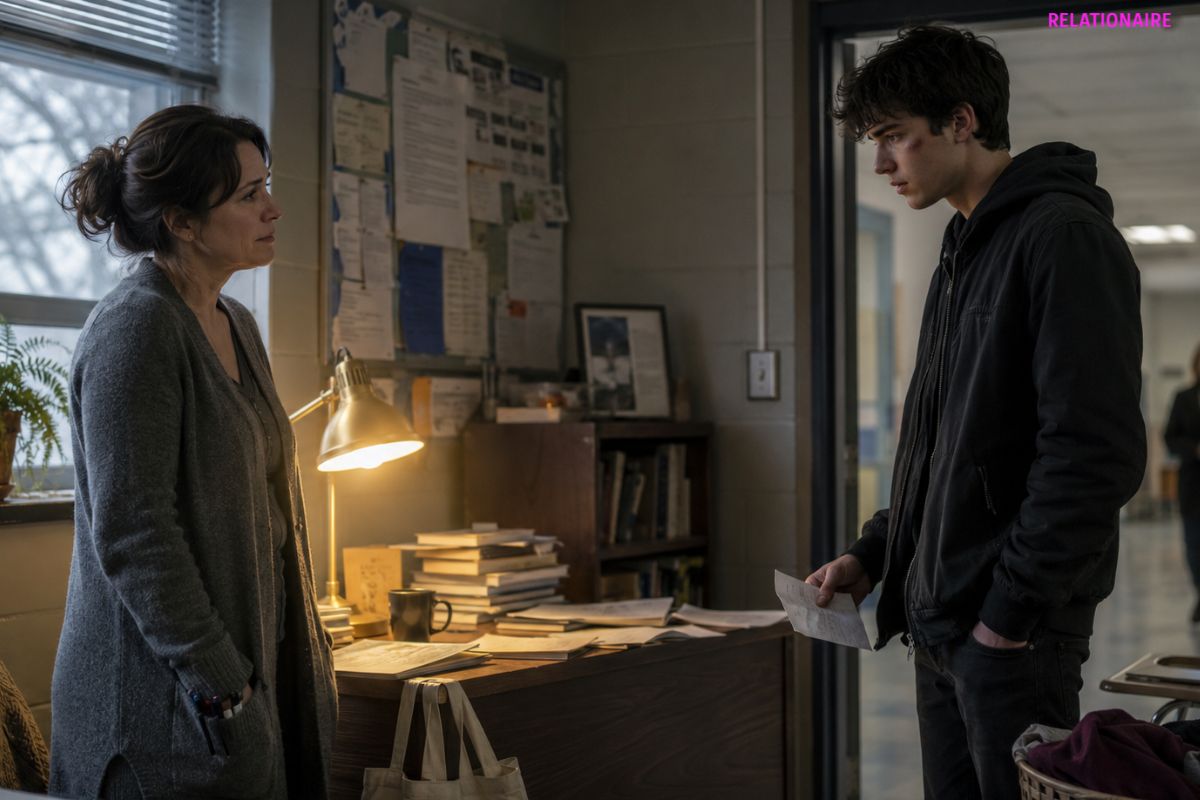
Inside was Ms. Elena Marlow, English teacher, forty-seven, always wearing cardigans with pockets full of pens that didn’t work, always carrying a canvas tote bag that looked one bad day away from giving up.
Her classroom was nothing special.
Old desks.
A dying fern on the windowsill.
A bulletin board with curling paper borders.
A quote from Maya Angelou taped crookedly near the pencil sharpener.
A lost-and-found basket under the sink with three hoodies, one pair of gloves, and a lunchbox no one ever claimed.
But there was always a lamp glowing on her desk.
Not the ceiling lights. Those buzzed too much.
The lamp.
Warm, yellow, soft.
Students joked about it.
“Room 214 got better hours than Walmart.”
“Ms. Marlow don’t even go home.”
“Her classroom is basically a shelter.”
They laughed when they said it.
Mostly.
The teachers didn’t always laugh.
“She needs boundaries,” Mr. Henson from chemistry said one Friday in the staff lounge, stirring powdered creamer into coffee that had been sitting since 7:15.
“She’s going to burn herself out,” said Ms. Vale, the assistant principal, not cruelly, just tired.
“She already looks burned out,” someone muttered.
Elena heard them from the microwave.
She was heating up soup she had packed three days earlier and forgotten twice.
The plastic lid was warped.
Her hands smelled faintly of dry erase marker.
She didn’t turn around.
The truth was, they were not wrong.
She was tired.
Her mortgage was late.
Her car made a clicking sound every time she turned left.
Her mother’s nursing home called so often that Elena had started flinching whenever her phone buzzed.
And every night, she graded essays at her kitchen table under a light bulb that flickered just enough to make her feel like the whole apartment was holding its breath.
Still, every morning, she unlocked Room 214 before anyone asked.
Because students asked without asking.
They came in with broken backpack zippers and wrinkled homework.
They came in pretending they needed a stapler.
They came in to fill a water bottle.
They came in because the cafeteria was unbearable.
They came in because their parents were fighting.
They came in because no one was home until midnight.
They came in because being sixteen was sometimes just another way of being lonely in public.
Elena never made a big thing of it.
She didn’t say, “Tell me what’s wrong.”
She didn’t say, “This is a safe space.”
She just looked up from her papers and said, “There’s a chair.”
Sometimes that was enough.
The student everyone complained about most that year was Marcus Reed.
Seventeen.
Tall.
Quiet until he wasn’t.
Hoodie up even when the building was warm.
A cracked phone screen.
Shoes with one sole lifting at the front.
Marcus was smart in a way that made adults impatient.
He could read a room faster than most teachers could read an essay. He knew which adults were bluffing, which ones were scared of him, which ones just wanted him gone.
His grades were bad.
His attendance was worse.
He turned in essays half-finished, if he turned them in at all.
He slept through third period with his arms folded on his desk and his jaw clenched like even sleep was a fight.
When called on, he shrugged.
When corrected, he smiled without warmth.
When sent to the office, he walked like he’d been expecting it.
“Elena,” Ms. Vale said one afternoon, standing in the doorway of Room 214 with a folder pressed to her chest, “Marcus Reed was in here again during lunch.”
Elena was wiping crumbs from a desk. Someone had eaten crackers and left the wrapper tucked into a textbook.
“He was.”
“He’s skipping the cafeteria.”
“He wasn’t eating anyway.”
Ms. Vale sighed. “That isn’t the point.”
Elena looked at her.
The hallway behind Ms. Vale was full of noise. Lockers banging. Sneakers squeaking. Someone laughing too loudly near the stairwell.
“I’m worried you’re giving him a place to avoid expectations,” Ms. Vale said.
Elena folded the paper towel slowly.
“He wrote today.”
Ms. Vale blinked.
“Three paragraphs,” Elena said. “About the ocean.”
“Marcus?”
“Marcus.”
Ms. Vale softened, but only a little. “That’s good. But we can’t let your room become an escape hatch for every student who refuses structure.”
After she left, Elena stood still for a moment.
Then she turned back toward the desks.
Marcus was sitting in the back corner, hoodie up, pretending not to listen.
His notebook was open.
Three paragraphs.
All in pencil so hard the words had nearly cut through the paper.
At the top, he had written:
The ocean don’t ask where you been.
Elena didn’t comment on the grammar.
She only said, “That first line is strong.”
Marcus didn’t lift his head.
But his pencil moved again.
For months, that was their arrangement.
He came in early sometimes and sat near the radiator.
He came during lunch and stared at books he never checked out.
He came after school and did homework he claimed he didn’t care about.
Some days he said nothing.
Some days he asked strange questions.
“You think people can become different, or they just pretend better?”
“Why do teachers act shocked when kids lie?”
“You ever get tired of caring?”
That last one made Elena pause.
She was sorting essays into piles: late, missing name, needs conference, surprisingly beautiful.
“Yes,” she said honestly.
Marcus looked up.
“But tired isn’t the same as done,” she added.
He stared at her for a long second, then looked away.
The day everything changed was cold and gray, the kind of February afternoon that made the windows look dirty even when they weren’t.
Elena had stayed late for parent conferences.
Most parents didn’t come.
She sat at her desk with a stack of report cards, a clipboard of sign-in sheets, and a paper cup of tea gone cold.
At 5:43, Marcus appeared in the doorway.
No backpack.
No hoodie.
Just a thin black jacket and a face that looked too old for seventeen.
“You got a minute?” he asked.
Elena noticed the trembling in his hands before she noticed the bruise near his cheekbone.
She stood too quickly, bumping her knee on the desk.
“Marcus.”
“I’m not here for all that,” he said.
“All what?”
“The questions.”
Elena kept her voice even. “Okay.”
He stepped inside.
The hallway was nearly empty. Somewhere downstairs, a custodian dragged a trash bin over tile.
Marcus looked around Room 214 like he was memorizing it.
The lamp.
The old posters.
The basket of unclaimed hoodies.
The stack of worn paperbacks by the window.
Then he said, “I’m dropping out.”
Elena felt the words land in her chest.
She had heard students say it before.
Usually angry.
Usually dramatic.
Usually meaning, “Stop me.”
But Marcus said it quietly.
Like he had already packed the thought and carried it a long way.
“No,” Elena said.
He gave a short laugh. “That ain’t how this works.”
“Sit down.”
“I’m serious.”
“So am I.”
He didn’t sit.
His eyes were red, but dry.
“I can work full-time,” he said. “I got somebody who said they’ll take me on. School ain’t doing nothing but making everybody mad.”
“Who’s everybody?”
He looked away.
Elena walked to the door and shut it halfway, not all the way.
Never all the way.
“Marcus,” she said, “you are allowed to be angry. You are not allowed to disappear.”
His face changed.
Just slightly.
Like she had touched something he had been hiding under his ribs.
He swallowed.
Then he said the sentence that made Elena stop breathing.
“If I don’t disappear first, somebody else in my house might not make it.”
And before Elena could ask what he meant, Marcus reached into his jacket pocket and pulled out a folded piece of paper.
It was creased so many times the edges had gone soft.
He held it out.
His hand was shaking now.
“Elena,” Ms. Vale called from the hallway, approaching fast. “Is Marcus in there? We need to talk.”
Marcus looked at the door.
Then at the paper.
Then at Elena.
And he whispered, “Please don’t make me go home tonight.”
PART 2
Elena did not take the paper right away.
For one second, everything in Room 214 became too clear.
The lamp humming softly.
The smell of old books and cold tea.
Marcus’s thin jacket.
The bruise on his face.
The way his hand stretched toward her, holding the folded paper like it was both evidence and surrender.
“Elena?” Ms. Vale’s voice came again, closer now.
Marcus stepped back.
The old instinct appeared in his eyes.
Run first.
Explain never.
Elena moved to the doorway before he could.
“Give us two minutes,” she said.
Ms. Vale stopped just outside the room.
Her expression shifted when she saw Marcus. Not anger. Not yet. Concern wrapped in procedure.
“We’ve been trying to reach your guardian,” she said to him.
Marcus looked at the floor.
“No answer,” Ms. Vale added.
“There won’t be,” he said.
Elena heard the flatness in his voice.
That was the sound that scared her most.
Not crying.
Not shouting.
Flatness.
A child making himself smaller than pain.
Ms. Vale glanced at Elena. “Marcus, we need to understand what’s happening.”
He laughed once, without humor. “Everybody always needs to understand right when it’s too late.”
Elena finally took the paper.
It was not a note.
It was a utility shutoff notice.
The name at the top was not Marcus’s.
It was his grandmother’s.
Past due.
Final warning.
The address was four blocks from Ridgeway High, in the row of brick duplexes near the laundromat with the broken Pepsi sign.
Elena had driven past those houses for years and never known Marcus lived behind one of those doors.
There was writing on the back.
Not printed.
Pencil.
Marcus’s handwriting.
A list.
Milk.
Cereal.
Bus money.
Tylenol.
Diapers.
Elena looked up.
“Diapers?”
“My sister’s baby,” Marcus said. “She left him with Nana two months ago.”
Ms. Vale’s face softened.
“How old is the baby?”
“Eight months.”
“And your grandmother?”
Marcus pressed his lips together.
“She forgets stuff now.”
No one spoke for a moment.
The custodian’s trash bin rattled down the hall like distant thunder.
“She raised me,” Marcus said. “She’s not bad. She just… she gets confused. Leaves the stove on. Gives the baby the same bottle twice. Sometimes she thinks I’m my uncle.”
He looked at Elena, almost daring her to pity him.
“I been getting home before dark. That’s why I leave seventh period. I been taking extra shifts after school when I can. That’s why I sleep in class. I ain’t lazy.”
His voice cracked on that last word, and he looked furious that it had.
Elena thought of all the times teachers had said it.
Lazy.
Defiant.
Unmotivated.
A waste of potential.
She had not said it.
But she had thought versions of it on hard days.
On tired days.
On days when Marcus pushed every button and sat in silence like punishment.
That shame went through her quietly.
Not dramatic.
Just clean and painful.
Ms. Vale stepped inside. “Marcus, are you safe at home?”
He didn’t answer.
“Is the baby safe?”
His jaw tightened.
“If I’m there.”
Elena set the paper on her desk.
Her teacher brain moved through all the things she was required to do.
Report.
Document.
Call.
Refer.
Protect.
Her human heart was already standing beside a seventeen-year-old boy who had been holding up a whole house with failing grades and trembling hands.
“You did the right thing telling us,” Ms. Vale said.
Marcus shook his head.
“I didn’t tell you. I told her.”
The words hung there.
Not disrespectful.
Just true.
He pointed at Elena without looking at her.
“She don’t act like I’m a problem when I’m in here.”
Elena swallowed.
“I’m not special,” she said softly.
Marcus looked at the lamp on her desk.
“Yeah, well. You keep the lights on.”
Something about the sentence made the room go still.
Ms. Vale made calls that night.
Elena stayed.
Marcus sat in the back corner, arms folded, refusing snacks until Elena placed a granola bar on the desk beside him and walked away.
He ate it when no one was watching.
By 7:10, the school counselor arrived.
By 7:30, a social worker called back.
By 7:45, Marcus admitted the baby had been sleeping in a laundry basket because the crib broke.
At 8:02, Elena opened the supply closet and took out the emergency grocery cards the English department had collected for “student needs.”
There were three.
Twenty-five dollars each.
She put them in Ms. Vale’s hand.
“Elena,” Ms. Vale said quietly, “you don’t have to—”
“Yes,” Elena said. “I do.”
Marcus watched everything.
Suspicious.
Exhausted.
Afraid to hope because hope had embarrassed him before.
When a temporary safety plan was finally made, Ms. Vale drove Marcus home with the counselor, not to leave him alone, but to check on his grandmother and the baby.
Elena stood in the teacher parking lot as their taillights disappeared.
The air was cold enough to sting.
Her own car sat under the security light, old and dusty, with a stack of essays visible through the back window.
She did not go home right away.
She went back to Room 214.
The lamp was still on.
On Marcus’s desk, she found his notebook.
He had left it behind.
She should not have read it.
She knew that.
But it was open.
And there, beneath the ocean paragraph, was one sentence written over and over in different pressure, darker each time.
Tired isn’t the same as done.
Elena sat down.
For the first time in months, she cried at school.
Quietly.
With one hand over her mouth so the custodian wouldn’t hear.
Marcus did not drop out that spring.
But he did not suddenly become a perfect student either.
Life did not turn into a movie montage.
He still missed days.
He still snapped at teachers.
He still slept sometimes, though less.
His grandmother was placed on a care plan.
The baby went temporarily to a licensed relative.
Marcus hated that part.
He walked around for a week looking like someone had taken the last thing he was protecting.
Elena did not try to fix his grief with cheerful words.
She just kept the room open.
In April, Marcus turned in an essay titled “A House Can Sink Without Water.”
It was messy.
Too long in some places.
Too short in others.
But it was alive.
Elena wrote in the margin:
You have something to say. Keep going.
He read the comment three times.
Then folded the paper carefully and put it in his backpack.
On graduation day, Marcus almost didn’t walk.
His cap was too small.
His gown had been borrowed from the counseling office closet and smelled faintly of plastic.
But when his name was called, he crossed the gym stage with his shoulders stiff and his eyes straight ahead.
Elena stood with the faculty near the bleachers.
She clapped until her palms hurt.
Marcus did not look at her.
Not once.
After the ceremony, while families took pictures under balloon arches, he disappeared.
No goodbye.
No thank you.
No final scene in the hallway.
Just gone.
Years passed.
Students came and went.
Room 214 stayed open.
The lamp kept glowing.
Elena’s mother died on a rainy Wednesday in November.
Her car finally gave out the following spring.
The district changed grading systems twice.
The school hired new administrators who talked about data walls and instructional minutes.
At one staff meeting, a consultant with shiny shoes clicked through a presentation on “maximizing teacher efficiency.”
He said, “We want to reduce unstructured student dependency.”
Several people glanced at Elena.
She stared at the handout until the words blurred.
By then, she was fifty-three.
Her hair had more gray.
Her knees hurt when she climbed the stairs.
She still kept granola bars in the bottom drawer, but now she bought the cheaper kind.
One afternoon, Ms. Vale, now principal, stopped by Room 214.
“Elena,” she said gently, “I need to ask you something difficult.”
Elena looked up from a pile of essays.
“Is this about my lunch room?”
“It’s about your energy.”
Elena leaned back.
Ms. Vale stepped inside and closed the door halfway.
Never all the way.
“You’re exhausted,” she said.
“So is everyone.”
“You’re staying until six or seven almost every night.”
“Students need places to be.”
“They do,” Ms. Vale said. “But you are one person.”
Elena looked toward the back corner.
The radiator was clicking.
A freshman girl was asleep with her head on a folded hoodie. Two boys whispered over algebra. A senior silently ate crackers from a vending machine bag.
“I don’t know how to stop,” Elena said.
It came out smaller than she intended.
Ms. Vale’s face changed.
“Elena.”
“I mean it.” Elena laughed once, embarrassed. “I don’t know what I’m allowed to stop doing without feeling like I abandoned someone.”
Before Ms. Vale could answer, the classroom phone rang.
Elena picked it up.
“Room 214.”
The front office secretary sounded oddly careful.
“Ms. Marlow, there’s someone here to see you.”
“Can they make an appointment?”
A pause.
“He says his name is Marcus Reed.”
Elena’s hand tightened around the receiver.
The room around her seemed to fall away.
“He said,” the secretary continued, “you probably don’t remember him.”
Elena could not speak.
Then the secretary added, “And he’s holding an old paper with your handwriting on it.”
PART 3
Marcus Reed was not seventeen anymore.
That was the first thing Elena noticed when she walked into the front office.
He stood near the attendance counter in a navy work jacket, broad-shouldered, clean-shaven, with the same watchful eyes he had carried as a boy.
But now there was something steadier behind them.
Not healed exactly.
People did not heal like cracked phone screens getting replaced.
More like old wood holding after a storm.
His hands were still large.
Still restless.
In one of them, he held a folded paper.
For a moment, neither of them moved.
The front office was busy around them.
A student waiting for a late pass.
A parent signing out a child.
The secretary answering two phones at once.
The copy machine coughing near the wall.
Ordinary school noise.
The kind of noise that hides the biggest moments because nobody knows they are happening.
Marcus smiled first.
Small.
Nervous.
“Hi, Ms. Marlow.”
Elena pressed one hand to her chest.
“Marcus.”
“I know it’s been a long time.”
She wanted to say a hundred things.
Where have you been?
Are you okay?
I thought about you.
I was afraid we lost you anyway.
Instead, she said the only thing that came out.
“You got tall.”
He laughed.
The sound broke something open in her.
Ms. Vale appeared behind Elena, saw Marcus, and stopped.
“Oh my goodness,” she whispered.
Marcus nodded respectfully. “Principal Vale.”
“You remember me?”
“You drove me home the night everything fell apart.”
Ms. Vale’s eyes filled instantly.
Marcus looked down, embarrassed by everyone’s emotion, still a little seventeen inside.
“I didn’t come to make anybody cry,” he said.
“That was your first mistake,” Elena said softly.
He laughed again.
Then he looked past her toward the hallway.
“Is Room 214 still yours?”
Elena nodded.
“For now.”
He heard the words.
His eyes sharpened.
“For now?”
She tried to wave it away. “I’m just tired.”
Marcus looked at her the way she had once looked at him.
Like the words were not the whole truth.
“Can I see it?”
They walked together down the hallway.
Students stared a little.
Not because Marcus was famous.
Because teenagers notice when an adult walks through a school carrying history in his face.
Room 214 was exactly as he remembered and not at all the same.
New posters.
Different desks.
Same old radiator.
Same cracked windowsill.
Same lamp on the teacher’s desk, glowing even though the afternoon sun was still up.
Marcus stopped when he saw it.
His face changed.
He turned away slightly, pretending to examine the bulletin board.
Elena gave him the privacy of not noticing too loudly.
“You still got that lamp,” he said.
“I’ve replaced the shade twice.”
“But not the lamp.”
“No.”
He nodded.
Then he walked to the back corner.
His corner.
The desk there was newer. No gum under the edge. No carved initials.
But Marcus touched it once, lightly.
“I used to sit right here and count how many minutes I could stay before somebody told me to leave.”
Elena folded her arms, holding herself still.
“Nobody should have made you feel that way.”
“They didn’t make me,” he said. “Life did.”
He sat down.
For a second, she saw both versions of him at once.
The man in the navy jacket.
The boy with the bruise.
The student who wrote about oceans because land had failed him.
Marcus unfolded the paper.
It was his essay.
The one from April.
“A House Can Sink Without Water.”
The corners were soft.
The crease lines were nearly white.
In the margin, in Elena’s handwriting, were the words:
You have something to say. Keep going.
“I carried this for a while,” he said.
Elena sat at the desk across from him.
“You kept it?”
“Ms. Marlow, I kept everything from this room.”
He reached into his jacket and pulled out a small stack.
A vocabulary quiz with a C-minus.
A hall pass Elena had written when he needed to sit in the counselor’s office but was too proud to ask.
A wrinkled sticky note that said:
There’s soup in the staff fridge if you forgot lunch. Don’t argue.
Elena covered her mouth.
“I don’t even remember writing that.”
“I do.”
The room was quiet now. The students who had been there earlier had slipped out, sensing something private.
Marcus looked at the lamp.
“I came because my job asked me to speak at career day next month,” he said. “I work with kids now. Not teaching. Community youth program. Mostly teens who are one bad week from disappearing.”
Elena smiled through tears.
“That sounds like teaching.”
“Don’t insult me,” he said, and they both laughed.
Then his expression grew serious.
“I almost didn’t make it, you know.”
Elena’s smile faded.
He tapped the paper.
“That year. I don’t mean school. I mean me.”
She could not move.
Marcus looked at his hands.
“I was tired in a way I didn’t have words for. Angry too. But mostly tired. I thought leaving school would make things easier. Then I thought maybe leaving everything would make things easier.”
Elena’s eyes closed briefly.
The old classroom seemed to hold its breath.
“I’m sorry,” she whispered.
He shook his head.
“No. Listen.”
She opened her eyes.
“The night I told you I was dropping out, I already had my mind made up. I wasn’t planning on coming back. I only came to get warm for a minute.”
His voice stayed steady, but his eyes shone.
“You said, ‘You are allowed to be angry. You are not allowed to disappear.’”
Elena remembered saying it.
Barely.
A desperate sentence.
A teacher sentence.
The kind that comes out when training and fear and love collide.
Marcus swallowed.
“Nobody had ever said it like I was allowed to exist and still be a mess.”
Elena cried then.
Not loudly.
Just tears falling onto her cardigan while Marcus kept talking.
“I went home that night because adults made me. I came back the next day because you said I wasn’t allowed to disappear.”
He looked at the paper again.
“Then you wrote, ‘Keep going.’ So I did.”
Elena wiped her cheek.
“All these years,” she said, “I thought maybe I hadn’t done enough.”
Marcus leaned forward.
“You kept the lights on.”
The sentence returned to her from that February night.
But this time, it did not sound like a student explaining a classroom.
It sounded like a life being handed back to her.
Ms. Vale stood in the doorway.
Neither of them had heard her approach.
She was crying too, openly now, one hand pressed to the doorframe.
“I’m sorry,” she said. “I didn’t mean to interrupt.”
Marcus stood.
“No, it’s okay.”
Ms. Vale looked at Elena.
Then at the lamp.
Then back at Elena.
“We’ve been talking,” she said carefully, “about after-school supervision. Boundaries. Staffing.”
Elena stiffened.
But Ms. Vale shook her head.
“No. Not to stop this.”
She stepped inside.
“To support it.”
Elena stared at her.
Ms. Vale’s voice trembled. “We’re going to make Room 214 official. Before school. Lunch. After school. Not just you. Rotating staff. Counselor support. Food pantry cabinet. Quiet study. Safe check-in. We’ll call it The Light Room.”
Elena laughed and cried at the same time.
“That’s too much.”
“No,” Marcus said.
Both women looked at him.
He held up the old essay.
“It’s not enough. But it’s a start.”
Career day happened three weeks later.
Marcus stood in the auditorium wearing the same navy jacket, facing students who slouched in rows and pretended not to care.
Elena sat in the back.
He did not tell them every detail.
He did not turn his pain into a performance.
He simply said, “When I was a student here, I thought school was only about grades. I was wrong. Sometimes school is the one place where somebody notices you’re not okay before you know how to say it.”
The room went still.
A freshman in the third row wiped his eyes with his sleeve.
A girl near the aisle lowered her hood.
Marcus looked toward Elena.
“One teacher let me sit in her room when I had nowhere to put my fear. She probably thought she was just leaving a door open.”
He paused.
“She was leaving a future open.”
Afterward, students lined up to talk to him.
Not all.
But enough.
One boy asked about community work.
One girl asked if he had ever failed a class.
A senior with tired eyes asked quietly, “What if you already messed everything up?”
Marcus answered, “Then today is a good day to mess up different.”
Elena heard it and smiled.
That sounded like him.
That sounded like hope with work clothes on.
At the end of the day, she returned to Room 214.
The new sign was already taped to the door.
THE LIGHT ROOM
Before school. Lunch. After school.
You can sit here. You can breathe here. You do not have to disappear.
Elena touched the paper sign with two fingers.
Inside, the lamp glowed.
There were granola bars in the drawer.
A stack of blank notebooks on the shelf.
A coat left over the back of a chair.
A glue stick cap rolling under a desk.
Ordinary things.
Sacred things, if you knew how to look.
Elena sat down and opened a new stack of essays.
Outside, the hallway filled with the rough music of dismissal.
Lockers.
Laughter.
Sneakers.
Children pretending they were fine.
Children hoping someone would know better.
A few minutes later, a student appeared in the doorway.
Small for his age.
Backpack zipper broken.
Eyes on the floor.
“Can I sit here?” he asked.
Elena looked up.
The old tiredness was still there.
So were the bills.
The grief.
The aching knees.
The unfinished grading.
But something else was there now too.
Proof.
She smiled and pointed to the back corner.
“There’s a chair.”
And the boy came in.
Sometimes the most important thing a teacher gives a child is not a lesson they planned.
Sometimes it is a light left on, a door left open, and one ordinary sentence said at exactly the moment a young heart needed a reason to stay.