
If you’ve already read part 1 of this story on Facebook, go here for Part 2!
The little girl in the red thrift-store coat shook her head when they called her name.
Just shook it once, slow and small, with both hands wrapped around the edge of her folding chair like she thought it might carry her somewhere safer.
At first, people smiled.
They thought she was shy.
It was the Christmas giving night at First Mercy Church, the kind of small-town charity event where everyone wore too many holiday pins and brought crockpots of chili and paper trays of sugar cookies dusted with red and green sprinkles. The fellowship hall smelled like coffee, wet boots, cinnamon, and melting cheese from the casseroles lined up under aluminum foil.
Near the stage, a plastic tree blinked in uneven colors.
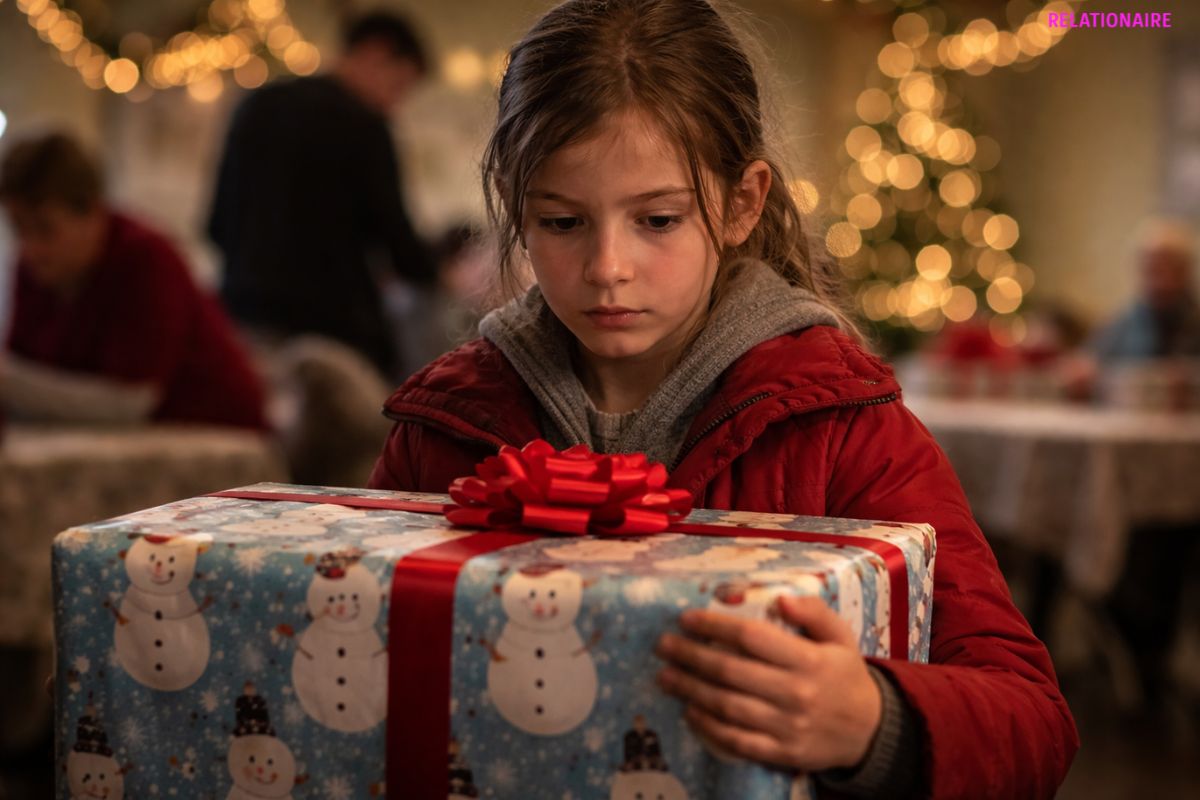
A volunteer in a Santa hat stood with a microphone and a big box wrapped in shiny snowman paper.
“And now,” she said brightly, “this one is for Ivy.”
All around the room, people clapped.
Not hard. Just enough.
The kind of clapping adults do when they want a child to feel safe.
But Ivy didn’t get up.
She was eight years old and new in town and had been with Laura Bennett for only six weeks. Long enough for Laura to know Ivy never slammed doors, never asked for seconds unless someone offered twice, and said “thank you” in a voice so careful it could break your heart if you listened too closely.
Not long enough for Laura to know what Christmas did to her.
Laura felt every head in the room turn.
She leaned down beside the girl. “Honey,” she whispered, keeping her smile pinned in place, “it’s okay. They’re calling you.”
Ivy looked at the giant gift, then at the floor.
“No,” she said.
Laura blinked. “No?”
Ivy’s fingers tightened on the chair.
The volunteer laughed into the microphone, trying to rescue the moment. “It must be a big surprise, huh?”
A few people chuckled.
Laura touched the child’s shoulder. “Sweetheart, go on.”
Ivy didn’t move.
Her face didn’t look angry. It didn’t even look stubborn.
It looked scared.
And that somehow made it worse.
Because fear, in a room full of people trying to be kind, makes everyone defensive.
“It’s all right,” Laura said more quietly, aware now of the eyes on her. “You can open it and sit right back down.”
Ivy shook her head again.
“No, ma’am.”
The “ma’am” cut straight through Laura.
That was Ivy’s word when she was frightened. Too polite. Too formal. Like she was trying not to take up space inside a sentence.
Onstage, the volunteer shifted awkwardly. “Well… maybe Laura can come up with her?”
Someone in the back muttered, not very softly, “Kids these days.”
Another voice: “Maybe she wanted something else.”
And then that dangerous little rustle started.
The whispering.
Not loud enough to own.
Just loud enough to spread.
Laura stood up too fast, her chair legs scraping against the church floor. “Excuse us,” she said, with a smile that felt brittle around the edges.
She crouched in front of Ivy so they were eye level. The girl smelled faintly of laundry soap and the peppermint lotion Laura had put on her chapped hands before they left home.
“Honey,” Laura said, keeping her voice low, “people worked really hard on this.”
Ivy nodded.
“I know.”
“Then why won’t you open it?”
The girl swallowed.
Her eyes flicked, just once, somewhere across the room. Then back down.
“Please don’t make me,” she whispered.
Laura felt heat crawl up her neck.
Humiliation is a strange thing. It can make a decent person think ugly thoughts for one sharp second.
For one shameful second, Laura thought, After everything we’ve tried to do for you.
And the second that thought appeared, she hated herself for it.
Still, the room was waiting.
Still, someone was holding a giant present with a bow the size of a dinner plate.
Still, all the church ladies who had sewn stockings and sorted donated toys and raised money with bake sales were looking at Ivy like she had just slapped kindness out of their hands.
Pastor Reed, who had a soft spot for rescuing awkward situations, stepped forward and said into the microphone, “That’s all right, sweetheart. We can save it for later.”
He set the big box near the stage.
The applause this time was thinner.
Politer.
More embarrassed than warm.
Laura sat back down beside Ivy with her jaw tight and her smile gone. She could feel pity around them now, which was somehow worse than judgment. Pity always carried questions with it.
What kind of child refuses a Christmas gift?
What kind of foster mother can’t manage one little girl?
The rest of the evening staggered forward.
Children were called up one by one. Some tore into wrapping paper before they even made it back to their chairs. One little boy got cowboy boots and held them against his chest like treasure. A teenage girl cried over a sketchbook and fancy markers. A pair of brothers fought over whose remote-control truck was faster.
Laughter rose.
Paper ripped.
Phones came out for pictures.
And all the while that untouched box sat near the stage, bright and enormous, like an accusation.
Laura noticed people glance at it, then at Ivy.
Ivy sat perfectly still.
Too still for a child.
She smiled when another girl showed her a baby doll.
She said “that’s pretty” when an older volunteer handed out cookies on snowman napkins.
She even laughed once, softly, at something Pastor Reed said.
But she did not look at her present.
After the gifts, everyone lined up for food. Laura fixed Ivy a plate with ham, mashed potatoes, a roll, and green beans no child really wanted. Ivy thanked her. Ate slowly. Left the roll untouched.
Across the room, two women from the church kitchen were talking while scraping casserole into foil containers.
Laura wasn’t trying to overhear.
That almost made it worse.
“Some children don’t know how good they have it,” one of them said.
The other sighed. “Trauma does strange things, I know. But still. That was hard to watch.”
Laura looked at Ivy, at the careful way she kept her eyes on her plate.
There was no chance she hadn’t heard.
Something inside Laura cracked a little then.
Not enough to fix anything.
Just enough to hurt.
On the drive home, the heater rattled and the windshield fogged at the corners. Main Street had gone soft and gold with Christmas lights. Plastic reindeer stood in front yards. Somebody had hung a giant wreath on the water tower again.
Ivy sat in the passenger seat with her too-big coat buckled under the seatbelt.
Laura kept both hands on the wheel.
“You embarrassed me tonight.”
The words came out before she could stop them.
The silence after them was terrible.
Ivy turned her face toward the dark window.
“I’m sorry.”
Laura closed her eyes for half a second at the red light.
An apology from a child should never sound that old.
When they got home to Laura’s small rental on Willow Street, there was a message on the answering machine from the church saying someone would drop the present off tomorrow.
Laura didn’t play it for Ivy.
She made hot chocolate anyway. Set marshmallows on top. Tried to make normal happen by force. Ivy thanked her and held the mug between both hands but barely drank it.
At bedtime, Laura stood in the hallway outside Ivy’s room with one hand on the doorframe.
The child had hung the paper snowflake they made together above her bed. Her little suitcase still sat half-unpacked in the corner, because every time Laura said they should find a better place for it, Ivy said, “It’s okay there.”
As if staying ready mattered more than belonging.
Laura looked at her now, at the careful way she folded back her blanket.
“Do you want to tell me why?” Laura asked.
Ivy didn’t answer right away.
From down the block came the faint sound of somebody’s Christmas music drifting through the cold.
Finally Ivy said, “Did they already buy it?”
Laura frowned. “What?”
“The big present.”
“Yes,” Laura said. “Of course they did.”
Ivy nodded like that confirmed something.
Then she reached under her pillow and pulled out a folded piece of construction paper, creased and re-creased at the corners from being opened and closed too many times.
Her voice was barely above a whisper.
“Then maybe… maybe you should read this first.”
Laura took the paper.
It wasn’t addressed to her.
Written across the front in careful block letters, with one backward R and a shaky little star in the corner, were the words:
FOR THE BOY IN THE GRAY SWEATER
Laura looked up.
“The boy from tonight?” she asked.
Ivy’s eyes filled, but she still nodded.
And then Laura unfolded the note.
Part 2
Inside the folded construction paper was a drawing first.
A child’s drawing, but not careless.
A little church room with a Christmas tree too tall for the page.
A row of chairs.
One big box with a bow.
And in the corner, drawn smaller than everyone else, a stick-figure boy in a gray sweater sitting alone.
Under it, in pencil pressed so hard it had dented the paper, Ivy had written:
He looked at my box the whole time.
He did not get called.
I think he was trying to be good about it.
Can he have mine or can we wait till he leaves?
Please don’t make him watch.
Laura read it twice.
Then a third time.
By the third time, the words blurred.
She sat down on the edge of Ivy’s bed because her knees had suddenly gone weak.
“The boy in the gray sweater,” she said, hearing the stupidity in her own voice. “You mean the little boy by the radiator? The one with the striped socks?”
Ivy nodded.
“He came with Ms. Teresa,” she whispered. “I heard her tell somebody they weren’t on the list in time.”
Laura stared.
She remembered him now. Seven maybe. Thin face. Hair in need of a trim. Sitting straight-backed beside an older woman with tired eyes. Laura had noticed him only in pieces: once when he refused a second cookie, once when he clapped for another child, once when he looked very quickly at the stage and then away.
Not enough.
Never enough.
“You thought he didn’t get anything,” Laura said.
Ivy looked down at her blanket and rubbed the edge between her fingers.
“He kept smiling when other kids went up,” she said. “But it was the kind of smile people do when they are trying not to cry.”
Laura had to turn her face away for a second.
Because yes.
That was exactly what it had been.
And an eight-year-old had seen it before any of the adults in the room.
“You didn’t want to open yours in front of him.”
Ivy shook her head. “Not if he had nothing.”
“Oh, Ivy.”
The girl flinched a little at the sound of her name, as if she expected scolding to come after it.
Laura’s throat burned.
“I thought maybe if I waited,” Ivy said, “somebody would remember him. Or maybe I could ask later when people weren’t looking. But then everyone got mad.”
Laura put the note down carefully on the quilt, like it was something breakable and sacred.
“I got mad too,” she said.
Ivy didn’t answer.
Laura reached for her, slow enough to give her time to pull away.
The child didn’t.
Laura wrapped both arms around her and felt how small she still was under the flannel pajamas. So light. So careful. A child who had learned to measure every need before saying it aloud.
“I am so sorry,” Laura whispered into her hair. “I was wrong. I was so wrong.”
Ivy stood very still in her arms at first.
Then, after a moment, she leaned in.
Just a little.
Enough to undo Laura completely.
The next morning, Laura called the church before eight.
The secretary said Pastor Reed was out delivering food boxes. Ms. Teresa, whoever she was, had already left with the children she’d brought over from the county motel. No, they didn’t always make the gift list if they came in last-minute. Yes, there had been a mix-up. Yes, they had a few extra donated items, but most had gone out.
Laura stood at the kitchen counter gripping the phone until her knuckles whitened.
“A mix-up?” she repeated.
On the other end came the practiced tone of someone used to apologizing for systems instead of failures.
“We truly did our best.”
Laura looked through the doorway at Ivy, who sat on the living room rug coloring with the cheap crayons from the diner kids’ menu she’d tucked into her coat pocket weeks ago. She was drawing the church again.
This time the boy in the gray sweater was bigger.
“We all did our best,” Laura said quietly, “except the part where we noticed.”
She hung up before the woman could answer.
By ten, the giant wrapped present had been delivered to Laura’s porch by a cheerful teenage volunteer who said, “Tell her no hard feelings,” like he was smoothing over a spat at a birthday party and not handing over the evidence of a room full of adults missing what mattered.
Laura brought the box inside.
Ivy looked at it, then at Laura.
“We can take it back,” Ivy said quickly. “I didn’t mean I don’t like it.”
“I know.”
“We could share it,” she said. “If it’s two things.”
Laura knelt beside the box and ran a hand over the snowman paper. Whoever wrapped it had done it carefully. The seams were sharp. The bow was tied with curling ribbon, not tape. Someone had wanted this to feel special.
Maybe that was what hurt most.
Kindness had been there.
But attention had not.
Laura cut the tape.
Inside the wrapping was a new winter comforter set with little cardinals on it, a plush robe, two storybooks, warm boots with fake fur around the tops, and a dollhouse nearly as big as Ivy’s torso.
Ivy touched the dollhouse roof with one finger.
“It’s beautiful,” she said.
And she meant it.
That made Laura turn away again.
Most children would have lunged for it. Ivy just sat there like beauty was something she had to ask permission to enjoy.
“We’re going to find him,” Laura said.
Ivy looked up fast. “Today?”
“Today.”
The county motel sat just off the highway beyond the gas station and the feed store, a low row of doors with peeling paint and a blinking vacancy sign that had given up on the V. Laura had passed it a hundred times without really seeing it.
Now she saw everything.
A tricycle on its side near room twelve.
A woman smoking in house slippers while bouncing a baby on one hip.
Two boys kicking a flattened soda can back and forth in the gravel.
Ms. Teresa was real after all. Mid-fifties, winter coat over scrubs, eyes tired in the way only people who carry too many stories get tired. When Laura explained why they were there, Teresa pressed her hand to her mouth.
“Oh,” she said. “Oh, honey.”
“The boy in the gray sweater,” Ivy said softly. “Is he here?”
Teresa nodded.
“His name is Mateo.”
She looked at Laura then, not accusing, just sad. “His mama had surgery two weeks ago. They’ve been here since the landlord changed the locks. He came last night because I told him there’d be dinner. I didn’t know the gifts were only for the registered families.”
Laura closed her eyes.
Dinner.
He came for dinner.
Not presents.
And still he had sat there and watched other children carry miracles in shiny paper to their seats.
“Can we give him mine?” Ivy asked.
Teresa hesitated. “That’s mighty sweet, but you don’t have to—”
“I know,” Ivy said.
The answer landed in the cold air with a kind of calm that adults spend years trying to fake.
Teresa led them to room eight.
Before she knocked, Laura looked down at Ivy. “You don’t have to do all of it,” she whispered. “We can share. We can bring some now and come back.”
Ivy considered this seriously.
Then she said, “He should get the big part first.”
Laura bit down hard on the inside of her cheek.
Teresa knocked.
A little boy opened the door almost immediately, like he had been close by hoping for noise in the hallway to belong to him. Gray sweater. Thin wrists. Striped socks.
Those eyes.
Older than they should have been.
He saw the box first.
Then Ivy.
Then Laura.
His face did something complicated and fast.
Hope. Confusion. Alarm. The quick self-protection of a child used to losing things before they are fully his.
“Hi,” Ivy said.
Mateo gripped the doorknob tighter.
Behind him, in the dim room, Laura could see one bed unmade, one chair piled with clothes, a microwave on a dresser, a woman asleep or trying to be on the other bed with a hospital blanket pulled to her chin.
Ivy lifted the folded note with both hands.
“I wrote something,” she said.
Mateo didn’t take it.
So Ivy stepped one tiny step closer and read it out loud instead, voice shaking only at the very end.
“I didn’t open my present because I didn’t want you to feel bad. I thought maybe we could both have Christmas if we waited.”
The woman on the bed stirred.
Mateo looked from Ivy to the box again.
His mouth trembled once, then flattened.
“No,” he said suddenly.
Laura blinked. “Sweetheart—”
He stepped back so fast he bumped the chair. “I don’t want it.”
And before anyone could speak again, his mother pushed herself up on one elbow, pale and furious with embarrassment, and said through clenched teeth:
“Mateo, tell them thank you and close the door. We are not taking charity twice.”
Part 3
For one painful second, nobody moved.
Cold air drifted down the motel walkway and slipped through the open door. Somewhere near the ice machine, a dog barked twice and stopped.
Mateo stood frozen, one hand still on the doorknob.
His mother looked like she wanted to disappear.
Laura knew that look.
Not because she had lived this exact life.
But because shame always wears the same face in the end. Tight mouth. Chin lifted too high. Eyes that dare you to pity them.
“I’m sorry,” the woman said, pushing herself upright with obvious effort. “He doesn’t need—”
“Yes, he does,” Ivy said.
Not rude.
Not loud.
Just true.
Every adult in that doorway went silent.
Mateo’s mother turned toward the voice.
Ivy stood there in her red coat with her knit hat slipping crooked over one eyebrow, holding a folded note in one hand and the edge of the giant box in the other.
“He does,” she said again, gentler now. “But not because he’s bad. Or because you did something wrong.”
Laura felt something pass through the moment then.
Not magic.
Just honesty, plain and clean.
The kind that makes grown people put down their defenses because a child has somehow said the thing nobody else could say without making it worse.
The woman’s shoulders dropped.
Only a little.
“My name is Elena,” she said, like it cost her something.
“I’m Ivy.”
Mateo was still staring at the box like it might vanish if he blinked.
Ivy looked at him, not at his mother. “I got this last night,” she said. “But I didn’t open it, so it’s still new for somebody.”
Mateo frowned. “Why?”
The answer came so fast it felt like she had been carrying it in both hands all along.
“Because I know what it feels like when everybody is trying to act normal, but something hurts anyway.”
No one spoke.
Inside the room, the motel heater clicked and rattled.
Elena pressed the heel of her hand against her eyes.
Laura turned her face slightly, giving her the privacy of not being watched in the exact second she broke.
Mateo looked at his mother, then back at Ivy.
“You wanted this,” he said.
Ivy nodded. “A little.”
Not a martyr.
Not a saint.
Just honest.
Then she added, “But I want you not to have that face more.”
That did it.
Mateo’s face crumpled all at once. Not loud tears. The dangerous kind children try to swallow because they think crying makes everything harder for the adults around them.
He wiped at his nose with his sleeve and failed.
Elena made a sound Laura would hear later in the middle of the night and never forget. It was small and ragged and full of all the times she had held herself together because there was no room not to.
Laura picked up the box and carried it inside without asking again.
Sometimes dignity is not asking. Sometimes dignity is knowing when to quietly keep going.
The room was colder than it should have been. Laura set the gift on the bedspread. Teresa came in behind them with a bag of groceries she had grabbed from her trunk without announcing it. Bread. Peanut butter. Soup. Bananas. Practical mercy.
Ivy stood close to Mateo but not too close.
“You can open it now,” she said.
He looked at her one last time, like he still didn’t believe permission could be real.
Then he knelt by the box and peeled the tape loose.
Not ripped.
Peeled.
Careful, like he was opening something alive.
When the snowman paper fell away and the dollhouse showed first, Mateo sucked in a breath so sharp it was almost a sob. Elena covered her mouth. The boots came next. Then the books. Then the robe and comforter.
“My God,” Elena whispered.
Mateo touched the little windows on the dollhouse with both hands. “It has stairs,” he said, stunned.
That was the line that shattered Laura.
Not thank you.
Not wow.
It has stairs.
Because what he saw first was not expense or luck.
He saw a place inside a house where someone could go up and belong on another floor.
Ivy smiled then. A real smile. The first easy one Laura had seen on her face all weekend.
“I liked the stairs too,” she said.
Mateo looked at her. “You can still play with it.”
Ivy shrugged one shoulder. “Maybe later.”
Elena tried to protest again, weakly now, but Laura sat beside her on the bed and said, “Let this be Christmas.”
The woman stared at her, exhausted and raw.
Then, very quietly, she nodded.
They stayed longer than anyone planned.
Teresa heated soup in the motel microwave. Laura helped Elena sort her medication bottles and wrote down the refill number for the free clinic. Mateo opened the books and handed one to Ivy, and the two of them sat on the floor turning pages together like children do when they don’t need an adult to explain tenderness to them.
At one point, Laura stepped outside to call Pastor Reed.
He answered on the second ring, cheerful at first, then confused when she asked whether the church had any more emergency funds, spare coats, grocery cards, anything left at all.
By the time she finished telling him what had happened, he had gone silent.
Finally he said, “We missed that boy.”
“Yes,” Laura said. “We did.”
Within three hours, half the church knew.
By evening, not through gossip this time but through shame and love doing their work together, things started arriving at room eight.
A used but sturdy space heater.
Gift cards.
A basket of toiletries.
A bag of oranges.
A toolbox from a deacon who heard Elena’s brother might help her find work once she recovered.
A little artificial tree someone pulled from their attic.
And, from the same women who had whispered in the kitchen the night before, a handwritten card that read:
We are sorry we saw the moment before we saw the child.
Laura read that line twice before handing it to Elena.
On Christmas Eve, Pastor Reed asked if Ivy would come back to the church.
Laura gave her the choice.
That mattered.
Ivy thought about it while spooning cereal into her mouth at the kitchen table, feet swinging above the floor.
“Only if Mateo comes too,” she said.
So they went together.
This time there were no names on stage.
No public calling up.
No bright microphone cheer.
Just tables in the fellowship hall, a meal, candles near the altar, and gifts placed quietly by families, not performances.
Mateo wore the new boots.
Ivy wore the red coat and, for the first time, left her little suitcase zipped under the bed instead of by the door.
During the candlelight service, when the lights dimmed and the room glowed soft gold, Laura looked over and saw Ivy slide half her cookie onto Mateo’s napkin without a word.
He didn’t thank her.
He just broke it in half again and slid part of it back.
Children, Laura thought, are sometimes better at grace because they have not yet learned to turn it into theater.
Later that night, after they got home, Laura found something tucked under the paper snowflake in Ivy’s room.
A new note.
Folded carefully.
On the front, in the same hard-pressed pencil, it said:
FOR LAURA
Inside were only two lines.
I knew you would understand when it was quiet.
Some people can hear better after everybody goes home.
Laura sat on the edge of the bed and cried with the note in both hands.
Not because children should have to know things like that.
But because some of them do.
And because every so often, one of them hands the truth back to the adults in the room so gently that we can bear to hold it.
Down the hall, Ivy was asleep under the cardinal comforter the church had insisted on replacing with another identical set after hearing what she’d done. One for her. One she had already given away.
Laura stood in the doorway for a long time, listening to the quiet little rhythm of her breathing.
The suitcase was still in the corner.
But it was closed.
For now, that was enough.
Sometimes the biggest thing a child gives away is not a toy or a gift.
Sometimes it is the chance for grown people to become softer than they were the day before.