If you’ve already read part 1 of this story on Facebook, go here for Part 2!
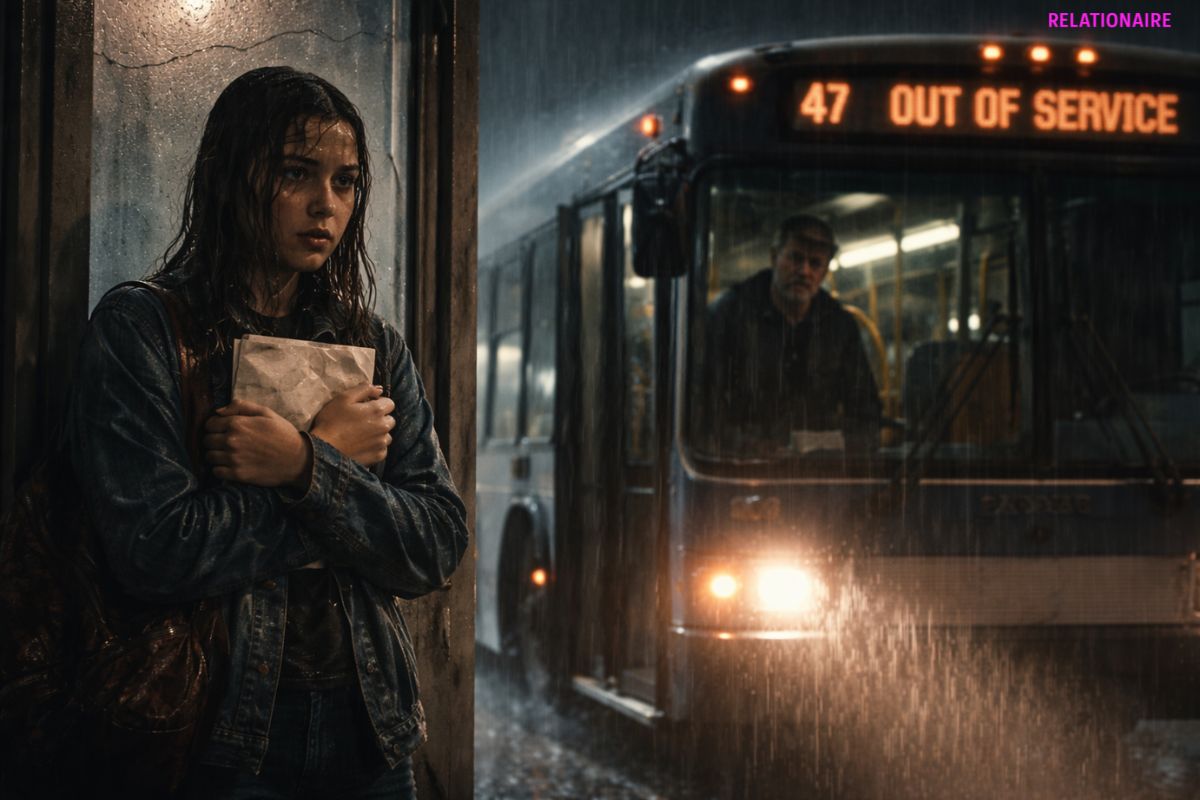
By the time the streetlights came on, the girl at the bus stop was soaked through.
Not damp. Not misted. Soaked.
Rain slid off the hood of her cheap gray sweatshirt and dripped from the end of her nose. Her jeans were dark from the knees down. The canvas sneakers on her feet looked like they’d been dipped in a creek. She stood under the bent plexiglass shelter on Mercer and 8th with a school backpack pressed against her chest and a long white envelope clutched so tightly in one hand it had gone soft around the edges.
Cars passed. Tires hissed on wet pavement. Every few minutes someone slowed down.
At first, people asked if she needed a ride.
Then they told her she shouldn’t be out there alone.
Then they got irritated.
A woman in an SUV cracked her passenger window and called, “Honey, it’s after eight. Get in before something happens to you.”
The girl shook her head.
A man in a pickup shouted, “You waiting for somebody or trying to get yourself killed?”
No answer.
Two boys in a dented Civic laughed as they rolled past and one of them yelled, “Maybe she got thrown out.”
The girl didn’t look up. She just kept staring down the road like she could will the right headlights into view.
Her name was Lena Morales, and she had been standing there for one hour and forty-three minutes.
She knew because she had checked the cracked screen of her phone until the battery died at 7:12.
After that, she counted buses.
Three had passed the other direction.
Two had splashed through the intersection without slowing.
One had gone out of service.
Not the bus she needed.
Not the one he drove.
She shifted the envelope to her other hand and winced. Her fingers were stiff with cold. Inside the envelope, the paper had started to curl from the damp, but she kept smoothing it flat through the thin layer like she could protect what was written there by force.
Across the street, the laundromat windows fogged with heat and yellow light. People moved inside carrying baskets and talking and living regular lives, and Lena hated them a little for it.
She hated the woman who had looked at her like she was trouble.
She hated the boys in the Civic.
She hated her dead phone, her wet socks, the smell of rain and diesel and old gum under the bench.
Mostly she hated herself for almost leaving twice.
Because if she left, then she’d never know.
At 8:17, a patrol car rolled by slowly.
Lena turned her face away.
It didn’t stop.
Good.
She wasn’t doing anything wrong. It just felt like she was.
That was the worst part. Grief had a way of making even breathing in public feel suspicious.
She bent and set the envelope on the bus bench for a second so she could flex her numb fingers. Her backpack shifted and one zipper hung open. Inside were a geometry book with a wrinkled corner, a half-eaten pack of crackers, and a plastic folder holding the paper her school counselor had printed for her that afternoon and told her to take home.
Lena hadn’t gone home.
Not yet.
At 8:26, a silver sedan eased to the curb.
The driver was an older woman with both hands on the wheel and worry all over her face.
“Sweetheart,” she said through the barely opened window, “I know you don’t know me, but please don’t stand out here all night. I can take you to the police station, a fire station, wherever you need.”
Lena stepped back from the curb.
“I’m waiting for the bus.”
“In this weather?”
“Yes.”
The woman looked at the empty road, then back at Lena’s face. Whatever she saw there made her soften.
“Are your parents looking for you?”
Lena swallowed.
“I just need the Number 47.”
The woman’s eyes dropped to the envelope. “Is that something important?”
Lena tightened her hand over it.
The woman nodded slowly, like she understood more than she probably did. “All right. But if that bus doesn’t come in ten minutes, I’m circling back.”
She drove away.
Lena watched the red taillights disappear into the rain.
Ten minutes passed.
Then fifteen.
Her stomach cramped with hunger, but she ignored it. The rain blew sideways now, sneaking past the shelter and peppering her face. Water ran down the back of her neck. Somewhere behind her, thunder grumbled low and tired.
She closed her eyes for just a second and saw her mother at the kitchen table three nights ago, folding the same dish towel over and over with hands that would not stop shaking.
He’s not coming, Lena.
Stop saying that, Mom.
I’m not saying he doesn’t love you.
Then what are you saying?
I’m saying some men know how to leave long before they ever go.
Lena had shoved her chair back so hard it scraped the linoleum.
You don’t know that.
Her mother’s face had done something terrible then. Not crying. Worse. Going flat.
Baby, I know exactly that.
Lena had grabbed the envelope off the table and stormed out before her mother could stop her.
The return address was from the transit authority.
The name typed beneath it was her father’s.
Miguel Morales.
Transit Operations. Route Division.
She had read the first line in the hallway before her mother snatched it back. That was all she got.
We regret to inform you—
That sentence had rooted inside her like glass.
Her mother had hidden the letter after that, but Lena found it the next morning tucked inside a recipe binder neither of them ever used. She took it to school in her backpack and carried it all day like a live thing.
She didn’t show anyone.
Not her counselor.
Not her best friend Tasha.
Not the assistant principal who asked if she wanted to call home.
Because the only thing worse than hearing bad news was hearing it from people who didn’t know the person it belonged to.
At 8:41, headlights swung around the corner.
Big. Square. Familiar.
Lena stepped right to the edge of the curb before she could stop herself.
City bus. Number 47.
Her breath caught so hard it hurt.
The bus slowed.
Then the illuminated sign above the windshield flicked to OUT OF SERVICE.
It rolled past anyway.
Lena stared after it, stunned, rain hitting her face in cold slaps. For one crazy second she thought about running after it, pounding on the door, making a scene in the middle of Mercer Avenue.
But the bus had already moved through the light.
Then the brake lights flared red.
Half a block down, the bus eased to the curb.
Lena blinked.
The doors did not open.
A long moment passed.
Then the big vehicle lurched again, backed slightly, and pulled up to the stop with a groan of brakes and a spray of water.
The door folded open.
The driver leaned out.
He was a thick-shouldered man maybe in his late fifties, wearing a dark transit jacket and a faded cap with rain beading on the brim. His face looked carved out of old wood—stern, lined, tired. The kind of face that made kids lower their voices without being told.
“This bus is done for the night,” he said.
Lena’s hope dropped so fast she felt dizzy.
Then he looked at her envelope, her backpack, her wet hair plastered to her cheeks.
He looked back up.
“And I know that,” he said. “So the question is why you’re still standing here.”
Lena hugged the backpack tighter.
“I need to know if you knew my dad.”
The driver went very still.
Cars moved behind him. Rain drummed on the roof of the bus. Somewhere in the back, an ad panel buzzed.
She held up the envelope with both shaking hands.
“His name was Miguel Morales,” she said. “And this letter came today.”
The driver stared at the envelope like it had struck him.
When he spoke again, his voice was no longer stern.
It was wrecked.
“Oh,” he said quietly. “Kid.”
He killed the engine, set the brake, and stood up from his seat.
Then he stepped down into the rain and said the one thing that made Lena realize, all at once, that she had been wrong about everything.
“I’m Thomas Bell,” he said. “I was there when your father died.”
Part 2
For a second Lena couldn’t hear anything except the rain.
Not the traffic.
Not the ticking of the cooling engine.
Not the loose ad panel rattling inside the bus.
Just that sentence, opening up the night beneath her feet.
I was there when your father died.
She had spent three days building herself around anger because anger felt stronger than fear.
Her father had left when she was nine, at least that was the family version of it. Not all at once. First the overnight shifts. Then the missed dinners. Then the apartment on the other side of town “because it’s closer to the depot.” After that, birthdays on the wrong days, postcards without return addresses, promises that came in thin little strips and snapped as soon as you put weight on them.
He still called sometimes.
Then less.
Then hardly at all.
Her mother stopped saying his name unless she had to.
Lena told people he was “around.” It was easier than explaining a man who existed like weather—sometimes there, sometimes not, always impossible to count on.
So when the letter came from Transit Operations and her mother went pale at the kitchen table, Lena had filled in the rest herself.
He finally disappeared for good.
He died somewhere else.
He left us with paperwork.
That hurt less than the other possibility.
That maybe he had been closer than she knew.
Thomas Bell stepped fully under the bus shelter with her, rain shining on the shoulders of his jacket. Up close, he smelled like coffee gone cold and diesel and wet wool. His hands were broad and rough, with the deep grooves of somebody who had spent a lifetime gripping wheels, tools, rails.
He looked at Lena the way people look at church steps after a funeral—carefully, like one wrong move might echo.
“You shouldn’t be out here alone,” he said.
A flash of anger rose in her anyway. “Everyone keeps saying that.”
“Because it’s true.”
“I wasn’t waiting for everyone.”
His jaw tightened, but not in a mean way. More like he was trying not to say five things at once.
“You were waiting for me?”
“I was waiting for someone who knew him.” Her voice shook. “I saw his name on the letter. I knew it had to be from the bus company. I knew he still drove the Forty-Seven on Fridays. Or he used to.”
Thomas stared at the rain beyond the curb. “He did.”
Lena swallowed. “My mom wouldn’t tell me anything.”
“She might’ve been trying to carry too much at once.”
“She always does that.”
He nodded once, like that answer fit somewhere he understood.
Inside the bus, the overhead lights cast a dim yellow glow over empty seats. A forgotten paper cup rolled gently near the back each time the bus shifted.
Thomas pulled a small hand towel from his jacket pocket and offered it to her. “Here.”
Lena looked at it, then at him.
“It’s clean,” he said.
She took it and blotted her face. Her hands were shaking too hard to be embarrassed.
He glanced at the dark street, then back at her. “Come sit inside while we talk.”
“I’m not getting in a bus with a stranger.”
Something in his face almost became a smile, but grief caught it before it formed. “That’s probably the smartest thing you’ve said all night.”
He stepped back and pointed through the open door. “You sit in the first seat, right next to the entrance. Door stays open. You want to get off, you get off. Fair?”
Lena hesitated.
Then thunder cracked somewhere close enough to rattle the shelter.
She climbed on.
The first seat was vinyl and cold. Water dripped from her jeans onto the rubber floor. Thomas stayed standing by the fare box instead of taking the driver’s seat, like he knew she needed the extra distance.
He took off his cap, ran a hand over his gray hair, and looked suddenly older.
“Your mother’s name is Elena, right?”
Lena’s fingers tightened around the towel. “How do you know that?”
“Because your dad talked about her like she was the first decent thing that ever happened to him.”
That landed hard.
People said a lot of things after someone died. Nice things. Convenient things. Clean things. She wanted to reject it on reflex.
Instead she asked, “Then why wasn’t he there?”
Thomas shut his eyes for a brief second.
When he opened them, there was no dodging in them.
“Because he was ashamed.”
Lena went cold in a way that had nothing to do with rain.
Thomas leaned one elbow on the metal barrier by the fare box, like the memory itself had weight.
“Three years ago, Miguel had a seizure at the wheel on a Sunday relief route. He got the bus stopped. Nobody got hurt. But after that, they pulled him from driving until he got cleared. Tests found something worse.”
Lena stared.
“What worse?”
He looked at the envelope in her lap.
“Brain tumor.”
The words were too blunt to fit inside her head.
“No,” she said immediately. “No, he would’ve told us.”
Thomas said nothing.
“He would’ve told me.”
Rain hit the windshield in hard silver lines.
Thomas rubbed a thumb over the edge of his cap. “Maybe. Maybe if he’d had more time. Maybe if he’d known how. Maybe if he wasn’t Miguel.”
“You don’t get to say his name like that.”
“You asked if I knew him.” His voice stayed quiet. “I knew him twenty-two years.”
Lena looked away. Out on the street, the silver sedan from earlier rolled slowly past. The older woman behind the wheel saw Lena sitting on the bus and seemed to decide, at last, that she was not in immediate danger. She drove on.
“He didn’t want your mother to watch him get sick,” Thomas said. “And he especially didn’t want you seeing it.”
“That’s not noble,” Lena snapped. “That’s cruel.”
Thomas nodded. “Yes.”
The answer startled her.
No defense. No neat explanation. Just yes.
“He moved into a room over Halpern’s Hardware when the treatments started,” Thomas continued. “Worked dispatch some days. Cleaned buses when he could still stand steady enough. Rode along with me when he was too weak to be alone but too proud to admit it.”
Lena’s throat burned.
“He was sick that whole time?”
Thomas looked at the wet floor between them. “Not the whole time. But long enough.”
“And nobody told us?”
“He wrote.”
The word was barely audible.
Lena stared at him.
Thomas reached into his jacket slowly, like he was handling something fragile, and pulled out a thick rubber-banded stack of envelopes. Some were worn soft at the corners. Some had rain spots. Every one of them had the same careful printing on the front.
Elena Morales.
Lena Morales.
Lena’s heart kicked against her ribs.
“I told him to mail them,” Thomas said. “I told him every week. He said not yet. Said he wanted to explain it right. Said he wanted to get stronger first so he could show up like a man instead of a problem.”
Lena’s voice came out thin. “You kept them?”
“He left them with me after his last hospital stay. Told me if he lost his nerve again, I was supposed to decide when.”
The bus seemed to tilt around her.
“You had those this whole time?”
Thomas looked sick with himself.
“Yes.”
“Why?”
“Because he made me promise.”
“That’s not good enough!”
Her voice cracked so loudly it seemed to bounce off every empty seat.
Thomas took it without flinching.
“I know.”
She stood so fast the towel fell from her lap.
“You don’t know anything about us.”
“No,” he said. “But I know he loved you both so much it curdled into cowardice. I know he kept your fourth-grade school photo tucked in the clear pocket behind his license. I know he turned down pain medication some nights because it made him foggy and he wanted to stay awake long enough to hear your old voicemails. I know he made me drive two extra blocks out of route once just so he could see your porch light still on at nine-thirty and pretend he had not missed every chance he was given.”
Lena couldn’t breathe right.
The cracked phone screen. The empty chair. The birthdays. Her mother folding that dish towel over and over.
All at once anger and grief stopped being separate things.
They became one sharp, unbearable point.
Thomas looked at the envelope in her hands.
“The letter from Transit,” he said. “That’s the official one. Benefits. Personal effects. Final notice.”
He took a breath that shook on the way in.
“But there’s another envelope you need to open first.”
He held the stack of letters out toward her, and Lena saw that one of them was newer than the rest.
Cleaner. Less worn.
On the front, in the same careful hand, was written:
For Lena. Please read this one yourself.
Her knees felt weak.
“What is it?” she whispered.
Thomas swallowed hard.
“It’s the only one he ever sealed in front of me,” he said. “And before he gave it to me, he said, ‘If my daughter ever comes looking, don’t let her hate me until she reads this.’”
Part 3
Lena did not open the letter on the bus.
At first, Thomas thought it was because she didn’t trust him.
Then he saw the way her fingers hovered over the seal without touching it, like even one movement might make the whole night become real.
“I need my mom,” she said.
It came out small. Younger than sixteen.
Thomas nodded immediately. “All right.”
He reached for the dashboard radio, then stopped. “Do you know if she’ll answer a number she doesn’t recognize?”
Lena shook her head. “Her phone’s been on silent since this afternoon.”
He looked at the rain beyond the windshield. “Then I’ll drive you.”
“You said this bus was out of service.”
“It is.”
“That’s against the rules.”
That time he did smile a little, worn and sad. “Kid, I’m on my final route. At my age, all the important things are against some rule.”
He called dispatch first anyway.
Lena listened as he spoke into the radio in a flat professional voice, reporting a mechanical delay near Mercer and 8th. Not a lie exactly. Something in both their lives had broken open there.
Then he pulled the bus away from the curb.
The city slid past in wet ribbons of neon and brake lights. Laundromat. Pawn shop. Closed bakery. The diner with the red sign where third-shift nurses drank coffee at the counter. Everything looked lonelier through rain.
Lena sat in the first seat with the sealed letter in her lap and the thick stack beneath it.
Thomas drove carefully, both hands at ten and two. Twice he glanced into the mirror like he was checking whether she was still there.
At a red light, he said, “Your mother knew he was sick at the very end.”
Lena looked up sharply.
“She found out six weeks ago,” he said. “Hospital called when he collapsed at the depot. He’d put her down years ago as an emergency contact and never changed it.”
Lena stared at the back of his head.
“She went?”
“Yes.”
“Then why didn’t she tell me?”
Thomas’s hands tightened on the wheel. “Because Miguel asked her not to. And because I think she was furious enough to agree.”
That sounded like her mother. Not weak. Wounded.
“What happened?”
“She sat by his bed for two hours and said almost nothing.” Thomas’s voice was gentle now, careful with memory. “Then before she left, she told him, ‘You do not get to make me carry this for you again.’”
Lena looked back down at the letter.
The bus turned onto Maple, where small duplexes sat close to the sidewalk under dripping pecan trees. Her building was halfway down the block, porch light glowing amber through the rain.
Her mother was already outside.
No coat. No umbrella. Just house slippers, old black leggings, and the blue cardigan she always grabbed when she was upset and forgot to button. She came down the front steps before the bus had fully stopped, one hand over her mouth.
When the door opened, Lena stood too fast and almost stumbled.
“Elena,” Thomas called from the driver’s seat, “she’s all right.”
Lena’s mother didn’t even look at him first. She went straight to her daughter, hands on her face, wet hair, shoulders, like checking for missing pieces.
“Do you have any idea—” she started, then broke off and pulled Lena against her so hard the envelope crumpled between them.
Lena held on just as tightly.
“I’m sorry,” she said into her mother’s shoulder. “I’m sorry. I found the letter and I thought—”
“I know what you thought.”
Her mother pulled back, eyes red and furious and exhausted all at once. Then she saw Thomas behind them and all the anger changed shape.
Not less. Older.
He came down the bus steps and stood in the rain with his cap in both hands.
“Elena.”
“Thomas.”
They looked at each other like two people carrying the same coffin from opposite ends.
He held out the stack of letters.
“I should’ve brought these sooner.”
Her mother stared at them but did not take them.
“Yes,” she said.
No shouting. Somehow that was worse.
Thomas nodded once, accepting it.
“I know.”
The three of them stood there in the rain, porch light falling gold over the wet concrete, while the engine idled low behind them.
Finally Lena lifted the sealed letter. “Can we read it now?”
Her mother’s face folded inward for a second, like pain had found the exact crack it needed.
Then she said, “Inside.”
They sat at the kitchen table together.
The same table where the transit envelope had first appeared.
The same table where Lena had shouted.
The same table where her mother had folded and unfolded that dish towel because her hands had nowhere else to put the grief.
Thomas stayed near the door at first, dripping onto the mat, but Elena looked up after a minute and said, “If you kept his last words from us, you can stay and hear them.”
He bowed his head and took the farthest chair.
Lena slid one finger under the seal.
Inside was a single sheet of paper, folded in thirds.
Her father’s handwriting slanted a little harder than it used to, but it was his. She knew it before she read a word. Knew it in the way her chest went hollow.
Lena,
If you are reading this, then I have run out of time and borrowed courage.
I want to start with the truth, because I have hidden behind too many almost-truths. I was sick. I got scared. Then I got ashamed of being scared, and after that shame made every day I stayed away feel harder to come back from.
I told myself I was protecting you from seeing me weak. What I was really protecting was the part of me that could not bear your disappointment.
Across the table, Elena covered her mouth.
Lena kept reading, the words blurring and clearing again.
I was not absent because you were easy to leave. You were the only thing that made leaving hurt.
I drove the Forty-Seven past Maple more times than I can admit. I watched your porch light. I watched you grow in glimpses I did not deserve. Once I saw you come out in a marching-band jacket and laugh at something your mother said, and I had to pull over because I realized a whole version of your life was happening without me in it.
I am sorry for all the ordinary days I missed. Those are the worst ones to miss because no apology can put them back.
Lena could hear him then. Not as a ghost. Just as the shape of his voice still living in the words.
At the bottom of the page, the handwriting grew shakier.
Thomas Bell has been kinder to me than I earned. If he is the one who gives you this, be gentler with him than I was with myself.
There is one more truth I need you to know. In the top drawer of my room above Halpern’s Hardware is a cedar box with your name on it. I kept every returned birthday card, every school picture your aunt posted online, every voicemail I could save, and the bus token from the day your mother first talked to me at the depot when we were both too young to know that love is not the same as bravery.
If you want nothing from me, that is fair.
But if you want to know me anyway, what is left is yours.
Love, always more than I knew how to show,
Dad
Silence settled over the kitchen.
Not empty silence.
The kind that comes after something has finally been said correctly.
Lena set the letter down with both hands. She was crying too hard to pretend otherwise now. Across from her, her mother was crying too, quietly, almost angrily, like tears were one more burden to carry.
Thomas stared at the tabletop.
“I should’ve brought it the day he died,” he said.
Elena wiped at her face. “Yes.”
He nodded.
“I thought I was honoring his wishes.”
“You were helping him hide,” she said.
“I know.”
Lena looked at him then.
Really looked.
At the deep lines around his mouth. The bus driver jacket still damp at the shoulders. The hands that had held onto a promise too long because maybe promises were all he knew how to do right.
He looked like a man who had been waiting for forgiveness he did not expect to get.
“Did he talk about us a lot?” Lena asked.
Thomas let out a breath that nearly became a laugh. “Every route. Every break. Every bad cup of coffee.”
Elena gave one wet, unwilling smile at that.
A week later, Thomas used his own key to open the room above Halpern’s Hardware.
He did not go in first.
Lena did.
The room was small. Narrow bed. Transit jackets on hooks. Medicine bottles lined by the sink. A mug with three pens in it. Everything neat in the way sick people sometimes keep things neat when their bodies have become unpredictable.
The cedar box was exactly where the letter said it would be.
Inside were birthday cards returned unopened after address changes. Photos printed from grainy screenshots. A macaroni necklace wrapped in tissue. A program from Lena’s fifth-grade music recital. A hospital bracelet. Bus tokens. Notes he had started and not finished.
There was even a plastic sandwich bag holding a tiny pink barrette Lena had lost when she was six and sobbed over for an hour.
Her mother sat down on the edge of the bed and pressed the barrette to her lips.
Sometimes grief wasn’t about discovering love too late.
Sometimes it was about discovering it had been there, all twisted up with fear and failure and distance, and not knowing what to do with that.
Thomas helped them carry the box downstairs.
After that, he kept showing up.
Not too much. Never trying to become something he wasn’t.
He fixed the loose hinge on their kitchen cabinet.
Dropped off a transit benefits form Elena had been too overwhelmed to finish.
Sat in the back row at Lena’s school band concert in his cleanest jacket and clapped with both hands when she played.
On Fridays, if his route brought him near Maple, he’d tap the horn once—soft and quick—and Lena would look up from the porch and wave.
Months later, when spring finally pushed the cold out of the sidewalks, Lena took the Number 47 downtown by herself.
Thomas was driving.
She dropped two fares into the box instead of one.
He glanced at the coins. “You overpaid.”
“No,” she said, taking the first seat. “One’s for me. One’s for the night you stopped.”
He looked forward for a second before answering.
Then he nodded once and pulled back into traffic.
Outside, people hurried under umbrellas, carrying groceries, backpacks, flowers, coffee, all the ordinary weight of being alive.
Most of them never looked up at the driver.
That was all right.
Some kindnesses happened in the full glare of the world.
The ones people carried the longest were usually quieter than that.
The kind that pulled over in the rain and stayed.