If you’ve already read part 1 of this story on Facebook, go here for Part 2!
By the time Lena got to the checkout line, the ice cream had already started to soften.
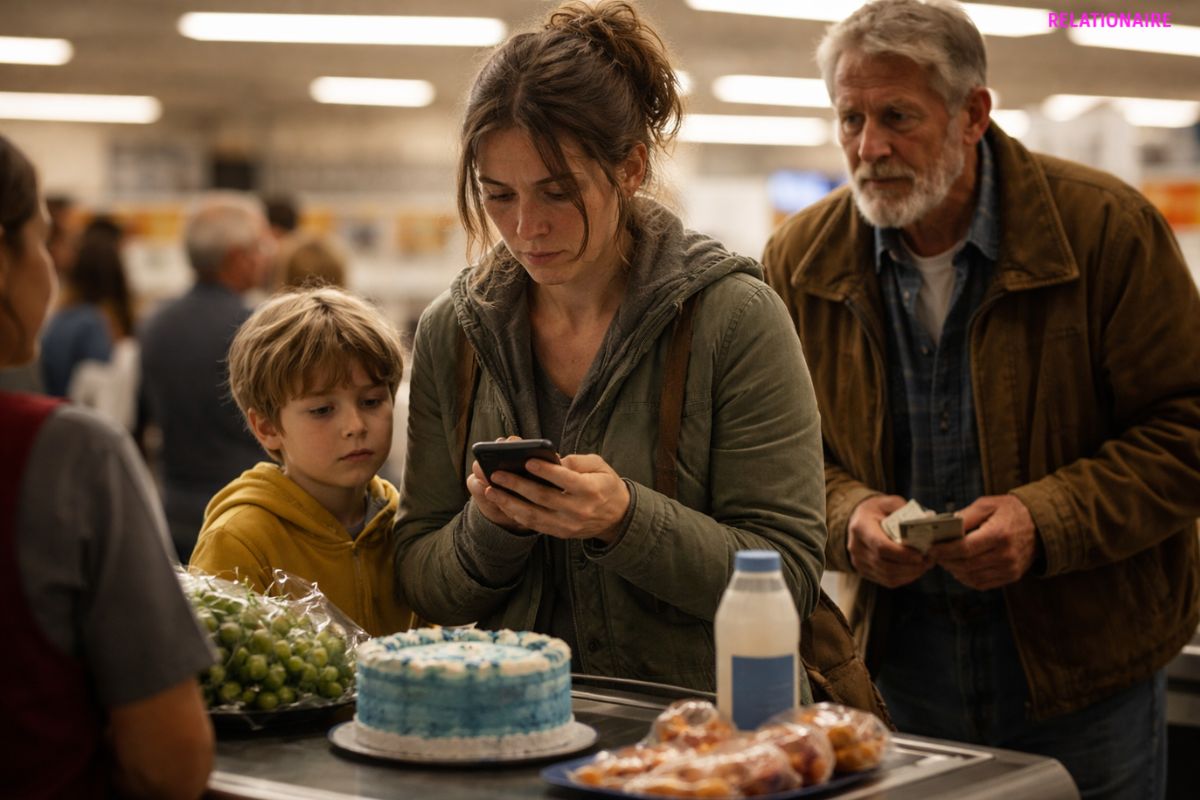
She could feel it through the thin plastic handle of the basket cutting into her fingers. Milk. Bread. Eggs. Peanut butter. A box of cereal with a cartoon tiger on it because Eli had stood there in aisle six hugging it to his chest like it was treasure. A small bakery cake with white icing and blue trim. Seven candles shaped like stars.
Nothing fancy. Nothing extra.
Except maybe the cake.
Except maybe the bag of coffee she’d stood holding for too long before putting it in the basket anyway, because tomorrow morning was tomorrow morning, and she was tired of waking up already defeated.
“Mom,” Eli whispered, tugging the sleeve of her faded sweatshirt. “Do you think Grandma would’ve liked the blue one better?”
Lena looked down at him.
His sneakers were scuffed white at the toes. His backpack still hung off one shoulder because she’d picked him up late from aftercare and they’d come straight here. His hair needed cutting. His eyes didn’t.
He still looked at the world like things could be fixed.
“She liked every color,” Lena said.
He nodded like that settled something deep.
The cashier was moving fast, barely looking up. A woman in her twenties with tired eyes and pink nails tapping items across the scanner in quick, sharp motions. Beep. Beep. Beep.
Behind Lena, the line had grown.
A man in a golf shirt with two cases of sparkling water.
A woman holding a rotisserie chicken and talking too loudly on her phone.
A teenager with earbuds and an armful of energy drinks.
Nobody said anything yet, but Lena could feel that checkout-line pressure building. That silent, collective thing people do when they want you to hurry up with your life.
She reached into her purse and touched the envelope again.
Rent notice.
Not yet final. But close enough to make her stomach burn.
The cashier read the total without emotion. “Ninety-three forty.”
Lena swallowed. That was a little higher than she’d hoped, but not impossible. Not if the app balance was right. Not if the automatic withdrawal for the electric bill hadn’t hit yet. Not if—
She slid the card.
The machine processed.
Then flashed red.
DECLINED.
The cashier looked at her. Not mean. Just blank. “You can try again.”
“Yeah,” Lena said quickly. “Sorry. It’s probably—yeah.”
She slid it again.
Eli stood very still beside her.
The machine thought about it a second longer this time, as if kindness might live inside electronics.
Then flashed red again.
DECLINED.
Heat climbed up Lena’s neck.
“Mom?” Eli said softly.
“It’s okay.”
It was not okay.
She opened the banking app with fingers that suddenly didn’t feel attached to her body. Her phone screen was cracked across one corner, the brightness too low, the store lights glaring against it. She saw the number and felt something cold move through her chest.
Forty-one dollars and twelve cents.
She had done the math this afternoon while sitting in the school pickup line. She had done it twice. But sometime between then and now, the gas station charge had posted. Or the pharmacy one. Or something small and ordinary and cruel.
She looked up at the screen again as if it might change because she needed it to.
It didn’t.
The woman behind her sighed.
Not loudly. Just enough.
Lena nodded once, set down her phone, and said to the cashier, “I’m sorry. I need to put some things back.”
The cashier paused the order. “Okay.”
Eli’s face changed.
Not into tears. That would’ve been easier.
It folded inward instead, like he was already learning how to make disappointment quiet.
Lena picked up the cake first.
No.
Not the cake.
She set it aside anyway.
Then the coffee.
Then the brand-name cereal.
Then the bag of grapes.
Then the frozen chicken.
Each item landed on the counter beside the register with a tiny sound that felt louder than it should have.
The woman behind her clicked her tongue. “Maybe people should check their balance before holding everyone up.”
Lena kept her eyes on the groceries.
The man with the sparkling water let out a short breath like agreement.
Eli looked back at them, confused in the raw, open way children still are before shame teaches them how not to look.
“It’s all right, buddy,” Lena said, but her voice had changed. Thin now. Careful. “We just don’t need all this.”
He stared at the little cake on the counter.
“It’s for Grandma,” he said.
Lena closed her eyes.
Today would have been her mother’s sixty-third birthday.
Every year, no matter how broke they’d been, her mother had made birthdays feel solid. Pancakes shaped like hearts. Dollar-store streamers. A candle stuck into a cinnamon roll if that was all there was. After her mother died last spring, Lena had told herself she would keep something of that alive for Eli. Not because he needed sugar. Because he needed ritual. Because grief was less frightening when it had a plate and a candle and a reason to gather around a table.
The woman on the phone lowered it just long enough to mutter, “Oh my God.”
Lena reached for the cake again.
A hand got there first.
Big hand. Knuckles worn. Nails clean but rough at the edges.
“Keep that,” a man’s voice said.
Lena looked up.
He was older. Maybe late sixties. Gray at the temples and under the chin. Brown work jacket. Flannel shirt. Work boots with dried mud in the treads. Not polished. Not performative. He looked like somebody who had spent most of his life lifting things that didn’t care how tired he was.
He had been farther back in line. She hadn’t even noticed him.
“That’s okay,” Lena said immediately, the words coming from the same place pride always came from—the place that kept people afloat until it drowned them. “You don’t have to do that.”
He didn’t answer her right away. He just looked at the cake, then at Eli, then at the cashier.
“Ring it all back up,” he said.
The cashier blinked. “Sir?”
“All of it.”
The woman behind Lena laughed once under her breath, like this was some kind of performance.
Lena turned fully toward the man. “Please don’t. I can’t pay you back.”
He finally met her eyes.
His were tired, too. But steady.
“I didn’t ask you to.”
Something in his tone stopped the air around them.
Not sharp. Not angry.
Certain.
“I can put some of it back,” Lena said quietly. “We only really need—”
“The milk’s sweating,” he said, nodding toward the bag. “The kid wants the cereal. And you look like you need the coffee.”
It was such a plain sentence that it nearly broke her.
The cashier started rescanning. The beeps came again, but softer somehow.
The man pulled out a wallet so worn at the fold that it looked one good day away from splitting in half.
Eli stared at him. “Are you rich?”
The man’s mouth twitched, almost a smile. “Nope.”
“Then why are you doing this?”
Nobody in line moved.
Nobody checked their phone.
The whole bright grocery store seemed to lean in without meaning to.
The man looked down at Eli for a long moment, then said, “Because sometimes a person needs someone to notice.”
Lena pressed her lips together hard.
The cashier read the total again. The man inserted his card. This time, the machine flashed green almost instantly.
Approved.
The woman behind Lena looked away first.
Lena felt her throat close.
“Sir,” she said, “please. At least tell me your name.”
He shook his head once. “No need.”
She reached for the receipt as the cashier handed it over, but he took it first.
For half a second she thought maybe he wanted a copy for himself. Instead, he folded it once, wrote something on the back with a pen from his shirt pocket, then tucked it into the bag with the cake.
His movements were unhurried. Familiar somehow.
Then he lifted the heaviest bag before she could stop him and set it gently in the child seat of her cart.
Eli said, “Thank you, mister.”
The older man rested his hand briefly on the handle of the cart. “Take care of your mom.”
Eli nodded solemnly. “I do.”
“I can see that.”
Then the man stepped away.
Not dramatically. Not waiting to be watched. He just turned and walked toward the automatic doors, his boots leaving faint, dusty marks on the white tile.
Lena stood there stunned, one hand gripping the cart, the other still holding her dead card.
“Ma’am?” the cashier said softly.
She looked up.
“There’s your receipt.”
Lena frowned. “I thought he—”
The cashier glanced into the bag with the cake. “He put it in there.”
By the time Lena pushed the cart outside, the man was gone.
No truck she could identify. No gray head in the parking lot. No chance to call after him. Just cold air, shopping carts rattling in the distance, and Eli climbing into the passenger seat of their old Corolla with the carefulness of a child who had learned that groceries could be fragile.
It wasn’t until she got home—until she set the milk in the fridge, placed the little blue cake on the counter, and pulled the folded receipt from the bag—that she saw there was more than a total tucked inside.
A note.
Her hands started shaking before she even opened it.
Because across the outside, in uneven block letters, were five words that made the room go still around her.
For Mary’s girls. Open this.
Lena sat down so fast the kitchen chair scraped the floor.
Eli looked up from the table. “Mom?”
But Lena couldn’t answer.
Because nobody in that store should have known her mother’s name.
And suddenly the man in the work boots didn’t feel like a stranger at all.
PART 2
Lena stared at the note until the words blurred.
For Mary’s girls.
Her mother used to say that when she wanted to gather them close, back when there had still been a “them.” Back when Lena’s younger sister, Ivy, still came by the apartment with fast food and loud opinions and cheap nail polish. Back before the funeral. Back before the fight that split everything open.
“Mom?” Eli asked again, quieter now.
Lena realized she was gripping the paper so tightly it had started to bend.
She let out a breath she didn’t remember holding. “It’s okay.”
But her voice came out strange.
Not okay. Never okay. Not since that day in the hospice room when her mother had opened her eyes just enough to whisper, Take care of each other, and Lena had said yes without knowing promises could rot inside a person when life got hard enough.
She unfolded the note.
Inside, the handwriting was the same uneven block print, careful and deliberate like someone who didn’t write much anymore unless it mattered.
Your mother helped me twenty-three years ago when my wife was dying. She stayed after her shift. She fed my little girl crackers from her own lunch and held her while I signed papers I couldn’t see through. Mary told me, “One day, if you get the chance, notice somebody.” I never forgot.
At the bottom was one more line.
You have your mother’s eyes.
Lena read it twice.
Then a third time.
The kitchen seemed too small for what was happening inside her chest.
Her mother had been a nurse’s aide at St. Andrew’s Hospital for almost thirty years. She used to come home smelling like hand soap and cafeteria coffee, her shoes leaving tired little squeaks on the apartment floor. She never talked much about work, only about people. Mr. Hanover likes extra mustard. Mrs. Bell hates mornings. Room 214 needs the blinds cracked just a little because the light bothers her.
She carried strangers home in pieces and called it a normal day.
But this—
This was from before Lena had Eli. Before her own marriage broke apart. Before the years that had turned everything into survival math and overdue notices and apology language.
“Who’s Mary?” Eli asked.
Lena looked at him.
“Grandma,” she said.
He straightened. “The man knew Grandma?”
She nodded slowly.
“How?”
Lena read the note again, and her eyes caught on one word harder than the others.
Girl.
Held her while I signed papers.
His little girl.
A memory flashed so quickly it felt like a dropped plate.
Her mother once sitting on the edge of Lena’s bed, folding towels while talking.
“There was this poor man today,” she’d said. “Scared out of his mind. Sweet little daughter with him. Curly hair all over the place. She fell asleep on my shoulder.”
Lena had been maybe twelve, half-listening, doing homework, annoyed about something stupid and temporary.
“You always bring work home,” she’d said.
Her mother had laughed softly. “Honey, people aren’t work.”
Now Lena pressed the heel of her hand against her mouth.
The cake sat between them on the counter, white frosting perfect under the yellow kitchen light. Seven blue star candles in a plastic sleeve beside it.
It had been for Mary’s birthday.
Now it felt like Mary had somehow sent it herself.
Eli slid off his chair and came to stand beside her. “Is the note good or bad?”
Lena looked down at him.
The truth was she didn’t know.
It was good in the way a hand on your shoulder is good.
It was bad in the way grief comes back wearing a different coat and still knows exactly where you live.
“It’s… important,” she said.
He leaned against her arm. “Are you crying?”
She laughed once through her nose. “A little.”
“Because you miss Grandma?”
“Yes.”
He thought about that. “Me too.”
The apartment went quiet.
The hum of the fridge. A car passing outside. Somebody in the building next door dropping something heavy. Ordinary sounds. But the room felt altered now, charged by the fact that kindness had not come from nowhere. It had come with memory. With history. With her mother standing invisible in the middle of it.
Lena turned the note over.
Nothing on the back.
No name. No number.
Just that message.
She sank into the chair and looked at the receipt underneath. Store name. Items. Total. Time stamp. One detail printed near the bottom caught her eye.
The cashier ID.
Mara.
The pink-nailed cashier.
Maybe she knew something.
“Eat your sandwich, baby,” Lena said softly. “I have to make a call.”
St. Andrew’s Hospital had changed names years ago and moved to a newer building on the highway, but the old staff still drifted through town like people who had once belonged to the same weather. Her mother had known everyone. Maintenance men, dietary staff, orderlies, volunteers. Some had come to the funeral. Some had sent casseroles. Some had meant to call and never did.
Lena still had a number for Doris, one of her mother’s old coworkers.
Doris answered on the fourth ring.
“Well,” the older woman said, warm and surprised. “Look what the Lord dragged back.”
Lena smiled despite herself. “Hi, Doris.”
“Oh, sweetheart.” Doris’s voice changed. Softer. “You okay?”
No one who really knew you ever asked that lightly.
Lena looked at the note in her hand. “I don’t know. I need to ask you something.”
Ten minutes later, she was sitting on the floor beside Eli’s chair while Doris told her what she remembered.
A man named Walter Cain.
His wife had died in oncology, years ago, after months of treatments and false hope.
He had come in every day in steel-toe boots straight from construction sites, carrying vending machine coffee and trying not to fall apart in front of his daughter.
“Your mother had a soft spot for the ones trying too hard not to break,” Doris said. “She stayed with that little girl one night for over an hour after her shift ended. The child was exhausted. So was the father. Mary rocked her in a waiting room chair and sang some church song under her breath.”
Lena closed her eyes.
Doris kept going. “After the funeral, Walter brought flowers to the unit. Cheap carnations, all he could afford. He said your mother had treated him like being scared didn’t make him weak.”
Lena looked over at Eli, who was licking peanut butter from the corner of his thumb.
A child at a table. Another child in a waiting room. Years folding over years.
“Do you know where he is now?” Lena asked.
Doris hesitated. “I heard he moved back here after retiring. Lost his daughter a few years ago, I think. Car accident maybe. I’m not sure.”
Lena sat very still.
Lost his daughter.
The note in her hand got heavier.
It explained something she couldn’t name. The look on his face in the checkout line. The way he’d watched Eli. Not politely. Carefully.
As if children were precious because they could vanish.
After she hung up, Lena lit one of the blue star candles and stuck it into the cake.
Just one.
Eli frowned. “Only one?”
“Tonight, one is enough.”
He accepted that.
She cut two small slices. He carried his to the table with both hands. Lena set hers down untouched.
“Can we sing?” he asked.
Her throat tightened. “Yeah.”
So they sang softly in that little kitchen with the cheap linoleum and the flickering overhead light and the note beside the cake like a fourth place setting.
Afterward, Eli licked icing from the fork and said, “I think Grandma sent him.”
Lena should have corrected him.
Instead she said, “Maybe she reminded him.”
That night, after Eli fell asleep with one sock on and one sock off, Lena sat at the kitchen table again. Rent notice on one side. Grocery receipt on the other. Coffee cup gone cold between them.
She thought about the past year.
The hospital bills from Eli’s asthma scare.
Her ex disappearing from child support like vanishing were a job.
The night shifts at the motel office.
Her mother’s funeral.
The argument with Ivy in the church parking lot afterward.
Ivy saying, “You always act like you were the only one who lost her.”
Lena saying the crueler thing, the unforgivable thing: “At least I was there at the end.”
Ivy’s face had gone white.
They hadn’t spoken since.
Now, on the back of a grocery receipt from a man who remembered her mother more tenderly than Lena had remembered her own sister, shame rose slow and full in her chest.
Mary told me, One day, if you get the chance, notice somebody.
Her mother had noticed a frightened man in a hallway.
That man had noticed Lena breaking in a checkout line.
And Lena, for almost a year now, had refused to notice her sister’s grief because it made her own feel less singular.
The next morning, the motel manager called before seven.
“Lena, I’m sorry,” he said, already sounding like somebody with another problem waiting. “I gotta cut Friday’s shift. Occupancy’s too low.”
Of course he did.
She stared at the wall while he talked. The peeling patch of paint above the stove looked like a state she couldn’t name.
Less money.
More math.
She thanked him anyway.
After she hung up, Eli came out rubbing his eyes. “Are we still going to school?”
She laughed despite everything. “Yes, buddy. School survived.”
But when she walked him to the bus stop, his teacher intercepted her on the sidewalk.
“Ms. Torres? Do you have a minute?”
Teachers never said that casually either.
The woman crouched a little, voice kind. “Eli’s field trip payment is due today. If that’s hard right now, I can ask the office about assistance.”
Lena felt the humiliation rise so fast it made her dizzy. Not because the teacher was unkind. Because she was kind enough to notice.
How visible had she become?
How thin was the line now between holding on and being seen not holding on?
“I’ll take care of it,” Lena said too quickly.
The teacher nodded, but her eyes said she didn’t believe her.
Back in the apartment, Lena opened the kitchen drawer where she kept rubber bands, takeout menus, dead batteries, and things too important to lose but too painful to look at often.
At the bottom was the funeral card with Ivy’s number written inside in blue ink.
Lena stared at it for a long time.
Then she set it beside the grocery receipt.
Two pieces of paper.
Two chances.
One from the past reaching back.
One from the present asking not to be wasted.
By noon she had done neither brave thing nor easy thing. She had not called Ivy. She had not returned to the store to ask about Walter Cain. She had only folded laundry, checked her account three times, and eaten crackers over the sink.
At three-fifteen, there was a knock on her apartment door.
Not loud.
Not impatient.
Three steady taps.
Lena froze.
Nobody visited.
She moved quietly to the door and looked through the peephole.
Work boots.
Brown jacket.
A white bakery box in one hand.
And tucked under his arm, something else.
A worn paper envelope with her mother’s handwriting across the front.
PART 3
For one second Lena didn’t move.
The hallway beyond the door looked washed out through the peephole. Beige walls. Faded carpet. A neighbor’s stroller parked crooked by the stairwell. And there he was again, as solid and ordinary as yesterday, standing under the buzzing light with a bakery box and an envelope from the dead.
Three steady knocks had turned her bones to glass.
She opened the door.
Up close, Walter Cain looked older than he had in the store. Or maybe grocery-store brightness had hidden some of it. The broken veins along his nose. The softened weight of grief around his mouth. The careful way he stood, like his knees sometimes argued with him.
“I’m sorry to just show up,” he said. “I got your address from the cashier. I told her I’d known your mother. She remembered you from your rewards account.”
Lena almost laughed at the absurdity of that. Modern life handing out old miracles through loyalty programs and minimum-wage witnesses.
“It’s okay,” she said, though her voice was barely there.
He nodded toward the envelope. “I found this in a box last night after I got home. Thought maybe it belonged with you.”
Behind her, Eli called from the couch, “Mom? Who is it?”
Walter’s face changed at the sound of his voice. Not dramatically. Just a small tightening around the eyes. A softness arriving and bracing itself at the same time.
Lena stepped back. “Come in.”
He hesitated at the threshold, wiping one boot carefully on the mat before the other. The habit of a man who had spent a lifetime trying not to bring the outside mess into other people’s homes.
The apartment suddenly felt exposed. The dish towel hanging off the oven handle. The school papers on the table. The rent notice she hadn’t hidden. The old couch with a blanket tucked over the rip in one arm. Poverty always felt louder in front of witnesses, even kind ones.
Walter seemed to notice all of it and none of it.
Eli popped up from the couch. “It’s him!”
Walter managed a faint smile. “It is.”
“You disappeared.”
“That’s true.”
“You brought cake again?”
Walter lifted the bakery box a little. “Pie this time. Peach. Your grandma Mary once told me cake gets too much credit.”
The words hit Lena so fast she had to grip the back of a chair.
That sounded exactly like something her mother would say.
Eli grinned. “I like him.”
Walter looked at Lena, asking permission without asking it aloud.
She nodded toward the table. “Sit.”
He placed the pie down carefully. Then the envelope.
Lena knew her mother’s handwriting before she even picked it up. The slant of the M. The full, generous loop of the y. Written across the front:
Walter — for when she’s older.
Lena stared.
He sat across from her, hands clasped, thick fingers lined with age and old cuts. “My daughter never wanted to open it,” he said quietly. “Said if she read the last thing tied to that hospital, it would make her mom’s death feel finished. So she kept it. After she died, I couldn’t bring myself to go through her boxes. Not really. Last night I did.”
Lena lifted her eyes.
“My daughter,” he said again, as if the words still needed practice. “Nora.”
The name seemed to settle into the room beside them.
Eli had wandered closer now, drawn by adult voices and dessert. “Did your daughter like pie?”
Walter looked at him. “She liked peach.”
“Me too.”
Walter nodded once, and for a moment Lena saw the full shape of his kindness. It wasn’t just that he had helped in the checkout line. It was that he kept walking back toward pain instead of away from it.
Lena turned the envelope over.
Still sealed.
The flap had yellowed with time. Her mother’s handwriting on the front looked alive enough to call the whole thing impossible.
“You can open it,” Walter said.
“Why did you come back?” Lena asked before she did.
He was quiet for a moment.
Then he said, “Because I went home and kept thinking about your face at that register. Not embarrassed. Not really. It was something else.” He exhaled slowly. “It was the look people get when they’re doing everything they can and still losing ground.”
Lena looked down.
He went on. “I know that look. I wore it myself for a long time.”
The room was so still she could hear the refrigerator humming again.
“I didn’t pay for your groceries because I’m noble,” he said. “I paid because once, when I was the one standing in the fluorescent light trying not to come apart, your mother treated me like I was still a man. Not just a problem to process. She noticed my little girl. And yesterday, when your boy asked if I was rich…” A breath that almost became a laugh. “I thought, no. But I have enough to be the person she told me to be.”
Lena felt tears press hot and immediate behind her eyes.
Not because it was beautiful.
Because it was specific.
Because it cost something.
Because human goodness was never abstract when it arrived with work boots and an old wallet and grief folded carefully under the arm.
She opened the envelope.
Inside was a single sheet of stationery, the kind hospitals used to keep at volunteer desks. Pale blue border. Her mother’s handwriting filling the page.
Walter didn’t look away, but he didn’t lean in either.
Lena read.
Walter,
If Nora ever opens this, she’ll be older, and that means you both made it through something impossible. That doesn’t mean you made it through unchanged. It just means you kept going. Sometimes that is the miracle.
You love that little girl in a way she will spend her whole life standing on, even in the years when she rolls her eyes and thinks you’re embarrassing. Don’t let grief make you doubt what she has already felt from you. Children know who stays.
Lena had to stop. Her vision blurred.
Walter sat motionless, jaw tight.
She kept reading.
And if this letter reaches someone else one day, maybe because life loops around in ways we can’t predict, here is what I want them to know: nearly everybody is carrying something heavier than they show in public. So when you can, make the line softer. Make the chair warmer. Make the day less cruel. It matters more than you think.
At the bottom, in smaller writing, almost as if added later:
Walter, if Nora has children someday, tell them their mother was once brave in a waiting room. If she doesn’t, tell somebody else’s child a good story about her anyway. Love keeps moving when people do.
Lena lowered the page.
No one spoke.
Eli broke the silence first.
“Was your daughter brave?”
Walter swallowed. “Yeah. She was.”
“What happened to her?”
Lena almost stopped him. But Walter answered with the plainness children deserve.
“A car hit her truck in the rain three years ago.”
Eli absorbed that. “Oh.”
That was all. Just oh. A child-sized word for an adult-sized sorrow.
Walter’s gaze drifted to the window for a second. “She was thirty-one.”
The number hollowed out the room.
Lena pictured him going through boxes alone. Finding the note. Seeing her mother’s name again after all those years. Walking back into somebody else’s difficult life because his own hadn’t made him selfish. It had made him gentler.
And all at once the thing Lena had been avoiding since the kitchen table rose in her like a demand.
Ivy.
Her sister had lost the same mother. Sat under the same church flowers. Held the same funeral program in shaking hands. And Lena had let her grief turn territorial, as if pain got smaller when shared.
Walter noticed the change in her face.
“You all right?”
“No,” Lena said, and then, with a rough little laugh, “Maybe for the first time in a while.”
She stood up suddenly, went to the kitchen drawer, and pulled out the funeral card with Ivy’s number inside.
Walter didn’t ask.
Lena looked at the note, at her mother’s last living loops of ink, and pressed call.
It rang four times.
Five.
Then Ivy answered, breathless and guarded. “Hello?”
Lena almost lost courage.
Then she heard her mother’s voice in memory—Take care of each other—and realized that love could become a command if you waited long enough.
“Ivy,” she said, and her own voice cracked on the name. “I’m sorry.”
Silence.
Then a sharp inhale on the other end.
“I’m sorry for what I said after the funeral,” Lena went on. “I’m sorry for acting like losing her was mine more than yours. It wasn’t. I just… I didn’t know how to be hurt and loving at the same time.”
Walter looked away, giving her privacy inside the same room.
Eli climbed quietly into his lap as if the world had decided that was where he belonged for a minute. Walter froze, then very carefully put one arm around him.
On the phone, Ivy started crying.
So did Lena.
They talked for almost an hour. Not enough to repair a year. Enough to begin.
By the end, Ivy was laughing weakly through tears because Eli had shouted into the phone that there was pie and “the grocery man” was here. She promised to come by Sunday. She said she still had Mom’s green casserole dish. Lena said bring it.
After the call, the apartment felt changed in the way a room changes after a storm passes through and leaves the windows open.
Walter looked down at Eli, who was half-curled against him. “Guess I got promoted,” he murmured.
Eli, sleepy now, said, “You’re safe.”
Walter closed his eyes for one second.
Lena turned away under the excuse of getting plates.
They ate peach pie at the table with paper napkins and mismatched forks. Walter told Eli a story about Nora at age seven sneaking a frog into the house in a rain boot. Eli laughed so hard pie came out his nose. Lena laughed too—an ugly, startled sound like something rusted had finally given way.
Before Walter left, he stood in the doorway holding his jacket.
“You don’t owe me anything,” he said.
Lena shook her head. “I know.”
He nodded, as if that mattered.
Then she said, “But I think my mother would’ve liked that you came back.”
His face folded briefly around the eyes. “I think I needed to.”
After he was gone, Lena cleaned the plates and wrapped the leftover pie. Eli fell asleep early on the couch, sticky with sugar and safe with exhaustion.
The note from her mother stayed on the table.
That Sunday Ivy came over with the green casserole dish. She cried when she saw the letter. They cried together in the kitchen while Eli built a fort from couch cushions and demanded sandwiches cut into triangles. Later, Ivy asked if Walter might like to come for dinner sometime. Lena said maybe.
Over the next few weeks, small things shifted.
Not miracle things.
Real things.
Ivy started watching Eli on Thursdays so Lena could pick up extra hours.
Eli’s teacher quietly arranged field trip assistance without making it feel like charity.
Walter stopped by once with a used backpack his church was giving away, then again with tomatoes from a neighbor’s garden, then once just to return a container Ivy had sent home with casserole.
He never stayed too long.
He never acted like he was saving anybody.
But he noticed.
That was different.
That mattered.
Months later, on a gray afternoon at the grocery store, Lena saw a young father in line ahead of her put back diapers and cough medicine when his card failed.
He kept apologizing to no one.
His little girl stood beside him in a pink coat with one mitten missing.
People were already starting to look.
Lena reached into her purse before she had time to think herself out of it.
“Keep those,” she said.
He turned, startled.
Lena smiled, though her throat tightened when she did.
“It’s okay,” she said. “Ring it all back up.”
And because some kindnesses do not end where they begin, because they travel quietly through waiting rooms and checkout lines and kitchens and years, she slipped the receipt into his bag before she left.
Not with anything poetic.
Just seven words written carefully across the back.
Someone noticed me once. I noticed you.
At home that night, Eli asked why she seemed happy and sad at the same time.
Lena looked at him, really looked at him, in the warm light over the stove. The child she was still raising inside all this uncertainty. The child who had been seen. The child who had watched her be seen too.
“Because that’s how some good things feel,” she said.
Outside, a car door slammed. Somewhere down the hall, somebody laughed. The world kept making its usual noise.
But in Lena’s kitchen, the old cruelty had gone quieter.
Not gone.
Just softer.
And sometimes, for a while, that was enough.