If you’ve already read part 1 of this story on Facebook, go here for Part 2!
PART 1
The first time I saw Mr. Alvarez pull something out of the trash, I judged him before I knew his name.
It was 2:14 in the morning outside the oncology wing, and the hallway had that tired hospital silence that only comes after midnight.
Not peaceful.
Just exhausted.
The lights were dimmed. The vending machine hummed beside the family waiting room. Someone had left a paper cup of coffee on the windowsill, cold and untouched. My shoes squeaked every time I turned toward the nurse station.
I was seventeen hours into a shift I had promised myself I would never take again.
Then I saw him.
The night janitor.
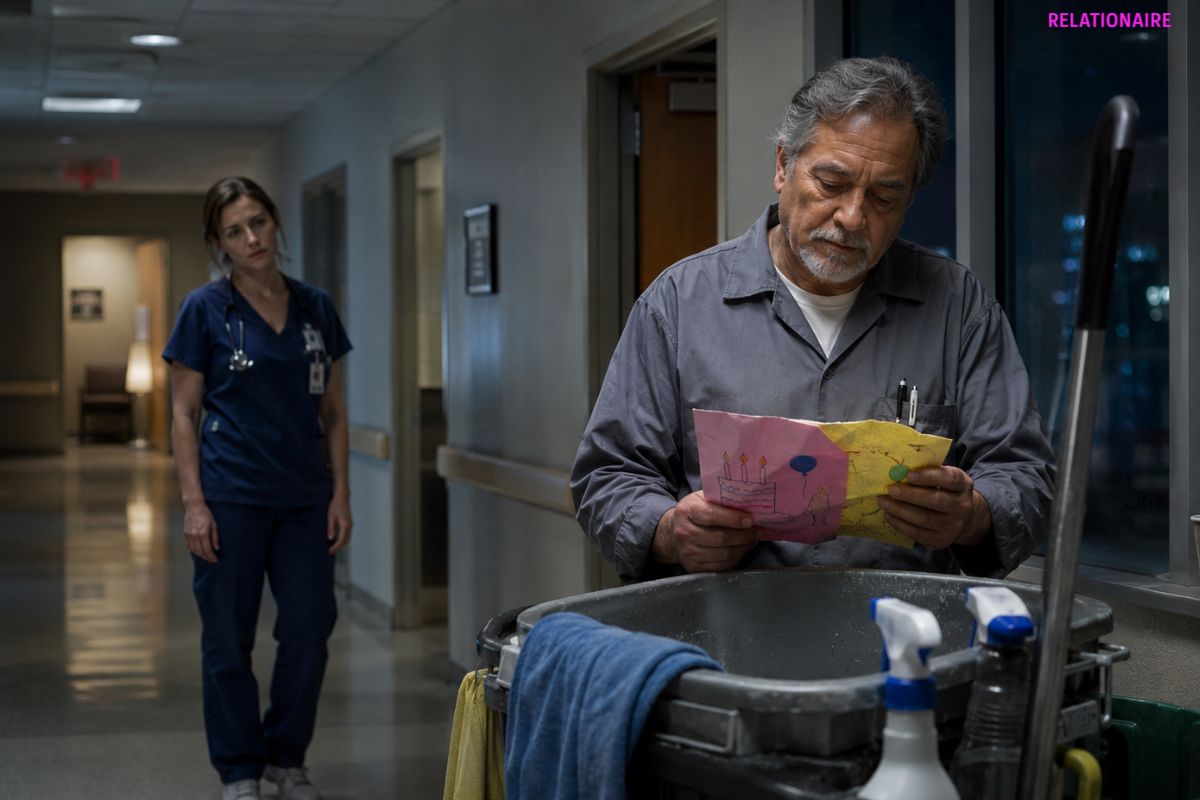
Gray uniform. Bent shoulders. One yellow glove tucked into his back pocket. He was standing beside the trash can near Room 418, holding a crumpled piece of construction paper like it was something fragile.
I stopped walking.
He didn’t hear me at first.
He smoothed the paper carefully against the side of his cleaning cart. Slow. Gentle. Almost tender.
It was a birthday card.
Handmade.
Purple marker. Crooked letters. A sticker shaped like a balloon peeling off one corner.
Happy Birthday, Grandma Rosie.
I knew that card.
The patient in 418 had turned seventy that afternoon. Her grandkids had filled her room with paper flowers and taped drawings to the wall. By evening, she was laughing so hard her oxygen tube slipped a little, and her daughter had cried trying to fix it.
By midnight, the family was gone.
By 2:14, the card was in the trash.
And Mr. Alvarez was keeping it.
I must have made a sound, because he turned.
For a second, he looked caught.
Not guilty exactly.
More like a child holding something he was afraid someone might take away.
“Everything okay?” I asked.
He folded the card once, then unfolded it again.
“Yes, nurse.”
“My name is Claire.”
He nodded, but his eyes didn’t quite meet mine.
“Mr. Alvarez, right?”
“Mateo,” he said quietly.
His voice was rough, like he didn’t use it much.
I glanced at the card in his hand.
He followed my eyes.
“It was in the trash,” he said.
“I saw.”
He swallowed. “I clean.”
“I know.”
The hallway seemed to stretch between us.
I should have walked away. Nurses see strange things at night. Grief makes people do odd, harmless things. So does loneliness. So does exhaustion.
But something about the way he held that card made my stomach tighten.
People left all kinds of things behind in oncology.
Flowers after they wilted.
Visitor badges folded into pockets.
Half-written grocery lists.
Prayer cards.
Empty water bottles.
Sometimes things were thrown away because the family couldn’t bear to take them home.
Sometimes because no one had come to collect them.
And here was this quiet man picking through it.
I heard myself say, “You keep things patients throw away?”
His face changed.
Just a little.
The softness closed.
“No,” he said.
Then he tucked the card beneath the lid of his cart, picked up his mop, and rolled away without another word.
I told myself it wasn’t my business.
By morning, I told myself I had imagined the tenderness.
But three nights later, I saw him do it again.
This time it was outside the pediatric infusion room.
A child’s drawing had been dropped beside the trash instead of inside it. Blue house. Red sun. Four stick people holding hands.
Mr. Alvarez picked it up, brushed a coffee stain from the corner, and placed it inside a manila folder clipped beneath his cleaning cart.
He didn’t see me watching.
Or maybe he did and chose not to look.
After that, I noticed things I hadn’t noticed before.
He worked like a shadow.
He knew which doors creaked.
He knew which families wanted conversation and which ones wanted silence.
He never entered a room without knocking, even when the patient was asleep.
If a visitor cried in the hallway, he moved his cart around them like tears deserved privacy.
If a patient dropped a blanket, he would wash his hands, fold it, and place it back without saying anything.
And still, the folder grew.
Cards.
Drawings.
Notes.
Old photographs printed on pharmacy paper.
Once, I saw him pick up a birthday napkin with a cupcake on it.
I started to feel uneasy.
Not afraid.
Just bothered.
Hospitals require trust in small ways. People are vulnerable here. They leave pieces of themselves everywhere. A card in a trash can might look useless, but it still belonged to someone’s life.
One morning, I mentioned it to Angela at the nurses’ station.
“You ever notice Mateo keeps things from the trash?”
Angela didn’t even look up from the medication chart.
“Mateo keeps lots of things.”
That answer did not comfort me.
“What does that mean?”
She sighed. “Claire, you’re new to nights.”
“I’ve been here six months.”
“Exactly.”
I waited.
Angela capped her pen and lowered her voice.
“Leave him be.”
That bothered me more.
Because when people say leave him be, they usually mean either there’s a story too painful to explain or something everyone has quietly agreed to ignore.
A week later, Mrs. Rosen from Room 421 had a birthday.
Eighty-three.
No family came.
The social worker called twice. Her son lived three states away and said he might come over the weekend. Her daughter’s number was disconnected. By lunch, the cupcake from dietary sat untouched beside her bed.
When I brought her evening medication, she smiled like she was apologizing for being alive.
“Don’t worry about me, honey,” she said. “At my age, birthdays are mostly paperwork.”
I laughed because she wanted me to.
But her table was empty.
No flowers.
No card.
No visitor badge clipped to a coat.
Just a small white cupcake under plastic and a plastic fork she hadn’t unwrapped.
Later, during rounds, I passed her room and heard a voice inside.
A man’s voice.
Soft.
I paused.
Through the half-open door, I saw Mateo standing beside her tray table.
His cleaning cart was parked in the hallway.
In his hands was the purple handmade card I had seen him take from the trash days before.
Happy Birthday, Grandma Rosie.
Only now, the word Grandma had been covered with a small strip of blank paper.
In careful blue pen, someone had written:
Happy Birthday, Mrs. Rosen.
Mrs. Rosen held it with trembling fingers.
Her eyes were wet.
Mateo stood with his head bowed.
“It’s beautiful,” she whispered.
He nodded once.
“There was cake today,” he said.
“There was.”
“You should eat a little.”
She smiled at him.
“Will you sit while I do?”
He hesitated.
Then he sat.
Not in the visitor chair closest to her.
The one beside the bed.
Like someone who had been invited before.
I stepped back before either of them saw me.
My face burned.
I had thought he was strange.
I had thought he was taking things.
I had thought he was collecting scraps of other people’s lives for reasons I didn’t want to understand.
But he wasn’t hoarding sadness.
He was rescuing proof.
Proof that someone had been celebrated.
Proof that there had been love in the building, even if it had missed the room that needed it most.
The next night, I waited until the hallway was quiet and found him in the janitor’s closet refilling disinfectant spray.
“I saw you with Mrs. Rosen,” I said.
His hand froze on the bottle.
“I’m sorry,” I added quickly. “I didn’t mean to spy.”
He didn’t answer.
“I thought…” My voice got smaller. “I thought the wrong thing.”
He kept his eyes on the shelf.
Finally, he said, “Most people do.”
The words landed harder than they should have.
I stepped inside the doorway.
“How long have you been doing that?”
He wiped the bottle with a rag, though it was already clean.
“Long enough.”
“Why?”
He looked at me then.
Really looked.
His eyes were dark and tired, but not cold.
“Because empty tables make people feel forgotten.”
The janitor’s closet smelled like bleach and old cardboard. A faded calendar hung crooked on the wall. On the metal shelf behind him, I noticed a small stack of manila folders tied with rubber bands.
Birthdays.
Get Well.
Kids.
Mothers.
Fathers.
The last folder was different.
It was thicker than the rest, the edges soft from being handled too often.
On its tab, written in careful black marker, was one word:
Unsent.
Before I could ask, the hallway call light blinked red.
Room 427.
Mr. Ellis.
No visitors. No flowers. No family listed except one emergency contact he refused to update.
A bitter old man who snapped at every nurse, sent trays back untouched, and once told me kindness was “what people offered when they wanted to feel useful.”
I turned to go.
Then Mateo said something behind me.
So quietly I almost missed it.
“Don’t give that man a birthday card.”
I stopped.
My hand was already on the doorframe.
“What?”
Mateo’s face had gone pale.
He looked past me, down the hall toward Room 427.
Then he said the line that made everything I thought I understood fall apart.
“Because if he sees my handwriting, he’ll know I’m his son.”
PART 2
For a moment, I forgot the call light.
The hallway outside Room 427 kept blinking red, blinking red, blinking red, but I stood in the janitor’s closet with my hand on the doorframe, staring at Mateo Alvarez like he had just opened a door under the floor.
“His son?” I whispered.
Mateo looked like he regretted saying it the second it left his mouth.
He turned back to the shelf, lined up the spray bottles with shaking precision, and said, “You should answer the light.”
I did.
Because nurses answer lights.
Even when their own hearts are making too much noise.
Mr. Ellis was sitting upright in bed when I entered, scowling at the untouched dinner tray.
His room was always too neat.
No extra blanket.
No family photos.
No slippers under the chair.
No cards taped to the wall.
Just a folded newspaper, a plastic water pitcher, and his glasses placed perfectly beside the call button.
“You people forgot my tea,” he said.
“Your tea?”
“Hot. Not that lukewarm dishwater from earlier.”
I picked up the paper cup on his tray. Cold.
“I’ll get you a fresh one.”
He looked toward the doorway.
“Was someone out there?”
“No.”
I hated how quickly I answered.
He narrowed his eyes.
“I heard a cart.”
“It’s the hospital, Mr. Ellis. There are always carts.”
He grunted and looked away.
On his wrist, his hospital bracelet had twisted backward. I reached to fix it, and he pulled his arm away like touch offended him.
“I can do it.”
I let him.
His birthday was the next morning. I knew because his chart had the little reminder icon beside his name.
Eighty-one.
When I returned with hot tea, he didn’t thank me.
But he wrapped both hands around the paper cup.
That was something.
For the rest of the shift, Mateo avoided me.
He cleaned the rooms on the far side of the hall first. He pushed his cart quietly past the nurse station without looking up. When he entered Room 427 after Mr. Ellis finally fell asleep, he was inside less than three minutes.
The next morning, I asked Angela.
Not everything. Just enough.
“Did you know Mr. Ellis is Mateo’s father?”
Angela’s pen stopped.
That was answer enough.
She looked toward the hallway, then back at me.
“Mateo told you?”
“Not exactly. It slipped out.”
Angela leaned back in her chair.
Her face softened in that way nurses’ faces do when they are remembering something they never wrote down.
“They haven’t spoken in years,” she said.
“How many?”
“Twenty, maybe.”
I stared at Room 427’s closed door.
“What happened?”
Angela shook her head. “That isn’t mine to tell.”
Then, after a pause, she added, “But I’ll tell you this. Mateo has worked here twelve years. His father has been admitted three times in the last two. Mateo has cleaned that room every time.”
“Does Mr. Ellis know?”
“No.”
My throat tightened.
“He asked us not to say.”
“Why?”
Angela looked tired.
“Because sometimes loving someone from the hallway is the only way you’re allowed to love them.”
I carried that sentence with me all day.
At noon, dietary sent Mr. Ellis a birthday cupcake on a small tray.
Vanilla. White icing. One sugar candle decoration stuck in the top.
He stared at it like it had insulted him.
“What’s this?”
“It’s your birthday,” I said.
“I know what day it is.”
“Dietary sends one to every patient.”
“Take it away.”
“You don’t have to eat it.”
“I said take it away.”
His voice was sharp, but his hand trembled under the blanket.
I looked at the empty walls.
No calls.
No visitors.
No flowers.
Not even a text message lighting up the bedside table.
Just the cupcake between us, bright and unwanted.
“Would you like me to call anyone?” I asked gently.
He laughed once.
Not amused.
“Everyone worth calling learned to stop answering.”
There was bitterness in it.
But underneath, something else.
A bruise pretending to be armor.
I thought of Mateo’s Unsent folder.
I thought of all those rescued cards.
I thought of Mrs. Rosen holding a stranger’s birthday wish like a warm hand.
“Maybe someone would come,” I said.
Mr. Ellis turned his head slowly.
“You’re young.”
“I’m thirty-four.”
“Young enough to think people come back because you finally decide you’re lonely.”
I had no answer for that.
So I took the cupcake tray and left.
In the break room, I found Mateo standing beside the sink, washing out his lunch container.
Plain rice. Two slices of boiled egg. A banana with a brown spot.
The kind of meal a person packs when they are used to not needing much.
“It’s his birthday,” I said.
“I know.”
“He sent the cupcake away.”
“I know.”
“Mateo.”
He dried the container slowly.
I tried again. “You don’t have to tell me anything. But he’s alone.”
Mateo gave a small, sad smile.
“He made sure of that.”
I should have stopped.
But I was tired.
And tired people sometimes mistake honesty for courage.
“So that’s it? You’ll give cards to every lonely patient except your own father?”
His face changed.
Not anger.
Pain.
The kind that makes a room go silent.
He set the container down.
“When my mother was dying,” he said, “he stopped visiting her room.”
I didn’t move.
“She was here. Not this wing. Fourth floor, before they remodeled. He said hospitals made him useless. He said he didn’t know what to do with sickness.”
Mateo looked at his hands.
“I was twenty-six. I worked days then. I would sit with her at night. She kept asking if he was coming.”
His voice did not break.
That made it worse.
“I lied,” he said. “Every night, I lied. I told her he had car trouble. Work. A headache. Anything.”
Outside the break room, someone laughed at the nurse station. Normal life passing too close to old grief.
“The last birthday she had,” Mateo continued, “he forgot.”
He reached into his back pocket and pulled out a small folded paper.
Not a card.
A photocopy, creased white at the edges.
He opened it carefully.
A child’s drawing of a cake.
No. Not a child’s drawing.
An old handmade birthday card, faded from years of handling.
To Mom.
Love, Mateo.
“She kept it under her pillow,” he said. “After she was gone, I found it in the linen bag before it went to laundry.”
I looked at him.
“And that’s when you started saving them.”
He nodded.
“People throw away cards because they think the moment is over. But sometimes the moment is all someone has.”
His words sat between us.
Heavy.
True.
Then he folded the photocopy and put it back in his pocket.
“I tried to see him after the funeral,” he said. “He told me my mother was gone because I kept her hoping too long. Said I filled her head with lies.”
“That wasn’t your fault.”
Mateo’s jaw tightened.
“He said I was weak like her.”
I felt heat behind my eyes.
“He said that?”
“He said worse.”
I looked toward the hallway.
“And now he’s here.”
“And now he’s here.”
“Does he know you work nights?”
“No.”
“But you keep cleaning his room.”
“It’s my section.”
“Mateo.”
He looked at me, and there it was.
The truth beneath the quiet.
Not forgiveness.
Not peace.
Something more painful.
Loyalty with nowhere safe to go.
“I change his water before he wakes,” he said. “I leave extra blankets because he gets cold and won’t ask. I tell dietary he hates peas. I make sure his newspaper isn’t thrown out.”
I remembered Mr. Ellis’s perfect room.
It wasn’t empty because no one cared.
It was carefully held by someone he had wounded.
“He doesn’t deserve that,” I said softly.
“No,” Mateo said.
Then he looked down.
“But my mother would have wanted him warm.”
I had to look away.
That afternoon, a storm rolled over the hospital.
Rain tapped the windows. Families shook umbrellas in the lobby. The oncology wing smelled faintly of wet coats and cafeteria soup.
At 5:30, Mr. Ellis became restless.
Not medically alarming. Just agitated.
He asked for his glasses, then said they weren’t his. He asked what time it was, then snapped when I answered. He stared at the blank wall beside his bed.
Finally, he said, “Did anyone call?”
I checked the chart though I already knew.
“No messages today.”
He nodded like that was exactly what he expected.
But his face folded inward for one quick second.
By evening, his birthday cupcake had returned on a new tray.
Still untouched.
This time, I didn’t take it away.
I left it near the window.
At 10:45, after medication rounds, I found Mateo outside Room 427.
He wasn’t cleaning.
He was standing still with a card in his hand.
Not one from the folders.
This one was old.
Yellowed.
Soft at the fold.
The envelope had no name.
His thumb rested over the flap.
“Mateo,” I said gently.
He didn’t look at me.
“I wrote it the year after she died,” he said.
“For your father?”
He nodded.
“Never sent it.”
“What does it say?”
He let out a breath that was almost a laugh.
“Too much. Not enough.”
Inside the room, Mr. Ellis coughed and shifted.
Mateo closed his eyes.
For one second, I thought he might walk in.
Instead, he handed the envelope to me.
“No,” I said.
“Please.”
“I can’t do this for you.”
“I’m not asking you to fix it,” he said. “Just put it on the tray.”
His voice was steady, but his eyes were not.
“If he throws it away, I’ll clean it up.”
That was the part that broke me.
Not the card.
Not the father.
The fact that Mateo had already made room in his heart for rejection.
I took the envelope.
My hands felt too small for it.
Inside Room 427, Mr. Ellis was awake, staring at the rain running down the window.
I stepped in quietly and placed the envelope beside the untouched cupcake.
“What’s that?” he asked.
“A birthday card.”
“From who?”
I looked back through the half-open door.
Mateo stood in the hall, hidden by the shadow of his cart.
Waiting.
I turned to Mr. Ellis.
“I think you should read it.”
He stared at the envelope.
Then he saw the handwriting.
His face went still.
All the anger left at once, and what remained looked older than eighty-one.
His fingers reached for the card, stopped, then reached again.
He whispered one word.
“Mateo?”
From the hallway, the janitor did not move.
And for the first time since I had known him, Mr. Ellis looked afraid of being answered.
PART 3
Mr. Ellis did not open the card right away.
He held it against his blanket with both hands, as if the paper weighed more than he could manage.
Outside his room, Mateo stood half-hidden by the cleaning cart.
I could see only one side of him through the doorway.
His gray sleeve.
His tired hand gripping the mop handle.
His wedding ring, old and dull, though I later learned he had never married. It had been his mother’s. He wore it on a chain under his shirt most days, but that night, he had slipped it onto his finger.
Maybe for courage.
Maybe because she was the only one who could have made either man brave.
Mr. Ellis stared at the envelope.
“You know him?” I asked softly.
It was a foolish question.
But sometimes people need an easier question before the real one.
His mouth moved once before sound came.
“He’s my son.”
The words were thin.
Not proud.
Not angry.
Just bare.
I looked toward the hallway.
Mateo’s grip tightened.
Mr. Ellis swallowed.
“He works here?”
“Yes.”
“For how long?”
“Twelve years.”
The old man closed his eyes.
Twelve years is a long time to miss someone in the same building.
When he opened them again, they were wet.
Not crying yet.
Just no longer able to pretend.
“He cleans this floor?” he asked.
“Yes.”
“My room?”
I didn’t answer.
I didn’t have to.
Mr. Ellis looked around then.
Really looked.
At the extra blanket folded at the foot of the bed.
At the newspaper placed where his right hand could reach it.
At the pitcher filled with ice water, even though he had never asked after the first day.
At the dinner tray without peas.
His face changed piece by piece.
Recognition is not always a bright thing.
Sometimes it hurts.
Sometimes it makes you see every kindness you were too stubborn to notice.
“He did that?” Mr. Ellis whispered.
I nodded.
He looked down at the envelope again.
For a while, the only sounds were rain against the window and the soft beep of machines down the hall.
Then he opened it.
I looked away to give him privacy.
But I heard the paper unfold.
I heard his breath catch.
I heard the silence that comes when a person finds the door he nailed shut is still standing there, waiting.
He read slowly.
His hands shook.
When he finished, he didn’t speak for almost a minute.
Then he said, “Is he outside?”
Mateo stepped back.
I saw it.
That small retreat.
A man preparing to disappear before he could be dismissed.
“Mateo,” I said.
He shook his head.
But Mr. Ellis heard my voice.
“Is he outside?” he asked again, louder this time.
Mateo closed his eyes.
Then he rolled the cart aside and stepped into the doorway.
He did not enter the room.
He stood with one foot in the hall, one foot near the threshold, like the line between them was visible.
Mr. Ellis looked at him.
For twenty years, maybe he had imagined his son frozen at the age of the last argument.
Twenty-six. Hurt. Furious. Still young enough to slam a door.
But Mateo was not that man anymore.
His hair had silver in it.
His shoulders had learned to bend.
His face carried the quiet of someone who had comforted strangers for years because he could not comfort the person he came from.
Mr. Ellis stared.
“You got old,” he said.
It was not the right thing.
But it was the truest thing he could find.
Mateo gave one small nod.
“So did you.”
The old man let out something that almost became a laugh and almost became a sob.
“I didn’t know you were here.”
“I know.”
“I didn’t know you…” Mr. Ellis looked at the water pitcher, the blanket, the tray. “I didn’t know.”
Mateo’s face stayed still.
“That was the point.”
The sentence was not cruel.
That made it harder.
Mr. Ellis looked at the card in his lap.
“What you wrote,” he said. “Is it still true?”
Mateo did not answer quickly.
I respected him for that.
Forgiveness should not be forced to perform on command.
Finally, he said, “Some of it.”
The old man nodded as if he deserved less.
“What part?”
Mateo stepped one inch into the room.
“The part where I said I missed who you were when Mom laughed.”
Mr. Ellis covered his mouth with his hand.
There it was.
Not the illness.
Not the years.
Not the anger.
A memory.
A kitchen maybe. A woman laughing. A child watching his father become gentle because she was in the room.
The old man’s shoulders began to shake.
He turned his face toward the window, ashamed of tears he had probably spent a lifetime refusing.
“I was scared,” he said.
Mateo looked down.
“So was she.”
“I know.”
“No,” Mateo said softly. “You don’t.”
The words sat there.
No yelling.
No punishment.
Just the truth, placed gently enough that it could not be denied.
Mr. Ellis nodded again.
This time, slower.
“You’re right.”
I stepped toward the door.
“This is private,” I said.
But Mr. Ellis reached out—not to me.
Toward Mateo.
His hand hovered in the air.
Not demanding.
Asking.
Mateo looked at it.
For a second, I thought he would walk away.
And I would not have blamed him.
Some wounds do not close just because someone finally touches the edge of them.
But then Mateo crossed the room.
He did not embrace his father.
He did not fall into his arms.
He simply placed his hand in the old man’s.
Their fingers did not fit neatly.
They were stiff.
Awkward.
Out of practice.
But they held.
Mr. Ellis looked at their hands.
“I don’t know how to be forgiven,” he whispered.
Mateo’s face tightened.
“Then don’t start there.”
“Where do I start?”
Mateo looked at the untouched cupcake by the window.
“With cake.”
It was such a small answer that I almost cried.
I got two plastic forks from the nurse station.
Angela saw my face and did not ask.
When I returned, Mateo had pulled the visitor chair close to the bed.
Mr. Ellis had the birthday card on his lap.
The old one.
The unsent one.
Beside it sat another card.
A rescued one from Mateo’s folder.
Blue construction paper. Glitter on the edges. A crooked balloon sticker.
On the front, in careful handwriting, Mateo had written:
Happy Birthday, Mr. Ellis.
He had signed no name.
But now Mr. Ellis knew.
He held that card longer than the first.
Maybe because it was easier to accept kindness from a stranger.
Maybe because it was harder to accept it from the son he had hurt.
They ate the cupcake in silence.
One fork for each man.
Mr. Ellis took the smallest bite first, then another.
Mateo didn’t say anything.
He just sat there, elbows on his knees, looking at the floor like he was afraid eye contact might break the fragile thing between them.
After a while, Mr. Ellis asked, “Did your mother suffer?”
Mateo looked up.
I held my breath.
“No,” he said.
It was not the whole truth.
It was mercy.
Mr. Ellis understood that too.
His eyes filled again.
“She asked for you,” Mateo added.
The old man closed his eyes.
“I know.”
“No,” Mateo said. “You don’t. She asked because she loved you. Not because she was angry.”
That was the gift.
Not the card.
Not the cake.
That sentence.
For twenty years, Mr. Ellis had hidden behind shame dressed up as bitterness. Maybe it was easier to believe he had been hated. Easier than knowing he had been loved and had not come.
He bent over the card and wept quietly.
Not loudly.
Not dramatically.
Just like an old man finally too tired to hold the door shut.
Two days later, Mr. Ellis asked for a comb.
Then a clean shirt from the patient belongings bag.
Then he asked whether “the night janitor” was working.
By the end of the week, Mateo was coming in before his shift ended.
Only five minutes at first.
Then ten.
They did not fix twenty years in one hospital room.
Real life is not that tidy.
Some visits were quiet.
Some were uncomfortable.
Once, I heard Mr. Ellis say, “I was a coward,” and Mateo answer, “Yes.”
Then both men sat with that word until it stopped being a weapon and became a fact.
On the morning Mr. Ellis was discharged to rehab, he had three cards on his tray table.
The unsent one.
The blue birthday card.
And a new one.
White printer paper folded in half.
On the front, in shaky block letters, Mr. Ellis had written:
For Mateo.
Mateo stood beside the bed, holding the discharge papers.
“You don’t have to open it now,” Mr. Ellis said.
Mateo looked at him.
“I know.”
But he opened it anyway.
Inside were only six words.
I saw them because Mateo’s hands lowered, and the card faced the doorway.
I should have looked away.
I didn’t.
I’m sorry I left you alone.
Mateo stared at the words for a long time.
Then he folded the card carefully.
Not once.
Twice.
The same way he folded every rescued piece of love that came through our wing.
Only this time, he didn’t put it in the folder labeled Unsent.
He placed it in his shirt pocket.
Close to his heart.
Months later, Mrs. Rosen’s daughter mailed us a thank-you note.
She mentioned the nurses.
The doctor.
The social worker.
And then, near the bottom, she wrote:
Please thank the kind man who sat with my mother on her birthday. She said he made her feel remembered.
Mateo read it during his break.
Then he taped a copy inside the janitor’s closet, beside the faded calendar.
Under it, he wrote one line in blue pen:
No table should be empty.
He still saves discarded cards.
Not because he thinks paper can fix loneliness.
It can’t.
But sometimes a card is not just a card.
Sometimes it is proof that love passed through the room.
Sometimes it is a bridge made from something everyone else thought was trash.
And sometimes, if it is placed gently enough into the right hands, it gives two people one small chance to stop being strangers before it is too late.