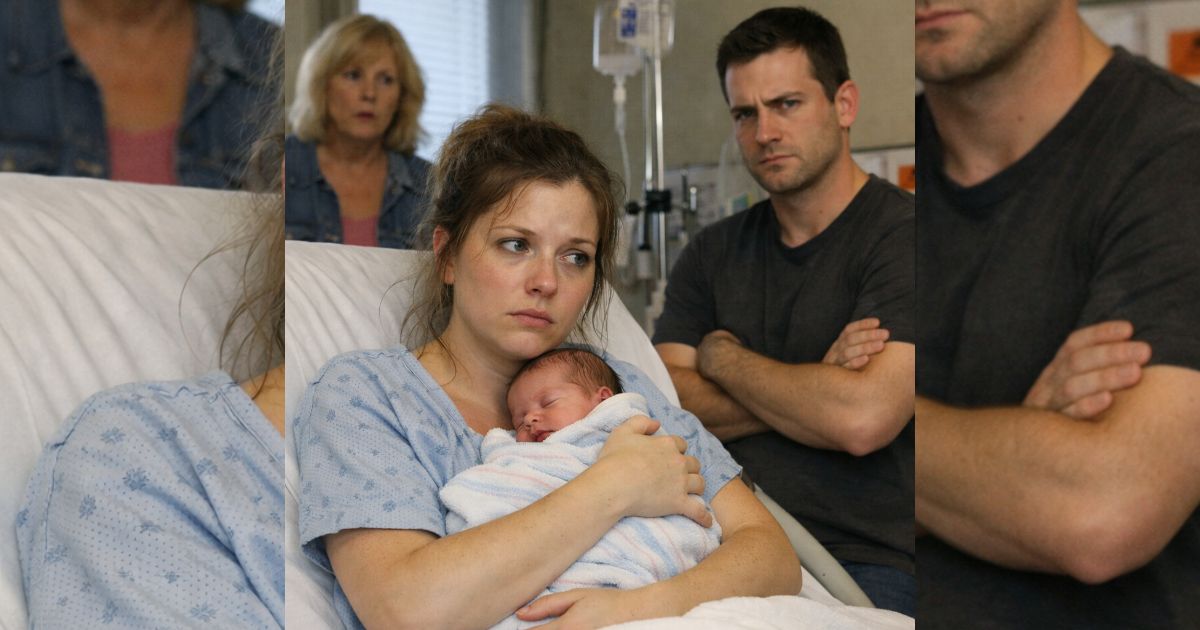
The first time my husband saw our newborn son, he didn’t cry, smile, or reach for him. He stared into the bassinet, let out one quiet breath, and said, “We need a DNA test, Sophie. He’s too perfect to be mine.”
I laughed.
Not because it was funny.
Because sometimes when your whole body is sore, your hands are still shaking from labor, and the person you love says something so cold you can’t make sense of it, your mouth does the wrong thing before your heart catches up.
My laugh came out thin and strange.
The room didn’t join me.
One nurse looked down at the chart in her hand like the ceiling had suddenly become very interesting. Another adjusted the blanket around my legs even though it didn’t need adjusting. My mother, standing near the window with her purse tucked under one arm, slowly lowered her phone and stared at Marcus like she had always expected something like this and was almost tired of being right.
I held Liam closer against my chest.
He was only a few hours old.
He still had that newborn softness, that fragile pink warmth that made him feel less like a person and more like a miracle someone had briefly allowed me to borrow. His little fist was pressed near his cheek. His mouth moved once like he was dreaming of something kind.
Marcus stood at the foot of my hospital bed with his hands in his pockets, calm as if he had just asked whether we had remembered to pay the water bill.
“What did you just say?” I asked.
He gave one shoulder a shrug.
“I’m just saying,” he said, “look at him.”
I did look at him.
Of course I looked at him.
I had been looking at him for hours already, memorizing every inch of his face, every tiny sound, every flutter of his eyelids. I knew the shape of his nose. I knew the little crease in one ear. I knew the soft down of hair on his head, dark and thick, lying flat in places and standing up in others.
“He’s beautiful,” I said.
Marcus let out a breath through his nose that almost sounded like a laugh.
“Exactly.”
The nurse nearest the bassinet shifted her weight.
My mother took one step closer.
I felt the heat rise up my neck.
“So that means what?” I asked. “What exactly are you saying?”
Marcus finally looked at me instead of the baby.
His face was smooth. Too smooth. Not angry. Not hurt. Not confused.
That might have been easier.
He looked amused.
“I’m saying it wouldn’t hurt to check,” he said. “That’s all. Just to be sure.”
Just to be sure.
He said it like we were talking about a smoke alarm battery. Like certainty was something you picked up on the way home.
For a second, the entire room seemed to tilt.
I stared at the man who had held my hand through every appointment. The man who had painted the nursery pale green because he said yellow was too bright and blue felt too expected. The man who had lain awake beside me one night with his hand on my stomach, smiling every time Liam kicked, and whispered, “This little guy already has opinions.”
That man had been so real to me.
And yet the one standing at the end of my bed felt like a stranger wearing his face.
“Marcus,” I said quietly, “stop.”
He opened his mouth as if to say something else, but my mother spoke first.
“This is not the moment,” she said, and her voice was low and sharp in a way I had heard only a few times in my life.
Marcus looked at her and gave that same small shrug.
“I didn’t mean anything by it.”
That made it worse.
Because he clearly did.
No one says words like that by accident.
No one drops them into the first hour of parenthood like they are harmless pebbles and not stones big enough to crack the whole foundation beneath a family.
Liam made a soft little squeak in his sleep.
My eyes burned.
I kissed the top of his head and told myself not to cry.
Not there.
Not in front of nurses and my mother and the man who had somehow managed to turn the happiest day of my life into a room full of tension and swallowed words.
I said nothing after that.
Neither did he.
And maybe that was the first real ending, even though at the time I thought it was only a bad beginning.
The next two days in the hospital passed like I was moving through water.
Everything happened.
The pediatrician came in and checked Liam’s reflexes. Lactation consultants smiled too brightly and adjusted pillows. Nurses taught us how to swaddle him tighter. My mother brought me lip balm, socks, and the good kind of iced tea from the café downstairs because she said hospital ice always tasted tired.
Marcus behaved exactly how a new father was supposed to behave.
That was almost the worst part.
He held Liam carefully.
He changed diapers.
He took photos of me without asking and said I looked strong even while my hair was flat on one side and I still had dried tears near my temples from labor.
He joked with the nurses.
He texted updates to friends.
Once, he kissed my forehead and asked if I wanted him to grab me soup.
It would have been easier if he had been cruel after that comment.
If he had doubled down, picked a fight, stayed distant.
But instead he moved through those two days with this effortless normalcy that made me question whether I had somehow imagined the ugliness in what he said.
Maybe he had panicked.
Maybe men said dumb things in hospital rooms all the time.
Maybe lack of sleep had turned one awful sentence into something larger in my head.
That is what I kept telling myself.
But every time I looked at Liam, I heard it again.
He’s too perfect to be mine.
And every time I heard it, something inside me tightened.
On the afternoon before discharge, I was half asleep with Liam against my shoulder when I opened my eyes and saw Marcus standing by the bassinet.
He didn’t know I was awake.
He was just looking at Liam.
Not smiling.
Not soft.
Just studying him.
His forehead was slightly creased. His lips were pressed together. It was the look a person gets when they are trying to solve a problem that refuses to settle.
Then he noticed me watching.
His face changed instantly.
“Hey,” he said. “I was just wondering who he looks like more.”
I gave him a tired nod.
But the knot inside me pulled tighter.
My mother drove behind us when we went home.
She said it was in case we needed anything.
What she meant was that she didn’t trust him.
What I meant, when I told her she was overreacting, was that I was terrified she might not be.
We lived in a small subdivision outside Columbus, in a neighborhood full of similar houses and trimmed bushes and porches with seasonal wreaths. Ours had white siding, a maple tree out front, and a nursery I had spent months nesting into life.
A rocking chair in the corner.
A soft rug.
Shelves with little board books.
A hand-knit blanket my mother had made in cream and sage.
When I walked Liam into that room for the first time, I should have felt safe.
Instead, I felt like someone had followed us home.
Not a person.
A thought.
A shadow.
A question I never would have asked on my own but now couldn’t stop hearing.
For the first week, Marcus didn’t mention the DNA test again.
He acted cheerful.
He posted one photo online of Liam’s tiny hand around his finger with the caption, “My little guy.”
He told the neighbors through the screen door that everybody was healthy and tired.
He brought me toast in the mornings and reheated frozen lasagna in the evenings. He swaddled Liam better than I did. He walked him around the living room at 2:00 a.m. humming some old song his grandfather used to sing, or so he said.
If you had seen us then, you might have thought we were adjusting.
You might have thought the rough hospital moment was behind us.
But even while he played the part of devoted father, little things kept snagging at me.
Small things.
Nothing I could have laid neatly on the table and said, there, that’s it, that’s why I can’t relax.
Just moments.
A glance that lasted too long.
A silence that felt too deliberate.
A joke that didn’t land right.
One night, around three in the morning, Liam started fussing in his crib. I woke up before Marcus did and padded quietly to the nursery. The hallway was dark except for the small night-light we had plugged in near the baseboard.
I stopped at the door.
Marcus was already there.
He was standing over the crib in the dim light, one hand resting on the rail, looking down at Liam.
Something in the stillness of him made me freeze.
Not fear.
That’s not the word.
More like recognition.
Like whatever had unsettled me in the hospital had followed us into this room.
He turned when he heard me.
“Oh,” he said, too quickly. “He woke me up.”
Liam hadn’t cried yet. He was only squirming.
Marcus looked back into the crib and smiled, but it looked placed there rather than grown there.
“Still trying to figure out where he got that chin,” he said.
I walked past him and lifted Liam into my arms.
“He got his chin from being a baby,” I said.
Marcus laughed.
But when I looked up, his eyes were already somewhere else.
Three days later, a nurse from the hospital called.
Her name was Rachel, I think. Or maybe Rebecca. I had slept so little that names slid past me like leaves in a stream.
She said they were doing a routine follow-up.
Was the baby feeding well?
Was I resting when I could?
Did I have any concerns about healing?
I answered automatically while Liam dozed on my chest.
Then she asked for Liam’s hospital ID number.
I frowned.
“Why?”
There was the slightest pause.
“Standard verification,” she said.
Her voice was pleasant, but something in it felt pinched.
I gave her the number from the paperwork folder on the kitchen counter. I heard clicking on the other end, then another pause.
“Everything okay?” I asked.
“Yes,” she said too fast. “Yes, of course.”
When the call ended, I sat still for a long time.
That feeling again.
Not a fact.
Not proof.
Just a tug.
Later that afternoon, while Liam napped in the bassinet beside the couch, I opened the folder from the hospital and started sorting through every paper more carefully than I had before.
Discharge instructions.
Feeding chart.
Birth certificate worksheet.
Insurance forms.
A photocopy of the ID bracelet information.
That was when I saw it.
One number on Liam’s bracelet record didn’t match mine.
Only one digit.
Everything else was the same.
I stared at it until the numbers blurred.
I told myself it was probably nothing.
A typo.
A clerical mistake.
But once a doubt finds a place to sit, it doesn’t stay small for long.
That night, after Marcus went to shower, I sat in bed with my phone and typed things I never thought I would type.
newborn bracelet mismatch one digit
hospital baby identification error
how often are babies accidentally switched
I hated myself while I searched.
I hated the fear curling under my ribs.
I hated that a single cruel comment from my husband had primed my mind to go looking for disaster.
When Marcus came back into the bedroom in gray sweatpants with a towel around his neck, I showed him the bracelet paperwork.
He barely glanced at it.
“Sophie,” he said, almost laughing, “seriously?”
“There’s a different number.”
“It’s one digit.”
“Yes.”
He sat down on the edge of the bed and gave me the kind of look people use when they think they are being patient with someone unreasonable.
“You’re exhausted,” he said. “You just had a baby. You’re not sleeping. This is exactly why I wanted us to just do the test and put all this to bed.”
I stared at him.
The words landed harder than he probably intended.
Or maybe exactly as hard as he intended.
“You wanted the test because you thought I cheated on you,” I said.
He rubbed one hand over his mouth.
“I wanted the test because something felt off.”
I should have shouted.
I should have demanded he explain what exactly felt off besides our son not fitting whatever image he had carried in his head.
Instead I just looked at him.
Because I realized something in that moment that chilled me more than anger would have.
He wasn’t embarrassed.
He wasn’t sorry.
He thought he was being reasonable.
And if a person can wound you while convinced they are the calm one in the room, there is no easy place to stand.
The next morning, my mother came by with a casserole she knew I wouldn’t eat right away but could freeze.
She took one look at my face and said, “What happened?”
I told her about the bracelet number.
I expected her to tell me I was spiraling. That I needed rest. That I was letting Marcus’s ugly joke get too far inside my head.
Instead she went very quiet.
“What else?” she asked.
“What do you mean?”
“What else feels wrong?”
I opened my mouth to tell her nothing.
Then everything came out.
The hospital room comment.
The way he stared at Liam.
The nurse’s tone on the phone.
How easily Marcus had started talking about a test again, like it was already settled and all that remained was scheduling.
My mother listened without interrupting.
When I finished, she sat back in the kitchen chair and folded her hands in her lap.
“I didn’t like him at first,” she said.
I almost rolled my eyes.
She had said that before about every man I dated, but then she shook her head.
“No,” she said, “I mean I really didn’t like how little of his life seemed to exist before you met him.”
I frowned.
“What are you talking about?”
She looked at me carefully, like she was placing each word on glass.
“Every time I asked about his family, he gave me a different kind of answer. Not a different story. Just no real substance. There were no old friends at the wedding. No cousins. No aunt who told embarrassing stories. No one who said, ‘He was always like this when he was a kid.’”
“He said he wasn’t close with them.”
“Yes,” she said. “And some people aren’t. I know that. But not close is not the same as empty.”
I wanted to dismiss her.
But I couldn’t.
Because once she said it out loud, I realized I had noticed it too. I had just never stopped long enough to look directly at it.
When Marcus and I got engaged, we had a backyard engagement party at my mother’s house.
My side came with folding chairs, deviled eggs, old family stories, and the loud warmth of people who had known me too long to be impressed by a ring.
Marcus came with one coworker, one former roommate, and a story about how his extended family was scattered and complicated.
I had accepted that.
People had complicated families.
People had painful histories.
Not everybody had scrapbooks and reunions and a grandmother who called every birthday.
Still, now that my mother had said it, I couldn’t stop seeing the gaps.
That afternoon, while Liam slept in the swing and my mother washed bottles at the sink, I opened the hall closet and pulled down the plastic bin that held documents.
Mortgage papers.
Tax returns.
Car insurance.
Our marriage certificate.
I wasn’t even sure what I was looking for.
Just something solid.
Something that would make me feel silly later.
Something that would let me say, see, I got scared, but here’s the explanation.
I found Marcus’s college diploma.
His driver’s license photocopy from when we bought the house.
A few employment forms.
A passport copy from a trip we had planned and then canceled when I got pregnant.
All of them said Marcus Evans.
All of them looked normal.
And yet there was something strangely thin about the pile.
No old school awards.
No baby pictures in a keepsake box.
No letters from family.
No faded yearbooks with messages in the margins.
No paper trail of becoming.
Just the finished adult version of a man, as if he had stepped into the world fully formed around age twenty-two.
That evening, I asked him lightly, “Do you have any pictures from when you were little?”
He was rinsing out a coffee mug.
He didn’t turn around.
“Most of that stuff got lost years ago,” he said.
“How?”
He set the mug down in the drying rack and finally looked at me.
“House fire,” he said. “I told you that.”
Maybe he had.
Maybe he hadn’t.
That was the awful thing.
Once doubt settles in, memory stops feeling like memory and starts feeling like soft ground.
I couldn’t tell if he had really told me that once, in passing, and I had forgotten, or whether he was handing me a convenient answer and trusting I wouldn’t push.
So I smiled.
“Right,” I said. “I forgot.”
But I had not forgotten the look in his face.
Not fear.
Not pain.
Calculation.
Like he was checking whether the answer had worked.
A few days later, he brought up the DNA test again.
Not during a fight.
Not with anger.
Over coffee.
The baby monitor hummed on the counter. Liam was asleep upstairs. Morning light came through the kitchen blinds in pale stripes, catching the dust in the air.
Marcus took a sip from his mug and said, “I found a private clinic.”
I looked up slowly.
“For what?”
He blinked.
“The test.”
The casual tone of it made my stomach twist.
“You’re still on this?”
He set the mug down.
“I think it would help.”
“Help who?”
“Both of us.”
That almost made me laugh.
Because now that he said it, I realized something ugly and true.
Part of me did want answers.
Not because I thought I had done anything wrong.
Not because I doubted my own body or my own life.
But because the hospital paperwork, the nurse’s odd call, the bracelet number, his constant watchfulness around Liam—all of it had become one tangled knot in my head.
He leaned back in his chair.
“You’ve been anxious,” he said. “You barely sleep even when Liam sleeps. You keep going through papers. You’re worried too.”
He was right.
That made me hate the conversation more.
“I’m worried because of you,” I said.
He held my gaze.
“Then let’s settle it.”
I don’t know what expression crossed my face then, but something in him softened, or performed softness.
“I’m not trying to hurt you, Soph,” he said quietly. “I’m trying to remove doubt.”
The problem was that by then doubt had multiplied.
And it was no longer only about Liam.
That night, after Marcus fell asleep, I lay in the dark listening to the soft static of the baby monitor and the slower, deeper rhythm of his breathing beside me.
I turned my head and looked at him.
At his profile in the dark.
At the face I had once trusted more than my own instincts.
At the man who knew exactly how I took my coffee, how to warm my side of the bed with his leg before I got in, how to calm me down by rubbing circles into my palm with his thumb.
I tried to line that man up with the one in the hospital room.
The one asking for proof before he had even said hello to his son.
They would not sit on top of each other.
The next morning, while he was at the pharmacy picking up diaper cream, I called the hospital.
The woman at the desk transferred me twice before I reached someone in records. From there, I was transferred to an administrator named Ellen.
Her voice was careful.
Professional.
The kind of careful that tells you a person is choosing each word before it leaves their mouth.
I explained about the bracelet number.
She made a small clicking sound with her keyboard.
“Everything looks fine on our end,” she said after a pause.
“The numbers don’t match.”
“There can be harmless data entry discrepancies in older printouts.”
“Older printouts?” I repeated. “It’s been less than two weeks.”
Another pause.
“We updated our labeling system recently,” she said.
Something in the wording caught my attention.
Recently.
Updated.
System.
I pressed my fingers into the edge of the kitchen counter.
“So there was a problem?”
“No,” she said quickly. “No, no problem. If you want copies of all associated paperwork, you can submit a formal request.”
“Was my baby ever listed under another mother?”
Silence.
Not long.
But long enough.
Then, “I don’t have anything further to add.”
The line clicked dead.
I stood there with my phone in my hand and felt the back of my neck go cold.
That afternoon I told Marcus I had agreed to the DNA test.
I said it quietly while folding burp cloths at the dining room table.
He exhaled.
Not like a man relieved by truth.
Like a man relieved by compliance.
That was when something inside me shifted.
Because for the first time, I realized he did not seem afraid of what the test might reveal.
He seemed afraid of what would happen if I refused to move forward.
As if the test itself served some purpose beyond the answer.
I smiled at him and said, “Let’s just do it.”
He crossed the room, kissed the top of my head, and told me that once this was done, we could finally breathe again.
I almost shivered.
We went to the clinic that Thursday.
It was in a low brick office building tucked between a dentist and a tax preparer in a shopping plaza with too many empty parking spaces. The waiting room smelled faintly like lemon cleaner and old magazines.
Marcus had done all the paperwork ahead of time.
He checked us in.
He carried Liam’s diaper bag.
He joked with the receptionist about how our son already had strong opinions because he hated having his socks on.
I sat in a padded chair with Liam in my arms and watched him.
Every move was easy.
Every smile landed where it should.
If I hadn’t been married to him, I would have thought he was simply a calm husband trying to comfort his exhausted wife.
Maybe that was why it took me so long to see certain things.
Because Marcus was never clumsy with people.
He knew exactly how to sound reassuring.
Exactly how to look steady.
The swabs took minutes.
Mine.
His.
Liam’s.
The technician wore blue gloves and a sympathetic smile that made me want to look away.
When it was done, she said results typically came back in five business days.
Marcus thanked her.
On the way out, he put one hand on my lower back and said, “See? Easy.”
Easy.
I stared out the passenger window the entire drive home.
The next day, I dropped Liam off with my mother for an hour and drove back to the hospital alone.
I told the front desk I thought I had left behind a receiving blanket with Liam’s name stitched into the corner. It was a flimsy excuse, but being newly postpartum made people less likely to challenge me.
Eventually I found the nurse who had called.
Rachel.
This time I was sure.
She recognized me immediately.
“How’s your little guy?” she asked with a warm smile.
“Good,” I said. “Can I ask you something a little strange?”
Her smile faltered just enough for me to notice.
I told her about the bracelet number and the phone call.
I told her the administrator had sounded evasive.
I told her I needed the truth, even if it was nothing.
Rachel looked down the hall before she answered.
“I probably shouldn’t say this,” she said softly, “but there was a brief system issue that night.”
My heart thudded once, hard.
“What kind of issue?”
She lowered her voice.
“For a short time, two babies were linked to your file in the charting system.”
The words passed through me like ice water.
“Two babies?”
“It was flagged,” she said quickly. “Then corrected. Management told us it was a software sync problem. They said no actual placement error had happened.”
“Had Liam been taken out for testing?”
“For a routine newborn screen, yes.”
“How long?”
She hesitated.
“Not long.”
“How long is not long?”
Her eyes filled with the kind of discomfort that says a person knows more than they are allowed to say.
“I don’t know exactly,” she said.
Maybe she was telling the truth.
Maybe she wasn’t.
Either way, the answer hollowed me out.
I thanked her and walked back to my car in a daze.
I sat behind the wheel without turning the engine on.
Two babies.
One file.
A correction.
No actual placement error had happened.
That sentence kept circling because it sounded less like reassurance and more like language someone had been trained to use.
When I got home, Marcus was in the living room bouncing Liam gently against his shoulder.
He smiled when I came in.
“There you are.”
I stood in the doorway looking at him and had the sudden, dizzying feeling that I was living in a set built to resemble my life.
The couch we picked together.
The framed print above it.
The soft green blanket from our registry folded over the armrest.
The man holding my child.
The whole scene looked normal.
It felt borrowed.
I smiled back anyway.
Because I wasn’t ready for him to know how much I had started to see.
After that, I began searching in quieter ways.
Not dramatic ones.
Not movie ways.
No dark rooms full of maps and red string.
Just a tired woman with spit-up on her shirt, sitting one-handed at a laptop during naps, searching around the edges of the life she thought she knew.
Marcus’s social media only went back so far.
That should not have meant much. Plenty of people start over online.
But there was a strange emptiness before college.
No tagged childhood photos.
No old teammates.
No comments from people who knew him in middle school or remembered his first car or his terrible prom tux.
Nothing.
I searched his hometown.
Nothing.
I searched combinations of his name with old sports rosters, local paper mentions, school awards.
Nothing that clearly belonged to him.
Then I searched his college years.
There he was.
Not much.
But enough.
A debate team list.
A student volunteer photo.
A mention in an alumni newsletter about business school scholarships.
Oddly, even those things felt sparse.
Like a person who had arrived already assembled and left no earlier fingerprints.
I asked my mother if she remembered the names of any of Marcus’s family members from the wedding guest list.
She frowned and thought hard.
“There was an uncle,” she said. “Or maybe he said family friend. Someone named Howard, I think.”
Howard never came.
No one from Marcus’s side came, actually, except that old roommate and the coworker.
At the time Marcus had looked sad but unsurprised. He told me family letdowns were normal for him. I held his face in my hands and told him he had me now.
I think about that sometimes.
How love can make generosity look so much like blindness.
The clinic called early Wednesday morning.
I was in the kitchen with Liam in one arm and a cup of coffee in the other that had already gone cold twice.
The number was unfamiliar.
I almost ignored it.
Something made me answer.
“Mrs. Evans?” a man asked.
“Yes.”
“This is Dr. Graham from Willow Creek Family Genetics. We’d like you and your husband to come in today to discuss the results of your test.”
I tightened my hold on Liam.
“Can’t you tell me over the phone?”
“I’m sorry,” he said. “We’d prefer to discuss them in person.”
My mouth went dry.
“Is something wrong?”
A pause.
“There are findings we’d like to explain clearly.”
That was all he would say.
When Marcus got home, I told him.
He grabbed his keys immediately.
No questions.
No visible nerves.
Just motion.
“Good,” he said. “Let’s go.”
The drive there was too quiet.
Liam slept in the back seat with his head tilted slightly to one side, his lips parted, milk-drunk and peaceful.
I kept turning around to look at him at red lights as if the shape of his face might steady me.
It didn’t.
At the clinic, a receptionist led us to a private office instead of an exam room.
That alone made my pulse jump.
There was no medical equipment.
Just a desk, three chairs, a box of tissues, and a small lamp that made the room feel more like the office of a school counselor than a lab.
Dr. Graham came in carrying a folder.
He was in his fifties, maybe, with silver at his temples and kind eyes that looked strained in a way kind eyes only do when someone has to say something difficult.
He sat down across from us.
Folded his hands.
Looked at me first.
“I’m going to be direct,” he said. “The results are unusual.”
My throat tightened.
He opened the folder.
“Biologically, Liam is your son.”
The breath left me so fast I almost cried right there.
For one clean second, everything else disappeared.
He is mine.
The room blurred.
I kissed the top of Liam’s head.
A hot tear rolled down my cheek before I could stop it.
Then Dr. Graham continued.
“He is not biologically related to Marcus.”
The relief shattered and rearranged itself into something sharp.
Beside me, Marcus went very still.
Not shocked.
Still.
I turned toward him.
He was staring at the doctor with a hard expression I couldn’t read.
Then Dr. Graham said the sentence that split the rest of my life in two.
“There is another issue,” he said carefully. “The identification profile provided under your husband’s records appears inconsistent with prior linked family documentation.”
Marcus’s head turned slowly.
“What does that mean?” he asked.
Dr. Graham chose his words with visible care.
“It means that the information connected to your submitted profile may not align with the biological lineage implied by the family history you listed.”
I blinked.
“What family history?”
Marcus had filled out the forms.
I had signed where he told me to sign while Liam fussed in his carrier.
Dr. Graham slid one paper toward us.
It listed the family reference information Marcus had provided for internal comparison.
His father’s name.
His mother’s maiden name.
A hometown.
Even a notation about paternal ancestry connected to a hereditary marker panel.
I stared at the page.
“I never saw this,” I whispered.
Marcus’s jaw tightened.
Dr. Graham continued gently, “In simple terms, the paternity question is resolved. But the related background details attached to the submission raised discrepancies that suggest either family records were mistaken for many years, or key personal history information has been misrepresented.”
Misrepresented.
That word landed heavily.
Not criminally.
Not sensationally.
Plainly.
Like something at a dinner table after all the guests have gone home and only the truth is left.
I looked at Marcus.
He was not confused.
That was when I knew.
Really knew.
Not the way I had known in flashes before.
Not in fears and guesses and unsettled instincts.
I knew because his face did not ask a question.
It surrendered an answer.
The doctor glanced between us.
“It may be related to adoption, informal guardianship, undisclosed parentage, or a family name change that was never properly discussed,” he said. “We see painful situations like that more often than people realize. But this is clearly personal, and I would recommend you continue this conversation privately.”
Privately.
He was giving us dignity.
He was also giving Marcus an exit.
I looked down at Liam, then back at my husband.
“Say something,” I whispered.
Marcus rubbed one hand over his mouth.
The silence stretched.
Then he said, very quietly, “Not here.”
I stood so fast my chair legs scraped the floor.
“No,” I said. “Here. Right here.”
The doctor rose halfway, awkward and sympathetic.
“I can step out—”
“Please,” Marcus said, and his voice had changed. It was flatter now. Tired. Cornered.
Dr. Graham nodded once and left us alone.
The door clicked shut.
I heard the hum of the air vent.
The tiny cooing noise Liam made in his sleep.
My own heartbeat.
Marcus stayed seated.
For a moment he looked smaller than I had ever seen him.
Not physically.
Emotionally.
Like some invisible structure had collapsed inside him and he was suddenly just a man in a chair, not the steady, polished version of himself he always offered the world.
“Talk,” I said.
He looked at Liam first.
Then at me.
“My name is Marcus,” he said. “That part is real.”
“That part?”
He closed his eyes briefly.
“Evans isn’t.”
It felt like the air left the room.
I sank back into my chair because my knees stopped trusting me.
“What do you mean it isn’t?”
He swallowed.
“When I was eleven, my mother left me with relatives in Kentucky. They were supposed to care for me for a few months. It turned into years. Nothing was ever done cleanly. No proper papers at first. Then later there were papers, but not all of them matched each other. Some used my birth name. Some used the last name of the couple raising me. Some used the name of a stepfather who was never legally my stepfather.”
He said it in pieces.
Like a man pulling glass out of himself.
I stared at him.
“You lied to me.”
“Yes.”
“How long?”
His eyes met mine.
“All along.”
I felt sick.
Not because I suddenly thought he was dangerous.
Because I suddenly understood how many separate moments in our life together had been built on information he had chosen to shape instead of share.
“Why?” I asked.
His laugh had no humor in it.
“Because by the time I was old enough to straighten it out, I didn’t know which version of me was easier to live with. Because the name on the college forms opened doors. Because I was ashamed. Because every time I almost told you, it got harder.”
I thought of our engagement.
Our wedding.
Tax forms.
Mortgage papers.
Doctor visits.
Baby name lists.
I thought of the soft green nursery.
I thought of him painting tiny stars on one wall because he said Liam needed something to look at while we rocked him at night.
And then I thought of the hospital room.
The DNA test.
The suspicion.
A fresh kind of anger rose in me then, hotter than the rest.
“You questioned me,” I said, my voice shaking. “You looked at me in a hospital bed after I had just given birth and you questioned me.”
He looked down.
“Yes.”
“Why?”
His answer came so quietly I almost missed it.
“Because I was scared.”
I laughed then, and it sounded ugly.
“Scared of what? That I cheated? Or that a test would reveal something about you?”
His face changed.
Only a little.
But enough.
And there it was.
Not the whole answer.
But the center of it.
I felt my skin go cold.
“You did this to get ahead of it,” I said.
He said nothing.
“You did this because you knew if questions got asked, if records got checked, if anything got stirred up, something about your own history might come loose.”
“I didn’t know that would happen.”
“But you knew it could.”
He looked away.
That was yes.
I sat there holding Liam while my marriage rearranged itself into rubble around me.
The man I had trusted had not committed some dramatic movie-level deception. It was somehow simpler and worse. He had built our life on omissions. On edited truths. On a version of himself that was always polished enough to pass, quiet enough not to invite too much looking.
And when our son was born, instead of protecting me, instead of protecting that moment, he had thrown suspicion into the room like a shield.
Not against me.
Against exposure.
I thought I might scream.
Instead I whispered, “Did you ever even doubt Liam?”
He shook his head slowly.
“No.”
I closed my eyes.
The cruelty of that answer nearly broke me.
All those nights.
All those looks into the crib.
All those little comments.
Not doubt.
Strategy.
Not confusion.
Cover.
I stood up again.
This time I didn’t wobble.
“When we leave here,” I said, “you are not coming home with me.”
His head snapped up.
“Sophie—”
“No.”
He rose too.
“Please. Let me explain all of it.”
“You’ve had years.”
“I know.”
“No, you don’t.”
My voice cracked then, and the ache in it surprised even me.
“Because if you knew, you would have understood that there is no explanation big enough for what you took from me. You didn’t just lie. You made me doubt myself. You made me question my baby. You took the most sacred moment of my life and filled it with your fear.”
He looked like he wanted to reach for me.
He didn’t.
Maybe for the first time, he understood that whatever had lived between us before had become something else entirely.
I walked out of that office with Liam in my arms and my whole body buzzing like I had touched a live wire.
Dr. Graham was at the desk outside. He stood when he saw me.
“Are you all right?” he asked gently.
No one had ever asked a less useful question.
I nodded anyway, because nodding was simpler than telling the truth.
The truth was that I felt split open.
The truth was that relief and grief and rage were all moving through me at once so fast I couldn’t separate them.
The truth was that my son was mine and my husband was not who I thought he was and those two facts together felt impossible to hold in one body.
I called my mother from the parking lot.
The moment she heard my voice, she said, “I’m coming.”
I didn’t explain on the phone.
I couldn’t.
I drove straight to her house.
When she opened the front door, I started crying before I even crossed the threshold.
Not graceful crying.
Not movie crying.
The kind that bends you.
The kind that feels like your ribs are trying to come apart.
My mother took Liam first so I wouldn’t drop him.
Then she held me.
And for the first time since the hospital, I let myself fall.
That evening, once Liam was asleep in the old bassinet my mother had kept in the attic, I told her everything.
The test.
The clinic.
The name.
The false family details.
The confession that he had never truly doubted Liam but had still made me live inside that doubt because it served him.
My mother sat very still in her armchair while I talked.
When I finished, she did not say, I knew it.
She did not say, I warned you.
She just looked at me with eyes full of grief and anger on my behalf.
Then she said, “You’re staying here.”
It wasn’t a question.
I nodded.
Marcus texted that night.
And the next morning.
And the day after.
At first the messages were long.
I am so sorry.
I didn’t know how to tell you.
I never meant to hurt you.
Please let me explain the whole history.
I love you.
I love Liam.
Then the messages grew shorter.
Please answer.
Please let me see my son.
I know I don’t deserve anything right now but please.
I did not answer.
Not because I had no words.
Because every word I had was either too sharp or too tired.
After three days, I finally wrote one sentence.
You may write what you want to say in an email. Nothing in person right now.
He did.
A long one.
Then another.
Then another.
I read them all while Liam slept against me on my mother’s couch, milk-drunk and warm and real.
They told the history in layers.
His birth mother had struggled. That was how he put it. She moved often, trusted the wrong men, left him with relatives more than once. Different adults used different surnames for him depending on school forms, health coverage, and convenience. At sixteen he had been sent to live with a family friend who helped him “streamline” paperwork for college applications. By then Marcus Evans was the name on enough records that it felt easier to keep living under it than to untangle the older mess.
He wrote that he had meant to fix it after graduation.
Then after the wedding.
Then before Liam was born.
But each year made the confession heavier, and each silence made the next one feel more impossible.
He wrote that when Liam was born, panic took over.
He knew a test connected to official records might expose discrepancies in family details.
He was ashamed of how quickly his mind had turned self-protective.
He was horrified by what he had put me through.
He kept repeating that he had never doubted Liam.
That part was supposed to comfort me.
It did not.
Because it meant every cold glance, every suggestion, every ounce of uncertainty he planted in me had been deliberate enough to use but not honest enough to own.
Over the next few weeks, life became both smaller and harder.
Smaller because my world shrank to feedings, diapers, naps, laundry, tears, and paperwork.
Harder because every simple task happened inside a mind still trying to sort grief from humiliation.
I moved mechanically sometimes.
Warm bottle.
Burp cloth.
Rocking chair.
Wash pump parts.
Try to nap.
Wake up anyway.
Cry in the bathroom where no one can hear.
Then come back out and hold my son and remind myself that one thing in this whole story was solid.
Him.
My mother became the bridge that kept me from collapsing.
She didn’t smother.
She didn’t push.
She made oatmeal.
She took Liam after 5:00 a.m. feedings so I could sleep one extra hour.
She changed the sheets when milk leaked through mine and pretended not to notice the tears dried on the pillowcases.
Once, about two weeks in, she found me sitting on the floor of the guest room surrounded by old printed photos from my wedding album.
I had taken them out without knowing why.
I was looking at Marcus’s face in each one.
At the angle of his smile.
The way he touched my waist.
The expression in his eyes during the vows.
I kept thinking that if I stared long enough, I might see the lie visible there.
Some crack in the image.
Some clue.
My mother sat down beside me on the floor.
Neither of us spoke for a while.
Finally I said, “Was any of it real?”
She reached for a photo, looked at it for a moment, then set it back down.
“I think he probably loved you,” she said.
That made me cry harder, not less.
Because love should not be this slippery thing that can sit beside deception so comfortably.
What does it mean for someone to love you and still hand you confusion when you are bleeding and exhausted and holding a newborn?
What does it mean for tenderness to exist beside manipulation?
I still don’t fully know.
Maybe some people love as much as they are able, and sometimes what they are able to give is deeply flawed.
Maybe love without truth is just need in better clothing.
Maybe both can exist at once, and that is why betrayal hurts so much.
Because it rarely comes from a total stranger.
It comes from someone who knew exactly where your softest places were.
Marcus kept writing.
I read everything and answered almost nothing.
Once, after about three weeks, I agreed to one phone call while my mother held Liam on the back porch.
I put Marcus on speaker and sat at the kitchen table with both hands wrapped around a mug I wasn’t drinking from.
He sounded tired.
Not dramatic.
Just worn down.
“I know I don’t get to ask for patience,” he said. “But I need you to understand I never set out to trick you in some grand way.”
“Then what do you call it?” I asked.
A long silence.
“Cowardice,” he said.
I had not expected that word.
It disarmed me for half a second.
Then the anger returned.
“You let me think my baby might not be mine.”
“No,” he said immediately. “I never thought that.”
I shut my eyes.
“You let me think he might not be yours.”
Another silence.
“Yes.”
The honesty of it hurt more than excuses.
“Why should I ever trust another thing you say?”
“I don’t know,” he admitted.
That, at least, was real.
There was no neat ending after that call.
No breakthrough.
No collapse.
Just the slow acceptance that whatever future existed now would not look like the one I had been carrying in my head.
I met with a family counselor recommended by a friend of my mother’s.
Not because I wanted to save my marriage.
I didn’t know if there was a marriage left to save.
I went because I was starting to feel like my own thoughts had become slippery, and I needed someone objective to tell me I wasn’t losing my mind.
In our second session, the counselor said something that stayed with me.
“Your pain isn’t only about the false information,” she said. “It’s about being made to carry confusion that did not belong to you.”
I sat there blinking.
Because yes.
That was exactly it.
Marcus had his own history.
His own shame.
His own unresolved family mess.
Those things were real.
But instead of bringing them honestly into our life, he handed me a different burden. He made me carry suspicion, self-doubt, and fear while he protected the part of himself he feared might come apart under scrutiny.
The cruelty wasn’t only the lie.
It was the transfer.
The way he moved his panic into me.
Once I understood that, my anger became cleaner.
Not smaller.
But clearer.
Around that same time, the hospital finally responded to my formal records request.
There had, in fact, been a temporary digital mismatch the night Liam was born.
A software synchronization issue linked two newborn files under one maternal admission record for less than an hour. Manual review corrected it before final discharge and all bedside identifiers had reportedly remained physically accurate throughout.
It was the kind of letter written by people trained to sound both reassuring and legally careful.
But the important part was simple.
Liam had never been switched.
He had been mine from the first breath to the moment they laid him on my chest and every second since.
I read that letter three times.
Then I folded it carefully and put it in the top drawer of the dresser beside Liam’s sleepers and tiny socks.
Not because I needed proof anymore.
Because I wanted the truth near me.
One afternoon, about six weeks after the clinic appointment, Marcus asked if he could see Liam.
I had known that question was coming.
It had lived at the edge of everything from the beginning.
No matter what he had done to me, there was still the reality of diapers changed, lullabies hummed, tiny fingers grasping his shirt collar. He had loved Liam in practice if not in blood. He had rocked him, fed him, paced the hallway with him at dawn.
But every time I imagined Marcus holding him, I also saw the hospital room.
I heard the words.
I felt that first tear in reality.
I didn’t know how to separate one from the other.
I asked the counselor what to do.
She didn’t tell me what choice to make.
She said, “You do not owe access simply because someone wants redemption. But if you choose contact, let it be built around safety, clarity, and your pace.”
My pace.
That phrase mattered.
So I agreed to one visit.
At my mother’s house.
In the afternoon.
With both of us there.
When Marcus arrived, I barely recognized him.
Not because he looked physically different.
But because the polished ease was gone.
He looked thinner.
His beard was uneven.
His shirt was clean but wrinkled.
He stood on my mother’s porch holding nothing in his hands, like a man who understood that even flowers might feel like an insult.
When he saw Liam in my arms, his face crumpled for one terrible second before he got hold of it again.
That almost undid me.
Because grief is not less painful when it belongs to the person who caused yours.
It just makes the whole room heavier.
He sat in the armchair across from me.
My mother remained in the kitchen but close enough to hear if needed.
For a while, no one spoke.
Then Marcus asked softly, “Can I hold him?”
I looked at Liam.
At his round cheeks.
At the milk dampness on his bib.
At the tiny sigh he made in his sleep.
Then I stood, crossed the room, and placed him carefully into Marcus’s arms.
Marcus held him like something fragile and holy.
He looked down at him with wet eyes and whispered, “Hey, little man.”
Liam stretched, blinked once, and settled back against his chest.
The sight hit me so hard I had to grip the back of the couch.
Because this was true too.
Not the whole truth.
But part of it.
The tenderness.
The attachment.
The quiet ache of a man who had blown apart the life he wanted and now sat in the wreckage holding the child he had loved anyway.
He looked up at me.
“I’m sorry,” he said.
I nodded once.
“I know.”
It was the first soft thing I had said to him in weeks.
I didn’t mean forgiveness.
I meant recognition.
He stayed for twenty minutes.
Then he left.
And after he did, I went into the bathroom and cried again.
Not because I wanted him back.
Because letting people become complicated after they hurt you is its own kind of suffering.
It would have been easier if he had been cold all the way through.
Easier if every memory had turned false the moment I learned the truth.
But that isn’t how life works.
Sometimes the person who betrays you also once made you soup when you had the flu.
Sometimes the liar is also the man who rubbed your swollen feet without being asked.
Sometimes the father-shaped figure in your child’s first weeks is both loving and untrustworthy.
And there is no clean shelf in the heart where you can place that and walk away unshaken.
Over the months that followed, I stopped measuring time by calendar dates and started measuring it by Liam.
The first real smile.
The first night stretch longer than four hours.
The way his hair lightened slightly at the temples.
The day he discovered his own toes and acted like this was the greatest surprise any human had ever encountered.
Life rebuilt itself around those things.
Not around healing in some dramatic way.
Just repetition.
Laundry.
Feedings.
Fresh air on the porch.
My mother’s old wind chime outside the kitchen window.
Morning cartoons playing softly while I folded onesies.
A world small enough to survive inside.
Marcus and I met with a mediator once to discuss separation in a practical sense.
We were not screaming people.
We sat at a table with notepads and water glasses and spoke in low voices about housing, accounts, and future contact.
If someone had passed the conference room door, they might have thought we were discussing a home refinance.
That’s another thing no one tells you.
The end of a marriage is not always loud.
Sometimes it is paperwork and tired eyes and two people trying not to break down in front of a stranger with a legal pad.
Marcus brought corrected records to that meeting.
His actual birth certificate.
Amended school documents.
Name change filings he had finally begun.
When I looked at the papers, I felt almost nothing.
Not because they didn’t matter.
Because I was past the stage where more facts could wound me in fresh ways.
The damage had not come from missing documents.
It had come from years of watching him choose silence over honesty.
Still, seeing the papers did one thing for me.
It ended the floating sensation.
The part of me that kept wondering whether there might still be some bigger twist, some deeper hole, some hidden second layer beneath the first.
There wasn’t.
Just shame.
Avoidance.
A lifetime of messy identity turned into adult deception because it felt easier than confession.
Ordinary in one sense.
Devastating in another.
Friends asked careful questions.
Some were kind.
Some were too curious.
A few wanted a dramatic villain and seemed disappointed when I described something sadder and more human.
“He just lied about his whole background?” one woman said. “That’s it?”
That’s it.
As if that were small.
As if trust isn’t built almost entirely out of the invisible things people assume are steady beneath them.
Names.
Stories.
Family.
Past tense.
The way someone says, “When I was ten,” and you believe the memory belongs to the person in front of you.
It took me a long time to stop replaying the hospital room.
Even after Liam’s first laugh.
Even after the leaves outside my mother’s house turned orange and dropped.
Even after I found a rhythm that no longer included Marcus’s toothbrush beside mine or his shoes by the front door.
Sometimes, late at night, I would still hear it.
We need a DNA test.
And then the other line.
He’s too perfect to be mine.
I used to replay it and think of the insult.
The accusation.
The humiliation.
Eventually I heard something else under it.
Fear.
Not noble fear.
Not understandable enough to excuse anything.
Just naked self-preserving fear.
A man seeing his life about to become more official, more documented, more fixed through the birth of a child, and panicking that the version of himself he had maintained might finally crack.
That understanding never softened the memory.
But it did make it less confusing.
And confusion, I learned, is often what hurts longest.
The opposite of confusion isn’t always comfort.
Sometimes it’s just clarity sharp enough to breathe through.
By Liam’s first Christmas, we were still at my mother’s house.
I hung a small stocking for him beside mine on her mantle. My mother insisted on one for herself too, saying she refused to be excluded from her own fireplace.
The tree was crooked.
The lights on the bottom half blinked while the top half stayed steady because my mother never threw anything out if half of it still worked.
Liam was fascinated by tissue paper.
He grabbed at bows with solemn concentration, then burst into laughter when one curled ribbon snapped back against his hand.
I watched him from the couch with a blanket over my legs and felt something unfamiliar.
Not joy exactly.
Something steadier.
Safety.
Not complete.
Not permanent.
But present.
The kind of peace that doesn’t come from life returning to what it was, but from finally stopping the fight to make it do so.
Marcus dropped off a gift that afternoon.
A wooden name puzzle for Liam.
No note inside.
Just the gift.
My mother set it by the door and looked at me.
“You don’t have to decide anything today,” she said.
That became one of the most healing sentences anyone offered me that year.
Not today.
Because after betrayal, people rush you toward meanings.
Will you forgive him?
Will you move on?
Will you date again?
Will Liam know him?
Will you tell the whole story when he’s older?
People want endings.
They want neat moral shapes.
I had none to give.
I only had today.
Today, I was drinking coffee while my son gnawed on a soft reindeer toy.
Today, I was not in the hospital room anymore.
Today, the truth and the lie had stopped wrestling quite so loudly inside my chest.
That was enough.
Spring came.
Liam started crawling.
Then pulling himself up on furniture with a fierce little determination that made my mother laugh and say, “He gets that from you.”
Maybe he did.
I went back to work part-time remotely while Liam napped. I cut my hair shorter because I was tired of it falling into bottles and baby food. I bought a stroller that folded with one hand and felt absurdly proud the first time I managed it in a parking lot without pinching my fingers.
My life became ordinary again in places.
Ordinary saved me.
The grocery list.
The pediatrician waiting room.
The way Liam clapped when the dryer buzzer went off as if laundry itself deserved applause.
I had once thought major heartbreak would feel dramatic all the time.
But healing is embarrassingly domestic.
It is toast.
It is sleep when you can get it.
It is saying no to a phone call because you don’t have the bandwidth.
It is discovering one afternoon that you went three hours without replaying the worst moment of your life and then quietly crying over that fact because it means your mind is finally loosening its grip.
Marcus remained in the edges.
Occasional visits.
Updated paperwork.
Short messages about practical things.
He never stopped apologizing, not fully.
I never asked him to.
There are apologies that heal and apologies that simply mark the spot where a wound was made. His often felt like the second kind.
Still, I do not hate him.
That surprises people sometimes.
But hate is a heavy job, and I had a baby to raise.
What I feel is sadder and more useful.
I feel clear.
I know now that trust is not built from chemistry, or comfort, or the ability to make someone laugh in the middle of a grocery store aisle.
It is built from truth offered before it becomes convenient.
It is built from letting yourself be known while there is still risk in being known.
It is built from not turning your fear into somebody else’s burden.
If I ever love again, that is what I will look for.
Not perfection.
Not polish.
Not a man who always knows the right thing to say.
A man whose story does not change shape depending on what protects him most.
A man who does not place his panic in my lap and call it partnership.
Sometimes, when Liam falls asleep against me now, one heavy cheek pressed to my shoulder, I think back to that hospital bed.
To how small he was.
To how fiercely I wrapped my arms around him the moment the room changed.
I didn’t know it then, but that instinct was the truest thing in the whole story.
Before the paperwork.
Before the clinic.
Before the emails and the confessions and the long months of rebuilding.
My body knew.
Hold what is real.
Hold what is yours.
Hold what did not lie.
So I did.
And I still do.
That is the part of the story I keep.
Not the sentence that broke the room.
Not the name that turned out to be borrowed.
Not the edited past or the shame or the careful explanations that came too late.
I keep the baby in my arms.
The mother I became in one breath.
The woman who thought she was breaking and then found out she could survive on less certainty than she ever imagined.
I keep the letter from the hospital tucked in the drawer near Liam’s pajamas.
I keep the image of my mother opening the front door and taking one look at my face and saying nothing because love sometimes knows words are too small.
I keep the first Christmas at her house.
The crooked tree.
The blinking lights.
The knowledge that peace can return in fragments and still be enough.
And I keep this truth above all others:
Sometimes the person standing beside you is not who you thought they were.
Sometimes the life you built is missing beams you never knew to check.
Sometimes the moment that should have been beautiful gets marked by fear, suspicion, and a sentence you will never fully forget.
But that is not the end.
Because truth, even when it arrives late and shaking and incomplete, still clears ground.
It still gives you somewhere honest to stand.
And once I had that, once I knew Liam was mine and the rest was what it was, I could begin again.
Not as the wife I had been.
Not as the woman begging her own memories to make sense.
As Liam’s mother.
As my mother’s daughter.
As myself.
And after everything that name finally means something solid.
Thank you so much for reading this story!
I’d really love to hear your comments and thoughts about this story — your feedback is truly valuable and helps us a lot.
Please leave a comment and share this Facebook post to support the author. Every reaction and review makes a big difference!
This story is a work of fiction created for entertainment and inspirational purposes. While it may draw on real-world themes, all characters, names, and events are imagined. Any resemblance to actual people or situations is purely coincidenta