If you’ve already read part 1 of this story on Facebook, go here for Part 2!
By the third Sunday, people had stopped smiling when they saw the little girl with the flowers.
They watched her the way adults watch a child who is doing something they do not yet have the energy to correct.
She was seven, maybe eight. Small for her age. Brown sandals, white socks slouched at the ankles, a yellow dress that had been washed so many times it looked softer than sunlight. Every Sunday after church, while people stood in knots beside their cars and talked about casseroles, blood pressure, school fundraisers, and whose son had finally moved back home, she wandered the parking lot with both hands full of wildflowers.
Not roses.
Not anything polished.
Little roadside things. Daisies. Queen Anne’s lace. Purple clover. Buttercups. Stems bent at odd angles. Petals already bruising in the heat.
And one by one, she slid them under the windshield wipers of random cars.
At first people thought it was sweet.
Then they started noticing it was not random.
“Lila, honey, don’t touch that,” one man said after the second week, half laughing.
The third week, he was not laughing.
“It scratches the glass,” someone muttered.
“It makes pollen marks.”
“She could break the wiper.”
“Who lets a child run around other people’s cars like that?”
Nobody said it loudly enough for it to sound cruel.
Which somehow made it worse.
Martha Bell heard every word.
Lila was her granddaughter. Her only one.
Martha stood near the church steps with her purse clutched under her arm and a paper plate of pound cake balanced in one hand, feeling heat creep up her neck. At sixty-eight, she had lived long enough to know that embarrassment could arrive quietly. It did not need a scene. It only needed a few lowered voices and one too-careful smile.
She called out, “Lila, come back over here now.”
But Lila either did not hear her or pretended not to.
She crossed the parking lot with the solemn focus of a nurse carrying medicine.
Martha watched her pause beside a silver sedan, look through the windshield, then choose a single white daisy from her fist and tuck it under the blade with such care you would have thought she was putting a blanket around somebody sleeping.
Then she moved on.
Martha closed her eyes for one second.
Just one.
When she opened them, Deacon Avery was approaching with that gentle church face people used when they were trying to correct you without sounding like they were correcting you.
“Martha,” he said, lowering his voice. “She’s a sweet child. Truly. But a few folks have mentioned the cars.”
Of course they had.
Martha gave a stiff nod. “I’ll handle it.”
He touched her elbow kindly and moved on.
That was the part that stung. Kindness. You could armor yourself against rudeness. Kindness went straight in.
Martha set the paper plate down on the folding table and crossed the lot, her sensible shoes clicking against the asphalt. The July sun had baked the blacktop until it smelled like tar and summer dust. Somewhere nearby, somebody’s toddler was crying because they had dropped a cookie. The bells above the church door gave one soft clatter as the last of the late lingerers came out.
Lila was reaching up toward an old blue pickup now, stretching on her toes to fit a little spray of clover under the wiper.
“Lila.”
The child turned.
Her face was open and calm, not guilty. That made Martha’s irritation flare hotter.
“How many times have I told you not to touch what doesn’t belong to you?”
Lila looked down at the flowers in her hand. “I’m not hurting them.”
“That isn’t the point.”
“It’s a flower.”
“I know what it is.”
A few people glanced over, then glanced away with the quick politeness of people pretending not to listen. Martha hated them for that too.
Lila’s fingers tightened around the stems.
“They need them,” she said softly.
Martha let out a breath through her nose. “Need what?”
“The flowers.”
“Oh, sweetheart.” Martha rubbed her forehead. “No. No, they do not. People come to church to pray and see each other and go home. They do not need weeds tucked into their windshield wipers.”
“They’re not weeds.”
“Lila.”
The child fell silent.
That was almost worse than arguing.
Lila’s parents had died three years ago on wet pavement fifteen miles outside town. A truck, a curve, rain that came down too hard too fast. Martha still could not say the details without feeling something cold open under her ribs. Since then it had been the two of them in Martha’s small white house with the sagging porch and the hydrangea bush that never bloomed right.
Lila had become a quiet child after the accident.
Not unhappy, exactly.
Just careful.
As if she had learned too early that loud joy could be interrupted.
Martha tried not to shame her. She really did. But lately it felt like everything Lila did in public came wrapped in the possibility of explanation.
Why she did not like birthday parties.
Why she still slept with the hallway light on.
Why she sometimes asked strangers if they were okay with a seriousness that made adults shift their feet.
Now this.
Flowers on cars.
“Come sit with me,” Martha said, gentler this time.
Lila looked across the parking lot.
At the cars.
At the people still talking.
At the last three flowers in her hand.
“Please,” Martha added.
That word did it.
Lila came over and sat on the low brick edge of the church flower bed while Martha stood beside her, trying to think of how to untangle a child’s strange private logic without breaking whatever soft thing lived underneath it.
Across the lot, a woman in a green cardigan came out of the church alone.
Martha noticed her because she did not stop to talk to anyone. She kept her head down, one hand tight around her purse strap, the other holding a folded church bulletin. She looked to be in her early forties. Neat hair. Nice shoes. The kind of woman who carried herself like she had once known exactly who she was and had lately misplaced the map.
She walked to a white SUV near the back row.
Lila noticed her too.
Martha felt the girl go still beside her.
Then, before Martha could catch her arm, Lila slipped off the brick ledge and ran.
“Lila—”
Too late.
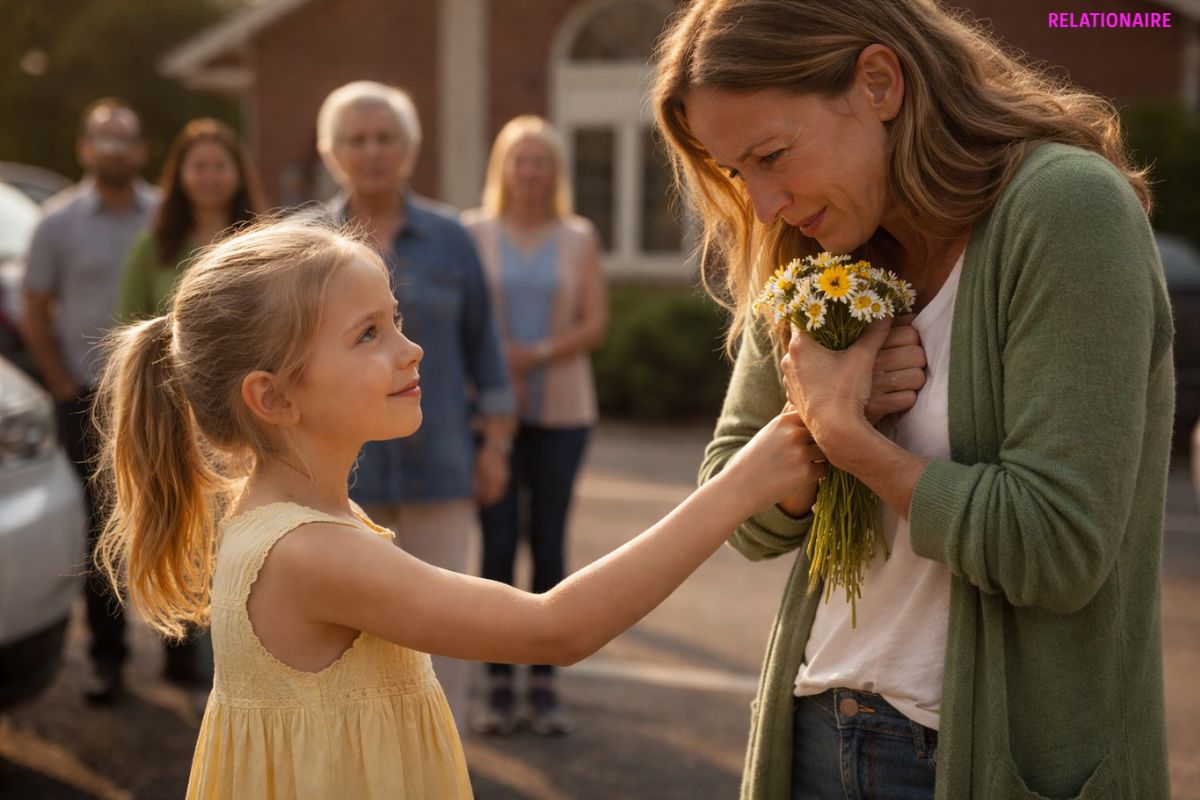
The woman in green had just reached her driver’s door when Lila came up, small hand extended.
Not to touch the car.
To offer the last daisy directly to her.
The woman looked startled. She glanced around, maybe for a parent, maybe for an explanation.
Lila said something too low for Martha to hear.
The woman’s mouth parted.
Then she took the flower.
For one heartbeat, the parking lot seemed to hold itself still.
Then Martha heard the whisper behind her.
“This has got to stop.”
Another voice. “It’s inappropriate.”
Someone else, drier: “Children aren’t supposed to single people out like that.”
Martha turned and saw three women near the church steps watching. Not malicious. Worse. Concerned.
Concerned could turn into consensus in a church parking lot faster than fire found dry grass.
Martha’s face burned.
She crossed back toward the center of the lot, lifted a hand, and said too loudly, “I am so sorry, everyone. Truly. I know she shouldn’t be bothering your cars. It won’t happen again.”
A few people gave the automatic little smiles people give after an apology they feel entitled to.
One man nodded as if an issue had been properly handled.
Martha swallowed hard and looked toward Lila.
The woman in the green cardigan was still standing by her SUV.
Still holding the daisy.
And then, so suddenly it looked like something inside her had snapped loose, she covered her mouth with one hand and burst into tears.
Not delicate tears.
Not a single shining line down the cheek.
The kind that bent her forward.
The kind that made a person look caught off guard by their own pain.
Conversations around the parking lot died mid-sentence.
Martha froze.
The woman tried to speak and couldn’t. She pressed the daisy to her chest instead, shaking her head like she could not believe what was happening to her in broad daylight with church people watching.
Lila stood very still in front of her.
Then the woman finally managed to whisper, broken and raw enough for the nearest few people to hear:
“This is the first Sunday I came alone since my divorce.”
The parking lot went silent.
Martha felt something drop through her body.
She turned slowly toward her granddaughter.
Lila was not smiling.
She was not proud.
She just looked up at the crying woman with those solemn, watchful eyes and said, in the plain voice of a child explaining something obvious:
“I know.”
And only then did Martha understand that this had never been random at all.
Not the flowers.
Not the cars.
Not once.
She looked at the other windshields across the lot.
At the daisy on the silver sedan.
The clover on the blue pickup.
The little white bloom under Deacon Avery’s wiper.
And for the first time, she realized there was a pattern she had completely missed.
A pattern only made of people who had walked into church alone.
Lila bent down, reached into the pocket of her yellow dress, and pulled out a folded piece of paper Martha had never seen before.
She held it out toward her grandmother.
“Mamaw,” she said softly, “I wrote down why.”
Martha stared at the paper in her granddaughter’s hand.
And all around them, the whole church seemed to wait for her to open it.
Part 2
Martha took the folded paper with fingers that had started to tremble.
It was torn from a church bulletin, the back side covered in a child’s careful printing. Not quite straight. Some letters backward in the way Lila still occasionally did when she wrote too fast. Smudges of dirt along one edge. A pressed buttercup flattened inside like she had closed the paper around it on purpose.
The parking lot had gone so quiet Martha could hear the far-off hum of traffic from the county road.
She opened the note.
At the top, in pencil, Lila had written:
People who came in sad today
Below that was a list.
Not names. Descriptions.
Green sweater lady — eyes looked like crying already
Blue truck man — sat by himself at donuts but kept smiling when nobody talked to him
Silver car grandma — held her purse with two hands in church
Mr. Avery — looked lonely even when people shook his hand
Lady with red lipstick — took ring off in car before coming inside
Martha stopped breathing for a second.
The woman in the green cardigan gave a wet, shocked laugh through her tears. One hand stayed pressed to her chest around the daisy.
A few people stepped closer.
Not in accusation now.
In disbelief.
Martha looked down at Lila. “How long have you been doing this?”
Lila lowered her eyes. “Since winter.”
“Since winter?”
Lila nodded.
That meant months.
Months of Sundays.
Months of people noticing the flowers but never the pattern beneath them.
Martha thought back. There had been other comments, smaller ones. How Lila “wandered.” How she always seemed to disappear after the service. Once, someone had joked that the child was trying to start her own florist business. Martha had laughed along, irritated but distracted, too busy carrying casseroles, remembering medications, paying bills, getting through another week without thinking too long about the two gravestones she still could not visit on back-to-back days.
“How did you decide who gets one?” Martha asked quietly.
Lila looked confused by the question, as if the answer was already sitting there in plain sight.
“I watch.”
“Yes, but what do you watch for?”
Lila glanced around the lot.
“For the ones who walk slow.”
Nobody said anything.
She kept going, still in that small matter-of-fact voice.
“The ones who look at everybody else talking and then look away.”
A swallow.
“The ones who sit at the end of the pew.”
The woman in green let out another broken sound.
Lila lifted one shoulder.
“The ones who hold themselves like they don’t want to fall apart where people can see.”
Martha shut her eyes.
Just for a second.
When she opened them, she saw faces around her changing shape. Not physically. But morally. The set of people’s mouths. Their shoulders. That awful church parking lot ease had drained away, replaced by something closer to shame.
Deacon Avery stepped forward. He was a large man with a calm voice and a wife who had died eighteen months earlier after a short, ugly fight with pancreatic cancer. Since then he had mastered the art of carrying grief in public so neatly people mistook it for strength.
“She left one on my truck last week,” he said.
Martha turned to him.
He gave a small nod, eyes brightening. “I found it after everybody had gone home.”
His voice caught, and he pressed his lips together before continuing.
“I hadn’t told a soul it was Clara’s birthday.”
Nobody moved.
The woman in green leaned against her SUV and stared at Lila like she was looking at someone impossibly small and impossibly ancient at once.
“My husband moved out in March,” she said, wiping under her eyes. “I sat in the parking lot for ten minutes before I could come inside. I almost turned around.”
She looked at the daisy in her hand.
“When she walked up to me, I thought…” Her laugh came out embarrassed and ragged. “I thought maybe she was selling something for Vacation Bible School.”
That loosened a fragile ripple of laughter around them. Soft. Grateful. A way to breathe again.
Martha looked back at the paper.
There were more descriptions.
Man with old boots — said “I’m fine” too fast
Lady with the pretty scarf — nobody saved her a seat
Gray jacket man — looked like he forgot why he came
And at the bottom, in larger letters, one sentence:
Flowers help because they don’t ask questions
Martha had to press her hand flat over her mouth.
Because suddenly she knew.
Not just what Lila was doing.
Where she had learned it.
Three weeks after the accident, when casseroles were still showing up and people were still saying the wrong kind things, a neighbor’s little boy had left a dandelion on Martha’s porch rail. No note. No words. Just a weed gone to seed, bright as a small sun.
Martha had cried so hard she had to sit down on the floor by the front door.
She had never told Lila that.
Or maybe she had, once, in the half-broken blur of those first months.
Children heard what adults dropped carelessly.
They kept what mattered.
The crowd began to thin around the edges, but not the way it had before. Now people stayed because they were pulled toward something tender and difficult, as if they needed to witness it all the way through to make sense of themselves.
One of the women who had complained first, Linda Carroway, stepped forward with her car keys hanging from one finger.
“I owe you an apology, sweetheart,” she said to Lila.
Lila looked at her with polite uncertainty.
Linda swallowed. “I thought you were just… fooling around.”
Lila nodded once, accepting the information without ceremony.
Children could do that. Accept remorse in a way adults made complicated.
But Martha was not done feeling what she felt.
Shame came first.
Then grief.
Then something worse than both: the realization that she, of all people, had almost told Lila to stop seeing what she saw.
Had almost trained the kindness out of her because it made other people uncomfortable.
They drove home in silence that afternoon.
The church parking lot gave way to the two-lane road bordered by pines and leaning mailboxes. Lila sat in the passenger seat of Martha’s old Buick with her hands folded around the now-empty flower bucket. Dust danced in the slanted light through the windshield. On the radio, some preacher from a station out of Jackson was talking about obedience in a voice too cheerful for the subject.
Martha turned it off.
At the red light by the hardware store, she finally said, “Why didn’t you tell me?”
Lila looked out the window. “I thought you knew.”
The answer landed with a quiet bruise.
Martha tightened both hands on the steering wheel. “No, baby. I didn’t.”
Lila nodded like that made sense too.
Then, after a moment: “Sometimes grown-ups look at the wrong part.”
Martha almost laughed, but it came out as something closer to a sob.
Back at the house, the late afternoon heat sat heavy on the porch. Martha unlocked the door, and the familiar smell of lemon cleaner, old wood, and laundry soap met them. Lila set the flower bucket by the sink and went to peel off her shoes.
Martha stayed standing at the kitchen counter with the note in her hand.
People who came in sad today.
The words would not let her go.
That evening, after supper, she found Lila on the living room rug with crayons spread around her knees. She was drawing small flowers on scraps of paper.
Not pictures.
Cards.
Martha sat slowly on the sofa. “What are those?”
“In case there aren’t enough flowers next Sunday.”
Martha looked at the neat pile forming by Lila’s elbow.
Some had just blooms.
Some had words.
You can sit with me.
I’m glad you came.
You looked lonely. So this is for you.
Martha’s throat closed again.
“Lila,” she said carefully, “does it make you sad, watching all that?”
Lila thought about it.
“Sometimes.”
“Then why do you keep doing it?”
The child shrugged one shoulder.
“Because sometimes they look less sad after.”
Martha stared at her.
Not because it sounded wise.
Because it sounded expensive.
Like something learned the hard way.
Later that night, after Lila was asleep, Martha stood in the doorway of the little bedroom painted pale blue years before and watched her granddaughter breathe. One arm flung above her head. Hair stuck to her cheek. The stuffed rabbit with one ear bent underneath her chin.
On the nightstand sat a jar.
Inside were dried petals.
Dozens of them.
Saved.
Martha picked it up carefully. Beneath the petals was a second folded paper.
This one was older, softer at the creases.
She opened it and recognized Lila’s printing again, shakier this time.
At the top it said:
People who were sad before
Underneath, only two entries.
Mamaw
And below it, after a long blank space:
Me
Martha had to sit on the edge of the bed because her knees would no longer hold her.
She heard the front porch step creak an hour later and looked through the window to see a car pulling into the drive.
The woman in the green cardigan got out holding something against her chest.
A box.
White.
Carefully taped.
Martha opened the door before she reached the porch.
The woman’s eyes were swollen from crying, but steady now.
“This belongs to your granddaughter,” she said.
Martha frowned. “I’m sorry?”
The woman looked down at the box and then back up.
“No,” she whispered. “I think this belongs to both of you.”
She held the box out.
And when Martha saw what was written across the top in a man’s handwriting, her hand flew to her mouth.
Because she knew that writing.
And it belonged to someone who was supposed to be gone forever.
Part 3
Martha took the box like it might break open in her hands.
Not because it was fragile.
Because she was.
The woman on the porch shifted her weight and tucked a strand of hair behind one ear. Up close, she looked even more exhausted than she had in the church lot. Not messy. Not undone. Just worn thin in the exact places people tried hardest to hide.
“I’m sorry to show up unannounced,” she said. “My name is Elise.”
Martha could barely get words around the pressure in her throat. “This handwriting…”
Elise nodded slowly. “I know.”
Across the top of the box, in dark blue ink, were three words Martha had not seen in three years.
For Lila someday
It was Ben’s handwriting.
Her son-in-law’s.
The loops in the F. The heavy downstroke in the L. The way he always crowded the last word as if he had misjudged the space.
Martha felt dizzy.
“Come in,” she said, and even to her own ears the words sounded far away.
Elise stepped into the house. Martha set the box on the kitchen table as gently as if it held a sleeping thing. Lila, hearing voices, padded in from the hallway in her nightgown, hair rumpled from sleep.
She stopped when she saw Elise.
Then she saw the box.
“Is that mine?” she asked.
Martha could not answer.
Elise knelt to bring herself level with the child. “I think so.”
Lila came closer.
Not grabbing.
Just looking.
Children knew when an object had weight beyond itself.
Martha pulled out a chair and sat. “Tell me where you got this.”
Elise drew in a breath and folded her hands.
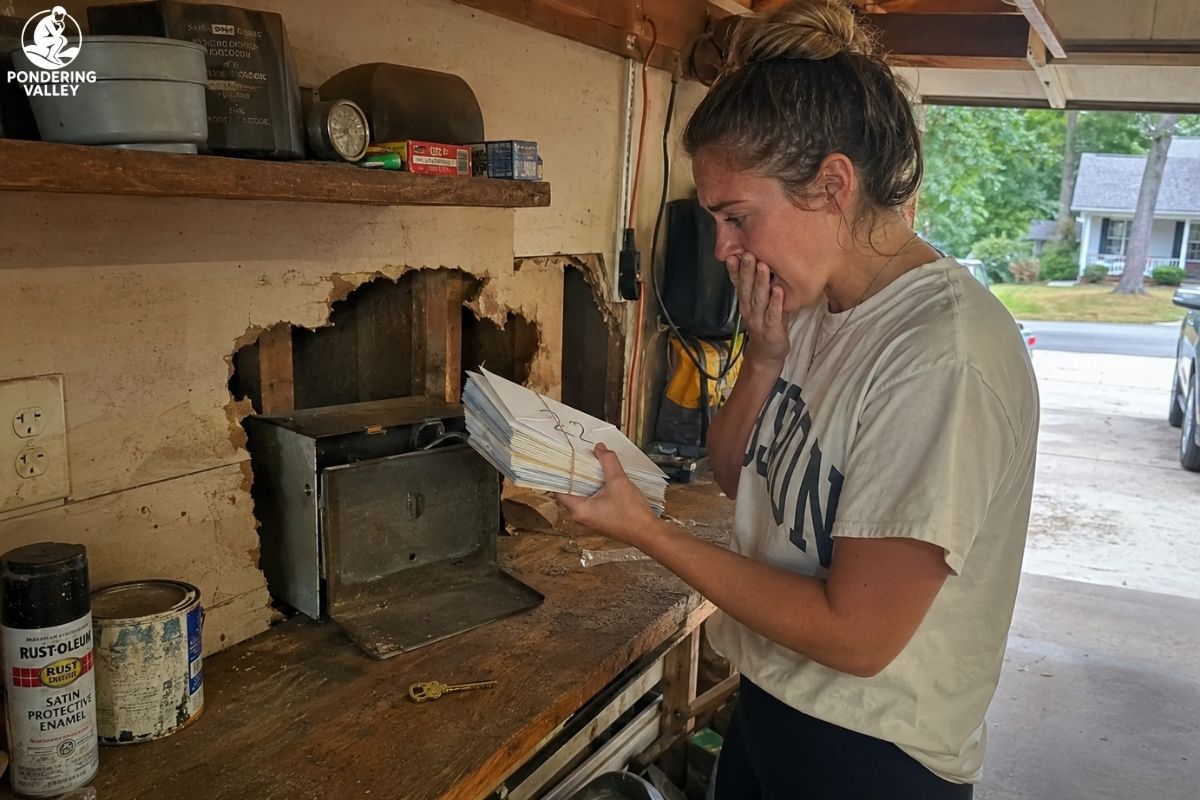
“My husband and I bought the house on Maple Ridge in January,” she said. “We’ve been remodeling the back bedroom. Today, after church…” She glanced at Lila, then back at Martha. “After what happened in the parking lot, I went home and couldn’t stop crying. I started cleaning out the hall closet to settle myself.”
Her mouth trembled, but she went on.
“There was a loose panel above the shelf. Behind it was this box.”
Martha frowned. “Maple Ridge…”
“Elise used to be Ben and Caroline’s first rental,” Elise said softly. “Before they bought the place outside town.”
Memory hit Martha all at once.
The little yellow rental with the slanted porch.
The starter house.
The one with bad plumbing and pecan trees out back.
Ben had fixed shelves in that hallway himself.
Of course.
Of course the handwriting was his.
“He must’ve hidden it there,” Martha whispered.
Lila had come around to the table now. She placed one hand on the box but did not try to open it.
“Why did you bring it tonight?” Martha asked.
Elise looked at the child. Then at the note still lying on the counter from the church parking lot.
“Because I think,” she said carefully, “that your granddaughter is the reason I found it today.”
Martha did not even try to understand that sentence all at once.
She simply reached for the tape.
Her fingers slipped. Elise handed her a butter knife. Martha slid it under the seam and lifted.
Inside the box were smaller things, packed with tissue gone yellow at the folds.
A photograph on top.
Ben on the floor with toddler Lila on his shoulders, both of them laughing so hard their faces had gone crooked.
Martha made a sound that belonged more to injury than grief.
Lila stared.
“That’s Daddy,” she whispered.
Martha nodded.
Under the photo was a bundle of envelopes tied with twine. A wooden music box with one corner chipped. A tiny pair of baby socks. A church bulletin from Lila’s dedication Sunday. A receipt from a diner with CAROLINE + BEN + BABY PANCAKES written across the back. A pressed sprig of lavender in wax paper.
And at the bottom, a letter.
Longer than the others.
Addressed in Ben’s handwriting:
For Lila, when she is old enough to ask harder questions
Martha sat absolutely still.
Lila looked up. “Can you read it?”
Martha should have waited.
Maybe until morning.
Maybe until Lila was older.
Maybe until her own hands were not shaking badly enough to crumple the page.
But grief had already taught her something cruel: there was never a perfect time to touch what hurt.
So she opened it.
Ben’s words were steady. Warm. Entirely alive on the page.
He wrote that he had started the box after Caroline got pregnant because he was afraid ordinary life moved too fast and he did not want to lose the small holy things. He wrote that if Lila was reading this, then life had changed in some way he could not control. He prayed it had not changed through loss, but he knew enough about life not to bargain with certainty.
Martha had to stop there for a moment and wipe her face.
Then she kept reading.
He wrote to Lila about her mother’s laugh. About how she danced badly in the kitchen on purpose just to make him laugh when bills were late and the sink leaked and the baby would not sleep. He wrote that love was not made of big speeches. It was made of noticing.
Noticing when somebody was tired.
Noticing when they got quiet.
Noticing what they stopped asking for.
Noticing when they said “I’m fine” in the voice that meant they were not.
Martha stopped again.
Across the table, Elise pressed her lips together and looked away.
Lila listened without moving.
Ben wrote:
If you ever feel like the only person in the room who sees somebody hurting, do not let that make you ashamed. That is a gift. It may not feel like one. People who notice pain often carry some of their own. But the world is held together more by people who notice than by people who impress.
Martha’s vision blurred.
She could hardly see the rest.
Your mama was like that. She noticed everybody. I hope if you are like her, nobody teaches you to stop.
Something in the room broke open then.
Not loudly.
Not with shouting.
With weeping.
Elise covered her face.
Martha lowered the letter and cried over it.
And Lila, who had been so quiet, reached out and put her hand over the line that said I hope if you are like her, nobody teaches you to stop.
Then she looked at her grandmother.
Not accusing.
Not wounded.
Just honest.
“Mamaw,” she asked, “were you going to make me stop?”
There it was.
The hardest question in the room.
Harder, in some ways, than death.
Harder than memory.
Because it asked Martha to look straight at the smallness fear could make of love.
She nodded.
“Yes,” she whispered.
Lila absorbed that.
Martha took the child’s hand. “I was wrong.”
Lila blinked slowly.
Then, in that plain way children sometimes forgive what adults would spend paragraphs explaining, she said, “Okay.”
That should not have been enough.
It was.
Elise stayed for tea.
Not because anybody offered at the proper moment, but because nobody seemed ready to return to ordinary life yet. They sat around the kitchen table under the yellow light with the open box between them, touching objects as if they might still be warm from the hands that left them.
Elise told them her own story in pieces.
The divorce.
The empty side of the bed.
The way church had felt unbearable because everyone there seemed to belong to someone.
“I kept sitting in the parking lot after services,” she admitted. “Even on the weeks I came. Just sitting. Waiting until most people left.”
Lila nodded. “I know.”
That made Elise laugh through fresh tears.
“I believe you do.”
The next Sunday, Martha expected whispers.
There were some.
But not the same kind.
Word had spread, because of course it had. Churches carried sorrow and casseroles and stories with equal efficiency.
When they pulled into the lot, Martha saw something strange immediately.
Flowers.
Not tucked under wipers yet.
Held in hands.
A little bunch of daisies in a mason jar on the welcome table. Sunflowers in a coffee can beside the church doors. A deacon holding what looked like clover wrapped in damp paper towel. Three children with dandelions. Linda Carroway with a bundle of wild asters and a face that said she was trying not to cry before nine-thirty in the morning.
Martha parked and turned off the engine.
Lila looked confused. “Why does everybody have flowers?”
Martha smiled through a sting behind her eyes. “I think because you taught them to look.”
Inside the sanctuary, people still sang off-key and fanned themselves with bulletins and checked crockpots in their minds. It was the same church.
And not.
After service, nobody rushed away.
Not exactly.
Something slower happened.
People lingered on purpose.
Seats were offered before they were needed.
Hands touched elbows.
A widow who usually slipped out the side door was stopped by three women who asked her to lunch and meant it. Deacon Avery sat with the old boots man from the donut table. Linda crossed the room to stand beside Elise before Elise had to decide where to stand alone.
And in the parking lot, with Martha beside her this time, Lila placed flowers under a few windshield wipers.
Not many.
She did not need to.
Others were already doing it.
Not because it was cute.
Because they finally understood what it was for.
When they reached Martha’s Buick, Lila paused and pulled one last daisy from her pocket.
“For who?” Martha asked.
Lila tucked it carefully under their own windshield wiper.
Martha looked at her. “Us?”
Lila nodded.
“Why us?”
The child shaded her eyes against the sun and looked up at her grandmother with that steady, unadorned gaze.
“Because sad doesn’t always leave,” she said. “It just gets lonely if nobody notices.”
Martha had no answer to that.
Only tears again.
And gratitude.
The kind that humbles more than it lifts.
Years later, people in that church would still talk about the summer the flowers started. They would remember the parking lot. The note. The box. The woman in green who had come back every Sunday after that and eventually laughed again from her whole chest. They would remember Martha learning, in public and painfully, that protecting a child sometimes meant not protecting the world from what the child could see.
But what stayed with Martha most was smaller.
One daisy under one wiper.
A child watching who walked in alone.
A box waiting in the dark until the right Sunday found it.
And the quiet, life-changing mercy of being noticed before you had the strength to ask.
Some people think love has to arrive loudly to count.
But sometimes it comes as a bent wildflower on a hot windshield, left there by the smallest person in the parking lot, just to say: I saw you come in alone.