If you’ve already read part 1 of this story on Facebook, go here for Part 2!
PART 1
The first time Dr. Elias Ward left a full cup of coffee on the waiting room table, Maya thought he had forgotten it.
The second time, she thought he was exhausted.
By the fifth morning, she began to wonder if something inside him was quietly coming apart.
Maya worked the front desk of St. Agnes Emergency Department, where everyone learned how to watch without staring. She noticed which families were scared before they said a word. She noticed who walked in holding paperwork too tightly. She noticed which nurses smiled with only half their faces because the other half was saving itself for later.
And lately, she noticed Dr. Ward.
He came in every morning at 6:12.
Not 6:10. Not 6:15.
6:12.
Wrinkled blue scrubs under a dark coat. Hospital badge clipped crooked. Hair still damp from a rushed shower. Wedding ring absent, though a pale mark remained on his left hand.
He always carried two paper cups from the coffee cart outside the ambulance bay.
One black coffee for himself.
One with cream and two sugars.
He drank the black one standing near the nurses’ station, answering questions before he even took off his coat.
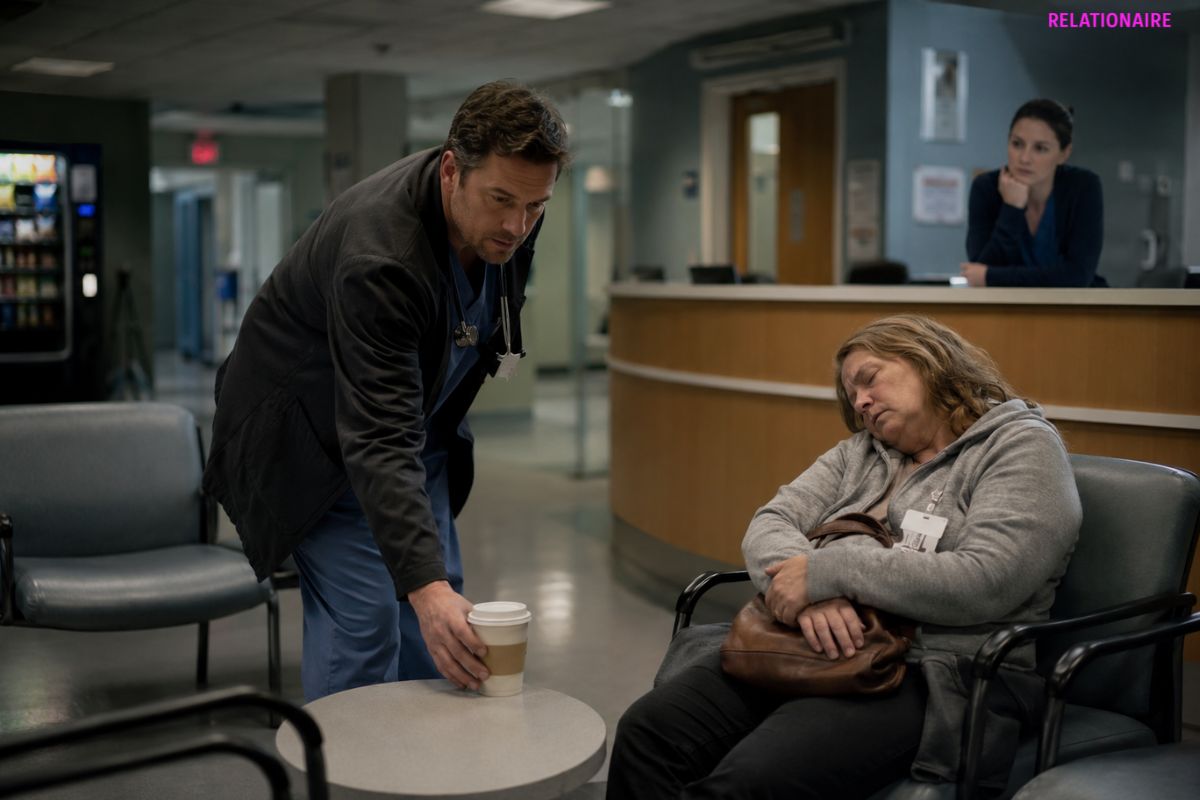
The second cup, he set down in the waiting room.
Always near the corner.
Always on the low wooden table beside the row of vinyl chairs closest to the vending machines.
Always untouched.
At first, Maya almost threw it away.
She reached for it one Monday morning, just as Dr. Ward passed behind her.
“Leave it,” he said.
His voice wasn’t sharp.
That was almost worse.
Maya froze with her fingers inches from the cup.
“Oh,” she said. “Sorry. I thought someone forgot it.”
“No,” he said.
Then he walked into Trauma Three without another word.
Maya watched him go, annoyed in the small way people get annoyed when kindness and rudeness arrive in the same sentence.
Doctors could be like that.
Not all of them.
But some.
They moved through the hospital like weather. Everyone adjusted around them. Receptionists, cleaners, aides, volunteers, cafeteria workers — they all learned to step aside when a white coat came fast enough.
Dr. Ward wasn’t cruel. Maya had never heard him raise his voice. But he was distant. The kind of tired that made other people feel like furniture.
Still, the coffee bothered her.
By 8:00 that morning, the cup was gone.
Not thrown away.
Gone.
The next morning, he did it again.
Two coffees. One black. One with cream and sugar.
He placed the extra cup on the same table and went back through the double doors.
Maya watched from the desk while pretending to sort visitor badges.
At 7:43, a woman in a gray hoodie woke up in the corner chair.
Her name was Ruth Bell. Maya knew because Ruth signed in every morning with careful handwriting, even when her hand shook.
Ruth’s husband, Henry, was receiving treatment upstairs. Not in the ER anymore, but somehow Ruth kept ending up in the emergency waiting room before visiting hours began. Maybe because the chairs were always open. Maybe because no one asked too many questions. Maybe because when you had nowhere else to put your fear, a hospital waiting room felt honest.
Ruth slept sitting up with her purse hugged against her stomach.
She wore the same gray hoodie most days. It had a tiny bleach mark near the sleeve. Her visitor badge was always folded at the corner from being peeled off and reused too many times.
That morning, Ruth woke slowly.
She looked confused for a moment, like she had forgotten where she was, then remembered all at once.
Her face did something Maya had seen too many times.
It fell before she touched it.
Ruth reached for the coffee.
She looked around first, as if afraid someone might tell her it wasn’t hers.
No one did.
She wrapped both hands around it and held it close before drinking.
Maya looked toward the ER doors.
Dr. Ward was nowhere in sight.
After that, she watched every morning.
The coffee always found Ruth.
Some days, Ruth noticed it right away.
Some days, she slept through the steam and drank it lukewarm.
Once, a teenager reached for it, and before Maya could say anything, Dr. Ward appeared from the hallway.
“That one’s taken,” he said gently.
The teenager blinked. “By who?”
Dr. Ward looked toward Ruth, asleep under the flickering television.
“Someone who needs it.”
Then he walked away.
Maya did not know what to make of him.
There was something strange about the routine. Something careful. He never handed Ruth the coffee. Never smiled at her. Never waited for thanks.
He just left it nearby and disappeared.
It made Maya uncomfortable.
Kindness was supposed to have a face.
This had no face.
It was almost like he was hiding from his own good deed.
One Thursday, Maya’s coworker Tasha leaned over the counter and whispered, “You notice Dr. Ward and the coffee thing?”
Maya kept her eyes on the waiting room. “Hard not to.”
“You think he knows her?”
“I don’t know.”
“Maybe he feels bad for her.”
Maya frowned.
There it was.
The thing that had been bothering her.
Pity.
She had watched enough families get treated like problems to know the difference between compassion and pity. Pity looked down. Compassion sat beside you.
Dr. Ward never sat beside Ruth.
He never even said good morning.
That day, Ruth came to the desk near noon clutching a wrinkled cafeteria receipt.
“Excuse me,” she said softly. “Do you know who keeps leaving the coffee?”
Maya hesitated.
Ruth’s eyes were tired but kind. There were deep lines around them, the kind carved by too much worrying and not enough sleeping.
“I’m not sure,” Maya said.
It was only half a lie.
Ruth nodded, disappointed.
“I wanted to say thank you,” she said. “My husband thinks it’s silly, but sometimes that coffee is the only warm thing I touch before noon.”
Maya swallowed.
Before she could answer, the doors opened and Dr. Ward stepped out, reading a chart.
Ruth turned.
For one second, her eyes landed on the cup in his hand.
Then on his face.
Something changed in her expression.
Not recognition.
Something sharper.
Dr. Ward looked up and saw her looking.
The color drained from his face so quickly Maya stood up behind the desk.
Ruth took one step toward him.
“You,” she whispered.
Dr. Ward did not move.
Maya looked from Ruth to the doctor, suddenly certain she had been wrong about everything and not knowing how.
Ruth’s voice trembled as she asked, “Why are you doing this?”
Dr. Ward lowered the chart slowly.
And for the first time since Maya had known him, the doctor looked less like someone saving other people and more like someone barely holding himself together.
He opened his mouth to answer.
PART 2
Dr. Ward did not answer right away.
The waiting room seemed to notice.
The vending machine hummed. A child coughed into his mother’s sleeve. Somewhere behind the double doors, a monitor chimed softly and then stopped.
Ruth stood in front of him with her gray hoodie zipped to her chin and her visitor badge curling away from her sweater.
Maya stayed frozen behind the desk.
She had seen people receive terrible news. She had seen people argue over insurance forms, waiting times, discharge instructions, parking validation. She had watched families break down in quiet corners where they thought no one could see.
But this was different.
This was not panic.
This was recognition without knowing what had been recognized.
Dr. Ward looked at Ruth’s hands first.
They were trembling.
Then he looked at the coffee on the table.
“I didn’t mean to upset you,” he said.
His voice was low.
Ruth let out a small laugh that was not a laugh at all. “Upset me?”
He looked past her, toward the row of chairs where she had slept for nearly three weeks.
“I just thought…” He stopped. “I thought it might help.”
Ruth’s eyes filled, but she did not cry.
People who spend too long in hospitals often become careful with tears. They learn tears use energy.
“Do I know you?” she asked.
Dr. Ward shook his head.
“No.”
“Does Henry know you?”
“No.”
“Then why?”
Maya expected him to say something simple.
Because you looked tired.
Because I noticed.
Because somebody should.
Instead, Dr. Ward’s face tightened in a way that made Maya feel suddenly ashamed of every private judgment she had made about him.
“Because when I was seventeen,” he said, “my mother slept in a hospital waiting room just like that.”
Ruth’s mouth opened slightly.
Dr. Ward held the chart tighter against his side.
“She wouldn’t leave my father. Not for meals. Not to shower. Not even when my aunt begged her. She said if he woke up and she wasn’t there, he’d be scared.”
The words came out controlled, but Maya could hear the effort beneath them.
A nurse passing by slowed, then kept walking.
Dr. Ward looked down.
“I was too young to understand what it cost her. I thought she was being stubborn. I was angry at her, honestly. Angry that she smelled like coffee and antiseptic. Angry that she forgot to eat. Angry that she kept telling me she was fine when she clearly wasn’t.”
Ruth’s lips pressed together.
Maya’s eyes drifted to the coffee cup on the table.
Cream and two sugars.
Still warm.
“Every morning,” Dr. Ward continued, “someone left her a coffee.”
He paused.
“Same way. On the little table beside her chair. No note. No name. Just coffee.”
Ruth looked toward the chair where she had been sleeping.
Maya did too.
For a moment, the vinyl chair was not just an uncomfortable place in an ER waiting room. It was a place where mothers waited. Wives waited. Sons misunderstood them. Strangers noticed them.
Dr. Ward drew a breath.
“My mother never found out who did it.”
Ruth whispered, “But you did?”
“No,” he said. “I didn’t.”
His eyes lifted then, and they were red at the edges.
“I looked for years in my head. I made up faces. A nurse. A janitor. Another family member. A doctor. A receptionist. Someone passing through.” His mouth moved into something almost like a smile, but it broke before it became one. “I used to hate that I didn’t know who it was.”
Maya felt something small and painful twist in her chest.
Dr. Ward looked toward the ER doors.
“Then I became a doctor and realized maybe that was the point.”
No one spoke.
Ruth touched the visitor badge at her chest.
“The point?”
“He didn’t need her thanks,” Dr. Ward said. “Whoever it was. He didn’t need to be remembered. He just saw a woman in a chair who was trying not to fall apart. And he made one hour of her morning easier.”
Ruth covered her mouth.
Maya looked away because it felt wrong to witness that much tenderness without permission.
Dr. Ward shifted his weight.
“I started doing it during residency,” he said. “Not every day. Not always the same person. Just when I saw someone who looked like my mother did.”
Ruth’s tears slipped over her fingers.
“My Henry keeps telling me to go home,” she said. “He says I look terrible.”
Dr. Ward’s voice softened. “He’s probably scared you’ll disappear.”
She nodded once, quickly, like a child trying to be brave.
“He sleeps better when I’m there.”
“I know.”
The two words were simple.
But they landed heavily.
Ruth’s face changed again.
This time, it was not suspicion.
It was the terrible relief of being understood.
Maya thought the moment was over.
She thought Ruth would thank him. He would nod. The coffee would become a sweet hospital story told quietly between shifts.
But then Ruth reached into the pocket of her hoodie and pulled out a folded piece of paper.
“I wrote a note,” she said.
Dr. Ward looked confused.
“To whoever kept buying the coffee,” Ruth said. “I didn’t know if I’d ever find them.”
She held it out.
He did not take it.
Not at first.
Maya saw his hesitation and misunderstood him again.
She thought he was uncomfortable with emotion. Maybe embarrassed. Maybe unwilling to be pulled into Ruth’s gratitude.
Then she noticed his hand.
It had started to shake.
Ruth saw it too.
“You don’t have to read it now,” she said gently.
Dr. Ward took the note like it weighed more than paper.
“Thank you,” he said.
Ruth smiled through tears. “That was my line.”
For the first time, Dr. Ward smiled back.
A real smile.
Small. Tired. Gone quickly.
But real.
Then the double doors opened and a nurse called Ruth’s name.
“Mrs. Bell? Your husband is asking for you.”
Ruth wiped her face with her sleeve.
“I should go.”
Dr. Ward nodded.
She started toward the elevator, then turned back.
“Doctor?”
“Yes?”
“Did your mother make it through that week?”
Maya held her breath.
Dr. Ward looked at the floor.
The waiting room softened around him.
“She did,” he said. “For six more years.”
Ruth nodded with the solemn care of someone who understood that six years could be both a gift and not nearly enough.
“I’m glad,” she whispered.
Then she disappeared into the elevator.
Dr. Ward stood there holding the folded note.
Maya watched him stare at it.
He did not open it.
He slipped it into his coat pocket and went back to work.
That should have been the end of it.
But near midnight, Maya found him in the empty cafeteria, sitting alone with Ruth’s folded note beside a cold cup of black coffee.
He had not read it.
His elbows rested on the table.
His hands were clasped as if he were praying, though Maya somehow knew he wasn’t.
She could have walked away.
She almost did.
Instead, she approached slowly.
“Dr. Ward?”
He looked up, startled.
For once, he looked younger than he was.
Maya nodded toward the note.
“You okay?”
He gave the answer everyone in hospitals gives when the truth is too large for a hallway.
“I’m fine.”
Maya sat across from him without asking.
For a while, neither of them spoke.
Then he said, quietly, “My mother died with a coffee in her hand.”
Maya’s throat tightened.
“She was home by then,” he continued. “It wasn’t dramatic. She was in her kitchen. My sister had brought her groceries. I had worked a double and missed her call that morning.”
His face did not crumble.
That made it worse.
“She left me a voicemail,” he said. “I deleted it by accident two years later. I still remember most of it. Not all. That’s the part that bothers me.”
Maya looked at the folded note.
“Maybe that’s why you don’t want to open it.”
He turned toward her.
She worried she had gone too far.
But he only looked tired.
“I don’t know what I’m afraid it will say,” he admitted.
Maya thought of all the mornings she had judged him from behind the desk.
Cold.
Absent-minded.
Unraveling.
Maybe pitying a woman he refused to face.
All that time, he had been trying to repay a stranger he never found.
Trying to keep his mother’s worst week from disappearing into hospital noise.
Trying to become the kind of person he wished he had noticed sooner.
Maya reached across the table and gently pushed the note closer to him.
“Maybe,” she said, “it says what she would’ve said.”
Dr. Ward stared at the paper.
His eyes filled, but he blinked the tears back.
Then, slowly, with the cafeteria lights buzzing above them and the night shift moving softly in the distance, he opened Ruth Bell’s note.
PART 3
Ruth’s handwriting was small and careful.
Dr. Ward read the first line and stopped breathing for a second.
Maya watched his face change.
Not dramatically.
Hospitals teach people how to hide their breaking.
But his shoulders lowered. His jaw loosened. One hand covered his mouth.
He set the note down between them.
Maya did not reach for it until he nodded.
The note said:
To whoever keeps leaving the coffee,
I don’t know your name.
Maybe you don’t want me to.
But this morning, I woke up and thought, “Someone remembered I was human.”
That was all.
One sentence.
Someone remembered I was human.
Maya felt tears come quickly, without warning.
There were longer things Ruth could have written. More polished things. More grateful things.
But nothing would have said it better.
Dr. Ward folded the note again with great care.
Then he pressed it flat under his palm.
“My mother would have liked her,” he said.
Maya smiled through the ache in her throat. “I think so.”
The next morning, Dr. Ward did not come in at 6:12.
At 6:20, Maya looked toward the ambulance bay doors.
At 6:31, she checked the coffee cart through the glass.
At 6:45, Ruth arrived wearing the gray hoodie and carrying a canvas tote bag with a hospital blanket folded over one arm.
She looked immediately toward the corner table.
There was no coffee.
Maya saw the disappointment pass across Ruth’s face before Ruth could hide it.
It was tiny.
Almost nothing.
But Maya had spent years reading tiny things.
“Good morning, Mrs. Bell,” Maya said.
“Morning, sweetheart.”
Ruth signed in slowly.
“How’s Henry today?” Maya asked.
Ruth looked toward the elevators.
“He had a rough night,” she said. “But he asked for toast this morning.”
In hospitals, toast could become a celebration.
Maya smiled. “That’s good.”
Ruth nodded, but her eyes drifted again to the empty table.
A minute later, the ambulance bay doors opened.
Dr. Ward came in wearing the same dark coat, hair still damp, badge still crooked.
But he was carrying three coffees.
Maya looked up.
He placed one black coffee near the nurses’ station.
Then he walked into the waiting room.
Ruth sat up straighter.
For the first time, he did not leave the cup anonymously.
He stood in front of her chair and held it out.
Cream and two sugars.
Ruth looked at the cup.
Then at him.
“I thought maybe you forgot,” she said.
“I almost did,” he admitted. “Then I remembered what your note said.”
Her eyes filled.
He held out the third cup.
“This one’s for Henry. Decaf. If he’s allowed.”
Ruth let out a soft laugh and took both cups like they were fragile.
“He’ll say he doesn’t need it,” she said.
“Most people who need things say that.”
Maya pretended to look at her computer.
She was not pretending well.
Ruth stood slowly.
For a moment, she and Dr. Ward faced each other in the middle of the waiting room, surrounded by people who had no idea they were witnessing something sacred in an ordinary place.
“Thank you, Elias,” Ruth said.
Maya looked up.
Dr. Ward did too.
Ruth smiled faintly. “I asked the nurse your name.”
He nodded.
“You’re welcome, Ruth.”
Names changed things.
They made kindness harder to hide from.
Over the next week, the morning coffee became less of a mystery and more of a ritual.
Not loud.
Not sentimental.
Just human.
Sometimes Dr. Ward handed Ruth the cup himself. Sometimes Maya did when he got pulled into a room too quickly. Sometimes Tasha brought napkins from the desk and joked that the waiting room was becoming a café with terrible seating.
Henry improved enough to come downstairs one afternoon in a wheelchair.
He was thin and pale, with a blue knit cap pulled low and a stubborn look that made it easy to imagine him telling Ruth to go home and rest.
When Dr. Ward approached, Henry lifted his cup.
“So you’re the coffee doctor.”
Dr. Ward smiled. “I’ve been called worse.”
Henry looked at him for a long moment.
Then he said, “She slept because of you.”
Ruth waved him off. “Henry.”
“No,” he said, his voice quiet but firm. “Let me say it.”
Dr. Ward became still.
Henry looked down at the lid of his cup.
“I couldn’t fix anything from that bed,” he said. “Couldn’t drive her home. Couldn’t make her eat. Couldn’t stop her from sleeping in chairs like a folded-up coat.” He swallowed. “But every morning she came upstairs holding that coffee, and I knew somebody had seen her.”
Ruth looked away.
Maya felt her own eyes burn.
Henry reached for his wife’s hand.
“She kept saying it was just coffee,” he said. “It wasn’t.”
Dr. Ward did not answer right away.
Then he said, “No. It wasn’t.”
Two days later, Henry was discharged.
Ruth came to the front desk with two bags, a stack of papers, and the exhausted joy of someone afraid to believe she could leave.
Maya helped her sort the discharge packet while Henry waited by the automatic doors in his wheelchair, complaining gently about the cold air.
Dr. Ward came down just before they left.
He had no coffee this time.
Only a small envelope.
Ruth looked at it. “What’s this?”
“A copy,” he said.
“Of what?”
He glanced at Maya, then back at Ruth.
“Your note. I made one. I wanted you to have the original.”
Ruth pressed the envelope to her chest.
“I wrote that for you.”
“I know,” he said. “But I think I was only borrowing it.”
Ruth’s face softened.
Dr. Ward reached into his coat pocket and pulled out something else.
A small, faded photograph.
The edges were worn from being handled too often.
He showed it to Ruth.
In the photo, a woman sat at a kitchen table in a yellow sweater, smiling over a mug of coffee. Her hair was silver at the temples. Her eyes were kind and tired.
“My mother,” he said.
Ruth touched the corner of the photo with one finger, careful not to bend it.
“She looks like someone who worried beautifully,” Ruth said.
Dr. Ward laughed once, quietly.
Then his face shifted.
“She did.”
Ruth looked from the photo to him.
“You’ve been carrying her a long time.”
He nodded.
“She carried me first.”
Ruth handed the photo back.
Then, before anyone could make the moment smaller, she stepped forward and hugged him.
Dr. Ward froze.
Only for a second.
Then he hugged her back.
Not like a doctor.
Not like a stranger.
Like a son who had finally found somewhere safe to put one small piece of grief.
Maya looked down at the desk.
The printer hummed.
The phones rang.
Someone asked where Radiology was.
The hospital kept being a hospital.
But for a few seconds, the waiting room felt less like a place where people lost things and more like a place where something lost had been returned.
After Ruth and Henry left, Dr. Ward stood by the automatic doors until their car pulled away.
Maya joined him.
“You’ll keep buying them, won’t you?” she asked.
He looked toward the coffee cart outside the ambulance bay.
“Probably.”
“For strangers?”
He nodded.
“For my mother,” he said. Then after a moment, “For theirs too.”
Months later, Maya started keeping a small basket at the front desk.
Not official.
No sign.
Just granola bars, spare phone chargers, tissues, and packets of instant oatmeal she bought with her own money.
Sometimes families asked if they owed anything.
Maya always said no.
Sometimes they asked who put it there.
Maya would look toward the ER doors, or the corner chair, or the coffee cart outside.
Then she would smile.
“Someone who remembered,” she said.
Because hospitals are full of people trying not to fall apart.
And sometimes the smallest mercy is not a cure, not an answer, not a miracle.
Sometimes it is a warm cup placed beside a sleeping stranger.
Sometimes it is one quiet way of saying:
I see you.
You are still human.
You are not alone.