He told his son to burn the box.
Said it was nothing but ghosts and bad blood.
But sons don’t always listen.
So Jack opened it—and found a war, a girl, and a dog that weren’t supposed to be remembered.
This is what his father took to the grave—and what came clawing back.
Part 1: The Box He Didn’t Burn
Jack Nichols never liked the barn.
It wasn’t just the spiders or the way the dust made his throat raw—it was the smell. Old oil. Mouse piss. Straw soaked with the ghosts of things long since dead. Even now, at 47, he avoided it unless something broke.
But his father’s funeral had stirred up more than grief. It had stirred up promises.
Jack stood under the barn’s beam-crossed ceiling, sunlight shafting through like heaven had splintered. He held the note again. It was short. Just four words, scrawled on the back of an old mechanic’s invoice:
“Burn the box. – Dad.”
He found it taped to the attic door, wedged behind a rusted coffee tin labeled SCREWS + FUSE THINGS.
He knew which box.
His dad, Charles Ray Nichols, had never been sentimental. He kept no medals on the wall, no photo albums. Jack barely knew his grandfather’s name. But that crate—thick wood, iron clasps, army green, half-buried under hay in the barn—had been off-limits since Jack was a boy.
“Government junk,” his dad once muttered when Jack asked. “Leave it to rot.”
Now it sat before him, like a body waiting for embalming.
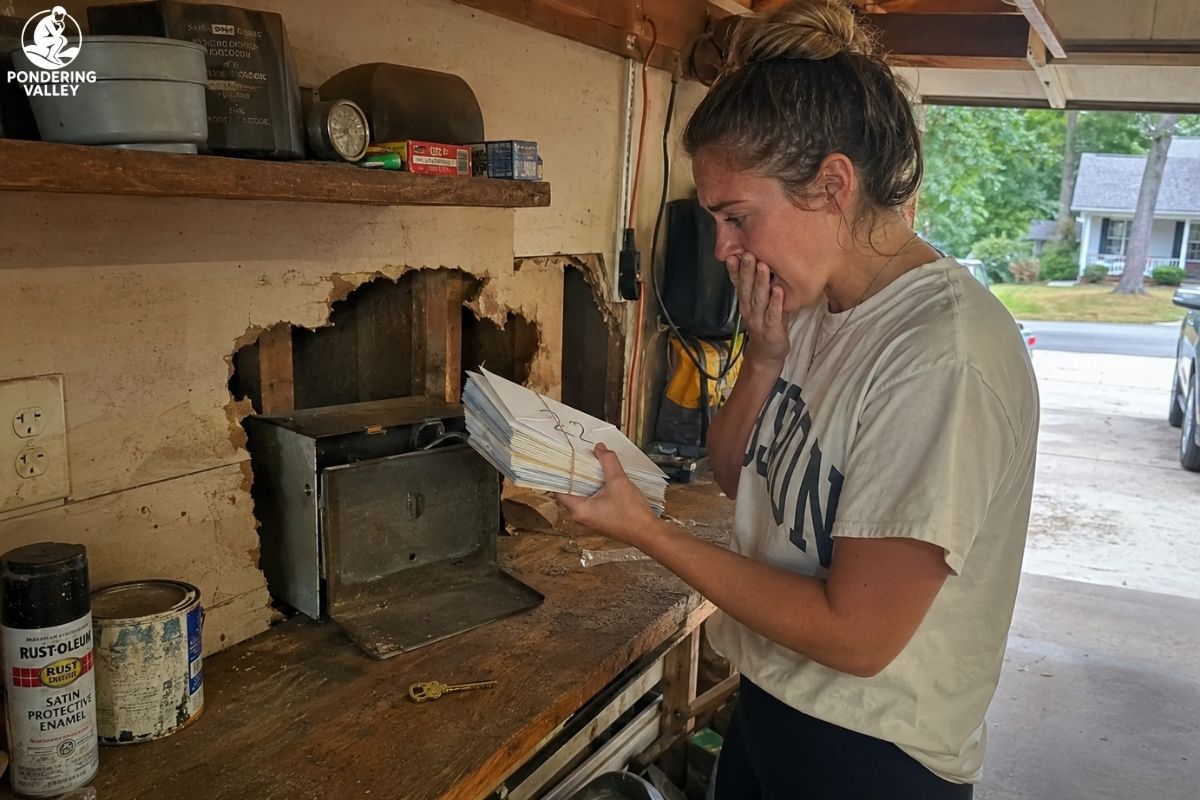
Jack knelt, pried the latches open.
The hinges moaned.
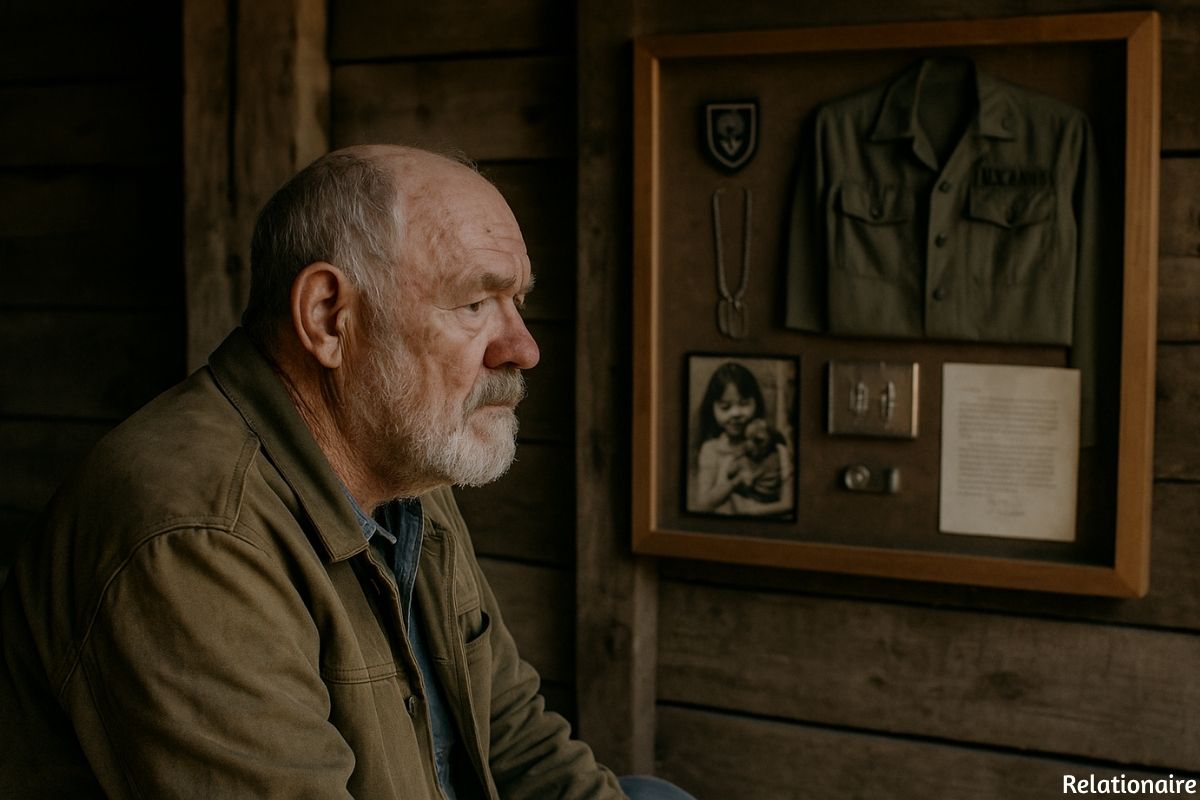
Inside: a folded uniform, creased and dark with time. A Zippo lighter. Bloodied dog tags. A photograph.
He stared.
The photo showed a young Vietnamese girl—barefoot, dress torn—holding a puppy in her lap. The girl looked no older than ten. The puppy was wagging its tail. Both smiled.
Behind them, a boyish version of his father crouched in jungle fatigues, one hand on the puppy’s head.
And something cracked in Jack’s chest.
He carried the crate into the house.
Placed it on the kitchen table like it might wake up.
Outside, the wind moved the cornstalks. In the distance, cows lowed—a slow, sleepy sound. Kentucky in late summer always felt like a lullaby.
He sat down and pulled the contents out, piece by piece.
The dog tags first.
They weren’t his father’s.
LANCASTER, M.T.
O POS | CATHOLIC
229-54-1029 | USMC
Not Nichols. Not even Army.
He ran his fingers along the edge of the metal. Dried rust. Or blood. Or both.
The Zippo had scratches—deep ones, like it had been bitten. On the side: a crude engraving.
“Keep your damn promises.”
Jack opened it. No fuel, but the flint struck.
Next, the uniform. His father’s size. The patches were faded, but the insignia was still there: 173rd Airborne Brigade.
He laid it on the table like a shroud.
The last thing was a bundle of letters, bound in green twine. Each envelope was water-damaged, some torn open, others still sealed.
They were addressed in two hands.
One set from Michael T. Lancaster—the same name on the dog tags.
The others, returned letters, were addressed to C.R. Nichols, Horse Cave, KY.
The front door creaked.
Jack’s son, Ethan, came in. Sixteen. Ballcap backwards. Boots dirty.
“Grandma says dinner’s in ten,” he said, then frowned. “What’s that?”
Jack covered the photo with his hand. “Just some of Grandpa’s old junk.”
Ethan stepped forward, gaze caught on the dog tags.
“Those his?”
“No.” Jack paused. “Someone else’s.”
“Cool.”
Jack said nothing.
After Ethan left, Jack picked up the photo again. On the back, in faint pencil, just three words:
“Her name’s Mai.”
That night, Jack couldn’t sleep.
He went back to the barn, flashlight in hand. Something about the Zippo’s engraving clawed at him.
Keep your damn promises.
The words weren’t his father’s style. Charles Nichols hadn’t kept promises. He hadn’t broken them either. He just didn’t make them.
But someone had trusted him once.
The next morning, Jack called the local VFW.
“Anyone ever heard of a Mike Lancaster? Vietnam-era? Marine?”
The man on the line—Dave Monroe—paused.
“Michael T. Lancaster?” he said slowly. “Yeah. Name rings a bell. Got killed in ‘Nam. Hero stuff. One of those stories that never made the papers. Why?”
“I’ve got his dog tags,” Jack said.
A long silence.
“I’ll be damned,” Dave said. “You should come by. I’ll dig up what I can.”
Jack looked at the open crate on the table.
And something deep in him stirred. Guilt, maybe. Or curiosity.
Or maybe just the sound of a box whispering, don’t burn me yet.
Part 2: The Girl in the Photo
The VFW sat on the edge of Horse Cave, Kentucky, just past the BP station and across from a shuttered diner that still smelled like fryer grease when the wind hit right.
Jack pulled into the gravel lot and cut the engine. The morning sun painted long shadows across the cracked sidewalk. He stepped out of the truck with the photo in his shirt pocket and the dog tags clenched in his fist.
Inside, the hall was dim. A jukebox hummed quietly in the corner, though nobody had fed it in years. The walls were yellowed with cigarette smoke, lined with photos of men who looked too young to have died and too old to have fought.
“Jack Nichols?”
He turned.
A broad-shouldered man with a white buzz cut and an artificial-looking tan stood by the bar, holding two Styrofoam coffees. “Dave Monroe.”
They shook hands—firm, dry palms.
“You said your dad was Charles Nichols?” Dave asked, motioning Jack toward a back table.
Jack nodded. “Charlie.”
“He served with the 173rd Airborne, right?”
“Yeah.”
Dave slid one coffee across the table. “I remember the name. Quiet guy. Didn’t drink with us much, but when he did, he got this haunted look.” He sipped. “Lot of ‘em did.”
Jack reached into his pocket, pulled out the tags, and placed them on the table. “These aren’t his. Found them in a locked crate under the barn hay. Along with this.”
He slid over the photo.
Dave leaned in. His face changed—not shock, but something like recognition filtered through decades of dust.
“I’ll be damned. That’s Mike.”
“Mike Lancaster?”
“Yeah.” Dave traced the edge of the photo with his knuckle. “God. Haven’t seen his face since ‘69.”
“Who was the girl?”
Dave blinked. “Mai.”
“So you knew her?”
“No,” he said slowly. “But everyone in Firebase Contour knew of her. Little village girl. Used to sneak over with mangos for the grunts. Smart as a whip. She had a way of making these hardass men act like babysitters.”
Jack nodded toward the photo. “And the dog?”
“Puppy followed her everywhere. Named it Bobo. Little mutt. Looked like it’d been stitched together from spare parts. Mai fed it her rations, sometimes didn’t eat just to keep it alive.”
Jack’s jaw tensed. “Why was my dad in the photo?”
Dave looked up.
“Your dad and Mike were tight. Like, foxhole tight. They saved each other more times than anyone counted. But something happened out there.”
“What?”
Dave stared at the photo again. “Mike didn’t come home. Charlie did. That always meant something.”
Jack drove home with the dog tags on the dash, glinting like a second sun.
In the rearview, the fields rolled by—green, endless. But his mind was stuck in a jungle he’d never seen.
The girl. The dog. His father crouched behind them with a grin Jack had never seen in real life. That man in the photo looked alive. His real father—the one who raised him—rarely smiled without bitterness riding shotgun.
Jack parked beside the barn again.
Instead of going in, he lit the Zippo. The flint snapped. He held the flame close to the engraving:
“Keep your damn promises.”
That night, after Ethan went to bed, Jack cracked open one of the unopened letters. The paper was thin, spotted from moisture. But the handwriting—tight, blocky—held firm.
Charlie,
If you’re reading this, I guess I’m dead.
Don’t feed me no ‘you couldn’t help it’ crap. If the deal goes sideways, just make sure Mai and Bobo get out. That’s it. That’s the whole damn favor.
I know what we’re doing ain’t regulation, but neither’s this war. If you screw this up… don’t come looking for redemption. Just keep your promise.– Mike
Jack read it twice. Then a third time.
Something went wrong.
He looked at the photograph again. Focused now not on the girl’s smile—but the man behind her.
Charlie Nichols had been 23 in that photo. Young. Full of whatever it is the war burns out of a man. But if he promised Mike Lancaster he’d save that girl, Jack had no idea whether he ever did.
And it mattered now. Because guilt like that doesn’t rot in a box—it lives on in the way a man raises his son. In the silence. The cold dinners. The barked orders instead of advice.
Jack thought of all the times his father stared out past the fields like he wasn’t really seeing them. Like he was still in that jungle, looking for something he’d left behind.
He Googled Mai. Searched every variation he could think of: “Vietnam girl Bobo 173rd,” “Firebase Contour 1969 Mai dog,” “refugee camp 1970 South Vietnam.”
Nothing.
He tried Mike Lancaster. A few old death records. A single newspaper clipping from 1970: “Kentucky Marine Killed in Quang Tri Ambush.” No family listed. Just a line: Survived by fellow soldier Charles R. Nichols.
Jack stared at it until his eyes blurred.
So his father had been recognized. Just not officially. Just not by the government. But by a dead man’s family. By a letter never sent. By a photograph sealed in a box he was never supposed to open.
But sons don’t always listen.
The next morning, Jack told Ethan they were going on a road trip.
“To where?” Ethan asked, pulling on his hoodie.
“Quang Tri,” Jack said, dry.
Ethan blinked.
Jack smiled. “I’m kidding. Sort of. We’re heading to D.C. I want to look through some military archives.”
“Why?”
Jack tapped the photo. “Because someone asked my dad to save a girl and her dog. And either he did, or he didn’t. But I need to know which.”
Ethan looked confused, but curious.
“Can I bring snacks?” he asked.
Jack tousled his hair. “Load the truck.”
As they pulled away from the barn, Jack looked once more in the rearview mirror.
The barn stood still.
But in his mind, the box wasn’t buried anymore.
It was wide open—and it was calling him forward.
Part 3: A Favor Not Forgotten
Washington, D.C. smelled like concrete and rain.
Jack never liked cities much, but something about this one always made him feel small and out of place—like walking through someone else’s memory.
He parked his truck two blocks from the National Archives and handed Ethan a folded map, even though the kid hadn’t looked up from his phone since Richmond.
“You sure this place has what we need?” Ethan asked, trailing behind him.
“Not sure,” Jack muttered. “But if it doesn’t, nothing will.”
The building was quiet that morning, half-emptied of tourists by the drizzle. They passed beneath columns older than the war itself, past security checks and a guard who nodded politely at the dog tags on Jack’s neck—Mike’s tags. Jack had started wearing them two days ago. Not for show. For weight.
They met a woman in the records office named Tessa Dowling—mid-60s, clipped voice, glasses on a chain. She looked like someone who alphabetized her spices.
“You’re looking for evacuee records?” she asked, tapping keys on a yellowing Dell keyboard. “From where?”
“Vietnam. Quang Tri Province. 1970. Civilian evacuation, unofficial, maybe… unsanctioned,” Jack said.
Tessa raised an eyebrow.
“We’ll start with what’s declassified.”
Ethan leaned toward Jack and whispered, “How do you unsanctionedly evacuate someone?”
Jack didn’t answer. Because he wasn’t sure.
Hours passed. Paper burned Jack’s fingertips—photocopies, typewritten reports, redacted memos with thick black bars like censorship scars.
Operation names flicked past: Firefly Harvest. Broken Kettle. Jade Lotus. Some sounded like poems. Others like threats.
Then one jumped out.
Operation Paper Lantern – March 1970
Objective: Relocation of high-risk civilian assets from Firebase Contour region.
Status: Mission compromised. Partial success. Assets unconfirmed.
There was a list attached—names typed neatly in two columns.
He ran his finger down the left side.
Then stopped.
MAI, Female, est. age 10 – Unconfirmed
Notes: “Escorted by Lt. Nichols, Army, under informal order. No further records.”
Jack stared.
“Jesus,” he whispered. “He tried.”
Tessa leaned over. “That’s not typical language for these files. Informal orders mean someone acted off the book.”
“Would that mean he broke protocol?”
“Maybe. Or maybe he just didn’t wait for permission.”
Ethan leaned in. “So Grandpa tried to save her?”
Jack nodded. “Looks like he did.”
“But it didn’t work?”
He stared at the word: Unconfirmed.
“I don’t know.”
That night in the motel, Jack sat on the edge of the bed, staring at the dog tags in his palm. He could still smell his dad’s aftershave if he closed his eyes—Old Spice and motor oil.
He’d grown up believing his father was cold. Hard. Unreachable.
But maybe he was just wounded.
Maybe guilt hardened into silence over time, the way wet earth dries into clay.
Ethan turned on the lamp between their beds. “You okay?”
Jack looked at his son—his face still soft with youth, but already sharper at the edges. He thought about the chain of fathers and sons. About the things passed down that no one talks about.
“Yeah,” Jack said finally. “Just thinking.”
Ethan tilted his head. “So what now?”
Jack picked up the photo again. “Now we find out what happened to her. Mai.”
The next morning, they met a Vietnamese-American historian named Lien Vu at the Library of Congress. Tessa had connected them.
Lien wore a red scarf and spoke softly, as though every word carried weight.
When Jack showed her the photo, her lips parted.
“I’ve seen this before,” she said.
Jack’s heart thumped. “You’ve seen them?”
“No,” she said gently. “But photos like it. There were many children like Mai. Some got out. Some didn’t. Many disappeared in the fall.”
“But this was before the fall,” Jack said. “Before ‘75.”
Lien nodded. “Even then, the danger was real. The NVA targeted villages that cooperated with Americans. Girls like Mai were often marked.”
“Marked how?”
“By surviving.”
Jack swallowed.
“Some families made it to Guam,” Lien continued. “Others went to refugee centers in California. There’s a place called Camp Pendleton. I can give you names to contact.”
“Do you think she could’ve made it?”
Lien held his gaze. “If your father kept his promise, yes.”
They drove straight to Camp Pendleton’s historical archive two days later. On the last page of a faded intake manifest, typed in all caps:
MAI NGUYEN
DOB: UNKNOWN
ESCORTED BY U.S. ARMY PERSONNEL, NAME UNRECORDED
Jack sat back in his chair, heart pounding.
“Is that her?” Ethan asked.
“Has to be.”
They kept reading.
In the right column: Placed with sponsor family: Bakersfield, CA – Nguyen, Trinh & Phuong.
Jack scribbled the name. His hands shook.
He stood, exhaled, and whispered, “He did it. My dad actually did it.”
That night, Jack called a number he found online.
An older woman answered, her voice careful and lightly accented.
“Mrs. Nguyen?” he asked. “My name is Jack Nichols. I believe… I believe my father helped evacuate a girl named Mai during the war. I’m trying to find out if she’s okay.”
Silence.
Then:
“This is Mai.”
Jack nearly dropped the phone.
“You’re—” He stopped. His throat tightened.
She spoke gently. “You are Charles Nichols’s son?”
“Yes.”
Another pause.
“Then I have something to tell you,” she said. “Because your father saved my life. And Bobo’s too.”
Jack closed his eyes. Let the weight lift, just a little.
Part 4: Her Name Was Mai
The air in Bakersfield was dry as paper.
Dust rolled off the hills like memory, silent and constant.
Jack stood at the edge of a modest one-story house on Persimmon Avenue, clutching the photograph that had started all of this. Ethan stood beside him, quiet, hands shoved into his hoodie pockets.
“Ready?” Jack asked.
Ethan shrugged. “Are you?”
Jack wasn’t. But he rang the bell anyway.
She opened the door slowly.
Mai Nguyen was small—barely up to Jack’s shoulder. Her hair was streaked with silver and pulled into a neat twist. Her face bore deep laugh lines, but her eyes… her eyes hadn’t changed. Not from the photo. Not from the jungle. Wide, alert. Soft in a way the war hadn’t stolen.
For a moment, they just looked at each other.
Then she said, “You have your father’s eyes.”
Jack swallowed something thick in his throat. “You remember him?”
“I could never forget.”
She stepped aside, motioning them in. Her home smelled like jasmine tea and books. The living room was cluttered in a lived-in way—knitted throws, faded photos, framed embroidery on the walls.
Ethan plopped onto a couch, already eyeing the ginger candies in a crystal bowl.
Mai sat across from Jack and took the photo gently from his hands. She didn’t cry. Just stared.
“I was ten,” she said. “I don’t remember everything. But I remember that day.”
Jack leaned forward. “What happened?”
She turned the photo over in her hands. “We’d heard the NVA was getting close. My mother had already been killed. My uncle—he worked with Americans—had disappeared. I was alone.”
She touched the edge of the picture, tracing the little dog’s tail.
“Your father came with another man. Mike. They had one vehicle and a list of names. I wasn’t on it. But Mike…” She paused. “Mike said he’d vouch for me.”
Jack’s stomach tightened. “Mike Lancaster?”
She nodded. “They argued. Your father didn’t want to leave anyone behind. But they didn’t have room.”
“What happened?”
“There was an explosion. Mortar, maybe. Mike… he pushed me behind a tree. Bobo ran. I don’t know what got him first—the shrapnel or the bullets. He was gone before your father could get to him.”
She finally looked up. “But your father came back. Through gunfire. Carried me out.”
Jack didn’t speak. Couldn’t.
Mai touched his wrist gently.
“He made me promise I would live a full life. That I’d never forget Mike. Or him. But I never saw him again after Camp Pendleton.”
Jack opened his mouth. Closed it. Then asked, “Do you want to know why?”
Mai tilted her head.
Jack reached into his coat and pulled out the last sealed letter from the box.
“I haven’t read it,” he said. “I thought maybe… maybe you should.”
She looked at it for a long time, then slowly peeled the flap open. Her hands were steady.
The letter was dated June 1972.
Mai,
I hope this finds you someday. I don’t even know where they sent you. After Camp Pendleton, I lost the trail. I asked around. No one had answers.
I don’t know what you remember. Probably too much. Probably things a kid shouldn’t see. Mike died trying to protect you. I lived. That truth doesn’t sit easy. I’ve carried it like a stone.
You should’ve been on the manifest. I should’ve made it official. But red tape doesn’t give a damn about promises. So I made one anyway. And I kept it.
If you’re reading this… then maybe there’s something left in this world that I didn’t break.
Be happy, kid.
– Charlie Nichols
Mai closed the letter and pressed it to her chest.
“Your father was brave,” she whispered. “But he was also kind. Kindness is harder.”
Ethan walked Bobo’s namesake around the backyard—Mai had adopted a wiry little mutt a few years back and named it after the original. “He’s dumb,” she admitted with a smile, “but sweet. Like the first one.”
Inside, Jack sipped tea he didn’t taste. He kept staring at the photo on the mantle—Mai, in her 20s, holding a baby. A man stood beside her, Vietnamese, wearing a college sweatshirt.
“Your family?” Jack asked.
She nodded. “My husband died three years ago. Cancer. My son works in San Jose. Two grandkids. One plays trumpet.”
Jack smiled, then grew quiet. “I wish he knew.”
“Your father?”
He nodded. “I think… he never believed he deserved peace. Not after Mike. Not after all the things he couldn’t fix.”
Mai reached for a small wooden box on the shelf. She opened it and pulled out something wrapped in silk.
The original dog tags.
Mike’s.
“I think they belong with you,” she said, pressing them into Jack’s hand.
“I already have a pair,” he said softly, pulling the second set from his pocket.
She blinked. “You do?”
Jack nodded. “Two sets. Maybe your dad gets buried with one. Maybe the friend keeps the other, to remember who he couldn’t save.”
“But he did save me,” she whispered.
Jack looked down at the tags. One set scarred and bloodied. The other pristine.
Then he looked at Mai—older now, but very much alive.
And he realized: his father did keep the promise.
He just couldn’t forgive himself for how much it cost.
Later, before they left, Mai packed them lunch for the road. Sticky rice, boiled eggs, pickled vegetables. She pressed it into Jack’s hands like a mother sending off her son.
“I want to visit Kentucky someday,” she said at the door. “See the barn. The place he came from.”
Jack smiled. “You’re welcome anytime.”
As they pulled away, Ethan rolled down the window and waved.
Jack kept his hand on the wheel, the road open ahead, the past finally in the rearview—but not buried. Never buried.
Just understood.
Part 5: The Things We Carry
The road back to Kentucky felt different.
Not shorter, not smoother—just quieter.
Ethan had fallen asleep in the passenger seat somewhere near St. Louis, arms crossed, earbuds in. Jack drove with one hand on the wheel and the other resting lightly on the letter Mai had given him. Charlie’s words. A truth Jack had chased halfway across the country.
The truck rumbled down Route 31, past empty gas stations, rusted tractors, barns collapsing inward like old men bent with memory. This was the land that raised his father. This was where he came home to—broken, silent, and never once explaining why.
But now Jack knew.
Now, he carried it too.
The barn greeted him like it always did—with the thick smell of hay, diesel, and rain-dampened wood.
He stepped inside, shut the door behind him, and stood in the center, surrounded by dust motes dancing in golden light. The crate still sat on the table where he left it. Open now. Hollowed out.
Jack sat down slowly on the stool and looked around.
Everything was the same.
And yet nothing was.
He pulled out the photo again—Mai, the dog, Mike Lancaster, and a young Charlie Nichols crouched behind them. That smile. Jack had stared at it for days now. It haunted him less than it used to.
He finally understood what lived behind it.
Love. Not for war, or country, or even duty. But for the moment. For a kid and her scrappy dog, and a promise to a dying friend that somehow made more sense than any order ever would.
Jack stood and climbed the attic ladder. The same rusted tin of screws still sat on the shelf.
He pulled it down, felt around behind the boards.
This time, he wasn’t surprised when he found another envelope.
It wasn’t sealed.
The paper was yellowing, edges curled.
To My Son, it read on the outside, in Charlie’s thick, all-caps handwriting.
Jack took it downstairs. Sat on the porch, boots on the top step. The Kentucky wind rolled through the soy fields. Crows called in the distance.
He opened the letter.
Jack,
I told you to burn the box. I figured you’d open it instead. You always were a mule when you had your mind set.
I kept that stuff buried because I didn’t know what to do with it. The war took a lot of things, but it gave me a few too. Mike was one of the good ones. He trusted me to do the right thing, and somehow I did. But that doesn’t mean I didn’t carry the weight.
You probably don’t remember, but there were nights I stood outside your door and listened to you breathe. That sound kept me sane. Reminded me the world hadn’t gone all to hell.
You grew up thinking I didn’t care. I get that. I wasn’t good at showing it. I never learned how. But I carried you the same way I carried that girl out of the jungle—with everything I had.
You’re a better man than me. Tell Ethan the truth. Don’t leave him the dust and dog tags. Leave him the story.
Burn the box if you want. But don’t bury the heart of it.
— Dad
Jack read it once. Then again. Then a third time, slower.
The last line hit hardest. Don’t bury the heart of it.
That night, he called Mai.
She answered on the second ring.
“I found another letter,” he said.
She didn’t ask what it said. Just let the silence stretch until it wrapped them both like a blanket.
“I think I hated him for so long,” Jack whispered. “For being so… closed off. For never saying anything.”
“And now?”
“I think I miss him more than I ever let myself admit.”
Mai’s voice was warm, steady. “The ones who carry the most never complain the loudest.”
The next morning, Jack and Ethan stood in the barn again.
Ethan eyed the crate. “So what are we gonna do with it?”
Jack looked down at the empty box.
“Nothing.”
He walked past it and opened a side cabinet instead. Pulled out an old Polaroid camera. Blew the dust off.
“We’re going to tell the story,” he said. “Properly. Start with your grandpa’s patch. Then the tags. The photo. Piece by piece.”
Ethan raised an eyebrow. “Like a documentary?”
“Like a memory,” Jack said. “One we don’t hide.”
Ethan smiled faintly. “Guess that’s cooler than just burying it.”
Jack reached into his shirt pocket and handed Ethan the second set of dog tags.
“These are yours now.”
Ethan hesitated, then slipped them over his neck. “Heavy.”
Jack nodded. “They’re supposed to be.”
Later, they printed out the photo of Mai and her family—now. Her son, her grandkids, Bobo the second lying on the porch. Jack pinned it to the barn wall next to the old photo.
Side by side.
Proof that some promises don’t die in the jungle.
They live. In daughters. In dogs. In the way a man finally tells his son the truth—not with words, but with what he leaves behind.
Part 6: Where Ghosts Settle
Jack never planned on turning the barn into anything.
It had always just been a barn. A place to store broken things—equipment, crates, grudges.
But after the trip to Bakersfield, and after Mai’s voice cracked on the phone when she thanked him one last time, the barn stopped being just wood and nails.
It became sacred.
Ethan stood on the ladder, hammer in hand, trying to center the new plank of cedar above the old hayloft door.
“Left. My left,” Jack called.
“I am going left!”
“You’re going your left. That’s not the same as mine.”
Ethan groaned, readjusted, and nailed it in place. Below him, Jack held up the engraved sign:
“The Nichols-Lancaster Room: Stories Worth Carrying”
It wasn’t fancy. But it was honest.
They’d cleared out the rusted tools and oiled the floor. Hung the photo of Mai beside a new one she’d mailed—her grandkids smiling under a cherry blossom tree in San Jose. Jack printed out Charlie’s letter and framed it beside Mike’s dog tags.
A shelf along the wall held the sealed crate. Untouched since Jack’s return. Inside it, the uniform still lay folded, the Zippo tucked into its pocket. Jack figured it belonged here—just not front and center.
Some ghosts, you don’t burn.
But you also don’t put them behind glass.
The Veterans Day event was Ethan’s idea.
“Let’s invite people who knew Grandpa,” he said. “Ask them to share stories. Like a pop-up memorial.”
Jack hesitated. His father hadn’t been the type to host crowds—or be remembered, really. He left that to others.
But maybe that’s exactly why it mattered.
So they printed flyers. Called the local VFW. Put up a post on a military message board. Jack even mailed Mai an invitation, not expecting her to show.
She did.
She stepped out of the taxi in a navy dress, a single white lily pinned to her chest. Jack met her in the driveway, and for a moment, he didn’t speak.
He just hugged her.
“Welcome home,” he said quietly.
She looked up at the barn. “Is it okay to be nervous?” she asked.
Jack nodded. “I still am.”
They set folding chairs in the field behind the barn, facing the open doors. It wasn’t a big turnout—maybe 25 people—but each one mattered.
A man named Sergeant Bill Hanley came with a cane and a photo of Charlie sleeping on sandbags.
“I didn’t know half the things he did,” Bill said into the mic. “But he once gave up his rations to feed a stray dog because some kid was crying. I asked why he cared. He said, ‘The world’s burning, Bill. Let’s save what we can.’”
Another man—now a grandfather—choked up while reading a letter Charlie wrote to his sister in ‘71.
A woman in her 70s said nothing. Just pressed her fingers to the dog tags on display and whispered, “Mike was my brother.”
Jack hadn’t known.
They sat together afterward, in silence. That was enough.
As dusk fell, Ethan lit the old firepit. People brought lawn chairs, blankets, bourbon.
Mai stood near the barn’s edge, holding a framed photo of her and Charlie from that day in the jungle—restored, now. Colorized.
“Do you know what I remember most?” she said to Jack. “Not the fear. Not the noise. I remember his hands.”
“His hands?”
“They never shook. Even carrying me, bleeding, he never let go.”
She turned the photo slightly so the light caught it just right.
“That’s what I want my grandchildren to know. That a man like that lived. That he kept a promise when it would’ve been easier to forget.”
Later, after everyone left and the fire burned low, Jack and Ethan sat shoulder to shoulder, watching the stars come out.
“You think Grandpa would’ve liked this?” Ethan asked.
Jack thought about it.
“No,” he said. “But he’d have stayed the whole time anyway. Would’ve sat in the back. Wouldn’t clap. But he’d listen.”
Ethan smiled. “Like you?”
Jack chuckled. “Yeah. Like me.”
They sat a little longer. The barn behind them glowed in soft light. The stories hanging inside felt warm now—not heavy.
“I think we should leave it open,” Ethan said.
“What? The barn?”
“Yeah. Let people come. Hear the story. Add their own.”
Jack nodded.
Because healing doesn’t come in grand gestures.
It comes in open doors. In dusty barns.
In telling the truth out loud.
Part 7: Dust and Light
The storm rolled in just after midnight.
It wasn’t a big one—just thunder growling low across the cornfields, rain tapping the tin roof of the barn like fingernails on a coffin lid. Jack stood in the open doorway, arms crossed, listening to it roll.
The barn was quiet now. The chairs were folded, the stories packed into memory. Ethan had gone to bed, Mai was asleep in the guest room. The dog tags still hung on the wall, catching flashes of lightning like they were waiting for something.
Jack was about to turn off the lights when he saw the headlights.
A single car, crawling down the gravel drive. Not familiar. Not local. Not expected.
Jack stepped onto the porch, tension rising in his chest like an old injury. The car stopped. The engine died. The driver’s door opened.
And a man stepped out.
Older. Black boots. Civilian coat, but military in posture. Close-shaved hair, weathered skin, a face that had seen more than it had said.
“Jack Nichols?” the man called.
Jack nodded, cautious. “That’s me.”
The man walked slowly through the rain, hand in his coat pocket. Jack didn’t flinch, but didn’t move either.
The man stopped six feet away. Rain pooled around his shoes.
“My name’s Raymond Lancaster,” he said. “Mike was my father.”
Jack’s breath caught.
“I didn’t know he had a son.”
“You weren’t supposed to.”
They sat in the kitchen, rain clattering against the windows. Jack poured two mugs of black coffee. Raymond didn’t touch his.
“I didn’t come for ceremony,” he said. “Or closure. I came for truth.”
Jack nodded slowly. “I think we’ve been chasing that too.”
Raymond pulled something from his pocket—a photograph, wrapped in wax paper.
He slid it across the table.
Jack unwrapped it.
It showed three men: Charlie Nichols, Mike Lancaster, and a third figure—blurry, taller, with a patch over one eye and a smile that didn’t reach it.
Jack frowned. “This wasn’t in the box.”
Raymond tapped the photo. “That man? That’s Captain Jerome Ridgeway. Special Forces. Dirty as hell. They called him ‘Clean Sweep’—because no loose ends followed his orders.”
“I’ve heard the name.”
“He’s the reason my father didn’t make it out.”
Jack looked up.
“You’re saying Ridgeway—what? Betrayed him?”
“I’m saying your father and mine didn’t just try to evacuate a girl. They were part of something bigger. Ridgeway was running side ops—extracting villagers who could be ‘useful assets’ later. Intelligence. Blackmail. Leverage.”
Jack’s chest tightened. “Mai was just a kid.”
Raymond’s jaw clenched. “Exactly.”
“I didn’t learn any of this until after my mother passed,” Raymond said. “She kept a box. Photos. Letters. One of them was from your father. Said he was sorry. Said Mike didn’t die by chance.”
Jack’s hands tightened around his mug.
“I’ve spent the last ten years digging. FOIA requests. Dead-end interviews. And then I find out you’ve got the dog tags. The uniform. The Zippo. The whole story buried in your barn.”
Jack swallowed hard. “I didn’t even know about it until six weeks ago.”
Raymond stared at him, eyes sharp, measuring.
“You believe your father was a hero.”
Jack didn’t answer.
Raymond leaned forward. “Mine was. And he died because someone gave an order that went sideways. I want to know if that order came from your father—or if he disobeyed it.”
Jack stood, walked to the mantle, and pulled down the letter. Charlie’s letter to Mai. The one about promises. About guilt.
He handed it over.
Raymond read it in silence. Once. Twice. His lips barely moved.
Then he let out a breath.
“So he didn’t kill him.”
“No.”
“But he couldn’t save him either.”
“No,” Jack said softly. “But he tried.”
Raymond nodded slowly, fingers gripping the letter.
“I’ve hated him for so long,” he said. “Hated what I thought he did.”
Jack sat across from him again. “That’s how I felt about my dad too.”
Outside, the rain lightened. The storm rolled west, leaving behind the scent of wet dirt and electric silence.
Raymond stood and walked to the screen door. Looked out toward the barn.
“You mind if I see it?”
Jack grabbed his coat. “Let’s go.”
They walked in silence.
Inside the barn, Raymond paused at the threshold, like the air held something heavy. His eyes scanned the wall—the patches, the photographs, the dog tags. Then he walked over to Mike’s tags.
He reached out but didn’t touch them.
“I remember these,” he said. “He used to hang them on the rearview mirror. Said they’d bring him home.”
Jack said nothing.
Raymond looked around. “You did this for him?”
“I did it for both of them.”
Raymond turned slowly. “You think it helps?”
Jack’s voice was quiet. “It doesn’t fix the past. But it makes the present hurt less.”
Raymond nodded.
Then, from his pocket, he pulled out a small silver lighter. Scuffed. Dent in the lid. Same model as the one in the crate.
He flipped it open. Flicked the flint.
A small blue flame danced in the dark.
“His backup,” Raymond said. “Never went to the jungle with him. I’ve kept it forty years. Thought you should have it.”
Jack took it gently.
It felt warm already.
Back in the kitchen, Raymond lingered by the door.
“If you ever dig deeper,” he said, “Ridgeway’s file was partially unsealed last year. I’ve got names. Places. Witnesses. There’s still truth out there.”
Jack nodded. “You think we owe them that?”
Raymond looked toward the barn one last time.
“I think they earned it.”
Then he stepped out into the night and was gone.
Part 8: Ridgeway’s List
Two weeks passed before Jack opened the folder.
Raymond had mailed it in a plain brown envelope, no return address, just a single word written in black ink across the seal:
“Answers.”
It sat on Jack’s desk untouched for days, pinned beneath bills and grocery lists, like the weight of it was too heavy to lift. But one morning—after Ethan left for school and the coffee turned lukewarm—Jack sat down, sliced it open, and read.
Inside:
- Photocopied documents, some redacted into near-nonsense
- A single photograph of Ridgeway, leaning on a jeep, grinning with a cigar
- A one-page report marked “RELEASED UNDER FOIA – PARTIAL”
- And a list
OPERATION LANTERN CATCH – JAN 1970
Status: Black — Eyes Only
Lead Officer: Capt. Jerome Ridgeway
Purpose: Relocation and/or extraction of high-value civilian contacts for future intelligence leverage
Notes:
- Multiple unauthorized additions to evac list by Cpl. Nichols and Sgt. Lancaster
- Incident at Firebase Contour resulted in loss of Sgt. Lancaster
- Operation deemed “Partially Compromised”
- Remaining civilians processed through Camp Pendleton intake, names anonymized per Section 8C
At the bottom of the list were ten names. Some scratched out. Some faded.
One stood out:
NGUYEN, MAI – ESCORTED: UNAUTHORIZED (NICHOLS)
And beneath it:
NGUYEN, LIEN – AGE 4 – POSSIBLE RELATION – STATUS: UNKNOWN
Jack stared at the second name.
He flipped through the rest of the folder but found nothing more. No records of where Lien went. No signature. Just a line in someone’s typewriter 50 years ago.
He called Mai.
The phone crackled. She answered on the second ring.
“Mai,” Jack said, voice tight, “Do you… do you know someone named Lien Nguyen? She would’ve been about four when you left.”
A long pause.
“I haven’t heard that name in years,” she whispered. “But yes. She was my cousin’s daughter. They were killed. Or so I thought.”
Jack sat down slowly.
“She was on the evac list.”
Mai gasped. “No. She couldn’t have been. She wasn’t with me. She was taken… I thought she was gone.”
Jack rubbed his eyes. “The file says ‘status unknown.’ Which means maybe she wasn’t.”
“Where did it say she went?”
“It doesn’t.”
Silence.
“I need to find her,” Mai said. “If she’s alive, she’s family. She’s mine.”
Jack nodded, even though she couldn’t see him.
“We’ll find her.”
He started at Camp Pendleton.
This time, he called in favors. The VFW’s regional office. A journalist Raymond had once worked with. A Vietnam-era refugee advocate in San Diego who still kept boxes of unscanned rosters from 1970.
It took ten days.
Then an email came in from a woman named Carla Bui, a second-generation Vietnamese-American archivist:
Found her. “Lien Nguyen,” age listed as 5, arrived under escort marked only ‘Cpt. R.’ Sent to foster care, later adopted. No further trace in refugee records, but name changed to “Lena Ray.” Last known address: Seattle, WA. Working as a professor of Southeast Asian History at UW.
Jack read the email three times.
Then he picked up the phone.
Lena Ray answered on the third try.
Her voice was calm, intelligent. Curious, not suspicious.
“Sorry to bother you,” Jack said, “but I think you may have family in California. A woman named Mai Nguyen. Does that name mean anything to you?”
He could hear her breathing.
“I’ve never met anyone by that name. I was adopted young. I’ve never traced my records.”
Jack paused.
“Would you be open to speaking with her? I believe she knew your mother. Maybe more.”
Silence.
Then: “Okay. But I want the truth. I’ve had enough fairy tales in sealed envelopes.”
Jack smiled faintly. “You’re not the only one.”
The video call was set for a Sunday afternoon. Jack drove to Mai’s place. They sat on her couch, laptop propped on a pillow between them. The room smelled of pho and old paper.
When Lena’s face appeared on screen, Mai’s hand flew to her mouth.
She didn’t cry.
She just whispered, “My God… she has my cousin’s eyes.”
Lena spoke first. “You’re Mai?”
“Yes.”
“I’m told you saved lives.”
Mai shook her head. “No. Your father did. I only survived.”
Lena hesitated. “Do you… know who my mother was?”
“I don’t know her name,” Mai said gently. “But I held you once. The day the soldiers came.”
She reached off screen and returned with a single photo—grainy, black and white. A woman holding a baby. “This was you,” she said. “Before the jungle took everything.”
Lena stared at the photo. Her hand rose to her lips.
“I always thought I was alone,” she said.
“You never were.”
That night, Jack stood alone in the barn again.
The storm had passed. The air smelled of cedar and ash.
He lit the second Zippo—the one Raymond gave him—and held it to the old barn wall, where Ridgeway’s photo now hung beside the others. He stared into Ridgeway’s smirk.
“You lost,” Jack whispered.
He didn’t need revenge. Didn’t need justice. Just this: for the lies to fade, and the truths to live on in people like Mai, like Lena, like Ethan.
In barns that held dust and light.
Part 9: The Last Promise
The plane touched down in Seattle beneath a gray morning sky.
Mai gripped her carry-on like it held her whole past inside. In a way, it did—a photo of Lien’s mother, Charlie’s last letter, and a faded scarf she hadn’t worn since Camp Pendleton. It still smelled faintly of wood smoke.
Jack waited by the baggage claim with a rented coat and two hot coffees. He wasn’t much for flying, but Mai had asked him to come—just in case she couldn’t walk through it alone.
He didn’t hesitate.
They drove in silence along the Puget Sound, rain misting against the windshield. Trees here were different—taller, darker, not like the soft hills of Kentucky. But something about the water calmed them both.
“She said she remembers dreams of a jungle,” Mai said, watching the road. “Smells she can’t name. A girl holding her hand.”
Jack nodded. “Memories that live in the skin.”
Lena Ray opened the door herself.
She was barefoot, wearing a navy sweater, and she smiled like she wasn’t sure if she was supposed to. Mai stood frozen on the porch, blinking back something deep and overwhelming.
Then Lena stepped forward and wrapped her in an embrace.
No words. Just warmth. Just time catching up.
Jack turned away and gave them space.
Inside, Lena’s apartment was lined with books—histories of Vietnam, Southeast Asian diaspora studies, ethics in wartime decision-making. Jack picked one off the shelf.
“Naming the Lost: Oral Histories of Forgotten Evacuations.”
He turned to the dedication page:
For the ones who carried others through fire. And for those who carried guilt even longer.
Lena made tea. Mai sat at the kitchen table, hands folded in her lap like a schoolgirl waiting for a lesson she already knew.
“I wanted to know where I came from,” Lena said, setting down the cups. “Now I’m not sure what to do with it.”
“You don’t have to do anything,” Mai said softly. “You’re already here.”
Lena nodded, eyes wet. “I thought you died.”
“And I thought you did,” Mai whispered.
They both laughed—a tired, grateful sound.
Later, they visited the university where Lena taught. In a glass case outside her office, Jack noticed a small display of wartime artifacts: a torn patch, a yellowed evacuation manifest, a single metal Zippo engraved with the words “What We Leave Behind.”
Jack recognized the handwriting.
“Ridgeway,” he murmured.
Lena nodded. “I found it in a flea market bin five years ago. Didn’t know the name then. Just felt something when I picked it up. Turns out my intuition was right.”
She paused, then added, “His file’s sealed again. Someone high up doesn’t want that part of the war unboxed.”
Jack said, “Some truths need to be heavy.”
Lena smiled. “But not hidden.”
That night, back at Lena’s apartment, Mai pulled a small package from her bag and handed it to Lena.
Inside: a silk-bound journal. A thin bracelet woven from jungle thread and a scrap of old uniform.
“I carried this since I was ten,” she said. “Now it’s yours.”
Lena opened the journal. The first page was blank.
But the second read:
We were never supposed to survive. So we did.
Back in Kentucky a week later, Jack sat in the barn with a yellow legal pad on his lap.
The floor smelled of dust and cedar. The crate sat beside him, open, not looming. Just present.
He began to write.
Not a memoir. Not a novel.
A collection of letters.
Dear Ethan,
Dear Mai,
Dear Mike.
Dear Dad.
He wrote long into the night. Paragraphs came in bursts. Memories he never lived but somehow felt inside his bones.
He wrote not just what happened—but why it mattered.
And what he hoped would outlive him.
In early spring, he got a call.
“Dad,” Ethan said, “my history teacher wants to know if you’ll come talk to our class.”
Jack almost said no.
Then he remembered Charlie’s letter: “Don’t leave him the dust and dog tags. Leave him the story.”
He said yes.
The classroom smelled like pencil shavings and warm plastic chairs. Kids stared at him like he was made of war stories and rural mystery. Jack wore Mike’s dog tags under his shirt, but he didn’t take them out.
Instead, he held up a single photo.
A young Vietnamese girl. A mutt in her arms. A soldier crouched behind them.
“This,” he said, “is not a war story. It’s a story about what we do when the rules break down. About choosing to carry someone, even when no one told you to.”
He saw their faces shift.
Then he told them everything.
Part 10: The Barn Will Stand
The spring rain came hard that year.
It ran in silver sheets off the barn roof, pattering the fields with the same rhythm Jack remembered from his childhood—tap tap, hush hush, like the land itself was whispering.
Inside the barn, it was warm. Still.
The old space had changed since last fall—benches lined the back wall, a new wood stove added warmth, and a handmade display case held the dog tags, the Zippos, the photo of Mai and the dog, and Charlie’s final letter beneath softly lit glass.
On the barn wall, written in Ethan’s careful print, was the new sign:
“This is where stories are carried, not buried.”
They opened the doors every first Sunday of the month now.
People came from all over—Vietnam veterans. Grandchildren. Historians. Strangers with folded letters and fractured memories. Some came to listen. Some came to speak. Some just stood quietly and looked at the photos with their hands in their pockets and tears in their eyes.
It wasn’t a museum. It wasn’t a monument.
It was a place.
That made all the difference.
One afternoon, Jack found a boy—maybe twelve—sitting on the barn floor, staring up at the framed picture of Mike Lancaster.
Jack sat beside him.
“Did you know him?” the boy asked.
Jack nodded. “No. But I know what he did.”
The boy tilted his head. “Is it true he died saving a girl and a dog?”
Jack looked at the picture. “Yes.”
“Did your dad save her too?”
“He did.”
The boy was quiet for a long time. Then he said, “I think that’s the kind of story I want to tell one day.”
Jack smiled. “Then you’re already doing better than most.”
At home, Jack sat at his desk in the evenings, finishing what he now called The Last Promise.
It wasn’t a war book. Not really.
It was a story about guilt and grace. About a sealed box and a barn full of dust. About the long, heavy work of understanding a father after he’s gone.
And it was about carrying people—not just through gunfire, but through time.
He wrote the last line late on a Sunday night.
You told me to burn the box.
But Dad… there were too many stories inside to let them turn to ash.
So I opened it. I carried them.
And I finally understand why you couldn’t.—Jack
He didn’t cry.
But he exhaled like he’d been holding something in for decades.
A month later, Mai and Lena visited the barn together.
They brought tea, candied ginger, and a stack of blank journals.
“We thought people could write their own stories,” Mai said.
Jack handed them a pen and gestured to the shelf. “Make it part of the room.”
They wrote the first entry together.
Lena read it aloud:
If you’re reading this, it means you’re still looking for something: a name, a face, a reason, a truth.
Good. Keep looking. But don’t forget to carry someone else’s story too.
That’s what saves us.
—Mai & Lena
Jack visited his father’s grave that night.
He didn’t bring flowers.
Just a folded copy of the manuscript and a pair of Zippos—one old, dented, still engraved; the other new, polished, blank.
He set them both on the headstone.
“You never told me why,” he said softly. “But you showed me how.”
The wind picked up. The grass swayed. He could almost hear the rattle of a Jeep somewhere behind him. Mike’s laugh. A dog barking in the jungle. A promise made and somehow—against all odds—kept.
Back at the barn, Ethan turned off the lights, locking the doors behind him.
He paused by the old crate.
It was empty now.
But he still ran his hand along the top, as if checking on a heartbeat.
Sometimes legacy is loud.
Other times, it’s a quiet room where someone finally feels brave enough to speak.
The barn would stand.
The stories would stay.
The boy who opened the box would never be the same.
And neither would the world.
The End