She hadn’t touched the attic since Harold died.
But when the roof leaked, she went up—and found it.
A dusty tape recorder. A name she hadn’t heard in decades.
It wasn’t Harold’s voice on the reel.
It was Tom’s—and he was speaking to her.
Part 1: The Widow and the Tape Recorder
Sharon Kline | Inverness, Florida | 81 years old
The storm came on a Tuesday.
Rain lashed sideways against the screened porch, the kind of warm Florida downpour that soaked you to the skin before you could curse it. Sharon Kline sat in her fraying armchair and watched the puddle creep across the kitchen tiles, leaking down from somewhere above. Probably the damn roof again. She sighed, lifted her swollen ankles onto a stool, and pressed her fingers against her temples.
The house had been quiet too long. Fourteen years since Harold passed. Forty since Vietnam ended. And now, the roof was leaking, and her dog—no, Harold’s dog—was long gone too. Just a house of memories and mildew.
She waited for the rain to pass. Then she climbed the attic ladder for the first time in decades.
The heat hit her first—wet, thick, like a wool coat on bare skin. She coughed and pulled a dish towel over her mouth. The attic smelled of old paper, rat droppings, and something sour beneath it all. She reached for the bulb, pulled the string, and winced as a single dim light buzzed to life.
Boxes. So many boxes. Labeled in Harold’s handwriting:
KLINE, H. – VIETNAM
KLINE, H. – 1969–72
TOM R.
That name stopped her cold.
Tom Riley. Harold’s best friend. Platoon brother. MIA.
No, wait—he hadn’t gone missing. That was someone else. Tom came back. Sort of. But Harold never talked about him after ’73. One postcard. Then silence. She hadn’t thought of him in years.
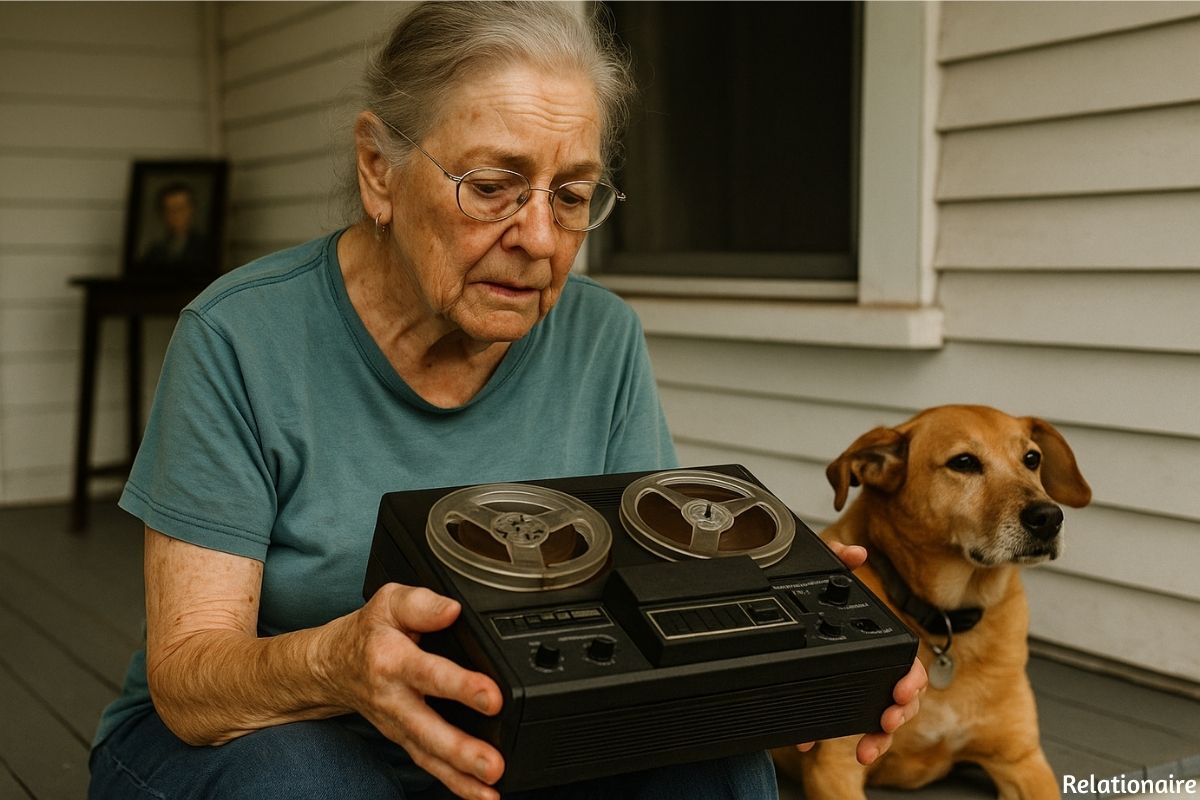
The box labeled “TOM R.” sat half open, a coil of old tape poking out like dried spaghetti. On top: a reel-to-reel recorder, dusty but intact.
She brought it downstairs like a relic.
Back in the kitchen, the smell of mildew was stronger. She wiped off the old TEAC deck, fumbled with the knobs, and clicked it on. It hummed, shockingly alive. The spool turned slowly, lazily, like it was waking from a coma.
Then—
Static. Crackling. Then a voice.
“Sharon… if you’re hearing this, I guess Harold never told you. He promised me he would. But I reckon that’s why I made this tape… back in Saigon. Because I knew he might not.”
Her hand flew to her mouth.
It wasn’t Harold.
It was Tom.
Alive, younger, shaken. His voice thick with smoke and pain. Not the pain of wounds. The kind that comes from something worse.
She stared at the machine. The reel spun, slow and relentless.
Tom kept talking.
“This is about what happened near Pleiku. That morning, February ’71. I never should’ve let it go… but Harold made me swear.”
Sharon’s heart thundered in her chest. Her hands began to shake.
Pleiku. That was the battle Harold used to wake up screaming about. The one he said “changed everything.” The one that took Danny Sharpe and Eli McConnell and half the damn squad.
Harold never told her anything about what happened. Just the names of the dead. And that one time in ’83 when he got drunk and whispered, “I should’ve gone instead of him.”
Instead of who?
She hit stop. Her finger hovered above the play button again, trembling.
Outside, the rain had stopped. The air felt charged, like something old and angry had stirred.
That night, she couldn’t sleep. The tape machine sat on the kitchen table like a ghost waiting to speak again.
At 3:15 a.m., she called the only person under 40 she knew:
Dani Parker, her 29-year-old neighbor with loud tattoos and a rescue mutt named Scooter.
The girl answered on the third ring, groggy.
“Miss Sharon? Is everything okay?”
“I need you to come over tomorrow,” Sharon said. “Bring the dog. And some fresh batteries.”
“For the dog?”
“No. For the truth.”
Part 2: The Letter Under the Floorboards
Scooter was the first to arrive.
The dog barreled through the screen door like a cannonball—tongue out, tail wagging, nails skittering across the tile. Sharon hated dogs in the house. But today? She let him stay. Somehow, the mutt made the air less heavy.
Dani followed behind, clutching two iced coffees and a handful of AA batteries. Her tie-dye shirt was inside-out, and her hair was shoved under a baseball cap that read “HELL IS HOT.”
“You okay?” Dani asked, handing her a coffee. “You sounded… I dunno, haunted.”
“I am haunted,” Sharon said, sitting down at the table. The recorder was still there, silent but ready.
Dani gave it a skeptical look. “What is that, like, a hipster record player?”
“It’s a reel-to-reel. From before your time.” Sharon slid the tape back into place. “The voice on it isn’t my husband’s. It’s his best friend’s. Tom Riley.”
“The guy in the photo by your piano? The one with the beard?”
“That’s Harold. Tom’s the one missing half an ear.”
Dani blinked. “Cool.”
“Not at the time.”
Sharon turned the knob. The reel spun. The voice began again.
“…February 12th, 1971. Near Pleiku. We weren’t supposed to be there. Not officially. Black ops, no radio. It was me, Harold, and McConnell—who didn’t make it back. But that ain’t the worst of it.”
Scooter growled low, tail stiff.
“We found something. Or someone. He wanted to help. Said he was just a boy trying to get home. But Harold made the call…”
Sharon’s fingers pressed into the wood of the chair. Tom’s voice was steady, but beneath it was something rotten—like mold under paint.
“…I still see his face. The kid’s. I still hear what he said. And I keep thinking, if Harold hadn’t—”
Click.
She couldn’t listen anymore.
“I think there’s more,” Sharon whispered.
Dani frowned. “More tapes?”
“No. More to this house.”
The crawlspace under the bedroom had always been off-limits. Harold said the floorboards were bad. Dangerous. That if she stepped too far left, she’d fall through to hell.
So she never did.
But now she wanted to.
They moved the bed. Peeled back the rug. And sure enough—one loose plank, warped with age, gave way with a groan.
Below it: a canvas pouch. Wrapped in oilcloth. Tied with twine.
Inside were three things:
- A rusted dog tag that wasn’t Harold’s.
- A photograph of four young men in jungle fatigues.
- And a letter. Yellowed, watermarked, and addressed in neat, block script:
MRS. SHARON KLINE
DO NOT OPEN UNLESS I’M GONE
Sharon sat on the edge of the bed, the letter trembling in her hands.
Dani sat beside her but didn’t speak.
Scooter whined and nosed her leg.
She unfolded the paper. Her husband’s handwriting. Not the lazy loops of birthday cards or grocery lists. But the rigid block of a man trying to say what he never could aloud.
Sharon,
If you’re reading this, I’m dead. Not just dead like gone, but dead like truth catching up with a coward.
There’s something I never told you. About Tom. About that day near Pleiku. About a boy named Lanh.
She stopped reading.
“I think I need to finish this alone,” Sharon said.
Dani nodded. “I’ll take Scooter out back.”
The air in the bedroom felt still—like even the dust was holding its breath.
She read.
Harold’s words unraveled like barbed wire. Descriptions of a Vietnamese boy who tried to warn them about a trap. Tom believed him. Harold didn’t. They tied the boy up and left him behind. He died when the ambush hit.
Tom wanted to tell the brass. I begged him not to. We were weeks from coming home. And I—I’d just proposed to you in that sweaty letter. I couldn’t lose everything. I made him promise.
But promises don’t bury guilt. They just slow the rot.
Sharon folded the letter and held it to her chest.
Her heart felt raw.
Her husband had carried that weight for forty years. And Tom? He’d made a tape instead of a phone call. Because neither of them had the guts to face her.
Until now.
That night, she sat on the porch with Scooter in her lap.
Dani came back over, no questions.
“You know,” Sharon said, “I thought I knew who I married.”
“You probably did,” Dani said gently. “He just didn’t know who he was yet.”
Sharon didn’t answer.
Instead, she reached for a fresh notepad and wrote four words at the top:
To Whom It May Concern.
Because the story wasn’t done.
Not yet.
Part 3: Tom’s Last Address
Inverness, Florida — Sharon Kline, 81
The problem with a name is it only gets you so far.
The problem with a ghost is it often lives longer than a man.
Tom Riley.
Harold’s best friend. The voice on the tape.
The one who knew. The one who promised silence.
Sharon Kline sat at her kitchen table at 6:45 a.m. with Scooter asleep under her feet and a cup of burnt diner coffee in her hand. She stared at the name, written on the back of the old army photograph.
RILEY, THOMAS J.
RICHMOND, VA — faded ink, half-gone.
“Do people still have phone books?” she muttered.
“No,” Dani called from the doorway. “But we do have the internet.”
An hour later, they were sitting side by side at Sharon’s dusty Dell desktop, both squinting at the glow like raccoons in a headlight. Dani tapped away at whitepages.com while Sharon dictated old fragments of memory.
“Middle name was James… or Joseph. He played banjo. Had a bad knee. And a thing for RC Cola.”
“Yeah, none of that’s helpful for search filters,” Dani said, chewing her lip. “Wait. Here—Thomas J. Riley. Age 82. Last known in Henrico County, just outside Richmond.”
Sharon stared. “Is he…?”
“Alive? Doesn’t say. But it’s a start.”
The address was a trailer park called Pine Hollow Estates. The kind of name meant to sound dignified. Probably wasn’t.
Sharon picked up her landline and began to dial.
“No number listed,” Dani said quickly. “But you could write him.”
Sharon looked down at the notepad she’d started the night before. The one that began with:
To Whom It May Concern
She scratched it out.
Instead, she wrote:
Dear Tom,
I found the tape. I know what happened to the boy.
I know what Harold carried. And I need to know what you carried.
The letter was short. Two pages. No blame. No forgiveness, either. Just questions. And a return address in small, trembling cursive.
They mailed it that afternoon. Sharon insisted on walking it herself to the post office—Scooter leading the way, ears perked, as if he too understood that something old and heavy had shifted.
Dani stayed back, watching from the porch, arms folded.
When Sharon returned, she said, “You think I’ll get an answer?”
“I think you already did,” Dani replied. “But maybe this one will be clearer.”
The next morning, the package arrived.
Not a letter. A padded envelope. No return name, just the same address from Pine Hollow, scrawled in shaky black ink.
Inside:
- A second reel-to-reel tape
- A faded Polaroid of a Vietnamese boy standing in front of a burned-out village
- And a note: “For her. Finally.”
Sharon didn’t cry. Not then.
She poured a cup of tea, turned on the old machine, and pressed play.
“Sharon… It’s Tom. If you’re hearing this, it means I’m still too much of a coward to pick up the damn phone. Or I’m dead. Either way, I guess that means it’s time to tell you everything.”
“That boy—his name was Lanh. He was about thirteen. No shoes. Carried a picture of his mother in a plastic pouch, said he was trying to get to Da Nang. Said the road ahead was mined. I believed him. Harold didn’t.”
“I should’ve stopped him. But I let it happen. The kid died. We lived. That was the trade.”
“Harold was never the same. You knew that. But what you didn’t know was that he tried, every year, to write you this truth. He’d write, then burn it. I kept this tape because I thought… maybe one day, you’d forgive him. Forgive us.”
“If you can’t, I understand.”
“But I thought you deserved to know.”
The tape clicked to a stop.
Sharon sat still. Hands folded in her lap. Tea gone cold beside her.
Scooter rested his chin on her foot, eyes looking up as if waiting.
Finally, she whispered: “I think… I need to go somewhere.”
“Where?” Dani asked softly.
“Virginia,” she said. “Then maybe… Vietnam.”
Part 4: The Boy in the Photograph
Inverness, Florida → Richmond, Virginia | Sharon Kline, 81
The boy’s eyes wouldn’t leave her.
They were frozen in Polaroid blur—dark, wide, impossibly still. His bare feet were caked with dust, and in his small hands he clutched a photo: a woman, blurry and smiling, with one arm raised like she was waving goodbye forever.
Sharon had stared at that image for over an hour now.
She sat at her kitchen table, robe still wrapped tight, morning toast untouched. The tape recorder sat silent beside her, like an old priest who’d already confessed all he could.
The second tape—Tom’s voice—hadn’t shaken her as much as the photo had.
Because the photo made the boy real.
“His name was Lanh,” she murmured. “Thirteen. Trying to get home.”
A boy who warned them about danger.
A boy who was left tied to a tree.
A boy her husband condemned.
The worst part wasn’t the story.
The worst part was she couldn’t decide who she hated more: Harold, or herself—for never asking.
“I booked your flight,” Dani said that afternoon, setting the laptop down like a chess piece.
Sharon looked up. “You’re serious?”
“Dead serious. You leave tomorrow. Richmond. One layover in Charlotte. And yes, I picked an aisle seat. I know you hate crawling over strangers.”
Sharon blinked. “I was… I was thinking of driving.”
“You’re eighty-one.”
“I can drive.”
“Not legally.”
Scooter barked once, as if in agreement.
Pine Hollow Estates was even sadder than Sharon had imagined.
The “Estates” part was clearly wishful thinking—just a row of tired trailers slouched beneath mossy oaks. Wheelchairs and wind chimes on every porch. A quietness that felt more like waiting than resting.
The manager, a woman named Beverly who wore a rhinestone visor and smoked like it was her job, pointed to lot 8.
“Riley don’t talk much,” she warned. “Heart ain’t great. Mind’s worse. You’re family?”
“Old,” Sharon said. “Like him.”
Tom Riley didn’t answer the door.
But when Sharon knocked again, it creaked open an inch, and a voice inside rasped, “If you’re selling anything, I already got it.”
“I’m not selling,” she said. “I’m Sharon Kline.”
The silence that followed could have filled a church.
Then: “You came.”
The inside smelled of dust and cedar and sour laundry. It was dim, but clean. A military blanket was folded on the back of the couch. A photo of a young Tom and Harold stood crooked on the mantle.
He was thinner than she remembered. Stooped. Eyes clouded by time but still sharp around the edges.
“You heard the tape,” he said without question.
“I did.”
Tom motioned to the armchair. “You want coffee?”
“I want the truth,” Sharon said, settling into the chair.
He poured them both something black and lukewarm and sat across from her.
“I made that tape in 1984,” he said. “Same week I tried to hang myself.”
Sharon flinched.
“Didn’t take,” he added dryly. “Ceiling beam cracked. I took that as a sign.”
Silence. Then Sharon leaned forward, pulled the photo from her purse, and laid it on the table.
“This boy. Lanh. What happened after?”
Tom stared at the image like it could kill him.
“We left him. I told myself he was dead already. That was the only way to walk away.” His voice cracked. “I found out years later—from a guy at the VA hospital—that villagers found him. Dead. Rope still around his wrists.”
Sharon nodded slowly.
Then, “Did Harold ever try to find his family?”
“No,” Tom said. “But I did.”
Her eyes snapped up.
“I hired someone. Vietnamese expat. Took months. But he found the boy’s village. There was a woman there—Lan’s mother. Her name was Thu. I wrote her. Sent her the photo. Translated everything I could.”
“And?”
“She wrote back. One line. In English.”
He pulled a brittle envelope from a box and handed it to her.
Inside, the message read:
He was a good boy. He wanted peace.
That night, Sharon lay on a motel bed just outside Richmond, staring at the ceiling fan as it clicked like a clock running down.
She held the photo of Lanh in one hand and the envelope in the other.
Outside, Scooter snored softly on a pile of borrowed towels.
Sharon whispered aloud:
“Then I’ll give him peace.”
Part 5: The Woman Named Thu
Richmond, Virginia → Hanoi, Vietnam | Sharon Kline, 81
A passport. A visa. A yellow vaccination card she hadn’t seen since the Reagan years.
Dani handled all of it. Online forms, embassy calls, even the translation app on Sharon’s new borrowed iPhone. Dani’s voice buzzed through the speakerphone every few hours like a mission control officer:
“You’re gonna be okay. You’re tougher than most people I know, Miss Sharon.”
To which Sharon always replied, “Tell that to my spine and the airport security line.”
But even at 81, with a suitcase full of antacids and orthopedic inserts, Sharon Kline was going to Vietnam.
Not as a tourist.
Not as a widow.
But as a woman on unfinished business.
The flight to Hanoi took 26 hours and three attempts at the in-flight entertainment system before she gave up and reread the letter from Thu.
He was a good boy. He wanted peace.
That was all the woman had said.
No hatred. No blame. Just… peace.
Sharon didn’t know if she could’ve done the same.
She landed in Vietnam in the dead of night. It was mid-April, just past the anniversary of the fall of Saigon, though nobody here called it that anymore. Ho Chi Minh City was what the ticket said. But she wasn’t staying long.
Her translator, a quiet college student named Binh, met her at the airport with a small placard that read: MRS. SHARON KLINE.
“You’re Harold Kline’s wife?” he asked gently in the taxi.
“Yes,” she said, eyes fixed on the rain-slicked window. “And Tom Riley’s friend.”
“You come for the boy?”
“I came for his mother.”
The road north was long and slow.
Sharon and Binh sat side-by-side in the back of a rust-colored van, winding through rice paddies and narrow dirt lanes. Every hour or so, they’d stop at a roadside stand—Sharon sipping tea that tasted like earth, Binh quietly texting directions to local contacts.
Finally, they arrived at a village tucked between two hills. Homes of concrete and tin. Chickens in the road. Laundry strung like prayer flags.
“Wait here,” Binh said. “I will ask if she is ready.”
She waited under a banyan tree, one hand on the photo of Lanh, the other clutching a silk scarf around her neck.
And then—there she was.
Thu.
She stood in the doorway of a small blue home, her back straight despite the cane in her hand. Her hair was silver and pulled tight, and her eyes were sharp enough to split wood.
Sharon took two steps forward, then stopped. The world seemed to quiet around them. Even the chickens stopped clucking.
Thu walked the rest of the way.
When she reached Sharon, she didn’t speak. She simply reached out and cupped Sharon’s face in both hands.
And Sharon broke.
They sat together inside the small home, the walls covered in old calendars and family photos. A shrine in the corner glowed with incense. On it: a picture of Lanh.
“I didn’t come for forgiveness,” Sharon said softly, as Binh translated.
Thu listened, hands folded.
“I came to tell you what happened. From my husband. From Tom. From me.”
Sharon pulled out the photo. The dog tag. The faded tape—though she wasn’t sure what good it would do here.
But Thu didn’t look at any of it.
She reached into a wooden drawer and pulled out a box the size of a cigar case. Inside was a photograph Sharon had never seen.
Lanh—standing with two American soldiers. One looked like Tom.
The other was Harold.
Alive. Smiling. A hand on the boy’s shoulder.
Thu pointed at it.
“My son,” she said in halting English, “was proud.”
Sharon didn’t know what to say. Her throat burned with something old and unfamiliar.
“Why?” she finally whispered. “Why would he be proud? We failed him.”
Thu nodded slowly, then pointed at Sharon’s chest.
“You carry him. Now,” she said.
Later, when the sun dipped behind the hills and the frogs began their nightly song, Sharon walked alone to the edge of the rice field behind the house.
There, beneath a flowering tree, was a stone. No inscription. Just a small pile of smooth river rocks placed neatly on top.
“This is where he sleeps,” Binh said behind her.
Sharon knelt. Her knees ached, her back screamed, but she stayed.
She laid down the dog tag.
And then, with trembling hands, she placed the photograph of Lanh—the one from the tape box—beside it.
She whispered a prayer she didn’t know the words to.
She cried the tears her husband never did.
And then she whispered, “Peace, little one. Peace.”
Back in the village, Thu waited by the door with a small bundle wrapped in silk.
“For your home,” she said, offering it to Sharon.
Inside:
- A wooden carving of a crane, symbol of long life
- A pressed flower from Lanh’s schoolbook
- And a note, handwritten in Vietnamese with a translated version beneath it:
We cannot rewrite the past. But we can choose how it ends.
Part 6: A Promise to the Dead
Vietnam → Inverness, Florida | Sharon Kline, 81
The plane descended into Florida under a blood-orange sky.
Sharon Kline gripped the armrest as if the landing itself carried a message. The wheels touched down, and for a moment, everything in her chest loosened—not relief exactly. Something more final.
She was home.
But it wasn’t the same home she’d left.
Dani was waiting at the arrivals gate, holding a sign that read:
WELCOME BACK, WARRIOR LADY
Scooter wagged his entire body.
Sharon smiled despite herself. “You didn’t have to come all this way.”
“I wanted to,” Dani said. “Plus, I figured if you didn’t show up, I’d keep the sign and get a movie deal.”
They hugged. It wasn’t the kind of polite embrace Sharon used to tolerate from church ladies. It was real. The kind that said: I stayed. I waited. I’m here.
Back at home, Sharon unpacked slowly. She set the silk-wrapped bundle from Thu on her mantle, next to Harold’s photo. For the first time in 14 years, she lit a candle in front of his picture.
Not out of devotion.
Out of acknowledgment.
“I know now,” she whispered.
She opened the notebook again.
This time, she wrote not to Tom. Not to Thu.
But to Harold.
You tried, didn’t you?
All those quiet nights. All those times you started to speak, then stopped.
I see now what it cost you to keep that silence. What it did to your hands, your sleep, your breath.
But I want you to know—I carried it back. I gave it to her. And she gave it back to me in the shape of peace.
That night, Sharon sat on the porch alone. The stars over Inverness were brighter than she remembered. Or maybe she just hadn’t looked in years.
Dani stepped outside, handing her a steaming mug. “Chamomile,” she said. “For the soul.”
They sat together in silence for a while, listening to crickets, Scooter snoring on the porch rug.
Finally, Sharon said, “There’s something I want to do.”
“Please don’t say skydiving.”
“No,” Sharon chuckled. “But I’m thinking… I want to share his story. Their story. Maybe in the paper. Maybe a book.”
Dani’s eyebrows lifted. “That’s a hell of a truth to put out there.”
“That’s exactly why I should.”
Over the next few weeks, Sharon worked.
Every morning she walked to the kitchen table, opened her notebook, and transcribed everything she knew—Tom’s tape, Harold’s letter, her trip to Vietnam, and the photo of Lanh. The writing was slow. Painful. But it was honest.
She called the project “The Boy They Left Behind.”
Dani helped scan the photos. Scooter served as emotional support. And every few days, Tom Riley called from Richmond to talk—sometimes about Lanh, sometimes about nothing.
“I told you I’d carry him,” Sharon said on one call.
“And you did,” Tom rasped. “Better than either of us ever could.”
The story got picked up by a local veterans’ group. Then a small Florida paper. Then, somehow, NPR called. Sharon did a radio segment in her bathrobe, answering questions about guilt, love, and the weight of silence.
She told them about Thu. About Lanh. About Harold’s trembling hands and Tom’s broken voice.
She told them the truth.
And people listened.
One afternoon, a letter arrived from a man in Oregon.
His father had served in the same region of Vietnam. He’d never talked about it. But after hearing Sharon’s story, the man said, “My dad finally told me about the boy he saw tied to a tree.”
There were others.
Dozens.
Men who had carried the same ghost.
And wives.
And sons.
And strangers.
All writing back to say: “Now I see him too.”
Dani printed one of the emails and framed it for her.
It said:
“Thank you for finishing a story we were too afraid to begin.”
– Sgt. Calvin Rhodes, Ret.
That night, Sharon sat on her porch once more, pen in hand.
She wrote just one line:
We can’t change what we did—but we can change what we do with it.
She folded the paper, walked inside, and slid it into the wooden box from Thu.
Then she turned off the light.
Part 7: The Veterans Who Wrote Back
Inverness, Florida | Sharon Kline, 81
The first card arrived on a Thursday.
No return address. No name. Just a hand-scrawled line inside:
“I was there too. Thank you for saying what we couldn’t.”
Sharon held the envelope like a wound.
The postmark said: Des Moines, Iowa.
But the pain—it came from somewhere older.
By the end of the month, there were nine more.
They came folded in shaky cursive, stiff capital letters, some with smudges where ink met tears. Dani organized them in a shoebox they labeled “Echoes.”
The veterans wrote of silence. Of bottles. Of women they loved but never opened up to. Of nightmares that aged with them. One man simply wrote:
“I tied the knot. I walked away. I never forgot his face.”
Another said:
“For fifty years, I’ve been afraid to tell my kids. You gave me a place to start.”
And one, scrawled in block letters with a trembling hand:
“His name was Lanh. I didn’t know. I know now.”
Sharon read every one.
Not quickly. Not all in one sitting.
She read them like prayers—slow, raw, and with space between.
Some days she cried. Some days she cussed. But mostly, she sat in the stillness afterward, listening to the quiet hum of her house and the bark of Scooter outside like punctuation to a long, unfinished sentence.
“I didn’t expect this,” she told Dani one morning as they sorted through another stack.
“You didn’t expect to change the world?”
“I didn’t expect to be believed.”
One letter, from Pennsylvania, came with a photograph. A black-and-white shot of four young men in fatigues beside a muddy trail.
On the back:
“Camp near Pleiku. 1971. Lanh was just here.”
Beneath that:
“We thought we had forever to say sorry. Then we ran out of time.”
Dani suggested they host a gathering.
“Not a reunion,” she said. “A reckoning.”
Sharon raised an eyebrow. “You’re full of dramatic titles, you know that?”
“Only the good kind,” Dani grinned.
They put a notice in the paper.
A small blurb on a veterans’ website.
An event page titled:
The Boy We Left Behind – A Gathering of Remembrance and Reckoning
For Vietnam veterans, their families, and anyone who carries stories they’ve never told.
They didn’t expect many.
Forty-six people showed up.
Twenty-seven of them were men who had served.
Some walked slowly, leaning on canes or wives. Others wore old unit patches on jackets that no longer fit. Most just stood in silence for a while, like they weren’t sure if they belonged.
But Sharon made them feel like they did.
She read a passage from Harold’s letter. Played the last thirty seconds of Tom’s tape. Lit a candle for Lanh. For the others. For the boys who were never named in photos. And then she said:
“We cannot change the moment they died.
But we can choose the way they are remembered.”
The men began to speak.
One stood up and said he remembered the boy. That he had seen him once—thin, shoeless, brave.
Another said he never knew Lanh’s name until today. That he’d lived with the ghost of a child he never touched, but never forgot.
One cried into his sleeve and said nothing at all.
And Sharon? She just listened. Held hands. Gave tissues. Let the quiet speak when the men couldn’t.
Afterward, one man lingered behind. Big hands, stiff shoulders, the smell of tobacco on his coat.
“You’re Harold’s wife?” he asked.
“I am.”
“I was with him, once. Not that day. But another. He saved my leg.”
She nodded slowly. “He saved my life too.”
The man blinked. “Then we were both lucky.”
“No,” Sharon said. “We were both loved.”
Later that night, Sharon and Dani sat on the porch with Scooter between them. The stars were out again. Soft wind through the trees.
“Do you think it mattered?” Dani asked.
“It mattered to them.”
“And to you?”
Sharon didn’t answer right away.
She looked at the wooden box from Thu on the mantle—now filled with more than she ever imagined: letters, tokens, old guilt turned into something softer.
“Yes,” she said finally. “Because now the boy isn’t just a ghost. He’s a name. A story. A bridge.”
Part 8: The Article That Changed Everything
Inverness, Florida | Sharon Kline, 81
It was supposed to be a local piece.
One article. Small-town human interest. “Widow Tells Vietnam Story After 50 Years.” Something quiet, respectful. The reporter—Kayla McBride from The Citrus County Chronicle—had even promised to keep it low-key.
But stories don’t stay small when they carry something heavy.
Something true.
Three days after it ran, NPR called again. Then the Tampa Bay Times. Then The Atlantic.
By the end of the week, the story had gone national.
They titled it:
“The Boy They Left Behind: One Widow’s Reckoning with a Forgotten War”
It opened with a photo—Sharon, seated on her front porch, hands folded, a faded photo of Lanh between her fingers. Scooter sat beside her, head resting gently against her knee. The caption read:
“Sharon Kline, 81, spent 50 years not knowing what her husband never said. Now she’s making sure others hear it.”
Then came the story.
About Harold. About Tom. About the tape.
About the letter from Thu.
About the gathering.
And about Lanh.
The internet did what it does.
Some readers cried. Some raged. Some called her a traitor. Others called her a saint.
But the overwhelming message was clear:
People needed this story.
Veterans sent voice messages.
Grandchildren of soldiers sent thank-you notes.
A teacher in Nebraska asked to share the piece in her 11th-grade history class.
And then something happened that Sharon never expected.
A young man named Dinh Le from Da Nang emailed her.
He was in his thirties, a documentary filmmaker working on a project about children lost during the war. He had read the article after it was translated into Vietnamese online.
*“My uncle,” he wrote, “was friends with a boy named Lanh who disappeared in 1971. We always wondered what happened to him. Your story… I think it may be him.”
Sharon sat at her computer, heart pounding.
She replied.
Shared the photo.
Held her breath.
Two days later, Dinh sent a voice message. His voice shook:
“My father… he cried when he saw the picture. He says that’s Lanh. They played together every morning. He said Lanh always carried a photo of his mother in his pocket. Said he was brave. Always smiling.”
Sharon closed her eyes and let the tears fall.
Lanh had a family.
A face.
A place in the world beyond the photo.
He was no longer just the boy they left behind.
Dinh offered to visit the village again. To record a new interview with Thu. To include Sharon’s story in his documentary.
He asked permission.
She gave it, of course.
But she added something more.
She mailed him the original photograph. The dog tag. A copy of the letter Harold had written but never sent.
“I want them back home,” she told him. “Where they belong.”
Dani printed the email chain and pinned it to the fridge under a magnet shaped like a cartoon pineapple.
“You realize,” she said, turning to Sharon, “you just changed history.”
“No,” Sharon replied. “I just told it.”
Two weeks later, Sharon got another call. This time from a curator at the National Museum of American History in D.C.
They had read the article.
They wanted to feature her collection—Harold’s letter, Tom’s tape, Lanh’s photo—as part of a new exhibit.
“Vietnam: Stories That Stayed Buried.”
“I’m not sure they’ll want to see it,” Sharon said. “Not everyone wants ghosts in their museums.”
The curator’s voice was gentle but firm.
“They’re not ghosts. They’re witnesses.”
The night before she mailed the final package to the Smithsonian, Sharon sat at her desk, everything laid out in front of her.
She added a small note, handwritten on the back of a grocery list:
His name was Lanh.
He warned them.
He died.
They lived.
And now, we remember.
She signed it:
—Sharon Kline, Inverness, Florida
Part 9: The Final Letter from Tom Riley
Inverness, Florida | Sharon Kline, 81
The letter arrived in early November.
No email. No call. Just a manila envelope with three stamps and a shaky return address:
T. RILEY – PINE HOLLOW ESTATES, RICHMOND, VA
Sharon knew the moment she saw it.
She didn’t open it right away.
She made tea. Fed Scooter. Sat at the table and stared at the envelope like it was ticking.
Then, slowly, she peeled it open.
Inside:
A single typed page.
And at the bottom—Tom’s signature, jagged but clear.
Dear Sharon,
I’m writing this now because I think I’ve said all I can say aloud. And because I don’t think I’ll be here much longer to say it again. The doctor doesn’t know, but I do. When you’ve carried something for fifty years, it starts to wear out the walls inside you.
I watched that article go places I never thought it would. I saw people cry in church when they read it. A man I served with—who I thought was long gone—called me just to say he remembered the boy’s voice. That he’d tried to forget it, but couldn’t.
You did something real, Sharon. You gave the kid back his name.
You gave us a story that didn’t end with silence.I’ve been thinking about Harold a lot. About how he tried to carry both our guilt. About how he thought loving you meant protecting you from the truth. Maybe it did. But I think he’d be proud of you now.
He always said you were stronger than he was.
Turns out, he was right.I’m leaving you something. There’s a little trust account in your name—nothing big. Just a few thousand I squirreled away back when guilt made me useful. I want you to use it to keep telling stories. Buy a good tape recorder. Hire that neighbor girl of yours—she’s sharp. Let her help you collect more ghosts.
Because they’re out there, Sharon. More boys. More names. More truths nobody had the guts to speak when it mattered.
If I go quiet before you get this, just know: I’m okay with it.
Because now, finally, I’m not the only one who remembers.—Tom
P.S. There’s a picture of me and Harold taped to the back. That was us in 1971, the day we got orders to stand down. We thought we were going home.
But you know better now. Home ain’t where you end up. It’s where you leave something behind that matters.
Sharon turned the page.
The photo was there, taped neatly: two young men in sun-washed fatigues. One with a cigarette, the other with a crooked grin. A jungle behind them, skywashed and heavy.
Harold and Tom. Alive. Before the silence set in.
She stared at it for a long time.
Then she took it to the mantle and set it next to the carved wooden crane from Thu, the candle, and the dog tag. Her altar of memory.
That night, she told Dani everything.
They sat cross-legged on the floor like two girls at a sleepover—one born in the war’s shadow, one who’d survived its echo.
Dani said, “Do you want me to help with the stories? Like, actually help?”
Sharon smiled. “You already are.”
They made a plan.
To build a website.
To collect more letters.
To record more veterans who still had something lodged in their throats.
They called it:
Names in the Silence: Stories Left Behind
The next morning, Sharon mailed her own letter.
This one went to Thu.
Inside: a print of the Smithsonian exhibit brochure, the NPR transcript, and a fresh photo of Harold’s face next to her own.
He was a good man.
He made a terrible mistake.
But he was never forgotten.Thank you for showing me that peace is not forgetting—it’s remembering, gently.
—Sharon
The mailbox clicked shut. The wind stirred the palmettos. Scooter barked at a passing lizard.
Sharon stood in the sunlight, hand still resting on the edge of the metal door.
Somewhere in the quiet of the trees, she imagined Lanh—barefoot, smiling, free.
Part 10: The Story That Stays
Inverness, Florida | Sharon Kline, 82
Spring came early.
The azaleas outside Sharon’s house bloomed wild, a riot of soft pinks against the weathered white of the porch rail. Scooter dozed under the rocking chair, twitching in some dream, paws flicking. Inside, the old tape recorder—cleaned, rewired, respected—sat on a small side table in the living room.
Not as a relic.
As a beginning.
Because Sharon Kline had become something she never set out to be.
Not a widow. Not a witness.
A storykeeper.
The website Dani helped her build, Names in the Silence, had grown bigger than either of them expected.
What started as a collection of three tapes and a single photograph was now a digital archive of over 300 letters, 52 audio recordings, and 19 oral histories submitted by veterans and families from across the country.
Some wrote about boys they’d seen once and never forgot.
Others recorded confessions, apologies, or fragments of songs they’d sung in jungles no one visited anymore.
One man mailed a cassette marked:
“1970. Mekong Delta. Things I never told my wife.”
Another sent only a folded napkin with:
“He was carrying a red kite. I still see it. That’s all.”
Sharon read or listened to every single one.
Sometimes with Dani.
Sometimes alone.
Sometimes with Scooter curled against her hip as if absorbing the grief himself.
They received a grant. Small, but enough.
Dani was now the “official” archivist, editor, and webmaster—titles she wore on a shirt she made herself:
KEEPER OF GHOSTS.
Sharon wore one, too. Hers said:
I’M HERE TO LISTEN.
The Smithsonian exhibit opened in June.
Sharon didn’t go.
Crowds weren’t her thing.
Spotlights even less so.
But they sent her photos. One showed a glass case with the old TEAC reel-to-reel, Harold’s dog tag, and the photograph of Lanh next to a printed excerpt of Tom’s final letter.
A school group stood nearby, notebooks in hand.
The caption read:
“His name was Lanh. He warned them. He died. They lived. Now, we remember.”
That night, Sharon sat on her porch with a printed copy of the exhibit photo on her lap.
She didn’t cry.
She did smile.
Because Lanh had a name now.
Not just in the photo, not just in the museum—
—but in the minds of strangers. In the hearts of men who had buried him in memory and now dug him out to speak his name aloud.
On her 82nd birthday, Dani handed her a wrapped package.
Inside: a new tape recorder. Modern. Small. Clean sound. A note taped to it read:
For the next story you’re brave enough to tell.
That night, Sharon opened a fresh notebook.
She wrote:
They told us some stories were better left buried.
But I’ve learned the buried ones still breathe.
They knock. They wait.
And if you’re lucky, they whisper before it’s too late.My name is Sharon Kline.
I listened.
And it changed everything.
The wind picked up.
The sky over Inverness turned golden and soft.
Scooter stretched, yawned, and rested his head on her foot.
In the quiet, Sharon heard it again—not a voice, not a ghost—
—but something deeper.
The sound of a story that stayed.
And she was ready for the next one.
THE END
In memory of the ones who were never named.
And the ones who finally spoke.