If you’ve already read part 1 of this story on Facebook, go here for Part 2!
Every Friday for seven years, one seat stayed empty under the cold stadium lights until the night a teenage boy tried to take it and an old man finally stood up.
“You can’t sit there.”
The words weren’t loud.
But in the sharp October air, with the band warming up on the track and the smell of popcorn mixing with coffee and bacon grease from the concession stand, they carried farther than shouting would have.
The boy stopped halfway down the bleachers.
He was maybe sixteen. Broad shoulders. Letterman jacket. Football tape still wrapped around one wrist. He looked back at the old man like he couldn’t believe somebody had said no to him in public.
“Why not?” the boy asked.
The old man didn’t answer right away.
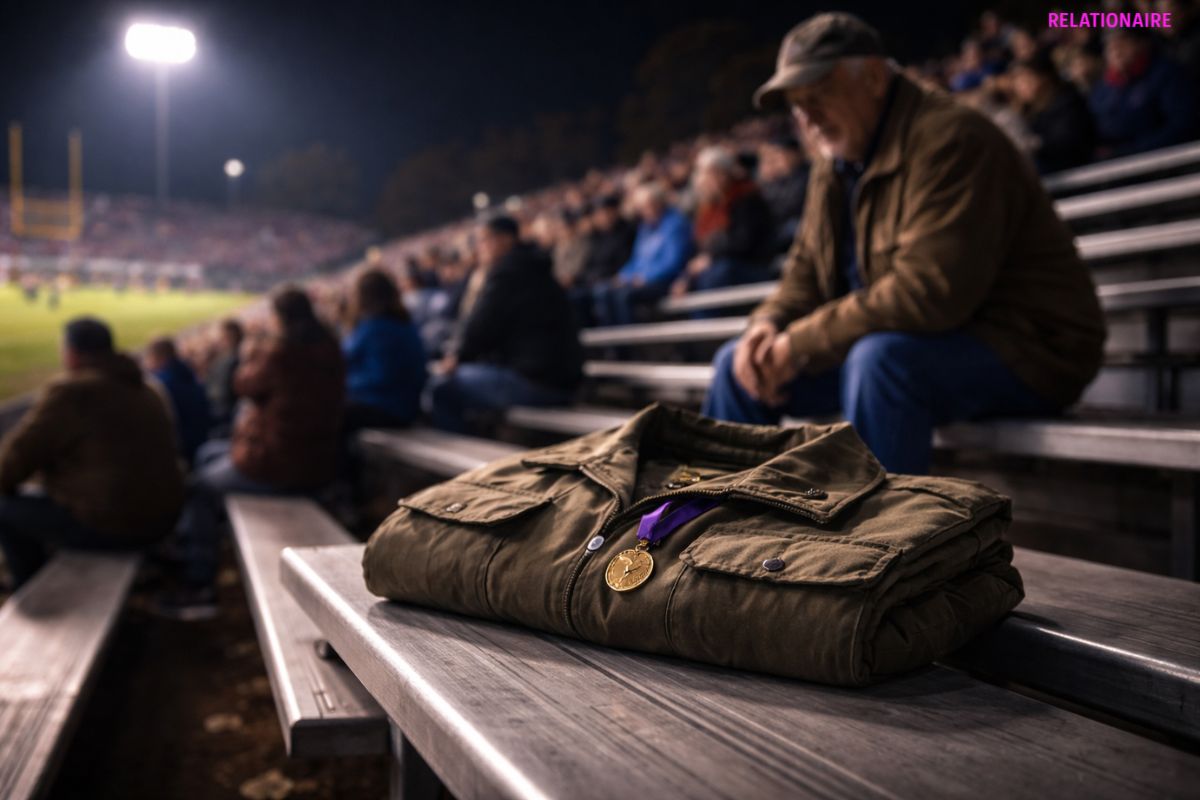
He stood near the end of the row, one hand resting on the aluminum rail, his thin brown coat moving in the wind. His boots were worn at the toes. The kind of boots a man kept because they’d already shaped themselves to his feet and life had taught him not to waste money on things that still worked.
Beside him, on the bench seat, lay an old field jacket.
Folded careful.
Not tossed. Not forgotten.
Folded with the sleeves tucked in and the collar straight, like somebody had put it there with both hands and meant for it to matter.
The boy looked at it and shrugged. “It’s a jacket.”
“No,” the old man said. “It’s a seat.”
Folks nearby had gone quiet by then.
At high school games in towns like that, everybody knew how to mind everybody else’s business without looking like they were doing it. A woman in a red sweatshirt paused with nachos halfway to her mouth. Two old men in hunting caps turned from the field. A little girl stopped swinging her legs.
The scoreboard clock still had eighteen minutes till kickoff.
The boy laughed once, short and sharp. “You serious?”
The old man nodded.
“Every seat’s full.”
“Not that one.”
The boy looked around, waiting for somebody to back him up. Maybe his mother. Maybe his buddies. Maybe the whole world. But nobody jumped in.
That irritated him more than the answer.
He stepped closer to the folded jacket. “For who?”
The old man’s jaw tightened.
Under the stadium lights, his face looked like old fence post wood—weathered, steady, split by time but not broken by it. He kept his eyes on the seat.
“For someone who belongs there.”
The boy snorted. “Well, he ain’t here.”
A few people winced.
The old man did not.
He just bent, lifted the jacket with both hands, and held it against his chest for a second.
That was when folks saw what was pinned under the collar.
A small round medal on a faded ribbon.
Not shiny anymore. Not polished for show. Just old.
Handled.
Kept.
The boy’s expression changed, but only a little. Not enough.
“It’s a football game,” he muttered. “Not church.”
The old man set the jacket back down and smoothed one sleeve flat.
“No,” he said. “It’s Friday.”
That meant something to some people.
You could tell by the way their faces shifted. By the way a woman near the aisle lowered her eyes. By the way one of the old men took off his cap and rolled it in his hands.
But plenty of others looked confused.
A couple teenagers behind the boy exchanged grins like this was just small-town weirdness, the kind of thing old people did because nobody told them to stop.
The marching band hit a sour note on the field.
The screen door at the concession stand banged shut.
Cold morning air had long since given way to cold night air, the kind that slipped under coats and settled in your bones. The old man didn’t seem to feel it.
The boy did.
He shoved his hands in his pockets. “Look, my girlfriend’s standing down there. I’m sitting here.”
He reached for the jacket.
The old man’s hand caught his wrist.
It wasn’t violent. Wasn’t even fast.
Just firm.
And that made it worse somehow.
The whole section went still.
The old man looked him dead in the face and said, “Don’t.”
That was when the boy’s mother started up the steps.
“Cody,” she snapped. “What are you doing?”
“He won’t let me sit down.”
She glanced at the old man like she knew exactly who he was and exactly how little that mattered. “Walter, it’s a packed game.”
Walter.
The name moved through the air like something remembered.
The old man let go of the boy’s wrist. “Then they can stand.”
The mother gave a dry laugh. “This again?”
That landed harder than anything the boy had said.
Because it told the crowd this wasn’t new.
This had happened before.
Every Friday, maybe.
Every game.
Every season.
Walter picked up the jacket again and sat down beside it, one hand resting lightly on the folded shoulders, like a man sitting next to family in a hospital waiting room.
“You don’t have to understand it,” he said. “You just have to leave it be.”
The mother crossed her arms. “It’s been years.”
Walter nodded once. “I know exactly how many.”
Nobody spoke for a second.
On the field, the players came running out under paper banners. The crowd rose with a cheer, but it sounded far away up there in the bleachers.
The boy looked embarrassed now. Angry too, but smaller in it. “So who was he?”
Walter kept his eyes on the field.
He didn’t answer.
The mother pulled at her son’s sleeve. “Come on.”
But Cody didn’t move. Not yet.
His face had changed from annoyed to curious, which is sometimes the first step toward decent in a young man. “Was he your son?”
Walter’s hand tightened on the jacket.
Not much.
Just enough for the medal ribbon to tremble.
A man three rows down stood slowly and said, “Leave it alone, boy.”
Another voice joined in. “That seat’s always been his.”
“Whose?” Cody asked.
Nobody answered straight.
That was the strange part.
In a town where everybody talked, nobody seemed willing to be the one to explain it.
Maybe because they didn’t know enough.
Maybe because they knew only pieces.
Maybe because the truth belonged to Walter, and Walter was the kind of man who carried things without setting them down in public.
The national anthem began.
Everybody stood.
Walter stood too, slower than the rest, with the jacket still in his arms. When the flag unfurled near the scoreboard, he held that old coat against his chest so carefully it looked heavy.
Not the fabric.
The memory.
And when the anthem ended, folks sat back down one by one.
All except Walter.
He stayed standing for another second.
Then another.
Eyes fixed on the empty space beside him.
Like he was waiting for somebody to sit.
That was when Sarah Bennett, who ran the diner off Route 8 and had served half that town eggs and coffee for twenty years, whispered from two rows back:
“Lord help me.”
Because she had finally recognized the name stitched in faded thread above the jacket pocket.
Not Walter’s.
Not even close.
A different last name.
One that used to be painted on the side of a mailbox out on Miller Road before the house burned and the family line went quiet.
Sarah put a hand to her mouth.
Walter heard her.
He turned just enough to meet her eyes.
And in that look was something so raw, so old, so carefully carried, that she sat down hard like the breath had left her.
Cody saw it too.
“So that’s not your son,” he said.
Walter looked back at the field.
“No,” he said softly.
Then he touched the medal under the collar and added, “But he was mine before he was anybody else’s.”
The crowd hushed again.
And nobody in those bleachers, not Sarah, not Cody, not even the folks who thought they knew the story, understood yet what he meant.
Not until halftime.
Not until the announcer said a name over the loudspeaker that hadn’t been spoken in that stadium in seven years.
And not until Walter finally stepped away from the empty seat.
What do you think that jacket meant to him?
PART 2
Halftime started with the marching band and a lot of noise.
But it only took one name to silence the whole stadium.
The announcer’s voice came over the speakers, warm and practiced at first. “Tonight, as part of our homecoming tradition, we would like to recognize local service members and remember those from our county who gave their lives in uniform.”
Folks clapped polite.
Kids kept talking.
The band shifted on the field.
Then the announcer read from a card.
“Private First Class James Miller.”
A few older people straightened in their seats.
“United States Army.”
The polite clapping thinned.
“Killed in action, October 14th, seven years ago.”
Now it was quiet.
Not full quiet. Stadiums never are. There’s always a baby crying somewhere, always cleats scraping track, always the metal tick of somebody dropping keys under the bleachers.
But it was quiet enough that Walter’s cough carried clear as a bell.
Cody looked at him.
So did half the section.
Walter didn’t lift his head. He sat with both hands on the folded jacket like he was bracing against weather nobody else could feel.
The announcer kept going.
“James Miller was a 2016 graduate of Hartwell High, captain of the wrestling team, volunteer assistant with the peewee football league, and the son of Carol and Dennis Miller.”
Sarah Bennett closed her eyes.
Because Carol had died the winter after the telegram came.
And Dennis had gone from a loud man to a silent one, then from silent to gone. Packed his truck one spring morning and left town without even changing the mailbox.
People remembered the Millers.
They remembered the casseroles.
The flag at the funeral.
The boots by the front door that nobody could bring themselves to move.
But memory is a slippery thing. It fades around the edges. Folks move on. Games keep getting played. Kids graduate. New names fill old jerseys.
That’s how a town forgets without meaning to.
But Walter, apparently, had not forgotten at all.
The announcer cleared his throat. “We’d like to ask anyone who served with James Miller, knew him, or wished to honor him, to please stand.”
No one moved.
Not at first.
The silence stretched too long.
Then Sarah rose.
Slowly.
Then one of the old men in the hunting cap.
Then the feed-store owner.
Then Jim Rollins, who coached JV ball back when James had been a lanky tenth grader with bad knees and more grit than size.
One by one, people stood.
But everybody was looking at Walter.
Because Walter stayed seated.
Cody frowned. “Why isn’t he standing?”
His mother didn’t answer.
Walter looked at the field and said, almost to himself, “Because tonight ain’t for me.”
Then he did something no one expected.
He lifted the folded jacket, stood, and walked toward the stairs.
The crowd parted before he even reached them.
There’s a kind of respect people show without announcing it. They shift their knees. Pull in their boots. Turn sideways. Make room for grief when they see it coming.
Walter moved carefully, one hand on the rail, the other holding that old field jacket and medal.
Cody watched him go.
Then, against his mother’s better judgment and common sense, he followed.
So did Sarah.
And then a few more.
By the time Walter reached the track, folks all along the lower rows were leaning forward, trying to understand what they were seeing.
The announcer had gone quiet. Maybe by choice. Maybe because somebody in the booth had finally looked down and seen Walter walking alone under the lights.
He crossed to the fifty-yard line.
The band stepped aside.
The cheerleaders lowered their signs.
Even the players on both sidelines turned.
Walter stopped right at midfield and bent down slow.
Every movement looked careful.
Practiced.
Like he’d done this somewhere else before, somewhere nobody clapped.
He laid the folded jacket on a metal folding chair set near the sideline for ceremony guests.
Only then did people realize the chair had been there all along.
Empty.
Waiting.
Walter set the medal on top.
Then he stepped back and came to attention.
His right hand rose to his forehead.
Not sharp anymore. Age had taken a little speed from him. Arthritis had stolen some straightness from his fingers.
But it was still a salute.
Still exact where it mattered.
The whole stadium went dead still.
Cody stopped on the track and stared.
Sarah had tears on her face already.
At last the announcer spoke again, but his voice was different now. Softer. Unsteady.
“For those who may not know,” he said, “the chair at midfield has been placed there every homecoming for PFC James Miller. We… we were told a family representative would attend.”
Walter did not lower his salute.
The announcer hesitated.
Then said, “Sir… would you please tell us your name?”
Walter finally brought his hand down.
When he answered, he didn’t use the microphone. Didn’t need to. The place was so quiet his words carried anyway.
“Walter Reed.”
A murmur moved through the stands.
Not Miller.
Reed.
Cody blinked. “So who is he?”
Sarah whispered, “Nobody knew?”
Walter looked up at the press box, then down at the chair.
His voice came rough. “Jimmy wasn’t my blood.”
That made people lean in.
Because blood is what folks expect. Father. Uncle. Brother. Granddad. Those are the easy stories. The accepted ones.
The safe ones.
Walter went on. “His daddy worked nights. His mama worked mornings. Boy spent more time at my garage than he did in his own kitchen.”
There was a small broken laugh somewhere in the stands. The kind that comes right before crying.
Walter kept his eyes on the jacket.
“He was twelve when he started sweeping my floor for five dollars and a MoonPie. Couldn’t fix a carburetor to save his soul. Talked too much. Asked too many questions.”
Some of the old-timers smiled through wet eyes.
Cody swallowed.
Walter’s hand hovered over the folded sleeve but didn’t touch it. “I taught him to change oil. Taught him how to patch a tire. Taught him how to stand up straight when he shook a man’s hand and look him in the eye.”
His jaw worked once.
“And when he enlisted, I told him not to go.”
The stadium seemed to hold its breath.
Because that didn’t fit the shape people wanted.
Not in a town like that.
Walter saw it on their faces.
“I told him the truth,” he said. “I told him a uniform don’t make a man brave. The choice does. I told him there are easier ways to prove yourself.”
He looked toward the home stands, toward the boys in shoulder pads and eye black and borrowed invincibility.
“He said he wasn’t trying to prove anything. He said he wanted to be useful.”
That line hit the crowd like a hammer wrapped in cloth.
No theatrics.
No speech.
Just a young man’s plain reason.
Walter’s voice thinned. “He left me his jacket the day before basic. Said, ‘Keep my seat warm, old man. I’ll be back by playoffs.’”
Sarah sobbed openly then.
Because now it all made sense.
The empty seat.
The Fridays.
The jacket.
Not a shrine to a son.
A promise kept by a man who had no legal right to grieve but every moral right in the world.
Walter bent and picked up the medal again. “This came in a box after he didn’t.”
Across the field, Cody took one slow step backward, ashamed of how loud he’d been, how sure.
Walter looked at the crowd for the first time.
Not angry.
That was the worst part.
He wasn’t angry.
Just tired.
“I kept the seat because somebody should’ve.”
And that’s when everything changed.
Because from the top row, somebody stood and saluted.
Then another.
Then another.
And before Walter could turn back to the chair, the whole home side was on its feet.
But the biggest thing hadn’t happened yet.
Not until Cody, the boy who’d tried to take the seat, reached into his own letterman jacket, pulled out something folded and worn, and stared at the name on it like he’d just been struck.
What do you think Cody was holding?
PART 3
Cody stood on the track with his mouth half open and something clutched in his hand.
It was a photograph.
Old enough at the edges to be soft.
Carried in a wallet too long.
He looked from the picture to Walter, then back again, like his own eyes had turned against him.
His mother came down the bleacher steps fast. “Cody?”
He barely heard her.
In the photograph, a younger Walter stood in front of a grease-stained garage bay with one arm around a skinny teenage boy in coveralls.
The boy was grinning like he had no reason in the world to think life would ever turn on him.
Above them hung a hand-painted sign: REED’S SERVICE & TIRE.
And on the back, in thick black marker, were seven words:
Keep my seat warm, old man. —Jimmy
Cody looked like the cold had reached inside him.
“My granddad had this,” he said.
Nobody answered.
His voice cracked. “He gave it to me last month.”
Walter turned.
The stadium lights caught his face, and for the first time all night he looked shaken clean through.
“Dennis?” he asked.
Cody nodded once. “That’s my granddad.”
Sarah put both hands over her mouth.
The whole story shifted again right there on the track.
Not away from Walter.
Toward him.
Because now folks understood something harder than grief and more complicated than memory: the loud boy on the bleachers hadn’t just insulted a stranger’s ritual.
He had almost sat down in his own family’s empty place without knowing it.
Cody stared at the chair, then at the jacket, then at Walter. “James Miller was my uncle.”
Walter didn’t speak.
Maybe he couldn’t.
Cody’s mother did. Quietly now. All that sharpness gone. “Dennis never talks about him.”
Walter let out a breath that sounded older than the rest of him. “He used to.”
No accusation in it.
Just truth.
The kind that stands by itself.
Cody stepped closer. “Granddad said there was a man named Walt who looked after Uncle Jimmy when he was a kid. He said if I ever saw him, I was supposed to shake his hand.”
Walter blinked.
Cody looked down at his own hands like he didn’t deserve them. “I forgot the rest.”
Then he swallowed and said the words as if he had to drag them out of deep water.
“I’m sorry.”
Not to the crowd.
Not because everybody was watching.
To Walter.
The apology hung there in the night air.
Real.
Walter looked at the boy a long moment.
Then he nodded once. “You didn’t know.”
Cody’s chin trembled anyway. “I should’ve.”
That’s the thing about decent apologies. They don’t defend themselves.
The announcer had long since given up on running the ceremony. Nobody cared. The game didn’t matter right then. The scoreboard glowed over a field no one was watching.
Walter held out the photograph.
Cody stared, confused.
“Put it on the chair,” Walter said.
Cody did.
His hands shook so hard the picture nearly slipped.
When he laid it beside the medal and folded jacket, the whole town could see it on the big screen because somebody in the booth had the good sense to put the camera there and leave it.
An old mechanic.
A young soldier.
A promise in marker on the back.
Walter stepped beside Cody.
Then, with the whole stadium looking on, he did one small thing that broke whatever pride the town still had left in it.
He brushed an invisible bit of dust off Cody’s shoulder.
Not grand.
Not theatrical.
Just a habit, maybe, from years of fixing boys up before sending them back into the world.
Cody’s eyes filled.
Walter said, low enough that only those nearest heard, “Your uncle used to slouch too.”
Cody laughed once through his tears.
That did it for half the crowd.
You could hear grown men clearing their throats, women crying openly, old veterans going quiet in the way they do when memory comes back with teeth.
Then Jim Rollins, the old JV coach, walked down from the stands and stopped at midfield.
He took off his cap.
Looked at Walter.
Looked at the chair.
And without a word, he moved a second folding chair beside the first one.
Then a third man came carrying another.
Then another.
The principal. The feed-store owner. Sarah’s husband. Two veterans from the VFW hall with shoulders bent but steps steady.
Soon there was a line of chairs stretching along the sideline.
Empty chairs.
Not because the dead were interchangeable.
But because folks were finally remembering there was more than one.
Private worth had become public honor.
Not because a committee planned it.
Because one old man had kept showing up with a jacket and a promise until the town was ashamed enough to see straight.
The band director lowered his baton.
No one had told him to.
He just understood.
The band set their instruments down.
The players removed their helmets.
And Walter, who had spent seven years honoring Jimmy in near silence, found himself standing in the center of a field while the whole town rose around him.
The principal walked out with a microphone and asked, “Mr. Reed, would you say a few words?”
Walter looked like he’d rather rebuild an engine in freezing rain.
But he took the microphone anyway.
His hand trembled.
He cleared his throat.
Then he said, “Most of you thought that seat belonged to a dead soldier.”
He glanced at the chair.
“It did.”
Then he looked at the crowd.
“But it also belonged to the people who still loved him.”
No one moved.
No one even coughed.
Walter’s thumb rubbed once across the medal ribbon. “Don’t wait seven years to honor somebody because you think grief belongs only to family on paper. Sometimes the one who keeps showing up ain’t the one with the same last name. It’s the one who made a promise.”
He turned and held out the microphone to Cody.
The boy froze.
Walter didn’t pull it back.
After a second, Cody took it.
His voice was young and unsteady and honest.
“I tried to take that seat tonight because I thought it was just an empty place.” He looked at Walter. “It wasn’t empty. I just didn’t know how full it was.”
There was no cheering after that.
Just something better.
Silence with meaning in it.
Then from the visitor’s side, where the veterans usually sat together in a knot of caps and quiet, an old Marine rose and saluted.
Walter answered.
So did the veterans.
Then the players.
Then fathers.
Then boys.
One long wave of hands to foreheads under bright Friday lights.
After the game, people didn’t rush for the parking lot.
They came one by one to the chair.
Some touched the jacket.
Some touched the photograph.
Some said Jimmy’s name out loud, maybe for the first time in years.
Cody stayed until nearly everybody was gone.
The cold had deepened. You could smell damp metal, old canvas, and the last of the coffee from the concession stand. Somewhere behind the bleachers, a screen door creaked and slapped shut.
Walter picked up the jacket carefully.
Cody looked at him and asked, “Can I carry the chair?”
Walter studied him for a moment, then nodded.
Together they walked off the field.
No speech.
No band.
Just a boy and an old man carrying honor between them in plain sight.
And on the way to the gate, Cody reached over and took the folded jacket for just a second.
Not to keep it.
Just to help bear the weight.
Some seats look empty until you learn who has been holding them for years.
Who in your life has carried something sacred without anybody noticing?