If you’ve already read part 1 of this story on Facebook, go here for Part 2!
The folded flag in his attic had been untouched for forty years but the morning his grandson reached for it, the old man finally raised his voice.
“Don’t touch that.”
The words cracked through the attic like a rifle shot.
Eli froze with both hands on the cedar chest.
Dust floated in the thin beam of light from the round window. The old house had gone quiet except for the hum of the box fan downstairs and the faint rattle of the screen door in the back.
Walter Mercer stood at the top of the attic stairs, one hand gripping the rail so tight his knuckles had gone pale.
Eli had never heard his grandfather sound like that.
Not once.
Not when the tractor died in the middle of hay season.
Not when Uncle Ray backed into the mailbox.
Not even when the doctor told him to stop climbing ladders.
Walter was a quiet man. Vietnam veteran. Retired mechanic. The kind of man who still folded his jeans over a chair and rinsed out coffee cups before setting them in the sink. The kind who stood when the anthem played, even if his knees shook.
But now his voice had an edge to it.
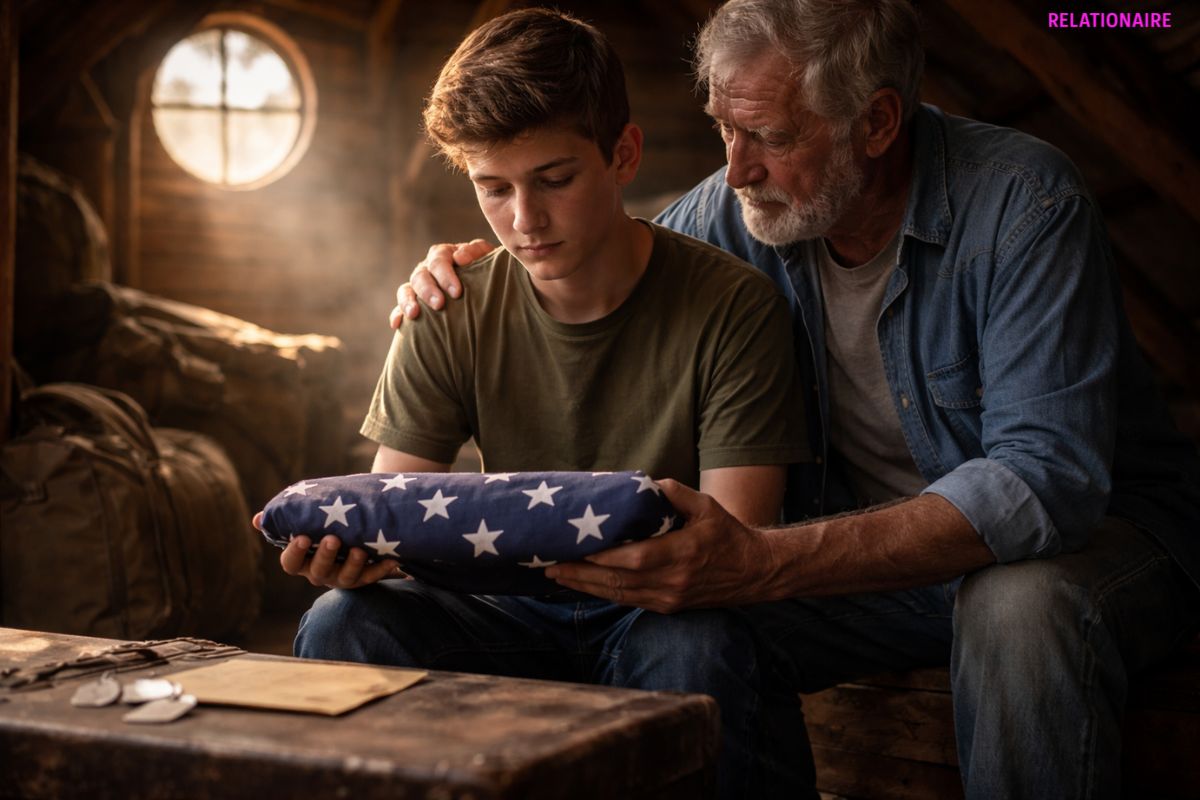
Eli looked down at the folded American flag inside the chest.
It was perfect.
Sharp corners. Tight triangle. Blue field turned outward, stars tucked clean under a film of dust that hadn’t settled right, as if the thing carried its own weather.
“I was just moving the box,” Eli said.
Walter climbed the last two steps into the attic.
“No,” he said, softer now. “You were about to open it.”
The attic smelled like old canvas and dry wood. Christmas ornaments in cracked paper boxes. A rusted lantern. A pair of Army duffel bags shoved into the corner under an old fishing net. Morning heat pressed against the roof.
Eli straightened up.
He was seventeen, broad in the shoulders, restless in the bones. He had come over because his mother said Grandpa Walter needed help cleaning before the church men came Saturday to patch the roof over the porch.
Down below, in the kitchen, bacon grease still hung in the air from breakfast. Coffee sat in a chipped mug on the counter. The game from last night still played in Eli’s head, the missed catch, the coach’s stare, the ride home without a word.
He was already irritated before he ever climbed the attic stairs.
And now there was this flag.
He looked at Walter, then back at the chest.
“What is it?” Eli asked.
Walter didn’t answer.
That made the silence heavier.
Eli had spent most of his life around that silence.
His grandfather didn’t talk much about the war. Didn’t talk much about anything before Grandma June died, and even less after. There was a photo on the living room wall—Walter in uniform, younger than Eli was now, stiff-backed and serious beside two other men—but if you asked who they were, Walter would just say, “Boys I served with.”
That was it.
No stories.
No speeches.
At the diner in town, the men at the counter nodded to Walter with a kind of respect Eli never really understood. At the VFW hall on Memorial Day, Walter came early, set out folding chairs, then slipped out before the cake was cut. He never wore his cap except at funerals.
It always struck Eli as strange.
Like maybe the old man wanted the respect without the questions.
Like maybe he liked being thought of as something he wasn’t anymore.
Eli knew that thought was unfair.
Still, it sat there.
Walter stepped past him and knelt in front of the chest. He didn’t touch the flag. Just rested one hand on the cedar rim and stared.
His work shirt was thin at the collar. His boots were scuffed white at the toes. There was grease tucked deep in the lines of his hands that never washed out.
“It ain’t decoration,” he said.
Eli crossed his arms.
“I didn’t say it was.”
Walter looked up then, and his eyes had that faraway look Eli hated.
The one that meant the conversation was about to die before it started.
“I told you not to touch it,” Walter said.
“That’s all.”
Eli let out a breath through his nose.
It came sharper than he meant.
“You always do that.”
Walter’s brow tightened.
“Do what?”
“Act like everything in this house is some kind of sacred thing nobody can ask about.”
Walter rose slow from the floor.
The attic seemed to shrink around them.
Below, a truck passed on the road out front. Gravel crackled. Then silence again.
Eli pointed toward the chest.
“It’s a flag, Grandpa. Not a live grenade.”
Walter’s face changed.
Not anger, exactly.
Something older than that.
He looked down at the triangle of blue and white, and when he spoke again, his voice sounded tired.
“You don’t know what you’re saying.”
“Then tell me.”
Walter said nothing.
That was when Eli made the mistake.
He laughed.
It was small. Bitter. Mostly aimed at himself, at the whole stale morning, at the feeling of being treated like a child when he was nearly a man.
But Walter heard it.
And Walter stiffened.
“You think this is a game?” he asked.
“No.”
“You think because I don’t run my mouth about it, it didn’t cost anything?”
Eli’s jaw tightened.
“I think maybe if something mattered that much, you wouldn’t keep it hidden in an attic.”
The words landed hard.
Walter took a step back as if something had struck him in the chest.
For a second Eli thought the old man might yell.
Instead, Walter reached into the cedar chest with both hands.
Careful. Too careful.
He lifted the folded flag like it had weight beyond cloth.
And maybe it did.
There was something underneath it.
An old photograph.
A chain of worn dog tags.
And a sealed letter, yellowed at the corners, with Eli’s own last name written across the front in faded ink.
MERCER.
Walter stared at the letter but didn’t pick it up.
Eli felt his throat go dry.
“What is that?”
Walter swallowed once.
The attic fan didn’t reach this high. Sweat tracked down Eli’s back. Dust clung to the hair on his arms.
His grandfather’s hand trembled just enough for Eli to notice.
“It should’ve been opened a long time ago,” Walter said.
Eli frowned.
“By who?”
Walter looked at him then.
Not through him.
At him.
And for the first time that morning, Eli saw something he had never seen in the old man’s face before.
Fear.
Not fear of being asked.
Fear of finally answering.
Walter set the flag back into the chest.
Not on top of the letter.
Beside it.
Like the two things had no right to cover one another anymore.
Then he lowered himself onto an old trunk near the window, breathing careful, one hand pressed flat against his knee.
Outside, through the dusty glass, the flag on the porch stirred once in the cold morning air.
“Your father,” Walter said, “wasn’t the first Mercer to come home quiet.”
Eli blinked.
The attic seemed to tilt.
Downstairs, the screen door creaked open, then shut. His mother calling from the kitchen, asking if they wanted more coffee. Ordinary sounds. Safe sounds.
But nothing in the attic felt safe now.
Eli looked again at the sealed letter.
At the dog tags.
At the folded flag no one had ever opened.
And suddenly he knew this wasn’t some keepsake from a funeral.
Wasn’t some old man’s pride tucked away in a box.
It was something worse.
Or something holier.
Walter leaned forward, elbows on his thighs, eyes fixed on the floorboards.
“When I tell you what that flag means,” he said, “you’re going to understand why I never let anybody touch it.”
He paused.
Then he added, so quietly Eli almost missed it:
“And why I never believed I deserved to.”
What do you think could make a man hide a folded flag for forty years?
PART 2
Eli didn’t move.
Neither did Walter.
The attic held its breath around them.
From downstairs came the clink of a spoon against a coffee mug, his mother humming under her breath like this was any other morning. Like the world below the attic was still plain and ordinary.
Eli looked at the flag again.
Then at his grandfather.
“You said you didn’t deserve it,” he said. “Why?”
Walter rubbed a hand over his mouth.
His fingers shook once before he locked them together.
“In ’72,” he said, “there were four of us on that ridge.”
He didn’t look up when he said it. He spoke to the floorboards. To the dust. To something only he could still see.
“Me. Jimmy Raines. Cal Bishop. Tommy Mercer.”
Eli’s pulse thudded in his neck.
“Mercer?”
Walter nodded once.
“My older brother.”
The word hit harder than Eli expected.
Brother.
Nobody had ever mentioned a brother.
Not his mother. Not Grandma June. Nobody at the VFW hall. Nobody at the diner. Not once.
He stared at the old photograph lying in the chest.
Three young men in uniform.
A fourth had been cropped at the edge, or maybe the picture had been damaged. Eli couldn’t tell from where he stood.
“You had a brother?” he asked.
Walter let out a dry laugh with no humor in it.
“Had.”
Eli sank down onto an overturned feed bucket across from him.
The wood beneath him creaked.
Walter reached into the chest and picked up the dog tags. They clicked softly against each other. That sound seemed smaller than it should’ve been.
“These were Tommy’s.”
Eli swallowed.
“Dad knew?”
Walter nodded again.
“He knew enough.”
“That means Mom knew.”
“She knew enough too.”
Eli sat back, stunned.
All his life he had thought the silence in this family was just the way they were. Men who worked. Women who carried it. Nobody saying the hard thing unless they had to.
Now it felt arranged.
Built.
Like boards nailed over a window.
Walter held the tags in his palm.
“He was twenty-three,” he said. “Two years older than me. Smarter than me. Better shot. Better with people. If a room got tense, Tommy could settle it with two words and half a smile.”
The old man’s own mouth twitched at the edge, almost remembering.
Then it was gone.
“We got pinned on that ridge before sunrise. Cold enough your breath came white. Mud up to the ankles. Radio cut in and out. We were taking fire from tree line we could barely see.”
Eli listened without blinking.
Walter didn’t dramatize it.
That made it worse.
“I was hit first,” he said. “Nothing heroic. Leg. Bad enough I wasn’t getting down that hill without help.”
He paused and looked toward the attic window where the porch flag moved again in the breeze.
“Tommy dragged me.”
The words came plain.
Like a man saying he’d gone to the store.
“Jimmy was trying to cover us. Cal was bleeding from the shoulder. We made it maybe thirty yards. Maybe less.”
Walter’s thumb rubbed over the worn edge of one tag.
“Then the shelling started.”
Eli’s hands tightened on his knees.
Walter drew in a long breath.
“He shoved me into a crater and threw himself over me.”
That was all.
No swelling music.
No heroic speech.
Just an old man in an attic, telling it like a man reports weather damage.
Eli stared at him.
“And he…?”
Walter nodded.
“Caught what was meant for me.”
The attic went silent.
Not the ordinary kind.
The kind that comes after something breaks and both people know there’s no putting it back.
Eli looked down at the folded flag.
Then back at Walter.
“You carried that all this time?”
Walter finally met his eyes.
“What do you think?”
Eli looked away first.
He thought about every time he’d seen the old man leave the room when somebody thanked veterans for their service.
Every time he’d stood in the back at Memorial Day.
Every time he’d looked almost ashamed when folks called him a hero.
Eli had judged that.
He saw that now.
Judged it hard.
Walter leaned over and took the yellowed letter from the chest. He held it by the edge like it could still burn.
“This came six weeks later,” he said. “From Tommy. Written before that patrol. Meant for our father if something went bad.”
Eli stared at the name on the front again.
MERCER.
Only now he noticed another word beneath it, smaller.
For Dad. If Walter comes home without me.
His throat closed.
“He gave it to you?”
Walter nodded.
“Our father couldn’t bring himself to read it. Said if the Army had already sent word, he didn’t need paper telling him his son was dead.”
The old man’s eyes drifted toward the rafters.
“So he handed it to me. Told me to put it away until I could stand to open it.”
“And you never did.”
Walter’s silence answered for him.
Eli felt a flash of anger then, quick and hot.
Not at the war. Not even at the death.
At the years.
At the choice.
“You just left it sealed?”
Walter flinched like the question had a blade in it.
“I tried,” he said. “More than once.”
“Then why didn’t you?”
Walter looked down at his own hands.
Because they were old hands now. Scarred hands. Hands that fixed carburetors and folded church bulletins and saluted graves. Hands that had once been saved by somebody who didn’t come home.
“When a man dies saving you,” he said, “there are some things you get scared to know.”
Eli didn’t speak.
Walter went on.
“I was afraid it would say he was angry. Afraid it would say he was tired. Afraid he knew he wasn’t coming back and I was still too dumb to stop him from shielding me.”
His jaw tightened.
“And I was afraid if I opened it, I’d find out I’d spent forty years living on something I never earned.”
Eli looked at the old photograph again.
At the cropped edge.
At the space where Tommy should’ve been.
Then something occurred to him.
“Why’d you keep the flag hidden?” he asked.
Walter’s fingers curled around the letter.
“Because it wasn’t given to me.”
He looked toward the cedar chest.
“It was supposed to go to Tommy’s people. But our mother died before they sent it. Our father wouldn’t take it. Said he didn’t want a folded flag in his house unless his boy carried it through the front door himself.”
Walter’s voice roughened.
“So it came to me. And every time I looked at it, it felt like I was holding proof of what he paid and what I didn’t.”
Eli’s chest hurt.
That was the flip.
That was the thing.
All these years Eli had half-believed the old man kept the flag like some secret badge of honor.
But Walter had hidden it because he couldn’t bear the weight of it.
Not pride.
Debt.
Not glory.
Grief.
Downstairs, his mother called again, closer now. “You boys all right up there?”
Neither answered.
Walter ran his thumb under the sealed flap of the envelope, then stopped.
His breathing changed.
Shallower.
He held the letter out toward Eli.
“I can’t do it alone.”
Eli looked at the envelope, then at him.
For a second he saw not a stubborn old man, not a veteran, not a mystery.
Just a brother.
Just a man who had carried a silence until it bent his whole life around it.
Eli reached out.
Their fingers touched on the paper.
The seal crackled.
And that’s when Walter suddenly pulled his hand back and whispered, almost to himself—
“If he wrote what I think he wrote, your father built his whole life on a lie.”
PART 3
The envelope opened with a dry tear.
That sound stayed with Eli later.
Not loud.
But final.
Walter stared at the unfolded pages in Eli’s hands like they might judge him.
Below them, the house carried on with ordinary life. Cabinet door shutting. Coffee poured. A chair scraped back across old linoleum.
Eli cleared his throat and read the first line.
Dad,
If this reaches you, then things went the way I prayed they wouldn’t.
Walter shut his eyes.
Eli kept reading.
I need you to hear this plain. If Walter comes home and I do not, you are not to let him carry me like a stone around his neck.
The words sat in the dusty air between them.
Walter’s head dropped.
Eli read on, slower now.
He thinks too much, even when he acts like he doesn’t. So I know what he’ll do. He’ll turn it over in his mind a thousand times and come out blaming himself for the one thing that was never his to carry.
Eli’s voice caught for a second.
He swallowed and kept going.
If one of us was always making it home, it was going to be him. Not because he was worth more. Not because I loved him less. But because that boy has a family in him. He may not know it yet, but he does.
Walter pressed a fist against his mouth.
The attic window rattled in a faint gust.
Eli read the next line, and this time the words hit his own chest too.
Tell him that saving his life was not the worst thing that happened to me. It was the last good choice I got to make.
Walter made a sound then.
Small.
Broken.
The kind of sound a man tries to hide and can’t.
Eli lowered the page for a moment.
His grandfather sat bent forward on the trunk, shoulders trembling once, then again. He didn’t cry loud. Didn’t collapse. He just bowed his head like he’d finally set something heavy down and didn’t yet trust the ground to hold it.
Eli looked back at the letter.
There was more.
Tell him to stop standing in the back at funerals.
Tell him to stop looking at folded flags like they belong only to ghosts.
Tell him if he gets the chance to love a wife, raise children, fix broken things, sit on a porch in old age, drink bad coffee, and complain about weather—then he better do it for both of us.
Eli had to stop again.
The smell of old canvas seemed stronger now. So did the cedar from the chest. So did the morning bacon grease from below, drifting up the stairwell from a life that had kept going, year after year, while this letter waited in the dark.
Walter wiped at his eyes with the heel of his hand, angry at the wetness like it had no business being there.
“Keep going,” he said.
Eli nodded.
And Dad, there’s one more thing.
If Walter ever has a boy of his own, or a grandson, or any young fool in this family who thinks silence means a man has nothing worth saying, make sure he knows this:
Some men come home loud.
Some come home quiet.
Both have seen enough.
Eli’s grip tightened on the page.
He read the last lines almost in a whisper.
Don’t let them turn Walter into a monument.
Let him be a man.
That’ll be burden enough.
Love,
Tommy
Nobody spoke for a long time.
The attic had changed.
It was still hot. Still dusty. Still full of old boxes and forgotten things.
But it no longer felt sealed.
Walter held out his hand.
Not for the letter.
For the dog tags.
Eli gave them to him.
Walter wrapped them in his fist and bent his head. The chain hung between his fingers, catching the light.
Then, after forty years of refusing it, he reached for the folded flag.
He lifted it into his lap.
Careful.
Reverent.
Not like a man claiming something.
Like a man accepting something he should have accepted years before.
His hands trembled against the cloth.
“Your father read this once,” he said quietly.
Eli looked up.
“What?”
Walter nodded toward the letter.
“About fifteen years ago. I found him in this attic with the envelope open. He’d come by while you were little. Your grandma had just passed. He read it, cried where nobody could see him, then sealed it again.”
“Why would he do that?”
Walter gave a sad half-smile.
“Because he said it wasn’t his moment to hand me peace. Said a man has to be ready to receive it.”
Eli thought of his father then.
A man of few words. Hard on the outside. Loving in ways that didn’t always look gentle.
Maybe now he understood him a little too.
Downstairs, his mother called up again, but her voice softened this time.
“Dad? Eli?”
Walter stood.
Slowly. Painfully. But straighter than before.
He tucked the letter inside his shirt pocket.
Held the flag against his chest.
Then he did something Eli had never seen him do in all seventeen years of his life.
He saluted.
Not toward a grave.
Not toward a crowd.
Just there in the attic.
To a brother only he could see.
His fingers touched his forehead. His hand shook so badly Eli thought it might fall. But he held it there.
And Eli, without thinking, rose to his feet.
He wasn’t military. Didn’t know all the rules.
Didn’t matter.
He stood straight anyway.
Walter lowered his hand and looked at him.
There was no speech.
No grand lesson.
Just a tired old man with wet eyes and a folded flag in his arms.
“Help me take this downstairs,” he said.
They carried it together.
At the bottom of the attic stairs, his mother stopped cold when she saw Walter holding the flag. One hand flew to her mouth.
In the kitchen, the coffee had gone lukewarm. Bacon sat on a plate under a paper towel. Morning light lay across the table in a bright square.
Walter set the flag down gently.
Then he pulled out the letter and handed it to his daughter.
She read the first lines and began to cry without a sound.
An hour later, Eli’s father came over.
Nobody had called him. Maybe his mother had. Maybe he just knew.
He walked in from the porch with cold morning air clinging to his jacket and stopped when he saw the flag on the table.
His eyes went to Walter.
Then to the letter.
Then back again.
For a moment no one moved.
Eli waited for some rough clearing of throats. Some joke. Some attempt to dodge the truth.
None came.
Walter stepped forward and held out the letter.
His son didn’t take it.
Instead, he stepped closer and put one hand on his father’s shoulder.
That was all.
Walter broke.
Not loudly.
But fully.
His chin trembled. His mouth pulled tight. He leaned into that hand like a man who had been standing too long by himself.
And his son held on.
Later that afternoon, they drove out to the cemetery past the football field and the gas station and the diner where men in caps sat at the counter talking over pie.
Walter carried the folded flag beneath one arm.
The Mercer family headstone stood under a maple tree, plain and gray.
He knelt there, old knees in the cold spring grass, and laid the flag at the base of the stone for just a moment.
No crowd.
No ceremony.
No cameras.
Just wind in the branches, the smell of damp earth, and a man finally bringing something out of hiding.
When he rose, Eli saw it in his face.
Not happiness.
Something better.
Relief.
That evening, on the porch, the screen door creaked behind them while the flag in its case rested on a chair by Walter’s side.
The sun went down over the road.
Walter drank his coffee black.
Eli sat beside him and listened to the quiet.
This time, it didn’t feel empty.
It felt earned.
Some burdens don’t get lighter because time passes.
They get lighter because, at last, someone helps you carry them.
What quiet truth do you think too many good men carry alone?