If you’ve already read part 1 of this story on Facebook, go here for Part 2!
The night I told my mother she wanted me to fail, she was standing at the kitchen sink washing the same plate for the third time.
Her hands were red from hot water.
Mine were shaking around a college acceptance letter I had waited my whole life to hold.
“You don’t want me to go,” I said.
She didn’t turn around.
Outside, rain tapped against the kitchen window of our little yellow house on Marigold Street, the one with peeling porch paint and a mailbox that leaned no matter how many times Mama hammered it straight.
My acceptance letter lay open on the table beside a stack of unpaid bills, a half-empty jar of peanut butter, and my little brother Jonah’s spelling test with a gold star at the top.
It was from Westbridge University.
Three hours away.
Three beautiful, impossible hours.
Mama had looked at the letter once, smiled in that small tired way of hers, and said, “That’s wonderful, Hannah.”
Then came the sentence that ruined everything.
“But maybe we should think carefully before making any big decisions.”
We.
Not me.
We.
That one word sat between us like a locked door.
For months, every time I brought up college, Mama got quiet.
When I talked about dorm rooms, she changed the subject to community college.
When I showed her pictures of the campus, she asked about gas money.
When my guidance counselor called to ask about financial aid forms, Mama said she would “look into it,” then left the papers in her purse for two weeks.
I started to feel something ugly growing in me.
Not sadness.
Resentment.
The kind that makes you hear every sigh as an insult.
The kind that makes a mother’s worry sound like a cage.
“You always do this,” I said.
She shut off the faucet.
Water dripped from the plate into the sink.
“Hannah.”
“No, don’t ‘Hannah’ me.” My voice cracked, but I didn’t stop. “You act like you’re being practical, but you just don’t want me to leave.”
Mama turned then.
She looked older in the yellow kitchen light. Her brown hair was pulled into a loose knot, and there was flour on the shoulder of her work shirt from the diner. She had been on her feet since five that morning, serving coffee to truckers and pancakes to people who never looked up from their phones.
But all I saw was the woman blocking the door.
“That is not true,” she said softly.
“Then why do you keep telling me no?”
“I never said no.”
“You don’t have to.” I grabbed the letter off the table. “Every time I get excited, you remind me we’re broke. Every time I say I can make it work, you tell me to be realistic.”
“Because realistic matters.”
“To you.”
Her face tightened.
Jonah appeared in the hallway wearing his dinosaur pajamas, holding his stuffed rabbit by one ear.
“Are you fighting?” he asked.
Mama wiped her hands on a towel. “Go back to bed, baby.”
He looked at me.
I looked away.
That was the thing about our house. You could hear everything. Every bill collector call. Every late-night whisper. Every time Mama cried in the bathroom with the fan running.
I used to press my pillow over my ears.
Lately, I just got angry.
Because I was tired of being poor in a way that made every dream feel rude.
I was tired of pretending I didn’t see Mama counting quarters at the grocery store.
Tired of school forms that asked for fees we didn’t have.
Tired of wearing sneakers with the sole lifting at the toe.
Tired of teachers saying, “You’re going places,” while my mother acted like places were dangerous.
Jonah shuffled back down the hall.
Mama waited until his door clicked.
Then she said, “I’m trying to protect you.”
That did it.
Something in me snapped clean in two.
“No,” I said. “You’re trying to keep me here.”
Her eyes changed.
I should have stopped.
I didn’t.
“You got stuck in this town, and now you want me stuck too.”
The kitchen went so quiet I could hear the refrigerator humming.
Mama’s mouth opened, but no words came out.
I had never said anything like that to her before.
Not out loud.
My father left when I was eight. He said he was going to Tulsa for work and sent birthday cards for two years before even those stopped. Mama never called him what he was. She just said, “Your dad has his own troubles.”
So she worked.
Diner shifts. Cleaning jobs. Weekend pie orders.
She missed school concerts and parent nights and award breakfasts because someone had to keep the lights on.
I knew that.
Of course I knew that.
But that night, knowing didn’t soften me.
It sharpened me.
“You don’t get it,” I said, crying now. “This is my chance to have something different.”
Mama picked up the towel again and folded it once, twice, too carefully.
“I get more than you think.”
“No, you don’t.” I wiped my face with my sleeve. “You keep saying you love me, but every time I try to leave, you pull me back.”
Her hands stopped moving.
I waited for her to yell.
She didn’t.
That made me angrier.
“Say something,” I demanded.
She looked at me with eyes so tired they seemed almost hollow.
Then she said, “Not everything that holds you is a trap.”
I laughed, but it came out broken and mean.
“That’s exactly what someone says when they’re holding the key.”
I took the acceptance letter and walked out before she could answer.
In my bedroom, I shut the door hard enough to rattle the little framed photo on my dresser: me, Jonah, and Mama at the county fair when I was eleven, all of us sunburned, smiling around a funnel cake we split three ways.
I didn’t sleep much.
The next morning, Mama was already gone to the diner when I came out.
On the table was a note.
Eggs in fridge. Jonah’s lunch packed. Please make sure he wears his jacket.
—Mom
No apology.
No explanation.
Just another list of things that needed doing.
I crumpled it, then smoothed it back out because I hated myself a little.
After school, I came home to find Jonah sitting on the couch with a fever, cheeks pink, cartoon light flickering over his face.
Mama called from the diner, breathless.
“Can you stay with him until I get off? Mrs. Alvarez canceled on me.”
I wanted to say no.
I wanted her to feel what it was like when someone’s life got smaller because someone else needed them.
But Jonah coughed and whispered, “Hannah?”
So I said, “Fine.”
By seven, his fever broke.
By eight, I had changed his sweaty pillowcase, made soup from a can, and carried laundry into Mama’s room because the washer had finally stopped thumping.
Her room smelled like lavender soap and tired perfume.
It was the smallest bedroom in the house. She had given me the bigger one after Dad left, saying she liked the morning light better on that side.
That was a lie.
I knew it even then.
I stripped the sheets off her bed, still hot with anger, still replaying our fight, still telling myself she was the reason my future felt like something I had to steal.
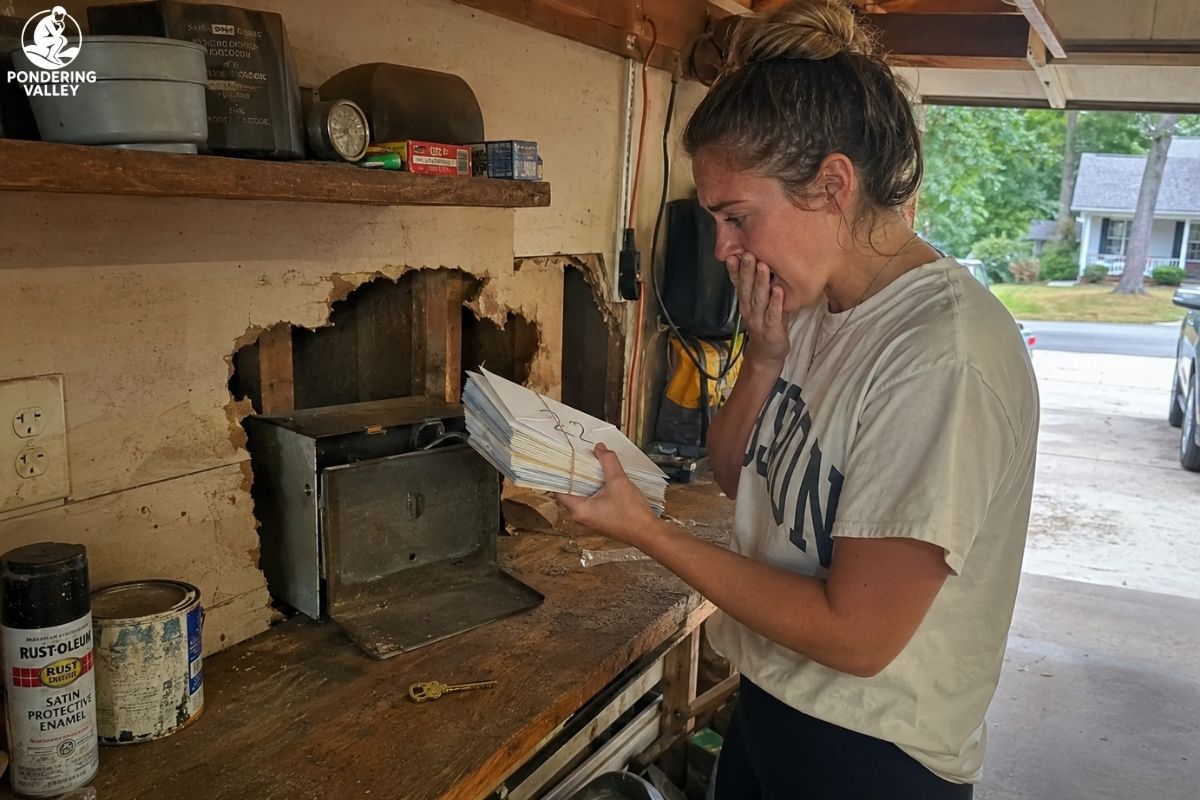
When I lifted the mattress corner to tuck the fitted sheet under, my fingers hit paper.
At first I thought it was an old receipt.
Then I saw the edge of a thick manila envelope, hidden flat between the mattress and box spring.
My name was written across it in Mama’s handwriting.
HANNAH — FIRST SEMESTER
My throat went dry.
I stood there with the clean sheet bunched in my hands, staring at that envelope like it had made a sound.
Then I heard the front door open.
Mama was home.
And I had the envelope in my hand.
PART 2
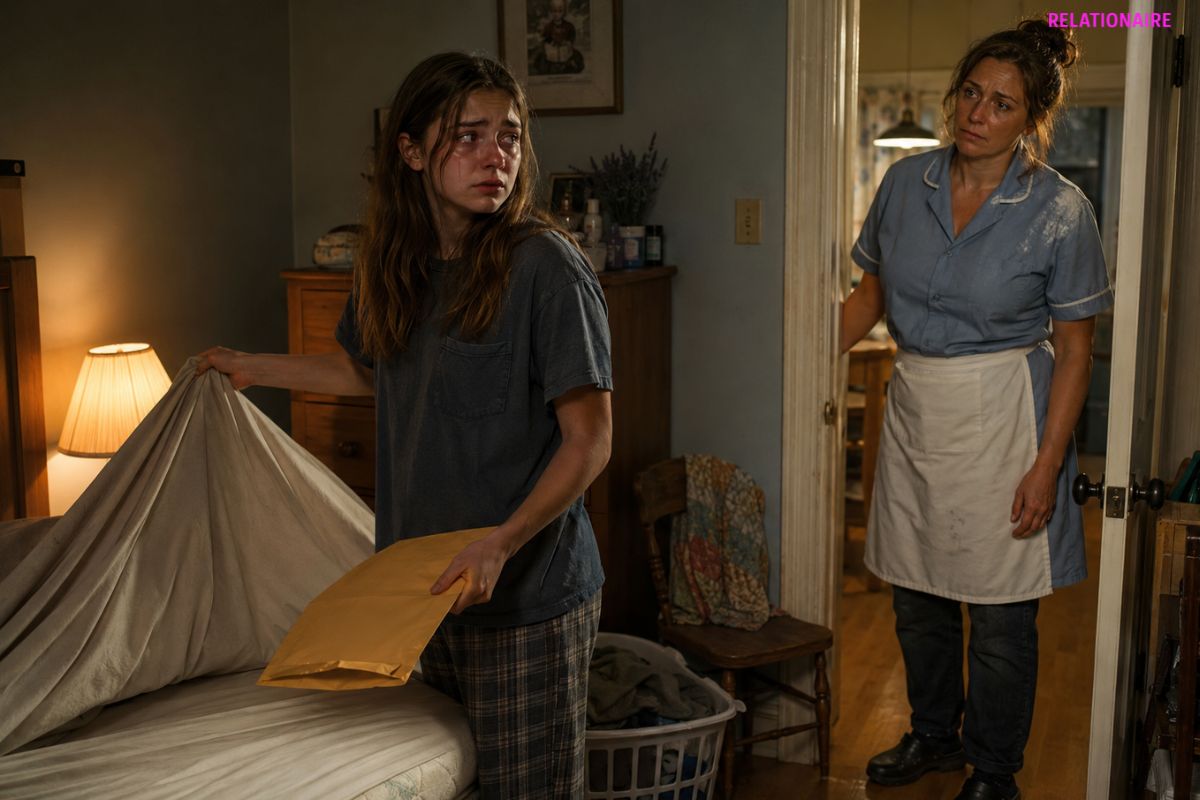
Mama stopped in the bedroom doorway wearing her diner uniform and shoes that squeaked faintly from rainwater.
For a second neither of us moved.
The envelope hung from my hand like proof of something.
I just didn’t know what.
Her face went pale.
“Hannah,” she said.
“What is this?”
She stepped into the room slowly, as if sudden movement might scare me away.
“It’s nothing.”
“My name is on it.”
“I know.”
“It says first semester.”
She reached for the envelope, but I pulled it back.
The motion hurt her. I saw it. I hated that I saw it.
“I found it under your mattress,” I said.
Her eyes dropped to the unmade bed, the clean sheet half-tucked, the old quilt folded over a chair.
“That wasn’t yours to find yet.”
Yet.
The word pushed against my ribs.
I looked down at the envelope. It wasn’t sealed. The flap was tucked in carefully, worn soft from being opened and closed.
“Mama,” I whispered, anger thinning into fear, “what is this?”
She sat on the edge of the bed like her legs had finally given up.
The room felt too small for both of us.
From the living room, Jonah laughed weakly at something on TV. The sound made Mama close her eyes.
“I was going to give it to you after graduation,” she said.
“Why hide it?”
“Because I wasn’t done.”
That answer made no sense.
My hands trembled as I opened the flap.
Inside was cash.
Not a lot, not the kind of money that solves a life.
But enough to stop me breathing.
Twenties and tens, folded in small bundles with paper clips. A few fives. Even singles, smoothed flat like she had pressed them under a book.
There were scholarship printouts, too, each one marked in blue pen. Deadlines circled. Requirements underlined. Little notes in the margins.
Ask Mrs. Bell about transcript.
Essay can mention science fair?
Need recommendation by March 10.
Application fee waiver?
Behind those were envelopes.
Seven of them.
Each had a label.
Open when you miss home.
Open before your first exam.
Open when you feel lonely.
Open when you’re mad at me.
Open when you think you can’t do it.
Open if you get sick.
Open after your first month.
I sat down on the floor because my knees stopped working.
Mama covered her mouth with her hand.
I touched one of the envelopes with two fingers.
“You wrote me letters?”
She nodded once.
“Why?”
Her eyes filled.
“Because I know what it feels like to be away from your mother and not know how to ask for comfort.”
I looked up.
I had never heard her say that before.
Mama rarely talked about her own mother. My grandmother died when I was little, before I had memories strong enough to keep. All I knew was a photo in the hallway: a woman with soft eyes, standing beside a rosebush.
“I was seventeen when I left home,” Mama said. “I had a duffel bag, eighty-two dollars, and pride bigger than sense.”
“You left?”
She gave a sad little smile. “I ran.”
The word landed heavily.
“I thought your grandma wanted to keep me small. She told me I wasn’t ready. Told me the city would eat girls like me alive.” Mama looked at the floor. “I thought she didn’t believe in me.”
I held the envelope tighter.
“What happened?”
“I left anyway.” Her voice was flat, but not cold. Just old. “I got a job at a laundry downtown. Took night classes for a while. Met your father. Got pregnant with you. Then my mother got sick.”
She swallowed.
“She called me three times before I answered. I was still angry. Still proving a point to nobody.”
My anger had nowhere to stand now.
It moved around inside me, searching for a place, and found only shame.
“By the time I came home,” Mama said, “she was already in the hospital. She kept asking if I had eaten. That was the first thing she said to me. Not ‘I told you so.’ Not ‘why didn’t you call.’ Just, ‘Did you eat, baby?’”
She wiped her cheek quickly.
“I lost a lot of time being sure she was against me.”
The room blurred.
I thought of all the times Mama had asked if I had eaten.
After tests.
After fights.
After Dad forgot my birthday.
I always answered like it annoyed me.
“So you don’t want me to go because Grandma died?” I asked, softer now.
“No.” Mama shook her head. “I want you to go.”
The words were quiet.
They also sounded like they cost her something.
“You do?”
“I want you to go so badly it scares me.” She looked at the envelopes in my lap. “I want you to have the library with the big windows. I want you to have friends who argue about books and stay up too late eating vending machine chips. I want you to walk across that campus and feel like your life belongs to you.”
My chest hurt.
“Then why did you keep telling me to be realistic?”
“Because wanting it doesn’t pay the bill.”
She reached into the envelope and lifted one small stack of cash.
“This is lunch tips. Pie money. The twenty Mrs. Haskins gave me for hemming curtains. The twelve dollars I didn’t spend on new shoes.”
I stared at her shoes.
The black diner shoes had a crack near the side. I had noticed it before. I had told myself she didn’t care how she looked.
I hadn’t let myself think anything kinder.
Mama continued, “I was trying to build enough so you wouldn’t get there and immediately feel hungry, scared, and stranded.”
I remembered her saying no to pizza night.
Her watering down soup.
Her laughing when Jonah asked why she wasn’t having chicken, saying, “I had a big lunch.”
I had believed her because believing was easier than seeing.
“I thought you were stopping me,” I said.
“I know.”
“Why didn’t you tell me?”
“Because I didn’t want you to carry my worry on top of your own.”
That was when I saw it.
Not all at once.
Piece by piece.
The financial aid forms in her purse weren’t forgotten. They were covered in notes.
The questions about gas money weren’t doubts. They were calculations.
The quiet after campus photos wasn’t disapproval. It was a mother imagining an empty bedroom and trying not to let grief speak louder than love.
I opened one of the letters before she could stop me.
The one that said: Open when you’re mad at me.
“Hannah,” she whispered.
But I had already unfolded it.
Her handwriting leaned slightly to the right.
Baby girl,
If you’re opening this, then I probably said something wrong. I do that sometimes. I get scared and it comes out sounding like rules.
I need you to know something.
Every time I seem hard on you, I am not trying to build a wall. I am trying, clumsily, to build a railing.
Something you can hold when the stairs get steep.
You may hate me some days. That is allowed.
Just don’t mistake my fear for a lack of faith.
I have believed in you since you learned to tie your shoes and announced you were “basically grown.”
I believe in you now.
Even when my voice shakes.
Even when I say the wrong thing.
Even when letting you go feels like tearing my own heart out and teaching it to walk three hours away.
Love,
Mom
I folded the letter back slowly.
My face was wet.
Mama didn’t reach for me.
Maybe she thought she didn’t deserve to.
Maybe she was waiting to see if I would let her.
Before either of us spoke, Jonah appeared in the doorway holding his rabbit against his chest.
“I’m sorry,” he said.
Mama turned. “For what, honey?”
He looked from me to the envelope.
“I told Hannah you had a secret.”
My breath caught.
“What secret?”
Jonah’s lower lip trembled.
He walked to Mama’s dresser and opened the bottom drawer.
From under a stack of winter scarves, he pulled out a small blue folder.
Mama stood so fast the bed creaked.
“Jonah, no.”
But he already handed it to me.
Inside was a college bill estimate printed from Westbridge’s website.
Across the top, in Mama’s handwriting, were three words underlined twice.
SELL THE HOUSE?
PART 3
I stared at those three words until they stopped looking like words.
SELL THE HOUSE?
The little yellow house on Marigold Street.
The house with Jonah’s height marks penciled inside the pantry door.
The house where Mama taught me to ride a bike in the driveway, running behind me in flip-flops, yelling, “I’ve got you,” even after she had let go.
The house where Dad’s empty chair slowly stopped being set at dinner.
The house where every birthday candle, every fever, every storm, every apology had happened.
“You were going to sell our house?” I asked.
Mama’s face crumpled, but only for a second. Then she put it back together the way she always did.
“I was looking at options.”
“That’s not an option. That’s our home.”
“It’s a house.”
“No, it isn’t.”
“Hannah—”
“No.” I stood, clutching the folder. “You don’t get to sell everything because of me.”
“I wasn’t doing it because of you.”
“Yes, you were.”
“I was doing it for you.”
The room went quiet again, but this time the silence didn’t feel angry.
It felt exhausted.
Jonah started to cry.
Not loudly. Just small, scared breaths.
Mama knelt in front of him immediately.
“Hey. Come here.”
He buried his face in her shoulder.
“Are we moving?” he asked.
Mama closed her eyes.
I watched her hold him. One hand on the back of his head. The other rubbing slow circles on his pajama shirt.
That was Mama.
Breaking privately.
Comforting publicly.
“We are not deciding anything tonight,” she said.
That wasn’t no.
That was when I understood how close we were to losing more than sleep.
The next morning, I skipped first period and went to see Mrs. Bell, my guidance counselor.
I brought the envelope, the scholarship printouts, and the blue folder.
Mrs. Bell read quietly, her glasses low on her nose.
When she reached Mama’s notes in the margins, her mouth tightened.
“Your mother has been trying very hard,” she said.
“I know that now.”
Saying it made my throat ache.
Mrs. Bell leaned back. “There may be more aid available. Work-study. Emergency grants. Local scholarships. But Hannah, your mother needs to be part of this conversation.”
“I know.”
“And you need to stop treating help like it means you’re a burden.”
That hit too close.
I looked down at my worn sneakers.
“I don’t want her to give up the house.”
“Then don’t let pride make decisions love should be allowed to discuss.”
That afternoon, I found Mama outside the diner after her shift, sitting on the curb near the employee entrance.
She had one shoe off.
Her sock had a hole in the heel.
In her lap was a foam cup of coffee gone cold.
For a moment I stood by the dumpster, watching my mother without her knowing.
She looked so small.
Not weak.
Just human.
I had spent so much time needing her to be either the obstacle or the answer that I forgot she was a person standing in the middle of a life that had never been gentle with her.
“Mama,” I said.
She looked up, startled.
“I talked to Mrs. Bell.”
Her face tightened with worry. “Hannah—”
“I didn’t tell her everything. Just enough.”
I sat beside her on the curb.
A delivery truck rumbled past. Somewhere inside the diner, dishes clattered and someone laughed too loudly.
I handed her a folded paper.
“What is this?” she asked.
“A list.”
She gave me a tired look. “Of course it is.”
That almost made me smile.
“Scholarships I can still apply for. A campus job. A grant Mrs. Bell thinks I qualify for. And community donors who help first-generation students.”
Mama stared at the paper.
Then I said the part I had practiced all day.
“I want to go to Westbridge. But I don’t want to go by letting you disappear piece by piece.”
Her fingers tightened around the list.
“I’m your mother. That’s what mothers do.”
“No,” I said softly. “That’s what you think love has to do.”
Her eyes lifted to mine.
“I need you to let me help carry it,” I said. “Not because I’m grown. Not because I don’t need you. Because I do.”
The wind moved a paper napkin across the pavement.
Mama looked away.
“I don’t know how to send you off without feeling like I failed to give you more.”
“You gave me more.”
She laughed once, bitterly. “Baby, I gave you secondhand jeans and store-brand cereal.”
“You gave me someone who stayed.”
That was the first time I saw my mother stop fighting her tears.
They slid down her face silently, no apology, no turning away.
I leaned into her shoulder like I used to when I was little.
She smelled like coffee, rain, and fryer grease.
For once, she let herself lean back.
We didn’t fix everything that day.
That would be too easy.
There were still forms to fill out and numbers that didn’t add up neatly. Mama still woke some nights and checked the mailbox like bad news might arrive early. I still got scared that leaving meant betraying her.
But something changed.
We stopped whispering around the truth.
Mama told me about money.
I told her about fear.
Jonah made a “college jar” out of an old pickle jar and decorated it with dinosaur stickers. He dropped in pennies, buttons, and once, a cough drop, which Mama said probably wouldn’t help tuition but showed initiative.
Mrs. Alvarez from next door brought over a casserole and a check for fifty dollars, saying, “Don’t argue with old women. We always win.”
The diner owner put a coffee can by the register labeled HANNAH’S BOOK FUND, though Mama threatened to quit when she saw it.
She didn’t.
By graduation, I had enough aid to go.
Not easily.
But truly.
The night before I left for Westbridge, my room was full of boxes and half-packed nerves. Jonah sat on my bed hugging my pillow like he was mad at it.
Mama came in holding the manila envelope.
It was thicker now.
She had added stamps, a small photo of the three of us, a grocery store gift card, and one final letter.
“This one,” she said, tapping the top envelope, “you open after I drive away.”
My throat tightened.
“You’re still driving me?”
She looked offended. “You think I’m letting you ride a bus to the rest of your life?”
So the next morning, we loaded my boxes into our old minivan.
The same minivan with the window that stuck and the radio that only worked when it felt appreciated.
The drive was quiet at first.
Jonah fell asleep in the back seat with his rabbit under his chin.
Mama kept both hands on the wheel.
When the campus signs appeared, she inhaled sharply.
I pretended not to notice.
My dorm room was on the third floor. No elevator. Mama carried boxes anyway, refusing to let me take the heavy ones. By the time everything was inside, her face was flushed and her hair was sticking to her forehead.
She made my bed.
I told her she didn’t have to.
She said, “I know.”
Then she did it anyway.
When it was time for her to leave, Jonah cried first.
I hugged him hard and promised to call every night.
Mama stood by the door, holding her keys.
For a second, she looked like she might say something big. Something mothers say in movies.
Instead, she reached up and fixed the collar of my shirt.
“You have snacks in the top drawer,” she said. “Don’t skip breakfast before exams. Call me if something feels wrong, even if you think it’s silly.”
I nodded because I couldn’t speak.
Then she pulled me into her arms.
Not carefully.
Not politely.
She held me like she was memorizing the shape of me.
“I’m proud of you,” she whispered.
“I’m sorry,” I whispered back.
“For what?”
“For thinking you were holding me back.”
Her hand pressed against my hair.
“Oh, Hannah.” Her voice broke. “I was trying to learn how to let you go without dropping you.”
After they left, I sat on my new bed in my new room with the door closed and the whole strange world waiting outside.
I opened the first letter.
Baby girl,
If I made it to the parking lot before crying, we both know that is a miracle.
I hope your room feels less strange by the time you read this.
I hope you remember that leaving home does not mean losing home.
It means home loved you hard enough to send you forward.
There is peanut butter in your snack bag because you get mean when you’re hungry.
There is twenty dollars in the small zipper pocket for emergencies, and yes, pizza counts if your heart hurts.
I am scared.
I am proud.
I am already missing you.
But more than anything, I am grateful I got to be the place you started from.
Go be brave.
And eat something.
Love,
Mom
I laughed and cried at the same time.
Then I took the photo she had packed and set it on my desk.
Mama, Jonah, and me at the county fair.
Three paper plates.
One funnel cake.
All of us holding on.
Years later, I would forget the exact amount of money in that envelope. I would forget the names of some scholarships and the color of my first dorm comforter.
But I would never forget the truth I learned under my mother’s mattress.
Sometimes love looks like fear.
Sometimes sacrifice looks like silence.
And sometimes the person you think is standing in your way is actually standing behind you, saving every dollar, writing every letter, and praying you’ll have the courage to go farther than they ever did.