If you’ve already read part 1 of this story on Facebook, go here for Part 2!
By the time Eli pulled the velvet box out of his backpack, his teacher had already started to regret show-and-tell.
It was one of those gray Thursday mornings that made everything in Room 12 feel smaller than it was. Wet jackets hung from hooks by the door. A puddle of muddy water had formed under the boot tray. Someone’s banana was turning brown on the windowsill beside a paper turkey left over from fall.
Mrs. Calloway stood near the reading rug with her clipboard pressed against her chest and watched Eli carry the little box to the front of the room with both hands, careful as if it might spill.
He was eight years old and small for his age, with a cowlick that never stayed down and a sweatshirt that looked like it had already belonged to another child first. He never volunteered in class unless he had to. He never interrupted. He had the kind of quiet that made adults say things like such a sweet boy when what they really meant was easy to overlook.
But not that morning.
That morning, his father was sitting in the visitor chair in the back.
The whole class had noticed him the second he stepped in.
He was tall and broad-shouldered, wearing a clean flannel shirt tucked into dark jeans. His hands were rough and stayed folded too tightly in his lap. He had the stillness of someone trying very hard not to be looked at. The other parents who came for classroom visits usually smiled too much, waved too often, took pictures on their phones.
Eli’s father had only nodded once when Mrs. Calloway greeted him.
“Thank you for coming, Mr. Mercer.”
“Yes, ma’am.”
That was all.
Mrs. Calloway had known Eli for three months and met his father only one time before, at parent-teacher conference. He had sat exactly the same way then too, eyes lowered, listening hard, answering politely, giving away almost nothing.
When she mentioned that Eli sometimes wrote about storms and empty houses and men who never slept, Mr. Mercer had stared at the little kidney-shaped table between them and said, “He’s got a good imagination.”
It did not sound like he believed it.
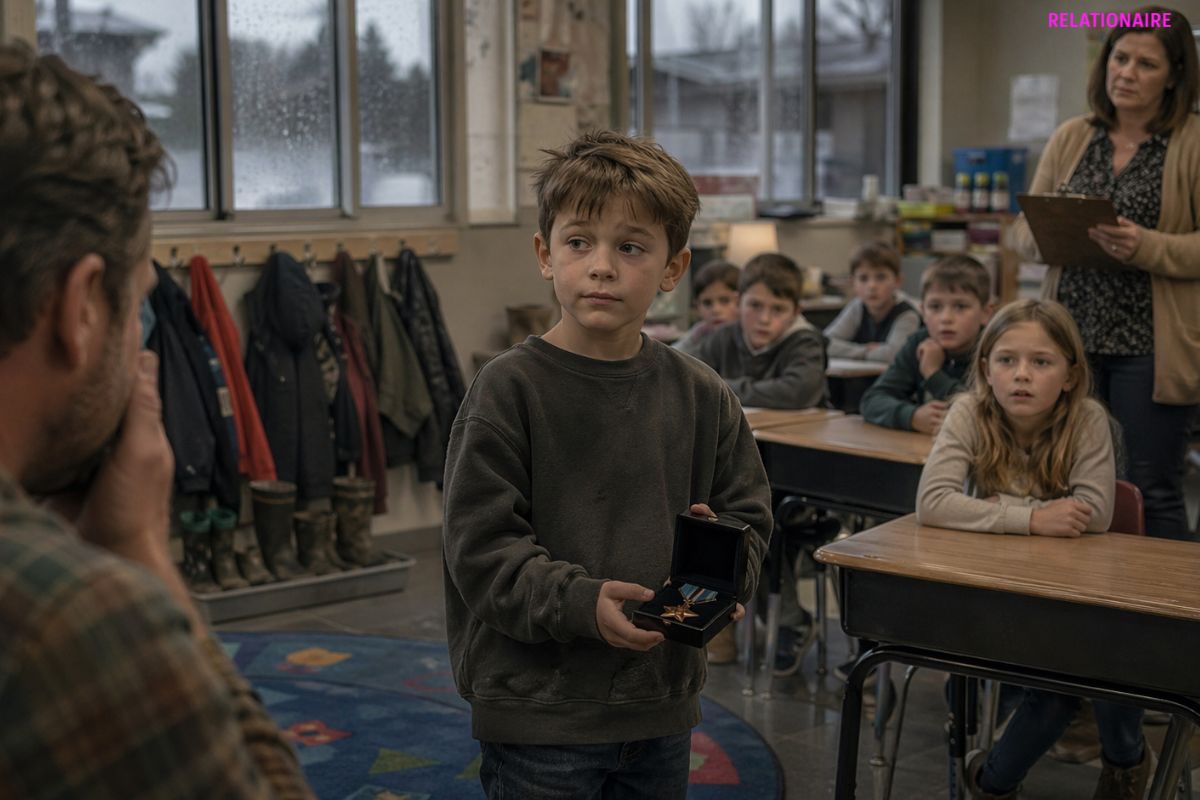
Now Eli stood at the front of the room and opened the velvet box.
Inside, on the white satin lining, lay a round bronze medal attached to a faded ribbon striped in red, white, and blue.
The room changed.
Even children could feel it.
A few of them leaned forward. One boy in the second row whispered, “Cool,” too loudly. Another asked, “Is that real?” before being told to raise his hand.
Eli nodded. “It was my dad’s.”
He didn’t look at the class when he said it. He looked at the medal. Then, just for a second, at the man in the back.
Mrs. Calloway felt something tighten in her chest.
She had not known exactly what Eli was bringing, only that he’d told her the day before, in that soft careful voice of his, “It belongs to my dad, but he said I can take it if I’m very, very careful.”
She should have asked more questions.
Now twenty-two third-graders were staring between a military medal and a father who looked like he wished the floor would open.
“Well,” she said brightly, too brightly. “Eli, would you like to tell us about it?”
He swallowed.
“It’s from the war.”
Children heard the word and became children again.
“What war?”
“Did he shoot bad guys?”
“Did he get blown up?”
“Did you kill anybody?”
The last question came from Liam Parker, who asked everything like he was poking a stick at something dead in the yard.
The room went still so fast it almost made a sound.
Mrs. Calloway’s mouth opened. “Liam—”
But Eli’s father had already lifted his head.
Not sharply. Not angrily.
Just enough.
Mrs. Calloway had seen men come back from the principal’s office, from divorce court, from funerals, with that same blank look that wasn’t blank at all. It was the look of somebody holding a door shut from the inside with both hands.
Liam shrank in his seat without understanding why.
“No,” Mrs. Calloway said, gentler now. “Let’s remember how to ask respectful questions.”
A little girl near the front raised her hand carefully. “Was your dad a hero?”
Another boy asked, “Did he win it?”
Then, from the back table, one of the twins said, “My uncle says soldiers aren’t supposed to talk about stuff because it’s gross.”
A nervous ripple moved through the room.
Eli stood very still.
He had one finger under the lid of the velvet box, holding it open. His ears had gone pink, but his face stayed calm in a way that did not belong to most eight-year-olds.
Mrs. Calloway glanced at Mr. Mercer, ready to step in and move the class along.
But he gave the smallest nod.
Not permission exactly. More like surrender.
She took a breath. “Maybe Eli can tell us what he knows, and then we’ll thank him for sharing.”
Eli nodded once.
“My dad got this a long time ago,” he said. “Before I was born.”
He paused.
“He keeps it in the top drawer with some folded papers and a photograph that has lines in it because it got bent.”
That detail landed harder than the medal itself. Mrs. Calloway saw it happen in the room. Children didn’t know what to do with military honor, but they understood drawers. Photos. Things people kept because they couldn’t throw them away.
A girl asked, “Who’s in the picture?”
Eli looked at his father again.
Mr. Mercer’s jaw moved once. He did not answer.
Eli said quietly, “His friends.”
There it was. The ache in the room. Small, but unmistakable.
Children shifted in their seats. Even Liam stopped fidgeting.
Mrs. Calloway took a step forward, ready now to save them all. To close the box. To praise Eli. To send everyone to math.
But then Eli did something she would think about for years.
He lifted the medal from the box with both hands and turned toward the back of the room.
Not toward the children.
Toward his father.
Mrs. Calloway felt her own heartbeat.
“Eli,” she said softly, uncertain.
He didn’t seem to hear her. Or maybe he did and understood this mattered more.
His father sat frozen in the little plastic chair, knees too high, shoulders too wide for it. Up close, Mrs. Calloway could see what she had missed before: the tiredness in his face, the way his wedding ring had worn a pale groove into his finger, the way one leg bounced once and then stopped, as if even that movement had been corrected.
Eli held the medal out.
“Dad?”
Mr. Mercer looked at him.
The whole class was watching now. No whispering. No wiggling. Just the sound of rain tapping the windows and the old heater clicking under the bookshelf.
“When you said I could bring it,” Eli said, “I thought maybe you wanted to tell them why you kept it.”
Mrs. Calloway saw something flash across Mr. Mercer’s face. Fear, maybe. Or pain so old it had become part of the bone.
“Eli,” he said, and his voice was rough. “Sit down, buddy.”
It was not harsh. That almost made it worse.
Eli didn’t move.
Most children would have folded right then. Most adults would have.
Instead, he frowned a little, not defiant, just trying to understand.
“You don’t even look at it,” he said.
Mrs. Calloway should have stopped this. She knew that. The room was too raw now, too intimate, too far outside anything a Thursday morning should have become.
But nobody moved.
Not her.
Not the children.
Not the father in the chair.
Eli’s hands were trembling just slightly around the medal, but his voice stayed steady.
“And you don’t talk about the picture either.”
Mr. Mercer stared at his son like he no longer recognized the distance between what children noticed and what adults hoped they didn’t.
Then Eli asked, in that plain, earnest voice that only made the question hit harder:
“Did you save this because you were brave… or because you miss the people who didn’t come home?”
The silence after that was so complete Mrs. Calloway could hear the rainwater ticking down the classroom radiator.
And in the back of the room, Eli’s father put one hand over his mouth, closed his eyes, and began to cry.
Part 2
No one in Room 12 knew what to do when a grown man started crying.
Not loud crying.
That might have been easier somehow.
This was the kind that looked dragged up from somewhere deep and rusted shut. Mr. Mercer bent forward in the tiny visitor chair, one hand still over his mouth, the other gripping his knee so hard his knuckles went white.
Mrs. Calloway moved first.
“All right, friends,” she said, her own voice unsteady, “let’s go line up for library a little early.”
There were no complaints. No whispers. Just the soft scrape of chair legs and sneakers on tile. Children looked back as they passed, not with nosiness now, but with the strange solemnity children get when they know something important is happening and don’t have the words for it.
Liam Parker lingered by the cubbies, cheeks red.
“I didn’t mean—” he started.
Mrs. Calloway touched his shoulder. “I know.”
Eli did not get in line.
He stood exactly where he was, the medal still in his hands, waiting.
Mrs. Calloway hesitated. The teacher in her wanted to protect him from what came next. But something older and wiser said this moment belonged to him more than anyone.
“I’ll take them,” she told him gently. “You can stay.”
He nodded without looking at her.
A minute later, the room was nearly empty except for Eli, his father, and the rain.
Mrs. Calloway stood at the doorway with the line of children stretching down the hall. She should have left. She knew she should have. Instead she stayed just long enough to see Mr. Mercer lower his hand from his face and look at his son.
“I’m sorry,” he said.
It was a terrible thing to hear an adult say to a child that way. Not because it was wrong. Because it was true in too many directions at once.
Eli took two small steps forward.
“Did I ask bad?”
Mr. Mercer let out a broken breath that was almost a laugh and almost another sob.
“No,” he said. “No, buddy.”
He looked at the medal, then at the bent photograph still lying inside the velvet box on the desk. Mrs. Calloway hadn’t even realized Eli had brought the photo too.
“I think,” he said slowly, “you asked the first honest question anybody’s asked me in a long time.”
Then Mrs. Calloway made herself go.
She spent the next forty minutes shelving books she didn’t need to shelve in the library just so she would have something to do with the feeling in her chest.
When Eli came back later for math, his eyes were puffy but calm. His father was gone.
Mrs. Calloway didn’t ask what had happened. She only knelt beside Eli’s desk during independent work and said, “You were very brave this morning.”
Eli shook his head.
“It wasn’t brave.”
“No?”
He pressed his pencil harder into a subtraction problem.
“He looks lonely when he opens that drawer,” he said. “I just wanted to know if he keeps the medal because it hurts to throw away the people.”
Mrs. Calloway had to blink twice before she could stand up.
That afternoon, when the buses left and the room finally emptied, she found something tucked under the edge of the whiteboard. The bent photograph. Eli must have forgotten it in the confusion.
She picked it up carefully.
Five young men stood in front of a dusty truck somewhere too bright to be home. Their uniforms were wrinkled. Their arms were slung around each other. One of them, thinner than the rest and smiling with all his teeth, was unmistakably a younger Mr. Mercer.
On the back, in faded ink, were four names.
And then a fifth, written smaller underneath:
Ben Mercer. Came home.
Mrs. Calloway sat down hard in the little reading chair.
Came home.
Not survived. Not returned. Not even me.
Came home.
As if that fact required explanation.
As if the others had not.
That evening, Eli’s mother called the school.
Mrs. Calloway braced herself, afraid there would be anger, complaint, embarrassment.
Instead the woman on the phone sounded tired in the way some women do when they have spent years holding a house together around a silence.
“This is Nora Mercer,” she said. “I just… I wanted to tell you not to worry. Eli’s dad isn’t upset with the school.”
Mrs. Calloway sank into her desk chair. “I’m relieved to hear that.”
There was a pause.
Then Nora said, very quietly, “He talked tonight.”
That single sentence carried the weight of a miracle.
Mrs. Calloway looked out through the classroom window at the dark parking lot and listened.
“He hasn’t talked about Afghanistan in almost nine years,” Nora said. “Not really. Not in full sentences. Not where anyone can follow it to the end.”
She drew a shaky breath.
“He came home after school and took the box out of the drawer. Just took it out and sat at the kitchen table with Eli beside him. For the longest time, I thought he wasn’t going to say anything. Then he pointed to each man in the picture and told our son their names.”
Mrs. Calloway closed her eyes.
“He told him who was funny. Who sang in trucks. Who cheated at cards. Who always saved his dessert till last.” Nora’s voice broke on that last word. “He told him which one never got to meet his daughter. Which one had a mother who kept setting a place for him the first year. Which one Ben was supposed to switch patrols with and didn’t.”
Mrs. Calloway pressed her hand to her mouth.
“Eli just listened,” Nora said. “He didn’t interrupt. He put that medal back in the box when Ben couldn’t hold it anymore.”
Another pause. Softer now.
“Then our son asked if the men in the picture had people who missed them on holidays.”
Mrs. Calloway felt tears spill before she could stop them.
“He asks things like that,” Nora whispered. “Always has. Once, when he was five, he cried because he thought the moon looked lonely in daylight.”
The next morning, Eli came to school with the velvet box again.
Mrs. Calloway’s heart jumped when she saw it, but this time he came to her desk before class started.
“Can I leave this with you till the end of the day?”
“Of course.”
He set it down carefully.
Inside the medal box, beside the photograph, was a folded sheet of notebook paper in adult handwriting.
For the families, it began.
Mrs. Calloway looked up. “What’s this?”
Eli’s backpack sagged off one shoulder. “Dad made a list.”
“A list?”
He nodded. “Of the moms and wives and one sister.”
She understood only slowly.
“He found them?”
“My mom helped.” Eli glanced toward the coat hooks, then back at her. “We’re gonna write letters.”
Mrs. Calloway stared at him.
Not one letter.
Plural.
“Your dad wants to?”
Eli thought about that.
“I think,” he said carefully, “he wants to stop being the only one who remembers them out loud.”
The ache that had begun yesterday widened into something almost holy.
After lunch, during silent reading, Eli raised his hand.
“Yes?”
“My dad said maybe if it’s okay, he wants to come back next week.”
Mrs. Calloway smiled. “For show-and-tell again?”
He nodded.
“What would he bring this time?”
Eli looked down at his book, then back up.
“Not the medal,” he said. “The stories.”
And somehow that was the part that undid her most.
Because medals were easy for strangers.
Shiny. Framed. Safe.
Stories were where the cost lived.
The next Thursday, the classroom was full again. Children sat on the rug. Rain had cleared. Pale sunlight fell across the cubbies. Mrs. Calloway had never been so nervous over third grade.
Mr. Mercer came in carrying no box.
Only a folded piece of paper in one hand and the photograph in the other.
He looked tired. He also looked like a man who had decided something and was frightened of it, but would do it anyway.
Children quieted without being asked.
He stood at the front of the room beside his son.
“I came last week because Eli asked me to,” he said. “I came this week because… he asked me a question I should’ve answered a long time ago.”
He looked at the picture.
Then at the children.
Then down at Eli.
And when he spoke again, his voice was steadier than before, but only just.
“This medal was never the most important thing I brought home.”
He unfolded the paper.
“So today, I want to tell you about the boys who should’ve been old men by now.”
Part 3
By the end of the second story, half the class had forgotten to blink.
Mr. Mercer did not speak like a hero.
That was the first thing everyone noticed.
He did not use the voice people used in movies when they wanted war to sound noble and clean. He spoke like a man carrying boxes down icy steps. Carefully. Knowing one wrong shift might send everything crashing.
He told them about Javier, who could fix anything with tape and stubbornness.
About Louis, who wrote letters home in tiny neat handwriting because his mother saved every stamp.
About Carter, who sang badly on purpose just to make everyone laugh.
About Danny, who once traded three packs of peanut butter crackers for a birthday candle so another soldier could stick it in a muffin and pretend.
The children listened with the solemn, open faces children sometimes have in church or hospital rooms or funerals, when they know the grown-ups are near something real.
Mrs. Calloway stood by the bookshelves and watched Eli the whole time.
He never looked proud in the usual way children do when a parent comes to school.
He looked relieved.
As if a locked door inside his house had finally opened and fresh air was moving through.
When Mr. Mercer finished, the room stayed quiet for a beat.
Then a hand went up.
Not Liam this time. Little Ava Romero, whose braids were tied with yellow ribbons.
“Did their families know they were funny?” she asked.
Mr. Mercer blinked.
“Yes,” he said after a moment. “I think they did.”
Another hand.
“Do they know now that you still remember them?”
That one came from Noah, who struggled with reading and always chewed his collar when he was nervous.
Mr. Mercer looked down at the folded paper in his hands.
“We’re working on that,” he said.
He did not glance at Eli, but everyone in the room seemed to feel the line running between them.
After class, when the other children had gone to recess, Liam Parker hung back by the pencil sharpener.
His face was red again.
He looked at Mr. Mercer and then at the floor.
“I’m sorry I asked if you killed anybody.”
Mrs. Calloway held her breath.
Children apologized all the time. For shoving. For blurting. For breaking crayons that weren’t theirs.
This felt different. Harder. Cleaner.
Mr. Mercer crouched in front of him, slow because one knee bothered him.
“You asked like a kid,” he said. “A lot of grown-ups ask worse without using words.”
Liam frowned, trying to understand.
Mr. Mercer gave him a small, tired smile. “What matters is you learned to ask better.”
Liam nodded hard and wiped his nose on his sleeve.
When he ran out to recess, Eli was waiting by the door.
“My dad says questions are like doors,” he told Mrs. Calloway matter-of-factly. “Some of them open the wrong room.”
She smiled through the tightness in her throat. “And yours?”
Eli looked through the classroom window at his father, who was carefully tucking the old photograph back into his wallet instead of the velvet box.
“I think mine opened a sad room,” he said. “But maybe it had to.”
That afternoon the whole thing might have ended there, as one beautiful classroom story people carried privately for years.
But it didn’t.
Because grief, once spoken aloud, has a way of asking for witnesses.
The letters began that weekend.
Not polished letters. Not perfect ones.
Nora Mercer bought a box of plain cream stationery from the pharmacy and set it on the kitchen table beside a chipped blue mug and a bag of store-brand chocolate candies. Mr. Mercer sat for a long time with the pen in his hand before he wrote a single word.
Eli sat across from him drawing tanks that looked like toasters with wheels. Every now and then he asked practical questions.
“How do you spell Javier?”
“Did Louis like dogs?”
“Should you tell the part about the muffin candle?”
His father answered every one.
Sometimes he stopped in the middle of a sentence and stared out the window at the bare maple tree in the yard until Nora touched his shoulder and brought him back.
Sometimes he wrote two lines and tore them up.
Sometimes he made it to the end.
Three weeks later, a reply came.
Then another.
One from a sister in Ohio.
One from a widow in Arizona.
One from a mother in Kentucky whose son had been twenty-one and stayed twenty-one in every frame on her mantel.
Mr. Mercer opened each envelope like it might contain an accusation.
Some of them did, a little.
Why now?
Were you with him?
Did he say anything at the end?
But beneath the hurt there was hunger too. A need as old as the silence itself.
Tell me something no one else knew.
So he did.
He told one mother her son hated instant coffee and drank it anyway so nobody would tease him.
He told a widow her husband kept a tiny notebook of things he wanted to teach his daughter someday, including how to bait a hook without looking scared.
He told a sister that her brother once walked two miles out of the way because there was a stray dog following the convoy road and he couldn’t stand leaving it.
The replies changed after that.
Thank you.
I can see him.
I didn’t know that.
I needed this.
At school, Eli never bragged. He only grew lighter somehow. Mrs. Calloway noticed he laughed more. Raised his hand more. Drew fewer storms.
Then, in early spring, a package arrived at the Mercer house.
Inside was a framed photograph of a young man in uniform holding a baby girl no more than a few weeks old. On the back, in careful handwriting, it said:
He never got to teach her how to fish. But she’s fourteen now, and she wants to meet you.
Nora cried first.
Mr. Mercer read the line three times.
Eli, sitting cross-legged on the rug, looked up and asked, “Is she one of the people the medal hurts about?”
For a second nobody could answer.
Then his father sat down on the floor beside him and said, “Yes.”
Eli leaned against his arm. “Then maybe she can help.”
Help what? Heal? Forgive? Remember? No one knew. Children rarely named things the way adults wanted them named.
But two months later, in a church fellowship hall that smelled like coffee and lemon cleaner, Mr. Mercer met three families connected by the same photograph, the same list of names, the same years of unfinished grief.
One widow.
One mother.
One daughter with her father’s eyes and none of his memories.
Mrs. Calloway came too, invited by Nora, though she felt almost embarrassed to be there. As if she had merely stood near the lightning, not been struck by it herself.
Eli wore a shirt with buttons all the way up and shoes that pinched his heels.
At first the adults stood awkwardly around folding tables, clutching paper cups and old pain.
Then the daughter—Maya, fourteen, all elbows and nervous courage—walked straight up to Ben Mercer and said, “My mom says you’re the one who remembers him laughing.”
It was such a child’s sentence, even from a girl nearly grown.
Not served with him. Not survived with him.
Remembers him laughing.
Ben covered his eyes with one hand.
When he lowered it, he was crying again.
“So do you,” he said hoarsely. “You have his face when you’re trying not to.”
That broke something open in the room in the best possible way.
People sat down.
Stories came.
Names were said out loud, then said again.
The kind of details that should never be all one person’s burden were shared around the table like bread.
At one point, Eli slipped away from the adults and stood beneath a bulletin board covered in faded paper flowers. Maya came and stood beside him.
“Did you really ask your dad that question in front of your whole class?” she said.
He nodded.
“Were you scared?”
“A little.”
“Why’d you do it?”
Eli thought for a long moment, watching the adults laugh through tears at a table across the room.
Then he shrugged.
“Because he missed them like he was hiding a broken arm,” he said. “And everybody was acting like if they didn’t touch it, it wasn’t broken.”
Maya stared at him.
Then she laughed once through her nose and wiped her eyes.
“That is such a weird thing to say.”
“I know.”
“It’s also true.”
He accepted that with the solemnity of a boy who had not been trying to be clever in the first place.
When the afternoon ended, the widow from Arizona hugged Eli so hard his ears turned red. The mother from Kentucky kissed the top of his head. Maya crouched down and handed him a small tackle box keychain in bright green plastic.
“For asking the wrong question,” she said.
Eli frowned. “It was the right question.”
She smiled. “Yeah. That’s what I mean.”
Later, back in the car, with the sunset turning the church windows gold behind them, Eli held the green keychain in his palm and looked at his father.
“Does it hurt less now?”
Ben Mercer kept both hands on the steering wheel for a long second before answering.
“No,” he said honestly. “Not less.”
Eli waited.
“But it hurts less alone.”
In the backseat, the boy nodded like that made perfect sense.
Maybe it did.
Maybe that was the whole thing adults forgot and children still knew instinctively: that sorrow does not shrink because someone explains it away. It shrinks because someone finally sits beside it and says the names out loud.
And sometimes healing doesn’t begin with the right answer.
Sometimes it begins with a child who loves you enough to ask the question everyone else is afraid to touch.