Part 1
“Get out of my seat. This isn’t a charity row.”
Ryan Harper said it louder than he meant to.
The words cut through Row 12 before the airplane door had even closed. A mother across the aisle stopped digging through her tote bag. A college kid with earbuds halfway in looked up. Two rows back, a man in a Titans hoodie froze with a neck pillow in both hands.
Ryan stood in the aisle of the Nashville-to-Dallas flight with his leather briefcase hanging from one hand and his boarding pass pinched in the other. He had already been bumped from an earlier flight, spilled coffee on his cuff, and taken three calls from the nursing home before breakfast.
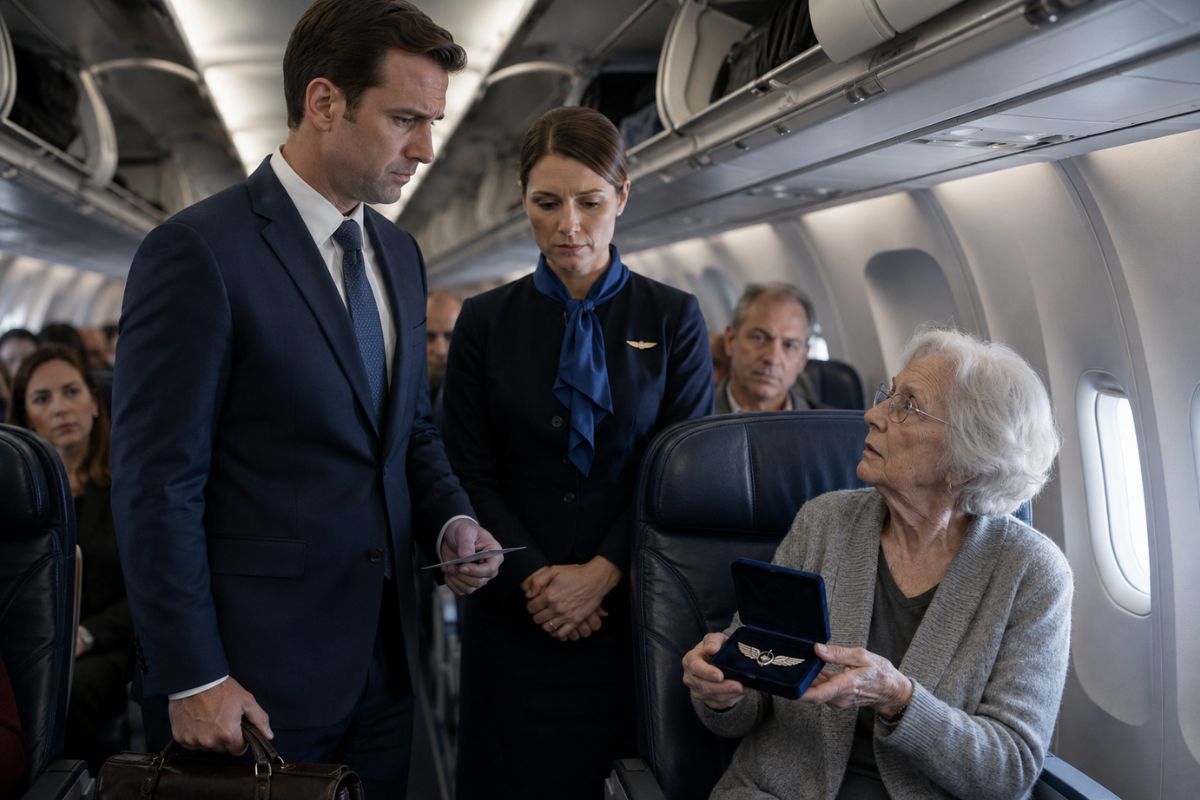
Now an old woman was sitting in 12A.
His seat.
She was small, neatly dressed, and holding a navy velvet box against her chest like it was alive. Her gray cardigan was buttoned wrong at the top. Her white hair was pinned back with a silver clip. She looked up at him through thick glasses, not angry, not confused.
Just tired.
“Please,” she said softly. “Just the window until takeoff.”
Ryan glanced at the seat number above her head. “Ma’am, I’m 12A.”
“I know.”
That made it worse.
He gave a short laugh, the kind people use when they are trying not to lose control but already have. “You know?”
She swallowed. “The flight attendant said she would ask.”
“Ask who?”
“You.”
Ryan looked around at the watching faces. He hated being watched. He hated scenes. He hated the way strangers made one person the villain before they knew a single thing about him.
He had paid extra for that seat. Not because he loved windows. Because he needed one thing to go right.
“My connection in Dallas is tight,” he said. “I have work to do. I chose that seat three weeks ago.”
The old woman’s fingers tightened around the box.
The lid had shifted slightly open. Inside, Ryan caught a flash of metal.
Silver wings.
Pilot wings, old ones, tarnished at the edges.
For half a second, something in his chest moved.
Then he killed it.
“I’m sorry,” he said, though nothing in his voice sounded sorry. “But I paid for dignity.”
The woman looked down.
That was when the flight attendant arrived.
Her name tag read Ava. She looked young enough to still believe calm voices could fix everything, but old enough to know they usually did not.
“Sir,” Ava said, placing one hand lightly on the seatback, “please lower your voice.”
“My voice is fine,” Ryan said.
Ava kept her expression steady. “Mrs. Pike was hoping to sit by the window for takeoff. We have an aisle seat available just two rows back.”
“Great,” Ryan said. “She can take it.”
Ava breathed in through her nose.
The old woman, Mrs. Pike, touched the velvet box with her thumb. “I only need it until we’re in the air.”
Ryan looked at her again. There was no entitlement in her face. No demand. That almost irritated him more. If she had been rude, he could have matched it. If she had acted superior, he could have put her in her place.
But she was just sitting there, quiet and embarrassed, while everyone else pretended not to stare.
His father would have called him sharp.
His mother, when she was still alive, would have called him ashamed.
Ryan pushed that thought away.
“I’m not switching,” he said.
Ava lowered her voice. “Sir, it’s a short request.”
“No,” Ryan said. “It’s a seat I paid for.”
The old woman slowly started to rise.
It took effort. She placed one hand on the armrest, the other around the little box. Her knees shook. The man in the Titans hoodie stood halfway, as if he might help, then stopped when Ryan glanced back.
Mrs. Pike gave Ryan a small nod.
Not forgiveness.
Not blame.
Just acknowledgment.
That bothered him most.
“I’m sorry,” she whispered.
Ryan stepped aside, letting her squeeze past him into the aisle. Her shoulder brushed his suit jacket. She smelled faintly of hand lotion and peppermint gum.
As she moved, the velvet box slipped.
Ryan reacted before thinking. He caught it against his briefcase before it hit the floor.
The lid popped open.
The silver pilot wings lay inside on a folded piece of yellowed paper. The paper had a name written across it in careful blue ink.
Captain Jack Pike.
Ava saw it.
Her face changed.
The professional calm disappeared for one quick second, replaced by recognition so sharp it made Ryan uncomfortable.
Mrs. Pike reached for the box. “Thank you.”
Ryan handed it back, but Ava was still staring.
“Mrs. Pike,” Ava said quietly, “are those his wings?”
The old woman gave a tiny nod.
“My son asked me to bring them,” she said. “He wanted them near the cockpit today.”
Ryan frowned. “Why?”
Mrs. Pike looked toward the closed cockpit door at the front of the plane.
“My son is flying this plane.”
The cabin went still in that strange way crowded places sometimes do, when no one admits they are listening but everyone hears.
Ryan looked from Mrs. Pike to Ava.
Ava turned to him slowly. “What’s your last name again, sir?”
He held up the boarding pass, irritated. “Harper. Ryan Harper.”
Ava looked at the boarding pass.
Then at the wings.
Then back at Ryan.
Her voice dropped so low only the three of them could hear.
“And those wings,” she said, “are for the man your father never thanked.”
Part 2
Ryan stared at Ava like she had spoken in another language.
“My father?” he said.
Mrs. Pike’s face shifted.
Not shock exactly.
Recognition.
Like she had been waiting years for a door to open, and now that it had, she was afraid of what might step through.
Ava glanced toward the front galley. Boarding had slowed. A line of passengers stood in the aisle behind Ryan, pretending to check overhead bins while listening to every word.
“Sir,” Ava said gently, “maybe you should sit down for a moment.”
“I’m not sitting down until somebody tells me what that means.”
Mrs. Pike touched Ava’s sleeve. “It’s all right.”
Ava leaned closer. “Mrs. Pike—”
“It’s all right,” the old woman repeated.
Ryan noticed then that her hand was trembling harder than before.
That should have softened him.
Instead, it made him defensive.
“My father is in a care facility outside Franklin,” he said. “He hasn’t flown in twenty years. Whatever you think you know—”
“I know his name,” Mrs. Pike said.
Ryan stopped.
“Glen Harper,” she said.
The sound of his father’s name inside that airplane cabin made the space feel smaller.
Ryan’s father had once been the kind of man people noticed in airports. Tall. Pressed shirt. Clean shoes. A voice that made gate agents stand straighter. He had worked for airlines most of his life—first in operations, then safety training, then corporate consulting after his knees went bad.
He was not that man anymore.
Now he sat by a window in a beige room, asking the same questions twice and apologizing to people who were not there.
Ryan had spent the last six months resenting him for falling apart.
Mrs. Pike looked down at the velvet box. “Your father was first officer on Flight 486 out of St. Louis in 1998.”
Ryan knew the number.
Not because anyone had explained it to him.
Because he had seen it written on envelopes in his father’s desk.
Again and again.
His mother once told him not to ask about it.
His father once snapped at him for touching a folder with that number on the tab.
Ryan had been twelve.
After that, he learned there were rooms inside his father no one was allowed to enter.
“What about it?” Ryan asked.
Mrs. Pike ran her thumb along the edge of the box.
“My husband was a passenger on that flight,” she said. “Retired Navy pilot. He was flying home from Kansas City after helping our daughter move.”
Ava stood close by, quiet now.
“The plane had trouble after takeoff,” Mrs. Pike continued. “Not the kind they put in movies. No screaming. No masks dropping. Just smoke where smoke shouldn’t be, alarms, a captain who hit his head during turbulence, and a young first officer with thirty-seven lives behind him.”
Ryan’s throat tightened.
The cabin noise faded until all he could hear was the air vents overhead.
“Your father did not freeze,” Mrs. Pike said, as if answering an accusation Ryan had not spoken. “That’s what some people said later. But my husband never said that. Jack said your father kept the plane alive long enough for help to matter.”
Ryan blinked.
That was not the version he had imagined.
In the private courtroom of his own mind, he had always made his father guilty of something simple: cowardice, maybe. Pride. Failure. Something clean enough to hate.
Mrs. Pike’s voice grew softer.
“My husband was asked to come forward from Row 3. He knew the aircraft. He talked your father through a checklist. Helped him keep his hands steady. Helped him land.”
A man across the aisle lowered his eyes.
Ryan looked at the cockpit door.
“My father never told me,” he said.
“No,” Mrs. Pike replied. “I don’t imagine he did.”
“Then why did Ava say he never thanked him?”
Mrs. Pike looked at Ava, then back at Ryan.
“Because he didn’t,” she said.
The words landed plainly.
No cruelty in them.
That somehow made them harder.
“My husband didn’t want attention,” she said. “He said your father was young, and young men can be ruined by one bad headline even when they did more right than wrong. Jack told the airline not to make a hero out of him. Said he was just a passenger who knew where to put his hands.”
Ryan looked at the wings again.
“But your father,” she continued, “couldn’t bear needing someone. That was the sad part. Not the emergency. Not even the silence afterward. The sad part was that needing help embarrassed him more than almost dying.”
Ryan felt heat crawl up his neck.
It sounded too familiar.
Mrs. Pike’s eyes said your father was young, and young men can be ruined lifted to his. “Jack waited for a call. Not for praise. Just a call. One man to another.”
Ryan thought of his father at the nursing home three days earlier, gripping his wrist with surprising strength.
“There’s someone I need you to find,” Glen had said.
Ryan had sighed. “Dad, I have a Dallas meeting Thursday.”
“Pike,” his father whispered. “Tell her I knew.”
Ryan had thought it was dementia.
Another broken piece floating up.
He had not asked.
He had not stayed.
He had looked at the clock.
Now he remembered the envelope in his briefcase.
The manila one his father had pushed toward him with shaking hands.
Ryan had shoved it into the side pocket beside contracts and presentation notes, annoyed by its weight, annoyed by another unfinished thing.
His stomach turned.
He set the briefcase on the seat and opened it.
His fingers moved past a laptop, a legal pad, a packet of numbers that had seemed urgent an hour ago.
Then he found it.
A yellowed manila envelope.
On the front, in his father’s uneven handwriting, were three words.
For Mrs. Pike.
The old woman saw it.
Her mouth parted slightly.
For the first time since Ryan had boarded, her composure cracked.
Ryan held the envelope but did not give it to her right away. Not because he wanted to keep it.
Because suddenly it felt too heavy to move.
“I didn’t know,” he said.
Mrs. Pike’s expression was tired, but not cold.
“That is often how pride survives,” she said. “It lets the children inherit the silence without telling them why.”
Ava looked toward the front of the plane. “Mrs. Pike, Captain Pike asked if you made it to the window.”
Ryan’s head turned.
“Captain Pike?”
Mrs. Pike nodded slowly.
“My son,” she said. “Daniel. He was nine when his father landed with your father. Today is his final flight before retirement.”
She held up the velvet box.
“He wanted his father’s wings in the cabin.”
Ryan looked at Seat 12A.
The window seat.
The wing view.
The old woman had not wanted comfort.
She had wanted to watch her son carry his father’s memory into the sky.
And Ryan had made her ask permission for it.
Part 3
Ryan stepped back into the aisle.
No speech came to him.
That was probably for the best.
For most of his life, words had helped him win. He could negotiate, redirect, explain, smooth over, make himself seem reasonable. He had built a career doing it.
But in Row 12, with Mrs. Pike holding her husband’s wings and his father’s envelope resting in his hand, words felt cheap.
He looked at Ava.
“Can I take the aisle seat two rows back?”
Ava’s face softened. “Yes, sir.”
Ryan turned to Mrs. Pike. “Please take 12A.”
She studied him for a moment.
Not because she wanted him to suffer.
Because she was deciding whether his humility had arrived or whether his embarrassment had.
There was a difference.
Ryan held out the envelope.
“My father asked me to find you,” he said. “I didn’t listen.”
Mrs. Pike looked at the envelope but did not take it yet.
“He’s alive?” she asked.
Ryan nodded. “Yes. But he’s sick.”
“I’m sorry.”
That undid him more than anger would have.
After everything, she was sorry.
Ryan’s eyes burned. He looked down quickly, pretending to adjust the strap of his briefcase.
“I thought he was rambling,” Ryan said. “He kept saying ‘Pike’ and ‘wings’ and ‘tell her I knew.’ I thought it was just… old guilt.”
Mrs. Pike’s voice was gentle. “Sometimes old guilt is the mind’s last honest room.”
Ryan handed her the envelope.
This time she took it.
Her fingers rested on his father’s handwriting.
Ava helped her back into 12A. Ryan moved aside and stood in the aisle while she settled by the window. Outside, a baggage cart rolled past under a gray Tennessee sky. The wing stretched beyond the glass, white and still.
Mrs. Pike placed the velvet box on her lap.
Then she opened the envelope.
Ryan did not mean to read. He looked away at first.
But the cabin was quiet, and Mrs. Pike’s hands shook so much that Ava leaned in and quietly asked, “Would you like me to help?”
Mrs. Pike nodded.
Ava unfolded the letter.
She read softly, only for the three of them.
Glen Harper’s handwriting was uneven, but the words were clear enough.
He wrote that he had spent twenty-eight years remembering Jack Pike’s hand on his shoulder in a cockpit full of smoke. He wrote that he had mistaken silence for strength. He wrote that he had let gratitude turn into shame, and shame turn into distance, and distance turn into a life where the most important thank-you became impossible to say.
Mrs. Pike pressed one hand to her mouth.
Ava paused.
Ryan stared at the floor.
The letter was not polished. It did not excuse him. It did not make Glen Harper noble. It simply told the truth in the voice of a man who had run out of time to protect his pride.
Near the end, Ava’s voice thinned.
“He says,” she continued, “‘Jack did not save my reputation. He saved my life, my wife’s life after that, and the life of my son, who was still young enough to think I was brave. I am sorry I let him carry my thanks alone.’”
Mrs. Pike closed her eyes.
For a long moment, no one spoke.
Then the cockpit door opened.
A tall man in a captain’s uniform stepped out.
He had silver at his temples and his mother’s eyes.
“Mom?” he said.
Mrs. Pike looked up.
For one second, she was not an elderly passenger in Row 12. She was a young mother again, seeing her boy come home from school, from war, from work, from the long dangerous world.
“Danny,” she whispered.
Captain Daniel Pike stepped into the aisle. His gaze moved from his mother to the wings, then to Ryan.
Ava quietly said, “Captain, this is Ryan Harper.”
The name did what names do when they carry history.
Daniel Pike’s jaw tightened.
Ryan braced himself.
He deserved whatever came.
But Daniel only looked at his mother.
“Did he give you the letter?” he asked.
Mrs. Pike nodded.
Daniel swallowed. “Good.”
Ryan frowned slightly.
“You knew?”
Daniel gave a small, tired smile. “My mother got a call from your father’s care facility two weeks ago. He asked for our address. She didn’t tell me until yesterday.”
Ryan looked at Mrs. Pike.
She folded the letter carefully. “Your father wanted to make it right.”
“I almost stopped that from happening,” Ryan said.
Mrs. Pike looked at him with sad warmth. “Almost is not the same as did.”
Daniel reached for the velvet box. His mother opened it and lifted the tarnished silver wings.
For a moment, the whole airplane seemed to hold its breath.
No announcement.
No applause.
No movie scene.
Just an old woman pinning her late husband’s wings inside her son’s uniform jacket while a few strangers quietly wiped their eyes and pretended not to.
Daniel bent and kissed her forehead.
“Dad would’ve liked the window,” he said.
Mrs. Pike laughed once through tears. “He would’ve complained about the legroom.”
That broke the tension just enough for everyone to breathe.
Ryan gave a small, ashamed smile.
Then he picked up his briefcase and moved toward the aisle seat two rows back.
Before he sat, Mrs. Pike touched his sleeve.
“Ryan.”
He turned.
“When you see your father,” she said, “tell him Jack heard him.”
Ryan’s throat closed.
“He didn’t say it in time,” he said.
“No,” she replied. “But he finally stopped protecting the wrong thing.”
Ryan nodded.
The flight took off a few minutes later.
From 14C, he watched Mrs. Pike sit by the window with her hand resting on the velvet box. Outside, Nashville fell away in patches of road, rooftops, church parking lots, and morning traffic. Ordinary America, shrinking beneath them.
Ryan thought about all the things people defend because they are afraid to be small: seats, titles, reputations, old versions of themselves.
His father had waited almost thirty years to say thank you.
Ryan had almost needed thirty seconds to refuse it.
The plane climbed above the clouds.
In Row 12, Mrs. Pike looked out over the wing, and for the first time that morning, Ryan was grateful he was not in the seat he had paid for.