If you’ve already read part 1 of this story on Facebook, go here for Part 2!
The boy looked too young to be standing in a pawn shop alone with that kind of grief on his face.
He couldn’t have been more than sixteen.
Maybe seventeen if life had been especially mean to him.
He stood just inside the door with one hand wrapped around a black violin case and the other shoved so deep in the pocket of his hoodie it looked like he was holding himself together from the inside. His eyes were red. Not the watery red of allergies. The swollen, raw kind that came from trying not to cry in public and failing at it in private.
Outside, rain tapped against the window in cold little bursts. Inside, the shop smelled like old metal, dust, coffee that had been sitting too long, and things people once loved enough to keep.
There were guitars hanging on the wall.
A line of watches in the glass case.
Power tools.
Wedding rings.
A military jacket with faded patches.
A row of forgotten things waiting for new owners or no owners at all.
Marty, the clerk behind the counter, looked up over his reading glasses.
He had worked at Harlan’s Pawn for twenty-two years and had seen every version of desperate walk through that door. Men pawning their tools on Thursdays and buying them back on payday. Women selling jewelry after divorces they swore were “mutual.” Teenagers trying to unload game consoles that still had somebody else’s name scratched into the bottom.
So when he saw the kid gripping that violin case like a secret, his first thought wasn’t sympathy.
It was trouble.
“What’ve you got there?” Marty asked.
The boy stepped forward and set the case on the counter carefully, like even now he couldn’t bear to be rough with it.
“A violin,” he said.
His voice was thin. Scraped out.
Marty gave a dry little grunt. “I can see that.”
The boy swallowed. “I just want to know what it’s worth.”
Just that.
Not I want to sell it.
Not Can you help me.
Just what it’s worth.
Marty had heard that line before too.
“Yours?” he asked.
The boy hesitated half a second too long.
That was enough.
Marty leaned back in his stool. “Because I’m not putting my business on the line for something that fell off the back of a truck. Or out of somebody’s living room.”
The boy’s face changed fast.
Not guilty.
Wounded.
He blinked hard and looked down at the scuffed toes of his sneakers. One lace was frayed almost to nothing.
“It’s mine,” he said quietly.
Marty folded his arms. “Then you won’t mind telling me where you got it.”
The kid’s grip tightened on the case handle.
For a moment, Marty thought he might bolt.
Instead, he said, “My mom.”
There it was, Marty thought. Inherited. Probably just like half the sad stuff that came through here.
Still, something didn’t sit right. The violin case wasn’t cheap plastic. It was old but well-kept, black leather with worn brass clasps and a handle polished by years of carrying. Somebody had cared for it. The boy hadn’t thrown it onto the counter like he was unloading junk. He’d laid it down like it mattered.
But habit is a stubborn thing.
“Your mom give it to you,” Marty said, “or you helping yourself to her belongings while she’s not looking?”
The boy flinched.
It was small, but sharp enough to land in the room.
There was only one other customer in the shop—a broad-shouldered man in a dark work jacket, maybe late fifties, standing near the glass case where the watches were displayed. He’d been quiet since he came in, hands in his pockets, waiting while Marty finished with the kid. Thick gray ran through his hair. His face was worn in that calm, weathered way some people get after years of carrying things they don’t talk about.
At Marty’s comment, the man lifted his head.
The boy cleared his throat, but his voice still cracked.
“She died three days ago.”
Everything in the room seemed to pause.
Even the rain.
Marty’s mouth shut.
The boy stared at the case, not at either of them, and went on like he was saying something he had already repeated too many times to too many adults who didn’t know what to do with it.
“She had hospital bills. I found notices. Past due. Final notice. And rent. And…” He pressed his lips together. “I just need to know what it’s worth.”
Marty felt heat crawl up the back of his neck.
He had not meant—
Well, maybe he had meant suspicion.
He just hadn’t meant this.
The stranger by the watches took a step closer, but said nothing yet.
Marty cleared his throat. “Son, I—”
He stopped. Apologies can sound thin in places like that.
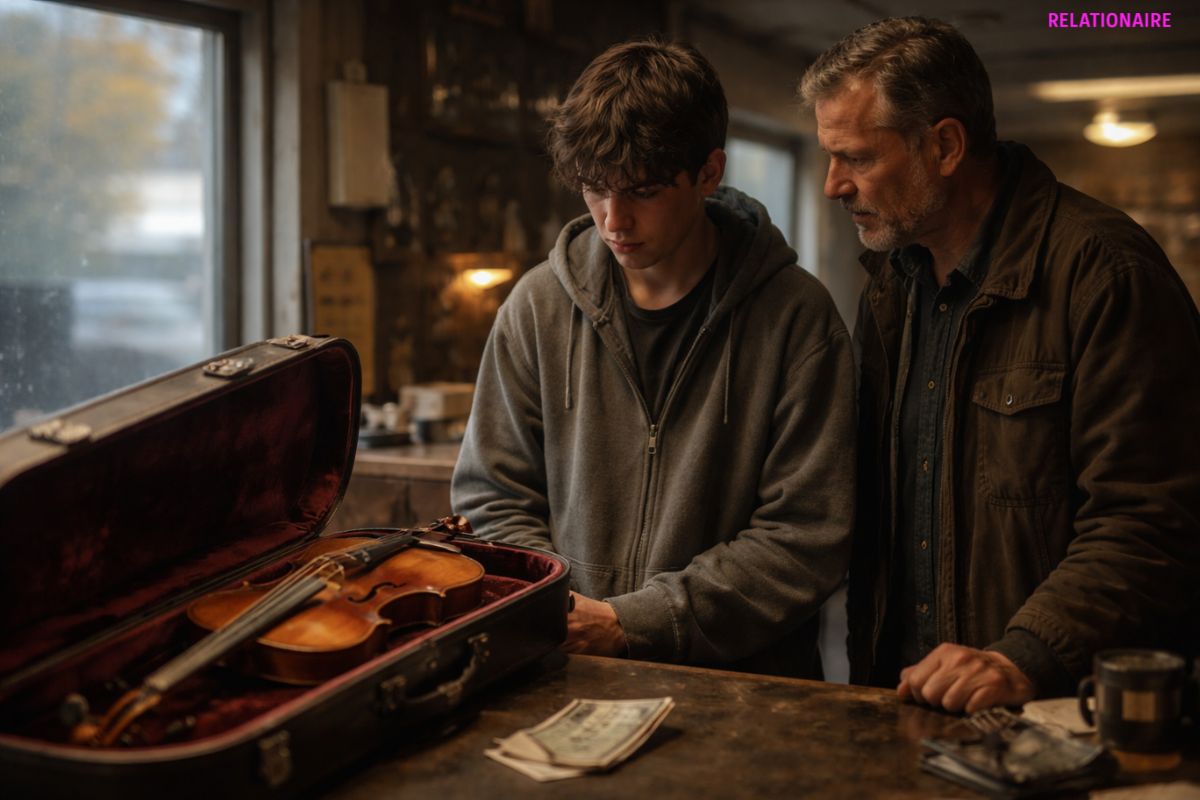
Instead, he gestured toward the case. “Open it.”
The boy unclasped it with trembling fingers.
Inside, on faded wine-colored velvet, lay a violin that looked older than the building.
Not flashy.
Not polished up to impress.
Just beautiful in the kind of way that makes people lower their voices without knowing why.
The wood glowed a deep amber-brown under the fluorescent lights. The chinrest showed years of use. Near the tailpiece, the varnish had worn soft where a hand must have rested over and over. It didn’t look like a school instrument. It looked lived in.
Marty reached for it carefully.
The boy moved before he could stop himself. “Don’t.”
The word came out quick and panicked.
Then he looked ashamed of it.
“Sorry,” he said. “Just… please be careful.”
Marty nodded once. “All right.”
He leaned forward instead, examining it without touching.
The stranger was close enough now to see inside the case too. His eyes settled on the violin, then on the bow, then on the folded piece of paper tucked into the velvet pocket near the scroll. He didn’t comment on any of it.
Marty squinted. “Could be decent. Could be worth something. Depends on the maker, condition, whether it’s authentic, whether there’s repair damage…”
The boy’s shoulders sank with every cautious word.
Marty knew that look too.
People didn’t come in hoping for “depends.”
They came in hoping for rescue.
“How much?” the boy asked.
“I can’t tell you exact without inspecting it properly.”
“How much if you had to guess?”
Marty exhaled. “Few hundred. Maybe more. Maybe less. Market’s odd on instruments.”
The boy went pale in a different way.
Like a few hundred wasn’t enough.
Like he had come here needing a miracle and been handed bus fare.
He looked down, nodded once, and started closing the case.
That was when the stranger finally spoke.
“Ask him to play it.”
Marty glanced up. “What?”
The man kept his eyes on the boy. “Before you say what it’s worth, ask him to play just one note.”
The shop went quiet again.
The boy stiffened. “I’m not here for that.”
The stranger’s voice stayed gentle. “I know.”
Marty frowned. “This isn’t a recital hall.”
“No,” the man said. “But sometimes instruments tell the truth faster than people do.”
The boy’s eyes flashed—anger this time, or embarrassment. Maybe both.
“I said I’m not here for that.”
The stranger nodded like he understood more than he was saying. “Then I’ll ask different.”
He reached into his jacket pocket and pulled out a crumpled ten-dollar bill. He laid it on the glass counter between them.
“One note,” he said. “If I’m wrong, keep the ten and walk out.”
The boy stared at the bill like it offended him.
Marty almost told the man to stop. The kid was hanging on by threads already.
But then the boy looked down into the open case.
At the violin.
At the bow.
At that folded paper tucked near the scroll.
His throat moved.
Very carefully, like he was handling something alive, he lifted the violin into his hands.
He didn’t tuck it under his chin right away.
He just held it there, staring at it with a look so naked and broken that Marty suddenly felt like an intruder in something sacred.
Then the boy set his jaw, raised the instrument, and drew the bow across the strings.
Only one note.
That was all.
But it filled the pawn shop so completely it seemed to press against every watch, every guitar, every secondhand wedding ring and old tool and broken promise in the place. The note was low and aching and clean. Not the scratchy sound of a kid who fooled around in school orchestra for a semester. It was something else. Something trained. Something lived with.
Something loved.
Marty felt the hair rise on his arms.
The stranger closed his eyes.
And the boy—
The boy lost the fight with his face.
His mouth trembled.
His hand shook.
The bow slipped.
He lowered the violin too fast and bent over like the sound had hit him in the stomach.
“I can’t,” he whispered.
The stranger opened his eyes.
There was something unmistakable in them now. Recognition. Shock. Grief.
He stared at the boy, then at the violin, then at the folded paper in the case pocket.
When he spoke, his voice had changed.
“Kid,” he said softly, “before you sell that violin…”
He paused, like the next words hurt to say.
“I need you to tell me your mother’s name.”
Part 2
For a second, nobody moved.
The rain kept ticking at the windows.
A neon beer sign from the bar two doors down threw a faint red pulse across the pawn shop floor, and the boy stood frozen in it with the violin still in his shaking hands.
Marty looked from the stranger to the kid.
The room felt suddenly crowded with something heavier than silence.
The boy’s eyes narrowed first with caution, then with anger. Not loud anger. The kind born from too many people suddenly acting interested only after they sensed there was something valuable in front of them.
“Why?” he asked.
The stranger didn’t answer right away.
Because there are moments when the truth arrives all at once, and people need a second to stand under its weight.
Finally he said, “Because I think I knew that violin before I ever knew you.”
The boy’s grip tightened.
“That doesn’t make any sense.”
“What was your mother’s name?” the man asked again.
The kid looked at Marty, like maybe the clerk would step in and stop whatever strange turn this was taking.
But Marty was no help now. He was too busy trying to make sense of the man’s face. That look wasn’t opportunistic. It wasn’t the sharp, eager look of somebody smelling money.
It was grief recognizing grief.
The boy swallowed hard.
“Lena,” he said. “Lena Marrow.”
The stranger shut his eyes.
Just for a moment.
When he opened them again, they were wet.
“Oh,” he said.
Only that.
But it landed like something breaking.
The boy took a step backward. “How do you know her name?”
The man let out a breath that sounded old.
“My name is Gabriel Vale,” he said. “Most people call me Gabe.”
That meant nothing to the boy.
It didn’t have to.
Gabe glanced at the violin. “Your mother used to play with the Ashbury Civic Quartet. Small venues, churches, fundraisers, community recitals. Nothing glamorous. But she was the best player in the room every single time.”
The boy’s head jerked up.
“She stopped playing before I was old enough to remember,” he said quickly, almost defensively. “So if this is some story—”
“It’s not a story.”
Gabe reached slowly into his wallet and pulled out an old photo so worn at the edges it looked like it had been carried for years.
He laid it on the counter.
Marty leaned in.
The boy did too.
It was a photo of four musicians standing outside a brick church, bundled in winter coats, holding their instruments and smiling into bad afternoon light. Younger versions of them. One man with darker hair and a violin under his arm. An older woman with a viola. A cellist in a long scarf.
And there, second from the left, was a woman with tired eyes and a beautiful crooked smile, holding the same violin now trembling in the boy’s hands.
His mother.
The boy made a sound so small Marty almost missed it.
“No,” he whispered.
Gabe pointed to himself in the picture. “That’s me.”
The boy stared.
Marty stared too.
The kid’s whole face had gone slack with shock. “She never said anything about a quartet.”
Gabe gave a sad little nod. “That doesn’t surprise me.”
He didn’t say it bitterly. Just like a man accepting a truth he’d lived with for years.
The boy looked down at the violin, then back at the photo, then at Gabe.
“She quit,” he said. “She told me she quit because life got busy.”
Gabe’s eyes moved to the folded paper in the case pocket. “Did she tell you why?”
The boy shook his head.
Marty noticed then that the folded paper was not just any paper. It was an envelope. Cream-colored once, now yellowed with age. A name was written on the front in blue ink, though from where he stood he could only make out the first letter.
Gabe noticed Marty noticing, and something passed across his face.
Not guilt.
Regret.
The boy saw it too.
“What is this?” he asked. “How do you know about that letter?”
Gabe looked at him carefully.
“Because I wrote it.”
No one spoke.
The fluorescent lights buzzed overhead.
Outside, a truck hissed through rainwater on the street.
The boy set the violin back in its case with more force than before, but still not enough to hurt it. Then he grabbed the envelope and held it out.
“You wrote this?”
Gabe nodded.
“It’s never been opened,” the boy said.
His voice sharpened with accusation, like this stranger had somehow failed an exam he didn’t know he was taking.
“I know,” Gabe said.
“How would you know that?”
“Because I gave it to her the night she stopped playing.”
The boy’s breath came fast now. Marty could see it in his shoulders.
There are some things grief does to a person that look like anger from the outside. Sometimes that’s easier to survive.
“You expect me to believe you just happened to be standing in a pawn shop the day I bring this in?” the boy said.
“No.”
“Then what?”
Gabe glanced at Marty, then back at the boy. “I came in to pawn my watch.”
That simple.
He rolled back his sleeve and showed the pale band on his wrist where one had sat for years. Marty looked at the display case. Sure enough, Gabe had been standing there when the boy walked in.
The randomness of it made the moment feel even stranger.
Crueler somehow.
Or kinder.
The boy’s face crumpled, then hardened again. “So what, this is fate?”
“No,” Gabe said quietly. “I think this is a rainy Thursday and two people meeting something they weren’t ready to meet.”
Marty turned away a little, pretending to straighten a receipt printer that didn’t need straightening. Some moments felt too private to witness head-on.
The boy looked down at the unopened letter in his hands.
“Why did she stop?” he asked.
Gabe swallowed.
“Because of me.”
The kid’s head snapped up.
Gabe rubbed a hand over his mouth. “Your mother and I…” He stopped, restarted. “We were close. Closer than we should’ve been, maybe. We played together for years. We talked after rehearsals. Ate terrible pie at the diner on Mercer. Shared more than music.”
The boy’s eyes widened. He looked suddenly much younger.
“You were with her?”
Gabe shook his head. “Not exactly. We were building toward something. At least I thought we were.” His voice thinned with memory. “I asked her to leave Ashbury with me. Chicago. Better orchestra work. More chances. I had a letter from an ensemble there. I thought if she came too, we could start over.”
“What happened?”
“She didn’t show.”
The words came out flat, like a sentence long rehearsed and never softened.
“I waited at the station for two hours. Then I found out why.”
The boy didn’t blink.
Gabe looked at him the way people look at fragile things they’re afraid of dropping.
“She was pregnant.”
The boy went very still.
Marty felt the room shift again.
Not because the fact itself was dramatic. Because of the math that instantly followed it.
The kid’s red eyes.
His age.
The years.
“She chose you,” Gabe said.
The boy’s lips parted, but nothing came out.
“She never told me in person. A week later, she sent my letter back unopened. No note. No explanation. Just the envelope, exactly like that.” Gabe nodded toward the one in the boy’s hand. “I thought she hated me. Thought she blamed me. Thought maybe I had imagined what we were to each other.”
The boy stared at the letter like it might suddenly speak.
“She kept it,” he said.
“Apparently.”
Marty could see the boy fighting several kinds of pain at once now. The pain of his mother being gone. The pain of learning she had a whole life before he was old enough to understand it. The pain of hearing that she gave something up—music, love, maybe a future—without ever placing the weight of that choice on his shoulders.
“She was sick for a long time?” Gabe asked carefully.
The boy shook his head. “Three months. Maybe less. She kept saying it was just exhaustion. Then it was tests. Then appointments. Then…” He stopped and pressed a fist to his mouth.
Marty looked away again.
“When she got bad,” the boy said after a moment, “she couldn’t play anymore. Her hands hurt too much.” He brushed at his face angrily. “But she’d still open the case sometimes. Just to look at it.”
Gabe closed his eyes again.
The boy looked at him, really looked this time, and something in his expression changed.
Not trust.
Not yet.
But uncertainty.
“My name’s Eli,” he said quietly.
Gabe nodded like the name mattered.
“It does,” he said. “Thank you.”
Eli turned the envelope over in his hands.
On the front, in faded blue ink, Marty could now read it clearly:
For Lena — if there’s still time.
Eli’s face twisted.
“She never opened it,” he said. “Maybe she didn’t want to.”
“Maybe,” Gabe said.
Then, after a beat:
“Or maybe she couldn’t bear to.”
The boy’s fingers trembled on the seal.
“You said before I sell the violin,” Eli whispered. “What weren’t you saying?”
Gabe reached into the inside pocket of his jacket and pulled out a folded leather checkbook. Old-fashioned. Worn.
Then he looked at Marty.
“What’s the most you’d have told him if you were buying it?”
Marty hesitated. “If it’s what I think it might be? Couple thousand, maybe more, depending on provenance.”
Eli’s face drained.
That was more money than he’d expected, but not enough to explain Gabe’s expression.
Gabe nodded once. “That violin was made by Tomas Bellori. Your mother’s grandfather had papers on it. It isn’t just decent, son.”
He looked at Eli with the kind of gentleness that hurts.
“It could be worth enough to pay every one of those hospital bills.”
Eli staggered back against the counter.
Marty actually reached a hand out, thinking the kid might fall.
But Gabe wasn’t done.
He looked at the unopened letter in Eli’s hand and said, very softly:
“And if you want to know why I’m sure…”
He stopped there.
Because Eli was already sliding one shaking thumb under the sealed flap.
Part 3
The envelope opened with the soft, dry sound of paper giving up a secret.
Eli stood hunched over the counter, breathing through his mouth like the air had changed and he didn’t trust it anymore.
Gabe didn’t move.
Marty didn’t either.
Inside the envelope was a single sheet, folded three times. The paper had gone thin at the creases. Eli opened it carefully, as if rough hands might erase whatever had survived this long.
His eyes moved across the page once.
Then again, slower.
The pawn shop stayed silent except for rain and the distant hum of traffic outside. Marty could hear the old wall clock ticking above the guitars.
Eli’s lips parted.
He sat down hard on the stool by the counter without seeming to know he was doing it.
“What does it say?” Marty asked before he could stop himself.
Eli looked up, dazed, then back at the page.
“It says…” He swallowed. “It says, ‘Lena, if there’s still time, come anyway. If you can’t, write. If you’re scared, tell me why. I can live with heartbreak. I can’t live with not knowing.’”
His voice shook harder on the next line.
“‘If there’s a child, I want to know that too.’”
Gabe covered his mouth with his hand.
Eli blinked rapidly and kept reading.
“‘You once told me music is the only place you never lie. So if you can’t say it to my face, send me one note. Any note. I’ll understand it came from your whole heart.’”
He stopped.
Looked at the violin.
Then at Gabe.
“That’s why you asked me to play.”
Gabe nodded once.
His eyes were full now.
“Your mother had a way of speaking through sound when words broke down. She played one note once after her father died. One note. I knew exactly what she meant.” He glanced at the violin, remembering. “When you played just now… it was her. Not because you sound exactly like her. You don’t. It was the ache in the way you leaned into it. That same place in the note.”
Eli looked at the letter again. His shoulders began to shake.
“She never mailed anything back,” he said. “She never told you about me.”
“No.”
“Why?”
That question was too large for the room.
Gabe took his time answering.
“Maybe she was afraid I’d ask her to leave again.”
“She could’ve said no.”
“She could have.”
“Maybe she thought you’d say she trapped you.”
“I wouldn’t have.”
“I know that,” Eli said, suddenly angry. “But maybe she didn’t.”
That landed.
Gabe nodded slowly. “Maybe she didn’t.”
The anger left Eli as quickly as it came, burned out by grief. He rubbed at his face with the heel of his hand, embarrassed by the tears and too exhausted to hide them.
“She did everything alone,” he said. “Every single thing. Two jobs. School forms. Rent. Doctor visits. The car breaking down. All of it.” He laughed once, bitter and broken. “And I used to get mad because she forgot stuff. Field trip money. Parent forms. One time she missed my concert because she was covering a shift, and I told her not to bother coming to the next one.”
Gabe listened without interrupting.
“I didn’t know she was sick until she collapsed in the kitchen,” Eli said. “I thought she was just tired. Always tired.” He stared at the paper in his hand. “Then after she died, I found all these bills in a cereal box over the fridge. All those notices. Her landlord’s message. The pharmacy receipt.” He looked toward the violin. “And that case. I knew it mattered, but I thought…” He swallowed. “I thought dead people don’t need beautiful things.”
Marty turned away and pretended to reorganize a row of pocketknives.
Some pain deserved privacy, even in a pawn shop.
Eli’s voice dropped almost to a whisper. “I hate that I brought it here.”
“You brought it here because you were trying to survive,” Gabe said.
“That’s not noble.”
“No,” Gabe said gently. “It’s human.”
The boy looked at him then with the same stunned expression people sometimes wear when kindness hurts worse than criticism. Because criticism is easy. Mercy asks you to forgive yourself, and that takes more strength.
Gabe stepped closer to the counter.
“Eli, listen to me. Do not let this become another thing your mother had to lose for both of you.”
Eli shook his head fast. “I don’t have a choice.”
“You do.”
“No, I don’t. The rent is due Monday. The hospital keeps calling. I have seventeen dollars in my checking account and half a loaf of bread at home.” His voice cracked again. “So unless violins can magically turn into groceries—”
“They can,” Gabe said.
Eli stared.
Marty did too.
Gabe pulled a chair over and sat across from him so they were eye level.
“I’m on the board of the Ashbury Arts Foundation,” he said. “Not because I’m important. Because I got old enough to care where music goes when people can’t afford to hold onto it.” He nodded toward the violin. “If the papers still exist, and if the instrument is authenticated—and I’d bet my house it will be—we can place it with a conservator and arrange a foundation-backed purchase or loan agreement.”
Eli blinked.
Marty blinked too.
“I don’t understand,” Eli said.
“It means,” Gabe said, “you do not sell this to a pawn shop for the fastest money in the room.”
Marty lifted a hand. “Fair.”
Gabe almost smiled, then looked back at Eli. “It means the foundation can advance funds against its appraised value to cover immediate expenses. Rent. Bills. Food. Legal paperwork if you need it. Then we decide together whether it should be sold to a collector, loaned to a conservatory, or kept in your family with its value protected another way.”
Eli just stared at him.
“You’d do that?”
“Yes.”
“Why?”
Gabe could have said because of your mother.
Because of regret.
Because I should have searched harder twenty years ago.
Because I have wondered about both of you for so long it became part of the furniture of my life.
Instead he told the simplest truth.
“Because I can,” he said. “And because someone should have stood next to her sooner.”
That was the line that broke Eli.
Not dramatically.
No sobbing collapse. No movie scene.
He just folded in on himself a little, letter in one hand, the other hand over his eyes, and breathed like somebody who had been carrying a full-grown man on his back and had just been told he could set him down.
Marty quietly slid the tissue box from beside the register across the counter.
No one mentioned it.
After a minute, Eli straightened and wiped his face.
“What if I don’t deserve that?” he asked.
Gabe’s expression changed then—soft, but certain.
“Deserving has very little to do with the best things people do for each other.”
The rain was slowing now.
A thin gray light pressed through the front window where the clouds had started to break.
Marty cleared his throat. “I know a probate attorney who doesn’t charge kids just to scare them with paperwork. My sister used her after her husband died. Good woman.”
Eli turned toward him, surprised.
Marty shrugged awkwardly. “And there’s a diner down the street. Best chicken soup in Ashbury. You look like you haven’t eaten since Tuesday.”
A wet little laugh escaped Eli before he could stop it.
“That obvious?”
“To anyone with eyes,” Marty said.
Gabe stood. “First things first. We call the foundation director. Then the attorney. Then you eat.”
Eli looked down at the violin case.
He ran his fingers over the worn leather handle.
“My mom wanted me to play when I was little,” he said quietly. “I quit after six months. Said it was boring.”
Gabe smiled sadly. “That tracks. Most children are fools.”
Eli let out another laugh, more real this time.
Then he went serious again.
“She used to stand in the kitchen and hum when she cooked,” he said. “Not songs from the radio. Other things. I used to think she was making them up.” He looked at Gabe. “Maybe she was remembering.”
“Probably,” Gabe said.
Eli nodded slowly.
For the first time since he walked in, he didn’t look like a boy trying to get rid of something.
He looked like a son trying to understand what had been placed in his hands.
Marty watched him close the case again, but differently now. Not like surrender. Like stewardship.
The red neon from outside had faded with the storm light. The shop no longer looked quite as tired.
Gabe took out his phone and stepped aside to make a call.
Marty gave Eli a paper cup of bad coffee anyway, because sometimes bad coffee is just warm hands and an excuse to sit still.
Eli held the cup, stared at the case, and said quietly, almost to himself, “I thought I came in here to lose the last thing that mattered.”
Marty nodded once.
“And?”
Eli looked through the front window where the rain had thinned to mist.
“Turns out,” he said, “sometimes the thing you almost let go of is the thing that brings someone back.”
Later, after the calls were made, after the soup was ordered to go because Eli wanted to eat at home where his mother’s mug still sat by the sink, after names were written down and plans were made for morning, he lifted the violin one more time before leaving.
Just once.
He tucked it under his chin and played a single note into the thinning gray day.
Gabe looked down.
Marty stood very still.
The note wasn’t hopeless this time.
It still hurt.
It probably always would.
But it carried something else now too.
Not certainty.
Not healing, not yet.
Just enough room inside the grief for another person to stand there with him.
And sometimes that is how life changes.
Not all at once.
Not with speeches.
Not even with answers.
Sometimes it changes because in the moment you are most prepared to lose everything, somebody hears one broken note and decides not to let you carry it alone.