If you’ve already read part 1 of this story on Facebook, go here for Part 2!
Every night at 2:17, the same woman bought the cheapest coffee in the hospital.
Not the fresh kind from the café downstairs. That closed at nine.
Not the machine by the emergency room that still spat out something almost drinkable if you got lucky.
She bought the pale, bitter coffee from the vending machine outside the maternity wing. The one that tasted like wet cardboard and pennies. The one even the night-shift security guard joked could bring a person back from the dead out of pure spite.
She always used exact change.
Always stood there with both hands wrapped around the paper cup like she was trying to keep them from shaking.
And she never went into a room.
At St. Agnes, people noticed patterns because night shift ran on them.
The woman came in a little before two, wearing the same thrift-store coat with one broken button near the collar and sneakers so worn the white rubber at the toes had gone gray. She had a canvas tote bag hanging from one shoulder and a phone with a cracked screen she checked but never seemed to answer.
She never asked for directions.
Never checked in at the desk.
Never visited postpartum.
Never went near labor and delivery.
She just sat in the plastic chair beside the vending machine, under the framed print of yellow daisies that had faded almost white from years of bad fluorescent light, and waited until almost dawn.
Then she left.
For twelve nights, the staff made up stories about her.
“She’s probably sleeping in the waiting rooms,” one unit clerk whispered.
“Could be someone’s ex,” said another. “You’d be amazed what people do when there’s a baby involved.”
One respiratory tech thought she might be unstable.
A postpartum nurse said she gave her a bad feeling.
Not cruelly. Just the quiet way tired people talk when they’re trying to explain what they don’t understand.
Only Marcus, the security guard, never joined in.
He was a broad-shouldered man in his late fifties with silver at his temples and the habit of speaking gently to everyone, even the drunks in the emergency entrance. He saw her the first night and started nodding to her after that.
She nodded back.
That was all.
On the thirteenth night, Tessa finally saw her up close.
Tessa had been on her feet for eleven hours in the NICU already. Her scrub top had a smear of formula near the hem. Her ponytail was slipping. The skin under her eyes had that bruised look nurses got when sleep had become something other people did.
She was heading to the vending machine for crackers because she’d missed dinner again.
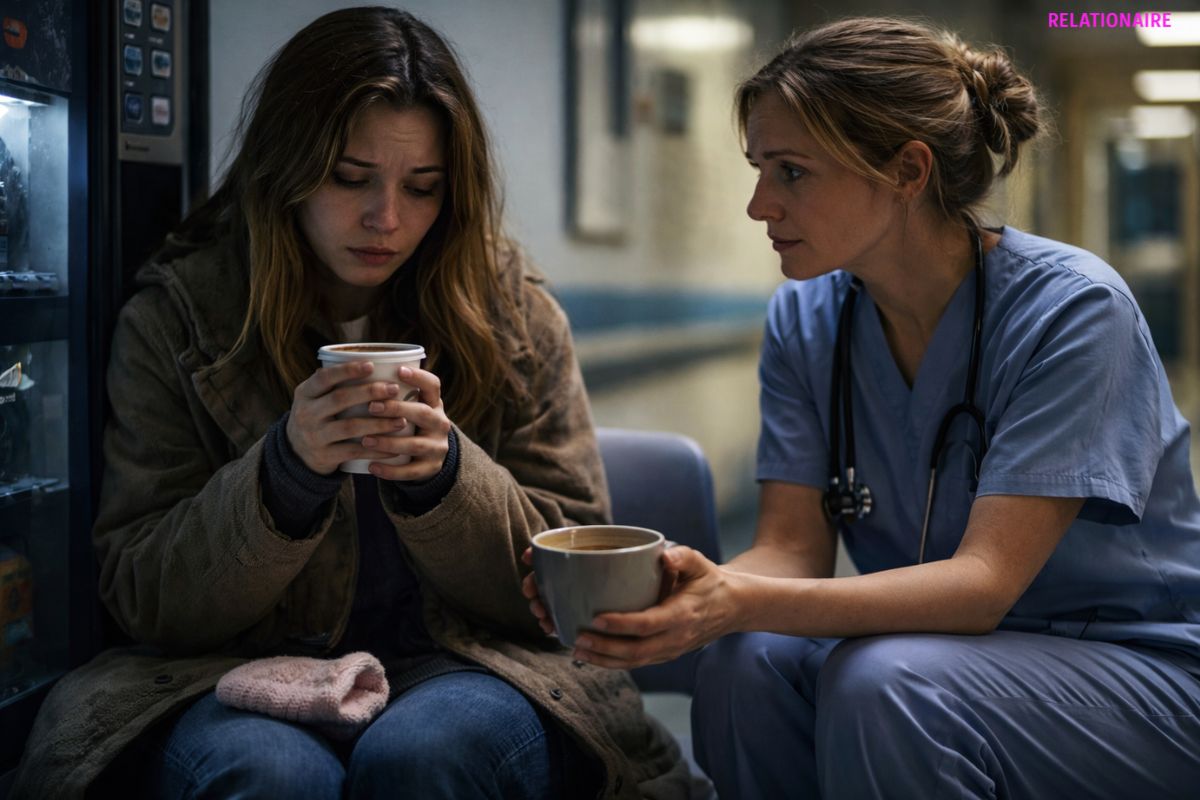
That’s when she saw the woman sitting there, curled inward on herself, staring at a paper cup she hadn’t touched.
She looked young. Younger than Tessa expected. Maybe twenty-three. Twenty-four at most.
No makeup. Chapped lips. A faint crescent of old tape residue on the inside of one wrist, like a hospital bracelet had been pulled off too fast. Her eyes were fixed on nothing.
On the chair beside her was a tiny knit cap.
Pink.
Folded neatly on top of the canvas tote.
Tessa slowed.
The woman noticed and quickly turned the cap over with one hand, as if hiding it.
That small motion did something sharp and strange inside Tessa’s chest.
“You waiting for someone?” Tessa asked.
The woman blinked, like she’d forgotten other people could see her.
“No,” she said softly.
It should have ended there. Tessa should have gotten her crackers and gone back to Bed 4, where a premature baby boy had just finally stabilized after a rough start.
Instead she heard herself say, “You’ve been here a lot.”
The woman lowered her eyes. “I know.”
Her voice was calm, but her grip tightened around the paper cup until the lid bent.
Tessa was too tired for patience and too human for indifference.
“This floor isn’t really a public lounge,” she said, and instantly hated how she sounded. Like every suspicious nurse the woman had probably already run into.
The woman nodded as if she deserved that.
“I’m sorry,” she said. “I don’t make trouble.”
That should have made Tessa feel better.
It made her feel worse.
Because there was something about the way she said it—small, practiced, almost rehearsed—that sounded like a person who had spent too much of her life trying not to be an inconvenience.
Tessa glanced at the untouched coffee. “That stuff’s awful.”
A tiny, tired smile touched the woman’s mouth. “It’s cheap.”
“Barely qualifies as coffee.”
“It’s warm.”
That landed harder than it should have.
Tessa looked at her coat, the tote bag, the hidden pink cap, the exhausted stillness of someone trying not to take up too much space in a place built for other people’s emergencies.
Then she said, “Wait here.”
The woman’s face changed instantly—panic, not gratitude.
“No, please, I can go—”
“I’m not calling security,” Tessa said.
That made the woman glance up, surprised.
Tessa held up a hand. “I’m getting you real coffee.”
For a second, the woman looked like she might cry over those three words alone.
Tessa went to the staff lounge, where the coffee was stronger and at least tasted like it had once met an actual bean. She found a clean mug with faded blue stripes and filled it nearly to the top. On impulse, she grabbed two packets of sugar and one of those tiny sealed creamers.
When she came back, the woman was exactly where she’d left her.
Still small in the plastic chair.
Still trying to disappear.
Tessa handed her the mug.
The woman stared at it like no one had handed her anything warm in years.
“You’ll have to give it back,” Tessa said, trying for lightness.
The woman took the mug with both hands.
It was ridiculous, maybe, how careful she was with it. Like it wasn’t hospital ceramic but something breakable and precious.
“Thank you,” she whispered.
Tessa sat down beside her before she could overthink it.
The vending machine hummed.
A baby cried somewhere far down the hall.
Overhead, the fluorescent lights buzzed faintly, flattening everything into a tired kind of honesty.
For a while, neither of them spoke.
Then the woman said, without looking at her, “The nurse with the red glasses thinks I’m crazy.”
Tessa winced. “I’m sorry.”
“The unit clerk thinks I’m homeless.”
Tessa said nothing.
“And one of the aides told security I might be trying to steal a baby.”
That made Tessa go cold.
She looked at her sharply. The woman kept her eyes on the mug.
“I’m not,” she said.
“I know,” Tessa answered, before she had even asked herself how she knew.
The woman gave the smallest nod.
“Twelve nights,” Tessa said quietly. “Why here?”
The woman swallowed.
Her throat moved once. Then again.
When she finally spoke, her voice sounded like something dragged over broken glass.
“Because if I sit here long enough,” she said, “sometimes I can hear her cry through the doors.”
Tessa didn’t move.
The hallway seemed to narrow around them.
The woman opened the canvas tote and took out a folded piece of paper, softened at the creases from being opened too many times. She held it in her lap without handing it over.
Tessa saw one word at the top before the woman’s thumb covered it.
Discharge.
And beneath that, in thick black handwriting, another word.
Mother.
Tessa’s heart knocked once, hard.
The woman’s eyes filled, but her face stayed eerily still.
“They told me it would be easier,” she said. “For bonding. For feeding. For consistency. They said it was temporary, and they said I could come back when—”
Her breath broke.
She shut her eyes.
“When I was stable enough.”
Tessa stared at her.
The pink cap on the chair.
The hospital bracelet mark.
The maternity floor.
The nights spent outside a door she never entered.
Not a visitor.
Not a drifter.
Not unstable.
A mother.
One who had been near enough to hear her baby cry.
And still had never been allowed to hold her.
Tessa felt shame hit her so fast it was almost physical.
“What’s your name?” she asked.
The woman opened her eyes.
“Lena.”
“Tessa.”
Lena nodded, as if names mattered now that the worst thing had already been said.
Tessa looked at the folded paper in her lap. “Why weren’t you allowed?”
Lena’s fingers trembled against the crease.
At first Tessa thought she wouldn’t answer.
Then Lena lifted her gaze to the locked NICU doors at the end of the hall.
And in a voice so quiet Tessa almost missed it, she said, “Because the last time they put my daughter in my arms, I asked them not to take her back.”
Tessa went still.
Lena took a shaky breath and tightened her grip on the discharge paper.
“There’s more,” she whispered. “You need to know what happened the day she was born.”
And then she unfolded the paper between them.
PART 2
The paper shook in Lena’s hands.
Not dramatically. Not like in movies.
Just enough for Tessa to notice how hard Lena was fighting to keep control of herself.
The top half was standard hospital language. Discharge instructions. Medication notes. Follow-up care. The kind of paperwork most people shoved into a purse and forgot until a bill came.
But clipped to it was something else.
A photocopied form with names blacked out.
At the bottom, in a signature box, Lena’s name was written in uneven blue ink.
And under it, one word that made Tessa’s stomach drop.
Relinquishment.
Tessa looked up too fast. “Lena—”
“I know what it looks like.”
Lena said it without anger.
That almost made it worse.
She stared straight ahead at the NICU doors, where a badge reader blinked red in the empty hallway.
“I was twenty-two. I had no apartment. I was sleeping in my car behind a tire shop off Route 6. Her father was gone before I even started showing, and my mother…” She stopped there, swallowed, and started again. “My mother said if I loved the baby, I’d let someone better raise her.”
Tessa said nothing.
The right silence matters in a hospital. Nurses learn that.
Lena looked down at the form.
“I told myself I was signing because I was brave,” she said. “That’s what the social worker kept calling it. Brave. Selfless. Loving.”
Her mouth twisted.
“But I’d been awake for thirty hours. I’d lost a lot of blood. I was scared. I hadn’t held her for more than maybe five minutes total. One nurse put her on my chest, and I remember counting her fingers because I couldn’t believe something that small was real.”
Tessa felt her own throat tighten.
“She had a little crease in one ear,” Lena said, her voice drifting somewhere far away. “And this dark hair right at the crown. Not everywhere. Just there. Like somebody touched her with a paintbrush.”
She smiled then.
It was the saddest thing Tessa had seen in months.
“Then they took her to the NICU because she was early,” Lena said. “They told me it was routine at first. Then it wasn’t. She had trouble breathing. They kept saying she needed monitoring. I kept saying I wanted to see her. They said after I signed the papers, things would be… less confusing.”
Tessa’s stomach turned.
“You signed before you were discharged?”
Lena nodded.
“I signed before I had slept. Before I had eaten. Before I had seen her without wires.” Her hand drifted over the crease in the paper. “And after I signed, everything changed.”
The maternity wing around them went on breathing like usual.
Phones rang at the desk.
A cart squeaked by somewhere.
A newborn let out a thin, outraged cry from behind a closed door, and then another, softer voice soothed them.
But the bench outside the vending machine felt sealed off from all of it.
Tessa understood pieces now.
Not the whole story. But enough to know the whispered version on the unit was uglier than the truth.
“What happened after?” she asked.
Lena looked exhausted suddenly. Old, in a way that had nothing to do with age.
“They moved fast,” she said. “I think they were supposed to. I think once I signed, everyone had a job to do. Paperwork. Placement. Phone calls. I don’t even know who all the people were.” She laughed once, without humor. “One woman kept saying this was a beautiful beginning for everyone involved.”
Tessa shut her eyes for half a second.
Beautiful beginning.
Hospitals had a terrible habit of putting polished phrases over raw wounds.
Lena continued.
“I told them I changed my mind the same day.”
Tessa opened her eyes.
“What?”
“I told them I wanted to revoke it. I said I hadn’t understood. I said I’d been scared and I wanted my baby. I said I’d sleep in a shelter if I had to. I said I’d do anything.”
Her voice began to shake for the first time.
“They told me the process had already begun.”
“That fast?”
“They said I could talk to legal aid. They said there were waiting periods and statutes and consent rules and procedural steps. They kept using words while I was still bleeding through a pad the size of a mattress.”
Tessa let out a breath through her nose.
The rage came quietly.
Not loud. Not hot.
Cold and focused.
“Did anyone advocate for you?” she asked.
Lena gave her a look that answered before she spoke.
“I didn’t know how to ask.”
That landed like a bruise.
Tessa had worked NICU for nine years. She knew the good the system could do. She also knew what happened when exhausted people with no money got folded into it.
“What about the baby now?” she asked. “Is she still here?”
Lena nodded toward the locked doors. “Born at thirty-three weeks. She’s stronger now. They said maybe another week, maybe two.”
Tessa’s chest tightened.
That meant Lena had been sitting outside the very unit where her child slept.
Night after night.
Close enough to hear alarms.
Close enough to catch the occasional cry when the doors opened.
Close enough to feel like a ghost haunting her own life.
“Why didn’t you come during the day?” Tessa asked gently.
Lena looked embarrassed.
“That’s when the adoptive couple visits.”
The words were so plain they split Tessa open.
“Oh.”
Lena pressed her lips together.
“They’re not bad people,” she said quickly, which was the kind of thing broken people said when they didn’t want to sound cruel. “I’m sure they’re good. They have money. A house. They brought little swaddle blankets with her name embroidered on them before I’d even picked one.”
Her hand flew to her mouth then, too late.
Tessa caught it.
“Her name?”
Lena went still.
A long second passed.
Then she whispered, “I called her Ivy.”
Tessa looked down at the pink knit cap.
Was that why Lena carried it? Because it was the only thing she’d chosen for her own child?
Before Tessa could ask, Marcus appeared at the far end of the hallway with his usual rolling gait, coffee in one hand and a radio clipped to his shoulder. He slowed when he saw them sitting together.
Everything okay? his face asked.
Tessa gave the smallest nod.
Marcus returned it and kept moving, but not before setting a fresh packet of crackers silently on the chair beside Lena as he passed.
He didn’t say a word.
Lena stared at the crackers after he walked away.
“I didn’t know he was being kind,” she said.
“Most kind people don’t announce it,” Tessa answered.
For the first time, Lena looked like she might actually cry.
She blinked hard and looked up at the NICU doors again.
“I don’t want to ruin anyone’s life,” she said. “That’s the part nobody gets. If it was just about me being hurt, I’d leave. But she’s mine. And also maybe not mine now. And those are not the same thing, but they both feel true.”
Tessa didn’t know what to say to that because some pain did not fit inside comforting language.
So she asked the only question that mattered.
“What do you want?”
Lena laughed softly, brokenly. “You mean besides impossible things?”
“Yes.”
Lena rubbed her thumb over the edge of the mug.
“I want someone to tell me whether I still have a right to fight.”
That sentence sat between them like a live wire.
Tessa thought about the day’s charting, the feeding schedules, the oxygen settings, the stack of forms she had signed over the years without looking twice because her job was the baby in front of her.
Then she thought about a young mother on no sleep, bleeding, scared, alone, signing something while other people called it brave.
And she thought: maybe the wrong people had been protected by how efficient everything was.
“Tessa?”
It was another nurse, calling from down the hall.
Bed 6 needed help with a desat.
Tessa stood automatically, years of training pulling her upright before her heart could catch up.
“I have to go,” she said.
Lena gave a quick nod, already folding inward again, as if she had asked for too much by talking.
Tessa looked at her.
At the coat.
The cap.
The discharge papers.
The grief so carefully contained it had started to look like loitering from a distance.
Then she made a decision before she could talk herself out of it.
“Don’t leave tonight,” she said.
Lena blinked. “Why?”
“Because my charge nurse gets in at four-thirty, and there’s a social worker on call I trust more than most attending physicians.”
Lena stared at her, stunned.
“I can’t promise anything,” Tessa said quickly. “I don’t know what’s legally possible. I don’t know how far things have gone. But I know this much—you should never have been left alone with paperwork bigger than your life.”
Lena’s eyes filled.
Tessa leaned closer.
“And if there’s still a door open,” she said, “we’re going to find it.”
A sound came out of Lena then, half sob and half breath, like hope hurt worse than despair because it required the body to wake back up.
Tessa squeezed her shoulder once and headed down the hall at a near run.
The next two hours blurred.
A brady episode in Bed 6.
A feeding tube issue in Bed 3.
One father panicking over monitor numbers.
A resident asking questions with the confidence of someone who had never watched a mother break in real time.
But under all of it, Lena sat in Tessa’s mind like a pulse.
At 4:38 a.m., Tessa cornered Angela Price, the senior social worker, just as she was taking off her coat.
Angela was in her sixties, with iron-gray hair, sharp eyes, and the weary posture of someone who had seen too many systems fail people while insisting they were helping them.
Tessa spoke fast.
She left nothing out.
The young mother. The signed forms. The attempted reversal. The midnight visits. The baby in NICU. The adoptive couple. The possibility—God, please let there still be one—that the process was incomplete.
Angela listened without interrupting.
Then she said two words that made Tessa’s whole body go cold.
“Baby Ivy?”
Tessa stared.
Angela’s face changed.
Not confusion.
Recognition.
And then something worse.
Regret.
“You know this case?” Tessa asked.
Angela looked down the hallway toward the vending machine.
When she spoke, her voice was low.
“Yes,” she said. “And if that girl is still here, there’s something you need to understand before you bring her in.”
Tessa felt the floor tilt under her.
“What?”
Angela took a breath.
“The reason Lena was never allowed to hold her daughter again,” she said, “was not the paperwork.”
PART 3
For one suspended second, Tessa heard nothing.
Not the monitors.
Not the overhead pages.
Not the hiss of the oxygen by Bed 2.
Just that sentence.
It was not the paperwork.
Angela’s face had gone pale in the harsh morning light.
Tessa stepped closer. “Then what was it?”
Angela looked around, lowered her voice, and said, “Walk with me.”
They moved into the empty family consult room near the end of the NICU hall. It smelled faintly of hand sanitizer and old coffee. There was a sofa nobody ever looked comfortable on and a box of tissues on the table that had been used often enough to lose all meaning as décor.
Angela shut the door.
Then she leaned both hands on the table like she needed the support.
“I remember Lena,” she said. “Not because cases like hers are unusual. Because they should be, and still somehow aren’t.”
Tessa waited.
Angela went on.
“The adoption paperwork was real. The timing was ugly, but technically within policy. I argued that she should have been given more time. I documented concerns about consent under physical distress. Legal reviewed it. Nobody loved it, but nobody stopped it.”
Tessa clenched her jaw.
Angela looked straight at her.
“But that wasn’t why they kept her from the baby after discharge.”
“Then why?”
Angela exhaled.
“Because Lena’s mother filed an emergency statement claiming Lena had threatened to run with the infant and disappear.”
Tessa stared. “Her mother?”
Angela nodded once.
“She told staff Lena was unstable. Said she’d had panic attacks during pregnancy. Said the baby would not be safe in her arms. She made herself sound like the responsible adult stepping in to prevent a crisis.”
A slow fury moved through Tessa’s chest.
“Was it true?”
Angela’s eyes hardened.
“No. Not the way it was framed.”
She opened a thin case file she had brought under one arm and slid out a photocopied nursing note.
“Lena had one panic episode after delivery,” Angela said. “One. She was hemorrhaging. She was sleep-deprived and terrified. She begged not to be separated from the baby. At one point she said, ‘If you give her back to me, I won’t let anyone take her.’”
Tessa closed her eyes.
There it was.
The line.
Not a threat.
A mother’s panic, spoken aloud in the worst hour of her life.
And someone had used it against her.
Angela tapped the page.
“That sentence became, in later retellings, a risk flag.”
Tessa opened her eyes again. “Her own mother did that?”
Angela nodded.
“She had a relationship with the adoptive family through her church. She believed she was ‘saving’ the baby from poverty. I’m not saying money changed hands. I never proved that. But influence? Pressure? Absolutely.”
Tessa sat down slowly.
The room seemed too small for the ugliness of it.
“Why didn’t Lena fight harder?” she asked, though even as she said it, she hated herself for how it sounded.
Angela heard that.
“She was trying to survive,” she said gently. “She was discharged to nowhere. No stable housing. No counsel she could afford. No family support. By the time legal aid got back to her, she was already behind the process. And every person she met kept talking to her like the decision was done.”
Tessa thought of Lena outside the vending machine, apologizing for existing.
No wonder she had seemed like someone haunting the building instead of entering it.
She had been trained out of her own claim.
“What can we do now?” Tessa asked.
Angela was quiet.
“Here’s the part nobody wanted to say out loud,” she said. “The baby hasn’t been discharged yet. Final placement has not been completed. That means there is still a window. Narrow. Complicated. But real.”
Hope flared so fast it almost hurt.
“And no one told Lena?”
Angela’s expression turned bitter.
“They told her versions of the truth that sounded final enough to make her go away.”
Tessa stood.
“Then we tell her the actual truth.”
Angela nodded. “Yes. But carefully. If we hand her hope and it collapses, it could destroy her.”
“Leaving her outside that vending machine is destroying her already.”
Angela didn’t argue.
At 5:12 a.m., Tessa found Lena exactly where she had left her.
The real coffee mug was empty now. The crackers Marcus had left were still unopened beside her. The pink cap sat in her lap.
She looked up the moment she saw Tessa’s face.
People carrying bad news always forget they’re visible from across a room.
Lena stood too fast. “What is it?”
Tessa didn’t answer in the hallway.
She took Lena into the consult room, where Angela introduced herself and spoke with the deliberate care of someone handling glass already cracked at the center.
Tessa watched the words land one by one.
Your rights may not be gone.
The process is not finalized.
What you said that day was taken out of context.
Your mother’s statement carried weight it should not have.
You may still be able to contest.
You should have been told sooner.
By the end, Lena was gripping the pink cap so tightly her knuckles had gone white.
She didn’t cry right away.
That came later.
First came disbelief.
Then anger.
Then a look Tessa had never seen before: a human being feeling the shape of stolen time.
“I was right outside,” Lena whispered. “All these nights, I was right outside.”
Angela nodded, tears in her own eyes now. “I know.”
Lena turned away, pressing her fist to her mouth.
“I heard her,” she said. “Sometimes I heard her cry and I thought… I thought maybe that was all I was allowed now. Just to be close enough to know she existed.”
Nobody in the room could stand that sentence.
Nobody was built to.
Things moved quickly after that.
Not magically.
Not neatly.
There were calls. Legal reviews. Supervisors pulled in before sunrise. A patient advocate who arrived in wrinkled clothes and came in hot. Notes reexamined. Signatures scrutinized. A judge reached through emergency channels before noon.
The adoptive couple came in just after ten.
Tessa saw them through the NICU glass first.
A well-dressed woman in a camel coat, a man carrying a gift bag with a plush elephant peeking out the top.
They looked like people who had painted a nursery and prayed hard and believed the world had finally turned toward them.
And that was the terrible thing.
They weren’t villains either.
When the truth reached them—the questions around consent, the mother’s coercion, the unresolved legal status—the woman sat down like her knees had stopped working.
The man covered his face.
There are some heartbreaks with no clean side to stand on.
By midafternoon, Lena had a lawyer.
By evening, she had a bed at a women’s transitional home arranged by Angela and two prepaid months funded quietly by a collection Marcus started before anyone even asked him to. The postpartum nurses who had once whispered about her filled the envelope hardest after they learned the truth.
One added a note that simply said: I’m sorry we looked at you and didn’t see you.
But the moment that stayed with Tessa happened before any of that.
Before the legal language.
Before the housing papers.
Before the signatures that might finally bend the story back toward the truth.
It happened at 1:06 p.m., when Angela stepped out of the NICU doors carrying a tiny bundled shape in a pale striped blanket.
Lena froze.
Every person in the hallway seemed to understand at once that something sacred was happening and stepped back without being asked.
Angela crossed the distance slowly.
Not because the baby was fragile, though she was.
Because the moment was.
Lena put both hands over her mouth.
“No,” she whispered, already crying. “No, I can’t—”
“You can,” Angela said.
Lena shook her head like it hurt to believe it.
Angela stopped in front of her.
“This is your daughter,” she said softly. “And right now, you are allowed to hold her.”
The sound Lena made then came from somewhere deeper than sobbing.
Somewhere old.
Somewhere that had been waiting outside locked doors for thirteen nights and much longer than that.
She reached out with trembling arms.
Angela laid the baby into them.
Tiny. Warm. Real.
Ivy’s face was mostly blanket and impossibly small features. Dark hair at the crown, just as Lena had remembered. One ear folded slightly at the top in the same little crease.
Lena stared as if her body had forgotten how to breathe.
Then Ivy made a soft, puzzled sound and settled against her chest.
And Lena folded around her daughter with the stunned, reverent instinct of a person catching something she had been falling toward in her sleep.
“There you are,” she whispered.
Not loudly.
Not theatrically.
Just the words a mother says when the world finally puts back one piece of what it took.
Tessa had to look away.
Marcus didn’t. He stood at the far end of the hallway with both hands clasped in front of him and tears running openly down his face.
Later, nobody would agree on what happened next.
Some said Ivy opened her eyes right then.
Some said Lena started singing before she even realized she was doing it.
Tessa only remembered the silence.
A whole hospital floor, for one brief moment, becoming quiet around a young woman in a thrift-store coat holding the child she had come night after night just to hear.
The case was not resolved that day.
That would take weeks.
There were hearings. Statements. grief on all sides. The adoptive couple stepped back when the evidence became clear, and the woman in the camel coat sent over the embroidered blanket anyway, with Ivy’s name unpicked at the corner and resewn in plain hand thread.
At first that crushed Lena.
Later she kept it.
Not because it didn’t hurt.
Because sometimes even sorrow can choose not to become cruelty.
Months later, Tessa saw Lena again.
Not in the vending alcove.
In the NICU follow-up clinic, with Ivy in a carrier against her chest and that same pink knit cap tucked in the diaper bag.
Lena had color in her face now. The shelter had turned into an apartment share. The legal aid team had helped. Marcus still checked in. Angela still called. The staff lounge had a small secret fund now for mothers in crisis, and nobody on night shift said “loitering” so casually anymore.
Ivy fussed until Lena picked her up.
Then she settled immediately, cheek pressed under her mother’s chin.
Lena looked at Tessa and smiled.
Not a broken smile this time.
A tired one. A real one. The kind people earn.
“I still can’t pass that vending machine,” she admitted.
Tessa smiled back. “You don’t have to.”
Lena looked down at Ivy.
“She won’t remember any of it,” she said.
Maybe not.
But Tessa thought some things leave a mark anyway. Not only the harm. Also the hands that interrupted it. The people who noticed too late, then chose not to look away again.
In hospitals, everyone talks about critical moments like they announce themselves with alarms.
Most of them don’t.
Sometimes they look like a woman with exact change buying terrible coffee at 2:17 in the morning.
Sometimes they look like a nurse sitting down.
Sometimes the whole shape of a life changes because one person finally asks, very simply, why.