If you’ve already read part 1 of this story on Facebook, go here for Part 2!
PART 1
By the time the last parent stopped clapping, the boy with the violin was already gone.
Not just gone from the stage.
Gone from the hallway, gone from the crowd of families taking pictures under the paper snowflakes, gone from the place where children usually waited to be told they did a good job.
Only his violin case was still there.
It sat alone on the second row of folding chairs in the gymnasium, black and scratched, with one silver latch hanging loose like a tired eyelid.
Mrs. Elena Ramos noticed it while stacking music stands after the winter concert.
The gym still smelled like floor wax, cafeteria pizza, and wet coats. Crumpled programs littered the bleachers. A glue stick cap rolled beneath a chair. Someone had left a red mitten near the piano bench.
The concert was over.
The noise was over.
But Mrs. Ramos stood still when she saw the case.
Because she knew whose it was.
Noah Bell.
Seventh grade.
Always late.
Always forgetting his music folder.
Always pretending not to hear when she asked him to tune.
Always giving that half-shrug that made adults feel dismissed before they had even finished speaking.
Mrs. Ramos closed her eyes for one second.
“Noah,” she whispered.
She didn’t say it angrily.
She was too tired for anger.
She had been at school since 6:45 that morning. She had fixed three broken music stands, retaped a torn cello bow, bought black socks for a boy whose family couldn’t afford concert clothes, and used her own lunch break to hem a girl’s skirt with safety pins from the front office.
Her feet hurt.
Her throat hurt.
Her heart hurt in that quiet teacher way nobody saw.
And now Noah had left behind the one thing he was responsible for carrying.
Again.
Mrs. Ramos picked up the case.
It was heavier than she expected.
“Of course,” she murmured.
From behind her, Mr. Han, the custodian, rolled his mop bucket across the gym floor.
“Another one left something?”
“Violin,” Mrs. Ramos said.
Mr. Han smiled softly. “Kids.”
But Mrs. Ramos did not smile back.
She looked toward the double doors where families had poured out ten minutes earlier, laughing, hugging, holding flowers from the grocery store.
Noah had not had anyone waiting for him.
She had noticed that too.
She noticed things even when she wished she didn’t.
The empty chair in the audience.
The way Noah kept glancing toward the back doors before his group played.
The way he stared down at the floor when the other children ran to their parents afterward.
But Noah had also rolled his eyes when she reminded him to stand straight.
He had almost walked offstage before the final bow.
And two weeks ago, when she asked why he had skipped rehearsal, he had said, “Because it’s not that serious.”
That sentence had sat in her chest like a pebble.
Not that serious.
She had wanted to tell him how serious it was.
How music could save a child who had nowhere to put his feelings.
How a classroom could be the only place some students were asked to create something beautiful.
How teachers stayed late not because they loved the fluorescent lights, but because sometimes a child’s life turned on a small hinge nobody else could see.
But she had only said, “Then try acting like it matters.”
Noah had looked at her.
Really looked.
Then he had packed his violin without another word.
Now the case was in her hands.
Mrs. Ramos carried it to the music room, her keys jangling against her hip. The hallway was dim except for the light leaking from the front office. The school felt different after concerts. Softer. Emptier. Like all the children had left pieces of themselves behind.
On the bulletin board outside her room, she passed the winter concert poster.
TONIGHT AT 6:00
COME CELEBRATE OUR STUDENTS!
Under it, someone had taped a crooked paper snowman.
One of Noah’s classmates had drawn a tiny violin in its stick hand.
Mrs. Ramos unlocked the music room and turned on the lamp near her desk. She didn’t use the overhead lights. They buzzed too loudly after a long day.
The room looked like every exhausted teacher’s room after a school event.
Sheet music spread across the piano.
Plastic cups from the reception.
A cracked rosin block on the floor.
Permission slips half-collected in a pile.
A forgotten hair ribbon on a chair.
Mrs. Ramos set Noah’s case on her desk.
She planned to put a sticky note on it.
NOAH — SEE MRS. RAMOS BEFORE HOMEROOM.
Maybe she would call home.
Maybe not.
The emergency contact form in the system listed his father, but the number worked only sometimes. Emails bounced back. Notes came unsigned. Noah’s hoodie sleeves were frayed at the cuffs. His backpack zipper had been broken since October.
Still, irresponsibility was irresponsibility.
That was what Mrs. Ramos told herself.
She reached for a sticky note.
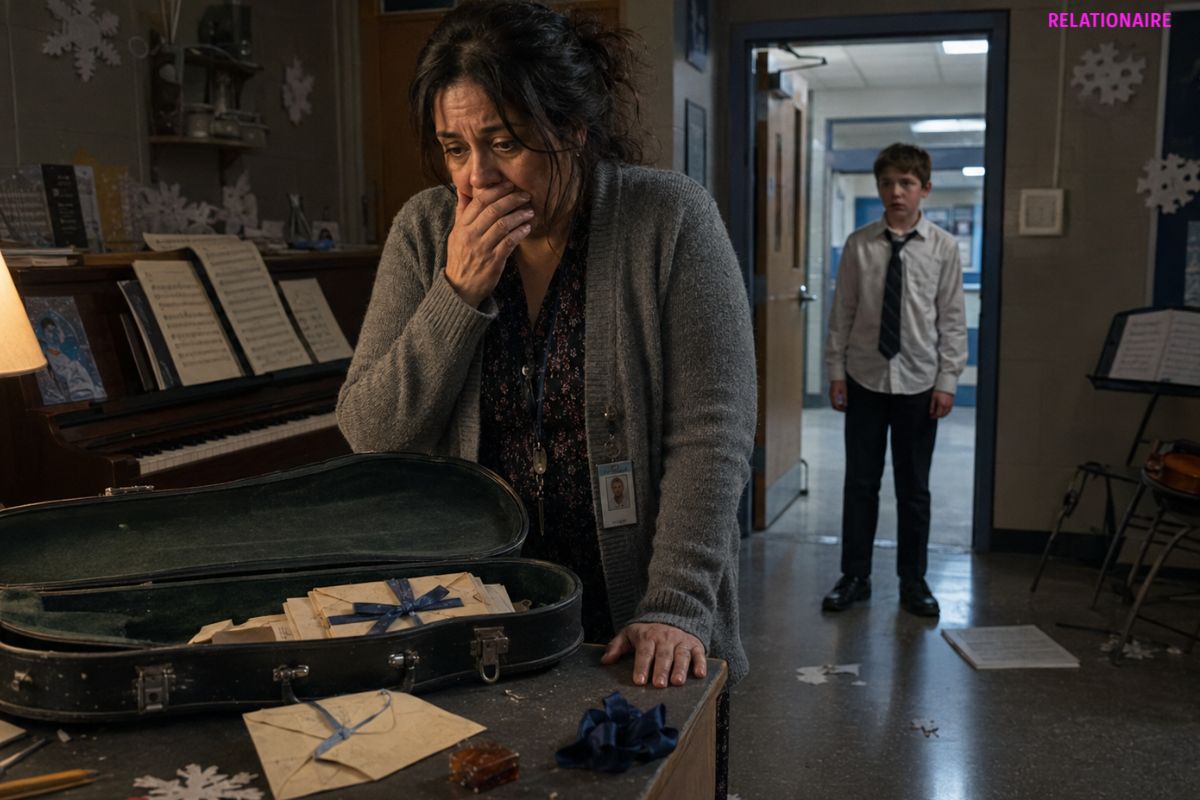
Then the loose latch on the case slipped open.
A small folded envelope slid partway out from the side pocket.
Mrs. Ramos froze.
She did not mean to pry.
Teachers were always walking a line between caring and intruding. Between noticing and respecting. Between asking one more question and letting a child keep the one private thing he still had.
She stared at the envelope.
It was old. Soft at the edges. Creased many times.
On the front, in careful handwriting, were two words.
For Noah.
Mrs. Ramos swallowed.
The room seemed to grow quieter.
She should have closed the case.
She should have pushed the envelope back inside, locked the latch, and waited until morning.
Instead, her eyes dropped to the corner of the envelope.
There was a date written there.
Four years ago.
Mrs. Ramos felt a strange chill move through her.
Four years ago was the year Noah’s mother had died.
Everyone on staff knew the basic story. Car accident. February. Noah had been nine. His father had pulled him out of school for two weeks. When Noah came back, he stopped singing in music class.
By sixth grade, he had chosen violin because, he said, “It’s small enough to quit.”
Mrs. Ramos had assumed he was joking.
Now her hand hovered above the case.
Inside, beneath the shoulder rest and wrinkled sheet music, she saw more envelopes.
Not one.
Many.
All tied with a faded blue ribbon.
Her breath caught.
At that exact moment, the hallway door opened.
Noah stood there in his concert clothes, shirt untucked, cheeks red from the cold, eyes fixed on the open case.
For once, he did not shrug.
For once, he looked exactly his age.
“Please,” he said, his voice breaking. “Don’t read those.”
PART 2
Mrs. Ramos stepped away from the desk so quickly her hip hit the chair.
“Noah,” she said softly. “I didn’t read them.”
His eyes moved from her face to the envelope and back again.
He didn’t believe her.
She could see that.
His hands were balled into fists at his sides, not angry fists. Scared fists. The kind children make when they are trying to keep themselves from falling apart in front of an adult.
“I came back for it,” he said.
“I know.”
“You opened it.”
“The latch was loose. An envelope slipped out.”
“You still looked.”
Mrs. Ramos had no defense for that.
So she gave him the only thing she could.
The truth.
“I saw your name,” she said. “And I stopped.”
Noah’s jaw tightened.
The lamp on her desk lit one side of his face. He looked smaller without the stage lights, smaller without his music stand in front of him. His black dress pants were too short. His shoes were scuffed at the toes. His tie was crooked in a way that made her wonder who had helped him put it on.
Maybe no one.
He crossed the room and grabbed the envelope, pushing it back into the case with shaking fingers.
“I shouldn’t have brought it,” he muttered.
Mrs. Ramos kept her voice low. “Why did you?”
Noah snapped the case shut.
“Because I’m stupid.”
“You’re not stupid.”
“You don’t know.”
“I know enough.”
That made him laugh once, hard and bitter.
“No, you don’t.”
The words landed exactly where they were supposed to.
Mrs. Ramos stood there with her tired feet and her teacher badge still hanging from her neck, and she knew he was right.
She knew his grades.
She knew his missed rehearsals.
She knew his late assignments, his empty practice log, his habit of staring out the window when she demonstrated bow hold.
She knew he had almost quit three times.
But she did not know what it cost him to stay.
Noah lifted the violin case from her desk and hugged it against his chest.
“My mom played this,” he said.
Mrs. Ramos did not move.
He looked down at the case like it might disappear if he loosened his grip.
“She was good. Like, really good. Not school concert good. Real good.”
“I didn’t know that.”
“She used to play in the kitchen.”
His voice changed when he said kitchen.
It softened.
“While making pancakes. While doing laundry. While waiting for water to boil. She’d put the violin under her chin and play some song from when she was little. I hated it sometimes because it was loud and I wanted cartoons.”
He wiped his nose with his sleeve, embarrassed by his own words.
“Then after she died, the house got quiet.”
Mrs. Ramos felt something inside her crack open.
Outside the music room, Mr. Han’s mop wheels squeaked faintly down the hallway.
Noah looked at the floor.
“My dad put the violin in the closet. He said it hurt too much to see it. But last year, I found it. The case had letters inside.”
He touched the latch with his thumb.
“She wrote them before she died. Not because she knew. Just… letters. Birthday letters. Random stuff. Things she wanted me to remember. My grandma said she used to write everything down because she was scared of forgetting people.”
His mouth twisted.
“Now everyone’s forgetting her.”
“Noah…”
He shook his head.
“Dad doesn’t say her name. Grandma gets sad when I ask. My little sister doesn’t remember her voice.”
Mrs. Ramos remembered then.
Noah had a younger sister in second grade.
Maya.
Quiet child. Big eyes. Always clutching the straps of her backpack.
“She came tonight,” Mrs. Ramos said carefully.
Noah looked up fast.
“What?”
“I saw Maya near the gym doors before the concert.”
His face went pale.
“She wasn’t supposed to.”
“Who brought her?”
“No one. She must’ve walked over from after-care.”
He pressed his fingers to his eyes.
“She kept asking if I was gonna play Mom’s song. I told her no.”
“Did you?”
Noah shook his head.
“I played the regular song. The one on the program. The easy one.”
Mrs. Ramos remembered his performance.
Noah had stood in the back row, half-hidden behind another student. His bow hand had trembled. He had missed two notes. Then, near the end, his sound had changed.
Only for a few measures.
It had become warmer.
Cleaner.
Like he had stopped fighting the instrument.
She had noticed, but she had been too busy cueing the cellos to think about it.
“What did you play at the end?” she asked.
Noah swallowed.
“Just three notes.”
“From your mother’s song?”
His silence answered.
He sat down in the chair beside her desk, still holding the case.
“I thought if I played it, I’d hear her,” he whispered. “But I didn’t. I just felt everybody staring at me. And then I felt mad. Like, why does everyone else get to take pictures with their moms after the concert?”
His face crumpled, but he fought it hard.
“Then Maya came up after and said, ‘You didn’t play it right.’”
Mrs. Ramos closed her eyes.
There it was.
Not disrespect.
Not laziness.
Grief with nowhere to sit.
A boy carrying his mother’s music in a case with a broken latch.
“I got mad at her,” Noah said. “I told her she doesn’t even remember Mom, so she should stop acting like she does.”
His voice went thin.
“She cried. Then she ran.”
“Where is she now?”
“At after-care. I checked before I came here.”
Relief passed through Mrs. Ramos, but only for a second.
Noah looked at the case again.
“I was going to throw it away.”
Mrs. Ramos went still.
“The violin?” she asked.
“The letters.”
The room seemed to lose air.
Noah’s thumb moved over the old blue ribbon inside the case.
“If I don’t have them, I don’t have to keep deciding whether to open them,” he said. “I don’t have to keep feeling like she’s almost here.”
Mrs. Ramos sat slowly in the chair across from him.
She thought of all the times she had told him to practice.
All the times she had written MISSING WORK beside his name.
All the times she had mistaken pain for attitude because attitude was easier to grade.
“Noah,” she said, “may I tell you something?”
He didn’t answer.
So she spoke gently anyway.
“My husband died six years ago.”
Noah looked up.
She rarely said it out loud at school. Most of the staff knew she was a widow, but students didn’t. To them, she was just Mrs. Ramos with the piano scarf and the coffee mug that said Please Do Not Make Me Use My Teacher Voice.
“He loved concerts,” she said. “He used to sit in the back and clap too loudly. Even for beginners. Especially for beginners.”
A small, sad smile touched her mouth.
“After he died, I almost stopped teaching music. Every song felt like a room he wasn’t standing in anymore.”
Noah listened without blinking.
“What made you not stop?” he asked.
Mrs. Ramos looked around the room.
At the chipped music stands.
At the winter concert programs.
At the tiny fingerprints on the piano lid.
“Students kept showing up,” she said. “So I did too.”
Noah’s face changed.
Not fixed.
Just less alone.
Mrs. Ramos nodded toward the case.
“You don’t have to open those letters tonight. You don’t have to play her song before you’re ready. And you do not have to throw away the only pieces of her handwriting you still have because grief is too heavy today.”
His eyes filled again.
This time he let the tears stay.
“What if I forget her anyway?”
Mrs. Ramos had no perfect answer.
Teachers are expected to have answers.
But the important moments rarely come with answer keys.
So she said, “Then we help you remember.”
The next morning, Noah did not come to homeroom.
By second period, Maya was absent too.
By lunch, the front office called Mrs. Ramos down.
Noah’s father was standing there in work boots, holding the violin case in one hand and the bundle of letters in the other.
His face was gray with exhaustion.
And when he saw Mrs. Ramos, he said, “I need to know what my son told you last night.”
PART 3
Noah’s father looked like a man who had been awake for years.
His name was Daniel Bell. Mrs. Ramos had seen it on forms, in email addresses that bounced back, on emergency contact sheets with numbers crossed out and rewritten.
But seeing him in the front office was different.
His jacket was dusty. His hands were cracked white at the knuckles. There was a smear of paint near his wrist. He held the violin case carefully, like it was fragile and guilty at the same time.
The school secretary lowered her voice.
“Mrs. Ramos, you can use the conference room.”
Daniel followed her in without sitting.
“I’m sorry,” he said first.
That surprised her.
“For what?”
“For not answering emails. For missing the concert. For whatever he did.”
Mrs. Ramos felt the old reflex rise in her.
The professional one.
The careful teacher one.
Noah had been inconsistent. Noah had been late. Noah had nearly quit. Noah had hurt his sister’s feelings.
But looking at Daniel Bell, she suddenly saw the other half of the story.
A father working until his hands cracked.
A house too quiet.
A man who could not look at a violin without losing his wife again.
“Noah didn’t do anything wrong,” she said.
Daniel’s face tightened.
“He left this.”
“He came back for it.”
Daniel looked down at the case.
“I found him sitting on the kitchen floor last night. All the letters spread around him. Maya was asleep under the table with her coat still on.”
His voice broke on Maya’s name.
“I didn’t even know she walked to the concert.”
Mrs. Ramos sat across from him.
Daniel finally sat too.
For a moment, neither of them spoke.
Through the conference room wall, morning announcements crackled over the speaker. A student laughed in the hallway. Somewhere nearby, a teacher reminded a class to walk, not run.
School kept moving.
Even when families were falling apart inside it.
Daniel rubbed both hands over his face.
“My wife’s name was Liana,” he said. “She played that violin since she was a girl. After she died, I couldn’t stand the sound of it. I put it away. I thought I was protecting the kids.”
He stared at the floor.
“But maybe I just made her disappear.”
Mrs. Ramos didn’t rush to comfort him.
Some guilt needs space before it can breathe.
“She wrote the letters?” Mrs. Ramos asked.
Daniel nodded.
“She wrote letters for everything. First loose tooth. First dance. Bad days. Good days. She said kids remember love better when they can hold it in their hands.”
He gave a broken laugh.
“I forgot she put some in the case.”
“Did Noah read them?”
“Some.”
Daniel reached into his jacket pocket and pulled out one envelope.
It was opened.
The paper inside was soft with age.
“He left this one on the table this morning.”
Mrs. Ramos did not reach for it.
Daniel unfolded it himself.
His eyes moved over the page.
Then he read, voice rough.
“Noah, if you ever play my violin and it hurts, that doesn’t mean you should stop. Sometimes love hurts when it comes back into the room. Play anyway, sweetheart. Not for the audience. Not even for me. Play so your own heart knows it survived.”
Mrs. Ramos looked away.
The conference room window faced the bus loop. A line of yellow buses sat empty in the pale winter sun.
Daniel folded the letter with shaking hands.
“He asked me this morning if he could play it again,” he said. “Not in a concert. Just somewhere Maya could hear.”
Mrs. Ramos sat very still.
An idea came quietly.
Not big.
Not dramatic.
Just human.
“Today is the last day before break,” she said. “We have the school assembly at two.”
Daniel shook his head quickly.
“No. He can’t stand up in front of everyone again.”
“I wasn’t going to ask him to.”
That afternoon, the whole school gathered in the gym for the winter break assembly.
There were paper snowflakes taped to the walls. Folding chairs scraped across the floor. Teachers stood along the sides with tired smiles and coffee cups hidden behind clipboards.
Noah was not on the stage.
Neither was Mrs. Ramos.
Instead, near the back of the gym, behind the last row of chairs, Mrs. Ramos set up one music stand.
Just one.
Maya sat on a folding chair beside her father. Her coat was zipped all the way to her chin. Her small hands held a tissue, twisted tight.
Noah stood in front of them with the violin under his chin.
His classmates didn’t notice at first. The principal was announcing canned food drive totals. The basketball coach was trying to quiet the eighth graders. The kindergarten teachers were helping children sit crisscross on the floor.
It was not a performance.
Not officially.
Noah had asked for that.
“No clapping,” he told Mrs. Ramos.
“No clapping,” she promised.
“And not the whole song.”
“Whatever you’re ready for.”
Now he looked at Maya.
“I’m sorry,” he whispered.
Maya’s eyes filled.
“You said I don’t remember her.”
Noah swallowed hard.
“I was wrong.”
Then he lifted the bow.
The first note trembled.
The second did too.
Daniel covered his mouth with one hand.
Mrs. Ramos stood close enough to help if the bow slipped, but far enough away for the moment to belong to them.
Noah played slowly.
Only a few lines.
The melody was simple. Warm. A little uneven. The kind of song a mother might play in the kitchen while pancakes browned too fast and children asked for cartoons.
Maya’s face changed first.
Her eyes widened.
Then her lips parted.
“I know that,” she whispered.
Noah kept playing.
His bow steadied.
Around them, the assembly noise softened, not because anyone announced silence, but because children have a way of recognizing tenderness even when adults forget to explain it.
One row turned.
Then another.
Teachers looked over.
The principal stopped mid-sentence.
Noah did not look at them.
He looked at Maya.
And Maya, crying now, whispered, “That’s Mom’s morning song.”
Daniel bent forward like the words had knocked the breath out of him.
When Noah finished, there was no applause.
For one second, the whole gym held still.
Then Maya stood and walked straight to her brother.
She wrapped both arms around his waist, pressing her face against his shirt.
Noah froze.
Then his chin dropped.
He hugged her back with one arm, the violin still in his other hand.
Daniel stood next.
He didn’t say anything.
He just put his arms around both of them.
In the back of the gym, under paper snowflakes and flickering lights, a family stood around an old violin and remembered a woman out loud.
No certificate was given.
No award was announced.
No test score changed.
But every teacher in that gym knew they had just witnessed the kind of learning schools rarely get credit for.
After break, Noah still forgot things.
He forgot pencils.
He forgot his math folder.
Once, he forgot his lunch and pretended he wasn’t hungry until Mrs. Ramos quietly slid a granola bar beside his sheet music.
But he did not forget his violin.
Every Friday after school, he stayed for ten minutes.
Sometimes he practiced scales.
Sometimes he played three notes of his mother’s song and stopped.
Sometimes Maya came and colored at the front table while Daniel waited in his work boots by the door.
And sometimes Mrs. Ramos sat at the piano and played softly underneath him, not leading, not correcting, just holding the room steady while a boy learned that grief could make music without swallowing him whole.
On the last day of school, Noah handed Mrs. Ramos an envelope.
Her name was written on the front in careful handwriting.
Inside was a note.
Thank you for not reading my mom’s letters.
Then underneath, in smaller writing:
Thank you for helping me keep them.
Mrs. Ramos kept that note in the top drawer of her desk, beside extra rosin, spare strings, and a stack of blank permission slips.
Years later, she would still think about that winter concert.
Not because it was perfect.
It wasn’t.
A cello string snapped. The sixth graders rushed the tempo. Someone knocked over a music stand during the final bow.
But she remembered the violin case left behind on a folding chair.
She remembered the boy everyone thought was careless.
She remembered his father’s cracked hands.
She remembered a little girl whispering, “That’s Mom’s morning song.”
And she remembered, again, why schools matter.
Not just because children learn fractions and spelling and how to sit still in rows.
But because sometimes a child brings grief into a building in a scratched black case.
And someone tired enough to miss it chooses to notice anyway.