If you’ve already read part 1 of this story on Facebook, go here for Part 2!
“Mom, why’s that old man doing that again?”
The boy’s voice carried through the half-open bus window, clear as a spoon dropped in a quiet kitchen.
Walter Mercer heard it.
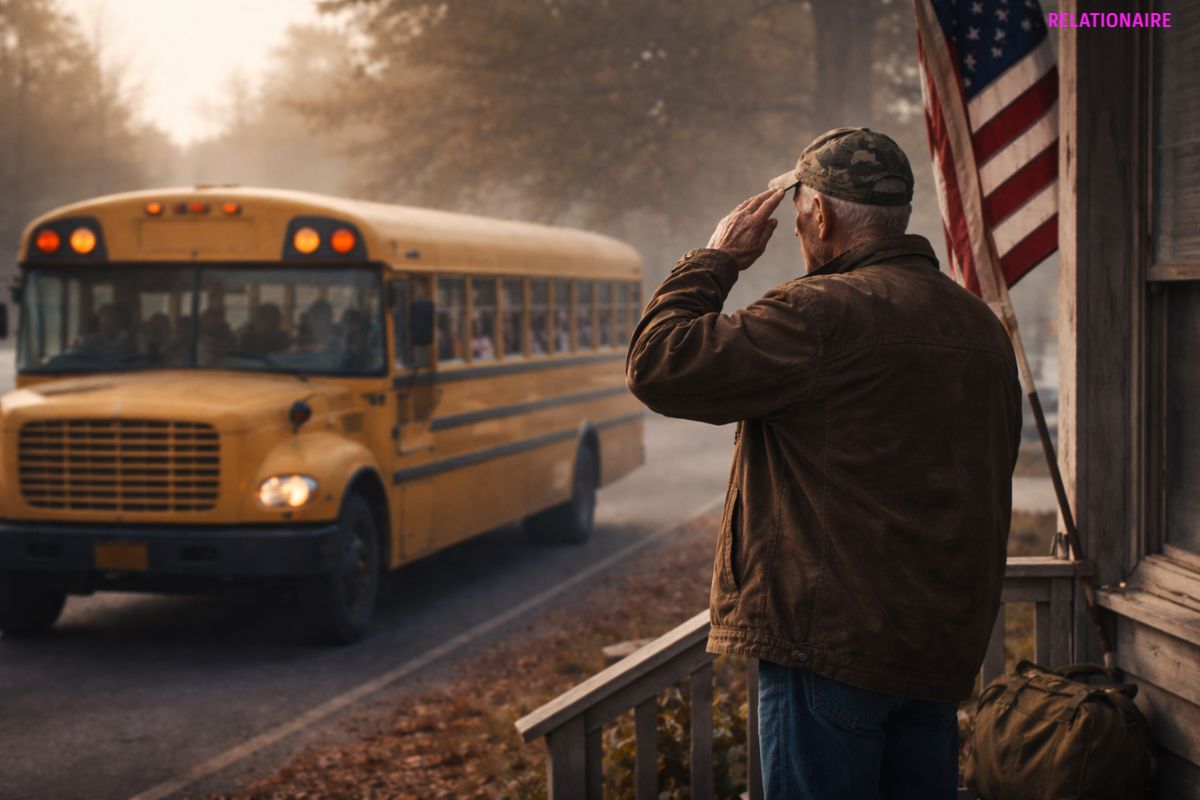
He stood on his porch the way he always did, shoulders squared under a faded brown jacket, one hand gripping the pole of the small American flag bolted beside the steps. The other hand was raised to his forehead in a salute so steady it looked like it had been nailed there.
The school bus rolled past in a cough of diesel and dust.
Not one child saluted back.
The driver gave Walter the same quick nod she always did, soft and polite, the kind people gave old men they didn’t understand. Then the bus was gone, leaving only the rattle of loose windows and cold morning air moving through the pines.
Walter held the salute two seconds longer.
Then he lowered his hand.
The screen door behind him creaked.
“You’re gonna catch your death out here one of these mornings,” Sarah said.
She set a mug of coffee on the porch rail beside him. The smell rose warm and bitter into the chill. Inside, bacon grease still hung in the kitchen from breakfast. Walter didn’t turn.
“Bus was early,” he said.
“No. You were.”
He gave the smallest shrug.
Sarah looked at him the way only family can look at you when they know every silence you own. She was his daughter, though folks in town often mistook her for his nurse now. He had gotten thinner over the years. Smaller somehow. But when he stood at that flag with the cold biting his face, there was still enough soldier left in him to make a man straighten his own back just seeing it.
At least, that used to be true.
Now most people slowed their trucks when they passed, not out of respect but curiosity.
At the diner in town, folks talked.
Old Walt’s slipping.
Been doing that every morning for months.
Saluting a school bus like it’s a parade.
Poor Sarah.
Walter knew they talked because small towns ran on coffee, weather, and other people’s business.
He just didn’t care.
He lifted the mug, took one sip, and set it back down.
“You should come in,” Sarah said. “Your hands are shaking.”
“They always shake.”
“More now.”
He ignored that.
Down by the steps, beside a chipped flowerpot long emptied by winter, sat an old canvas field bag. Army green once. Now worn almost gray. Walter kept it near him on the porch every morning. Never opened it in front of anybody. Never let Sarah move it.
She had asked once what was inside.
“Mine,” he had said.
That was the end of that.
Across the road, Mr. Talley from two houses down was dragging out his trash can. He glanced over, saw Walter by the flag again, and looked away too fast. Like embarrassment could be catching.
Walter noticed.
Sarah noticed him noticing.
“That man ought to mind his own porch,” she muttered.
Walter’s mouth twitched, not quite a smile. “Let him look.”
But later that morning, when Sarah stopped at Miller’s Diner before work, she heard them.
Same booth by the window.
Hank Crowley with his feed-store cap on the table.
June with her tea glass sweating in her hand.
And young Mike Sanders, who had never served a day in uniform but had opinions enough for three men.
“I’m just saying,” Mike said, spearing eggs with his fork, “if my daddy was standing out there every day saluting a bus full of kids, I’d get him checked.”
June frowned. “That’s ugly.”
“It ain’t ugly if it’s true.”
Hank scratched his chin. “Walter was a proud man once.”
“Was,” Mike said. “That’s what I’m saying.”
Sarah stopped beside their table so suddenly the coffee in her cup sloshed over her thumb.
“My father still is.”
Three faces turned up at once.
Mike leaned back. “Didn’t mean nothing by it.”
“Yes, you did.”
The whole diner got quiet in that particular way only diners can—plates still clinking, grill still hissing, but every ear pointed your direction.
Sarah set her cup down.
“He gets up before sunrise. He folds his own blanket. He shines boots no one’s asked him to wear in twenty years. He thanks the cashier at the hardware store every single time she hands him change. And he’s got more dignity in that porch than most people carry into church.”
Mike lifted both hands. “I just said he don’t seem right.”
Sarah stared at him a long moment.
Then she said, “A lot of things don’t seem right when you don’t know the whole story.”
She picked up her cup and left before her voice could crack.
That evening, Walter sat in the VFW hall through a fish fry fundraiser and barely touched his plate. Men who used to clap him on the shoulder now nodded from a distance. Some from kindness. Some because they didn’t know what to say anymore.
The hall smelled like old coffee, worn leather, fried batter, and floor polish.
On the far wall hung flags from wars with too many names and not enough graves.
Walter sat beneath them with his field bag at his feet.
“Walt.”
He looked up. It was Jim Rollins, another veteran, one of the few men in town who could still speak plain to him.
“You all right?”
Walter nodded.
Jim pulled out the chair across from him anyway. “Heard folks talking.”
“They got mouths.”
Jim grunted. “You gonna tell me why you do it?”
Walter’s eyes shifted toward the window, where the dark outside had turned the glass into a mirror. In it, he could see himself: lined face, silver hair, a man worn thin by weather and memory.
After a while, he bent, pulled open the old field bag, and reached inside.
Jim watched him carefully.
Walter drew out a folded child’s drawing, edges soft with age.
Crayon house.
Blue sky.
Yellow bus.
Stick-figure flag on a porch.
And beside it, taped in place, a small tarnished medal no bigger than a silver dollar.
Jim frowned. “Whose is that?”
Walter stared at the drawing so long Jim thought maybe he wouldn’t answer.
Finally he said, “It belonged to a boy.”
“What boy?”
Walter folded the paper once, then again, his fingers slow and careful.
“A boy who used to wave from that bus.”
Jim opened his mouth, then closed it.
Walter slipped the medal back into the bag and stood.
“All these people,” he said quietly, “they think I’m saluting the bus.”
He picked up the bag and headed for the door.
At the threshold, with the smell of fried fish behind him and cold night waiting ahead, he stopped just long enough to say, “I ain’t.”
The screen door slapped shut behind him.
And for the first time, Jim Rollins felt a chill that had nothing to do with the weather.
What had Walter been saluting all this time?
And why did his voice sound like a man still waiting for someone who would never come home?
PART 2
The next morning, the cold came in hard.
It silvered the grass, turned the porch rails slick, and made Walter’s breath show white in the dark before sunrise.
He was already outside when the first truck passed.
Flag straight.
Boots planted.
Canvas bag at his feet.
Sarah watched him through the kitchen window while the coffee dripped. The old house made its usual sounds—heater clicking, pipes ticking, bacon grease popping in the pan—but her father stood in the quiet like he belonged to something older than the house itself.
She had spent half the night turning over Jim Rollins’s words after he called.
“He showed me a kid’s drawing,” Jim had said.
Sarah had gripped the phone tighter. “What drawing?”
“Didn’t say much. Just said folks got it wrong.”
That was all.
Now she stepped onto the porch, and the screen door gave its tired creak.
“Daddy.”
Walter didn’t look at her. “Morning.”
She wrapped her sweater tighter. “Who was the boy?”
He said nothing.
The bus could be heard before it could be seen—the low engine growl, the loose metal rattle, the familiar approach from down the road. Walter lifted his chin slightly. Sarah noticed the change in him right away. Not confusion. Not drift.
Attention.
Sharp and exact.
The bus rounded the bend.
And there he was.
Third row from the back on the right side. Dark hair. Narrow shoulders. Blue jacket too light for the weather. He sat with one hand against the window, looking out the way children do when they’re trying not to look like they’re looking.
Walter’s hand rose to his brow.
The bus passed.
The boy stared.
But this time, just before the bus cleared the mailbox, the child’s fingers twitched upward, uncertain, almost embarrassed.
Not a full salute.
Just the beginning of one.
Walter held his own until the bus disappeared.
Then his arm dropped.
Sarah saw his hand tremble.
“Who is he?” she asked again, softer now.
Walter bent, lifted the field bag, and carried it inside.
He set it on the kitchen table.
For a moment he only stood there, staring at it like it weighed more than canvas and metal and paper had any right to weigh.
Then he opened it.
Sarah came closer.
Inside was a folded flag the size of two hands. A letter, yellowed and creased at the folds. A photograph of a young man in uniform. And the small medal Jim had mentioned, tied to a ribbon gone dull with age.
Sarah touched the edge of the photograph.
The young man had Walter’s jaw. Walter’s eyes before time dimmed them.
Her breath caught. “Michael.”
Walter nodded once.
Her brother.
Her older brother.
Dead twenty-two years.
Sarah sank slowly into a chair.
Michael Mercer had enlisted straight out of high school. He had laughed loud, run fast, and written letters home full of jokes that made their mother cry into the dish towel after she read them. Then one spring afternoon two men in dress uniforms came up the walk, and everything in the house changed shape.
Sarah had been twenty then.
Walter had never really spoken about what was left behind.
Now he touched the child’s drawing with one finger.
“This came in his last box.”
Sarah looked at it again. The crayon bus. The porch. The flag.
On the back, in uneven pencil, were the words: For Sergeant Mike. From Eli.
“He sent this home?” she whispered.
Walter nodded. “From overseas.”
She looked up. “Who was Eli?”
Walter sat across from her.
For a while he rubbed his thumb over the medal ribbon before he answered.
“Local interpreter’s boy,” he said. “Hung around the checkpoint where Mike was posted. Skinny little thing. Always asking questions. Always drawing.” A faint breath of something like pride passed through him. “Took to Mike right away.”
Sarah said nothing.
“Mike wrote about him every week.” Walter’s voice stayed level, but it cost him something. “Said the boy waited for the supply trucks like they were Christmas. Said he’d stand there and salute all wrong, elbow too high, grinning with half his teeth missing.”
Sarah swallowed.
Walter tapped the drawing. “Mike taught him proper.”
Outside, a truck rolled by on the highway.
Inside, the refrigerator hummed.
Walter reached for the letter and unfolded it with the same care he used on the flag.
“This one came before the officers did.”
He handed it to her.
Sarah had never seen it.
The paper shook in her hands as she read.
It was Michael’s writing. Plain. Fast. Ink pressed hard into the page in places.
He wrote about heat, dust, long hours. About bad coffee and worse jokes. About a little boy named Eli who had started waiting for him every morning near the road. About how the child reminded him of nobody and everybody all at once. About how he’d promised the boy that when things settled down, he’d send a picture of their house with the porch flag.
Then, near the end:
If anything ever happens, tell Dad not to be mad at the world too long. Tell him the boy isn’t the reason. The boy tried to warn us. He ran into the road waving his arms. Mike
Sarah stopped reading.
The room went still.
She looked up at her father. “Warn you?”
Walter’s face had gone hard in the old way.
“Roadside bomb,” he said. “Patrol was supposed to pass at 0900. That boy heard something the night before. Saw men where they shouldn’t have been. He came running.”
Sarah pressed a hand over her mouth.
Walter looked past her, not at the kitchen, not at the house, but at something only he could see.
“Mike got out of the vehicle when he saw him. Thought the child was in danger.” His voice roughened. “He got three men clear before it blew.”
Sarah shut her eyes.
The house seemed too small to hold the weight of what sat at that table.
“Did the boy live?” she whispered.
Walter took a long breath.
“We never knew.”
She stared at him. “And the child on the bus?”
Walter finally looked at her.
“Same eyes.”
Sarah frowned through tears. “Daddy, there’s no way to know that.”
“I know.”
“Then why—”
“Because last month that new family moved into the rental by the church. I saw the woman in town. Heard her accent. Saw that boy step out of the truck.” He paused. “He looked at the flag the same way.”
Sarah sat back, stunned.
The pieces began sliding together in a shape too human to ignore.
A refugee family.
A boy on a school bus.
A town too small and too quick to decide what it was seeing.
Walter folded the letter again.
“I asked around,” he said. “Quietly. Found out his family came here after years in camps. Different country. Different road. But his mother’s name…” He stopped and swallowed. “It matched the name Mike wrote once in a letter.”
Sarah’s eyes filled again.
“You think that child is Eli’s son.”
Walter nodded.
“And you’ve been saluting him?”
Walter’s jaw tightened. “No.”
He stood, carrying the little folded flag to the window.
“I’ve been saluting a promise my son made to a frightened boy who tried to save him.”
He put one hand against the glass.
“And every morning that bus comes by, I think maybe some part of it made it home after all.”
That afternoon, word spread faster than rain on tin.
Not the truth. Not yet.
Only that Walter Mercer had gone to the school.
That he had asked to speak with the bus driver.
That he had stood in the office holding an old letter while secretaries watched from behind desks and children hurried past in the hall.
By supper, people were talking harder than ever.
By dark, Mike Sanders told three different men at the gas station that the old veteran had finally lost his grip.
And that was when everything changed.
Because the next morning, just as the bus rounded the bend and Walter raised his hand again, it slowed.
Then stopped.
Right in front of his porch.
And the boy in the third row stood up.
PART 3
The bus door folded open with a hiss.
Cold morning air rushed in around it.
Walter stood frozen on the porch, hand still at his brow, while every child on that bus leaned across the aisle or pressed to the glass to see what was happening.
The driver stepped down first.
Her name was Denise Parker. She had driven that route for eleven years and seen just about every kind of home life a child could carry onto a bus seat. This morning her eyes were wet.
Behind her stood the boy from the third row.
Up close, he looked even smaller than Walter expected. Maybe ten. Maybe eleven. Thin coat zipped to the chin. One backpack strap frayed. Dark eyes steady in a face trying hard to be brave.
Denise spoke softly. “Mr. Mercer, this is Sami.”
Walter lowered his salute.
For a second he couldn’t seem to find his voice.
The boy stepped down onto the road. In one hand he held a folded piece of paper, careful the way children are careful with things that matter.
Sarah had come to the door by then, still in her slippers. Across the street, Mr. Talley stopped mid-step with his trash can. By the time Denise reached the porch, three more front doors had opened up and down the road.
Small towns were like that.
They showed up fast when there might be trouble.
Sometimes they stayed long enough to witness grace.
Denise looked at Walter. “Sami asked me yesterday why you salute the bus.” She glanced at the child beside her. “I told him I thought maybe you were honoring the children.”
Walter’s throat moved.
Sami spoke then, in careful English.
“My mother said maybe not the bus.”
Walter blinked once.
The boy held out the paper. “She said give this to the man with the flag.”
Walter took it with both hands.
It was a photograph, old and copied too many times. Grainy. Sun-bleached at the edges.
A young American soldier crouched beside a skinny boy with a crooked grin and a too-big shirt. Between them was a rough salute, both hands halfway wrong, both faces lit with the same foolish pride.
Michael.
And Eli.
Walter’s knees nearly gave.
Sarah was beside him in an instant, one hand under his elbow. He didn’t look at her. He couldn’t. He was staring at his son’s face as if the years between then and now had suddenly gone thin as paper.
Sami reached into his coat pocket and brought out something else.
A small strip of ribbon. Faded. Frayed.
Walter knew it before the boy spoke.
“My grandfather kept this,” Sami said. “My mother said it was from the brave soldier who pulled him to the ditch.”
Walter’s fingers opened.
Sami laid the ribbon in his palm.
It matched the little tarnished medal in the canvas bag.
For a long moment nobody moved.
The only sound was the bus engine idling and a dog barking somewhere down the road.
Then Walter did something no one on that road had seen him do in years.
He cried.
Not loudly.
Not with collapse or spectacle.
Just one old soldier standing on a porch beneath a flag, shoulders shaking once, then again, while tears ran down a face that had held too much for too long.
He looked at Sami.
“Your grandfather lived?”
The boy nodded. “He died last winter.”
Walter closed his eyes.
Sami went on. “Before he died, he told my mother many times about the American soldier named Mike. He said, ‘If I ever find his family, tell them he did not die alone. Tell them I carried his name all my life.’”
Sarah covered her mouth.
Across the street, Mr. Talley took off his cap.
Denise lowered her head.
Children inside the bus went quiet one by one, even the rowdy ones, because sometimes kids know when they are near something sacred even if they don’t yet have the word for it.
Walter opened his eyes again and looked at Sami with the full ache of twenty-two years in them.
“That why you watched me from the bus?”
Sami nodded.
“My mother saw you first,” he said. “She cried when she saw your flag. She said my grandfather drew that porch many times from memory because Mike showed him a picture.”
Walter’s hand trembled around the photo.
All those mornings.
All those whispers in town.
All those people certain they understood an old man standing in the cold.
And all along, he had been saluting a thread stretched across oceans and graves and years, a promise still somehow alive.
Walter drew a breath that shook.
Then, slowly, with every eye on him, he straightened.
He tucked the photograph carefully against his chest.
And he saluted the boy.
This time Sami didn’t hesitate.
His small hand came up sharp and sure to his forehead.
Perfect.
Not awkward.
Not half-learned.
Perfect.
Walter’s lips parted, and a sound almost like a laugh broke through the grief.
On the bus, one little girl copied the gesture.
Then another child.
Then three more.
Until, row by row, hands rose all along the windows.
A bus full of children saluting an old man on a porch.
Mr. Talley’s chin dropped to his chest.
June Miller, who had pulled over in her car halfway down the road, began to cry openly.
And at the edge of the gathering crowd, Mike Sanders stood with both hands shoved into his jacket pockets, shame written plain across his face.
He came up the walk after the bus had gone and the road had fallen quiet again.
Walter was sitting now, canvas bag in his lap, Sami and his mother inside the house with Sarah, coffee warming between their hands at the kitchen table.
Mike stopped at the bottom step.
“I was wrong,” he said.
Walter looked at him.
Mike swallowed hard. “About all of it.”
Walter said nothing.
Mike’s eyes dropped to the porch boards. “I thought you were just…” He shook his head. “Don’t matter what I thought.”
Walter studied him for a moment, then nodded toward the flag.
“Most things worth respecting,” he said quietly, “don’t explain themselves first.”
Mike looked like the words hit him square in the chest.
He removed his cap.
“Sir,” he said, voice breaking, “I’m sorry.”
Walter gave one short nod.
Not dramatic. Not grand.
Just enough.
A quiet act of dignity.
By noon, the whole town knew the truth.
But the strangest thing was how little Walter seemed changed by finally being understood. He still stood on the porch the next morning. Still in the cold. Still beside the flag. Still with the old canvas bag near his boots.
Only now, when the bus came around the bend, the children were already watching for him.
And every single one of them raised a hand.
Walter returned the salute, not for attention, not for pity, not even for memory alone.
He did it for the living thread between sacrifice and mercy.
For a son who kept his word in the worst place on earth.
For a frightened boy who tried to save him.
For a grandson who carried the story across years and borders until it found the right porch at last.
Inside the house, Sarah stood at the window with her hand over her heart.
Outside, the flag stirred in the morning breeze.
And Walter Mercer, whose pain had been mistaken for confusion, whose ritual had been mistaken for decline, stood straighter than any man in town.
Some grief does not ask to be seen.
It asks only to be honored.
And sometimes the salute no one returned is the one that teaches everybody else how to raise their hand.
What’s something in your life people judged too quickly before they knew the whole story?