If you’ve already read part 1 of this story on Facebook, go here for Part 2!
“Sir, if you’re not ordering, I need this table.”
The old man looked up like he’d been pulled out of another year.
Not another thought. Another year.
The diner had gone quiet in that ugly way places do when people are pretending not to stare. Forks still moved. Coffee still poured. But everybody within three booths had already made up their mind.
He was taking up space.
That was the feeling in the room.
Marlene stood there with one hand on her order pad, the other on the back of the empty chair across from him. She was at the end of a double shift, her feet hurt, and Table Seven had been dead weight all morning.
One coffee.
Three refills.
No breakfast special.
No pie.
Just the same thing he did every Thursday.
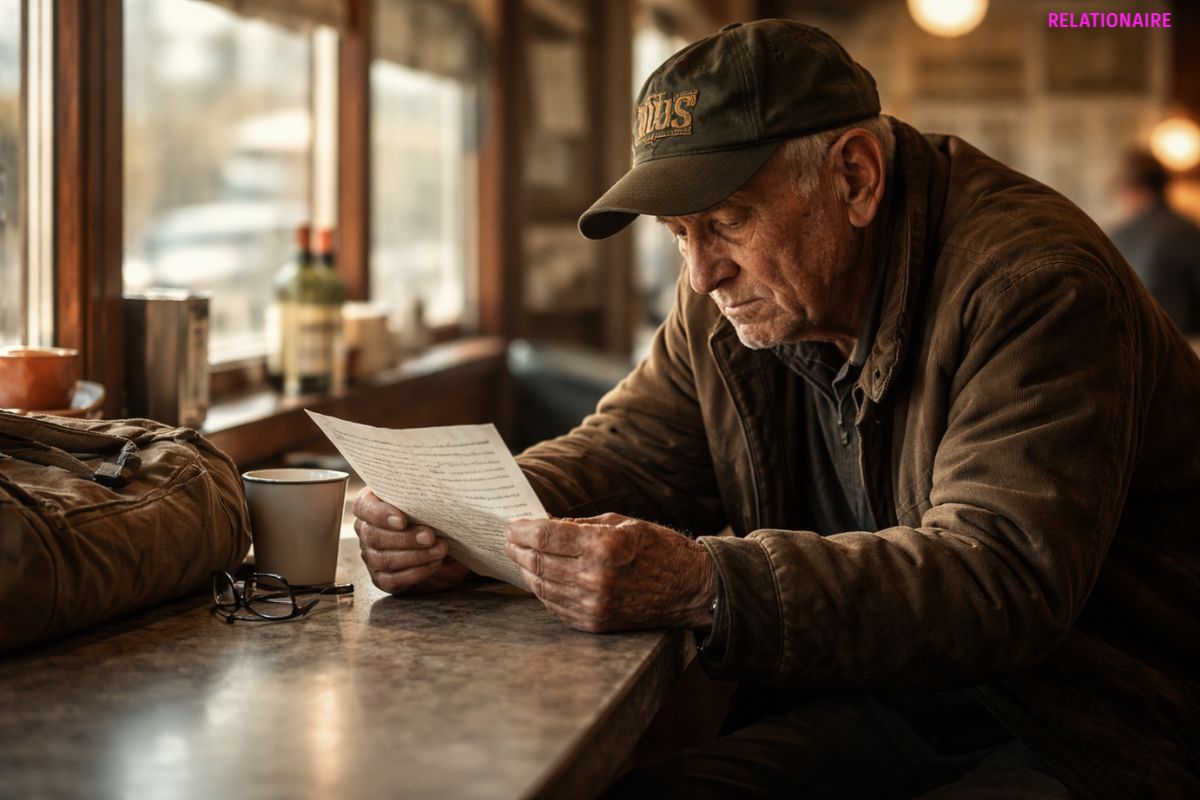
He’d come in before sunrise, when the cold morning air still slipped in every time the screen door creaked open. He’d take the booth by the window. Set down his old canvas bag. Pull out a yellow legal pad and a folded envelope. Then he’d write.
And cross it out.
Write again.
Cross it out again.
Around nine, when the smell of coffee and bacon grease had settled into the walls and the regulars started complaining about weather, fences, and bad knees, he’d fold the paper like he was finally done.
Then he’d put it back in the envelope.
Then he’d put the envelope back in the bag.
And leave without mailing it.
Every week.
For almost four months.
Folks noticed.
Small towns always notice.
The old man had a name, but most people didn’t use it. They called him “that fellow from the trailer out past Miller Road,” or “the veteran,” or, when they thought Marlene couldn’t hear, “the one who looks half gone.”
His name was Walter.
He wore the same brown coat every time, thin at the elbows and shiny at the cuffs. His boots were cracked across the toes. His hands were big, stiff, and scarred, the kind of hands that looked like they remembered hard work better than comfort.
He never asked for anything.
That was somehow the part people trusted least.
Marlene tapped her pad against her palm.
“Sir?”
Walter blinked. His eyes moved from her face to the untouched letter in front of him.
“I ordered coffee,” he said.
“You ordered coffee at six-fifteen.”
A couple men at the counter glanced over. One smirked into his mug.
Walter nodded once. Slow. “Then I guess I’ve been sitting awhile.”
Marlene let out a breath through her nose. She wasn’t cruel. She was tired. There’s a difference, but not always to the person on the receiving end.
“We got folks waiting on booths.”
That wasn’t true.
Not yet.
But it would be soon.
Walter slid a hand over the letter, almost protective, like it might blow away though there wasn’t a breeze in the place.
“All right,” he said.
He reached for his bag.
Then the envelope slipped from under his fingers and fell to the floor.
A plain white envelope. No stamp.
The flap was tucked in but not sealed.
When Marlene bent to grab it, she saw the handwriting.
To the family of Private First Class Daniel Mercer
Her hand froze.
Walter reached down faster than she expected from a man his age. “I got it.”
But she already had it between two fingers.
Just long enough to see the front.
Just long enough to feel the room notice that she’d seen it.
Marlene handed it back.
“I’m sorry,” she said, though her tone hadn’t softened much.
Walter took the envelope and slid it into the canvas bag. “Nothing to be sorry for.”
He stood carefully, favoring one leg.
Then he set two dollar bills beside the mug and turned toward the door.
The screen door groaned when he pushed it open. Cold air rushed in, bringing the smell of wet dirt and diesel off the road.
And that should have been the end of it.
But Earl from stool four couldn’t leave a thing alone.
He twisted around on his stool and called out, “You writing the same dead boy’s people every week, old-timer, or just practicing?”
The diner went still.
Even the cook looked up through the service window.
Walter stopped with one hand on the door frame.
He didn’t turn around.
For one second, Marlene thought maybe he hadn’t heard.
Then she saw his shoulders draw tight beneath that thin coat.
Real tight.
Like the words had landed somewhere old.
Earl laughed once into the silence, low and mean, because some men mistake silence for permission.
Walter finally turned.
No anger on his face.
That was the worst part.
No fire. No bark. No scene.
Just a tired kind of steadiness.
“Yes,” he said.
That one word seemed to make Earl uncomfortable, so he covered it with another laugh.
Walter looked at him, then at the floor between them, then back up.
“I keep trying to get it right.”
Nobody said a thing.
Earl shrugged like it was all a joke anyway. “Man’s been gone however many years. Family probably moved on.”
Walter nodded once, like he’d heard something reasonable.
“Maybe,” he said.
Then he opened the door and stepped out into the morning.
The screen slapped shut behind him.
Marlene stood there staring at the booth.
At the coffee ring on the table.
At the dent in the vinyl seat where he’d been sitting.
She was still staring when Hank came in ten minutes later.
Hank ran the feed store two blocks down and wore his late brother’s Marine Corps jacket every winter, though the zipper had been busted since Reagan was in office. He was the kind of man who didn’t talk much until he had a reason.
He took one look at Marlene’s face and asked, “What happened?”
She told him.
Not the whole thing.
Just enough.
The old man. The letter. Earl being Earl.
Hank’s jaw worked once.
“Walter Grady?” he said.
“I guess.”
Hank looked toward the window, where Walter’s truck—a faded green pickup with primer on one door—was just pulling out.
“You let him leave?”
Marlene bristled. “I didn’t know he was the governor.”
Hank didn’t smile.
“He ain’t that.”
He glanced at Table Seven.
Then at the trash can beside the pie case.
Then back at Marlene.
“What’d he leave behind?”
She frowned. “Nothing.”
But Hank was already moving.
He stepped to the booth, leaned down, and reached into the crack between the wall and the seat cushion. When he stood back up, there was a single folded sheet in his hand.
Yellow paper.
Covered in handwriting.
Marlene stared. “He dropped that?”
“Looks like.”
Hank unfolded it with more care than she expected from a man built like a grain silo.
His eyes moved across the page.
Then stopped.
The color in his face changed.
Not pale.
Not exactly.
Just emptied out.
“What?” Marlene asked.
Hank didn’t answer.
He read one line again.
Then he folded the paper back up with both hands.
Real gentle.
“Where’s he headed?”
“I don’t know.”
But Hank was already moving toward the door.
Marlene followed him two steps. “Hank?”
He stopped without turning around.
When he spoke, his voice had gone rough.
“You ever say something you can’t take back?”
She didn’t answer.
He looked over his shoulder then, and there was something in his face she hadn’t seen before.
Not pity.
Not anger.
Recognition.
“Everybody in this town thinks they know who that man is,” Hank said. “They don’t.”
Then he pushed through the screen door and disappeared into the cold.
Marlene stood in the diner with the smell of burnt toast and bacon grease in the air, Earl suddenly very quiet behind her, and Walter’s empty booth in front of her.
On the table, beside the coffee cup ring, something else still sat there.
A small silver pin.
Crossed rifles on a worn backing card.
Military issue.
Bent on one side like it had been carried a long time.
Marlene picked it up and felt the weight of it in her palm.
Then she looked out the window and saw Hank climbing into his truck with Walter’s unfinished letter in his hand.
She didn’t know what was in that letter.
She only knew this:
A man doesn’t rewrite the same words every week for four months unless the truth is heavier than paper.
And as Walter’s truck disappeared down the county road, Marlene began to wonder if the whole town had been wrong about him from the start.
What would you write to a family if no words could ever be enough?
PART 2
Hank caught Walter at the red light by the grain elevator.
Not by speed.
By luck.
The old pickup was idling at the empty intersection, exhaust puffing white into the cold. Hank pulled up beside him and jumped out before the light changed.
Walter looked over, saw him coming, and his face tightened.
“You forgot this,” Hank said through the open window.
He held up the folded yellow page.
Walter didn’t reach for it.
For a second he just stared ahead at the red light glowing through the windshield.
Then he said, “Should’ve thrown it away.”
Hank rested one arm on the window frame. “I read enough to know I wasn’t going to.”
Walter shut his eyes once.
Just once.
Like a man bracing for impact.
The light turned green. Nobody moved.
A truck behind them gave a short impatient honk, then swerved around.
Walter said, “Get in.”
They drove in silence out past the last gas station, past the football field, past the church with the peeling white paint and the cemetery behind it. Walter turned onto a narrow road lined with scrub pine and winter grass and finally parked at the edge of the veterans cemetery on the hill.
Rows of stones sat pale in the morning sun.
Flags snapped low in the wind.
When Walter cut the engine, the quiet came down hard.
He took the letter from Hank without looking at him. Folded it once. Slid it back into the envelope.
“You shouldn’t have read it.”
“I know.”
Walter gave a dry nod. “But you did.”
“Yes.”
Walter stared through the windshield at the headstones.
“I’ve written that thing sixty-three times,” he said.
Hank looked over. “Sixty-three?”
“One every Thursday since November.”
Hank let that sit.
Then he asked the only thing that mattered. “Why not mail it?”
Walter rubbed a thumb over the edge of the envelope until the paper bent.
“Because every version sounds like I’m asking to be forgiven.”
His voice was steady, but the hand holding the letter wasn’t.
“I ain’t.”
The wind rocked the truck a little.
Hank waited.
Walter finally opened the door.
They walked through the cemetery side by side, boots crunching gravel, breath clouding in front of them. Walter moved slow, favoring that bad leg. Hank could smell old canvas and cold metal off the man’s coat as the wind pressed it close.
They stopped at a stone near the far corner.
PFC DANIEL MERCER
Beloved Son and Brother
1998–2021
At the base of the stone sat a coin, a small faded flag, and a smooth white rock someone had left recently.
Walter stood over it without speaking.
Then he crouched with visible effort and set the letter on the grass.
Not on the stone.
On the grass.
Like he hadn’t earned the right to touch the marker with it.
Hank looked from the grave to Walter.
“This is why you come to town every Thursday?”
Walter nodded.
“The diner’s on the way.”
That wasn’t the whole answer, but Hank understood enough to keep quiet.
After a long while Walter spoke.
“He was nineteen.”
Hank looked at the stone again, though it already said so plain enough without the numbers.
“Kids always look older in uniform,” Walter said. “Then you hear ’em laugh one time, and there it is. Nineteen.”
He swallowed.
“Mercer was from three counties over. Joined straight out of high school. Had one of those cheap wallets held together with hope. Carried a picture of his mama, his sister, and a dog with one ear that stood up and one that didn’t.”
The words were simple.
That made them worse.
Hank shoved his hands in his jacket pockets against the cold.
Walter kept his eyes on the stone.
“We were convoy security. Bad road. Bad day. Bad luck.”
His jaw flexed once.
“No. Not luck.”
He bent, picked a dead leaf off the grass, and crumbled it between his fingers.
“My call.”
Hank said nothing.
Walter looked down at his own hand like he hated it.
“There was a vehicle off the shoulder. Could’ve been nothing. Could’ve been trouble. I made the call to keep moving.”
The wind snapped the little flag at the base of the stone.
“Mercer was in the second truck.”
Hank exhaled slowly.
Walter went on, voice flat now, like he’d said these facts too many times in his head to leave any life in them.
“The blast rolled that truck into the ditch. Fire took fast. I got one man out.” He stopped. “Then I went back.”
His throat moved.
Hank could see him there without wanting to.
Heat.
Smoke.
Screaming metal.
A young man trapped under everything that used to be a truck.
“I had him by the straps,” Walter said. “I had both hands on him.”
His own hands opened as if they remembered.
“And the ammo started cooking off.”
The words dropped between them.
Hank stared at the name on the stone.
Walter’s face had gone still in that frightening way some men get when feeling too much is the only thing keeping them upright.
“He told me to leave him.”
Hank shut his eyes.
Walter nodded like he could still hear it.
“Told me, ‘Sergeant, go.’ Said it twice. Maybe three times.” He took a breath that didn’t seem to go anywhere. “I told him no.”
The wind pushed at their coats.
Walter looked down at the letter on the grass.
“Then he said, ‘Tell my mom I wasn’t scared.’”
Hank’s head bowed before he meant it to.
Walter laughed once, but there wasn’t anything human in the sound.
“That’s the line I can’t get past.”
He pressed the heel of his hand to his mouth for a second, then dropped it.
“Because it was a lie.”
Hank looked up. “What?”
Walter’s eyes were red now, not from tears but from holding them back too hard.
“He was scared.”
The words came out fierce.
“Of course he was scared. He was nineteen and burning alive and looking at me like I was supposed to fix it.”
His chest rose sharply.
“He was brave. That ain’t the same thing.”
Hank didn’t move.
Walter’s voice dropped again.
“I left because he ordered me to and because my men were dragging me out and because if I’d stayed, there’d have been two names on two stones instead of one.”
He stared at the grave.
“And every week I try to write his family a letter that says what happened without making him smaller, and says what I did without making me cleaner than I was.”
Hank looked at the envelope.
On the front were the same careful words Marlene had seen.
To the family of Private First Class Daniel Mercer.
Not Dear.
Not Mr. and Mrs.
Just that.
Like Walter hadn’t yet earned the right to be personal.
“What happened after?” Hank asked.
Walter rubbed his palm over his jaw.
“Official report said I acted with valor.”
Hank turned toward him.
Walter smiled without warmth.
“There’s your joke.”
He reached into his coat pocket and pulled out a small box. Old. Navy blue velvet rubbed thin at the corners.
He opened it.
Inside sat a bronze medal.
Hank stared.
Walter shut the box again before the sunlight could catch too much of it.
“They pinned it on me for the extraction.” He slipped it back into his pocket. “For going back in.”
Hank felt something twist in his chest.
All those mornings. All those whispers. All those looks across diner coffee.
Walter wasn’t haunting Table Seven because he wanted attention.
He was hiding from it.
“Did the family know any of this?” Hank asked.
Walter shook his head. “I met his mother once. Casualty assistance. Front porch with a flag. White rocking chair. Screen door creaked every time somebody breathed near it.” His eyes stayed on the stone. “She thanked me.”
Hank looked away.
“I couldn’t stand there and tell her her boy’s last order was the reason I’m still breathing.”
Walter’s fingers tightened into a fist.
“So I wrote. And rewrote. And rewrote.”
He looked at the grave a long time.
Then he said, very quietly, “Tomorrow’s his mother’s birthday.”
Hank turned back.
Walter nodded toward the letter.
“She comes here every year.”
“And that’s when everything changed…”
PART 3
The next morning broke gray and cold.
Marlene woke before dawn with Walter’s bent rifle pin still sitting on her kitchen table where she’d left it beside her keys. She stared at it while the coffee brewed.
By seven-thirty, she was driving out past the church cemetery, then farther, to the veterans hill Hank had told her about after closing.
She didn’t know why she was going, exactly.
Guilt, maybe.
Curiosity, sure.
But something else too.
The feeling you get when you realize a person has been carrying something alone for so long that even walking away from it would look like weakness.
When she got there, Walter’s truck was already parked near the gate.
So was Hank’s.
And one older blue sedan she didn’t recognize.
The wind was sharp enough to bite through her coat as she stepped out. The grass was silver with frost. Flags along the lane clicked softly on their poles.
Down near the far corner, three figures stood by Daniel Mercer’s grave.
Walter.
Hank.
And a woman in her seventies with a dark coat, sensible shoes, and a folded scarf tucked at her throat. Beside her stood a younger woman, maybe late twenties, holding a leash attached to a brown dog with one ear standing up and one folded down.
Marlene stopped walking.
The dog sat beside the younger woman’s leg, calm as if he understood where he was.
Walter held the envelope in both hands.
Not speaking.
Not moving.
Just standing there while the cold turned his breath white.
The older woman looked at him with the kind of face that had seen enough in life to stop mistaking silence for emptiness.
“Sergeant Grady,” she said.
Marlene saw Walter flinch at the title.
He gave a small nod.
“Yes, ma’am.”
The younger woman’s eyes were already wet. She had Daniel’s jawline. Same set to the mouth. Same brow.
The older woman looked at the envelope in Walter’s hands. “You came.”
Walter tried to answer.
Didn’t manage it the first time.
On the second try, he said, “Yes, ma’am.”
The wind moved through the pines behind them.
No one hurried him.
That was the mercy of it.
Finally Walter held out the letter.
“I’ve been trying to write this for a long time.”
The older woman took the envelope, but she didn’t open it.
Not yet.
She looked at him instead.
“I know who you are,” she said.
Walter’s face changed.
Not relief.
Not fear.
Something more naked than both.
He swallowed. “Ma’am, I should’ve told you years ago—”
She raised one hand.
“My son wrote to us too.”
Walter stopped.
The younger woman pressed her lips together hard and looked down at the dog.
The older woman went on. “Three letters made it home before…” Her voice wavered once, then steadied. “In the last one, he mentioned you.”
Walter stared at her.
She reached into her purse and unfolded a worn piece of paper from a plastic sleeve. The creases were soft with age. She held it carefully, like touching a bruise and a blessing at the same time.
“I brought it because I thought maybe today you finally would.”
Her hands trembled a little as she read.
“Sgt. Grady rides us hard, but he’s the one you want with you when things get bad. Don’t worry about me. He always comes back for his men.”
The world seemed to go still around those words.
Marlene felt her throat tighten from twenty yards away.
Walter didn’t move.
Didn’t breathe.
The older woman lowered the page.
“He wrote that two weeks before he died.”
Walter’s hand rose halfway, then dropped. His fingers had begun to shake.
“I didn’t save him,” he said.
It came out raw.
No shield left on it.
No rank. No practiced tone. No place to hide.
“I got to him, and I still didn’t save him.”
The younger woman started crying quietly.
The dog leaned into her leg.
Walter looked at Daniel’s grave as if speaking to the stone instead of the family.
“He told me to tell you he wasn’t scared.” His voice broke on the word. “That wasn’t true. He was scared. Anybody would’ve been. But he stayed brave anyway, and I didn’t know how to write that without sounding like I was dressing up his death so I could sleep.”
He pressed a hand hard against his chest.
“I couldn’t come here and hand you something polished. I couldn’t take that medal they gave me and pretend I earned it clean.”
Then, with slow hands, Walter reached into his coat and took out the small velvet box.
He opened it.
Even from where she stood, Marlene could see the bronze inside.
The older woman looked at it, then back at him.
Walter held it out.
“This belongs with him.”
Hank took a breath like the cold had hit him in the lungs.
The cemetery stayed silent.
Then the older woman closed Walter’s fingers back over the medal.
“No,” she said.
Walter stared at her.
“That medal belongs to the man who went back.”
Her eyes filled, but her voice did not fail.
“My son belongs here. Your guilt does not.”
Walter’s chin trembled.
He looked down.
Not hiding.
Breaking.
The younger woman stepped forward then, leaving the dog where it sat, and wrapped her arms around Walter before he seemed to understand she was moving.
For one stiff second he didn’t know what to do.
Then his free hand lifted and hovered over her back before finally resting there.
Gentle.
Careful.
Like he was afraid grief might bruise if held too tightly.
The older woman opened the envelope.
She read the letter while the wind moved the edge of her scarf.
No one spoke.
When she finished, she folded it once and pressed it to her chest.
Then she said, “Would you read it aloud?”
Walter looked stunned.
“I don’t think I can.”
“You can,” she said.
So he did.
His voice was rough and low, but it carried in the cold.
He read every line.
How Daniel had obeyed.
How he had thought of home.
How brave and scared could live in the same young body at the same time.
How no medal sat right on Walter’s shelf because one mother’s son had not come home to earn the years Walter got to keep.
When he finished, nobody clapped.
Nobody needed to.
Hank, standing off to the side with both hands shoved in his jacket pockets, quietly raised his hand to his forehead.
A salute.
Walter saw it and froze.
Then, slowly, his own hand rose.
It shook hard enough that Marlene noticed even at a distance.
But it got there.
Straight to his brow.
Held there over the grave of the boy he could not save and the family who had come anyway.
The older woman stepped forward and touched Walter’s sleeve.
“Thank you,” she said.
Not for losing him.
Not for surviving.
For coming back.
That was the thing Walter had been unable to believe mattered.
Marlene stood there with the bent rifle pin in her pocket and felt ashamed of every irritated thought she’d had at Table Seven.
Public places are full of quick judgments.
Private burdens usually arrive without witnesses.
On her way back to the car, she stopped at Walter’s truck and tucked the pin beneath the wiper blade.
No note.
Just the pin.
A small thing returned.
By the following Thursday, Table Seven was full before sunrise.
Not with gossip.
With coffee.
With quiet.
When Walter came in, no one stared.
Marlene met him at the booth, set down a mug, and said, “This one’s on the house.”
Walter looked at her, then at the booth.
“Thank you.”
She nodded toward the canvas bag under his arm. “You bringing a letter?”
He rested one hand on it.
“No.”
His voice was soft.
“I think it finally got where it needed to go.”
Some wounds don’t heal when they’re hidden.
Sometimes they heal when somebody finally bears witness.
What’s something a person might be carrying that the world gets wrong at first glance?