If you’ve already read part 1 of this story on Facebook, go here for Part 2!
PART 1
By the time Mara found the note, her hands already smelled like bleach, warm towels, and the kind of tiredness sleep never fixed.
It was folded twice around an expensive black pen.
Not the kind of pen people lost and forgot.
The kind a doctor clicked once before changing somebody’s whole life.
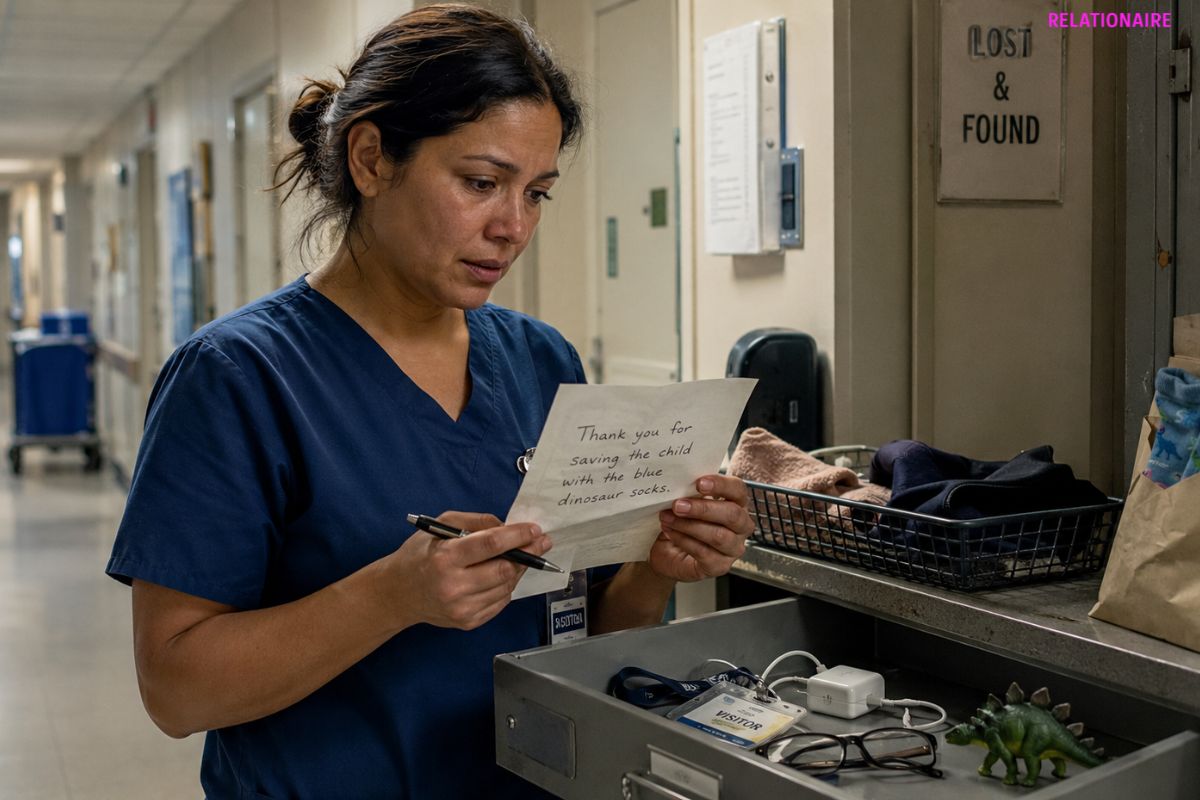
Mara stood beside the hospital lost-and-found drawer with a basket of abandoned things balanced against her hip: a gray scarf, two phone chargers, a child’s mitten, a pair of reading glasses, and one small plastic dinosaur with a missing tail.
The drawer was in a narrow hallway behind the front desk, between the security office and the volunteer room. Nobody paid much attention to it except the people who had to clean around it.
That was usually Mara.
She worked laundry services on the night shift at St. Anselm’s Hospital. Sheets, gowns, blankets, towels. The things people touched when they were scared, sweating, waiting, healing, leaving.
She knew the hospital by fabric.
The pediatric blankets with little faded stars.
The oncology shawls families brought from home.
The surgical towels that came down in heavy carts.
The tiny socks that somehow slipped into the corners of beds.
Mara had been working there almost five years, though most people still called her “laundry” instead of her name.
“Laundry, can you bring more blankets?”
“Laundry, this cart needs moving.”
“Laundry, you forgot the third floor.”
She answered anyway.
She had a son to feed. A rent notice folded under a magnet at home. A car that made a sound like loose change whenever she turned left.
And she had Noah.
Noah was eight now, thin as a pencil, with big serious eyes and a habit of lining up his cereal by color before eating it. He loved dinosaurs, hated loud hand dryers, and still slept with one sock on and one sock off no matter how many times Mara tucked him in.
Years ago, he had been a patient at St. Anselm’s.
Mara did not like remembering that part.
She remembered enough.
A tiny hospital bracelet around his wrist.
His blue dinosaur socks peeking out from under a blanket.
A doctor’s voice saying, “We’re going to take care of him.”
And then hours of waiting that seemed to stretch across her whole life.
Since then, Mara had kept her head down in the same hospital that once nearly swallowed her whole.
That Thursday night had been worse than most.
The laundry chute on the east wing jammed. A family member yelled at her because the warmer was empty. The cafeteria had run out of soup before her break.
At 10:42 p.m., while sorting linens near the emergency department, she watched Dr. Adrian Vale stride past without looking at anyone.
Everyone knew Dr. Vale.
Tall. Sharp jaw. Gray at the temples. Perfect white coat. Expensive watch. No small talk.
The nurses called him brilliant when they were being honest and impossible when they were tired.
Families whispered worse.
“He didn’t even look me in the eye.”
“He talks like we’re wasting his time.”
“He thinks he’s God.”
Mara had no reason to disagree.
She had seen him step over dropped tissues without slowing down. Seen him ignore a volunteer who said good morning. Seen a young resident stumble after him with tears in her eyes.
That night, he entered the hallway like a storm dressed as a man.
A father by the vending machines stood up quickly, clutching a paper cup of water.
“Doctor, please,” the man said. “Can you just tell us if she’s—”
Dr. Vale didn’t stop.
“Ask the attending nurse,” he said.
The father froze.
Mara felt heat rise in her chest.
She knew exhaustion. She knew pressure. But she also knew what it felt like to wait for one kind sentence from a person who held your child’s future in their hands.
Dr. Vale disappeared through double doors.
Mara whispered to herself, “Must be nice to be too important to be human.”
She regretted it as soon as she said it, but only a little.
An hour later, she found the pen.
Security had left the lost-and-found drawer open while looking for a visitor’s wallet. Mara was wiping the counter when the pen rolled out from behind a stack of visitor badges.
It was heavy and smooth, with silver initials engraved near the clip.
A.V.
Mara turned it over in her palm.
Of course.
She almost put it straight back.
Then she saw the folded note.
It was tucked into the pen case, worn soft at the creases, as if someone had opened it many times and folded it carefully again.
Mara should not have read it.
She knew that.
But the first line was visible where the fold had loosened.
Thank you for saving the child with the blue dinosaur socks.
Her fingers went still.
For a moment, the sounds of the hospital thinned.
The rolling carts.
The elevator bell.
The distant cough.
The page over the speaker.
All of it faded behind those five words.
Blue dinosaur socks.
Mara looked down at the note as if it had spoken her son’s name.
She told herself plenty of children wore dinosaur socks. Blue was common. Hospitals were full of children. Notes were full of sentimental things.
Still, her throat tightened.
She unfolded the paper.
The handwriting was small and neat, with a slight slant.
I never knew how to say this out loud. You saved him before I ever touched a scalpel.
You noticed what everyone else missed.
You stayed when no one asked you to stay.
You gave me ten more minutes.
That was the difference.
There was no name at the bottom.
Only initials.
A.V.
Mara read it twice.
Then a third time.
She tried to understand who “you” was.
A nurse, maybe. A resident. Another surgeon. Someone important enough for Dr. Vale to thank in private but not publicly. Someone from his world.
Not someone like her.
She folded it again, slower than before.
The blue dinosaur socks would not leave her mind.
Noah had owned exactly one pair like that. Bright blue. Green brontosauruses. Yellow toes. Bought from a clearance bin because he had refused to let go of them.
He wore them the day he got sick.
Mara could still see those socks on the hospital bed.
One heel twisted sideways.
One little toe poking through.
She pressed the note flat on the counter, her heart beginning to move too fast.
“Everything okay?”
Mara jumped.
Rina, the overnight receptionist, leaned into the hallway with a half-eaten granola bar in her hand.
Mara quickly covered the note with her palm.
“Yeah,” she said. “Just lost-and-found.”
Rina nodded toward the pen. “That Dr. Vale’s?”
“Looks like it.”
“Figures. That man probably owns pens that cost more than my phone.”
Mara gave a weak smile.
Rina disappeared back to the desk.
Mara stood alone with the note.
The right thing was simple. Put it in an envelope. Write Dr. Vale’s name on it. Leave it at the surgical office.
But something had hooked under her ribs.
You saved him before I ever touched a scalpel.
You noticed what everyone else missed.
You gave me ten more minutes.
Her hands began to tremble.
Because eight years ago, before the surgery, before the rush of doctors, before everyone knew what was wrong, someone had noticed Noah first.
Mara had been half-asleep in a chair, exhausted from two jobs and worry. Noah had been quiet. Too quiet. A cleaning woman had come into the room, seen him, and stopped.
Mara remembered a soft voice.
“Ma’am. Wake up.”
She remembered the woman pressing the call button.
She remembered footsteps.
She remembered the room filling.
After that, everything blurred.
Mara never knew the woman’s name.
For years, she had carried a strange little guilt about it.
Someone had saved her son, and Mara had never found her to say thank you.
Now she stared at Dr. Vale’s initials and felt the world shift in a way she was not ready for.
At midnight, she took the note to the staff lockers.
Not to steal it.
Just to look at it away from the front desk. Away from fluorescent lights and ringing phones and people asking her for blankets.
She sat on the wooden bench in the laundry changing room, the pen and note in her lap.
Her locker door hung open.
Inside were two spare scrubs, a pack of vending machine crackers, a faded photo of Noah at six holding a plastic T. rex, and an old envelope she had kept for years.
Mara rarely looked at that envelope.
It held Noah’s discharge papers.
The bracelet.
And the blue dinosaur socks.
She had never been able to throw them away.
Slowly, with fingers that did not feel like her own, Mara reached into the back of the locker and pulled the envelope free.
The paper was soft with age.
Her name was written across the front in her own handwriting.
NOAH — HOSPITAL
She set Dr. Vale’s note beside it.
For one long second, she did nothing.
Then Mara slid her thumb under the flap of the old envelope, about to open the past she had spent eight years trying not to touch.
PART 2
The envelope opened with a tired little tear.
Mara sat in the laundry changing room with the hum of dryers shaking the wall behind her, and for a moment she was not thirty-six years old, not a night-shift worker, not a mother counting grocery money in her head.
She was twenty-eight again.
Sitting in a pediatric room under a too-bright ceiling.
Holding a paper cup of water she never drank.
Begging a child to keep breathing normally because she did not know what else to beg for.
She pulled out Noah’s old hospital bracelet first.
The plastic had yellowed slightly. His name was still there.
NOAH ELLIS.
AGE: 11 MONTHS.
Then the discharge papers, folded into squares.
Then the socks.
Blue, faded now. Little green dinosaurs. Yellow toes. One tiny hole near the seam.
Mara covered her mouth.
The memory did not come back all at once.
It came in pieces.
Noah burning warm against her chest.
A nurse saying, “His vitals look okay for now.”
Mara trying not to sound dramatic.
The doctor leaving.
The room dim.
Noah’s tiny foot kicking out from under the blanket.
Then that woman.
Not a nurse.
Not a doctor.
A woman with a cleaning cart and tired eyes.
Mara had barely noticed her when she entered the room. She was older, maybe late fifties, with silver hair pinned back and a wedding ring on a chain around her neck.
She had started wiping the windowsill.
Then she stopped.
Mara remembered that stop more clearly than anything.
The woman looked at Noah.
Not glanced.
Looked.
Then she said, “Ma’am. Has his breathing been like that?”
Mara had blinked. “Like what?”
The woman moved closer. Her hands were still in yellow gloves.
“Call them,” she said gently but firmly. “Now.”
Mara pressed the call button.
The nurse came, then another. Then the hallway filled with footsteps.
Dr. Vale had appeared later.
Young then.
Not gray. Not famous. Not cold.
His sleeves had been pushed up. His hair was messy. His face serious but not unkind.
He crouched beside Mara’s chair and said, “Your son is very sick, but we caught something early. That matters.”
We.
That one word had stayed with her.
She had thought he meant the medical team.
She had never wondered who the first person in that “we” had been.
Until now.
Mara unfolded Dr. Vale’s note again.
You saved him before I ever touched a scalpel.
You noticed what everyone else missed.
You stayed when no one asked you to stay.
You gave me ten more minutes.
That was the difference.
Her breath caught on the last line.
The cleaning woman.
The note was not written to a surgeon.
Not to a nurse.
Not to someone whose name went on the chart.
It had been written to someone like Mara.
Someone people walked around.
Someone families barely saw unless they needed the trash changed.
Mara sat very still.
The door opened.
Rina poked her head in. “Mara? You in here?”
Mara wiped her face quickly. “Yeah.”
Rina stepped in, saw the socks, the old papers, and the note. Her expression softened.
“Oh,” she said quietly. “Honey.”
Mara tried to laugh, but it came out broken. “I think this is about Noah.”
Rina sat beside her.
Mara showed her the note.
Rina read it in silence. By the time she finished, her eyes had changed.
“You should give it back,” she said.
“I know.”
“To Dr. Vale.”
“I know.”
But Mara did not move.
Rina watched her. “What’s stopping you?”
Mara looked down at the socks in her lap.
“Because I hated him tonight,” she whispered. “I watched him walk past that father like he didn’t care. I called him inhuman in my head. Maybe out loud.”
Rina sighed. “A lot of people do.”
“And maybe he is.”
“Maybe,” Rina said. “Or maybe he’s just bad at looking like he isn’t drowning.”
Mara turned toward her.
Rina leaned back against the locker. “You don’t remember the story?”
“What story?”
Rina hesitated, like she had stepped near a private thing.
“I’ve worked the front desk seventeen years,” she said. “You hear things even when you don’t want to. Dr. Vale used to be different. People said he talked to families for as long as they needed. Remembered birthdays. Brought stickers to peds.”
Mara tried to imagine it.
She could not.
“What happened?”
Rina looked at the note again. “His daughter.”
The dryers hummed.
Mara’s fingers tightened around the socks.
“She was a patient here,” Rina said softly. “Years ago. Little girl. I don’t know the details. Nobody says much, and they shouldn’t. But after that, he changed. Stayed brilliant. Stopped being… open.”
Mara swallowed.
The note in her hand suddenly felt heavier.
“Was she the child with the blue dinosaur socks?” Mara asked.
Rina shook her head. “No. That’s your boy, sounds like.”
“Then why would he keep this?”
“Maybe because your boy lived.”
The words landed gently, but they landed hard.
Mara looked at the pen again.
A.V.
Not just initials engraved on something expensive.
A man carrying a thank-you note he had never delivered.
A man everyone thought had no feelings, keeping a folded piece of paper about a child who survived.
The next morning, after her shift ended, Mara did not go home right away.
She should have.
Noah needed breakfast before school. Her neighbor Mrs. Alvarez was watching him and would pretend not to mind, but Mara knew she had arthritis in both hands.
Still, Mara climbed the stairs to the surgical wing with the pen and note inside a clean interoffice envelope.
The hallway up there felt different.
Quieter.
Cleaner in a way that made her aware of her shoes.
A resident at the desk glanced up and barely saw her. “Laundry pickup?”
“No,” Mara said. “I need to return something to Dr. Vale.”
“He’s in conference.”
“I can wait.”
The resident looked annoyed, then pointed toward a row of chairs.
Mara sat.
Doctors passed. Nurses passed. Families passed with faces that looked like yesterday had emptied them.
At 7:18 a.m., Dr. Vale came out of the conference room, reading a chart, surrounded by two residents.
Mara stood too quickly.
“Dr. Vale.”
He did not look up. “Leave it at the desk.”
His tone was flat.
The old anger sparked in her.
“It’s not laundry.”
That made him stop.
He looked at her then. Really looked, though not warmly.
“Yes?”
Mara held out the envelope.
“I found your pen in lost-and-found.”
His eyes dropped to it.
For the first time since she had known him, Dr. Vale looked startled.
Not much. Just a flicker.
But Mara saw it.
He took the envelope. “Thank you.”
He turned to leave.
The hurt and confusion in Mara rose before she could stop it.
“Did you ever give it to her?”
Dr. Vale went still.
The residents looked between them.
Mara knew she should stop. She was laundry services. He was the hospital’s most respected pediatric surgeon. This was not her place.
But the blue socks were in her coat pocket.
Her son’s socks.
Her past.
Her unanswered thank-you.
Her judgment.
Her ache.
Dr. Vale slowly turned back.
His face had gone pale.
“What did you say?”
Mara’s voice trembled.
“The note,” she said. “The person who noticed the child with the blue dinosaur socks. Did you ever give it to her?”
The hallway seemed to quiet around them.
Dr. Vale looked at the envelope in his hand, then back at Mara.
And for one long, painful moment, the arrogant surgeon everyone whispered about looked like a man who had been carrying a locked door inside his chest for years.
“No,” he said quietly. “Because she disappeared before I could thank her.”
PART 3
Mara did not know what to do with the softness in Dr. Vale’s voice.
It was so different from the clipped hallway voice everyone knew that it almost frightened her.
The residents had gone silent.
A nurse at the desk pretended to type.
Dr. Vale looked down at the envelope in his hand as if it might break open and spill the years onto the floor.
“She was a cleaner,” he said.
Mara nodded.
“I know.”
His eyes lifted sharply.
Mara reached into her coat pocket and pulled out the tiny blue socks.
They rested in her palm, faded and impossible.
Dr. Vale stared at them.
The color left his face.
“That was your son?”
Mara could only nod again.
For a second, neither of them spoke.
A surgeon who had saved hundreds of children.
A laundry worker holding one pair of socks.
A hallway full of people who had no idea that a whole life was being turned over between them.
“He’s eight now,” Mara said. “His name is Noah. He likes dinosaurs, still. He hates carrots unless they’re cut small. He reads the same page five times if the story has a dragon in it.”
Dr. Vale closed his eyes.
When he opened them, they were wet.
Not crying exactly.
Just no longer armored.
“I remember him,” he said. “I remember the socks.”
Mara’s own eyes burned.
“I never knew who called for help,” she said. “I thought it was a nurse.”
Dr. Vale shook his head. “Her name was Elena Ramos.”
The name moved through Mara like a bell.
Elena.
At last, the woman had a name.
“She worked environmental services on nights,” Dr. Vale said. “She had been here twenty-three years. She noticed everything. Which rooms needed quiet. Which parents hadn’t eaten. Which children were scared of the dark.”
He swallowed.
“She noticed your son’s breathing before anyone else did.”
Mara held the socks tighter.
“Why didn’t anyone tell me?”
“Because in the rush, people forget the first person who saw the danger. They remember the surgeon. The monitors. The doors. The big parts.”
His voice dropped.
“But sometimes the whole story turns because someone with a mop is paying attention.”
Mara looked away.
That line was too much.
Not because it was dramatic.
Because it was true.
Dr. Vale asked the residents to continue without him. Then he led Mara to a small consultation room near the end of the hall.
The room had two chairs, a tissue box, and a window facing the hospital roof.
For once, he did not stand.
He sat across from her like a person with no title at all.
“I wrote that note three days after your son’s surgery,” he said. “I carried it around because I could never catch Elena at the right time. Then she stopped coming.”
“What happened?”
“She retired suddenly. Family reasons, they said. I asked for an address, but there were privacy rules. I left messages through supervisors. Nothing came back.”
Mara frowned. “You never saw her again?”
“No.”
He turned the pen between his fingers.
“That year was…” He paused. “Difficult.”
Rina’s words came back.
His daughter.
Mara did not ask.
But Dr. Vale seemed to understand the silence.
“My daughter was treated here the year before,” he said. “Her name was Lily.”
Mara’s chest tightened.
“She loved dinosaurs too,” he said with a faint, aching smile. “Not blue socks. Purple backpack. Terrible singing voice. Very confident about it.”
Mara laughed softly before she could stop herself.
The smile faded from his face, but not bitterly.
“When we lost her, people were kind,” he said. “But kindness can feel very far away when you have to keep walking into the same rooms. I came back to work because I did not know who I was if I didn’t. And then your son arrived.”
He looked at the socks.
“Elena called us in. We moved fast. He lived. And for the first time after Lily, I felt something other than emptiness in an operating room.”
Mara pressed her fingers to her lips.
“I should have told you,” he said. “I should have told you about Elena. I should have thanked her. I should have thanked you for trusting us. But I was not whole enough to say any of it.”
Mara thought of all the times she had watched him pass by families without stopping.
“How many notes do you carry?” she asked softly.
He looked surprised.
Then ashamed.
“Too many.”
That answer changed something in her.
Not everything.
Not the fact that families still needed tenderness.
Not the pain of being ignored by people with cleaner coats and louder names.
But something.
Mara understood, suddenly, that coldness was not always pride.
Sometimes it was grief with a locked jaw.
She still wanted to say, You could do better.
But she heard herself say, “Elena deserved to know.”
Dr. Vale nodded. “Yes.”
“So does my son.”
His eyes lifted.
Mara took a breath. “Noah thinks doctors saved him. He doesn’t know a cleaner did too.”
Dr. Vale looked down at his hands.
“Then we should tell him.”
Two weeks later, Mara brought Noah to the hospital on a Saturday morning.
Not as a patient.
That mattered.
He wore a green hoodie, carried a plastic dinosaur in one hand, and asked if the elevators still made the “ding sound like a microwave.”
Mara laughed for the first time all week.
Dr. Vale met them near the lobby.
He was not wearing his white coat.
Just a gray sweater and dark pants.
Without the coat, he looked less like a wall and more like a tired man trying very hard.
Noah hid halfway behind Mara.
Dr. Vale crouched, slow and careful.
“I heard you like dinosaurs,” he said.
Noah studied him. “Depends which ones.”
“A fair answer.”
Mara saw the doctor’s mouth twitch.
They walked to a small room near the chapel where the hospital kept old staff photos. Rina had helped find Elena’s picture in a retirement binder.
There she was.
Silver hair pinned back.
Kind eyes.
Wedding ring on a chain.
Mara touched the page with two fingers.
“That’s her,” she whispered.
Noah looked up. “Who?”
Mara knelt beside him.
“That’s one of the people who saved your life.”
Noah frowned. “She was a doctor?”
“No,” Mara said. “She cleaned rooms here.”
Noah looked at the photo again with new seriousness.
“She saw you when nobody else knew what was wrong,” Mara said. “She helped bring the doctors fast.”
Dr. Vale stood quietly behind them.
Noah tilted his head. “Did we say thank you?”
Mara’s throat closed.
“No, baby,” she said. “We didn’t know her name.”
Noah thought about that.
Then he pulled a folded paper from his hoodie pocket.
Mara had helped him write it the night before.
Dear Ms. Elena,
Thank you for seeing me.
From Noah with the dinosaur socks.
The handwriting was crooked.
Perfect.
Dr. Vale turned his face toward the window.
Rina found Elena’s daughter through the hospital alumni office.
It took more forms than Mara expected and more patience than Dr. Vale looked capable of, but he made every call himself.
A month later, Elena’s daughter came to St. Anselm’s.
Her name was Sofia. She was in her forties, with her mother’s same watchful eyes.
Mara met her in the lobby holding Noah’s note.
Dr. Vale stood beside them holding his own note, the one he had carried for eight years.
Sofia listened as they told her.
Not all of it. Just enough.
How Elena had noticed.
How Noah had lived.
How Dr. Vale had never forgotten.
How Mara had spent years not knowing the name of the woman who gave her more time with her son.
Sofia cried quietly, one hand over her mouth.
“My mother always said the hospital belonged to everyone,” she said. “Not just the people with degrees.”
Then she opened her purse and pulled out a small prayer card, worn at the edges.
“She passed three years ago,” Sofia said gently. “But she kept a list in her Bible. Children she prayed for. First names only.”
She unfolded a photocopied page.
There, near the middle, in careful handwriting, was one word.
Noah.
Mara made a sound she had never made before.
Half sob.
Half laugh.
Half a door opening.
Dr. Vale covered his eyes.
Noah, confused but gentle, reached for his mother’s hand.
After that day, something changed at St. Anselm’s.
Not loudly.
Hospitals do not become kinder all at once.
But small things shifted.
Dr. Vale started stopping in hallways.
Not every time.
But more.
He learned the names of the cleaners on his floor. He thanked the laundry staff when blankets arrived warm. He told residents that noticing was a clinical skill, not a personality trait.
Mara still worked nights.
The carts were still heavy.
The pay was still not enough.
The world did not become easy just because one truth was uncovered.
But sometimes, when she passed Dr. Vale near the pediatric wing, he would nod and say, “Good evening, Mara.”
Not “laundry.”
Mara.
And every time, she thought of Elena Ramos.
A woman with a cleaning cart.
A woman who saw a baby’s breathing change.
A woman who stayed when no one asked her to stay.
Years later, Noah kept the photocopy of Elena’s list in a frame on his desk. Beside it, he placed the blue dinosaur socks, too small for any living foot, but big enough to hold the beginning of his second chance.
Mara used to believe hospitals were held together by the people who knew the most.
Now she knew better.
Sometimes they are held together by the ones who notice quietly.
The ones who fold the blankets.
Change the trash.
Press the call button.
Remember the socks.
And save a life without ever waiting to be thanked.