If you’ve already read part 1 of this story on Facebook, go here for Part 2!
PART 1
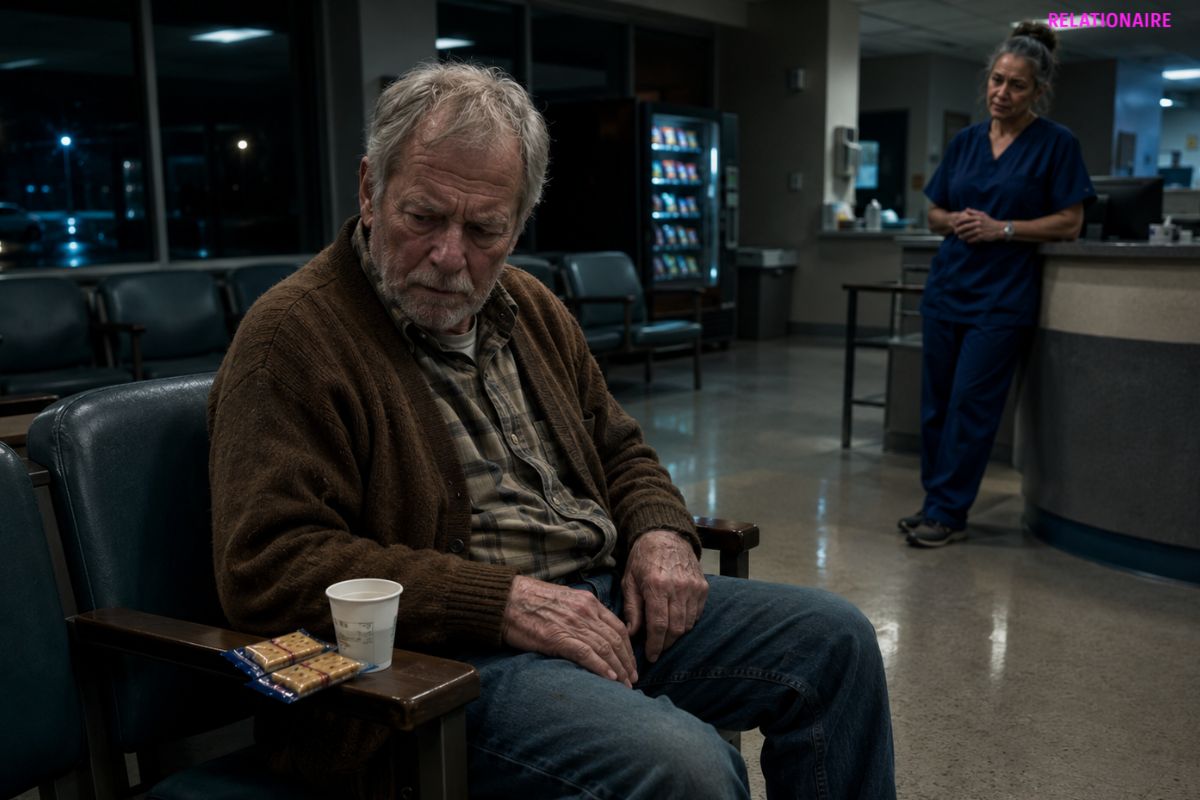
At 3:17 in the morning, Harold Tate woke up in a hospital chair with a stiff neck, a paper cup of water by his shoe, and two peanut butter crackers resting on the armrest beside him.
Again.
He stared at them like they had insulted him.
The ICU waiting room was nearly empty except for the hum of the vending machines, the soft buzz of the fluorescent lights, and a young man across the room sleeping with his hoodie pulled over his face. The television was on mute. A weather map flashed blue and green over a city that felt too far away from anything real.
Harold sat forward slowly, one hand pressed to his lower back.
He was seventy-four, widowed, and not built for sleeping upright.
He was also not built for being helpless.
His daughter, Marcy, was down the hall behind two sets of doors he was not allowed to pass without permission. The nurses kept saying she was “stable,” which Harold had learned was a word hospitals used when they wanted you to breathe but not relax.
So he stayed.
He had been there for two nights, wearing the same brown cardigan, the same work boots, the same worry carved into his face. His visitor badge had curled at the edges from being clipped and unclipped too many times.
He looked again at the crackers.
Then at the paper cup.
Then toward the nurse station.
His jaw tightened.
“Oh, no,” he muttered.
The first night, he thought maybe another family had left the food there by mistake. The second time, he figured some hospital volunteer had come through with snacks. But this was the fourth time.
Every time he woke up hungry, there they were.
Crackers.
Water.
Like the hospital was keeping count.
Harold had spent enough years paying bills to know nothing was free. Not parking. Not coffee. Not the thin hospital blanket someone had handed him like it was a kindness.
He pictured Marcy’s name on a bill somewhere.
Water cup: $12.
Crackers: $18.
Comfort for father: itemized.
He grabbed the packet and stood.
His knees popped. His shoes squeaked against the polished floor as he walked toward the nurse station, holding the crackers in front of him like evidence.
Behind the desk sat a nurse with silver-threaded black hair pulled into a tight bun. Her badge said EVELYN R. She wore navy scrubs, a faded watch, and the expression of someone who had not sat down in hours.
She was writing something in a chart when Harold stopped in front of her.
“Are you the one leaving these?” he asked.
Evelyn looked up.
Her eyes moved from his face to the crackers in his hand.
“Yes,” she said quietly.
Harold let out a short breath through his nose.
“Well, stop it.”
The nurse blinked once.
The young man under the hoodie shifted in his sleep across the room.
Evelyn lowered her pen. “I’m sorry?”
“I said stop leaving food by me. My daughter doesn’t need more charges on her bill.”
For a second, something crossed Evelyn’s face.
Not surprise.
Not anger.
Something smaller.
Like a door inside her had opened and shut quickly.
“These aren’t charged to anyone,” she said.
“That’s what they always say.” Harold held up the packet. “Hospitals don’t hand out peanut butter crackers out of the goodness of their hearts.”
Evelyn’s mouth softened, but she did not smile.
“No,” she said. “They usually don’t.”
Harold did not know what to do with that answer, so he pushed harder.
“My daughter has two kids. She works at a grocery store. She doesn’t need a bill for snacks I didn’t ask for.”
The nurse’s gaze dropped to his cardigan, then to his trembling hand gripping the crackers.
“You haven’t eaten a real meal since yesterday afternoon,” she said.
Harold stiffened.
“That’s not your business.”
“No,” Evelyn said. “It isn’t.”
But she didn’t look away.
That bothered him most.
People had been looking through him for two days. Doctors looked at screens. Nurses looked at monitors. The receptionist looked at his badge. Everyone asked him to wait, sit, sign, step back, lower his voice, take care of himself.
But Evelyn looked at him like she had actually seen him.
And Harold did not like being seen when he was scared.
He tossed the crackers onto the counter.
“I’m not charity,” he said.
The words came out sharper than he meant.
Evelyn looked down at the packet, then back at him.
“No,” she said. “You’re a father.”
That should have ended it.
Instead, it made Harold angrier.
Because she was right.
Because being a father had once meant fixing a flat tire in the rain, scaring off boys who honked from the driveway, working double shifts, checking locks at night, making sure Marcy always had the bigger piece of chicken.
Now being a father meant sitting in a vinyl chair waiting for permission to see his grown daughter.
It meant asking strangers whether she had woken up.
It meant being handed words he couldn’t understand and pretending they didn’t scare him.
Harold leaned both hands on the counter.
“My daughter is not a case number,” he said.
Evelyn’s face changed then.
Only a little.
“My patients never are.”
“You know her?”
“I know every patient on this floor tonight.”
“That’s not what I asked.”
The nurse looked away toward the hall, where the ICU doors opened with a soft mechanical sigh. A doctor stepped out, rubbing his eyes. Somewhere, a monitor chimed and stopped.
Evelyn stood.
She was shorter than Harold expected.
“I need to check on room twelve,” she said.
“Is that Marcy?”
“Yes.”
He stepped in front of the desk opening.
“Then tell me something.”
“I can’t discuss anything beyond what the doctor has told you.”
“I’m her father.”
“I know.”
“You don’t know anything.”
The waiting room went still.
Harold heard his own breathing.
Evelyn stood there in the blue-white light, hands at her sides, her face tired but steady.
Then she said, softly, “I know she likes her water without ice.”
Harold froze.
He had not told anyone that.
Marcy hated ice in hospital cups because it made the plastic sweat and drip onto her blanket. She had hated it since she was a girl. Harold remembered her at seven years old, lying on the couch with a fever, complaining that ice water tasted “too loud.”
He stared at Evelyn.
“What did you say?”
Evelyn’s eyes dropped.
“Nothing.”
“No.” Harold’s voice was lower now. “How do you know that?”
The nurse turned away, but not fast enough.
He saw it.
Pain.
Not professional concern. Not tired kindness.
Pain.
The kind a person carries carefully because it has already spilled once and ruined everything.
Harold followed her gaze to the counter beside the printer.
There was a small brown paper envelope tucked halfway under a stack of discharge forms. Marcy’s name was written across the front.
Not typed.
Written.
In blue ink.
Harold reached for it.
Evelyn’s hand landed gently over his before he could touch it.
“Please,” she whispered.
And that was the moment Harold realized the crackers were not the mystery.
The nurse was.
PART 2
Harold did not move his hand.
Neither did Evelyn.
For one strange second, they stood like that under the fluorescent lights, two tired people touching the same envelope for very different reasons.
“What is this?” Harold asked.
Evelyn slowly pulled her hand back.
“It’s not mine to open.”
“It has my daughter’s name on it.”
“Yes.”
“Then why is it at your desk?”
Evelyn looked toward the ICU doors again.
“She asked me to keep it here until morning.”
Harold’s throat tightened.
“She woke up?”
“For a few minutes.”
The words hit him so hard he had to grip the counter.
Nobody had told him.
He had been sleeping in that awful chair, his mouth dry, his back aching, and his daughter had been awake.
“She asked for me?”
Evelyn hesitated.
That hesitation broke something in him.
“She didn’t ask for me,” he said.
“She was tired.”
“She didn’t ask for me.”
Evelyn lowered her voice. “She said, ‘Don’t wake Daddy unless it’s bad.’”
Harold looked away.
The waiting room blurred around the edges.
Daddy.
Marcy had not called him that in years. Not since she became a mother herself. Not since life put bills and school forms and car repairs between them.
He pressed his thumb and forefinger to his eyes.
“She’s always doing that,” he said. “Protecting me like I’m the one in the bed.”
Evelyn did not answer.
Harold looked back at the envelope.
“What’s in it?”
“I don’t know.”
That was the first thing she said that he did not believe.
He noticed then that her eyes were wet. Not crying, exactly. Just holding back more than her face could manage.
Harold was old enough to recognize a person who had practiced not breaking.
He should have softened.
Instead, shame made him rough.
“You knew her before tonight,” he said.
Evelyn folded her arms across her chest, not defensively, but as if she were cold.
“Yes.”
“When?”
“A long time ago.”
“How long?”
“Nineteen years.”
Harold went very still.
Nineteen years was not just a number.
Nineteen years was the age of Marcy’s oldest child, Lucas.
Nineteen years was the year Harold almost stopped speaking to his daughter because she came home at seventeen with shaking hands, a positive test, and no boy brave enough to stand beside her.
He remembered the kitchen that night.
The yellow light over the sink.
Marcy in her high school sweatshirt.
His late wife, June, crying quietly into a dish towel.
And Harold himself, standing too tall, too angry, saying words he would spend the rest of his life regretting.
“You have no idea what you’ve done.”
Marcy had flinched.
He still saw it sometimes.
A small backward step.
Like his voice had become a hand.
He had apologized over the years, in practical ways. Oil changes. Rent money. Picking up Lucas from school. Fixing a broken porch step. Showing up.
But he had never said the exact words.
I was wrong.
I was scared.
I made your fear lonelier.
Harold stared at Evelyn.
“You were there?”
Evelyn nodded once.
“She was admitted near midnight,” she said. “She kept saying she didn’t want to call home.”
Harold’s face went hot.
“She called.”
“Not at first.”
He remembered the phone ringing at 2:00 a.m. June answering. Marcy sobbing. Harold driving too fast through empty streets, furious at the boy, furious at the world, furious at himself because he had no idea how to hold what was happening.
When they arrived, Marcy had already been in a room.
Her hair stuck to her cheeks. Her eyes were red. A nurse was beside her, holding a cup of water with no ice.
Harold had forgotten the nurse.
No, that wasn’t true.
He had never really looked at her.
That was worse.
Evelyn reached for the crackers on the counter and turned them over in her hand.
“She was hungry,” she said. “But too embarrassed to ask. She said she didn’t have any money.”
Harold closed his eyes.
Evelyn continued, quieter.
“The vending machine took dollar bills back then. I bought her peanut butter crackers. She ate one sleeve and saved the other for later. She said, ‘My daddy’s going to be so mad.’”
The sentence landed in Harold’s chest like something old and rusted being pulled loose.
He sat down in the nearest chair.
Not because he wanted to.
Because his knees had forgotten their job.
Evelyn stayed by the desk.
“She was just a child,” Harold whispered.
“Yes,” Evelyn said.
He looked up, almost sharply.
There was no accusation in her face.
That made it hurt more.
“You think I don’t know that now?”
“I think most parents learn some things too late.”
Harold swallowed.
The waiting room doors opened, and a woman in a winter coat came in carrying a sleeping toddler. She glanced at the vending machines, then at the chairs, then settled in the corner with the child against her shoulder.
Evelyn watched them for a moment.
Then she reached into the pocket of her scrub top and pulled out two dollar bills, folded into a small square.
Without making a show of it, she walked to the vending machine.
The machine hummed. The spiral coil turned. A packet dropped.
Peanut butter crackers.
Harold watched her carry them to the woman in the corner with a paper cup of water from the dispenser.
The woman looked confused at first.
Then grateful.
Then too tired to say anything except, “Thank you.”
Evelyn touched the toddler’s blanket lightly and returned to the desk.
Harold could not stop looking at her.
“How many people?” he asked.
She knew what he meant.
“I don’t count.”
“Why?”
Evelyn’s face went somewhere far away.
“Because hunger feels different in a hospital,” she said. “At home, hunger is just hunger. Here, it becomes fear. It becomes waiting. It becomes pretending you’re fine because someone you love is worse off.”
Harold looked at the envelope again.
“Is that why you remembered Marcy?”
Evelyn shook her head.
“No.”
For the first time, her voice cracked.
Harold waited.
Evelyn picked up her pen and set it down again.
“My son was born on this floor,” she said. “Not in this unit. Before the renovation. Before the new signs and glass doors. He was early. I was young. I was alone most nights because my husband worked construction out of town.”
She looked at the vending machine.
“I remember being so hungry I could feel it in my hands. I remember pretending to sleep when nurses came by because I didn’t want them to know I was scared. One night, an older cafeteria worker left crackers and water next to my chair.”
Harold’s anger had nowhere left to stand.
“What happened to your son?” he asked gently.
Evelyn’s hand moved to the watch on her wrist.
It was faded, with a scratched face and a worn leather band.
“He grew up kind,” she said.
That was all.
But Harold heard what she did not say.
Some stories have closed doors you do not push open.
A soft chime sounded from the desk phone. Evelyn answered, listened, and stood straighter.
“Yes,” she said. “I’ll bring him.”
She hung up.
Harold stood so quickly the room tilted.
“Marcy?”
Evelyn came around the desk.
“She’s asking for you now.”
He took one step, then stopped.
The envelope was still on the counter.
Evelyn picked it up and held it out.
“She said to give you this before you come in.”
Harold stared at his daughter’s name in blue ink.
His hands trembled so badly Evelyn had to help place the envelope between his fingers.
He looked at her.
“What if I don’t deserve what’s in here?”
Evelyn’s eyes softened.
“Most of us don’t deserve the grace we’re given,” she said. “But we’re still supposed to open it.”
PART 3
Harold carried the envelope like it weighed more than paper.
Evelyn walked beside him down the ICU hallway, not rushing, not speaking. The floor shone under their feet. Behind closed doors, machines breathed and blinked. Somewhere, a nurse laughed softly at something ordinary, and that small sound made the hallway feel less frightening.
At Marcy’s door, Harold stopped.
Through the glass, he saw his daughter propped slightly against white pillows, her hair flattened on one side, her face pale but familiar.
Still his little girl.
Still the child who once asked him to check under the bed for monsters.
Still the teenager who became a mother before she had finished being mothered.
Still the woman who remembered his prescriptions, brought soup when his arthritis flared, and never let him leave her house without leftovers.
Her eyes were closed.
“She may drift in and out,” Evelyn said softly.
Harold nodded, but he did not go in.
He looked down at the envelope.
“I should open it first?”
“She asked that you do.”
He slid one finger under the flap.
Inside was a single folded sheet from a hospital notepad.
The handwriting was uneven, but it was Marcy’s.
Daddy,
If Evelyn gives you this, it means I woke up and chickened out saying it out loud.
Harold let out a broken half-laugh, half-breath.
He kept reading.
I know you’re sitting out there pretending you’re not hungry. Please eat something. I know you hate being fussed over, but let someone take care of you for once.
There was a pause in the writing, a shaky line where the pen had dragged.
I saw Evelyn tonight. I recognized her before she recognized me. She was the nurse who stayed with me when Lucas was born. You and Mom were driving in, and I was so scared I couldn’t breathe right.
She bought me crackers. She got me water with no ice. She told me, “One hard night doesn’t get to decide the rest of your life.”
I never forgot that.
Harold pressed the paper to his mouth.
Evelyn looked away, giving him the dignity of not being watched too closely.
He read the last part through tears he did not bother hiding.
You came in angry that night, Daddy. I know you were scared. I know you loved me. But before you got there, she made me feel like I was still someone worth being gentle with.
Please don’t be mad at her for feeding you.
She fed me first.
And maybe I never told you this, but you did come back to me. Not perfectly. Not all at once. But you came back. You showed up for Lucas. You showed up for me. I forgave you a long time ago.
Now forgive yourself enough to eat the crackers.
Love,
Marcy
Harold folded the note slowly.
Then he unfolded it again, because folding it felt too much like putting it away.
He looked at Evelyn.
For a moment, he could not speak.
All his life, he had believed apologies had to be large enough to cover the damage. Big words. Right timing. Perfect courage.
But maybe some apologies arrived in smaller ways.
A grandfather in the school pickup line.
A repaired porch step.
A bag of groceries left on a kitchen counter.
A packet of crackers beside a hospital chair.
“I didn’t know,” Harold said.
Evelyn nodded.
“Most of us don’t.”
He looked through the glass at Marcy.
“I made her first night as a mother harder.”
Evelyn did not soften the truth.
“Yes,” she said.
Harold closed his eyes.
Then Evelyn added, “But you didn’t leave her in it.”
That was the sentence that finally broke him.
He covered his face with one hand and cried quietly in the hallway, the way old men sometimes do when grief finds the boy still living inside them.
Evelyn stood nearby.
She did not pat his shoulder too soon. She did not tell him not to cry. She simply waited, like she had waited with countless families at countless doors, holding space for pain that did not fit neatly into visiting hours.
After a while, Harold wiped his face with the sleeve of his cardigan.
“I owe you nineteen years of thank-yous,” he said.
Evelyn shook her head.
“You owe me nothing.”
“I was rude to you.”
“You were scared.”
“That doesn’t excuse it.”
“No,” she said. “But it explains it.”
He looked at her watch again.
“Was that your son’s?”
Her fingers touched the worn leather band.
“Yes.”
Harold waited, but did not push.
Evelyn surprised him by continuing.
“He gave it to me when he got his first real paycheck. Said nurses were always looking at clocks, so I might as well look at one from somebody who loved me.”
Her smile trembled.
“He passed three years ago. Nothing dramatic. Nothing anyone could fix. Just one of those losses that makes the world keep going when you don’t understand how it can.”
Harold’s face softened with the ache of it.
“I’m sorry.”
“Thank you.”
She looked back toward the waiting room.
“For a while after, I stopped eating on night shift. I stopped noticing who was hungry. Then one morning I found a packet of crackers in my locker. No note. Just crackers.”
“Who left them?”
“I never found out.”
A quiet understanding passed between them.
Kindness did not always announce itself.
Sometimes it came in brown paper wrappers.
Sometimes in paper cups.
Sometimes from a person whose name you never learned until years later.
Harold took the packet of crackers from his cardigan pocket. He had slipped it in without noticing.
He opened it.
The plastic crackled loudly in the quiet hallway.
Evelyn smiled a little.
He ate one cracker slowly.
It stuck to the roof of his mouth, dry and plain and somehow impossible to swallow around the lump in his throat.
Then he held the other sleeve out to Evelyn.
She started to refuse.
He raised his eyebrows.
“You said most of us should let someone take care of us.”
Evelyn looked at the crackers.
Then at him.
Then she took one.
They stood there outside Marcy’s room, two strangers tied together by one frightened girl nineteen years ago and one tired father who had finally learned what had been placed beside him in the dark.
Not food.
Mercy.
Inside the room, Marcy stirred.
Harold stepped in.
Her eyes opened halfway.
“Daddy?” she whispered.
He moved to her bedside and took her hand as carefully as if it were a sleeping bird.
“I’m here.”
She tried to smile.
“Did you eat?”
Harold laughed through fresh tears.
“Yes, ma’am.”
Her fingers tightened weakly around his.
“I knew Evelyn would make you.”
He looked back.
Evelyn stood at the doorway, one hand on the frame, ready to leave them their privacy.
Harold shook his head.
“She didn’t make me,” he said. “She reminded me.”
Marcy’s eyes moved to Evelyn.
For a long second, neither woman spoke.
Then Marcy whispered, “You told me one hard night wouldn’t decide my life.”
Evelyn’s face crumpled softly, but she held the tears in.
“You proved me right.”
A week later, Marcy went home with discharge papers, a bag of medications, and her father fussing over every step she took. Lucas drove them, pretending not to cry when his mother leaned against his shoulder in the elevator.
Before they left, Harold stopped by the nurse station.
Evelyn was charting again, silver-threaded hair tucked into the same tight bun, watch on her wrist, coffee gone cold beside her.
He placed a small brown paper bag on the counter.
Inside were peanut butter crackers, a sleeve of plain crackers, two bottles of water, and a folded note.
Evelyn opened it after he walked away.
For whoever wakes up hungry at 3 a.m.
Thank you for feeding my daughter before I knew how.
—Harold
Evelyn sat down slowly.
For the first time in a long time, she let herself cry at work.
Not the kind of crying that empties a person.
The kind that makes room.
By the end of the month, there was a basket under the waiting room table.
Nothing official.
No sign with a hospital logo.
Just crackers, water bottles, granola bars, applesauce cups, and a handwritten card that said:
Take what you need. Leave what you can. You are not alone tonight.
Families added to it.
A mother left fruit cups. A mechanic left bottled coffee. Lucas brought crackers every Friday after work. Harold came once a week, always in his brown cardigan, always pretending he was “just passing through.”
But he never passed through without filling the basket.
And sometimes, when the overnight hall grew quiet and the vending machines hummed like tired hearts, someone would wake in a hard plastic chair and find water beside them.
Something small.
Something human.
Something that said, without a sermon or a speech, that even in the longest night, someone had noticed they were still there.