If you’ve already read part 1 of this story on Facebook, go here for Part 2!
The list was printed on yellow paper, like that would make it gentler.
It didn’t.
It sat on the front office counter beside the late slips and the visitor stickers, seven pages of names, numbers, and balances owed for school lunches. Some were a few dollars. Some were more than a week of groceries.
And there, halfway down page three, was the name that made Mrs. Elena Morales stop breathing for a second.
Maddie Bell – $48.75
Elena knew that name.
Everybody at Maple Ridge Elementary knew Maddie Bell.
She was the little girl with the crooked ponytail and the purple backpack with one broken zipper. Second grade. Room 12. Always first to wave at adults. Always last to finish lunch.
She smiled with her whole face.
Too hard, sometimes.
“Front office needs these sent home today,” Principal Harris said, tapping the stack with two fingers. “Before spring break. District wants families notified.”
Elena looked at the amount again.
“Maddie Bell?” she asked softly.
Mr. Harris sighed. Not annoyed exactly. More tired.
“She’s been on there for weeks.”
From the hallway came the squeak of sneakers, the buzz of children before break, the sound of a custodian dragging a trash bin past the office door. Somewhere, a teacher called, “Walk, please,” in the voice of someone who had said it a thousand times and still believed it might work.
Elena picked up the stack.
Lunch debt notices were routine.
Print. Fold. Seal. Send home.
She had done it for years.
But some tasks still felt like putting shame into an envelope.
At 10:47, Maddie Bell came into the office with a hall pass clipped to her shirt.
“Mrs. Morales?” she said brightly.
“Yes, sweetheart?”
“My teacher said to ask if you had any Band-Aids. Not for blood. Just for my shoe.”
She lifted one foot.
The sole of her sneaker had come loose at the toe. Someone had tried to fix it with glitter tape.
Elena reached into the drawer where she kept Band-Aids, paper clips, cough drops, and the tiny things children needed when life came undone in public.
“For your shoe?” Elena asked.
Maddie nodded seriously. “It flaps when I run.”
“You’re not supposed to run in the hallway.”
“I know.” Maddie smiled. “That’s why I run quiet.”
Elena almost laughed.
Almost.
She took out a strip of masking tape instead and crouched carefully, smoothing it around the front of the shoe. Maddie stood very still, one hand resting lightly on Elena’s shoulder.
She smelled faintly like cafeteria syrup and dry erase markers.
“There,” Elena said. “Try that.”
Maddie took two little steps.
“Perfect,” she whispered, as if Elena had fixed something much bigger.
Then her eyes landed on the yellow stack.
“What are those?”
Elena placed her hand over the top page.
“Just office papers.”
“Oh.” Maddie tilted her head. “My mom says office papers usually mean somebody owes somebody money.”
Elena looked up.
Maddie’s smile stayed on, but it didn’t reach the corners of her eyes.
Before Elena could answer, the phone rang. A parent was angry about a missing jacket. A kindergarten boy needed his inhaler. A delivery man stood at the door with boxes of copy paper.
By the time Elena looked back, Maddie was gone.
At lunch, Elena walked the yellow envelopes down to the teachers’ mailboxes.
Room 12 was at the end of the second-grade hallway, past the bulletin board covered in paper butterflies and the lost-and-found bin overflowing with one red mitten, three sweatshirts, and a coat no child claimed.
Mrs. Keene, Maddie’s teacher, stood by the doorway, holding a clipboard and a half-eaten granola bar.
“You’ve got notices,” Elena said.
Mrs. Keene looked at the stack and made a tired face.
“Lunch debt again?”
Elena nodded.
The teacher thumbed through them and paused at Maddie’s name.
“That one bothers me,” she said quietly.
Elena waited.
“Maddie never complains,” Mrs. Keene said. “Never asks for anything. But she keeps a lot in her desk. Napkins. Plastic spoons. Saltines from snack. I thought maybe she was just being messy.”
“Her family?”
Mrs. Keene hesitated.
“Mom doesn’t answer much. Dad’s not listed. Emergency contact has one name crossed out and a grandmother number that’s disconnected.”
A bell rang.
Children poured out of classrooms like water, laughing, bumping shoulders, dragging lunch boxes behind them.
Maddie came out with the others.
She saw Elena and waved both hands.
“Hi, Mrs. Morales!”
“Hi, Maddie.”
The girl was carrying her lunch tray carefully with both hands. Chicken nuggets, carrots, peaches, milk.
And napkins.
A stack of them.
Too many for one child.
A boy behind her said, “Why do you always take like a hundred napkins?”
Maddie hugged them to her chest.
“In case somebody spills.”
“You’re weird.”
“I know,” Maddie said cheerfully.
She walked on.
Elena watched her go.
At the cafeteria door, Maddie paused and looked over her shoulder, like she was checking whether anyone was watching.
Then she slipped two napkins into the front pocket of her broken purple backpack.
By dismissal, the yellow envelopes had been delivered to every classroom.
At 2:36, Maddie appeared in the office again.
No hall pass this time.
Her face was pale beneath the smile.
“Mrs. Morales?”
Elena looked up from the attendance sheet.
“Yes, honey?”
Maddie stood with both hands behind her back.
“Did my teacher put something in my folder?”
Elena’s stomach tightened.
“Probably just papers for home.”
“Yellow papers?”
Elena said nothing.
Maddie nodded slowly, as if she had already known.
Then she took one step closer to the desk.
Her voice dropped so low Elena barely heard it over the copier humming.
“If my mom sees it,” Maddie whispered, “will they stop letting my brother eat?”
Elena froze.
The office went on around them.
The phone blinked.
A teacher laughed down the hall.
A child cried because his bus tag had fallen off.
But Elena heard only that one sentence.
“My brother?” she asked.
Maddie’s eyes filled so fast it looked painful.
She opened her backpack, reached into the front pocket, and pulled out a folded cafeteria napkin.
Inside it was half a chicken nugget, wrapped like treasure.
Elena stared at it.
And before she could ask the question sitting heavy in her throat, Maddie whispered—
“Please don’t tell. It’s the only dinner he gets.”
PART 2
Elena did not reach for the phone.
That was the first thing.
Her hand moved toward it because that was what front office hands did. They called. They reported. They notified. They followed forms printed in small black boxes.
But then she looked at Maddie Bell.
Seven years old.
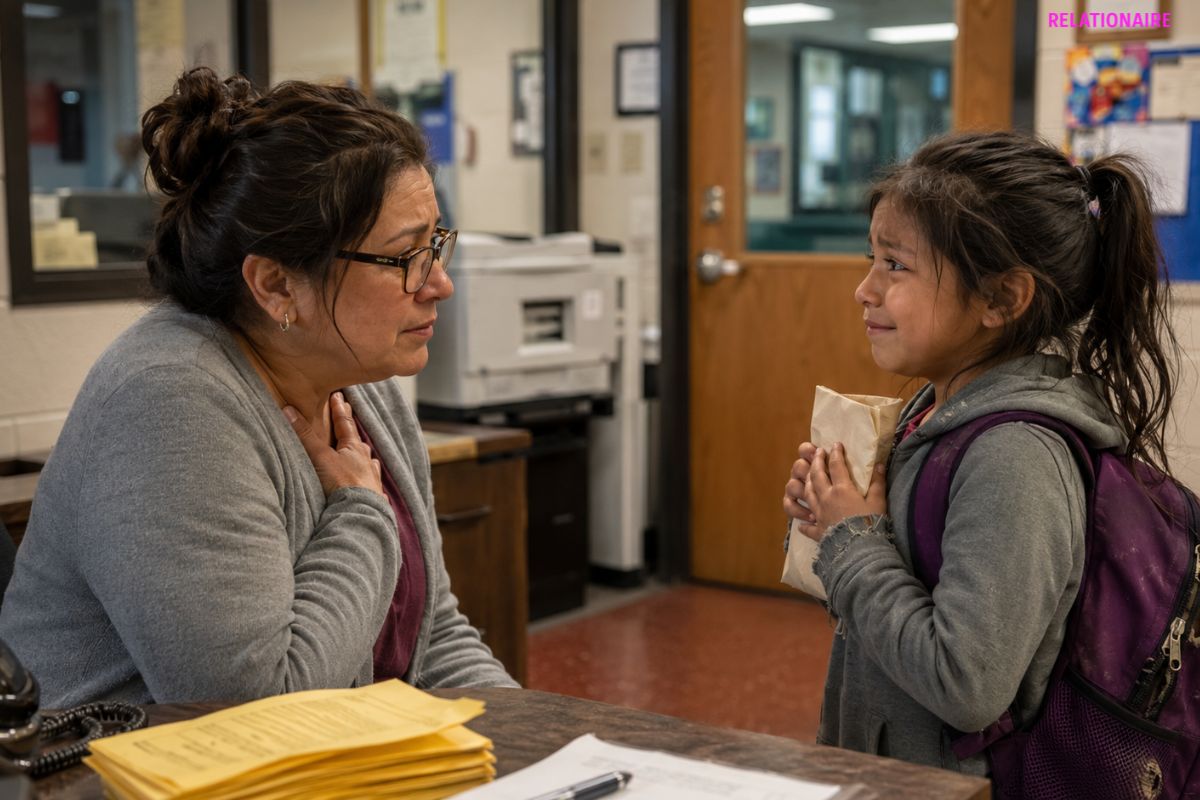
Standing in the front office with half a chicken nugget wrapped in a cafeteria napkin, apologizing with her eyes for being hungry in a building full of adults.
Elena moved the yellow lunch debt notice out of sight.
“Maddie,” she said gently, “come sit with me.”
The girl shook her head fast.
“I’m not in trouble?”
“No.”
“If I’m in trouble, can it be after break? Because Tommy doesn’t know where the noodles are.”
“Who is Tommy?”
“My brother.” Maddie swallowed. “He’s four. He doesn’t like carrots unless I tell him they’re orange french fries.”
Elena felt something inside her crack, quietly.
She lowered herself into the chair beside the copier.
“Where is Tommy right now?”
“At home.”
“Is a grown-up with him?”
Maddie stared at the floor.
The answer was in the silence.
Elena closed her eyes for one second.
Not because she didn’t care.
Because she cared so much she needed one second to keep her face calm.
When she opened them, Maddie was twisting the corner of her hoodie.
“My mom works,” the girl said quickly. “She really works. She’s not bad. She just gets tired. And sometimes her boss changes the schedule. And sometimes the babysitter can’t come if we don’t pay first.”
She said it like she had practiced defending her mother to adults.
Elena heard that more than anything.
“She loves us,” Maddie added.
“I believe you.”
Maddie looked up, surprised.
“I do,” Elena said. “But I need to make sure you and Tommy are safe.”
Fear rushed across the child’s face.
“No. Please. Please don’t make us leave her. Please.”
The office door opened, and Mrs. Keene stepped in with a folder.
She stopped when she saw Maddie’s face.
“What happened?”
Elena stood.
“Can you cover the phones for two minutes?”
Mrs. Keene looked from Elena to Maddie to the napkin in the girl’s hand.
Then her own face changed.
Not shock.
Recognition.
Teachers recognize pain before they have words for it.
“Of course,” Mrs. Keene said.
Elena led Maddie into the nurse’s office, where it smelled like hand sanitizer and crackers. Nurse Pam was labeling ice packs.
“I need a quiet place,” Elena said.
Nurse Pam took one look at Maddie and opened the little cot room without asking.
Maddie sat on the edge of the cot, purple backpack still clutched to her chest.
“Can I keep this?” she whispered, holding the napkin.
“We’ll make sure Tommy eats,” Elena said.
Maddie shook her head. “But he likes when I bring it. He says it tastes like school.”
That one nearly undid Elena.
She stepped into the hallway and found Principal Harris already coming toward her. Mrs. Keene must have told him something.
Elena explained in a low voice.
The lunch debt.
The napkins.
The brother.
The empty house.
The mother working changing shifts.
Mr. Harris took off his glasses and rubbed the bridge of his nose.
He looked older than he had that morning.
“We have to call,” he said.
“I know.”
“And we need to do it carefully.”
“I know.”
His voice softened.
“Elena, are you okay?”
She wasn’t.
But she nodded because there was work to do.
That was what schools did.
They kept moving while hearts broke in the hallway.
A few minutes later, Elena called the number on Maddie’s emergency contact form.
The first number went to voicemail.
The second was disconnected.
The third rang six times.
A woman answered, breathless.
“Hello?”
“Mrs. Bell? This is Elena Morales from Maple Ridge Elementary.”
There was a pause.
“What did Maddie do?”
The question came sharp.
Not angry.
Terrified.
Elena knew the difference.
“She didn’t do anything wrong.”
Silence.
Then a small sound, like the woman had set something down too hard.
“Is she hurt?”
“No. She’s safe. But we need you to come to the school.”
“I can’t leave right now.”
“I understand, but it’s important.”
“I said I can’t.” Her voice cracked. “If I leave again, I lose this job.”
Elena looked through the small window in the nurse’s door.
Maddie sat on the cot beside Nurse Pam, swinging her taped shoe back and forth, trying very hard not to cry.
“Mrs. Bell,” Elena said softly, “is Tommy home alone?”
The line went dead quiet.
Then the woman whispered, “Oh God.”
Not denial.
Not excuses.
Just the sound of a mother realizing the thing she had been trying to hold together had already slipped through her hands.
“I was supposed to be off at two,” she said. “They changed me to close. I called three people. Nobody answered. Maddie said she knew how to keep him busy. I thought—”
Her breath broke.
“I thought I had until six.”
Elena leaned against the wall.
Around her, school life continued. A student office aide delivered attendance folders. The copier jammed. Someone announced bus 12 was running late.
“I’m coming,” Mrs. Bell said. “Please don’t let them take my kids.”
By the time she arrived, the school day was almost over.
She came through the front doors in a grocery store polo, hair pulled back messily, cheeks flushed from running. Her name tag said Cassie. There was a cracked phone in her hand and a receipt stuck to her sleeve.
She looked nothing like what people had assumed.
Not careless.
Not lazy.
Just exhausted in a way that had no room left to look presentable.
Maddie ran to her.
“I’m sorry, Mama.”
Cassie dropped to her knees right there on the scuffed office floor and pulled her daughter into her arms.
“No,” she whispered into Maddie’s hair. “No, baby. I’m sorry.”
Elena turned away to give them a moment, but she heard the words anyway.
“Tommy was hungry,” Maddie cried. “I didn’t want him to cry.”
“I know.”
“I saved him the good parts.”
“I know.”
Principal Harris spoke quietly with Cassie in his office. A counselor joined them. Calls were made. Not to punish first. To protect first. To find emergency help. To make sure Tommy was not alone another night.
Still, rules had to be followed.
There were reports.
There were forms.
There was the terrible dignity of asking a mother how much food was in her cabinets.
Cassie answered every question with her hands folded in her lap.
“Rice,” she said. “Half a jar of peanut butter. Two packs of noodles. Cereal, but no milk.”
Her face burned with shame.
Elena recognized that shame.
Years ago, after her husband died, Elena had once stood in a pharmacy with her son’s antibiotic in one hand and her debit card in the other, praying the card would approve. It hadn’t. She had smiled at the cashier like nothing was wrong and gone to the car to cry where her son couldn’t see.
People called poverty irresponsibility when they didn’t want to look too closely.
That afternoon, Elena looked closely.
When Cassie finally left with Maddie, a social worker was driving to their apartment to meet Tommy. Nurse Pam had packed crackers, applesauce, and juice boxes into a plastic grocery bag. Mrs. Keene slipped in a small book with dinosaurs on the cover.
Maddie hugged the bag like it was gold.
At the office door, she turned to Elena.
“Am I still allowed to come back after break?”
Elena’s throat tightened.
“Of course you are.”
“Even if we owe lunch?”
“Especially then.”
Maddie nodded, but she didn’t smile this time.
After they left, the front office felt too quiet.
Elena picked up the yellow lunch debt list.
Seven pages.
So many names.
So many numbers pretending to tell the whole story.
She found Maddie Bell’s name again.
$48.75.
Forty-eight dollars and seventy-five cents had been enough to make grown-ups sigh, judge, complain, and fold shame into envelopes.
But it had not been enough to tell them that a second-grade girl had been cutting her lunch in half.
Elena sat down at her desk.
She opened the staff email.
Her hands hovered over the keyboard.
Then she typed a subject line she knew might get her in trouble.
Before we send one more notice
And for the first time all day, Elena stopped following the routine.
PART 3
By morning, Elena’s email had been forwarded to the whole staff.
She had not meant for it to become a movement.
She had written it at 5:18 p.m. from the front office, while the halls smelled like floor wax and leftover cafeteria pizza.
She did not use Maddie’s name.
She did not tell private details.
She wrote only this:
Before spring break, please remember that a lunch balance is not a character report. Sometimes a child’s account is empty because the refrigerator at home is empty too. If anyone wants to help quietly, come see me. No speeches. No announcements. No shame.
That was all.
By 7:40 the next morning, there was a brown paper grocery bag on her desk.
Inside were granola bars, cereal cups, tuna packets, and a note from the art teacher.
For whoever needs it.
At 7:52, Coach Daniels came in and set down a box of fruit cups.
“Don’t make a thing of it,” he said.
At 8:03, Mrs. Keene arrived with three packs of socks and a pair of children’s sneakers, size 13.
“Found them on clearance,” she said, eyes suspiciously bright. “Just in case any shoes are flapping.”
Nurse Pam brought shelf-stable milk.
The librarian brought peanut butter crackers.
The custodian, Mr. Lee, came in last. He carried two grocery bags in each hand.
Elena knew he took the city bus to work.
“Mr. Lee,” she said softly, “you don’t have to.”
He shrugged.
“When I was little, school lunch was the best meal I got,” he said. “Somebody noticed me once.”
Then he walked back out before anyone could thank him too much.
By noon, the little conference room behind the office had become something different.
Not a pantry exactly.
Not officially.
Official things required approvals, committees, and names.
This was quieter.
A shelf cleared of old testing binders.
A box labeled spring break snacks.
A drawer with clean socks, toothbrushes, and grocery gift cards tucked inside plain envelopes.
Principal Harris stood in the doorway, arms crossed.
“You know district will want a policy for this,” he said.
Elena looked up.
“Then we’ll write one.”
He nodded once.
“I already called the community liaison.”
There were still rules.
There always were.
But that day, the rules had a pulse.
Cassie Bell came to the school after lunch, thinking she was there to sign paperwork.
She wore the same grocery store polo, washed but still wrinkled. Her eyes were swollen. She held Tommy’s small hand.
Tommy was smaller than Elena expected. Serious brown eyes. Dinosaur sweatshirt. He hid behind his mother’s leg and peeked at the office candy bowl like he wasn’t sure he was allowed to want things.
Maddie spotted him from the hallway and broke into a run.
“Tommy!”
Mrs. Keene called, “Walking feet,” out of habit.
Then she covered her mouth and let the child run.
Maddie wrapped her arms around her brother.
“I told you school was real,” she said.
Tommy looked at the ceiling tiles, the bulletin boards, the secretary desk, the plastic chairs.
Then he whispered, “It smells like nuggets.”
Everyone pretended not to cry.
Cassie met with the counselor, the community liaison, and Principal Harris. There was emergency childcare paperwork. A food pantry referral. A spring break meal program. A district fund no one had told her about because sometimes help existed behind doors you had to know how to knock on.
Cassie kept saying, “Thank you,” until Elena finally touched her hand.
“You don’t have to keep paying us back with shame.”
Cassie stared at her.
Elena spoke carefully.
“I know what it feels like to be one bill away from being misunderstood.”
Cassie’s face changed.
Not fixed.
Not healed.
But less alone.
A week later, spring break began.
Before dismissal, Maddie was called to the office.
She came in slowly, like children do when they are sure adults have found another problem.
But this time, there was no yellow envelope.
There was a plain canvas tote bag on Elena’s desk. No label. No pity. Just food packed neatly inside, with a dinosaur book on top for Tommy and a new pack of napkins tucked in the side pocket.
Maddie touched the napkins first.
Her chin trembled.
“These are for spills?” she asked.
Elena smiled.
“For anything.”
Maddie looked at the bag, then at Elena.
“Do I have to split it?”
The question was so small.
The room went still.
Elena crouched so they were eye level.
“No, sweetheart,” she said. “There’s enough for both of you.”
Maddie blinked hard.
Then she did something Elena had never seen her do.
She stopped smiling.
Her little face crumpled, and she cried with her whole body, quietly at first, then into Elena’s shoulder as if she had been waiting for permission to be seven years old again.
Elena held her.
She thought about all the times she had printed names on paper and believed she was just doing paperwork.
She thought about the children who smiled too hard.
The ones who acted out.
The ones who slept through math.
The ones who stole extra crackers and said they were “saving them for later.”
Later had a name.
Later had a brother.
Later had an empty cabinet.
When Maddie finally pulled away, she wiped her face with the back of her sleeve and gave Elena a tired little look.
“Mrs. Morales?”
“Yes?”
“When I grow up, I’m gonna work in a school.”
Elena smiled through tears.
“What job?”
Maddie thought about it.
“Maybe the office,” she said. “So I can know everybody’s names.”
On the Monday after spring break, something had changed at Maple Ridge.
Not loudly.
There were no banners.
No assembly.
No post online about kindness.
But in the cafeteria, the lunch ladies started putting a basket of extra fruit near the end of the line with a sign that said Take one if you need one.
In the front office, lunch debt notices were still sent when they had to be.
But they were no longer just folded and passed along.
A phone call came first.
A question came first.
“Is everything okay?”
Sometimes the answer was yes.
Sometimes it wasn’t.
And when it wasn’t, the school tried to be more than a building where children learned spelling words and long division.
It became what it had always been, underneath the bells and forms and scuffed floors.
A place where adults noticed.
A place where a custodian’s grocery bag mattered.
A place where a teacher’s tired eyes could still see.
A place where a secretary understood that a child’s balance was not the same thing as a child’s worth.
Years later, Elena would still think of Maddie Bell whenever she saw a cafeteria napkin folded too carefully.
She would remember the half chicken nugget.
The taped shoe.
The little girl who carried dinner home in pieces.
And she would remember the lesson Maple Ridge learned that spring.
Sometimes the most important work in a school never shows up on a test score.
Sometimes it is just this:
A hungry child is noticed.
A tired mother is not judged.
And someone, somewhere, decides that dignity should be handed out as quietly as lunch.