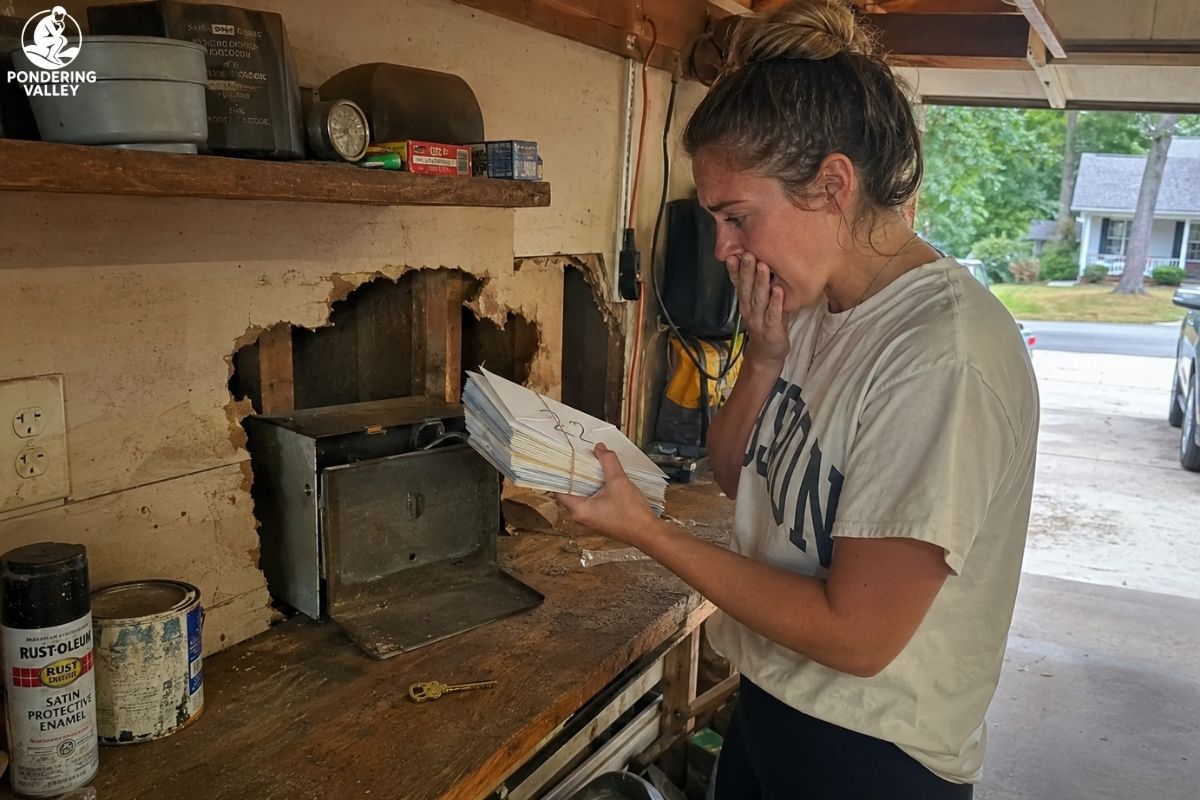
If you’ve already read part 1 of this story on Facebook, go here for Part 2!
By the time anyone noticed the old man in aisle twelve, he had already been standing there long enough for two different women to steer their carts around him with tight little smiles.
He wasn’t blocking the ribbon.
He was just… there.
Still as a post. One hand gripping the shopping cart handle. The other holding something small and square between his fingers like it might fall apart if he breathed wrong.
Mara saw him from the endcap while she was restocking glue sticks.
At first, she thought he was lost.
That happened all the time at Hensley’s Crafts & Home. Husbands wandered in after their wives. Grandparents got dragged there for school projects. Men who looked deeply betrayed by the existence of decorative moss would stand in the middle of an aisle like they’d been dropped behind enemy lines.
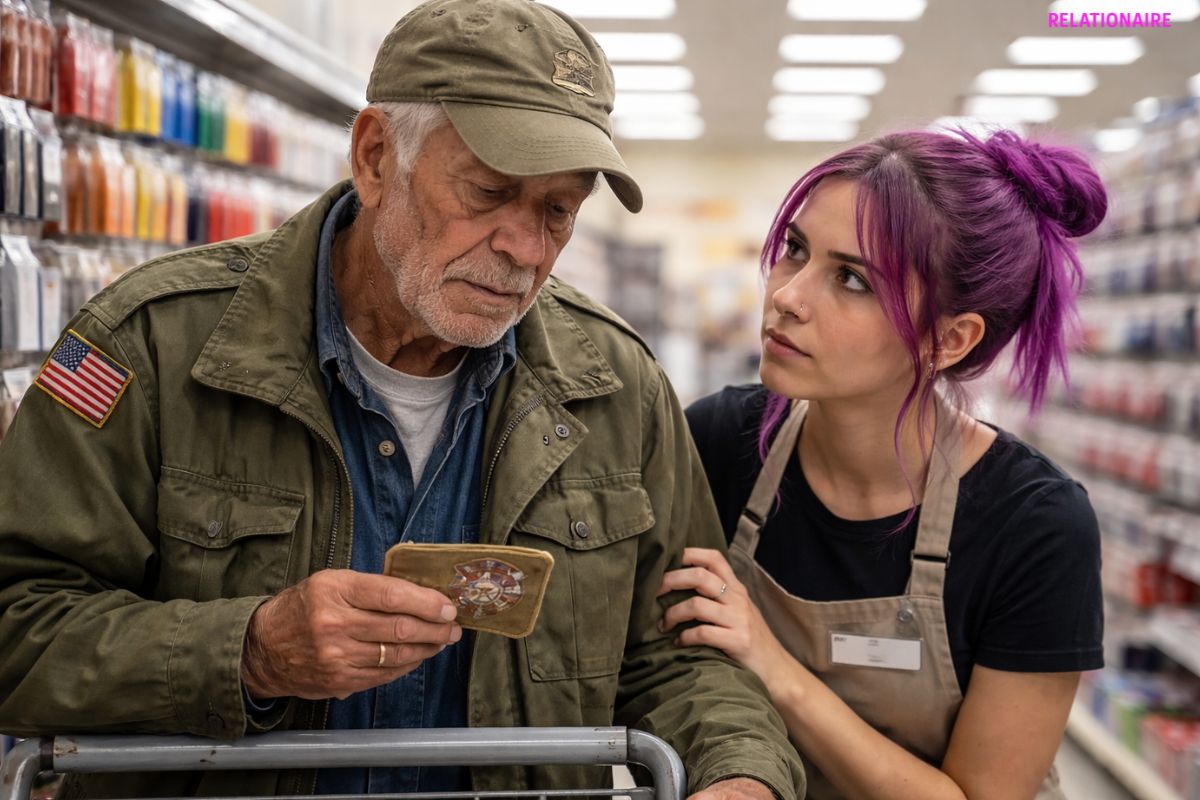
This guy looked older than most, maybe late seventies. Big shoulders gone narrow with age. White hair clipped short. Faded green jacket even though it was warm outside. His hands were rough, thick-knuckled, the hands of someone who had spent his whole life lifting things that fought back.
He was staring at the wall of ribbon like it had insulted him.
Cream, ivory, ecru, eggshell, antique white.
Then blues. Then reds. Then the little satin spools with their ridiculous names printed underneath.
Dusty rose.
Winter berry.
Patriot blue.
He didn’t move.
Mara tucked a pack of glue sticks into place and watched him for a second longer.
“Need help?” called a woman pushing a stroller.
The old man didn’t answer.
The woman gave Mara a look that said, You should probably handle that.
Mara exhaled through her nose and walked over, brushing purple bangs out of her eyes.
“Hey,” she said gently. “You doing okay, sir?”
He blinked like he hadn’t heard anyone speak in years.
Then he looked at her, and what hit her first wasn’t confusion.
It was panic.
Not big dramatic panic. Not yelling or shaking.
Worse.
The kind someone was trying very hard not to let anybody see.
“I’m fine,” he said.
His voice was low, steady, older Southern with a little gravel in it.
Then he looked back at the ribbon wall and added, “Just need a color.”
That should’ve been easy.
That was the thing.
People came in all the time with pieces of fabric, wedding invitations, baby shower decorations, trying to match shades. Mara was seventeen. She had worked here eleven months. She could match blush pink to dusty pink in under ten seconds.
“No problem,” she said. “What’re you matching?”
He looked down at the object in his hand.
It wasn’t fabric.
It was a folded military patch.
Small. Dark. Frayed around the edges. The kind that had once been sewn onto something important.
He held it out carefully.
Mara took it like it was fragile, even though it didn’t look fragile at all.
The patch had an eagle on it and old stitching. It smelled faintly like cedar and attic dust. She could tell it had lived in a box for a long time.
“I need ribbon for this,” he said.
She looked from the patch to the wall, trying to understand.
“For… a display?”
“No.”
“A shadow box?”
He shook his head.
She waited.
His mouth tightened. “A package.”
There was something in the way he said it that made her stop smiling automatically.
“What kind of ribbon?”
He swallowed.
“I don’t know.”
Two teenage girls passed behind them with baskets full of fake flowers. One of them glanced at the old man and whispered something to the other. Both giggled.
Mara shot them a look sharp enough to cut cardboard.
The old man had heard. She could tell by the way his shoulders changed.
Not slumped.
Braced.
“I can come back,” he said quickly, reaching for the patch.
Mara didn’t hand it over.
“No, you can’t,” she said before she thought about it.
He looked at her.
She softened her voice. “I mean—you don’t have to. We can figure it out.”
For a second, he seemed unsure what to do with kindness.
Like it had been offered in the wrong aisle by the wrong person and he didn’t have the paperwork for it.
“What’s the package for?” she asked.
His jaw worked once.
Then he said, “An apology.”
The word landed between them harder than it should have.
Mara looked at the patch again.
She suddenly understood this wasn’t about ribbon.
This was about the thing that made a man stand frozen in fluorescent light under a SALE sign, unable to move toward satin or grosgrain because one wrong shade might mean one more reason to give up and go home.
“Okay,” she said quietly. “Then we do it right.”
He let out a breath that sounded painful.
Mara pulled a few spools off the rack and held them next to the patch. Deep navy. Muted red. Plain cream.
He rejected each one with a tiny shake of his head, but not impatiently. Almost sorrowfully.
“Too bright.”
“This one?”
“Too clean.”
She frowned. “Too clean?”
“It can’t look new.”
That told her more than he meant to say.
She glanced into his cart.
There was a plain white mailing box. Tissue paper. A pack of acid-free wrapping paper. One small glass jar with a metal lid. A blank card.
And nothing else.
No decorations. No gift bag. No cheerful nonsense.
It looked less like a present and more like evidence.
“Did somebody ask you to send it?” Mara asked.
His answer came too fast.
“No.”
Then, after a pause: “Nobody asked me for anything.”
There it was again, that tightness in his face. Not confusion. Not even embarrassment.
Grief, maybe. But older than grief. Grief calcifies if you leave it alone long enough.
A woman in yoga pants turned into the aisle, saw them standing there, and gave Mara a sympathetic smile people used when they thought they were watching someone help a stranger whose mind was slipping.
“Take your time, hon,” she said to Mara, not to him.
The old man went very still.
Something hot flashed through Mara.
“He’s fine,” she said flatly.
The woman blinked, offended, and moved along.
The man’s eyes stayed on the ribbon.
After a moment, he said, “Most people see an old man standing still and decide the rest for themselves.”
Mara looked at him.
“What should I decide?”
He gave a tired half-smile that didn’t reach his eyes. “That I should’ve written a letter forty years ago.”
Now she really didn’t know what to say.
She was supposed to be facing up ribbon. Her manager would be annoyed if she disappeared too long. But the whole aisle felt different now, quieter somehow, as if all those bright little spools were suddenly part of something sacred and none of them had noticed.
“Okay,” she said. “Then maybe the ribbon doesn’t match the patch.”
He finally turned to look at her fully.
“What?”
“Maybe it matches the reason.”
He stared at her, and for the first time, the panic in his face shifted into something else.
Surprise, maybe.
Or the strange relief of being understood by someone who had no business understanding you.
Mara held up a narrow spool of faded blue-gray seam binding she’d found shoved behind the satin ribbon.
It wasn’t flashy. It looked worn before it was even used.
Soft. Humble. Honest.
His throat moved.
“That one,” he said.
She nodded like it was obvious.
“Good. Now let’s do the card.”
His hand tightened on the cart. “No.”
“You bought one.”
“I know.”
“Then we write it.”
“No.”
This time the word came hard enough to make a woman at the scrapbook paper rack glance over.
Mara didn’t flinch.
“You came this far.”
He looked at the blank card in the cart like it might accuse him in public.
“I can’t fit forty years into a card.”
“No,” Mara said. “But maybe you can fit the first true sentence.”
That did it.
His face changed.
Not angry. Not confused.
Broken.
He took one breath, then another, and reached slowly into his jacket pocket. His hand came out with an envelope so worn at the fold it looked like he’d opened and closed it a hundred times.
His fingers shook as he held it toward her.
“I already got a letter,” he said.
Mara took it carefully.
The return address was from a law office in Ohio.
The front had his name written in firm black ink: Mr. Thomas Weller.
He stared at the envelope, then at the patch in her other hand.
When he spoke again, his voice was so low she almost didn’t catch it.
“She died in February,” he said. “And I didn’t know she existed until last week.”
Mara stopped breathing.
The whole aisle seemed to tilt.
The ribbon, the blank card, the little white box, the patch in her hand—suddenly every piece snapped into a shape she hadn’t seen coming.
He closed his eyes once, as if saying it out loud had made it final.
“The package,” he said, opening them again, “is for my granddaughter.”
Part 2
Mara didn’t speak for a moment because every ordinary response felt wrong.
I’m sorry felt too small.
Oh my God felt selfish.
So she did the only thing that seemed useful.
She led Thomas Weller to the little clearance table near the framing counter where people sat to fill out custom-order forms, and she brought him a pen.
He looked at it like it weighed ten pounds.
The store hummed around them with its usual Saturday noise. A toddler whining near yarn. The beep of a register. A woman laughing too loudly in floral decor. Life going on in fluorescent indifference.
But at that tiny table, something had gone very quiet.
Mara set the faded ribbon beside the blank card and slid the envelope back to him.
“You don’t have to tell me anything you don’t want to,” she said.
He sat down slowly.
“That’d be easier,” he said.
“But?”
“But easy is how a man wastes forty years.”
Mara took that in and pulled up the extra folding chair, though she didn’t sit yet.
Thomas opened the envelope with careful fingers.
Inside was a letter on cream paper, crisp and official. Also a photograph, bent slightly at one corner from being handled too much.
He handed Mara the photo first.
It was of a woman in her forties standing on a porch in winter, wrapped in a brown coat, smiling into the wind. She had his eyes.
Not exactly. Softer. Kinder, maybe.
But undeniably his.
Mara looked up.
“My daughter,” he said. “Emily.”
He said the name like it was both a gift and a punishment.
“She was born in 1974. Her mother never told me. Or maybe she tried and the letter never reached me. Or maybe she took one look at who I was back then and decided not to hand a child over to it.”
He gave a rough laugh without humor.
“I was twenty-six. Fresh back from Vietnam. Meaner than hell. Drinking too much. Jumping at doors slamming. Sleeping with the lights on. Breaking things for no reason and apologizing after. Your average dream man.”
Mara sat down across from him.
No one had ever talked to her like this in the store before. Usually people wanted coupon help or directions to seasonal wreaths.
But now the old man was opening his life like an old wound in a place that smelled faintly of cinnamon pinecones and acrylic paint.
“She knew you were her father?” Mara asked.
He nodded.
“According to the lawyer, yes. Her mother told her when Emily turned eighteen.”
“Then why didn’t she contact you?”
He looked at the photo again.
“Maybe she did.”
Mara frowned.
Thomas reached into his jacket and pulled out a second thing she hadn’t noticed before—a letter, much older, folded and refolded until the edges had turned soft as cloth.
The envelope was yellowed. The stamp was old. Unopened.
“My sister found it in Mama’s cedar chest after she passed,” he said. “Said it got tucked inside a stack of church bulletins somehow and nobody ever saw it. Emily mailed it in 1998.”
Mara felt her stomach drop.
He placed the old unopened letter beside the newer one from the lawyer.
Twenty-eight years between them.
“I opened it three nights ago,” he said. “In my kitchen. Took me fifteen minutes just to slit the envelope because my hands wouldn’t work.”
His voice changed as he remembered it.
“Inside was one page. She said she wasn’t asking for anything. Said she just wanted me to know she existed. That she had a little girl of her own. That if I ever wanted to answer, I could.”
He looked away.
“I never answered because I never knew.”
A customer approached halfway, took one look at Thomas’s face, and retreated without asking whatever coupon question she’d had. Mara barely noticed.
“What happened to her?” she asked softly.
Thomas rubbed a hand over his mouth.
“Cancer. Fast, according to the lawyer. She died in February. Her daughter found my name in old papers after the funeral. The lawyer tracked me down.”
Mara stared at the blank card again.
The whole package made sense now, and somehow that made it hurt worse.
“This patch,” she said, touching it lightly. “Was it yours?”
Thomas nodded. “Off my uniform jacket.”
“You’re sending it to your granddaughter?”
“She asked the lawyer if there was anything of mine that had meaning. Said if I didn’t want contact, she’d understand. But if I did… she’d like to know something about the man her mother spent half her life wondering about.”
He swallowed hard.
“I didn’t know what to send. Didn’t know what right I had to send anything.”
Mara thought of him standing paralyzed in the ribbon aisle while strangers assumed his mind had wandered off.
Not one of them had guessed he was trying to package forty years of absence.
“What’s your granddaughter’s name?” she asked.
“Lily.”
Of course it was something gentle.
“How old?”
“Sixteen.”
Mara blinked.
The number hit strangely. Same generation. Same awkward age. Same unfinished edges.
“She’s my age.”
Thomas nodded once. “That scared me too.”
He looked down at his hands.
“Because I know what sixteen-year-old girls need from the world. Consistency. Safety. Truth. And the first thing she’s ever getting from me is a box from a stranger with my last name on it.”
Mara felt her eyes sting.
“She reached out,” she said.
“Through a lawyer.”
“She still reached.”
He didn’t answer.
So Mara did something she normally wouldn’t have dared. She slid the blank card across the table and turned it toward him.
“Tell the truth, then.”
Thomas stared at it.
His fingers twitched, but he didn’t pick up the pen.
“I don’t know how to begin.”
Mara thought for a second.
Then she said, “Not with an excuse.”
His eyes lifted to hers.
She held his gaze. “Not with Dear Lily, I’m sorry this is strange. Not with explanations. Just the truest thing first.”
He leaned back like the words had hit him physically.
Then, after a long silence, he picked up the pen.
His handwriting came slowly. Stiff. Careful. Like every letter had to be convinced to leave him.
Mara looked away while he wrote the first line. It seemed private.
When he finally stopped, she saw his hand trembling so hard he had to set the pen down.
“Want me to read it?” she asked.
He hesitated. Then nodded.
She lifted the card.
It said:
Lily,
Your mother did write to me. I was just too late to hear her.
I do not know if there is room in your life for me, but there has not been an hour since I learned her name that I have not wished I had been better than late.
Mara pressed her lips together.
It wasn’t polished. It wasn’t pretty.
It was true.
“That’s the one,” she whispered.
Thomas stared at the card like he didn’t recognize something that honest as his own.
Then he gave a small nod.
Mara helped him choose tissue paper. Not bright white—soft cream. She showed him how to loop the faded ribbon without making it look like a birthday present. He wrapped the patch in plain paper first, then added the photograph of himself at twenty, one she almost missed because it was tucked inside his wallet behind his driver’s license.
In the photo, he was young and broad and unsmiling in uniform, looking straight at the camera like he trusted nothing.
“Will you send the old letter too?” Mara asked.
His jaw tightened.
“I don’t know.”
She understood why. That unopened letter was proof of the worst thing that had ever happened without anybody meaning for it to happen. Sending it would mean telling Lily that her mother had reached, and he had failed her without even knowing.
But not sending it would be another silence.
Thomas looked at the old envelope for a long time.
Then he placed it in the box.
Mara taped it shut.
He stood at the register while she rang him up. The total was only $18.47, but he looked at the card reader like it was one more test of nerve.
When the receipt printed, he folded it carefully and put it in his pocket.
Not because of the money.
Because it was proof he had done a thing he could still back out of.
“Post office closes at four,” Mara said.
He glanced toward the front windows. It was already past three-thirty.
He nodded, but he didn’t move.
Mara understood before he said it.
“You’re scared,” she said.
He looked ashamed of that.
“Terrified,” he admitted.
She came around the counter before she could overthink it.
“Then I’ll go with you on my break.”
Thomas blinked. “You don’t have to do that.”
“I know.”
That was when her manager, Denise, who had apparently heard enough to piece together some version of the situation, silently walked over from floral supplies, untied her apron, and handed Mara the keys to her own car.
“Take thirty,” Denise said roughly. “And Thomas?”
He looked up.
“Don’t you dare leave that box in your truck.”
His eyes filled so suddenly Mara had to look down.
They drove three blocks to the post office in Denise’s dented Honda with the air conditioner rattling and the package on Thomas’s lap like something alive.
Inside, the line was short.
A man in work boots. A woman mailing a birthday card. A mom with a toddler on one hip.
Nothing dramatic.
Just a regular afternoon.
Which somehow made it harder.
Thomas stepped up to the counter when his turn came, set the box down, and then froze all over again when the clerk asked, “Anything fragile, liquid, perishable, or potentially hazardous?”
He looked at the package.
Then at Mara.
Then back at the clerk.
His mouth opened.
And what came out made the woman behind them gasp softly.
“Yes,” he said. “It’s fragile. I think I waited too long.”
Part 3
The postal clerk was an older woman with silver glasses on a chain and the kind of face that had seen every version of human behavior without being shocked by much.
But even she paused.
Not annoyed. Not confused.
Just still.
Thomas looked like he wanted the floor to open and finish the job.
Mara stepped a little closer to his side, not touching him, just there.
The clerk’s expression softened by degrees.
“Well,” she said gently, as if answering the truth instead of correcting it, “then let’s make sure it gets there carefully.”
Something in Thomas’s face crumpled for half a second.
Not a full breakdown. He seemed too trained for that, even now.
Just one terrible flicker of relief.
The clerk weighed the box, printed the label, and asked if he wanted tracking.
Thomas nodded.
“Yes, ma’am.”
His voice sounded young suddenly. Or maybe just stripped down to something unguarded.
When she told him the cost, he paid with exact bills from a worn leather wallet. Mara noticed his hands had steadied a little.
Then came the last moment.
The clerk turned the box and slid it toward the outgoing bin behind the counter.
Thomas didn’t let go.
Not right away.
His hand stayed on top of it, broad and weathered and stubborn.
Mara could almost feel what was happening inside him: forty years of silence, all gathered into that one point of contact.
Finally, he released it.
The box disappeared behind the counter with a soft cardboard scrape.
That was all.
No music. No lightning. No miracle.
Just a package mailed on a weekday afternoon by a man who should’ve done it decades earlier, to a girl who had every right never to answer.
Thomas stood there a second too long after it was gone.
The clerk handed him the receipt.
“Hold onto that,” she said.
He nodded and folded it with almost ceremonial care.
Outside, the sky had turned that pale gold it gets before dinner. The parking lot shimmered with heat. Somebody somewhere was mowing grass.
Thomas stood beside Denise’s Honda and stared at nothing.
Mara wasn’t sure if she should say something comforting. Most comforting things people said were useless anyway.
So she just asked, “Do you want coffee?”
He blinked at her as if the question had pulled him back from far away.
“There’s a diner across the street,” she added.
He gave the smallest shrug. “I suppose I can survive coffee.”
The diner was cold inside and smelled like grease, pie filling, and old booths wiped down a thousand times. They took a table by the window.
Mara got fries and a Coke because she was seventeen and always hungry. Thomas got black coffee he barely touched.
For a while they didn’t say much.
Then he reached into his jacket and set something on the table.
It was the old unopened letter’s envelope.
Mara frowned. “I thought you mailed it.”
“I mailed the letter,” he said. “Not the envelope.”
She looked confused.
“I couldn’t send her mother’s handwriting hidden inside another layer of silence. So I opened it fully last night and made a copy. Sent the pages. Kept this.”
He ran his thumb over the old ink where Emily had written his name nearly thirty years earlier.
“She was real before the lawyer said she was,” he murmured. “I think I needed proof I could hold.”
Mara nodded. That made sense to her, even if she couldn’t have explained why.
“Do you think Lily will answer?” she asked.
Thomas gave a tired smile. “I think Lily is sixteen. Which means she might answer immediately, or in six months, or never. All of those would be fair.”
He looked out the window at the post office across the street.
“But at least if she hates me, she’ll hate the truth. Not another absence.”
That line stayed with Mara.
Not another absence.
When they got back to the store, Denise didn’t ask for details. She just looked at Thomas, looked at Mara, and slid a paper bag across the counter.
“Blueberry muffin,” she said to Thomas. “You look like you forgot lunch.”
Thomas actually laughed then. Briefly, but real.
He took the muffin.
“Thank you.”
He turned to Mara like he wanted to say something larger than the moment had room for.
Instead he said, “You’re very young to know when not to walk away.”
Mara shrugged, suddenly embarrassed. “My grandma says people are usually asking for help long before they ask out loud.”
Thomas nodded slowly, as though filing that away somewhere important.
Then he left.
Mara watched him cross the parking lot to an old truck with peeling paint and one dented fender. He moved carefully, like his bones hurt, but something about him was different now.
Not lighter.
That wasn’t the word.
Just less unfinished.
The next two weeks passed like normal and not normal at all.
Mara stocked shelves. Cut fabric. Endured customers who treated coupons like constitutional rights. But she kept thinking about Thomas Weller and the box moving through sorting facilities and trucks and hands and conveyor belts until it reached a sixteen-year-old girl somewhere in Ohio.
She wondered what Lily looked like.
If she had her mother’s eyes.
If she opened the package alone.
If she cried.
If she rolled her eyes and left it on a counter for three days before daring to read the card.
Mostly, Mara wondered whether kindness counted if it couldn’t fix anything.
Then, on a Tuesday afternoon just after school let out, the front bell jingled and Denise called from the register, “Purple Hair, your veteran’s back.”
Mara turned so fast she nearly dropped a basket of embroidery floss.
Thomas stood near the entrance, hat in hand this time.
He looked shaken.
For one awful second, Mara thought the answer had come and it was bad.
Then she saw the envelope.
Fresh. White. Opened already.
And the expression on his face wasn’t grief.
It was disbelief trying very hard not to become joy.
He walked to the framing counter where she stood and held out a folded piece of notebook paper.
“My granddaughter writes with green ink,” he said, as if that were the important part.
Mara took the letter.
The handwriting was young but careful.
There were a few crossed-out words, places where the pen had pressed hard.
She read:
Mr. Weller,
My mom kept your unopened envelope in a wooden box with three pictures, a pressed daisy, and my baby hospital bracelet. So I don’t think she hated you. I think she was sad. Maybe both.
I was mad when the lawyer found you. Then your package came and I got madder because the first true thing I ever got from you was honest enough to hurt.
I think Mom would’ve liked that you didn’t pretend.
I don’t know what to call you yet.
But I want to write back.
Also, thank you for sending the patch. I put it next to her picture.
My school has Grandparents’ Day in October. If that’s too weird, ignore this part.
—Lily
Mara covered her mouth.
Thomas looked down, blinking too much.
“She underlined ‘ignore this part,’” he said.
“I saw.”
“I have read this letter eleven times.”
“I believe you.”
He laughed once and scrubbed at his eyes with the heel of his hand like he was annoyed to be caught having them.
Then he reached into his pocket and pulled out a photo.
This one was recent. Printed on regular home paper.
Lily, standing in a kitchen, awkward and serious, holding the military patch against her chest. Behind her on the refrigerator was a magnet shaped like Ohio.
“She sent that too,” he said.
Mara looked from the photo to him.
“What are you going to do?”
He took a breath.
“Buy a card that doesn’t look like it belongs at a funeral.”
She burst out laughing so suddenly that Denise glanced over.
Thomas smiled—a real one this time, lined and gentle and almost boyish beneath all that age.
Mara led him back to stationery, but he didn’t freeze this time.
He moved slowly, thoughtfully, touching things with intention.
They picked a card with a watercolor tree on the front. Nothing sentimental. Nothing fake. Inside, it was blank.
Of course it was.
At the register, Thomas bought the card, a sheet of stamps, and—after Denise pushed it toward him without asking—a small frame for Lily’s photograph.
“Employee discount,” Denise said when he protested.
“You don’t work here,” Thomas replied.
Denise shrugged. “Today you do.”
He chuckled and shook his head.
Before leaving, he looked at Mara.
“I may need help again,” he said.
“With what?”
He held up the blank card.
“Figuring out what a man says when he’s offered a place in a life he didn’t earn.”
Mara smiled softly. “Probably the same thing as before.”
His brow furrowed.
“The truth first.”
He stood there a moment, taking that in.
Then he nodded.
Months later, on the first Saturday in October, Mara would get a photo in the mail from Ohio. Thomas Weller in a pressed button-down, standing beside a lanky girl with serious eyes and green-ink handwriting, both of them looking slightly uncomfortable and deeply proud in front of a school banner that read GRANDPARENTS’ DAY.
The frame he’d bought was visible in the background on a table behind them. Inside it, the old patch.
Nothing about it erased what had been lost.
Emily was still gone.
The years were still the years.
But sometimes a life didn’t turn because someone had the perfect words.
Sometimes it turned because a man stood frozen in a craft aisle with an old patch in his hand, and a teenage girl with purple hair understood that he wasn’t lost.
He was trying, at last, to arrive.