If you’ve already read part 1 of this story on Facebook, go here for Part 2!
“Don’t move them.”
Walter’s voice wasn’t loud, but it stopped Sarah in the doorway like she’d walked into a wire.
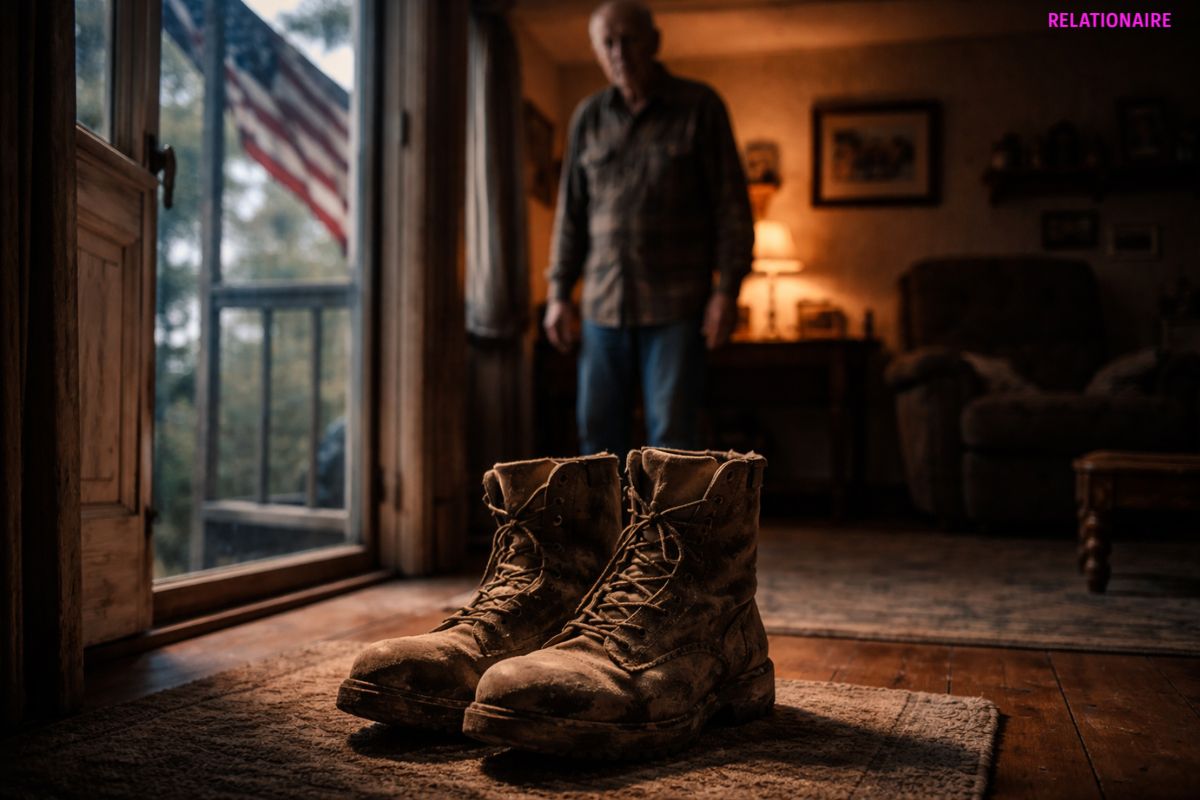
She stood there with the boots in her hands, one in each hand by the frayed laces, mud long dried into the cracked leather. They looked heavy for something that hadn’t been worn in forty years.
“I’m not throwing them out,” she said. “I’m moving them so you don’t break your neck.”
Walter rose slowly from his chair by the front window. The old recliner groaned under him. Outside, the flag on the porch snapped once in the cold morning air, and the screen door gave its familiar creak when the wind caught it.
Those boots sat by his front door every day of Sarah’s life.
Toe to toe. Straight as soldiers.
He never dusted around them. Never let anyone touch them. Never explained them.
And every time somebody asked, he’d just say, “They stay there.”
Sarah set them down harder than she meant to.
“You fell last week,” she said. “The doctor said—”
“The doctor ain’t the one living here.”
The smell of coffee drifted from the kitchen, burnt just a little, the way Walter always made it. Bacon grease still hung in the curtains from breakfast. The house had the same smell it had when Sarah was ten years old and sitting at this same table, coloring while her mother fried eggs and Walter came in from the porch with cold red hands.
Only now her mother was gone.
The house was quieter.
And Walter, at eighty-two, seemed to have shrunk into his flannel shirt and those old habits nobody could argue with.
Sarah rubbed her forehead. “Daddy, I’m not trying to fight with you.”
He looked past her, down at the boots.
His jaw worked once.
“You already are.”
By noon, the whole thing had settled into the kind of silence families know too well. The silence with edges.
Sarah drove him to Miller’s Diner anyway, because Thursday was Thursday, and Walter had been going there at eleven-thirty sharp since before the town put in the new stoplight.
The bell over the diner door jingled when they walked in. Warm air hit them first, then coffee and bacon grease and biscuits. Boots thudded on worn tile. A couple farmers sat at the counter. Three men in ball caps leaned over pie and talked low about rain.
Miller’s wasn’t fancy, but it held a town together.
Walter moved slower these days, one hand on his cane, the other brushing the back of each booth as he passed. He wore his old coat, thin at the elbows. His collar was clean. His boots—his real boots—were polished though the leather was splitting near the sole.
Everybody knew him.
That didn’t mean everybody understood him.
Lena, the waitress, poured his coffee before he sat down.
“The usual, Mr. Walter?”
He nodded.
At the booth behind them, somebody said quietly, “Still keeping those dead-man boots by the door?”
The words were low, but not low enough.
Sarah stiffened.
Walter didn’t turn around.
He just reached for the coffee cup with both hands, like the heat mattered more than the words.
Another man chuckled. “My boy did some work out there. Said those things look like they came off a museum shelf.”
Sarah half-rose from the booth. “Excuse me?”
Walter put two fingers on her wrist.
Not hard.
Just enough.
“Sit down.”
His hand was cold.
She sat, furious now, not at him but at the way he could hear something like that and keep his face still. Like it was easier to let people be small than ask them to be better.
Lena shot the men a look, but the moment passed the way small cruelties often do in small towns: without anybody wanting to claim it.
Walter stirred nothing into his black coffee and stared out the window.
Across the street stood the feed store.
Next to it, the barbershop.
And beside that, the brick wall with the names from their county carved into a memorial plaque: Korea, Vietnam, Desert Storm, Iraq, Afghanistan.
A child could have walked by it every day and never seen the whole weight of it.
Sarah said softly, “Why do you let them talk like that?”
He took a long sip before answering.
“Because I know something they don’t.”
That should have ended it.
Instead it stayed with her.
All afternoon, it stayed with her.
After diner, Walter asked to be dropped at the VFW hall. The old building sat just outside town, with white paint peeling at the trim and a flag out front that never seemed to come down, no matter the weather.
“I’ll get you at four,” Sarah said.
He nodded and got out carefully.
From the car, she watched him on the walkway for a second longer than usual. An old man with a cane. Thin shoulders. Worn coat.
He looked ordinary enough that a stranger might have missed the straightness in his back.
Inside the hall, he met with the same four or five men every Thursday. Coffee in foam cups. Folding chairs. Quiet talk. Nothing dramatic.
But that day, when Sarah came back for him, she found him alone in the little side room near the framed photos.
He was standing in front of the display case.
In his hands was a folded flag.
Not large. Not ceremonial.
Small enough to have come from a casket long ago or from some private remembrance nobody else had a right to touch.
He looked up when he heard her.
For one second, she saw something raw in his face. So raw it felt like she’d opened a door she wasn’t supposed to.
Then it was gone.
“What’s that?” she asked.
“Something I borrowed.”
He slid the folded flag under his coat and walked past her.
Borrowed.
From a VFW hall display case.
Sarah followed him outside. “Daddy.”
He kept walking.
“Walter.”
That made him stop. She only used his name when she was angry or scared.
He turned slowly.
“Those boots,” she said. “That flag. Whatever this is… I need you to tell me.”
He looked toward the road, toward the town, toward home.
When he finally spoke, his voice was so quiet she almost missed it.
“They ain’t mine.”
She frowned. “What?”
“The boots.”
He swallowed once.
“They never were.”
Sarah stared at him.
All those years. All those birthdays, Christmas mornings, thunderstorms, arguments, funerals, Sunday dinners. All those years those boots had stood by the door, and not once had it crossed her mind they belonged to somebody else.
“Then whose are they?” she whispered.
Walter’s hand tightened around his cane.
His knuckles went white.
A truck rumbled by on the highway. Somewhere behind the hall a screen door banged shut.
And Walter, who had spent forty years saying almost nothing about those boots, looked at his daughter with eyes that had suddenly gone much older than his face.
“The man who should’ve come home instead of me.”
Sarah felt the ground shift under her.
He turned away before she could answer.
And that was the moment she realized the boots by the door had never been about clutter.
They had been a place held open.
A place nobody in that house had ever truly understood.
What Sarah found inside the left boot that night would make that much worse.
PART 2
Inside the left boot was a photograph folded so many times it looked more cloth than paper.
Sarah almost missed it.
Walter had gone to bed without supper, which wasn’t like him. The house was quiet except for the refrigerator hum and the clock over the stove that had been five minutes fast since 1998. She stood by the door, staring down at those old boots in the porch light, seeing them now as if they had just arrived there.
Not his.
Never his.
Her fingers shook a little when she reached inside.
The photo was black-and-white and worn thin at the creases. Two young men stood shoulder to shoulder in front of a bus station bench. One was Walter, though it took her a second to know him without the years on his face.
The other man was broad-shouldered, grinning, one arm thrown over Walter’s neck.
Both wore plain shirts.
But at their feet, even in the faded picture, Sarah could see the boots.
Mud on the toes.
Heavy lace-up combat boots.
On the back, in blocky handwriting, were four words:
Walter and Jim, before leaving.
Jim.
Sarah sat down hard on the chair near the door.
Not some war buddy. Not a stranger.
Jim.
The name opened something old in her memory. Not clear memory—she’d been too young for that—but scraps. Her mother once saying, “Your father was never the same after his brother.” A shoebox of letters she was told not to touch. Walter going quiet every Memorial Day. The way he always stood alone at the cemetery after church while other folks made their way to picnic tables and paper plates.
She heard the bedroom floorboard creak.
Walter stood in the hallway, one hand on the frame.
He looked at the photograph in her hand and didn’t ask where she found it.
“That’s why you didn’t want them moved,” she said.
He nodded once.
Sarah held up the photo. “Jim was your brother.”
“Older by thirteen months.”
She pulled out the chair across from her. “Sit down.”
He did, slowly, lowering himself with that careful pride old men have when they don’t want help and need it anyway.
For a while, neither of them spoke.
Then Walter said, “He was the loud one.”
Sarah looked up.
Walter stared at the table, not at her.
“He could walk into a room and make everybody feel like they’d been waiting on him all day. Mama used to say if I was the matchbox, Jim was the flame.”
A small breath left him. Not quite a laugh.
“He was the one girls noticed. The one coaches liked. The one folks remembered after a handshake.”
“And you?”
“I was just there.”
Sarah wanted to object, but she didn’t. This wasn’t a time for comfort that sounded pretty.
Walter ran his thumb over the grain of the table.
“When the draft number came, mine was the one that would’ve sent me first.”
She frowned. “What do you mean, would’ve?”
He was quiet so long she thought he might stop there.
Instead he said, “Jim took my place.”
The words landed with no room around them.
Sarah blinked. “That’s not possible.”
“It was back then, for one bus ride and one processing line and one county clerk who knew our daddy and didn’t look too close.”
She stared at him.
Walter looked up now, and what she saw in his face was not confusion or old age or one of those family legends that change shape over time.
It was memory.
Sharp as a blade.
“I had a wife already,” he said. “Your mother was carrying you. We hadn’t told but three people. I was working at the mill nights and trying to keep the lights on. Jim knew if I went…” He stopped and swallowed. “He knew what that would do to her.”
“So he lied?”
“He said it wasn’t lying if he was going anyway.”
Sarah pressed both hands flat to the table.
The room felt too small.
“All these years,” she said. “You let people think those were yours.”
Walter nodded.
“They can think what they want.”
“No, Daddy, listen to me.” Her voice cracked. “You let me think they were yours.”
That hit him.
She could see it.
He lowered his head.
“I know.”
Silence sat between them.
Then Sarah asked the thing that had been clawing at her since the VFW hall.
“What happened?”
Walter’s hand trembled once on the tabletop.
Not from age.
From effort.
“There was a field outside Da Nang after rain. Red mud. Stuck to everything. Men cussing, trucks bogged down, air thick as wet wool. Jim wrote me one week before. Said his boots weighed ten pounds apiece with all that mud on them.”
He looked toward the front door, toward the boots themselves, as if he could see that field through the cracked leather.
“The last man from his unit who came back said mortar hit near their position before daylight. Smoke. Mud. Screaming. He said Jim dragged one wounded boy halfway to cover before the second blast caught him.”
Sarah covered her mouth.
Walter kept going because some doors, once open, do not close gently.
“They sent home his dog tags. Sent a folded flag. Sent a letter with words that looked official enough to matter and empty enough not to.” He laughed once then, a terrible little sound. “But the boots came later.”
“Later?”
He nodded. “A fella named Ruiz. Same unit. Came through town almost a year after. He brought them himself on a bus. Said Jim had taken them off one night because they were still soaked. Said after…” Walter’s voice broke. He steadied it. “After the blast, Ruiz grabbed what he could. Said he held onto them because they were all he could carry back that felt like Jim.”
Sarah was crying now and didn’t know when it had started.
Walter’s own eyes stayed dry, but his jaw was tight enough to ache just looking at it.
“I put them by the door the day Ruiz brought them,” he said. “Your mama asked why there. I told her because he hadn’t made it home yet.”
Sarah whispered, “But he was dead.”
Walter looked at her then.
“No,” he said softly. “He was dead over there. Home’s a different thing.”
The words went through her.
All those years, she’d thought the boots were grief frozen in place.
Now she saw they were something else too.
A promise.
A brother taking his place once, and Walter trying to take his brother the rest of the way home.
“Is that why you took the flag from the VFW?” she asked.
He nodded.
“I asked them to let me borrow it till tomorrow.”
“Why tomorrow?”
Walter stood, walked to the coat rack, and took down the envelope she had not noticed hanging from the pocket of his coat. It was thick, yellowed, and addressed in her mother’s neat hand.
For Walter. Memorial Day. When you are ready.
Sarah stared.
“Mom wrote that?”
He nodded.
“She wrote it twenty-three years ago. Told me not to open it till I was ready to do what needed doing.”
“And were you?”
“No.”
His hand shook as he held the envelope.
“But this morning, when you moved those boots…” He looked at her. “I think maybe it’s time.”
Sarah felt suddenly that the whole house had been waiting on this one night.
“What’s in the letter?”
Walter looked toward the door again.
“Permission.”
The next morning, half the town would gather in a place where most of them still believed they knew the whole story.
They didn’t.
And that’s when everything changed.
PART 3
The cemetery sat on a low hill outside town, where the wind always seemed a little colder than it was anywhere else.
By ten in the morning, pickup trucks lined the gravel shoulder. Folks in pressed shirts stood in clusters beneath bare trees. Veterans in old caps formed a row near the small memorial stone, shoulders squared out of habit more than strength. Somebody had set folding chairs in the grass. Somebody else had brought a box of small flags for the children.
Sarah stood beside Walter and held her breath.
He wore his good coat.
The one he’d been married in.
In his left hand, he carried the folded flag from the VFW.
In his right, by the laces, he carried the boots.
Not cradled.
Not hidden.
Carried plain and visible for everybody to see.
The leather looked darker in the morning light. Cracked. Mud-scarred. Real.
People noticed.
Sarah saw it happen in little turns of the head, in whispers, in the quick glance of folks who remembered diner talk and front-porch guesses. The strange old man with the boots by the door. The stubborn one. The one people had made into a story because they never bothered to learn the truth.
Walter walked past all of them.
Slow.
Steady.
At the front, near the stone, stood Pastor Dale and the post commander from the VFW, a wide-shouldered man named Hank Brewer whose own left arm never quite hung straight anymore.
Hank stepped forward. “Walter.”
Walter nodded.
“Still want to do this?”
Walter looked at the boots. Then at the empty patch of ground beside the memorial where one small marker had no stone, only a brass name plate worn near smooth by rain and years.
JAMES R. BENNETT
He answered the way men answer when the decision was made long before the words.
“Yes.”
The service began simply.
Prayer.
A hymn sung a little off-key.
Names read aloud from wars most schoolkids only knew from textbooks and old movies.
Cold air moved through the cedars. Somewhere behind them a child asked a question too loudly and got hushed by his mother. A crow called once from the far fence line.
Walter stood through it all.
Sarah watched his face and saw the strain in it, but also something else. Not peace. Not yet.
Resolve.
When Pastor Dale finished, Hank stepped up to the little microphone on the stand.
“We gather every year to remember those from this county who gave all,” he said. “This morning, one family asked to say something personal. Mr. Walter Bennett.”
A murmur passed through the crowd.
Walter hated microphones. Hated attention. Hated standing in front of people unless he absolutely had to.
That was why what happened next mattered.
He handed Sarah the folded flag, then moved toward the stand with his cane in one hand and the boots hanging from the other.
For a second, watching him make that walk, Sarah understood something about courage she had missed most of her life.
Sometimes it looked like running toward gunfire.
Sometimes it looked like an old man crossing wet grass in front of people who had never seen him clearly.
He stopped at the microphone.
The wind touched his coat.
He looked out at the crowd, and for one hard second, Sarah thought he might not be able to speak.
Then he lifted the boots a little.
“These belonged to my brother,” he said.
That was all it took.
The cemetery went still.
He didn’t rush.
Didn’t decorate it.
“My brother Jim left home in my place. Most folks never knew that, and I let it stay that way because he didn’t do it for praise.” Walter’s voice was thin, but it carried. “He did it because I had a wife, a baby coming, and not much to leave them but my two hands.”
Sarah pressed her lips together. Around her, heads turned. Faces changed.
Walter went on.
“He died before he got back. A man from his unit brought me these boots. Mud still on ’em. Said Jim had dragged another soldier to cover before the second blast hit.” He swallowed. “I put them by my front door because I told myself my brother still had a little farther to come.”
A woman near the back put her hand over her mouth.
One of the men from the diner stared at the ground.
Walter looked down at the boots as if speaking to them now instead of the town.
“I kept them there forty years. Maybe longer than I should have.”
Then he reached into his coat pocket and pulled out the letter.
The envelope shook in his hand.
“My wife wrote this before she died. Told me to open it when I was ready.”
He unfolded the paper with care, the way a man handles something that has already outlived one life.
His voice roughened as he read.
“Walter… Jim has been home every day you remembered him, every time you said his name in your heart, every time you kept a place for him. But a porch is for waiting, and a grave is for resting. Love him enough to stop asking him to stand at the door.”
Sarah broke then.
Not loud.
Just tears she could no longer hold back.
Walter lowered the letter.
For the first time all morning, his hand trembled so badly the paper rattled in the wind.
Hank stepped forward as if to help, but Walter gave the smallest shake of his head.
Not yet.
He turned.
Walked the last few steps to the brass plate.
Knee joints stiff, breath shallow, he bent down.
Sarah half-moved toward him, afraid he would fall.
He didn’t.
With both hands, he laid the boots carefully at Jim’s marker, toes pointing forward, like a man finally facing home.
Then he took the folded flag from Sarah.
For a long moment he just stood there with it against his chest.
And then, slow as sunrise, Walter Bennett raised his trembling right hand to his forehead and saluted his brother.
No one moved.
No one spoke.
The old men in veteran caps straightened one by one and returned the salute.
Then the younger men did too.
Then boys barely old enough to shave.
Even the man from the diner, the one who’d laughed, lifted his hand with tears on his face.
What filled that cemetery then was not noise.
It was recognition.
Late, but real.
Walter let the salute fall. He looked smaller after it, somehow, and lighter too.
Hank came beside him, rested a hand against his shoulder, and said, not into the microphone but plain enough for those nearest to hear, “He’s home, Walter.”
Walter’s mouth worked before any sound came out.
“I know.”
After the service, people came slowly.
No speeches.
No grand apologies.
Just the kind that matter.
A hand on the shoulder.
A bowed head.
One of the diner men took off his cap and said, “I was wrong.”
Walter nodded once. “Yes, you were.”
Nothing cruel in it. Nothing soft either. Just truth.
Sarah stood back and watched the town see her father for the first time.
Not as difficult.
Not as odd.
Not as some old man stuck in the past.
But as a brother who had carried love like a burden and a duty for most of a lifetime.
Before they left, Walter asked Sarah for one minute alone.
She gave it to him.
From a distance, she saw him stand by the marker, hands empty now, shoulders bowed just a little. The wind moved through the grass. The flag above the hill snapped once.
When he came back, his eyes were red.
But he was breathing easier than she had heard in years.
As they reached the truck, he paused and looked back.
“Your mama was right,” he said.
Sarah slipped her arm through his.
“About what?”
He opened the passenger door, then rested his hand on the top of it.
“Love ain’t always holding on.” He looked toward the hill one last time. “Sometimes it’s finally setting something down.”
On the drive home, the space by the front door waited for them.
Empty now.
And somehow holy.
We think the strongest people are the ones who never break.
Sometimes they’re the ones who carry the weight for years… and finally find the courage to put it down.
What is something someone you love carried quietly that others never understood?