If you’ve already read part 1 of this story on Facebook, go here for Part 2!
By Friday morning, the classroom was so cold that even the glue sticks felt stiff.
Mrs. Helen Ward stood at the front of Room 12 with her hands wrapped around a paper cup of cafeteria coffee, watching twenty-four fifth graders breathe little clouds into the air every time the door opened.
The heat had gone out in the east wing three days earlier.
The district had sent one maintenance man, two apologetic emails, and a promise that parts were “on the way.”
So everyone made do.
Children wore hoodies under their uniforms. Teachers taught in scarves. The principal walked the hallways with a clipboard and a red nose, telling everyone, “Just one more day.”
Mrs. Ward had been saying that to herself for years.
Just one more day.
One more day of buying pencils because half her class came without them.
One more day of answering parent emails at midnight.
One more day of putting granola bars in her desk drawer and pretending she didn’t know which children took them.
One more day of holding herself together because someone had to.
That morning, she reached into the classroom closet for her old navy-blue winter coat.
Her hand touched empty air.
She moved aside the box of dry erase markers. The stack of construction paper. The lost-and-found sweatshirt nobody had claimed since October.
Nothing.
Her coat was gone.
For a moment, she just stared.
It wasn’t an expensive coat. The zipper caught if you pulled too fast. One pocket had a hole in the lining. The left cuff was shiny from years of wear.
But it was hers.
And in the pocket was a small pair of gray gloves her daughter had given her before college.
“Mom, these are ugly,” Emma had said, laughing, “which means you’ll actually wear them.”
Mrs. Ward had worn them every winter since.
Now the closet looked strangely open without the coat hanging there.
“Mrs. Ward?”
She turned.
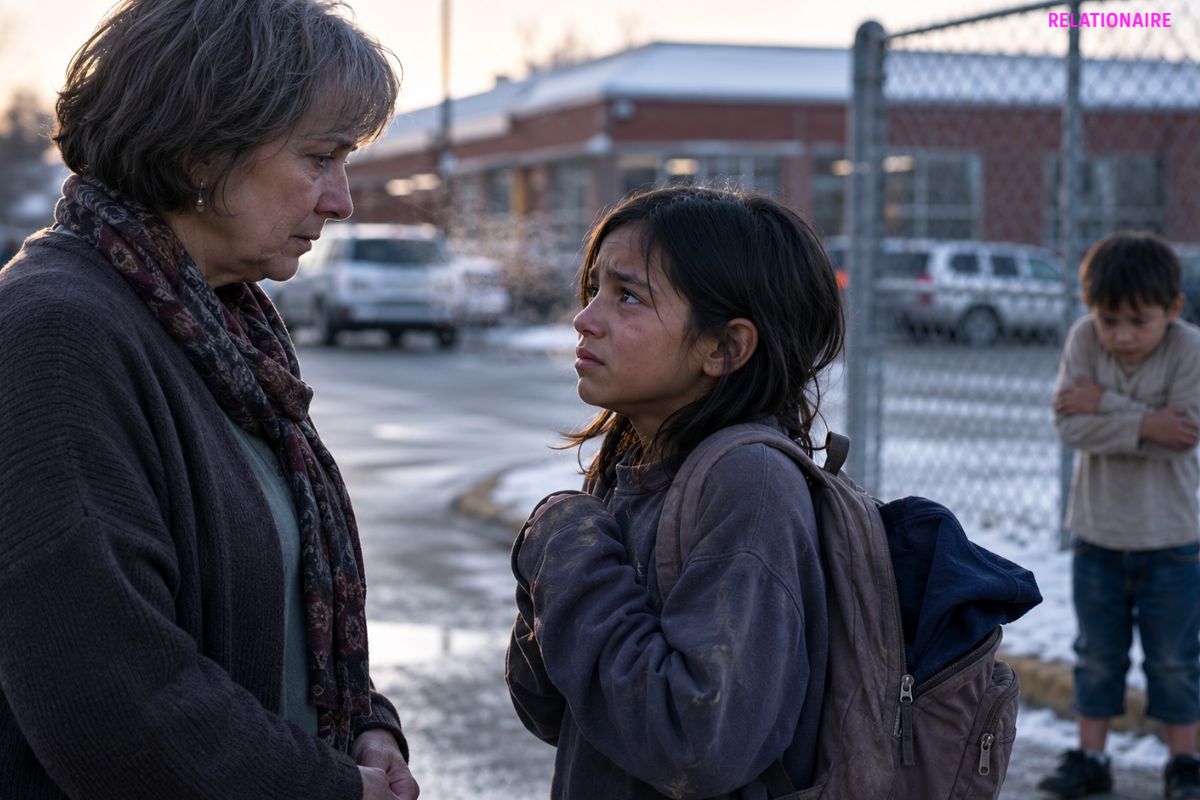
Maya Ellis was standing beside her desk, holding a wrinkled spelling test in both hands. Maya was eleven, thin as a pencil, with dark hair she always kept tucked behind one ear. Her backpack had a broken zipper that gaped open no matter how many times she tried to pull it closed.
“Yes, sweetheart?”
Maya held out the paper. “I fixed number seven.”
Mrs. Ward looked down at it.
The word was “responsible.”
Maya had spelled it correctly this time.
“Good work,” Mrs. Ward said softly.
Maya nodded, but her eyes flicked toward the closet.
Just once.
Quickly.
Then away.
Mrs. Ward felt something tighten in her chest.
She hated that she noticed.
She hated that the thought even came.
But Maya had been acting strange all week.
On Monday, Mrs. Ward had seen her stuffing extra napkins into her backpack after breakfast.
On Tuesday, Maya asked if she could take home a half-used notebook from the supply bin.
On Wednesday, she stayed inside during recess and stood near the heater vent that only blew cold air, rubbing her hands together until her knuckles turned red.
Yesterday, Mrs. Ward had found the granola bar drawer open.
And now the coat was missing.
Mrs. Ward looked at Maya’s thin sweatshirt. The sleeves were stretched over her wrists. There was a small tear near the collar.
“Do you know anything about my coat?” Mrs. Ward asked before she could stop herself.
Maya froze.
The classroom noise seemed to drop around them.
Pencils scratching.
A chair leg squeaking.
A glue stick cap rolling across the floor.
Maya’s mouth opened, but no words came out.
Mrs. Ward immediately wished she could pull the question back.
She had asked it quietly, but it landed hard.
Too hard.
“I just noticed it’s missing,” Mrs. Ward added, gentler now. “From the closet.”
Maya shook her head.
Not fast.
Not dramatically.
Just once.
“No, ma’am.”
Mrs. Ward watched her fingers curl around the spelling test.
The paper crumpled.
“All right,” Mrs. Ward said.
Maya went back to her seat.
But she did not look up for the rest of the morning.
By lunch, Mrs. Ward felt ashamed of herself.
By math, she felt angry.
By dismissal, she felt both.
She had spent seventy-three dollars at the discount store the previous weekend. Pencils. Tissues. Sanitizer. A pack of socks for the nurse’s office because too many children came in from the playground with wet feet.
She had bought crackers for Tyler, who claimed he “wasn’t hungry” every day until his stomach growled during silent reading.
She had paid for a field trip shirt for a student whose permission slip came back with the box for “unable to pay” checked in red pen.
And now someone had taken her coat.
Not a pencil.
Not a snack.
Her coat.
The one thing in the room that belonged to her.
At 3:08, the dismissal bell rang.
The hallway turned into a river of backpacks, squeaky sneakers, lunchboxes, and children shouting things they forgot to say all day.
“Line up for buses!”
“Pickup students, wait by the blue wall!”
“Do not run!”
Mrs. Ward stood by her door, scanning faces.
Maya was near the end of the pickup line.
Her backpack sagged open. A corner of a homework folder stuck out. She held the straps tightly, like she was afraid something might fall.
Mrs. Ward watched her.
Maya didn’t talk to anyone.
That wasn’t unusual.
But today she kept glancing toward the front doors.
When the line moved, Maya moved with it.
Mrs. Ward followed.
She told herself she was only making sure everyone got safely to the pickup area.
She told herself that twice.
Outside, the cold hit like a slap.
Parents idled in cars. Children hopped from foot to foot. A bus driver stood with both hands tucked under his arms. The flagpole rope clanged against the metal pole in the wind.
Mrs. Ward saw Maya near the far end of the sidewalk.
Then she saw something that made her stop.
Maya was not waiting for a car.
She was walking past the pickup line.
Toward the edge of the school property.
“Maya,” Mrs. Ward called.
The girl turned.
Fear flashed across her face so quickly Mrs. Ward almost missed it.
Almost.
“Maya, sweetheart, where is your ride?”
Maya swallowed. “I walk.”
“You’re listed as pickup.”
“My aunt sometimes comes,” Maya said. “But I can walk.”
“You live across the highway.”
Maya’s eyes dropped.
Mrs. Ward took a step closer. “Maya.”
The girl’s shoulders rose.
And then Mrs. Ward saw the navy-blue fabric sticking out from Maya’s backpack.
Just a small corner.
But she knew it.
Her coat.
A rush of hurt went through her so sharp she actually felt it in her throat.
“Maya,” she said quietly. “Open your backpack.”
Maya’s face changed.
Not guilty.
Not defiant.
Terrified.
“Please,” Maya whispered.
That one word did something to Mrs. Ward.
It stopped her anger from moving forward.
But it did not erase it.
“Maya,” she said again, her voice low so the other children wouldn’t hear. “My coat is in your bag, isn’t it?”
Maya’s eyes filled.
The pickup line kept moving behind them.
A mother honked at another car.
The principal called, “Keep the lane clear, please.”
The world went on.
Maya stood on the sidewalk with tears trembling on her lashes and Mrs. Ward’s coat hidden in her broken backpack.
“I didn’t take it for me,” Maya said.
Mrs. Ward went still.
“What?”
Maya looked past her.
Not at the school.
Not at the cars.
Toward the chain-link fence at the far side of the playground.
And that was when Mrs. Ward noticed a small boy standing there.
Maybe five.
Maybe six.
No coat.
No backpack.
Just a thin long-sleeved shirt, jeans too short at the ankles, and both arms wrapped around himself against the cold.
He was watching Maya with the kind of patience no child should have to learn.
Maya wiped her face with her sleeve.
Then she looked back at Mrs. Ward and said the line that made every thought in Helen Ward’s head go silent.
“He’s been waiting there since lunch.”
PART 2
Mrs. Ward did not move right away.
The cold wind pushed at her scarf. A paper flyer skittered across the sidewalk and stuck against the curb. Somewhere behind her, a child laughed because his backpack had fallen open and spilled crayons everywhere.
But Mrs. Ward heard only Maya’s words.
“He’s been waiting there since lunch.”
The small boy by the fence shifted from one foot to the other. His shoes were untied. His cheeks were red from the cold, but he did not cry. He just stood there, looking at Maya like she was the only safe thing in the world.
Mrs. Ward turned back to Maya.
“Who is he?”
Maya’s lips pressed together.
“My brother.”
“What’s his name?”
“Leo.”
“How long has he been outside?”
Maya’s chin trembled. “I told you. Since lunch.”
Mrs. Ward’s first instinct was disbelief.
Not because she thought Maya was lying.
Because she did not want the world to be the kind of place where a five-year-old waited outside an elementary school fence for hours in freezing weather.
“Why didn’t he come inside?”
Maya looked embarrassed then.
Deeply embarrassed.
The kind of embarrassed that looked older than eleven.
“He doesn’t go here,” she whispered. “He goes to Little Steps down the road.”
“The daycare?”
Maya nodded.
“Why is he here?”
Maya stared at her shoes.
Mrs. Ward noticed one sole pulling loose.
“His teacher called my aunt because he had an accident.”
“What kind of accident?”
“He wet himself during nap.” Maya’s voice was barely there. “They said he needed clothes. My aunt didn’t answer. They called my mom, but…” She stopped.
“But what?”
Maya shook her head.
The answer was too heavy to say outside beside a pickup line.
Mrs. Ward looked again at Leo.
He was standing with one hand tucked under his opposite arm, the other gripping the fence. His little fingers were bare.
A thin shirt.
No jacket.
No adult.
Mrs. Ward felt her anger change shape.
It did not disappear.
It turned into fear.
“Maya, did you leave campus during lunch?”
Maya nodded once.
“You walked to the daycare?”
“It’s not far.”
“It’s across two streets.”
“I looked both ways.”
The simple answer nearly broke her.
Mrs. Ward lowered her voice. “And then what happened?”
Maya’s eyes filled again.
“They said he couldn’t stay if nobody brought clothes. They said they called everyone. They said if nobody came, they had to call somebody else.” She swallowed hard. “He was crying.”
Mrs. Ward understood what “somebody else” meant.
Maya did too.
At eleven years old, she already knew what happened when grown-ups used careful words.
“So you brought him here?”
“He wouldn’t stop crying unless I came with him.” Maya looked toward her brother. “I told him to wait by the fence because if I brought him inside, everybody would know. I thought my aunt would come before school ended.”
“And my coat?”
Maya’s face folded.
“I was going to bring it back.”
Mrs. Ward’s own words from earlier came back to her.
Do you know anything about my coat?
She remembered Maya freezing.
Remembered the crumpled spelling test.
Remembered judging a child who was trying to keep a smaller child warm.
“I’m sorry,” Maya whispered. “I know it was stealing. I know. I just thought… I thought he could wear it until we got home.”
Mrs. Ward looked at the corner of navy fabric sticking from the backpack.
Her coat had become evidence in her own small trial.
And she had been the one sitting in judgment.
“Where is your mother?” Mrs. Ward asked softly.
Maya’s eyes darted to the sidewalk. To the cars. To the school doors.
“Work.”
“Where?”
“I don’t know today.”
“What do you mean, you don’t know?”
“She does cleaning. Sometimes houses. Sometimes offices. Sometimes the motel near the interstate. If someone calls, she goes.”
“And your aunt?”
“She watches Leo when Mom works late. But her phone got turned off last week.”
Mrs. Ward closed her eyes for one second.
A phone turned off.
A child at daycare with no spare clothes.
An older sister walking across streets at lunch.
A little boy waiting outside a fence.
A missing coat.
It all fit together now.
Not cleanly.
Painfully.
Mrs. Ward took off her scarf and walked toward Leo.
The little boy stiffened when she approached.
Maya hurried beside her. “It’s okay, Leo. She’s my teacher.”
Leo looked up.
His eyelashes were wet.
“Are you mad?” he asked.
Mrs. Ward crouched in front of him.
Her knees protested on the cold pavement.
“No,” she said. “I’m not mad at you.”
He looked at Maya. “Did you get in trouble?”
Maya didn’t answer.
Mrs. Ward wrapped the scarf around Leo’s shoulders. It was too big. It swallowed him.
“Let’s go inside where it’s warm,” she said.
“There’s no warm,” Leo said.
Mrs. Ward almost smiled.
“You’re right,” she said. “But the nurse’s office has blankets and crackers.”
That convinced him.
Inside, the hallway had emptied. The building felt tired after dismissal, like even the walls needed to sit down.
Mrs. Ward brought them to the nurse’s office. Nurse Donnelly took one look at Leo and said nothing at first.
That was why Mrs. Ward liked her.
Some adults made concern loud.
Nurse Donnelly made it useful.
She found sweatpants from the emergency bin. A sweatshirt with the school mascot on it. Clean socks. Apple juice. Crackers.
Leo ate like he was trying to be polite and starving at the same time.
Maya sat beside him, watching every bite.
Mrs. Ward stood in the doorway with her coat in her hands.
Maya had taken it from her backpack without being asked.
She held it out with both hands, like returning something sacred.
“I’m sorry,” Maya said again.
Mrs. Ward took it.
The coat felt heavier than before.
In the pocket, her daughter’s gray gloves were still there.
She should have felt relieved.
Instead, she felt ashamed.
The principal came after Nurse Donnelly called the office.
Mr. Alvarez was a careful man with kind eyes and a tie that was always slightly crooked by noon. He listened while Mrs. Ward explained what she knew.
He did not interrupt.
Maya sat stiffly, one arm around Leo.
When Mrs. Ward finished, Mr. Alvarez pulled a chair close.
“Maya,” he said gently, “you are not in trouble for trying to protect your brother.”
Maya’s face crumpled with relief.
Then he added, “But you cannot leave campus during lunch. That was dangerous.”
“I know.”
“And you cannot take things that don’t belong to you.”
“I know.”
His voice softened. “But I need you to hear this part too. You should not have had to solve this alone.”
Maya stared at him.
Like the sentence was in a language she had never been taught.
Mrs. Ward felt it hit her own chest.
You should not have had to solve this alone.
How many children needed to hear that?
How many adults?
Mr. Alvarez called the daycare.
Then Maya’s mother.
Then the aunt.
The aunt’s number went straight to voicemail.
Maya’s mother answered on the third try.
Mrs. Ward watched Mr. Alvarez’s face as he listened.
It changed slowly.
From professional concern.
To sadness.
To something like recognition.
“Yes, ma’am,” he said quietly. “They’re safe. They’re both here.”
A pause.
“No, nobody is calling anyone to punish you. We need you to come to the school.”
Another pause.
“I understand.”
Another.
“We’ll wait.”
When he hung up, Maya was staring at him like her whole life depended on his next sentence.
“She’s coming,” he said.
Maya’s body loosened.
Leo finished his juice.
Mrs. Ward should have gone home.
She had grading to do. A sink full of dishes. A daughter at college she kept meaning to call. A stack of unpaid bills tucked under a magnet on the fridge.
Instead, she stayed.
At 4:47, a woman ran into the front office wearing a motel housekeeping uniform under a thin black cardigan.
Her hair was coming loose from a bun. Her shoes were wet. Her hands were cracked red.
She looked younger than Mrs. Ward expected.
Older than she probably was.
“Maya,” the woman gasped.
Maya stood.
For one second, neither moved.
Then Leo ran first.
“Mommy!”
Their mother dropped to her knees and wrapped both children in her arms so tightly that Maya’s face disappeared against her shoulder.
“I’m sorry,” she kept saying. “I’m so sorry. I’m so sorry.”
Mrs. Ward looked away.
Not because it was private.
Because it was too honest.
Mr. Alvarez invited her into the conference room.
Mrs. Ward waited outside for a few minutes, telling herself again that she should go.
Then Maya appeared at the doorway.
“Mrs. Ward?”
“Yes?”
“My mom wants to talk to you.”
Inside, Maya’s mother sat at the small round table used for parent meetings and testing accommodations.
There was a box of tissues in the middle.
She had already used several.
“My name is Rosa Ellis,” she said, standing too quickly. “I’m Maya and Leo’s mother.”
Mrs. Ward held out her hand.
Rosa took it with both of hers.
“I’m sorry about your coat,” she said. “I’ll pay you back.”
“No,” Mrs. Ward said immediately. “Please don’t worry about that.”
“I will.” Rosa’s voice was shaking. “It may take me a little while, but I will.”
Mrs. Ward saw Maya standing behind her mother’s chair, eyes lowered.
Still carrying guilt that did not belong to her.
“Mrs. Ellis,” Mrs. Ward said carefully, “Maya was trying to help.”
Rosa closed her eyes.
“I know.”
Then she opened her purse with trembling hands and pulled out a folded paper.
It was soft from being opened and closed many times.
An emergency contact form.
Mrs. Ward recognized the school logo at the top.
One name had been crossed out in blue ink.
Another written in.
Then crossed out too.
Rosa pressed the paper flat on the table.
“I’ve been trying to fix this,” she said.
Her voice broke on the word fix.
“I swear I have.”
And then Maya looked at Mrs. Ward with the same terrified expression she had worn outside.
Because there was something else on that paper.
Something Mrs. Ward had not seen yet.
Something Rosa was now sliding across the table toward her.
PART 3
At first, Mrs. Ward thought it was just another form.
Teachers knew forms.
Emergency contact forms.
Free lunch forms.
Permission slips.
Absence notes written on torn envelopes.
Papers that came back late, damp, unsigned, or not at all.
But the paper Rosa Ellis pushed across the conference table was not only a form.
It was a map of a family slowly running out of people.
Maya’s father’s name had been crossed out.
Deceased.
The word had been written beside it in small careful letters.
Under alternate contact, Rosa’s sister’s name was written, then crossed out.
Phone disconnected.
Another name had been added below that.
A neighbor.
Moved.
At the bottom of the page, in the blank section for “additional notes,” Rosa had written one sentence.
Please call Maya’s teacher if no one answers. She will know what to do.
Mrs. Ward stared at the sentence.
She will know what to do.
Her throat tightened.
“Why did you write that?” she asked softly.
Rosa covered her mouth.
Maya looked at the floor.
“Because Maya talks about you,” Rosa said. “Every day.”
Mrs. Ward looked at Maya.
The girl’s cheeks turned pink.
“She says you keep crackers in your desk but pretend you don’t know who takes them,” Rosa continued. “She says you gave Tyler gloves and told everyone you found them in lost and found so he wouldn’t be embarrassed. She says you fix her backpack zipper when it gets stuck. She says when kids get answers wrong, you don’t make your face mean.”
Mrs. Ward could not speak.
Rosa wiped her eyes with the heel of her hand.
“I wasn’t trying to put more on you. God knows teachers already carry too much.” She gave a small, broken laugh. “I just thought, if something went wrong, maybe you’d be the safest adult in the building.”
The words landed harder than any accusation could have.
Mrs. Ward thought of that morning.
The empty closet.
Her tiredness.
Her hurt.
The way she had looked at Maya and seen a thief before she saw a child.
She looked down at her own hands.
“I’m sorry,” Mrs. Ward said.
Rosa blinked. “For what?”
“For asking Maya about the coat the way I did.”
Maya looked up.
Mrs. Ward turned to her.
“I should have asked if you were okay first.”
Maya’s mouth trembled.
“You were allowed to be mad,” she whispered.
“Maybe,” Mrs. Ward said. “But I’m the grown-up.”
For some reason, that was the sentence that broke Maya.
Not the apology.
Not the coat.
That one.
I’m the grown-up.
She began to cry silently, her shoulders shaking while she tried to stop it.
Rosa reached for her, but Maya shook her head, embarrassed.
Mrs. Ward pulled a chair beside her.
“Maya,” she said, “you did something wrong by taking my coat.”
Maya nodded quickly, tears falling.
“But you did it because you were scared for your brother. Those are two different truths. We can deal with the first one without pretending the second one doesn’t matter.”
Maya wiped her face.
“I didn’t know what else to do.”
“I know.”
“He was so cold.”
“I know.”
“And I thought if people found out, they’d take him.”
Rosa made a sound then.
Small and wounded.
Leo had fallen asleep in the nurse’s office by then, wrapped in a donated blanket, one hand still curled around an empty cracker packet.
Mr. Alvarez leaned forward at the table.
“Nobody here wants to punish your family for needing help,” he said. “But we do need to make sure the children are safe.”
Rosa nodded.
“I know.”
“We can connect you with the district family liaison. Emergency clothing closet. Transportation help. After-school care funds. Food pantry delivery. There are options.”
Rosa looked exhausted by the word options.
Sometimes help sounded like another job.
Another office.
Another form.
Another person to explain your pain to.
Mrs. Ward saw it.
So did Mr. Alvarez.
“We’ll do the forms with you,” Mrs. Ward said.
Rosa’s eyes lifted.
“You don’t have to figure out every step tonight.”
That was how they began.
Not with a miracle.
With a pen.
A conference table.
A tired mother.
A teacher who stayed.
A principal who called the right people and did not make anyone feel small.
They filled out three forms before the office lights clicked off automatically and left them sitting in dimness until Mr. Alvarez waved his arms to turn them back on.
Maya laughed.
Just once.
A small surprised laugh.
It sounded like a window opening.
The next Monday, the heat was fixed.
Warm air hummed through the vents like the building itself was apologizing.
Mrs. Ward arrived early with two bags from the community donation closet and one from her own hall closet.
She had told herself all weekend not to overdo it.
Then she overdid it anyway.
Coats. Socks. mittens. A pair of boots Emma had outgrown years ago but Mrs. Ward had never been able to donate. A red scarf. Two lunch containers. A small dinosaur hat for Leo.
She set them in the nurse’s office, not in front of the class.
Dignity mattered.
Especially when people were already hurting.
Maya came in at 7:42.
She paused at the classroom door.
Her backpack was still broken.
Her hair was tucked behind one ear.
“Good morning,” Mrs. Ward said.
Maya nodded. “Good morning.”
For a moment, neither mentioned the coat.
Then Maya walked to her desk and pulled something from her homework folder.
A note.
Folded twice.
She placed it on Mrs. Ward’s desk and hurried away before Mrs. Ward could read it.
During silent reading, Mrs. Ward opened it.
Dear Mrs. Ward,
I am sorry I stole your coat.
I know sorry does not fix it.
My mom said when you are desperate you still have to tell the truth.
So the truth is I was scared and I picked the wrong way to be brave.
Thank you for not hating me.
Thank you for helping Leo.
I will never take something from you again.
Love,
Maya
At the bottom, in smaller letters, she had added:
I put your gloves back in the pocket.
Mrs. Ward pressed the note flat with her hand.
Then she folded it again and placed it in the drawer where she kept things too important for bulletin boards.
That afternoon, she found Maya by the coat hooks.
The old navy coat hung there again.
Mrs. Ward had almost left it at home.
Then she decided not to.
Some things needed to return to the room changed, not hidden.
“Maya,” she said.
The girl turned.
“I have a job for you.”
Maya’s face tightened. “A job?”
Mrs. Ward opened the closet and pointed to the bottom shelf.
There was now a clear plastic bin with a handwritten label:
WARM THINGS — TAKE WHAT YOU NEED
Inside were gloves, hats, scarves, socks, and two folded sweatshirts.
“No names,” Mrs. Ward said. “No questions. If someone needs something, they can take it. If someone has extra, they can add it.”
Maya looked at the bin.
“Why are you showing me?”
“Because I want you to help me keep it neat.”
Maya stared at her.
Not because the task was hard.
Because she understood what Mrs. Ward was really offering.
Not punishment.
Trust.
“You still want me to help?” Maya asked.
“Yes.”
“But I took your coat.”
“I know.”
Maya looked down.
Mrs. Ward’s voice softened.
“You are more than the worst thing you did on a scared day.”
Maya stood very still.
Then she nodded.
Every Friday after that, Maya straightened the bin.
She folded scarves. Paired gloves. Tucked socks into corners. Once, she added a small pink hat with a missing pom-pom.
Other children used it too.
Quietly.
A boy from third grade took mittens before recess and brought them back with snow on the cuffs.
A first grader took socks after stepping in a puddle.
A girl from Mrs. Chen’s class slipped a scarf into her backpack when she thought nobody was looking.
Nobody announced it.
Nobody made it a lesson.
That was the point.
By December, the bin had become part of the classroom, like the pencil sharpener or the reading rug.
The school changed in small ways after that.
Mr. Alvarez asked every teacher to keep an eye out during pickup.
Nurse Donnelly made an emergency clothing shelf in her office.
The cafeteria manager started wrapping uneaten sealed items for children to take home discreetly.
The office secretary kept a list of families who needed calls made twice, not once.
And Mrs. Ward started asking one different question.
Not “What did you do?”
Not first.
First, she asked, “What happened?”
It did not solve everything.
Some children were still hungry.
Some parents still worked too many hours.
Some coats were still too thin.
Teachers still bought supplies with their own money. Still graded papers at midnight. Still sat in cars after school with the engine off, too tired to drive home yet.
But something had shifted.
A little more mercy had entered the building.
A little more noticing.
A little more room for children to be more than their mistakes.
In January, Mrs. Ward came in one morning and found a small envelope taped to her classroom door.
Inside was a school photo of Leo.
He was smiling with one front tooth missing, wearing the dinosaur hat.
On the back, Rosa had written:
Thank you for keeping my babies warm when I couldn’t.
Mrs. Ward stood in the empty hallway for a long time, holding that photo.
The floors were scuffed. The bulletin board paper was curling at the edges. Someone had dropped a crayon near the drinking fountain.
An ordinary school morning.
The kind nobody would remember.
Except she would.
She placed Leo’s photo inside her desk drawer beside Maya’s note.
Then she hung her old navy coat in the classroom closet.
The zipper still caught.
The cuff was still worn.
The pocket still had a hole in the lining.
But now, every time Mrs. Ward slipped her hands into those gray gloves, she remembered the little boy at the fence.
She remembered Maya’s face.
She remembered how quickly hurt can look like disrespect when nobody stops long enough to ask why.
And she remembered that in a school building, the most important lessons are not always written on the board.
Sometimes they are folded into a backpack.
Sometimes they are waiting outside in the cold.
Sometimes they are hidden in the pocket of an old coat.
And sometimes, the child who breaks your heart is the one teaching you how to keep it open.