If you’ve already read part 1 of this story on Facebook, go here for Part 2!
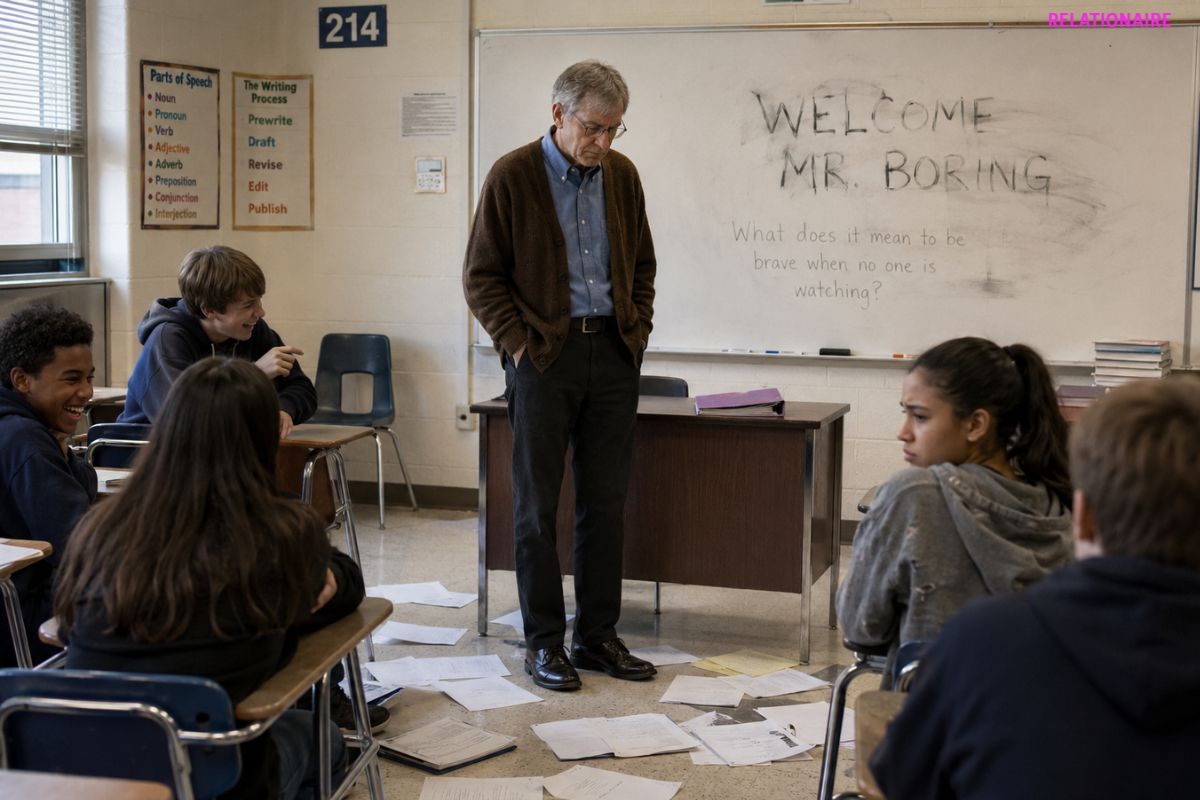
Nobody stood when the substitute teacher dropped his papers.
Not one student.
Not one staff member passing the open door.
The worksheets slid across the scuffed tile like fallen leaves, white pages skimming under desks, catching on sneaker soles, landing beside a backpack with a broken zipper.
The man just stood there for a second, blinking down at them.
He wore a brown cardigan even though it was warm outside, a pressed blue shirt buttoned all the way up, and shoes polished so carefully they looked like they belonged to another decade.
On the whiteboard, someone had already written:
WELCOME MR. BORING
The class laughed before he even said his name.
Room 214 was a ninth-grade English class at Fletcher Middle, the kind of room that smelled like dry erase markers, old books, and cafeteria fries drifting in from the hallway. Posters of commas and kindness hung crooked on the walls. A lost glue stick cap rolled slowly beneath the first row.
The regular teacher, Ms. Avery, had left emergency plans on the desk in a purple folder.
The substitute picked up one page, then another.
“My name,” he said quietly, “is Mr. Elias Ward.”
Nobody answered.
A boy in the back coughed, “Mr. Weird.”
The room cracked open with laughter.
Mr. Ward did not raise his voice.
He did not threaten detention.
He did not slam a ruler or send anyone out.
He only looked at the seating chart, then at the faces in front of him, as if trying to match names to people who had already decided he did not matter.
That made Maya Reynolds hate him a little.
Not because he was mean.
Because he wasn’t.
Maya trusted mean adults. Mean adults were predictable. They snapped. They pointed. They wrote referrals. They proved what she already believed.
Quiet adults made her nervous.
Especially ones with soft eyes.
She sat in the second row wearing a frayed gray hoodie with one sleeve stretched over her hand. Her hair was pulled into a tight ponytail. Her backpack leaned against her chair, heavy with books, crumpled papers, and a permission slip she knew her grandmother had not signed because her grandmother had fallen asleep at the kitchen table after a double shift.
Maya was the kind of girl teachers described in emails with careful words.
Bright but difficult.
Capable but disruptive.
Needs redirection.
She could hear those words even when nobody said them.
Mr. Ward glanced down at the roll sheet.
“Maya Reynolds?”
She leaned back. “Depends who’s asking.”
A few students went, “Ooooh.”
Mr. Ward looked at her, not angry. Just present.
“I am,” he said.
“That’s unfortunate.”
More laughter.
Across the hall, a teacher looked in, saw the class already tilting toward chaos, and kept walking.
Mr. Ward waited until the laughter thinned.
Then he said, “I’m glad you’re here, Maya.”
The words landed wrong.
They were too simple.
Too sincere.
Maya felt heat rise in her face, so she laughed like it was stupid.
“You don’t even know me.”
“No,” he said. “Not yet.”
That made the room quieter than a threat would have.
Only for a second.
Then Caleb in the back tossed a paper ball toward the trash can and missed by six feet. Jada started recording with her eyes, not a phone, because phones were locked in the front office now after too many hallway fights. Someone tapped a pencil against a desk. Someone hummed loudly.
Mr. Ward turned to the board.
He stared at the words MR. BORING for a long time.
Then he erased them with slow, careful strokes.
Underneath, he wrote:
What does it mean to be brave when no one is watching?
Maya snorted.
“Is this a therapy session?”
“It’s a journal prompt,” he said.
“Same thing with worse pencils.”
A few kids laughed again.
Mr. Ward passed out lined paper from Ms. Avery’s folder. His hands trembled slightly when he reached Maya’s desk.
She noticed because she noticed everything.
The tremble.
The old watch on his wrist.
The way he paused near the windows, like the view of the courtyard had caught him off guard.
The way his eyes moved to the far wall by the door, where a faded framed photo hung above the classroom light switches.
It showed an older group of students from years ago holding a banner for a school fundraiser.
Mr. Ward looked at that picture for one breath too long.
Then he looked away.
Maya saw it.
And because she did not like seeing things that made adults look breakable, she reached for the easiest weapon she had.
Her mouth.
“So, Mr. Ward,” she said, loud enough for everyone, “you always dress like you’re about to sell insurance, or is this just for us?”
The class burst out.
This time, even two boys who usually slept lifted their heads.
Mr. Ward placed a paper on the last desk.
“I wore this because I thought today deserved respect.”
That quieted them again.
Not because it was clever.
Because it was strange.
Maya folded her arms. “Respect has to be earned.”
“Yes,” he said. “It does.”
“And you think handing us a journal prompt earns it?”
“No.”
“Then what does?”
He looked around the room.
Then at the broken pencil on Maya’s desk.
Then at the empty chair near the window where nobody sat because the air conditioner dripped above it when it rained.
“Showing up,” he said. “Even when it hurts.”
Maya felt something tighten behind her ribs.
She hated that answer.
It sounded like something her grandmother would say at 5:30 in the morning while tying work shoes with swollen fingers.
So Maya rolled her eyes.
“You don’t know anything about that.”
The room went silent in a new way.
Not fun silent.
Not bored silent.
A silence with edges.
For the first time all morning, Mr. Ward did not answer right away.
His hand moved toward the attendance sheet on the desk, then stopped.
The bell for first lunch rang outside, but their class still had twelve minutes. The hallway erupted into sneakers, lockers, voices, trays clattering somewhere far away.
Inside Room 214, nobody moved.
Mr. Ward looked at Maya.
Not offended.
Not embarrassed.
Just wounded in a way that made the whole room feel smaller.
“You may be right,” he said.
That should have felt like winning.
It did not.
Maya looked down at her paper. She had written nothing.
The prompt stared back at her.
What does it mean to be brave when no one is watching?
She pressed her pencil so hard against the page that the tip broke.
Mr. Ward walked to the desk and opened Ms. Avery’s purple folder, maybe looking for the next instruction, maybe looking for somewhere to place his hands.
A folded note slipped from the folder and landed on the floor.
Maya was closest.
She bent down before he could.
It was not a lesson plan.
It was an old photograph.
The edges were soft from being touched too many times. In the picture, a younger Mr. Ward stood in front of Fletcher Middle beside a smiling girl with a crooked ponytail and a backpack covered in keychains.
On the back, written in faded blue ink, were four words:
First day back. Promise kept.
Maya lifted her eyes.
Mr. Ward’s face had gone pale.
And from the hallway, right outside their open door, the principal whispered to the counselor:
“I didn’t think he’d ever come back after what happened to his daughter.”
PART 2
Maya did not mean to hold the photograph so tightly.
But her fingers had closed around it before she understood what she’d heard.
His daughter.
The word moved through the room without anyone repeating it.
Daughter.
Caleb stopped rocking his chair.
Jada lowered her chin.
Even the pencil tapping died.
Mr. Ward took one step toward Maya, then stopped as if he were afraid of frightening her.
“That’s private,” he said gently.
Not sharply.
Not like an adult catching a child with something they shouldn’t have.
Gently.
That made Maya feel worse.
She handed it back.
“I’m sorry,” she said.
It came out smaller than she meant.
Mr. Ward accepted the photo with both hands. He slid it into the purple folder, under the lesson plans, like he was tucking something fragile back into a pocket near his heart.
Principal Hayes stepped into the doorway, his face tight with regret.
“Mr. Ward,” he said, “I’m sorry. I didn’t realize—”
“It’s all right,” Mr. Ward said.
But it was not all right.
Everyone could feel that.
The hallway noise went on because school always goes on. Lunch still happened. Lockers still slammed. Someone still laughed near the water fountain. A cafeteria worker still called for a student to come get a forgotten lunch box.
Pain could be standing in Room 214 with polished shoes and trembling hands, and the bell schedule would not care.
Maya stared at the wall beside the classroom door.
She had passed that hallway a thousand times.
She had leaned against the tile there waiting for friends. She had taped spirit week posters there. She had rolled her eyes when teachers reminded students not to block traffic.
She had never noticed the memorial wall.
Not really.
It was outside the library, just past the main office. A glass case with old photos, small plaques, yellowing newspaper clippings, and names students only glanced at when they were bored in line.
Names of teachers.
Names of alumni.
Names of children.
After class, nobody rushed out.
That was the first strange thing.
Usually, when the bell rang, Room 214 emptied like someone had pulled a fire alarm.
But that day, students packed slowly.
Maya shoved her broken pencil into her backpack. She wanted to say something to Mr. Ward, but words felt useless.
Sorry we called you boring.
Sorry I said you don’t know anything about showing up.
Sorry your daughter is behind glass in a hallway I never bothered to read.
Instead, she said nothing.
Which was what she usually did when the truth became too big.
At lunch, the story moved faster than the lunch line.
Not in a cruel way.
In a stunned way.
By the time Maya reached the end of the tray counter, half the ninth grade knew the substitute in Room 214 had once taught there.
They knew he had lost his daughter.
They knew he was back for the first time.
But nobody knew the whole story.
That was the problem with school rumors. They carried the shape of truth, but not the weight.
Maya sat alone at the end of the table near the windows, pushing peas around with a plastic fork.
Her friend Talia slid in beside her.
“Is it true?” Talia whispered.
Maya did not look up. “I don’t know.”
“But you saw the picture?”
Maya nodded.
“What happened?”
Maya glanced across the cafeteria.
Mr. Ward stood near the staff table with a paper cup of water. The other teachers were being gentle with him now, which somehow made everything more painful. A few hours ago, one had called him “the quiet sub” and asked if he knew how to use the attendance software.
Now they gave him space like he might shatter.
Principal Hayes approached him.
Mr. Ward nodded politely, then turned toward the hallway.
He did not eat.
Maya stood so fast her tray scraped the table.
“Where are you going?” Talia asked.
“To read something.”
The memorial case was quieter than the cafeteria.
Maya stood in front of it with her arms folded tight.
At first, all she saw were names and dates.
A retired music teacher.
A custodian who had worked at Fletcher for thirty-two years.
A former student who had become a nurse.
Then she saw the photograph.
The same girl.
Crooked ponytail.
Keychain backpack.
Only this picture was formal, a school photo with a blue background and a smile that looked like she had laughed right before the camera clicked.
Underneath was a small brass plaque.
LILY WARD
Student, Friend, Helper
2009–2022
“Leave every room kinder than you found it.”
Maya read it twice.
Then a third time.
Student. Friend. Helper.
Not perfect attendance.
Not honor roll.
Not test scores.
Helper.
A folded paper sat at the bottom of the case, a copy of an old article from the local paper.
Maya leaned close.
She caught fragments through the glass.
After-school fundraiser.
Rainstorm.
Bus loop.
Younger student.
Accident.
Her stomach turned.
The counselor, Ms. Benitez, stepped beside her quietly.
“She was in seventh grade,” the counselor said.
Maya swallowed. “His daughter?”
“Yes.”
Maya kept staring at the name.
“What happened?”
Ms. Benitez hesitated.
Not because it was secret.
Because some truths deserved careful hands.
“There was a storm after the winter concert,” she said. “The bus loop was crowded. A first grader got scared and ran back toward the entrance. Lily went after him.”
Maya felt cold spread through her chest.
“She saved him?”
Ms. Benitez nodded once.
“The little boy lived. Lily didn’t.”
The hallway blurred for a moment.
Maya pressed her thumb against the seam of her hoodie sleeve.
“And Mr. Ward taught here?”
“For seventeen years.”
Maya turned.
“Why did he leave?”
Ms. Benitez looked down the hall, toward Room 214.
“Because every corner of this building had her in it.”
Maya thought about him staring at the courtyard.
The framed class photo.
The empty chair by the window.
The way his hand shook passing out paper.
“What promise?” Maya asked.
Ms. Benitez looked at her.
Maya’s voice cracked. “The picture said ‘promise kept.’ What promise?”
Before the counselor could answer, a sound came from down the hall.
A crash.
Then shouting.
Not playful shouting.
The kind that makes adults move fast.
Maya and Ms. Benitez hurried toward Room 214.
Inside, Caleb was standing beside an overturned desk, his face red, his fists clenched. Two boys were backing away. A worksheet lay ripped in half on the floor.
Mr. Ward stood between them.
Not touching anyone.
Not yelling.
Just standing there.
Caleb’s chest heaved.
“He doesn’t get to talk about my dad,” Caleb snapped. “He doesn’t get to say anything.”
The room was frozen.
Mr. Ward’s voice was calm. “I didn’t say anything about your father.”
“He said I don’t have one,” Caleb shouted, pointing at another boy.
The boy looked terrified now.
“I didn’t mean—”
“Yes, you did.”
Caleb kicked the desk leg.
The sound cracked through the room.
Any other substitute would have sent him to the office immediately.
Any other adult would have made it about behavior first.
Mr. Ward looked at the ripped worksheet.
Then at Caleb.
Then he said, “It hurts when someone makes a joke out of the part of you you’re trying to hide.”
Caleb’s face changed.
Only a little.
But Maya saw it.
Mr. Ward bent down and picked up the torn worksheet.
“You can go to the counselor’s office,” he said, “or you can sit by the window and breathe for one minute before you decide what kind of man you want to be today.”
Nobody moved.
Caleb stared at him.
The room waited for a fight.
Instead, Caleb dragged a chair to the window and sat down hard, turning his face toward the glass.
Mr. Ward set the torn worksheet on the desk.
Then he looked at the class.
“I know many of you think today is about getting through a substitute period.”
His voice was still quiet, but no one missed a word.
“It isn’t.”
Maya’s heart started pounding.
Mr. Ward walked to the board and picked up the marker.
He wrote one name.
Lily Ward
The marker squeaked under his hand.
Then he turned back to them, and for the first time all day, his voice broke.
“My daughter made me promise something in this very room.”
Maya stopped breathing.
Mr. Ward looked at the students who had laughed at him, mocked him, ignored him, and now sat as still as children waiting at the edge of something sacred.
“She made me promise,” he said, “that if I ever came back here, I would teach the lesson she never got to finish.”
PART 3
Nobody asked what page the assignment was on.
Nobody asked if it would be graded.
For once, Room 214 did not sound like chairs scraping and whispered jokes and pencils being snapped for attention.
It sounded like students trying not to breathe too loudly.
Mr. Ward stood beneath his daughter’s name on the board.
For a moment, he looked less like a substitute teacher and more like a father standing in the doorway of a room he had not been brave enough to enter for years.
Maya wanted to look away.
She did not.
Mr. Ward rested one hand on the edge of the desk.
“Lily was not the best student in this school,” he said.
A few students glanced up, surprised.
“She was good. She worked hard. But math frustrated her. She spelled definitely wrong until the end. She once turned in a science project that still had glitter glue wet on the title page.”
A soft laugh moved through the room.
Mr. Ward smiled, and the smile hurt to see.
“But she noticed things.”
He looked toward the hallway.
“She noticed the child sitting alone at lunch. The teacher carrying too many boxes. The student pretending not to cry in the bathroom. The boy who wore the same sweatshirt all week because it was the only warm thing he had.”
Maya pulled her sleeve farther over her hand.
“She used to say school taught two kinds of lessons,” Mr. Ward continued. “The ones written on the board. And the ones walking right past us.”
He tapped the marker lightly against his palm.
“The day before she died, she sat in that seat.”
He pointed to the empty chair by the window.
Maya’s throat tightened.
The chair nobody used.
The chair everyone joked was cursed because the air conditioner dripped near it.
Lily’s chair.
“She told me a girl in her class kept getting in trouble for stealing snacks from the after-school program,” he said. “Everyone was angry. Teachers were tired. Kids were laughing. Lily asked if anyone had checked whether the girl had dinner at home.”
His eyes shone.
“I told her adults were handling it.”
He paused.
“That was my mistake.”
Maya watched his fingers tighten around the marker.
“The next morning, Lily brought two granola bars to school. One for herself. One for the girl. She didn’t announce it. She didn’t make a lesson out of it. She just put it in the girl’s backpack and said, ‘You dropped this.’”
A few students lowered their heads.
“That afternoon, during the storm, she saw a first grader run into the bus loop. She didn’t think about rules. She didn’t think about who was watching. She just saw someone small who needed help.”
His voice thinned.
“And she moved.”
No one cried loudly.
That would have made it easier, maybe.
Instead, the room filled with quiet tears.
Caleb wiped his face with his sleeve and looked furious about it.
Maya stared at the word Lily until it blurred.
Mr. Ward turned to the prompt still written on the board.
What does it mean to be brave when no one is watching?
“I left this school,” he said, “because I thought I had failed as a teacher and as a father. I thought I had spent too much time teaching essays and not enough time teaching children how to look at each other.”
Principal Hayes stood in the doorway now.
Ms. Benitez beside him.
Neither interrupted.
“For four years,” Mr. Ward said, “I could not drive past this building. I could not hear a school bell without feeling like the world had taken one step and left me behind.”
Maya pressed her broken pencil into her palm.
“Then last month, I found this.”
He opened the purple folder and took out the photograph.
Not the one Maya had seen.
A different one.
A folded sheet was tucked behind it.
He held it carefully.
“It was in Lily’s old homework folder. A letter she wrote for an assignment in this class. The assignment was called ‘A Promise to My Future Self.’”
Mr. Ward unfolded the paper.
His hands trembled again.
This time, nobody laughed.
He read only a few lines.
“When I grow up, I want to be like my dad, but maybe with better jokes. I want to teach kids who think nobody sees them. I want my classroom to feel like a place where people get another chance.”
His voice broke fully then.
He lowered the page.
The class waited.
Mr. Ward took a breath.
“At the bottom, she wrote: ‘If Dad ever gets too sad to teach, I hope he remembers somebody still needs him.’”
Maya covered her mouth.
Something inside her gave way.
Not loudly.
Not dramatically.
Just enough that she could not pretend anymore.
Mr. Ward folded the paper again.
“So I came back today. Not for a paycheck. Not because I am brave. Because my daughter believed school could still be a place where somebody notices.”
He looked at Caleb.
Then Jada.
Then Maya.
“And I thought maybe I owed her one day of trying.”
The bell rang.
Nobody moved.
For once, the bell did not decide what mattered.
Maya stood first.
Her chair legs scraped the floor.
She walked to the front of the room with her journal paper in her hand. It was wrinkled. The pencil marks were dark where she had pressed too hard.
She placed it on Mr. Ward’s desk.
“I didn’t finish,” she said.
“That’s all right.”
“No,” she said. “I mean… I want to.”
Mr. Ward looked at her.
Maya swallowed.
Then she turned to the class, to the doorway, to the adults who had also misjudged him by making him small in their minds.
“My grandma works nights,” Maya said. “Sometimes I’m late because I have to get my little brother ready. Sometimes I act like I don’t care because it’s easier than saying I’m tired.”
The room held her gently.
No one joked.
No one looked away.
“And when you said you were glad I was here,” she whispered, looking at Mr. Ward, “I thought you were lying.”
Mr. Ward’s face softened.
“I wasn’t.”
That nearly broke her.
Caleb stood next.
“My dad left,” he said, staring at the floor. “I tell people I don’t care. I do.”
Jada raised her hand halfway, then dropped it.
“My mom cries in the car before pickup,” she said. “I pretend I don’t see.”
One by one, not everyone, but enough, the room changed.
Not into a movie miracle.
Not into perfect children.
Into something quieter.
A place where the truth had somewhere to sit.
Principal Hayes wiped under one eye and cleared his throat.
“Mr. Ward,” he said, “would you consider staying through the end of the week?”
The old man looked startled.
Then afraid.
Then he looked at the empty chair by the window.
Maya followed his gaze.
The chair was still just a chair.
Plastic seat.
Metal legs.
A small water stain beneath it.
But somehow it felt like more now.
Mr. Ward took a long breath.
“Yes,” he said. “I think I can do that.”
The next morning, Room 214 was different.
Not perfect.
Caleb still muttered when the warm-up was long.
Jada still rolled her eyes at the comma worksheet.
Maya still had sharp edges.
But when Mr. Ward walked in, nobody had written on the board.
On his desk sat a paper cup of coffee from the staff lounge, a stack of freshly sharpened pencils, and a folded note.
He opened it after attendance.
Inside, in Maya’s handwriting, were five words:
We’re glad you came back.
Mr. Ward read it once.
Then again.
He placed the note beside Lily’s photograph.
Not on top of it.
Beside it.
As if grief and grace could share the same desk.
By Friday, the class had written letters for the memorial wall.
Not essays.
Not assignments.
Promises.
Caleb promised to stop laughing when someone’s pain showed.
Jada promised to notice her mother’s tired hands.
Maya promised to help her brother with his reading, even when she was exhausted.
Mr. Ward read every one of them after school, alone in Room 214, while the late sun stretched across the scuffed floor.
When he reached Maya’s, he stopped.
Her paper said:
Being brave when no one is watching means coming back to the place that broke your heart because somebody there still needs you.
Mr. Ward pressed the page to his chest.
Outside, the school emptied.
The buses left.
The hallway lights hummed.
The memorial wall stood quiet near the library, holding Lily’s name the way schools hold so many things people forget to notice.
But inside Room 214, her promise had moved.
From a plaque.
To a father.
To a class.
To children who would carry it into lunchrooms, bus loops, homes, and hard mornings.
Because sometimes the biggest lesson in a school building is not written in a textbook.
Sometimes it walks in wearing an old cardigan, carrying grief in a purple folder, and teaches everyone that respect is not always earned by being loud.
Sometimes it is earned by showing up softly.
Even when it hurts.