If you’ve already read part 1 of this story on Facebook, go here for Part 2!
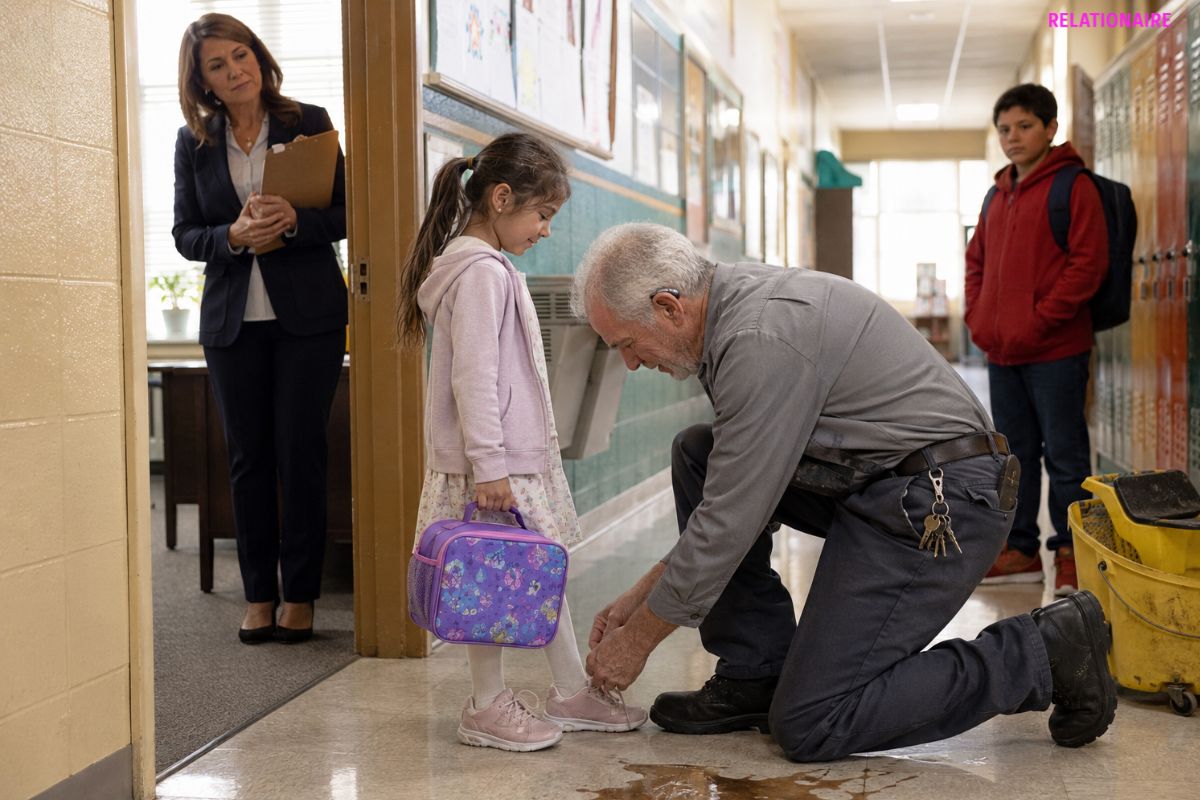
The first time Principal Mara Ellison saw Mr. Gabe sitting on the hallway floor, she thought he had fallen.
He was seventy-one, maybe older, with one bad knee, two hearing aids, and a gray custodian shirt that hung loose at the shoulders. His mop bucket stood beside him. A trail of chocolate milk stretched across the scuffed tile like someone had dragged a paintbrush through it.
But Mr. Gabe wasn’t hurt.
He was tying a kindergartner’s shoe.
The little girl stood perfectly still, gripping a purple lunchbox with both hands, while Mr. Gabe bent over her sneaker like it was the most important job in the building.
“You got double knots now, Miss Riley,” he said. “That means you’re ready for Tuesday.”
The girl smiled like he had handed her a crown.
Mara watched from the office doorway, holding her clipboard against her chest.
She had been principal at Maple Ridge Elementary for twelve days.
Twelve days was enough time to learn the alarm code, the copier jam trick, and which classroom smelled permanently like dry erase markers and old crayons.
It was also enough time to notice that the building ran a little too much on habit.
And Mr. Gabe was part of that habit.
He moved slowly.
He stopped to talk.
He knew which child hated peas, which child cried after drop-off, which child’s backpack zipper stuck, and which third grader needed to be reminded to eat before soccer.
It was sweet.
It was also inefficient.
At least, that was the word Mara wrote on her yellow legal pad during her first facilities review.
Inefficient.
The district had sent her to Maple Ridge with clear expectations.
Raise scores.
Improve attendance.
Tighten procedures.
Stop letting “the way we’ve always done it” become an excuse.
So when she saw Mr. Gabe sitting in the hallway during morning rush while chocolate milk dried under his bucket, she sighed.
“Mr. Gabriel,” she called gently.
He looked up.
Everyone called him Mr. Gabe, but his real name was Gabriel Turner. His employee badge was faded so badly that the photo looked like a ghost of a man.
“Yes, ma’am?”
“We need this hallway clear before first bell.”
He nodded and pushed himself up, one hand on the wall, one hand on his knee.
“Yes, ma’am.”
No argument.
No irritation.
Just that tired nod adults give when they have heard every version of being corrected.
Mara felt a small pinch of guilt.
Then the bell rang, and twenty-seven children thundered down the hall with untied shoes, swinging backpacks, and breakfast crumbs on their shirts.
By 9:15, the first student was sent to her office.
Darius Cole.
Fourth grade.
Red hoodie.
Scuffed sneakers.
A face too serious for a child.
Mara had already heard his name three times in twelve days.
He talked back.
He refused work.
He snapped pencils in half.
He had shoved a chair loudly enough to make Mrs. Phelps next door step into the hall.
That morning, he had been sent out for laughing during a reading assessment.
Not smiling.
Not whispering.
Laughing.
Mrs. Albright, his teacher, stood beside him with her lips pressed tight.
“He is choosing disruption,” she said, tired rather than angry. “Again.”
Darius stared at the floor.
Mara folded her hands on her desk.
“Darius,” she said, “look at me.”
He didn’t.
She softened her voice.
“I can’t help you if you won’t talk to me.”
Still nothing.
His hoodie sleeve had a small hole near the wrist. His fingers worried at it, tugging loose thread.
“What happened in class?”
He shrugged.
Mrs. Albright exhaled.
“He laughed when another student read the word ‘father’ in the passage. Then he said the story was stupid. Then he refused to open his book.”
Mara looked at him again.
“Is that true?”
Darius lifted one shoulder.
“Book was stupid.”
“It was about a family picnic,” Mrs. Albright said.
“Then it was extra stupid.”
“Darius.”
His eyes flashed up then.
For half a second, Mara saw something sharp and wet behind them.
Then it was gone.
She assigned him lunch detention.
He took the slip without looking at it.
On his way out, he passed Mr. Gabe, who was replacing a trash bag outside the nurse’s office.
“Morning, Darius,” Mr. Gabe said.
Darius did not answer.
But he slowed down.
Only a little.
Mara noticed.
That afternoon, she found Darius in the hallway again.
This time, he was standing outside the boys’ bathroom with his backpack dumped open at his feet. Crumpled worksheets, a broken pencil, an overdue library notice, and a permission slip with three coffee stains scattered across the tile.
Mr. Gabe was kneeling beside him, holding a roll of silver duct tape.
“What’s going on?” Mara asked.
Darius stiffened.
Mr. Gabe looked up.
“Backpack strap tore clean off.”
“He should be in class,” Mara said.
“He was heading there.”
Mara looked at the papers on the floor.
Darius grabbed them too fast, stuffing them into the backpack without smoothing them.
“I can call home,” Mara said. “Maybe someone can bring another bag.”
“No,” Darius said.
It came out too quickly.
Mara paused.
“No?”
“I said no.”
“Darius, watch your tone.”
His jaw locked.
Mr. Gabe tore off a strip of tape with his teeth.
“I can fix it enough for today,” he said quietly.
Mara didn’t like the way he said it.
Not defiant.
Just settled.
As if this was something he had done before.
“Mr. Gabe,” she said, “we have procedures for student needs. The counselor has forms. Donations are tracked through the office.”
“Yes, ma’am.”
But he kept taping the strap.
Darius stood motionless, staring at the floor.
When it was done, Mr. Gabe pressed the strap firmly and gave the bag back.
“There,” he said. “Don’t swing it by one shoulder. Two shoulders today.”
Darius took it.
His mouth moved like he almost said something.
Instead, he walked away.
That evening, Mara stayed late reviewing discipline referrals. Outside her office, the building changed after dismissal. It became hollow and honest.
No announcements.
No squeaking sneakers.
Just the hum of old lights and the soft drag of Mr. Gabe’s mop.
At 5:40, Mara heard voices near the fourth-grade lockers.
She stepped into the hallway.
Darius was there.
So was Mr. Gabe.
Darius had a small trash bag in one hand and a spray bottle in the other. He was wiping locker doors with serious concentration.
Mara’s stomach tightened.
“Darius?”
He startled.
The spray bottle slipped and hit the floor.
Mr. Gabe turned slowly.
“What is he doing here?”
Darius said nothing.
Mr. Gabe set his rag down.
“He’s helping me for a little while.”
“Was this assigned as a consequence?”
“No, ma’am.”
“Did his parent approve?”
Darius’s shoulders rose.
Mr. Gabe’s face changed, just slightly.
“His grandmother knows he’s here.”
Mara crossed her arms.
“Mr. Gabe, students can’t simply remain after school to work with staff without documentation.”
“He’s not working,” Mr. Gabe said. “He’s helping.”
“That’s not a distinction the district will care about.”
Darius threw the rag into the bucket.
“I told you,” he muttered.
Mr. Gabe looked at him.
“Darius.”
“No, it’s fine.” Darius’s voice cracked at the edge. “Everybody always gotta make it a problem.”
He grabbed his backpack and shoved his arms through the patched straps.
Mara felt the old principal voice rise in her before she could stop it.
“You do not walk away when adults are speaking to you.”
Darius turned.
His eyes were blazing now.
“You don’t know nothing.”
Mrs. Albright would have written him up.
The old handbook would have called it defiance.
Mara almost reached for the referral pad on the counter behind her.
But Mr. Gabe stepped between them.
Not fast.
Not dramatic.
Just one careful step.
“Darius,” he said softly, “go wait by the front bench. I’ll be there in a minute.”
Darius stared at him.
For one strange second, he looked younger than fourth grade.
Then he left.
Mara waited until he was around the corner.
“This cannot continue,” she said.
Mr. Gabe bent to pick up the spray bottle.
“No, ma’am.”
“I need you to understand. This is a school. Not a repair shop. Not an after-school arrangement. Not whatever this is.”
He nodded.
But he didn’t look ashamed.
That bothered her more than if he had argued.
The next morning, Mara asked the secretary for Darius Cole’s file.
The emergency contact form had one name.
Grandmother: Lillian Cole.
Mother: blank.
Father: deceased.
Mara read that word twice.
Deceased.
A small discomfort moved through her, but she pushed it aside. Schools were full of grief. That did not excuse unsafe procedures.
Inside the folder were old attendance notes, free lunch forms, behavior reports, and a school photo from kindergarten where Darius had round cheeks and a missing front tooth.
Mara was about to close the file when a faded document slipped from the back.
It was an old enrollment form.
Not Darius’s.
The paper was yellowed at the edges, from years before digital records.
Name: Marcus Cole.
Mara frowned.
Same last name.
She scanned down.
Emergency Contact: Lillian Cole.
Father/Guardian: blank.
She turned the page.
A sticky note had been placed there recently.
Mr. Gabe’s handwriting was slow and careful.
Marcus’s boy. Don’t let him think nobody remembers.
Mara sat very still.
Outside her office, the morning bell rang.
Children rushed past with lunchboxes and winter coats, filling the hallway with noise.
Then she heard Mr. Gabe’s voice near the lockers.
“Morning, Darius.”
This time, Darius answered so quietly Mara barely heard it.
“Morning.”
Mara stood, walked to the doorway, and watched them.
Mr. Gabe was holding something small in his hand.
A zipper pull.
Black rubber.
Newly attached to a broken backpack.
Darius stared at it like it was impossible.
Mara looked back down at the old enrollment form.
Marcus Cole.
Darius’s father.
And just before she could ask why Mr. Gabe had hidden that note in the file, Mrs. Albright appeared beside her office door, pale and breathless, holding a folded piece of notebook paper.
“You need to read this,” she whispered. “Darius left it in his desk.”
PART 2
Mara looked at the folded notebook paper in Mrs. Albright’s hand.
It was the cheap kind, wide-ruled, torn unevenly from a spiral notebook. The edges were soft from being opened and closed too many times. One corner had a dark smudge, like peanut butter or dirt.
“Where was it?” Mara asked.
“Inside his math workbook,” Mrs. Albright said. “He shoved it under the cover when I walked by. I thought it was another drawing.”
Mara took the paper.
For a moment, she did not open it.
Through the doorway, she could still see Darius standing near his locker. Mr. Gabe had moved on, pushing his cart toward the cafeteria, but Darius had not moved.
He kept touching the new zipper pull.
Not smiling.
Just touching it.
Like checking whether kindness stayed real after your hand left it.
Mara unfolded the note.
The handwriting was hard to read. Big letters. Angry pressure. Some words crossed out so many times the paper nearly ripped.
It said:
I don’t want people to say his name if they don’t know him.
I don’t want to read stories about dads.
I don’t want to bring a permission slip home because Grandma cries when papers need money.
I don’t want to be bad.
I just don’t know where to put mad.
At the bottom, smaller:
Mr. Gabe knew my dad.
Mara read it once.
Then again.
Mrs. Albright covered her mouth.
“I didn’t know,” she whispered.
None of them ever did, Mara thought.
Not at first.
That was the terrible truth of schools.
Children carried whole storms into classrooms, then adults marked them “off task” because the thunder came out sideways.
Mara walked toward the lockers.
“Darius?”
He turned quickly, and the moment he saw the paper in her hand, his face changed.
Shame arrived before anger.
Then anger came to protect it.
“You went through my stuff?”
“Your teacher found this in your workbook.”
“That’s mine.”
“I know.”
“No, you don’t.” His voice rose. “Everybody reads stuff and thinks they know.”
Mr. Gabe stopped at the far end of the hall.
He did not come closer.
Mara lowered the paper.
“You’re right,” she said.
Darius blinked.
She had surprised him.
Maybe herself too.
“You’re right,” she repeated. “Reading it doesn’t mean I know. But I want to understand.”
He looked away.
The bell rang again.
A first grader cried somewhere near the gym. A teacher called for walking feet. The school day rolled forward, careless and loud.
Darius whispered, “I didn’t write it for you.”
“Who did you write it for?”
His mouth tightened.
“Nobody.”
But his eyes flicked toward Mr. Gabe.
Mara saw it.
So did Mr. Gabe.
He looked down at his cart.
Later that morning, Mara called Lillian Cole.
The grandmother arrived at 11:30 wearing grocery store shoes, a faded blue work vest, and the exhausted look of someone who had come straight from one job and was worried about being late to another.
She held her purse with both hands in her lap.
“I’m sorry,” she said before Mara even finished greeting her. “I know he’s been acting up. I talk to him every night. I do.”
Mara sat across from her in the conference room.
There were laminated posters on the wall about kindness, attendance, and growth mindset. One corner of the table had a smear of dried glue no one had scraped off.
“This isn’t about blame,” Mara said.
Lillian gave a small, tired laugh.
“That’s usually what people say before blame.”
Mara deserved that.
She folded her hands.
“I wanted to ask about Darius’s father.”
The woman went still.
Her fingers tightened around her purse strap.
“Marcus.”
“Yes.”
Lillian looked toward the window, where children were lining up for recess in bright jackets.
“Marcus went here,” she said quietly. “Long time ago.”
“I saw the old enrollment form.”
“He loved this school.” Her face softened and broke at the same time. “Not the tests. Not the homework. But this building? He felt safe here.”
Mara waited.
Lillian swallowed.
“His mama left when he was little. I raised him. Gabe was the night custodian then, I think. Younger, but still Gabe. Always had a broom. Always had peppermint candy in his pocket. Marcus used to get in trouble too.”
“Like Darius?”
“Worse.”
A hint of a smile passed through her grief.
“Marcus had a mouth on him. Thought the world owed him a fight. Gabe used to let him help after school. Sweep the stage. Stack chairs. Fix little things. Made him feel useful instead of unwanted.”
Mara felt heat rise behind her eyes.
She thought of the spray bottle hitting the floor.
Everybody always gotta make it a problem.
“What happened to Marcus?” she asked carefully.
Lillian looked down.
“Warehouse accident. Three years ago. Darius was seven.”
There was no dramatic sob.
No long speech.
Just a grandmother in a school conference room holding herself together because she had probably held herself together everywhere.
“At the funeral,” Lillian continued, “Gabe came. Stood in the back. Didn’t say much. Just hugged Darius and told him, ‘Your daddy had hands that could fix anything.’ Darius has remembered that sentence more than anything I’ve ever told him.”
Mara sat silent.
The building hummed around them.
“Mrs. Cole,” she said, “did you know Darius has been helping Mr. Gabe after school?”
Lillian nodded.
“He asked me. I said yes.”
“You did?”
“He’s not in trouble when he’s with Gabe.” She looked up then, sharp and tired. “Do you know what that’s worth to me?”
Mara had no answer.
Lillian’s voice trembled.
“I work mornings at the grocery and evenings cleaning offices. My sister watches him when she can, but she’s got her own babies. Darius comes home mad. Hungry sometimes, even when I pack what I can. He breaks things because he misses a man who used to fix them.”
She wiped her cheek quickly, almost annoyed at the tear.
“Gabe doesn’t make him feel broken.”
That sentence stayed in the room after she said it.
At lunch, Mara watched Mr. Gabe from the cafeteria doorway.
The cafeteria was chaos. Plastic trays. Spilled applesauce. Children arguing over seats. A lunch monitor trying to open three milk cartons at once.
Mr. Gabe moved between tables with a rag over one shoulder.
Slowly, yes.
But not aimlessly.
He paused behind a boy who had no lunch tray and quietly pointed him toward the kitchen.
He handed a napkin to a girl whose sleeve was wet.
He picked up a dropped muffin, leaned close to a child, and said, “Accidents don’t make you bad.”
The child stopped crying.
Mara felt something in her chest loosen and ache.
For twelve days, she had been counting seconds.
Mr. Gabe had been counting children.
That afternoon, she found him in the maintenance closet, sorting through a plastic bin full of small objects.
Zipper pulls.
Pencil sharpeners.
Half a dozen clean lunch containers.
A pair of gloves with one fingertip sewn shut.
A repaired glasses case.
An old red toy truck with a wheel reattached.
Mara stood in the doorway.
“Are these for students?”
Mr. Gabe closed the bin slowly.
“Some.”
“Do their parents know?”
“Sometimes.”
“Does the office know?”
He looked at her then.
His eyes were not defensive.
They were simply tired.
“Ma’am, with respect, the office knows what gets written down.”
The sentence hit harder than an argument.
Mara stepped inside.
“Tell me about Marcus.”
Mr. Gabe’s hand rested on the lid of the bin.
For a long moment, he said nothing.
Then he pulled a wooden stool from the corner and sat down.
“Marcus Cole used to hide in the auditorium when his mama didn’t come pick him up,” he said. “Sixth grade. Skinny boy. Angry. Smart as lightning, but he’d rather get sent out than let anybody see he couldn’t pay for a field trip.”
Mara leaned against the shelf.
“I gave him small jobs. Nothing official. Just enough to let him stand next to me instead of outside the principal’s door.”
He smiled faintly.
“That boy could repair anything. Pencil boxes. Loose chair legs. A jammed stapler. Once fixed the library clock with a paper clip and pure attitude.”
Mara laughed softly despite herself.
Mr. Gabe looked past her, into memory.
“When Darius started here, I knew whose child he was the second I saw him. Same eyes. Same chin. Same way of acting like needing something was a crime.”
“Why didn’t you tell anyone?”
He rubbed both hands together.
“Because sometimes children deserve one place where their story isn’t passed around like paperwork.”
Mara had no defense against that.
“Those repaired items,” she said. “The backpack. The zipper pull. The gloves.”
He lowered his gaze.
“Marcus used to say, ‘A broken thing ain’t trash just because nobody fixed it yet.’”
His voice caught on the last word.
Mara realized, with sudden shame, that she had never once asked Mr. Gabe what he carried.
Only how fast he mopped.
Before she could speak, the intercom crackled.
“Principal Ellison to the front office, please. Principal Ellison.”
The secretary’s voice sounded strained.
Mara hurried down the hall.
When she reached the office, Darius was standing there with both fists clenched.
Beside him was a fifth grader named Caleb, red-faced and crying. Mrs. Albright stood between them.
“What happened?” Mara asked.
Caleb pointed at Darius.
“He stole from my backpack!”
“I didn’t steal nothing!” Darius shouted.
Mrs. Albright held out her hand.
In her palm was a small metal object.
A silver keychain shaped like a wrench.
Darius went pale.
Mara looked at him.
“Darius,” she said carefully, “where did you get that?”
His mouth opened.
Nothing came out.
Then Mr. Gabe stepped into the doorway.
He saw the keychain in Mrs. Albright’s hand.
His face changed completely.
Not fear.
Recognition.
Darius looked at him with panic in his eyes.
“Don’t,” the boy whispered.
But Mr. Gabe walked forward, slow and steady, and said the words that made the whole office fall silent.
“That belonged to his father.”
PART 3
No one spoke.
The front office, usually full of ringing phones and late slips and parents tapping impatient fingers on the counter, went so quiet that Mara could hear the copier warming up in the back room.
Darius stared at the floor.
Caleb sniffed hard.
Mrs. Albright looked from the keychain to Mr. Gabe, confused.
Mara took a careful breath.
“Mr. Gabe,” she said, “can you explain?”
He held out his hand, but he did not take the keychain.
Not yet.
“That was Marcus Cole’s,” he said. “Darius’s father. I gave it to Marcus when he left fifth grade.”
Darius’s face crumpled for half a second before he forced it flat again.
Caleb wiped his nose on his sleeve.
“But it was in my backpack,” he said.
“I put it there,” Darius whispered.
Everyone turned.
He swallowed.
His fists opened and closed.
“I didn’t steal it. I put it in Caleb’s bag because I didn’t want it.”
The words came out harsh.
But the hurt under them was louder.
Mara crouched a little, not too close.
“Why didn’t you want it?”
Darius shook his head.
Mr. Gabe’s voice softened.
“Darius.”
The boy looked at him, and suddenly he was not the troublemaker from referral slips.
He was a ten-year-old trying not to cry in front of people who had already misunderstood him too many times.
“You left it in my locker,” Darius said. “Like the zipper. Like the pencil case. Like the gloves.”
Mr. Gabe closed his eyes.
Mrs. Albright covered her mouth again.
Darius’s voice broke.
“I knew it was you. I knew. But I didn’t know it was his.”
Mr. Gabe took one step closer.
“I was waiting for the right time.”
“There isn’t a right time!” Darius shouted.
The office froze.
He was crying now, angry tears running down his face.
“You keep giving me fixed stuff like that fixes him being gone. It doesn’t. My backpack still breaks. Grandma still cries over bills. I still forget what his voice sounds like.”
His chest rose and fell.
“And everybody still thinks I’m bad.”
Nobody corrected him.
Because the cruelest part was that he was not entirely wrong.
Mara felt the weight of every referral, every sharp tone, every time she had seen behavior before pain.
Mr. Gabe lowered himself into the chair beside the office wall.
Not because he wanted to sit.
Because his knees had given him limits.
“I’m sorry,” he said.
Darius wiped his face with his sleeve.
“I don’t want sorry.”
“I know.”
“I want my dad.”
Mr. Gabe nodded.
His own eyes shone.
“I know that too.”
The secretary quietly closed the office door.
Outside, the school kept moving. Bells rang. Children laughed. A class passed by on the way to art, their sneakers squeaking against the floor.
Inside the office, no one moved.
Mr. Gabe reached into his shirt pocket and pulled out a folded envelope.
It was old, soft at the creases, with DARIUS written across the front in careful block letters.
“I was going to give this to you when you were older,” he said. “But maybe older isn’t about age.”
Darius stared at it.
“What is it?”
Mr. Gabe held it with both hands.
“Your father wrote it before he left Maple Ridge. Not for you. He didn’t know you yet.”
His voice thinned.
“But maybe it was always yours.”
Darius did not take it.
So Lillian Cole was called.
She arrived twenty minutes later still wearing her work vest, breathless, terrified, expecting trouble.
When she saw Darius’s face, she dropped her purse onto a chair and opened her arms.
He went to her like he had been holding himself upright with string.
“I didn’t steal,” he sobbed into her shirt.
“I know, baby.”
“I didn’t.”
“I know.”
Mara stood back.
So did Mrs. Albright.
So did Mr. Gabe.
There are moments in schools when adults should stop trying to manage and simply witness.
This was one of them.
When Darius finally sat beside his grandmother, Mr. Gabe placed the envelope on the table.
Lillian saw the handwriting and pressed a hand to her mouth.
“That’s Marcus’s?”
Mr. Gabe nodded.
“He gave it to me the day he promoted from fifth grade. Said he didn’t want it anymore. Said it was stupid.”
A sad smile touched Lillian’s face.
“That sounds like him.”
“But I found him crying behind the stage curtain after school,” Mr. Gabe said. “So I kept it.”
Darius looked at the envelope like it might hurt him.
“Do I have to read it?”
“No,” Mara said gently.
Everyone looked at her.
She swallowed.
“You don’t have to do anything before you’re ready.”
For the first time since Mara had met him, Darius looked at her without armor.
Just a boy.
Just tired.
“Can Grandma read it?”
Lillian’s hand shook as she opened the envelope.
Inside was a single sheet of lined paper.
The writing was messy, a child’s writing, but the words were clear enough.
Lillian read softly.
“My name is Marcus Cole. I am eleven. Mr. Gabe says I’m good at fixing things. I don’t know if that’s true, but I like when he says it. When I grow up, I want to have tools and a truck and maybe a kid who doesn’t have to be mad all the time. If I have a kid, I hope somebody tells him I wasn’t always angry. I hope somebody tells him I tried.”
Lillian stopped.
Her voice broke.
Darius stared at the paper.
The keychain sat on the table between them.
A tiny silver wrench.
Not worth much.
Worth everything.
Mr. Gabe looked down at his hands.
“I should’ve given it sooner.”
Lillian shook her head, crying openly now.
“No. You kept it safe.”
Darius reached for the paper.
Not fast.
Carefully.
He touched the word kid with one finger.
Then he picked up the keychain and held it in his palm.
For a long time, nobody said anything.
After that day, things did not become perfect.
Real life almost never gives children clean endings.
Darius still had hard mornings.
He still got angry when stories had fathers in them.
He still crumpled worksheets when frustration filled his chest faster than words could leave it.
But something changed.
Mrs. Albright stopped writing only what he did and started writing what happened before.
Mara changed the discipline form to include one small question:
What might this child be carrying today?
Some teachers rolled their eyes at first.
Then one used it for a child whose mother had been deployed.
Another used it for a girl falling asleep because the baby cried all night.
Another used it for a boy who shoved someone in line because his shoes were too small and his feet hurt.
The school did not get softer.
It got more honest.
And Mr. Gabe?
He still moved slowly.
He still took too long in the hallways.
He still stopped to tie shoes, open milk cartons, fix backpack straps, and greet children by name.
But Mara stopped calling it inefficient.
She began calling it what it was.
Care.
At the spring assembly, the district came to present awards for reading growth and attendance improvement. There were certificates, polite applause, and a microphone that squealed twice.
At the end, Mara stepped up with one more certificate.
Mr. Gabe was standing near the back wall beside his mop bucket, half hidden behind the folded cafeteria tables.
Exactly where he always stood.
“Before we leave,” Mara said, “we need to honor someone who has taught in this building for longer than most of us realized.”
Mr. Gabe looked around, confused.
A few students turned.
Mara’s voice wavered, but she kept going.
“He never had a classroom. He never had a grade book. He never gave a spelling test. But he has taught children that broken things can be repaired, that names matter, that dignity does not depend on who is watching.”
The room went quiet.
Then Darius stood.
Not because anyone told him to.
He walked to the back of the cafeteria, his red hoodie sleeves pushed up, the repaired backpack at his feet.
In his hand was the silver wrench keychain.
He stopped in front of Mr. Gabe.
“You knew my dad,” he said into the quiet.
Mr. Gabe nodded.
“And you know me.”
Another nod.
Darius swallowed.
Then he wrapped his arms around the old janitor’s waist.
Mr. Gabe held him back with one hand on his shoulder and one hand on his patched backpack, like both boy and burden deserved gentleness.
The cafeteria erupted.
Teachers cried without hiding it.
Students clapped because children understand love before they understand speeches.
Lillian stood in the back, covering her mouth, her grocery vest still on.
Mara did not clap at first.
She just watched.
Because some apologies are not spoken.
Some are lived differently from that day forward.
Years later, people would remember that assembly as the day Maple Ridge honored its janitor.
But Mara remembered it more truthfully.
It was the day they finally understood that a school is not held together by test scores or bulletin boards or polished floors.
It is held together by the people who notice.
The ones who bend down.
The ones who remember names.
The ones who fix what they can, quietly, before a child decides he is not worth repairing.