Part 1
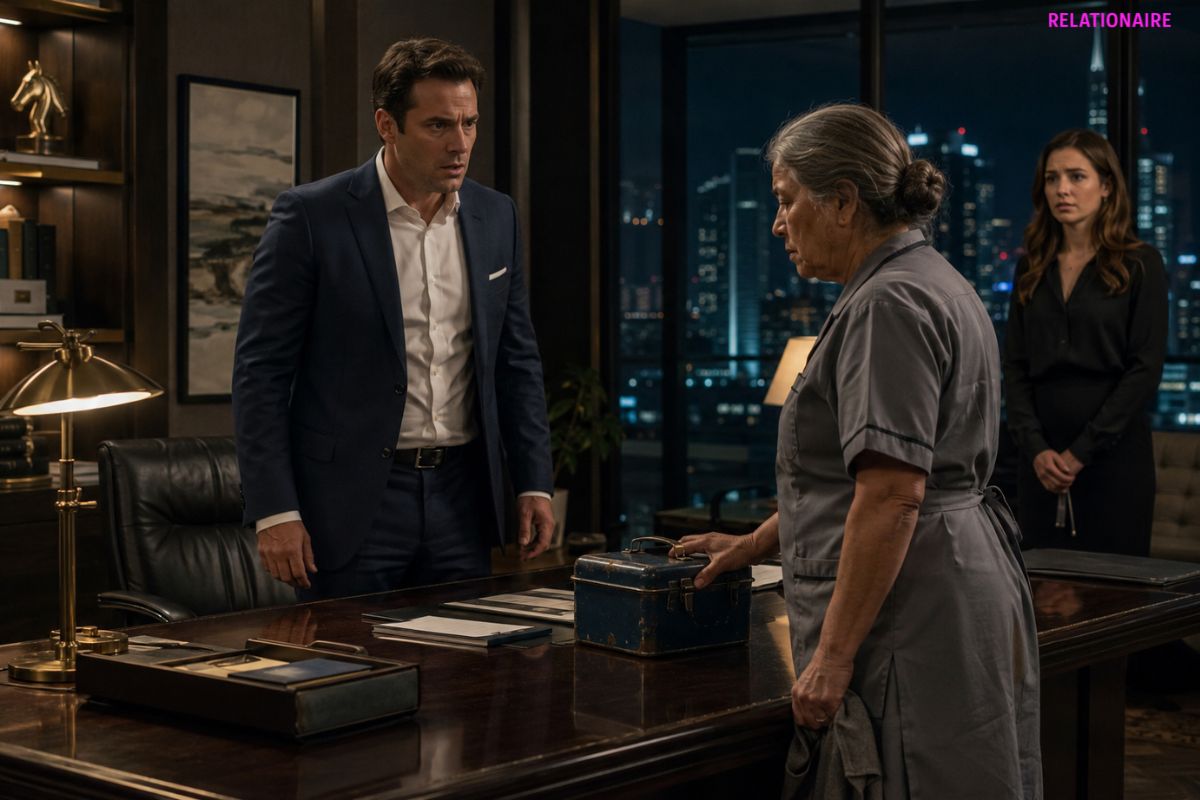
“Open that lunchbox, or you’re fired.”
Daniel Mercer’s voice cut across the private office so sharply that Claire stopped breathing.
The door had just slammed behind him. The glass wall still trembled in its frame. Outside, the forty-second floor was dark except for the cleaning lights and the pale blue shine of the city below.
Elena Reyes stood beside Daniel’s desk in her gray cleaning uniform, one hand wrapped around the handle of a dented navy lunchbox.
It was old. Metal. Scratched at the corners. The kind of thing nobody made anymore.
Daniel pointed at it.
“Now.”
Elena did not move.
She was sixty-two, maybe sixty-three. Small in the shoulders. Her hair was pinned back with the same plain black clip she wore every night. Daniel knew her only because she had cleaned the executive floor for nearly nine years and always moved like she was trying not to disturb anyone’s importance.
But tonight, she was in his office after hours.
And she was holding something that had been inside his locked private cabinet.
Claire took one cautious step forward.
“Mr. Mercer, maybe there’s an explanation.”
Daniel didn’t look at her.
“There usually is,” he said. “That’s what makes it worse.”
Elena’s eyes flickered, not with guilt exactly, but with exhaustion. She held the lunchbox closer to her chest.
“It isn’t company property,” she said quietly.
Daniel laughed once, without warmth.
“It was in my office.”
“It was in your cabinet.”
“My cabinet is in my office.”
“It was not yours to throw away.”
That sentence landed differently.
Claire looked at Elena. Then at Daniel.
The private office had been renovated that week. Daniel had ordered everything old removed. The dark wood shelves, the framed newspaper clippings, the dusty awards, the worn leather chair his father had once refused to replace.
He wanted the office clean.
Modern.
His own.
By Friday, only one locked cabinet remained untouched. It had belonged to his father, Samuel Mercer, who had built Mercer Foods from a single warehouse and a delivery van that smelled permanently of onions.
Samuel had been dead for six months.
Daniel had not opened the cabinet since the funeral.
That afternoon, when maintenance finally found the key, Daniel told them to empty it.
“Anything worth archiving goes to storage,” he had said. “Everything else goes out.”
He had not stayed to supervise.
He had meetings. Investors. A dinner he didn’t want to attend. A life that kept rewarding him for never sitting still long enough to feel anything.
Then Claire called him at 9:18 p.m.
“Daniel,” she had whispered, which she never did at work, “you need to come back.”
He found Elena in his office with the lunchbox.
The cabinet door was open.
A stack of old papers lay on his desk.
And Elena looked as if she had been caught holding a heart.
“Put it down,” Daniel said.
Elena swallowed.
“I will. But not like this.”
“Not like what?”
“Like I stole it.”
His jaw tightened.
“You were alone in my private office.”
“I clean this office every night.”
“You opened a locked cabinet.”
“It was already open when I came in.”
“So you decided to help yourself?”
Elena’s face changed then. Just slightly. Not anger. Not fear.
Disappointment.
That somehow irritated him more.
“Careful,” he said.
Claire whispered, “Daniel.”
He raised a hand to stop her.
Elena looked at that raised hand. Then at his face.
“I have been careful in this building for nine years,” she said. “Careful not to touch the wrong thing. Careful not to speak too loudly near men who forget I can hear them. Careful to smile when people leave coffee rings on the floor and call it my job.”
Daniel’s expression hardened, but something in his eyes shifted.
Elena continued, still soft.
“I have been careful enough.”
The office became very quiet.
The city blinked behind them like nothing inside that room mattered.
Daniel pointed again, this time at the desk.
“Open the lunchbox.”
Elena placed it down slowly.
The small metal sound it made against the polished desk seemed too loud.
But she kept one hand over the latch.
“If I open it,” she said, “you’ll have to hear why I kept it.”
Daniel stared at her.
“Kept what?”
Elena lifted her eyes to his.
“Your father’s last apology.”
Claire’s hand moved to her mouth.
Daniel did not speak.
For a moment, he looked almost young. Not the CEO. Not the man whose name was printed on the glass doors downstairs. Just a son who had heard a dead man mentioned in a room he had been trying to erase.
“What did you say?”
Elena’s hand trembled over the latch.
“Your father gave this to me before he went into the hospital.”
Daniel’s voice dropped.
“My father gave you that?”
“Yes.”
“Why?”
Elena looked down at the lunchbox.
The faded white sticker on its side had almost peeled away, but under the scratches, Daniel could still make out three letters written in old black marker.
SAM.
His father’s handwriting.
Daniel reached for the lunchbox, but Elena did not move her hand.
Not away.
Not yet.
“You don’t get to snatch this from me,” she said.
His face flushed.
Claire looked down.
Daniel’s lips parted, then closed again.
Elena’s voice remained steady, though her eyes shone now.
“I came here tonight because I heard them say the old cabinet was being emptied. I knew you would throw it away.”
“I didn’t know it was there.”
“No,” Elena said. “You didn’t.”
That hurt more than an accusation.
Daniel pulled back his hand.
The anger that had carried him into the room began to lose its shape.
He looked at Elena’s uniform. The plastic name badge clipped crookedly to her pocket. The worn shoes. The lunchbox.
Then he looked at the wall where his father’s portrait had hung until three days ago.
“What’s inside?” he asked.
Elena finally lifted her hand from the latch.
Her fingers paused once, as if asking permission from someone no longer in the room.
Then she opened it.
The hinges gave a dry little squeak.
Inside was not money.
Not stolen jewelry.
Not office property.
There was a folded red handkerchief, a tarnished key, and a sealed envelope.
On the envelope, in handwriting Daniel had spent six months avoiding, were four words.
For my son, Daniel.
Daniel stared at it.
His throat moved.
Claire took one step backward, as if the room had become too private for anyone else.
Elena did not touch the envelope.
She simply turned the lunchbox slightly so Daniel could see the line written underneath his name.
A line his father had added in smaller letters.
Open this when pride makes him cruel.
Daniel’s face went white.
Part 2
Daniel did not reach for the envelope.
For a man who signed contracts worth millions without blinking, his hand had gone strangely useless.
The office seemed smaller now. The ceiling lower. The air warmer.
Elena stood across from him with the open lunchbox between them, and Daniel understood with a sick heaviness that he had done exactly what the note expected him to do.
Pride had made him cruel.
Claire spoke first.
“I should go.”
No one answered, but she understood.
She slipped out of the office and closed the door gently behind her.
Daniel and Elena remained on opposite sides of the desk.
For years, that desk had made people feel smaller. It was designed to. Wide, black, expensive. A surface where men leaned forward and delivered news that changed other people’s lives.
Tonight, it only looked like furniture.
Daniel sat down slowly.
“Did he tell you what was in the letter?” he asked.
Elena shook her head.
“He told me it was not mine to read.”
“But he gave it to you.”
“Yes.”
“Why?”
She glanced toward the empty wall where Samuel’s portrait had once been.
“Because he said you would not take it from him.”
Daniel almost laughed, but there was no humor left in him.
“He was right.”
Elena’s eyes softened.
“That made him sadder than he let people see.”
Daniel looked at the envelope again.
He thought of his father in the hospital bed, skin gray under fluorescent light, still trying to sit upright whenever Daniel came into the room. Still asking about shipments, margins, warehouse problems, as if business could keep death waiting in the hallway.
Daniel had visited.
He had not stayed.
There was always another call. Another meeting. Another excuse dressed up as responsibility.
At the time, he told himself his father understood.
Now he was not sure his father had ever been fooled.
“How did you know him?” Daniel asked.
Elena looked down at the lunchbox.
“I knew him before you called him Mr. Mercer.”
Daniel frowned.
“What does that mean?”
“It means before the suit. Before this floor. Before the newspapers called him a founder.”
Daniel leaned back.
“You worked with him?”
“Yes.”
“At Mercer Foods?”
“No.” Elena smiled faintly, but it was full of old pain. “In this building. When it was still the Whitcomb Insurance Building. We cleaned nights together.”
Daniel stared at her.
“My father was never a cleaner.”
Elena did not argue quickly. That made it worse.
“He was,” she said. “For almost three years.”
Daniel stood.
“No.”
“He worked the north stairwells. I worked floors thirty-eight through forty-two.”
“No,” Daniel said again, louder this time. “My father started in distribution. He drove produce. He built—”
“He built later,” Elena said. “After.”
“After what?”
Elena’s fingers rested lightly on the edge of the lunchbox.
“After your mother got sick.”
Daniel’s mouth closed.
His mother had died when he was seven. Breast cancer, though no one had explained it to him properly at the time. His memories came in pieces: the smell of hospital soap, his father’s hand around his, the way adults lowered their voices when he walked into rooms.
“He needed work at night,” Elena said. “Something no one would ask many questions about. He cleaned offices here from six in the evening until two in the morning, then drove produce at dawn.”
Daniel turned away.
The city beyond the glass blurred.
“He never told me.”
“He was ashamed.”
“Of cleaning?”
“No,” Elena said. “Of not being able to save her.”
That sentence moved through Daniel quietly and found a place he had kept locked for years.
His mother’s death had always been a room he refused to enter.
He remembered his father coming home tired, smelling of bleach and apples. He remembered a metal lunchbox on the kitchen counter. He remembered being angry because his father missed a school play, a birthday dinner, a parent meeting.
He remembered deciding, at twelve years old, that success meant never being that tired.
Never being that helpless.
Never being looked down on.
Elena watched the memory arrive.
“He brought you here sometimes,” she said.
Daniel turned.
“What?”
“You were little. Too young to stay alone. He made a bed for you under the desk in one of the empty offices. You slept with your coat rolled under your head.”
Daniel’s voice became thin.
“I don’t remember that.”
“You were four. Maybe five.” She paused. “You had red mittens.”
He did remember the mittens.
Not the office. Not Elena. Not the nights.
But he remembered the red mittens because his mother had sewn a blue button on one of them after he lost the original.
His knees felt weak.
Elena reached into the lunchbox and touched the folded red handkerchief.
“He used to wrap your sandwich in this. Peanut butter, no crust. He said you hated crust like it had personally insulted you.”
A sound escaped Daniel before he could stop it.
It was not laughter.
It was not a sob.
It was something caught between the two.
He sat down again.
“Why would he give all this to you?”
Elena took a breath.
“Because I was there the night he almost quit.”
Daniel looked up.
“He had been cleaning the executive offices. A man from the insurance company came back late and found him sitting at a desk, writing numbers on the back of an envelope. Your father was trying to calculate medicine bills.”
She stopped.
Daniel waited.
“The man told him to remember which side of the desk he belonged on.”
Daniel’s face tightened.
Elena nodded, as if she had seen that same face on Samuel long ago.
“Your father said nothing. He picked up his mop and kept working. But after the man left, he went into the stairwell and cried.”
Daniel stared at the lunchbox.
“He cried?”
“He was tired. And scared. And proud. Pride can hurt poor men too, Mr. Mercer.”
Daniel had no answer.
“I found him there,” Elena said. “He was holding this lunchbox. He said, ‘One day my son will sit behind a desk, and no one will ever speak to him like that.’”
Daniel closed his eyes.
That was the inheritance, then.
Not the company.
The wound.
His father had built an empire partly out of love, partly out of fear, and Daniel had mistaken both for instruction.
Elena continued.
“I told him that if his son ever sat behind a desk and spoke to someone else that way, then the desk had won.”
Daniel opened his eyes.
The words were plain. Not cruel. That made them impossible to avoid.
He looked at Elena’s uniform again, really looked this time.
“How much do we pay you?” he asked.
She blinked.
“What?”
“The cleaning contract. Your wages.”
A guardedness returned to her face.
“I am not asking for money.”
“I didn’t say you were.”
“I didn’t come here for pity.”
“I know.”
“No,” she said. “You don’t. Not yet.”
Daniel fell silent.
Elena reached into the lunchbox and lifted out the tarnished key.
“This was to your father’s first delivery van,” she said. “He kept it after the engine died. Said it reminded him that every door he opened started with one that barely opened at all.”
She placed it on the desk.
Then she touched the envelope but did not pick it up.
“He asked me to give you this only if you forgot.”
Daniel looked at her.
“Forgot what?”
Elena’s eyes held his.
“That being above someone is not the same as being worth more.”
Daniel flinched.
The sentence did not shout.
It simply arrived.
And stayed.
For the first time that night, he lowered himself into the chair across from her instead of behind the desk.
Then, with hands that no longer looked powerful, Daniel picked up his father’s letter and broke the seal.
Part 3
Daniel unfolded the letter carefully.
His father had written in blue ink, the lines slanting slightly downward as if his hand had grown tired halfway through.
Daniel braced himself for blame.
He deserved it.
But the first words were not blame.
Danny,
If Elena is giving you this, then I waited too long to say something out loud.
Daniel pressed his lips together.
No one had called him Danny in years.
Not since his father.
He kept reading.
I used to think dignity was something a man earned after he climbed high enough. I was wrong. Dignity is what keeps a man human when he is low, and what keeps him decent when he is high.
Daniel stopped.
The office was silent except for the hum of the air conditioning.
Elena had turned slightly away, giving him privacy without leaving him alone.
He read on.
There were things I hid from you because I wanted you proud of me. I did not want you to remember me mopping floors. I did not want you to know I packed your lunch with hands cracked from bleach. I did not want you to see me tired.
But I think hiding that part of my life taught you the wrong lesson.
You learned to respect the climb.
I should have taught you to respect the ground.
Daniel’s eyes burned.
He wiped them quickly, then stopped pretending and let his hand fall.
His father wrote about the nights in the building. About Elena sharing coffee from a thermos when he forgot dinner. About her watching little Daniel sleep in an empty office while Samuel cleaned bathrooms down the hall.
He wrote about the night a man humiliated him.
He wrote about how close he came to becoming hard because of it.
Then the letter changed.
Elena saved me from that. Not with money. Not with speeches. She simply refused to let shame tell me who I was. She said work is work, and a person’s hands do not become dirty because they clean what others leave behind.
Daniel looked up.
Elena was staring at the carpet.
Her face was calm, but tears had gathered along her lower lashes.
Daniel continued.
If I built anything good, she was there at the beginning of it. Not in the papers. Not in the photos. But there.
I made her a promise once. I told her that if I ever owned an office like the ones we cleaned, no one working in it would be treated as invisible.
I tried to keep that promise.
I do not know if you will.
Daniel lowered the letter.
That line sat between them longer than all the others.
He thought of the cleaning staff entering after meetings, heads down, moving around executives who did not pause their conversations. He thought of the employee entrance near the loading dock. The separate elevators used after hours. The jokes he had ignored because ignoring them was easier than correcting people he needed.
He thought of himself ten minutes earlier, standing over Elena with a threat in his mouth.
He looked at her.
“I’m sorry,” he said.
Elena did not answer right away.
He had expected forgiveness to arrive quickly, because apologies usually bought him something.
This one did not.
Elena folded her hands.
“For what part?”
The question was gentle.
It still cut.
Daniel looked at the lunchbox, the key, the handkerchief, the letter.
“For thinking the worst of you because it was convenient.”
Elena held his gaze.
“And?”
“For using your job against you.”
“And?”
He swallowed.
“For forgetting that my father was more than the office he left me.”
Elena’s expression softened, but only slightly.
Daniel looked down.
“And for making you stand here and prove you had dignity before I treated you with any.”
Elena breathed in slowly.
That was the one.
She nodded once.
Not absolution.
Recognition.
Daniel took the old key from the desk and turned it over in his palm.
“Why didn’t you give this to me at the funeral?”
Elena gave a small, tired smile.
“You were surrounded by men in dark suits telling you how great your father was. I didn’t think you were ready to hear how good he was.”
Daniel looked toward the empty wall.
The portrait was gone, but for the first time all week, the office felt less empty.
“What should I do with it?” he asked.
“The letter?”
“All of it.”
Elena glanced at the lunchbox.
“That is not for me to decide.”
Daniel nodded.
Then, after a moment, he stood and walked to the wall where his father’s portrait had hung. Beneath it was a faint rectangle in the paint, a ghost left by something removed too quickly.
He looked back at Elena.
“Would you help me put the room back?”
She blinked.
“What?”
“Not all of it,” Daniel said. “Not like a museum. But the parts that mattered.”
Elena studied him carefully.
“You don’t need an old office to become a better man.”
“No,” Daniel said. “But I may need reminders.”
Claire knocked softly and opened the door a crack.
“Everything okay?”
Daniel looked at Elena first.
Then he answered.
“Not yet. But it can be.”
The next morning, the executive floor changed in small ways that made people whisper.
Daniel canceled the private contractor review. He asked for the cleaning team’s wage structure. He asked why the night staff had no proper break room. He asked questions that made directors uncomfortable because the answers had been comfortable for too long.
But the most important change was quieter.
At 8:30 a.m., when the senior staff gathered for their Monday meeting, Daniel placed the dented navy lunchbox in the center of the conference table.
Not as decoration.
Not as branding.
As evidence.
“This belonged to my father,” he said.
The room went still.
“He carried it when he cleaned offices in this building. Some of you knew that. Most of you didn’t. I didn’t. Or maybe I didn’t want to.”
No one moved.
Daniel looked at the polished faces around the table.
“Last night, I spoke to someone in this company as if her position made her character questionable. I was wrong.”
Across the room, Elena stood near the door because she had come to return the office keys and leave before the executives arrived.
Daniel turned toward her.
“Elena Reyes helped my father at the lowest point of his life. She also reminded me of who he hoped I would become.”
Elena’s eyes widened.
She gave the smallest shake of her head, uncomfortable with attention.
Daniel understood.
So he did not turn her into a symbol.
He simply said, “Thank you.”
Two words.
No applause.
No performance.
Just two words spoken in front of people who needed to hear them.
Later that week, Daniel rehung one photograph in his office.
Not the formal portrait.
A smaller one Elena brought from home.
Samuel Mercer stood beside a dented delivery van, young and thin, holding a navy lunchbox in one hand and little Daniel in the other. Beside him stood Elena, much younger, laughing at something outside the frame.
Daniel placed the old lunchbox on a shelf below it.
Some visitors noticed it and asked what it was.
Daniel always gave the same answer.
“That,” he said, “is where my father kept his dignity before he had a desk.”
And sometimes, late at night, when the floor grew quiet and the city softened behind the glass, Daniel would hear the cleaning cart in the hallway.
He would open his office door.
Not because he wanted to be praised.
Not because one apology could repair everything.
But because dignity is often protected in ordinary moments — in noticing, in making room, in speaking with care when no one important is watching.
And because a person’s worth was never meant to depend on which side of the desk they stood.