
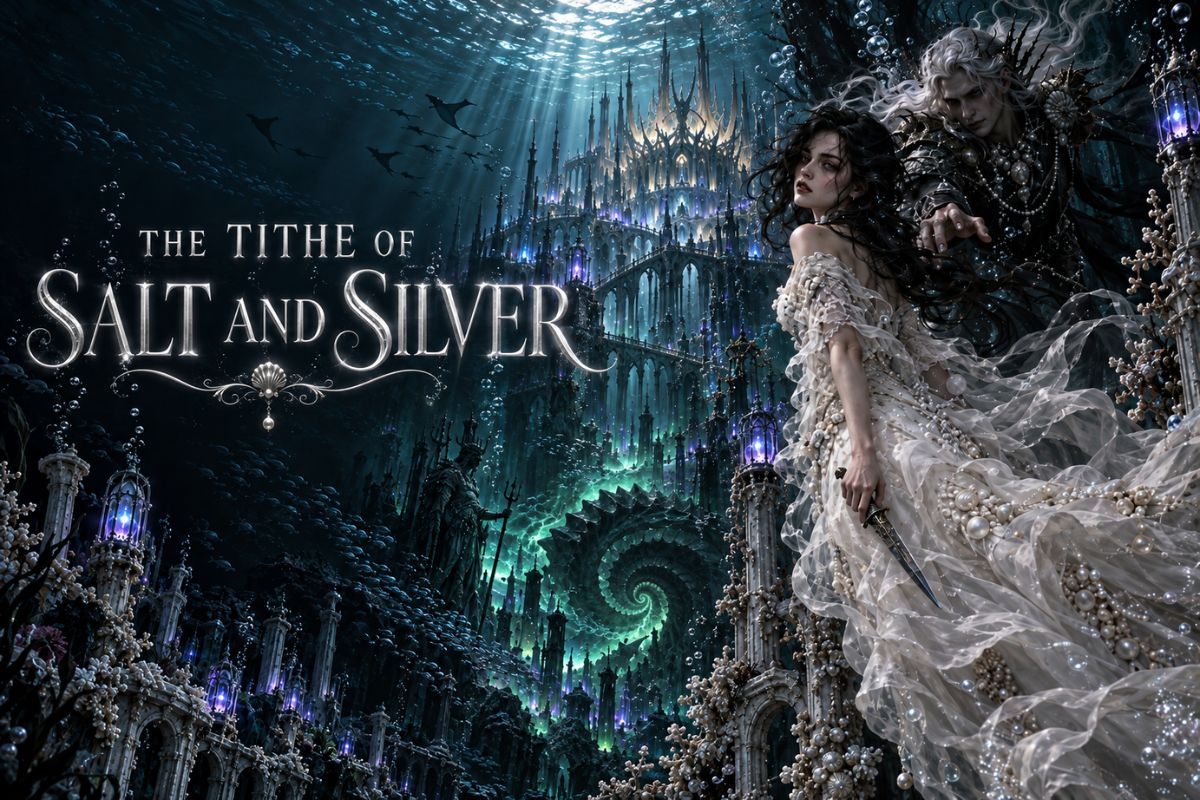
Chapter Two: Trial of Breath
The first trial is simple: breathe underwater or drown.
They tell us this at dawn, if there is such a thing as dawn at the bottom of the sea. I spend the night before it lying awake, staring at the ceiling, running one question over and over like a coin across my knuckles.
How does he know my name?
They keep us in a place the servants call the Tithe House. It’s a tower of old grey stone on the edge of the palace grounds, tilted slightly as if the seabed shifted under it a long time ago. Inside, the water is warmer and dimmer. Each of us has a narrow room with a bed carved from a single piece of pale coral and a window of thick green glass.
The bed has blankets. They float a little above the mattress. I lie under mine anyway, fully dressed, boots on, with my knife in my hand.
Nobody took it off me. That was the first surprise. They didn’t search us. Why would they? What’s one small blade against a city full of people who can breathe water?
I count what I know.
The man in grey knew who I was. That makes sense: he chose me. But he’s on the surface, and the prince is down here, and in between is a mile of sea and a hundred years of silence. So either the man in grey works for someone in Veyl, or somebody in Veyl has been watching my client.
Either way, my contract isn’t a secret. Which means either the prince is about to have me killed, or he wants something from me more than he wants me dead.
I turn it over for hours. Neither answer lets me sleep.
Somewhere near the middle of the night, when the light through the green window has faded to the colour of a bruise, there’s a soft knock on my door.
I’m on my feet before the second knock, knife low against my thigh. “Who is it?”
“Me,” says Tam’s voice. “Sorry. I know it’s late. I just— can I come in? I can’t sleep. Hollis snores. Even underwater. I didn’t know you could snore underwater.”
I open the door. He’s wrapped in one of the floating blankets, which gives him the look of a very worried ghost.
“Just for a bit,” he says.
I let him in. He sits on the floor with his back against my bed and his knees pulled up, and I sit above him with the knife hidden under my pillow, and for a while neither of us says anything.
“Do you think it hurts?” he asks eventually. “Drowning.”
I think about my father. About the night the Grey Lark didn’t come back, and my mother standing at the window until morning.
“Not for long,” I say.
He nods like I’ve told him something useful. “My mum used to say the tithe was a story to keep kids off the rocks. She said the sea was just the sea.” He picks at a loose thread on the blanket. “I wish she was here, so I could tell her she was wrong. She’d hate that.”
I shouldn’t like him. You don’t make friends with people who are going to die. That’s rule one. I learned it the hard way, and I’ve never needed to learn it twice.
“You should sleep,” I tell him.
“Yeah.” He doesn’t move. “Liss?”
“Mm.”
“The prince. When he stopped in front of you. What did he say?”
I look at the green window for a long moment.
“He said welcome,” I say.
At dawn a bell rings somewhere in the palace, a long, low note that I feel in my teeth rather than hear. The pearl under my tongue is smaller now. Thinner. I can feel it dissolving, the way a sweet dissolves when you’ve held it too long.
The servants come for us. They’re Veylish but plainly dressed, in grey, with their silver hair tied back. They don’t speak. They lead us out of the Tithe House, through a gate of black iron twisted into the shapes of waves, and into a garden.
I say garden. It’s a forest.
Kelp rises all around us, great golden-brown ribbons as thick as a man’s leg, climbing so high they vanish into the dim water above. They sway slowly in a current I can’t feel. The light that filters down through them is green and gold and moving, all shifting stripes and shadows, so that it’s hard to tell what’s still and what isn’t.
The floor of the forest is covered in shells.
Thousands of them. Tens of thousands. They cling to the rocks and roots in clusters, spiral shells and fan shells and long twisted horns, some as small as my fingernail, some as big as my fist. Many of them glow faintly: pink, violet, pale blue.
On a rock at the edge of the forest stands a Veylish woman in grey robes, holding a staff of white coral. She’s older than the others I’ve seen, her face lined in a way that seems almost deliberate, like weathering on a statue.
“I am Oriel, Warden of the Tides,” she says. “I oversee the trials. When your pearls dissolve, you will have perhaps a minute before your lungs fail you.”
A minute. The farm sisters grab each other’s hands.
“Somewhere in this forest grow breath-shells,” Oriel goes on. “When a breath-shell is pressed to the throat of a living creature, it bonds with the flesh and breathes for them. It will breathe for you for as long as you live. Find one before your pearl is gone, and you pass the first trial.”
“What do they look like?” says Hollis.
Oriel regards him. “Like shells.”
“And the others?” I ask. “The ones that aren’t breath-shells?”
She turns her ancient eyes on me. “Some are merely shells. Some are not so kind.” She lifts her staff. “The trial begins when you enter the forest. The court is watching.”
I look up. High above us, at the top of the kelp, where the ribbons thin out into water, there’s a long gallery of glass. Shapes stand behind it. The court of Veyl, come to watch us drown.
At the centre of the gallery, a little apart from the others, a tall figure with silver-white hair.
I look away first. I tell myself it’s because I have work to do.
We scatter.
The salt-pan man goes first, running into the kelp with his arms out, praying under his breath. The merchant’s son—his name is Edric Voss, I’ve learned, and his father owns half the warehouses in Corlen—shoves past the farm sisters and plunges straight into the thickest part of the forest. The scarred woman walks in slowly, head down, like someone searching for a coin she dropped.
I don’t move.
“Liss.” Tam is at my elbow. “Liss, we have to go.”
“Wait.”
“We don’t have time to wait!”
“Look,” I say, and point.
A fish is nosing through the shells at our feet: small, silver, harmless-looking. It moves from cluster to cluster, nibbling at the algae on the rocks. But it doesn’t nibble at all of them. It skirts wide around the clusters of pale violet spirals, flicks its tail, and changes direction. It does the same thing to a patch of long, thin horn shells that glow a faint poisonous green.
When I grew up smuggling, the first thing my father taught me was how to read the water. Where the fish go, the rocks aren’t. Where the gulls dive, the current turns. The sea tells you everything, if you’re quiet enough to listen.
“The fish know,” I say. “Watch what they avoid. Then watch what they don’t care about at all.”
Tam stares at me. Then at the fish. His whole face changes, fear turning into something that looks a lot like hope.
“That’s clever,” he breathes.
“It’s just fishing.” I start walking. “Stay close.”
The forest swallows the others quickly. The kelp is so thick that after a few dozen steps I can’t see the gate behind us. Every so often I hear someone crashing through the fronds, or a voice calling a name.
Then, not far away, someone screams.
It’s short and high and it cuts off suddenly, in a way that leaves the silence afterward worse than the noise. Tam flinches so hard he nearly falls over.
“Keep going,” I tell him. My voice sounds steadier than I feel.
The pearl under my tongue is barely there now. A sliver. I can feel my breaths getting shorter, less satisfying, like breathing through wet cloth.
We follow the fish. I watch them the way I’d watch a pickpocket in a crowd, every flick and turn. They avoid the violet spirals. They avoid the green horns. They nibble happily around the pink fan shells, which tells me they’re harmless and useless. And there’s one kind they do something strange around.
Small, ridged, dull blue shells, clustered in the shadows under the roots. The fish don’t avoid them. They don’t ignore them, either. They hover near them, close and still, mouths moving slowly. Almost as if they’re breathing in time with them.
“There,” I say.
Tam drops to his knees. “These? They’re ugly.”
“Everything useful is ugly.”
I pry one off the root. It comes away with a soft sucking sound. Inside the ridged lip, something moves: fine pale frills, fluttering like the gills of a fish. Warm. Alive.
My chest is burning now. The pearl is gone. I can taste nothing but salt.
I press the shell into Tam’s hand. “You first.”
“No, you—”
“Tam. Do it.”
He doesn’t argue again. He presses the shell to the side of his throat, just under his jaw, and gasps. I watch the frills latch onto his skin, watch the ridges of the shell flatten and soften and sink until it looks less like a shell and more like a pale blue scar with a faint, fluttering edge. His whole body shudders. Then he takes a long, slow breath, and another, and starts to laugh.
“It works,” he says. “Liss, it works, it—”
I’ve already turned back to the root for a second shell.
That’s when something hits me from behind.
The blow takes me across the shoulders and drives me face-first into the rocks. Shells crack under my cheek. The world goes white, then black, then slowly comes back, and when it does, there’s a weight on my back and a hand in my hair, and a voice in my ear, ragged and desperate.
“Give it to me. I saw you. You know which ones—give it to me.”
Edric Voss. The merchant’s son.
He’s lost his rings somewhere. There’s blood in the water around his mouth. His pearl must be gone too, because he’s breathing in short, frantic hitches, and there’s panic in every line of his body. Panic makes people strong. It also makes them stupid.
I slam my head backward into his face. I feel something crunch. He howls and his grip loosens, and I twist onto my back and get my knife up between us—
—and he’s ready for it. He grabs my wrist and bangs it against the rock, once, twice, and my fingers open. The knife tumbles away into the shells.
And I can’t breathe.
It hits me all at once, the way the wave did. There’s no air. There’s nothing in my lungs but burning. My body wants to open its mouth and suck in water, and I fight it, and fight it, and black spots bloom at the edges of my vision like ink in a glass.
Edric’s pried the second shell out of the root. He’s holding it up to his own throat, sobbing with relief.
Tam is shouting. I can hear him, far away. He’s pulling at Edric’s arm, and Edric throws him off like a doll.
I think, very clearly: Pip.
I think: I’m sorry.
Then the water around us changes.
It goes cold. Not the cold of the deep sea. Something sharper, like the air just before lightning. The kelp around us bends outward as if something has pushed it. The fish scatter.
And Caius is there.
I don’t see him arrive. One moment there’s Edric above me, and the next there’s a hand around Edric’s throat, and he’s being lifted clean off me as if he weighs nothing at all.
The prince holds him in the water at arm’s length. His face is completely calm.
“That,” he says, “is not yours.”
And he closes his fingers around the breath-shell on Edric’s neck and tears it off.
The sound it makes is terrible. Edric’s eyes go wide. His mouth opens. A stream of bubbles pours out of it, silver and bright, rising up and up toward the glass gallery where the court stands watching. His hands scrabble at Caius’s arm, at his own throat, at nothing.
Caius doesn’t let go.
It doesn’t take long. I know, because I watch all of it through the black spots at the edges of my eyes, and my own lungs are screaming the same scream Edric’s are.
When it’s over, the prince opens his hand, and the merchant’s son drifts slowly down into the shells, his hair floating around his face like weed.
Then Caius kneels beside me.
He turns the torn shell over in his fingers. It’s bloodied, but the frills inside are still moving. He cups my jaw with one hand, tilting my head to the side, gentle, almost careful. His skin is cool.
“Breathe, Wren,” he says, and presses the shell to my throat.
It hurts. It’s like being bitten by something small and hungry. I feel the frills burrow in, feel the shell soften and melt into my skin, and then my chest opens up and the water floods in and—
—and it’s air.
It isn’t air. But my body thinks it is. I gasp, and gasp, and gasp again, and every breath is cold and clean and tastes of salt and green light. I roll onto my side, coughing, shaking, clawing at the rocks.
When I can see again, he’s still kneeling beside me, watching.
“Why?” I rasp. My voice sounds like it’s been dragged over gravel.
He tilts his head, as if it’s a strange question. As if he’s been waiting for me to ask a different one.
“You’re no use to me dead,” he says.
Then he stands, turns, and walks away through the kelp, leaving me on the seabed beside the body of the man he just killed for me.
Above us, in the glass gallery, the court of Veyl begins, very softly, to applaud.
See next: Chapter Three: Trial of Masks