
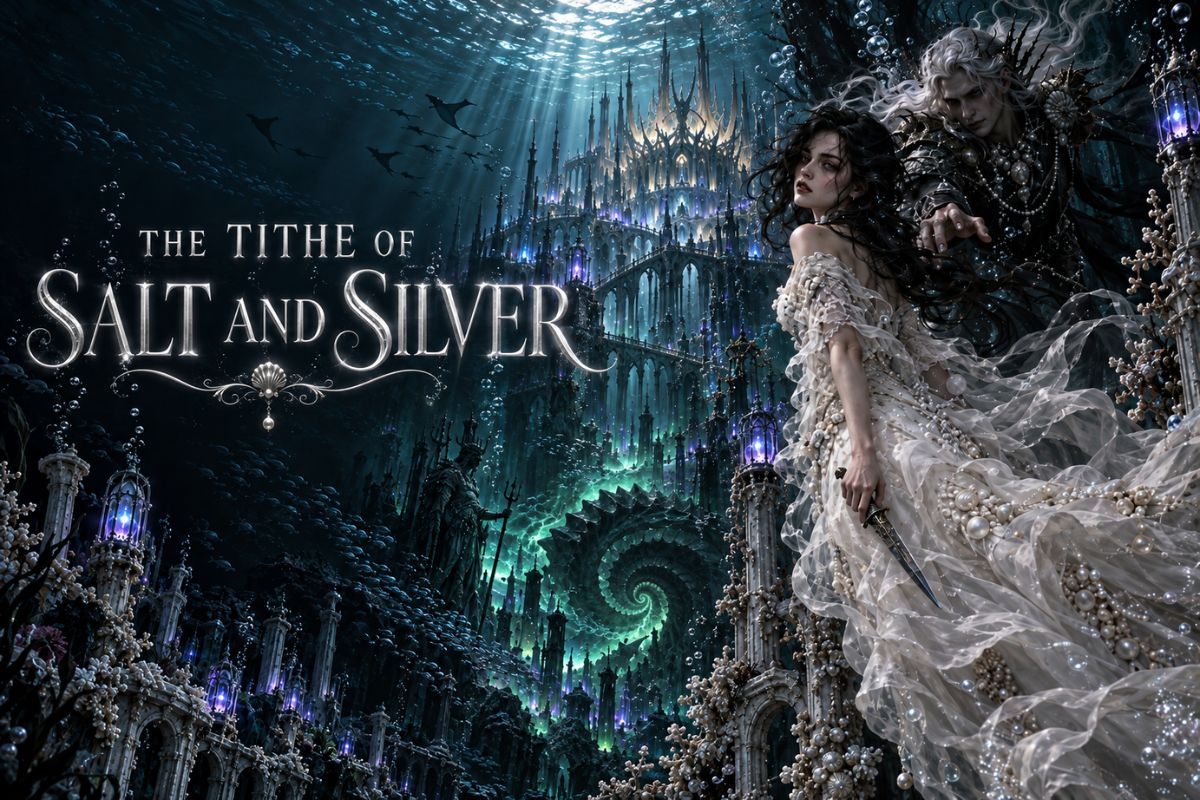
Chapter One: The Choosing
Every hundred years, the sea takes ten of us.
This time, I volunteer.
But not yet. First I have to stand on the cliffs of Saltmarrow with the rest of the town and watch the ocean leave.
It starts at dusk. The tide goes out the way it always does, and then it keeps going. It slides past the fishing markers, past the reef where my father lost his boat, past the black rocks the children dare each other to swim to. It goes until there’s nothing in front of us but a mile of wet, glittering seabed and a sound like breath being held.
Nobody speaks. A hundred years is long enough that no one alive has seen this, but every one of us knows the story. The sea pulls back. The priestess reads the lots. Ten walk out onto the sand, and the sea comes home.
The ten never do.
I keep my hood up and my hands in my pockets. My right hand is closed around a folded square of paper so worn it feels like cloth. I don’t need to read it. I know what it says.
One life. The heir of Veyl. On the night of his wedding.
Payment: the release of Pip Hale from the Debtors’ Keep at Harrow, and two hundred gold crowns.
There’s no signature. Just a seal pressed into black wax, a spiral shell curling in on itself like something trying to hide.
The man who gave it to me wore grey and smelled of cold water. He found me three nights ago in the back room of the Gull and Anchor, where I was counting out what I owed on smuggled brandy and coming up short, the way I always do. He didn’t sit. He put the paper on the table and said, “You’re the one who did the magistrate in Corlen.”
I said I didn’t know what he meant.
He said, “Good. Then you’ll know how to keep your mouth shut down there too.”
Down there. I laughed at him. I stopped laughing when he told me my brother’s cell number.
The priestess of the tide climbs onto the speaking stone. She’s old and bent, wrapped in grey netting strung with shells, and her voice carries farther than it should.
“The sea gave us fish,” she says. “The sea gave us salt. The sea spared our boats and our children for a hundred years. Tonight the sea asks for ten.”
The crowd murmurs the answer. Ten for a hundred. My lips move with them out of habit.
She draws the first lot from a clay jar. “Hollis Crane.”
A big dockworker near the front goes very still. His wife makes a sound I will remember for the rest of my life, however long that is. Hollis kisses her forehead and walks down the cliff steps without looking back.
The second lot is a man I don’t know. The third is a woman from the salt pans. The fourth is a boy.
“Tam Weller.”
He can’t be more than sixteen. He’s all elbows and freckles, and when his name is called he actually laughs, a small, shocked noise, like he’s been told a joke he doesn’t understand. Then he pulls himself together, wipes his hands on his trousers, and goes.
Five. Six. Seven. The names fall like stones into a well.
“Essa Brine.”
The girl standing beside me grabs my sleeve.
I know her. Everyone knows her. Her father mends nets by the harbour, and she sells the fish he doesn’t have time to gut. She’s fifteen. Last winter she gave me bread on credit when I’d had nothing for two days, and she never once asked me to pay it back.
She isn’t crying. That’s the worst part. She’s just holding my sleeve and staring at the empty sea like she’s trying to understand how big it is.
This is the moment. It was always going to be this moment, one way or another. The contract needs me down there, and a volunteer is the only way a woman like me gets chosen for anything. I’ve been waiting for a name I could stand in front of.
I didn’t expect it to be hers.
I peel her fingers off my coat, gently.
“I’ll go,” I say.
It comes out quiet. Nobody hears. So I push my hood back and say it again, loud enough that the priestess stops with her hand in the jar.
“I volunteer. In Essa Brine’s place.”
The crowd turns. I feel every eye on the cliff land on me, a hundred small weights. The old woman squints down from the speaking stone.
“The sea does not refuse a willing gift,” she says slowly. “Your name, child?”
My name is not something I give out. Not in Saltmarrow, where half the taverns want me arrested and the other half want me dead. Not anywhere.
“Liss,” I say. “Liss Tanner.”
She nods and writes nothing down. Essa’s hand finds mine one more time. She presses something into it, a hard little knot of blue glass on a string, the kind of charm sailors’ daughters give their fathers for luck.
“Come back,” she whispers.
I don’t tell her nobody ever does.
The steps down the cliff are slick with weed. At the bottom, the seabed is soft and cold under my boots. Stranded fish flap weakly in the pools. The ribs of old wrecks stick up out of the sand like the bones of something enormous that died here long ago.
The other nine tithes are waiting in a loose line. I take my place at the end and get a good look at them, because that’s what I do. Look first. Decide later.
Hollis Crane, the dockworker, stands like a wall. He’ll be strong, and slow, and kind to the wrong people. The man from the salt pans is already praying. There’s a pale, well-dressed young man with rings on every finger who keeps checking his reflection in a tide pool; I’d guess a merchant’s son whose father owed someone a favour. Two sisters from the hill farms, holding hands so tight their knuckles are white. A thin woman with a scar through one eyebrow who looks at nobody.
Tam, the boy, is bouncing on his heels to keep warm.
And the girl beside him, who is looking straight back at me.
She’s about my age, with dark red hair twisted into a knot and a face made of sharp angles. Inland clothes, too good for the coast and too plain for money. She’s the only other person on the sand who isn’t afraid, or at least the only one hiding it as well as I am.
“You volunteered,” she says. Not a question.
“Seems that way.”
“Nobody volunteers.” She tilts her head. “Either you’re very brave or very stupid.”
“Can’t I be both?”
The corner of her mouth twitches. “Maren,” she says.
“Liss.”
“No, it isn’t,” she says pleasantly, and turns back to face the sea.
I keep my face still. My pulse does not.
Tam leans around her. “I think it’s brave,” he says. His teeth are chattering. “Stupid, too. But mostly brave.” He sticks out a hand. “Tam. I’d say it’s nice to meet you, but, you know.” He waves vaguely at the horizon, at everything.
I shake his hand. It’s freezing. “It’s nice to meet you anyway, Tam.”
He grins, and something in my chest pulls tight in a way I don’t have time for.
The priestess comes down last, slow on the weeded steps, carrying a wooden bowl. When she reaches the line, she stops in front of each of us and holds it out.
Inside are ten pearls. They aren’t white. They’re silver, bright as coins, and they give off a faint cold light.
“Beneath the tongue,” she says. “Do not swallow. Do not spit. It will carry your breath as far as it can.”
“How far is that?” asks the merchant’s son.
The priestess looks at him with something close to pity. “Far enough to meet them.”
I take mine. It’s cold enough to sting, and it tastes like the inside of a shell. The moment it settles under my tongue, my lungs feel strange, full and light, like I’ve just breathed in the first air of spring.
Then the ground starts to shake.
It’s gentle at first, a tremble in the wet sand. The pools shiver. Somewhere far out, where the sea went, there’s a low sound, deeper than thunder. It doesn’t stop. It grows.
“Hold hands,” the priestess says. “It is easier if you hold hands.”
Nobody moves. Then Tam grabs my left hand and Maren’s right, and down the line the others do the same, until the ten of us are one long, shaking chain on the bottom of the sea.
I turn my head and look up at the cliff. The whole town is up there, a dark line of shapes against a darker sky. I look for Essa and can’t find her.
I think about Pip instead. Twelve years old, locked in a stone room in Harrow because our father borrowed money from the wrong men and then drowned before he could pay it back. I think about how he used to crawl into my bed during storms, even when he said he was too old for it.
One life. On the night of his wedding.
I can do this. I’ve done worse for less.
The sea comes home.
It doesn’t come as a wave. It comes as a wall, grey-green and taller than the cliffs, moving so fast that the roar reaches us after it does. I have time to see the moonlight shining through it, to see fish caught inside it like flies in amber. Then it hits.
The cold is total. It knocks every thought out of my head. I’m spinning, dragged, crushed, and my mouth wants to open and scream and I clamp it shut around the pearl so hard my jaw aches. Tam’s hand is ripped out of mine. I reach for it and find nothing.
And then, slowly, the violence stops.
I’m sinking.
I open my eyes, and they don’t burn. The water around me is dark and clear and very still. I’m breathing. I don’t know how, but I’m breathing, small, careful breaths that come from nowhere and taste of silver.
Around me, the others are sinking too, drifting down like leaves through deep green light, coats and hair and skirts floating up around them. Tam is a little way off, turning slow somersaults, his eyes huge. Maren sinks feet first with her arms folded, as if she’s just waiting for something boring to be over.
Below us, lights are coming on.
They bloom out of the dark one by one, blue and violet and pale gold, until I can see what they’re shining on, and all the breath the pearl gives me catches in my throat.
There’s a city down here.
Not a ruin. A city. Towers of white stone and pale coral rise out of the seabed, twisting upward in shapes no human builder would dare. Bridges arc between them, thin as ribbon. Great glass domes glow from the inside like lanterns. Shoals of silver fish pour through the streets in rivers. Everywhere I look there are lights: glowing jellyfish drifting inside iron cages, strings of luminous shells, windows full of blue fire.
In the middle of it all stands a palace so large it looks like a mountain someone carved into a crown.
We fall toward it.
We land in a great hall at the palace’s heart. My boots touch a floor of polished black marble, cracked in long lines like old ice. I stay standing, which is more than the merchant’s son manages. The water here is still and warm, and my coat settles slowly around me.
The hall is enormous. Columns of twisted white coral hold up a ceiling I can’t see. Along both walls, in tiered galleries, sit the people of Veyl.
I’ve heard stories about them all my life. They don’t prepare you.
They look like us, mostly. Tall and slender and beautiful in a way that makes my skin prickle, like a knife that’s been sharpened too well. Their skin has a faint sheen, like the inside of a shell. Their hair moves in the water as if it has thoughts of its own, silver and black and sea-green. Their eyes catch the light the way cats’ eyes do. Hundreds of them, dressed in pearl and scale and trailing silk, all perfectly quiet, all watching us.
At the end of the hall, a staircase of pale coral climbs to a throne.
The woman on it is the most beautiful thing I have ever seen. Her hair is black, wound through with ropes of pearls, and her face is smooth and ageless and utterly calm. She wears a gown the deep blue of the water just before it turns to night. On her brow sits a crown shaped like a wave about to break.
When she speaks, her voice fills the hall like a bell rung underwater.
“Welcome, children of the shore.”
The ten of us have drifted together without meaning to. Tam is beside me again, shaking. I find his hand without looking and he grips it hard.
“I am Nerissa, Queen of Veyl,” she says, “and you are the tithe. For a hundred years, your shore has been kept safe beneath the sea’s protection. Tonight you repay that gift.”
One of the farm sisters is crying silently. The queen’s gaze passes over her with what looks like tenderness.
“Do not grieve,” she says. “You have not come here to die. You have come here to be chosen.”
A ripple goes through the galleries. Not quite a sound.
“For ten nights, you will face ten trials. Each trial will ask something of you. Some of you will not be able to give it.” She pauses, and the pause does all the work. “At the end of the tenth night, one of you will remain. That one will be joined in marriage to the heir of Veyl, and will live beneath the sea as royalty for all the long years of their life.”
The merchant’s son makes a noise that might be hope.
I don’t. I’m doing the arithmetic. Ten go in. One comes out married.
That leaves nine.
“And the rest?” asks Maren.
Her voice is clear and steady, and the whole hall turns toward it. A few of the watching nobles shift in their seats.
The queen smiles at her. It’s a lovely smile. It doesn’t touch her eyes.
“The rest,” she says, “belong to the sea.”
Nobody asks another question.
“The pearls beneath your tongues will last until tomorrow’s tide,” the queen goes on. “After that, you must find your own way to breathe. That will be your first trial.” She lifts one hand, and the pearls on her wrist chime softly. “But first, you should meet the one you are competing for.”
She turns her head toward the top of the stair.
“My son. Caius, heir of Veyl.”
He comes down the stairs slowly.
He’s tall, taller than anyone in the galleries, and he moves through the water like it belongs to him. His hair is silver-white, long enough to brush his collar, and it drifts back from a face that’s all hard lines: high cheekbones, a straight nose, a mouth that looks like it’s made a habit of not smiling. He wears armour of black shell and dark pearl, fitted close, and a plain sword at his hip in a sea where everyone else wears jewels.
His eyes are the colour of the water just below the ice. Pale grey, almost silver.
They’re the eyes of the man I’m here to kill.
I study him the way I’d study any mark. How he walks: balanced, weight on the balls of his feet, a fighter. How he holds his left arm: a little stiff, an old injury, maybe. Where the gaps are in his armour: throat, the inside of the elbow, under the ribs. How the court watches him: carefully. Not the way people watch a beloved prince. The way people watch weather.
He reaches the bottom of the stair and walks along our line without a word.
He pauses at Hollis, who stares straight ahead like a soldier. At the merchant’s son, who tries to bow and nearly falls over. At the scarred woman, who meets his eyes and doesn’t blink. He pauses at Maren longest of all, and something passes between them that I can’t read.
Then he stops in front of me.
Up close, he’s even taller. I have to tip my head back to hold his gaze, and I do hold it. I’ve looked at magistrates and murderers and my own reflection on the worst night of my life. I can look at a prince.
He looks down at me for a long moment. Then down at Tam’s hand, still gripping mine. Then back up.
Something moves at the corner of his mouth. Not a smile, exactly. The memory of one.
He leans down, close enough that his hair drifts against my cheek, close enough that no one in the galleries could hear, and says it softly, almost kindly, like a secret we’ve shared for years.
“Welcome to Veyl, Wren Hale.”
Then he straightens, turns, and walks back up the stairs without looking back.
And I stand there on the bottom of the sea, with a stolen name in my mouth and a dead man’s contract in my pocket, and realise that the man I came here to kill already knows exactly who I am.
See next: Chapter Two: Trial of Breath