
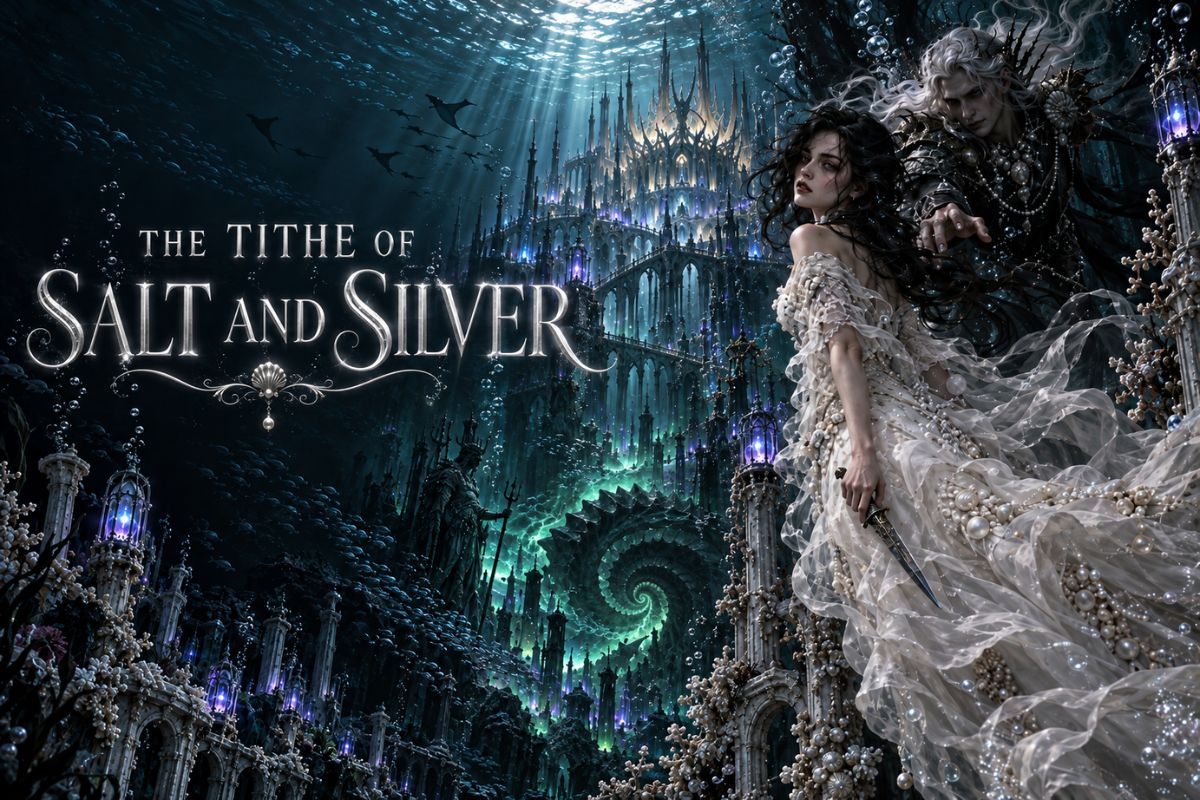
Chapter Three: Trial of Masks
One of us is lying about who we are.
It’s me. But by the end of tonight, I’ll have made sure it’s somebody else.
Eight of us come back from the kelp forest.
The scream I heard belonged to Jory Pell, the man from the salt pans. He picked a violet spiral. The servants carried him out afterward under a grey cloth, and nobody told us what the shell had done to him, and nobody asked.
The other body was Edric Voss. Nobody asks about him either. Everyone saw.
That night the Tithe House is very quiet. The farm sisters, Ada and Nell Cotter, share a room now and keep the door shut. Hollis sits in the common hall with his big hands hanging between his knees, touching the new blue scar on his throat every few minutes as if to make sure it’s still there. The scarred woman, whose name turns out to be Sable, sharpens a shard of coral against the wall of her room with a slow, steady scrape that goes on for hours.
Bram Keel, the quiet man from the second lot, sits in the corner and says nothing at all.
Maren finds me on the stairs.
She had her breath-shell before any of us. That’s what Tam told me, walking back. She came out of the forest while the rest of us were still searching, sat down on a rock by the gate, and waited. When he asked her how she’d known which one to pick, she’d said, Lucky guess.
Now she settles on the step beside me like we’re old friends. Her new scar sits neat and pale under her jaw. Mine is still raw and bruised where Caius pressed the shell into it.
“The prince,” she says, “doesn’t intervene.”
“He did today.”
“That’s my point.” She examines her fingernails. “Nine hundred years of tithes, and nobody has ever heard of a prince of Veyl stepping into a trial. The court is talking about nothing else. You’re very interesting to a lot of people all of a sudden, Liss.”
She leans on the name, just slightly. Just enough.
“Is that a threat?”
“It’s a kindness.” She stands and brushes off her skirts. “Interesting people don’t last long down here.”
When she walks away, something glints in her red hair. A pin, holding up the knot at the back of her head. Silver, small, shaped like a spiral shell curling in on itself.
I sit on the stairs for a long time after she’s gone, with my hand in my pocket, running my thumb over the black wax seal on my contract until I’ve worn a groove in it.
The next evening, the servants bring us clothes.
Not our salt-stained coats and farm skirts. Gowns and doublets, stitched from fabric that shifts like oil on water: deep blue, pale gold, sea-green, black. And masks. Each of us gets one, laid out on the pillow: delicate things of shell and silver wire and fish-scale that cover the eyes and cheekbones and leave the mouth bare.
Mine is black, edged with tiny grey pearls. The gown with it is the colour of storm clouds.
I stand in front of the green glass window for a long time, looking at a woman I don’t recognise. The gown fits as if someone measured me in my sleep. It leaves my arms bare and my shoulders bare and the scar on my throat bare, and there is absolutely nowhere to hide a knife.
I hide it anyway. There’s always somewhere.
The ball is held in a hall made entirely of glass.
It’s a dome, huge and round, and beyond its walls the dark sea presses in on every side, full of drifting lights. Inside, the water is warm and scented with something sweet. Musicians play instruments I have no names for: long spiralling horns, harps strung with something that glows. The sound doesn’t carry the way it would in air. It hangs, and hums, and gets into your bones.
The whole court is here, masked. Hundreds of them, dancing in slow circles that rise and fall through the water, their silks and hair trailing behind them like smoke. It’s the most beautiful thing I’ve ever seen, and I hate it.
Oriel, the Warden of the Tides, waits for us at the entrance. She’s the only one in the hall without a mask.
“The second trial,” she says, “is a trial of truth.”
She looks along our line. Eight masked faces. Eight blue scars.
“The sea was given ten names on the shore,” she says. “Not all of them were true. One of you walked into the water wearing a name that is not your own.”
The cold that runs down my spine has nothing to do with the sea.
“The sea does not forgive a lie,” Oriel goes on. “Before the last bell of the night, you eight will name the liar among you. Enjoy the ball. Speak with the court. Speak with each other. When the bell rings, each of you will whisper one name to me. The one named most will be returned to the sea.”
“And if we get it wrong?” Hollis asks.
“Then the sea will take the one you named,” Oriel says, “and the liar will have learned that lies are rewarded.” She inclines her head. “Go.”
There’s a particular feeling you get when you’ve been caught. A lurch, like missing a step in the dark. I’ve felt it a dozen times: when a magistrate’s guard grabbed my wrist in Corlen, when a customs man lifted the false bottom of my father’s boat. You learn to swallow it before it reaches your face.
I swallow it now and walk into the ball with my chin up.
Think. Ten names on the shore. The priestess wrote nothing down. The only people who know my name is false are the man in grey, the prince—and Maren, who seems to know everything.
If Maren tells the others, I’m dead by midnight.
So I need a better story than mine.
I take a cup of something pale and glowing from a passing tray and I do what I do best. I watch.
Tam is dancing, badly, with a Veylish girl who seems delighted by how bad he is. Hollis stands against the wall like a pillar. Ada and Nell hover at the edge of the floor, whispering, looking at each of us in turn, trying to guess. Sable moves through the crowd like a shark, listening to everything.
And Bram Keel stands alone by the glass wall, staring out at the dark.
I think back. Two nights on the seabed and in the Tithe House. How many times did someone say Bram to him? When Hollis asked him to pass the bread, he had to ask twice. When the servants called the names at dawn, Bram was last to step forward, and he looked at the others first, as if waiting to see who would move.
It’s not proof. It’s a feeling. But I’ve built a life on feelings like that.
I make my way around the edge of the hall, past the dancers, until I’m a few steps behind him. Then I say, in a normal, bored voice, as if talking to someone else entirely:
“Bram.”
He doesn’t turn.
I say it again, a little louder. “Bram Keel.”
Nothing. He keeps staring at the sea.
Then I say, softly, a guess: “You took his place, didn’t you?”
And that he hears. He goes absolutely rigid. When he turns to face me, his mask can’t hide the fear in his eyes.
“How did you—”
“It doesn’t matter.”
“Please.” His voice cracks. “Please. Bram was my brother. He had three children. When they read his name, I told him to run and I walked down the cliff instead. That’s all. That’s the only lie. I’m dying in his place, isn’t that enough? Isn’t that—”
He stops, because someone has stepped between us.
“May I?” says the prince of Veyl.
He isn’t masked. Of course he isn’t. His silver hair is tied back, and he’s in black again, a long coat stitched with thread so dark it only shows when the light catches it. He’s holding out his hand to me.
The entire ball has turned to watch.
I don’t take his hand. “I’m busy.”
“I noticed.” His eyes flick to Bram, who is shaking, and back to me. “Dance with me, and I’ll tell you something you want to know.”
I take his hand.
He leads me out into the water. Dancing here is nothing like dancing on land. There’s no floor, no weight. He puts one hand on my waist and holds the other, and we simply rise, turning slowly, until we’re floating above the crowd with the dark sea pressing on the glass all around us. I’ve never danced with anyone in my life. It doesn’t matter. He moves, and I follow, and the water does the rest.
“You didn’t have to kill him,” I say. “Edric.”
“He was going to kill you.”
“Everyone here is going to kill someone. That’s the point, isn’t it?”
His hand tightens a little on my waist. “Yes,” he says. “That’s the point.”
“How do you know my name?”
“That’s not the question you want answered tonight.”
“It’s the only one I care about.”
“No.” He turns us, and the lights of the hall slide past behind his head like falling stars. “Tonight you care about which name to give the Warden. You’ve found your liar. Now you’re wondering whether you can live with it.”
I say nothing. He’s right, and I hate that he’s right.
“Here’s your something,” he says quietly. “Nobody else knows your name. Not the court. Not my mother. Not the Warden. If the vote goes against you tonight, it won’t be because I told anyone.”
“And Maren?”
Something flickers across his face. There and gone. “Maren will vote how Maren votes.”
“Why protect me?”
“I’m not protecting you. I’m making you an offer.” His eyes hold mine. They really are the colour of ice. “I keep your secret. You keep winning. Whatever it takes, whoever it costs, you are still standing on the tenth night.”
“And then?”
“And then you do what you came here to do.”
I nearly lose the rhythm. His hand steadies me.
“You know what I came here to do,” I say.
“Yes.”
“And you want me to win anyway.”
“More than anything.”
I search his face for the lie. For the trap. I’ve looked into the eyes of a lot of liars, and I know what it looks like when someone is playing you.
He doesn’t look like that. He looks tired. He looks like someone who’s been carrying something heavy for a very long time.
“Why?” I ask him again.
“Win,” he says, “and I’ll tell you.”
The music ends. He lets go of me. And I sink slowly back down to the floor of the hall, alone.
The last bell rings a little before midnight.
We line up in front of Oriel in a small side chamber of dark stone, away from the music. One by one, we step forward and whisper a name into her ear.
I watch the others go. I watch their faces.
Maren goes before me. When she comes back, she catches my eye, and she smiles. I have no idea what that smile means. It could mean anything.
Then it’s my turn.
I think about Pip in his stone room. I think about the contract in my pocket. I think about a man who walked down a cliff in his brother’s place so that three children would still have a father.
I think about how it’s the bravest thing anyone did on that shore, braver than me, because at least I was getting paid.
I lean close to Oriel’s ear.
“Bram Keel,” I whisper. “His name isn’t Bram Keel.”
It isn’t close. Five of us name him. Maren names someone else; she won’t say who. Bram names Sable. Sable names Bram.
He doesn’t fight when the guards come. That’s the worst part, again. He just looks at me across the chamber, and I make myself look back, because I owe him that much.
“Tell them I’m sorry,” he says. “Tell his kids I’m sorry.”
Then they take him out through a door that opens directly onto the sea, and the door closes, and he’s gone.
Nobody talks on the walk back to the Tithe House. Tam walks close beside me without saying anything, and I’m grateful.
In my room, I pull off the mask and the storm-coloured gown and stand in the dim green light in my shift, shaking, trying to remember why I came here. Pip. Two hundred crowns. A life for a life.
It was so simple on the surface.
That’s when I see the thing on my pillow.
It’s another mask. Silver, this time, and finer than any I saw at the ball. And pressed into its brow, picked out in tiny black pearls, is a crest I’ve seen on banners all over the palace: a crowned wave, breaking.
The crest of the heir of Veyl.
Tucked behind it is a folded square of paper, sealed with black wax.
A spiral shell, curling in on itself.
My hands aren’t quite steady as I break it open. Inside, in a neat, unfamiliar hand, are four words:
Remember why you came.
See next: Chapter Four: Trial of Blood