Chapter 1
Marcus Reed came home two days early because he missed his wife.
That was the whole plan. No speech, no flowers, just a white box of peach cobbler from the little bakery off Interstate 71 that Danielle swore was better than anything in Columbus. He had spent nineteen days driving a sales territory that stretched from Indianapolis to Louisville, selling commercial heating and cooling parts to men who wanted discounts, and he was tired down to his bones.
He pulled into the driveway of the gray two-story house in Westerville a little after seven on a Friday evening in late September. The porch light was already on. Two cars he recognized sat at the curb: Keisha’s silver Camry and Tasha’s red Jeep with the salon decal on the back window. Crown & Glory Hair Studio. Walk-Ins Welcome.
Marcus smiled. Danielle had her girls over. Good. She’d been working nights at St. Clare Medical Center for three weeks straight, and she deserved a good evening.
He heard them before he reached the side gate. Laughter from the back patio, loud and loose, the kind that came from people who had known each other since their freshman year of college. Tasha’s voice rose above the others.
“Girl, I’m telling you, you’re gonna have to sit him down first—”
More laughter. The clink of glasses.
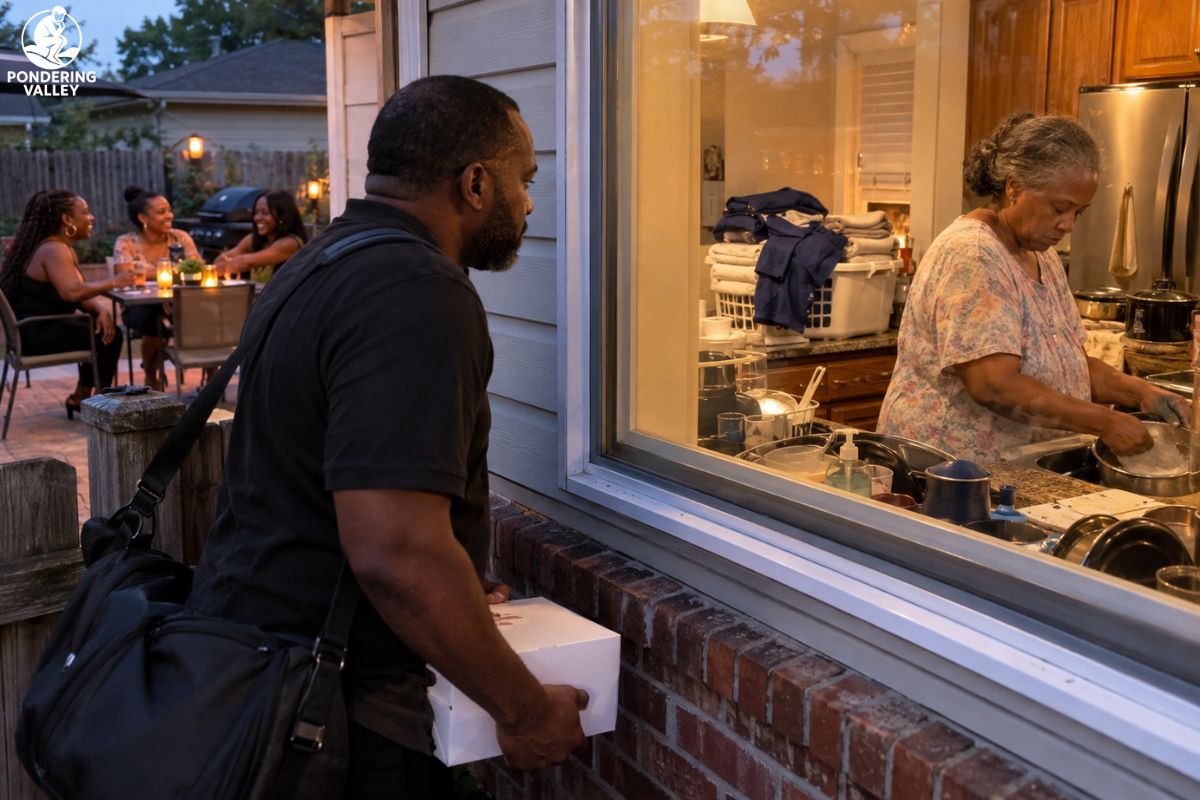
Marcus shifted the cobbler box to his other hand and started toward the gate. Then he glanced through the kitchen window, and he stopped.
His mother was standing at the sink.
Evelyn Reed was sixty-four years old. She had taught seventh-grade English in the Dayton public schools for thirty-one years, and she still stood like she was about to tell a room full of twelve-year-olds to put their phones away. But she wasn’t standing like that now. Her shoulders were rounded over a sink full of dishes. Steam rose around her wrists. On the kitchen chair behind her sat a laundry basket piled with folded towels and a stack of navy-blue hospital scrubs.
Danielle’s scrubs.
Marcus looked from the window to the patio and back again.
His mother had come to stay with them “for three weeks” while the old house on Garfield Street got new pipes. That was what she had told him on the phone in early August. He had been in Louisville when she arrived. He had been on the road, off and on, ever since.
That had been seven weeks ago.
He watched her lift a plate from the water, a white plate with a thin cobalt rim and a ring of tiny blue flowers. He knew that plate. He had eaten off that plate every Sunday of his childhood. It was part of the set his parents had received for their wedding in 1983, and his mother had never once let those plates leave the house on Garfield Street.
So what were they doing in his kitchen?
When Marcus was nine, his father, Walter, had died of a heart attack at forty-one, on a Tuesday morning, in the parking lot of the tire plant where he worked. Marcus remembered very little about the funeral. What he remembered was afterward: his mother at that same kind of table, grading essays past midnight, a pot of coffee going cold beside her, and his little brother asleep in her lap.
He remembered the rule she had posted on the refrigerator in her neat teacher’s handwriting, the one she said out loud every Sunday before grace:
Everybody at my table has a seat. And nobody pays for it.
She had meant that her boys would never have to earn their place in her home. Marcus had spent the rest of his life trying to earn it anyway.
And now here she was, bent over his sink, working like a hired woman while his wife laughed on the patio with a glass of wine in her hand.
Marcus set the cobbler box down on the porch rail. He set his travel bag down beside it.
Then he opened the gate and walked into the backyard.
The laughter stopped.
Chapter 2
Danielle saw him first.
She was sitting at the patio table in leggings and an old Central State sweatshirt, her feet tucked under her, her braids pulled up on top of her head. Her face went from surprise to joy and then, when she saw his expression, to something careful.
“Marcus? Baby, you’re not supposed to be home until Sunday.”
“I know.”
Tasha, who was forty pounds of attitude in a five-foot frame, set down her glass. “Well, look who it is. The traveling salesman returns.”
Keisha didn’t say anything. She sat back in her chair and folded her arms. Keisha Bell worked as a paralegal at Buckeye Community Legal Aid, and she had been looking at Marcus that same way, sizing him up like a witness, for twelve years.
There was a bottle of sparkling cider on the table, a bowl of chips, a notepad covered in Keisha’s handwriting, and a small white gift bag with pink tissue paper. When Marcus looked at the bag, Tasha casually slid it off the table and set it under her chair.
He noticed. He didn’t care.
“How long has my mother been in there?” he asked.
Danielle stood up slowly. “Marcus, let’s go inside and talk.”
“I’m asking you a question, Dani. How long has she been in there washing dishes?”
He did not shout. He had never been a shouter. His voice got lower when he was angry, and Danielle knew that was worse.
“She’s been cooking since four,” Danielle said. “I told her we’d order food. She wouldn’t—”
“And the laundry? Those are your scrubs in that basket.”
“I didn’t ask her to do my laundry.”
“But you let her.”
Tasha tried to smile. “Okay, now, Marcus, before we go giving the closing argument—”
“Tasha.” He did not look at her. “Respectfully. This isn’t your house.”
That landed hard. Tasha closed her mouth.
Danielle stepped closer to him. “Can we please talk inside? Please.”
“My mother is inside,” Marcus said. “Working. While you sit out here laughing with your friends. She’s sixty-four years old. She raised two boys by herself on a teacher’s salary. She did not come up here to be your maid.”
Danielle’s face changed. Marcus had seen that look on her before, usually when a doctor dismissed something she had said about a patient. It was the look of a woman choosing her words because the wrong ones would cost too much.
“That is not what’s happening,” she said.
“Then tell me what’s happening.”
Danielle opened her mouth. Then she looked past him, through the sliding door, toward the kitchen.
She didn’t answer.
Keisha did. She uncrossed her arms and leaned forward.
“You don’t know what you’re talking about, Marcus.”
He turned to her. “Excuse me?”
“You heard me. You’ve been gone seven weeks. You call at ten at night for five minutes, you ask if everybody’s good, and everybody says yes. And you believe it because it’s easier.” Keisha’s voice was even. “You don’t know what you’re talking about.”
“Keisha,” Danielle said sharply.
“No, he walked out here and put his mouth on you in front of us. He can hear it.”
Marcus looked at Danielle. She was staring at the ground, her jaw tight. She wasn’t defending herself. That was what bothered him most. Danielle Reed argued with everyone: doctors, insurance companies, the man at the tire shop. And she was standing here saying nothing.
“What don’t I know?” he said quietly.
Nobody answered him.
Behind him, in the kitchen, something hit the tile floor and shattered.
Chapter 3
Marcus was through the sliding door before anyone else stood up.
His mother was standing very still at the sink, both hands raised as if she were still holding something. At her feet lay a white plate with a cobalt rim, broken into four large pieces and a scatter of small ones.
“Don’t,” Evelyn said, before he could speak. “Don’t come in here in your socks. There’s glass.”
“Mama, sit down.”
“It’s china, not glass, and I’m fine.”
“Your hands are shaking.”
She looked at her hands as if they belonged to someone else. Then she dried them on her apron, the faded yellow one with the embroidered apples that a student had given her in 1991. She had worn it every Sunday on Garfield Street. She was wearing it here.
“Sit down,” Marcus said again, gentler, and pulled out a chair. This time she sat.
Danielle stood in the doorway. Keisha and Tasha hovered behind her.
“Miss Evelyn,” Danielle said, “are you all right? Did it cut you?”
“No, baby. I’m fine. Clumsy.” Evelyn gave a small laugh that didn’t sound like her. “Thirty-one years of carrying coffee across a classroom and I never dropped a thing. Now look at me.”
Marcus knelt and began picking up the larger pieces. Four of them fit together in his palm like a puzzle. He could see the tiny blue flowers running around the rim.
“How many of these are left?” he asked.
“Four now.”
“There were twelve.”
“There were twelve in 1983. Things break.” She folded her hands on the table. “Marcus, before you start, let me say this. Danielle has asked me to rest every day since I got here. Every single day. I’m the one who won’t sit down. I asked for something to do. Don’t you blame that girl.”
“Mama, you don’t have to cover for her.”
“I’m not covering for anybody.”
“Then why did you bring Daddy’s plates?”
The question came out before he’d thought about it, and he saw it land. His mother’s eyes flickered, just for a second, toward the counter beside the sink.
“I like my own plates,” she said.
“For a three-week visit.”
“Marcus.”
“You told me the pipes would take three weeks. It’s been seven. Every time I call, you tell me the plumber’s coming Monday. What plumber takes seven weeks?”
“You know how contractors are.”
He did know how contractors were. He sold parts to contractors for a living. None of them took seven weeks to replace the pipes in a two-bedroom house.
“Mama,” Danielle said softly from the doorway, and it struck Marcus that his wife called his mother Mama now. When had that started?
Evelyn gave Danielle a look. It wasn’t unkind, but it was firm, the kind of look she used to give students who were about to tell the class something that wasn’t theirs to tell.
Danielle said nothing more.
Marcus stood up with the broken pieces in his hand and went to throw them away. The trash can was beside the counter, next to the spot his mother had glanced at. A dish towel lay folded there, and when he set the pieces down on the counter to open the trash can, his elbow caught the towel and slid it aside.
Underneath was her purse. And sticking out of the side pocket was a long white envelope with red lettering across the top.
FINAL NOTICE.
Below that, in smaller type, he could read the words Sheriff’s Sale and an address.
1418 Garfield Street, Dayton, Ohio.
The house he grew up in.
Chapter 4
“Put that down,” Evelyn said.
Marcus didn’t put it down. He pulled the letter out of the envelope and read it standing up, the way he read contracts from people he didn’t trust.
It wasn’t long. It said that 1418 Garfield Street would be offered for public sale by the county sheriff on October 30th, thirty-six days from now, in connection with a judgment of foreclosure. It listed an amount owed. It listed the name of a bank.
He read it twice. Then he looked up.
“This isn’t right,” he said. “This house is paid off. You paid it off in 2014. I was there. We had cake.”
His mother did not answer.
“Mama. We had cake. Terrence brought the balloons.”
“I remember,” she said quietly.
He turned to his wife. “Did you know about this?”
Danielle held his gaze. “Yes.”
“How long?”
“Since her second week here.”
Marcus laughed, a short, disbelieving sound. “Five weeks. You’ve known for five weeks, and I’ve talked to you every night.”
“Don’t you raise your voice at her,” Evelyn said. “She found out because she walked in from a twelve-hour shift at four in the morning and found me at this table crying over that letter like a fool. I made her promise. I sat right here and made her swear she wouldn’t tell you until I’d fixed it.”
“Fixed it how?”
“That’s my business.”
“It’s the house I grew up in.”
“It’s the house I bought.” His mother’s voice rose for the first time. “In 1989, on a seventh-grade teacher’s salary, eleven months after your father died, when the bank officer asked me three times whether my husband would be co-signing. I bought it, and I paid for it, and whatever happens to it is my business.”
Marcus stood there with the letter in his hand.
Keisha spoke from the doorway, carefully. “She’s not doing it alone, Marcus. Danielle’s been driving her to Dayton every Tuesday. There’s a housing counselor. I’ve been helping with the paperwork for a loss mitigation application. We’ve been trying to get the bank to agree to a modification.”
Tuesdays. Marcus remembered Danielle telling him on the phone, three or four weeks back, that she was tired because she’d driven Mama to “a doctor’s appointment” in Dayton. He had said, You’re a good woman, Dani. And he had meant it, and then he had forgotten about it.
“So everybody knew,” he said.
“Not everybody,” Tasha said. “I only found out Wednesday, and I was very offended.”
Nobody laughed.
Marcus looked back down at the letter. The amount owed was more than forty-nine thousand dollars.
“Mama,” he said, and his voice was quieter now. “You paid that house off. So why is there a loan on it? How does a paid-off house end up at a sheriff’s sale?”
His mother looked at her folded hands. She looked at the four remaining plates drying in the rack. She looked, briefly, at Danielle.
She said nothing at all.
And in that silence, before Marcus could ask again, the doorbell rang.
Chapter 5
Nobody moved.
Then the front door opened, because whoever had rung the bell also had a key.
“Mama! It’s me. I got your catfish from Hooper’s, and they gave me extra hush puppies because the lady likes me—”
Terrence Reed came around the corner into the kitchen holding a greasy paper bag in one hand and a sweet tea in the other. He was thirty-one, tall and lean, with his father’s wide smile and a gray work jacket with a warehouse logo stitched on the chest.
He saw his brother and stopped.
“Big bro.” The smile came back, a little too fast. “I thought you were in Louisville.”
“I was.”
“Well. Welcome home.” Terrence looked around the room: at his mother sitting at the table, at Danielle and her friends in the doorway, at the letter in Marcus’s hand. The smile went away.
“Oh,” he said.
That one word told Marcus everything he needed to know. But he asked anyway.
“You come here a lot, Terrence?”
“Couple times a week.”
“With a key.”
“Dani gave me one. So I could drop Mama’s food off when she’s working nights.”
“That’s nice,” Marcus said. “Real nice. Now tell me why there’s a forty-nine-thousand-dollar judgment on a house that’s been paid off for ten years.”
Terrence set the bag of catfish down very carefully on the counter.
“Terrence,” Evelyn said, “you don’t have to—”
“Yeah, Mama. I do.” He looked his brother in the face. “It was me.”
Marcus waited.
“You remember the truck,” Terrence said.
Of course Marcus remembered the truck. Three years ago Terrence had quit his job at the auto parts store to open a barbecue food truck called Smoke on Third. He had painted it himself, black with orange flames. He had invited the whole family to the launch. Marcus had come, eaten a rib sandwich, told his brother it was good, and then told Danielle in the car that it would be gone within two years.
It had lasted two years and four months.
“The truck needed a new transmission the first winter,” Terrence said. “Then the commissary kitchen raised the rent. Then the city changed the permit rules downtown. I was behind on everything. The bank wouldn’t touch me. So Mama—” He stopped.
“So I took out a home equity loan,” Evelyn said. “Fifty-two thousand dollars. Against my house. And I gave it to my son. And I’d do it again.”
Marcus stared at her. “You put the house up for the truck?”
“I put the house up for my child.”
“And you paid it back?” Marcus asked his brother.
“For fourteen months, I did. Every month. On time.” Terrence’s voice cracked slightly. “Then the truck died for good last November, and I sold it for parts, and I couldn’t make the payments anymore. Mama’s pension couldn’t cover it. And by the time we—”
“By the time you what? Told somebody?” Marcus said. “You didn’t tell me.”
Terrence met his eyes. “No. We didn’t.”
“Why not?”
The kitchen was quiet except for the hum of the refrigerator.
“Because we knew what you’d do,” Terrence said.
“What’s that supposed to mean?”
“It means you’d do exactly what you’re doing right now. Walk in, take over, make everybody feel two inches tall, write a check, and then remind me about it at every Thanksgiving for the rest of my life.”
Marcus crossed the kitchen in three steps. Before he had fully decided to do it, his hand was full of the front of his brother’s work jacket.
Terrence didn’t pull away. He didn’t raise his hands. He just looked at him.
“Go ahead,” Terrence said quietly. “You been wanting to since we were kids.”
And then their mother was between them.
Chapter 6
Evelyn Reed was five-foot-four. She didn’t touch either of her sons. She simply stepped into the space between them, close enough that Marcus would have had to move her to go any farther.
“Let go of your brother,” she said.
Marcus let go.
“Not in this house,” she said. “Not in any house I’m standing in. Your father never raised a hand to anybody, and neither will his sons.”
Marcus stepped back. His hand was shaking now, the same way hers had been.
Terrence straightened his jacket, but he didn’t leave. He reached into the paper bag of catfish, pulled out a thick white envelope, and set it on the kitchen table.
“That’s eighteen hundred and fifty,” he said. “From this month.”
Marcus looked at it. “What is that?”
“I’ve been working nights at the distribution center out on Route 4 since January. Loading trucks. Every other week I bring Mama what I’ve got left after rent. It goes to the counselor’s account for the bank.” Terrence swallowed. “It’s not enough. I know it’s not enough. But it’s not nothing.”
Marcus stared at the envelope. “Eighteen hundred dollars against forty-nine thousand.”
“I know the math, Marcus.”
“Then you know it’s not going to save the house.”
“Marcus,” his mother said.
He turned to her. “Mama, why? Why didn’t you just call me? I would’ve handled it. You know I would’ve handled it.”
“That,” Evelyn said, “is exactly why.”
She sat back down at the table slowly, like her knees hurt, and maybe they did.
“You were nine years old when your daddy died,” she said. “And at the funeral, Deacon Harris put his hand on your shoulder and said, ‘You’re the man of the house now.’ I wanted to slap that man. Because you believed him. You never stopped believing him.”
Marcus said nothing.
“At sixteen you got that job at the car wash on Salem Avenue. Every Friday, you came home and put your whole check on this table. Every Friday. You thought I was using it to pay the light bill.”
“You were.”
“I was not.” She looked at him steadily. “I put every one of those checks in a savings account at the credit union. Six thousand three hundred and forty dollars. That was the money I gave you when you left for Ohio State. You thought it was from your father’s life insurance.”
Marcus opened his mouth and closed it again.
“I have been your burden since you were nine years old,” Evelyn said. “I was not going to be your burden at sixty-four. I wanted to fix this myself. I wanted to fix it and never have you find out. That’s all. That’s the whole terrible secret. Your mother has some pride too.”
The kitchen was very still.
Marcus felt the anger go out of him, but it had to go somewhere. He turned to his wife.
“You let me walk in here looking like a fool,” he said. “Seven weeks. You let me think everything was fine.”
Danielle had been quiet since the plate broke. She was not quiet anymore.
“I let you think? Marcus, you walked into our backyard and humiliated me in front of my best friends without asking one single question. Not one. You saw your mother at the sink and decided exactly who I was. Eight years of marriage, and that’s what you decided.”
“Dani—”
“No. You don’t get to ‘Dani’ me right now. I kept a promise to your mother. I kept it when it made me look bad, and I kept it tonight when you stood out there calling me lazy. I kept it because she asked me to, and because she’s my family too.” Her voice broke on the last word, and she stopped and pressed her lips together.
Marcus had no answer for that.
Keisha stepped forward from the doorway. Her voice was quieter than before.
“Tell him why we were celebrating,” she said.
Danielle shook her head. “Not like this.”
Chapter 7
For a moment, nobody moved.
Then Tasha walked out to the patio and came back with the small white gift bag with pink tissue paper, the one she’d slid under her chair when Marcus first walked through the gate. She didn’t hand it to Marcus. She handed it to Danielle.
“It’s yours, girl,” Tasha said. “You say what you want to say. But you ought to say it now. Because this man is about to go stand in the driveway and brood for three hours, and I cannot take it.”
In spite of everything, Terrence laughed. He tried to turn it into a cough.
Danielle looked down at the bag in her hands. Then she looked at her mother-in-law, not her husband.
“I was going to tell you first,” she said to Evelyn. “Tonight. After dinner. That’s what the girls came over for. To help me figure out how to say it.”
Evelyn frowned slightly. “Tell me what, baby?”
Danielle reached into the tissue paper and took out two things.
The first was a slim white stick with a small window in the middle.
The second was a tiny yellow onesie. Across the front, in careful stitching, were the words Grandma’s Favorite.
Evelyn put her hand over her mouth.
“I found out this morning,” Danielle said. “After my shift. I sat in the bathroom at the hospital for twenty minutes before I could drive home.” She laughed a little, wetly. “I’m an ICU nurse. I’ve read a thousand lab results. I read that one four times.”
Marcus stood very still.
“Why tell Mama first?” he asked. His voice came out rough.
Danielle finally turned to face him.
“Because my mother died when I was nineteen,” she said. “You know that. And for eight years, the only person who has ever called me every single Mother’s Day to ask about me is standing right here. Your mother drove to Columbus when I had pneumonia. Your mother taught me to make her greens, even though she swore she’d never give that recipe to anybody.” She paused. “And for seven weeks, Marcus, I have watched her apologize for existing in this house. She washes dishes that are already clean. She folds towels at midnight. She won’t sit on the couch unless I sit first. Because she thinks she’s in the way.”
Evelyn lowered her hand from her mouth. “Danielle—”
“You’re not in the way,” Danielle said to her. “That’s what I wanted to tell you. I wanted to give you one thing that said you belong here. That this house needs you. Not for the dishes.” She held out the onesie. “For this.”
Evelyn took the little yellow onesie in both hands. She didn’t cry, exactly. She just held it and looked at it for a long time, the way she used to look at a good essay from a student nobody expected much from.
Keisha looked at Marcus. Tasha looked at Marcus. Terrence looked at the floor.
Marcus looked at the test on the table. He looked at his wife, whose eyes were red and whose chin was up. He looked at his mother holding a baby’s onesie in the same hands that had been shaking over the sink fifteen minutes ago.
He thought about the man who had opened the backyard gate. He thought about what that man had said, and how sure he had been.
He didn’t say anything. He couldn’t.
Instead, he turned around, walked through the living room, and went out the front door. He didn’t slam it.
Behind him, he heard Tasha say softly, “I told y’all. The driveway.”
Chapter 8
He didn’t stay in the driveway.
He walked. Past the neighbors’ carefully edged lawns, past the elementary school where he and Danielle had once said their future kids might go, down to the little park at the end of Spruce Hill Road, where there was a bench under a streetlight.
He sat there for a long time.
He thought about his father, whom he remembered mostly as a laugh from another room and the smell of rubber on work boots. He thought about the car wash on Salem Avenue and the checks he’d laid on the table every Friday, so proud, so sure he was holding the family together. His mother had let him believe that for twenty-two years, because she knew he needed to believe it.
He thought about how he’d told Danielle, in the car after the food truck launch, that his brother’s business wouldn’t last two years. He’d said it like a man who was always right. He had been right, too, almost to the month. And being right hadn’t helped anybody.
He took out his phone and opened his banking app. There was a savings account labeled HOUSE FUND. Thirty-four thousand two hundred dollars. For three years, he and Danielle had been saving for a bigger place in Worthington, with a real backyard and a fourth bedroom.
A nursery, he thought now. It had always been meant for a nursery. They just hadn’t said it out loud.
He could solve this tonight. He knew that. He could call the counselor on Monday, get the reinstatement amount, and write one check. The house on Garfield Street would be safe, and his mother would thank him, and his brother would never be able to look him in the eye again.
Walk in, take over, make everybody feel two inches tall, write a check.
Marcus put his phone back in his pocket.
It was almost eleven when he came home. Keisha’s Camry and Tasha’s Jeep were still at the curb.
Everyone was in the kitchen. The catfish had been eaten. Keisha had her notepad and a folder full of paperwork spread across the table, and Terrence was sitting beside her, reading something with a pen in his hand. His mother was in the chair nearest the window, still holding the onesie in her lap. Danielle was standing at the counter.
They all looked up.
Marcus went to his wife first. He stood in front of her, in front of everyone, because he had shamed her in front of everyone.
“I was wrong,” he said. “I walked in and saw what I expected to see, and I said things to you that I don’t believe and never should have said. In front of your friends. In front of my mother. I’m sorry, Dani. I’m sorry I didn’t ask. I’m sorry you had to carry this by yourself while I was on the road.”
Danielle looked at him for a long moment. “You’re still in trouble,” she said.
“I know.”
“For a while.”
“I know.”
She reached out and took his hand anyway.
Tasha sniffed loudly. “I’m not crying. It’s the hush puppies.”
Keisha studied him from across the table, and for the first time in twelve years, the look on her face wasn’t suspicion. It was closer to respect.
“Before you start writing checks,” she said, “there’s something you need to know. The bank already offered a loan modification. Lower payment, longer term. It stalled three weeks ago.”
“Why?”
Keisha glanced at Evelyn. “Because with only a pension, her income isn’t enough to qualify. They’ll approve it with a co-borrower who has steady income and a partial reinstatement payment. About nine thousand.”
Marcus turned to his mother. “You needed my signature.”
“I didn’t need anything,” Evelyn said. Then, more quietly: “I didn’t want to ask.”
Marcus pulled out a chair and sat down at the table. He didn’t take over. He had spent the last three hours in the park making himself promise that.
“Here’s what I’d like to do,” he said. “If Mama says yes. I’ll co-sign the modification. Dani and I will put in the nine thousand from our house fund.” He glanced at Danielle, and she nodded once. “That means we stay in this house a little longer. The baby might start out in the small room upstairs. That’s all right.”
He turned to his brother.
“And you pay the monthly payment, Terrence. Not me. Every month. It’s your loan, and you’re going to be the one who saves that house.”
Terrence looked at him, confused. “I can’t cover a mortgage payment and my rent.”
“You won’t have rent,” Marcus said. “Somebody needs to live in that house. Somebody needs to fix the water heater that actually did break, keep the pipes from freezing this winter, and cut Mrs. Odom’s grass next door the way Daddy used to. You move into Garfield Street. What you’d pay a landlord goes to the bank instead.”
Terrence opened his mouth. Nothing came out.
“And the eighteen hundred and fifty,” Marcus said, pushing the envelope back across the table, “goes to the bank too. It’s not nothing. You were right. I’m sorry I said it was.”
Terrence picked up the envelope. He held it for a moment. Then he nodded, just once, and looked away toward the window so nobody would see his face.
Marcus turned to his mother last.
“It’s your house, Mama. You bought it. So it’s your decision. All of it.”
Evelyn Reed looked at her older son for a long time. It was the same look she had given him when he was sixteen, standing at her table with a paycheck, trying so hard to be the man of the house.
“You’re going to let your brother handle it,” she said.
“I’m going to let my brother handle it.”
“And you’re not going to bring it up at Thanksgiving.”
Marcus almost smiled. “I’ll try.”
“Try harder,” said Evelyn, and Terrence laughed out loud.
Then she looked down at the yellow onesie in her lap.
“I’ll say yes on one condition,” she said. “I’m not going back to Garfield Street right away. Not because I’m ashamed. Because I want to be here.” She glanced at Danielle. “If that’s all right. At least until this one comes and learns what a real Sunday dinner looks like.”
Danielle crossed the kitchen and put her arms around her mother-in-law. Neither of them said anything.
Keisha started gathering her papers. “I’ll have the forms ready Monday. Everybody signs at the counselor’s office Tuesday. Ten a.m. Don’t be late, Reed men.”
It was after midnight when the others finally left. Terrence hugged his mother at the door, then hesitated in front of his brother. Marcus pulled him in first.
Afterward, Danielle went upstairs to lie down. Evelyn sat at the kitchen table, still holding the onesie, too tired and too happy to move.
Marcus rolled up his sleeves and walked to the sink.
The water was cold now. He drained it and ran it fresh and hot. Then, one by one, he lifted the last four plates with the thin cobalt rims and the tiny blue flowers from the drying rack, washed them again even though they were already clean, dried them with the dish towel, and set them in the cabinet beside his own.
His mother watched him. “You don’t have to do that.”
“I know.”
“I can finish.”
“Sit down, Mama.” He dried the last plate and set it carefully on the stack. “Everybody at this table has a seat.”
He turned off the water.
“And nobody pays for it.”
Thank you so much for reading this story!
I’d really love to hear your comments and thoughts about this story — your feedback is truly valuable and helps us a lot.
Please leave a comment and share this Facebook post to support the author. Every reaction and review makes a big difference!
This story is a work of fiction created for entertainment and inspirational purposes. While it may draw on real-world themes, all characters, names, and events are imagined. Any resemblance to actual people or situations is purely coincidental.