
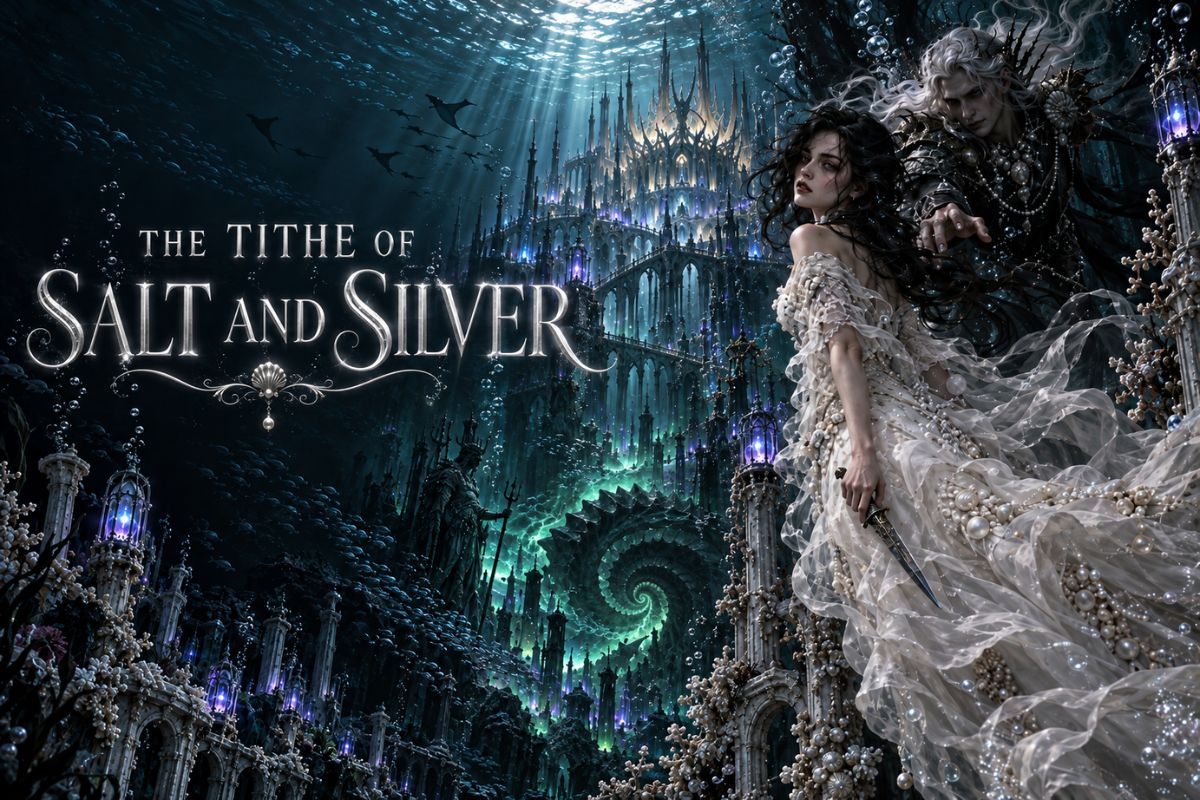
Chapter Six: Trial of Memory
The sea shows you what you’re most afraid of.
Mine was him.
We talk until the lanterns in the corridors start to brighten toward morning.
Not on the stair. Caius takes me somewhere I’d never have found on my own: a hollow in the outer wall of the palace, a little chamber no bigger than a ship’s cabin, with a round window that looks out over the whole drowned city. The lights of Veyl spread out below us like a field of stars someone knocked into the sea.
“I used to hide here as a boy,” he says. “After Hanne.”
I sit with my back against the wall and my knife across my knees. He sits across from me, the width of the tiny room between us, and he doesn’t ask me to put it away.
“Tell me how to stop her,” I say.
He tells me.
There’s a place beneath the palace called the Deep Throne. It isn’t a throne, not really. It’s a chamber at the very bottom of Veyl, older than the city, older than the palace built on top of it. The tithe was bound there, nine hundred years ago, by whoever made it. Every hundred years, when the tithe is paid, something in that chamber wakes up and drinks.
“I don’t know exactly what it is,” Caius says. “I know it’s tied to her. I know that every hundred years, after the tithe, she’s—” He searches for the word. “Brighter. Stronger. Younger, even, though she’s never looked old. I know the court remembers her being queen for longer than any of them have been alive, and none of them find that strange. I think the tithe is what keeps them from finding it strange.”
“And you can’t just walk in there.”
“No one can. The door answers to one thing only: the marriage vow. When the heir of Veyl is joined to the tithe’s survivor, the two of them together can open it. That’s what the wedding is for. It’s written in the oldest laws. Nobody reads them anymore.” A pause. “I read them.”
“So I have to win,” I say slowly. “I have to survive every trial, marry you, and then walk into the bottom of the sea with you on our wedding night, while your mother waits for me to stab you.”
“Yes.”
“And then what?”
“And then we break it.”
“How?”
The silence goes on a little too long.
“You don’t know,” I say.
“I know it can be broken. Everything that’s bound can be unbound.” He meets my eyes. “I’ll work out the rest by then.”
I stare at him. “That’s the plan? You’ll work it out?”
“It’s a better plan than hers,” he says, and for the first time since I met him, he laughs. It’s short and rough and surprised, like it got out before he could stop it.
I hate how much I like the sound of it.
The fifth trial is held in a place called the Mirror Pools.
It’s a cave deep in the seabed, where the rock opens into a series of chambers, one after another, each one holding a pool. I didn’t know you could have pools underwater. These are different: basins of something thicker and heavier than the sea, perfectly still, perfectly silver, like mercury. They lie flat as glass in the dark.
“Each of you will pass through the pools,” says Oriel. “From the first chamber to the last. The pools will show you what you most fear. You will walk through it. Those who reach the far side have passed.”
“And those who don’t?” says Hollis. He always asks. I’ve come to respect him for it.
“They will not want to,” Oriel says.
We go in one at a time, a little way apart. Nell goes first. She hasn’t said a word in two days. She walks into the first pool without hesitating, and the silver closes over her head, and she’s gone.
Then Hollis. Then Maren, who glances back at me before she goes in, with an expression I can’t read. Then Tam, who looks at me too. He hasn’t spoken to me properly since the Well.
“Tam,” I say.
He pauses on the edge of the pool.
“Whatever you see in there,” I say, “it isn’t real. It’s just the sea talking.”
He nods slowly. Then he steps in.
Then it’s me.
The silver is warm. That’s the first thing. It closes over me like bathwater and I sink into it, and then I’m not sinking anymore. I’m standing.
I’m standing on the dock at Saltmarrow, and it’s night, and it’s raining.
I know this night. I’ve dreamed it more times than I can count. The wind screaming off the sea. The boats knocking together at their moorings. My mother at the end of the dock with a lantern, staring out at the dark, and me beside her, twelve years old, holding Pip, who’s screaming because he’s cold and wet and doesn’t understand.
Out in the dark, a light. The running light of the Grey Lark. My father’s boat. I watch it lift on a wave, and fall, and lift again.
Then it doesn’t lift.
It isn’t real, I tell myself. It’s just the sea talking.
I walk forward, through my mother, through the lantern light. The dock dissolves under my feet.
I’m in Harrow.
In a stone corridor, deep underground, and the walls are running with water. There’s a door ahead of me, heavy oak, bound with iron, and through the little barred window in it I can see a room, and in the room, a boy. Twelve years old. All elbows and sticking-up hair.
Pip.
The water is rising in his cell. It’s at his knees. He’s pounding on the door, and he’s shouting my name, and I can’t hear him, and the water is rising faster.
I run. I throw myself at the door. It doesn’t move. I claw at the lock, I jam my knife into it, I scream his name until my throat tears. The water’s at his chest now. At his chin.
He looks at me through the bars, and his face is so calm.
“You said you’d come back,” he says.
I can’t breathe. The shell on my throat is fluttering, frantic, but there’s no air, there’s no—
It isn’t real.
I make myself let go of the door.
It’s the hardest thing I’ve ever done. Harder than Sable. Harder than anything. I take my hands off the iron and I turn my back on my brother’s drowning face and I walk forward, into the wall, and the wall dissolves.
And I’m somewhere else.
It’s the bridal chamber.
I know it without being told. A round room of white stone and pale silk, a bed hung with curtains like sea foam, lanterns glowing low and gold. Everything in it is soft.
Caius is lying on the bed. His eyes are closed. His silver hair is spread out on the pillow. He’s asleep, or pretending to be, his face younger and more peaceful than I’ve ever seen it.
I’m standing over him with my knife in my hand.
And I want to use it.
That’s the horror of it. Not the knife, not the room. It’s the feeling. A cold, clean, certain wanting, the same thing I feel when I go quiet. I look down at the gap in his armour where his throat is, and every part of me knows exactly how to do it, and every part of me wants to.
Two hundred crowns. Pip. A life for a life.
I raise the knife.
Caius opens his eyes. He looks up at me, and he isn’t afraid. He isn’t even surprised. He looks at me the way he looked at me on the stair, in the dark, with the point of my knife over his heart.
“I knew you would,” he says softly. “Everyone does, in the end.”
This is what I’m afraid of. Not the queen. Not the trials. This. That when the moment comes, I’ll be exactly what she chose me to be. That I’ll look at the one person in this whole drowned world who’s been honest with me, and I’ll do what I was paid to do, because that’s all I’ve ever known how to be.
That I’ll prove him right. That everyone does, in the end.
I lower the knife.
I put it back in my belt. I lean down, and I put my hand very lightly against his cheek, and I say, “No.”
And the bridal chamber dissolves.
But not into the next chamber. Into something else.
For a moment, a single heartbeat, I see a room I’ve never been in. Low and round and ancient, carved out of black rock, lit by a cold green glow rising from somewhere below. Nine bodies lie on the floor in a circle, still, their faces turned up. And in the middle of them, a girl in a white wedding dress stands with her arms spread wide, and she’s laughing.
She has black hair, and wide dark eyes, and a small, stubborn mouth.
I’ve seen her face before. In a mosaic, at the end of a long gallery, faded to the colour of bone.
Then the vision’s gone, and I’m staggering out of the last pool onto cold stone, gasping, silver running off me like water off a seal.
Three people are waiting on the far side. Hollis, sitting against the wall with his head in his hands. Maren, standing apart, her arms wrapped around herself. And Tam, who lurches to his feet when he sees me and then stops, awkward, as if he isn’t sure he’s allowed to come closer.
Nell isn’t there.
We wait. For a long time, we wait. The last pool stays flat and silver and still.
When Oriel comes to fetch us, she doesn’t say anything about Nell. She doesn’t need to. Hollis asks anyway, and she tells him, not unkindly, that some people see what they fear and walk through it. And some see what they’ve lost, and walk toward it.
I think about Ada, tumbling away into the dark. I think about Nell, walking into the silver after her. I hope she found her.
Four of us left.
On the walk back, Tam falls into step beside me.
“I saw my mum,” he says, after a long time. “In there. She was at the door of our house, and I was walking up the path, and she looked right through me. Like I’d never been born.” He swallows. “That’s the worst thing I could think of. Being forgotten.”
“You won’t be,” I say.
“You don’t know that.”
“I do.” I bump his shoulder with mine. “You’re too annoying.”
He laughs. It’s wet and shaky, but it’s a laugh. Then, quietly: “I’m sorry. For stepping back. After the Well. You saved my life and I looked at you like—” He shakes his head. “I’m sorry.”
“It’s fine, Tam.”
“It’s not. But thanks.”
And just like that, he’s my friend again. I’ve broken every rule I have for this boy. I don’t know how to stop.
Caius is waiting for me in the little chamber in the wall.
I don’t go there on purpose. I tell myself that. I tell myself I’m just walking, that I need to clear my head, that the corridors lead where they lead. And then I’m standing in the round doorway, and he’s sitting by the window with the whole lit city behind him, and he looks up at me like he’s been waiting for hours.
“What did you see?” he asks.
“Pip,” I say. “Drowning.”
He nods. He waits. He knows there’s more.
“And you,” I say.
I don’t know why I tell him. Maybe because I’m tired. Maybe because I’m still shaking from the pools and my guard is somewhere at the bottom of that silver. Maybe because he told me about Hanne and his arm, and I owe him a truth in return.
“I saw myself killing you. And I wanted to. That’s what scared me. Not that I could. That I wanted to.”
He gets up. He crosses the little room in two steps and stops in front of me.
“Did you?” he asks. “In the end?”
“No.”
“Why not?”
“Because you said everyone does,” I say. “And I didn’t want you to be right.”
Something changes in his face. Something opens.
He lifts his hand and touches the thin new scar on my cheek, the one Sable’s coral left. His fingers are cool and very careful, like he’s afraid I’ll break, or that he will.
I should step back. I don’t.
He leans down. I tip my face up. The lights of the drowned city glitter at the edge of my vision, and the whole sea goes quiet, and his breath is on my lips, and—
“Liss.”
We spring apart.
Maren is standing in the doorway. I don’t know how long she’s been there. Her face is perfectly composed, but her hands, at her sides, are clenched into fists.
“I’m sorry to interrupt,” she says, in a voice that isn’t sorry at all. She looks at Caius, then at me. “The queen has asked to see you. Alone.”
See next: Chapter Seven: Trial of Tides