At Seventy-Two, Margaret Slapped Her Successful Son—Then Announced Her Gardener Would Inherit Everything He Thought Was Already His
The slap landed before anyone in the room had time to react.
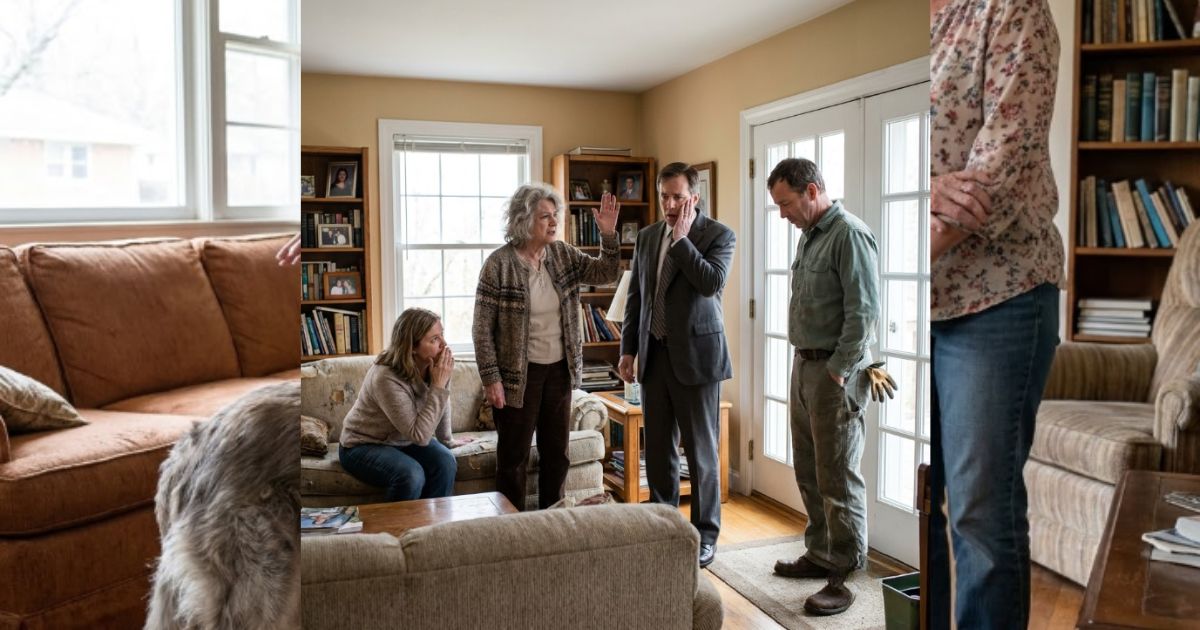
Margaret Collins stood in the middle of her living room, her hand still raised, staring straight at her oldest son.
“You think I’m senile?” she said. “Every dollar goes to him—the gardener!”
Her son, Daniel, touched his cheek and stared at her as if she had become a stranger.
Across the room, his wife, Laura, shot to her feet.
“What?” she cried. “After everything we did for you?”
Near the French doors, Miguel Ramirez stood frozen in his green work shirt, a pair of gardening gloves tucked into his back pocket.
He looked like he wanted the floor to open beneath him.
Daniel recovered first.
“Mom, this is insane. He isn’t family.”
Margaret’s expression barely changed.
“Exactly,” she said. “He cared for me when you only cared about the will.”
For nearly a year, Daniel had been telling himself that everything he did was for his mother.
He lived forty minutes away in a newer suburb outside Columbus, Ohio, and ran a small financial consulting office. He had a mortgage, two children in college, and more monthly bills than he liked to admit.
After Margaret’s husband died, Daniel began calling more often.
At first, Margaret was grateful.
Then she noticed something.
Daniel rarely asked what she had done that day.
He asked whether she had paid the property taxes.
Whether the roof had been repaired.
Whether she had updated her estate documents.
Whether she was “still comfortable handling the house.”
Laura began coming with him on Sunday afternoons.
She would glance around the living room and casually mention how expensive homes in Margaret’s neighborhood had become.
Once, Margaret heard her whisper to Daniel in the kitchen.
“If she sells eventually, at least the place won’t lose value.”
Margaret said nothing.
She wasn’t foolish.
She was lonely.
And sometimes loneliness makes a person tolerate conversations she would never otherwise accept.
The person who seemed to notice was Miguel.
He had been taking care of Margaret’s yard for six years.
He was thirty-eight, married, with a young daughter. He never stayed longer than necessary, never wandered through the house, and never asked Margaret a single question about money.
But after Margaret’s husband died, Miguel began doing small things that weren’t on his invoice.
He brought the newspaper from the end of the driveway when it rained.
He tightened the loose railing beside the back steps.
When he noticed Margaret struggling with a heavy bag of potting soil, he carried it into the garage.
One Tuesday morning, he found her sitting alone on the back porch, holding two coffee cups.
The second cup had belonged to her husband.
Margaret looked embarrassed.
“I still pour two sometimes,” she admitted.
Miguel didn’t tell her she needed to move on.
He simply sat on the bottom step for a few minutes.
“My mother still sets a place for my father on his birthday,” he said quietly. “He’s been gone eleven years.”
Margaret never forgot that.
Weeks later, she asked Miguel to help move an old wooden bench into the garden.
Her husband had built it by hand when Daniel was a boy.
The paint was peeling, and one leg had started to rot.
“You should probably throw this away,” Miguel said.
Margaret ran her fingers across the worn armrest.
“No,” she said. “I’d rather repair what mattered than replace it.”
Miguel nodded.
The next Saturday, he returned with a piece of leftover lumber and fixed the leg without charging her.
Daniel, meanwhile, had begun pushing harder.
He wanted Margaret to sign papers giving him more control over her finances.
“It’s just practical, Mom,” he told her. “You’re seventy-two.”
Margaret looked at him.
“What happens at seventy-two?”
Daniel laughed awkwardly.
“You know what I mean.”
She did.
That sentence stayed with her for months.
Not because Daniel was entirely cruel.
He wasn’t.
He loved his mother in the complicated way busy adult children sometimes love their parents—from a distance, with assumptions replacing attention.
Daniel remembered Margaret as the woman who had always handled everything.
He had forgotten that capable people still needed companionship.
And Margaret had begun to wonder whether her son saw her as his mother anymore, or simply as an estate waiting to be settled.
So she made a decision.
She invited Daniel and Laura over one Saturday afternoon.
Miguel happened to be finishing work outside.
Margaret asked him to come in because she wanted to pay him for repairing a damaged sprinkler line.
That was when Daniel noticed a folder on the coffee table.
He recognized the name of Margaret’s attorney.
His expression changed immediately.
“Did you change something?” he asked.
Margaret looked at him for several seconds.
Daniel reached toward the folder.
“Mom, I need to see that.”
She pulled it away.
“You need to?”
“Don’t make this difficult.”
That was the sentence that broke something in her.
The argument escalated quickly.
Daniel said she was becoming unreasonable.
Laura said people sometimes made reckless financial decisions when they were grieving.
Then Daniel glanced toward Miguel.
“You haven’t been putting ideas in her head, have you?”
Miguel’s face went pale.
“Daniel,” Margaret warned.
But Daniel kept going.
“He’s here all the time. What exactly has he been telling you?”
That was when Margaret slapped him.
Not hard enough to injure him.
Hard enough to stop the words.
And in the silence afterward, she announced that Miguel would inherit everything.
Daniel looked devastated.
Laura looked terrified.
Miguel looked sick.
“Ma’am,” he finally said, “I never asked for anything.”
“I know,” Margaret replied.
And that was the point.
Then Margaret picked up the attorney’s folder and opened it.
“There is no signed will leaving everything to Miguel,” she said.
Daniel’s eyes narrowed.
“What?”
“I wanted to know what mattered to you before I signed anything.”
The anger slowly disappeared from his face.
In its place came something worse.
Shame.
Margaret explained that she had already decided what she wanted.
A portion of her estate would go to Daniel and his sister.
A portion would help her grandchildren with education.
And a smaller amount would be placed into a fund for people in the neighborhood who helped older residents remain safely in their homes.
Miguel’s name was not in the will.
But Margaret had written him a personal letter and included enough money to replace the aging truck he used for work.
“You showed me kindness when there was nothing in it for you,” she told him.
Miguel lowered his eyes.
“I was just trying to be decent.”
Margaret smiled.
“That’s becoming rarer than it should be.”
Daniel sat down.
For several moments, nobody spoke.
Then he looked at his mother.
“When did I become this person?”
Margaret’s face softened.
“You didn’t become him all at once.”
Daniel swallowed.
“I thought I was protecting you.”
“No,” she said gently. “You were protecting what you thought would someday belong to you.”
Laura stared at the carpet.
She was the first to apologize.
Daniel took longer.
But when he finally did, there were no excuses.
Over the next several months, he began visiting without folders, documents, or questions about the house.
Sometimes he brought groceries.
Sometimes he stayed for coffee.
Sometimes they argued about ordinary things again, which Margaret secretly loved.
Miguel continued caring for the yard.
He refused Margaret’s offer to pay him for every little favor.
And the old wooden bench remained beneath the maple tree.
The following spring, Margaret sat there while Daniel planted tomatoes badly and Miguel laughed from the other side of the yard.
For the first time in years, Margaret looked at her son and felt that he was seeing her again.
Not her house.
Not her savings.
Not her age.
Her.
Family is not proven by what we expect to inherit, but by how we choose to care.
Thank you so much for reading this story!
I’d really love to hear your comments and thoughts about this story — your feedback is truly valuable and helps us a lot.
Please leave a comment and share this Facebook post to support the author. Every reaction and review makes a big difference!
This story is a work of fiction created for entertainment and inspirational purposes. While it may draw on real-world themes, all characters, names, and events are imagined. Any resemblance to actual people or situations is purely coincidental