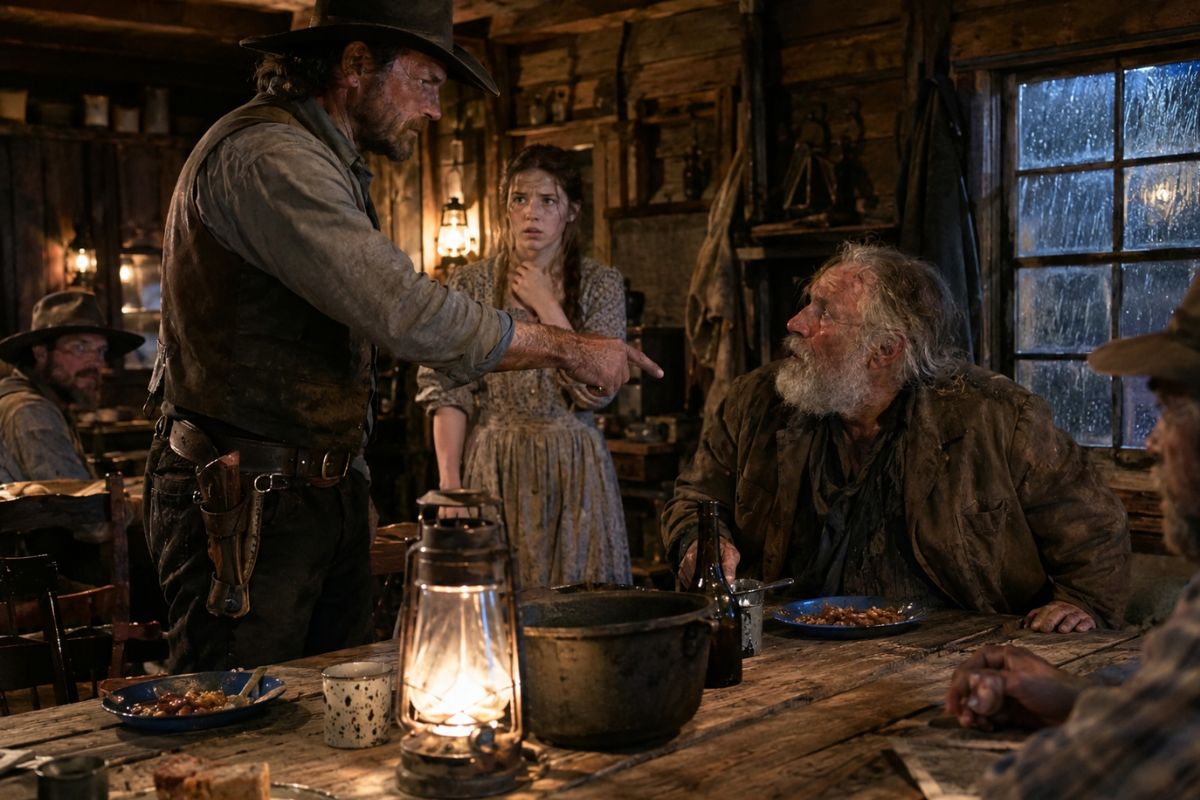
“Tomorrow morning,” Grant Caldwell said, “I want you gone from Copper Hollow.”
The scrape of Amos Reddick’s fork against his tin plate stopped.
Nobody else at the supper table moved.
Eleven ranch hands sat beneath the yellow light of two hanging lamps, shoulders still dusty from a day of sorting cattle. At the far end of the room, rain tapped against the bunkhouse windows, though the Wyoming sky beyond them still held enough evening light to show the barn and corral as dark shapes against the prairie.
Amos looked across the table at Grant.
At sixty-eight, he had the rawboned build of a man who had spent most of his life horseback. His shoulders had narrowed with age, but his hands were still broad and marked from rope, leather, cold weather, and more years of work than most men at the table had been alive.
Grant Caldwell was forty-two and owned everything they could see from those windows.
Or at least his name was written on the papers.
Copper Hollow Ranch had passed to him six weeks earlier when his father, Nathan Caldwell, died after a sudden fever that carried him off before anyone in the family understood how serious it was.
Grant had inherited nine thousand acres, nearly seven hundred head of cattle, a ranch house built from Wyoming pine, two barns, three line cabins, twenty-two horses, a respected family name—
and enough debt to lose all of it.
Amos set down his fork.
“Morning,” he repeated.
“That’s what I said.”
Ruth Caldwell, Grant’s wife, looked at him from the opposite end of the table.
“Grant.”
He did not turn toward her.
This was ranch business, and Grant had spent most of his adult life believing ranch business was improved by keeping emotion out of it.
Amos nodded once.
“All right.”
That was the first thing that bothered Grant.
He had expected an argument.
For twenty years, Amos had argued about almost everything that mattered at Copper Hollow: when to move cattle, when to hold them back, which horses were worth breaking, which men were worth trusting, whether the creek could be crossed after heavy rain, whether a sick calf could be saved, whether Nathan Caldwell was making a fool decision and needed someone willing to tell him so.
But now, after thirty-seven years on the ranch, Amos did not defend himself.
He did not remind Grant that he had been foreman since before Grant could saddle his own horse.
He did not ask for another month.
He merely pushed his chair back.
One of the younger hands, Ben Carrow, stared at his plate.
Old Jeb Dawley quietly removed his hat from the peg behind him and turned it in his hands.
Only seventeen-year-old Ellie Caldwell looked directly at her father.
Grant saw the accusation in his daughter’s face.
He ignored it.
Amos stepped toward the door, then stopped.
“There is one thing.”
Grant had been waiting for it.
Money, perhaps.
Or a horse.
Or some claim Nathan had made without putting it in writing.
“What?”
“The old saddle in the north corner of the barn.”
Grant’s jaw tightened.
His father’s trail saddle.
The one with the split cantle and dark leather polished almost black from years of use.
Amos said, “I’d like to take it.”
“No.”
Amos looked at him.
“It belonged to your father,” Grant continued. “It stays here.”
A faint movement crossed Amos’s face.
Not anger.
Something closer to disappointment.
“That’s fair,” he said.
Then he opened the door and walked into the rain.
Grant watched him go.
He should have felt relief.
Instead, for reasons he could not name, the fact that Amos Reddick had accepted thirty-seven years being reduced to a single night made Grant feel as if he had missed something important.
Grant did not dismiss Amos because he enjoyed cruelty.
That was the story he told himself, and there was enough truth in it to be convincing.
Copper Hollow was failing.
Three bad winters in seven years had weakened the herd. Beef prices had disappointed Nathan at exactly the wrong times. Repairs had been delayed until everything from the south barn roof to the creek fencing seemed to require money in the same season.
And Nathan, for all his strengths, had never been careful with debt.
The ranch looked prosperous from the county road.
Visitors saw pasture rolling toward distant blue foothills, cattle spread across grassland, horses in broad corrals, and the Caldwell name burned into the crossbeam over the front gate.
They did not see notes coming due.
They did not see Grant and Ruth at the kitchen table after midnight, calculating whether cattle prices would cover winter feed.
They did not see the letter from Bellweather Bank informing Grant that the largest payment on his father’s note would be required before spring.
They did not see the offer lying in Grant’s desk from a neighboring rancher willing to buy Willow Creek pasture.
Willow Creek was four hundred and eighty acres on the ranch’s western edge.
It was good land.
Better than good.
There was year-round water, wind shelter, and enough grass in a forgiving season to carry cattle when the high pasture browned.
Selling it could buy Copper Hollow time.
Keeping it might be the difference between surviving and losing everything.
Grant had thirty men’s wages over the course of a year to consider, counting seasonal hands.
He had a wife and daughter.
He had cattle.
He had a bank.
And he had an aging foreman who earned more than any other hired man on the ranch.
It was arithmetic.
At least that was what Grant called it.
But Ruth knew better.
That night, after the bunkhouse lamps had gone dark, she found Grant standing in the ranch office with the bank letter in one hand.
“You could have spoken to him privately.”
Grant did not look up.
“He’s leaving either way.”
“That wasn’t what I said.”
“He’s sixty-eight.”
“And?”
“And I’m paying foreman wages to a man who can’t ride three days straight anymore.”
“Amos rode north fence yesterday.”
“With Ben.”
“Ben said Amos outran him when they found the break.”
Grant threw the letter onto the desk.
“That isn’t the point.”
Ruth leaned against the doorframe.
She was thirty-nine, with brown hair she usually pinned plainly at the back of her head and a way of waiting through silence that Grant sometimes found more difficult than arguing.
“What is the point?” she asked.
Grant knew better than to answer too quickly.
“The ranch cannot carry sentiment.”
Ruth glanced toward the wall where Nathan Caldwell’s hat still hung on a peg.
“No,” she said. “But men can.”
Grant turned away.
Outside, rain drummed against the roof.
After a moment, Ruth said, “This is about your father.”
Grant gave a short laugh.
“Everything on this place is about my father.”
“And Amos.”
There it was.
The old irritation.
The one Grant had carried since boyhood.
He was seventeen the first time he heard his father call Amos the brother he should have had.
Grant had been outside the ranch office window when Nathan said it.
He remembered the exact summer heat. The smell of dust. The humiliation of hearing his father speak with more warmth about a hired cowboy than he seemed capable of offering his own son.
Years before that, Grant had noticed how Nathan listened when Amos spoke.
If Amos said a horse was no good, Nathan sold it.
If Amos said snow would come early, Nathan moved cattle.
If Amos told him a man could not be trusted, that man rarely lasted another week.
But there had been one exception.
The cattle drive.
Twenty-five years ago.
The disaster.
Grant remembered his father returning from it looking ten years older.
Half the herd had been lost or scattered after Nathan tried pushing cattle through rough country ahead of a storm. Men had quit. Money disappeared. Copper Hollow came within months of foreclosure.
And Amos Reddick disappeared.
Grant had heard the argument the night before Amos left.
Nathan’s office door had been half open.
Grant was seventeen and angry because everyone treated him like a child whenever ranch business became serious.
He had come down the hall quietly.
Nathan’s voice cut through the doorway.
“You betrayed me.”
Amos answered, “You know that isn’t what happened.”
“My ranch is nearly gone.”
“I warned you.”
“And now you’re leaving.”
“I have to.”
Nathan had struck the desk hard enough to rattle the lamp.
“If you ride out tomorrow, don’t expect me to explain it for you.”
Then Amos said something Grant did not hear.
Nathan shouted, “Get out.”
The following morning Amos was gone.
For nearly two years.
No explanation.
No letter that Grant ever saw.
And when Amos returned, Nathan gave him his job back.
More than his job.
Over the years, he made Amos foreman.
Protected him.
Defended him.
Trusted him.
Grant never understood it.
Nathan never explained.
So Grant filled in the silence himself.
His father had been weak where Amos was concerned.
Perhaps guilty.
Perhaps foolish.
Perhaps attached to the man in a way Grant resented precisely because he did not understand it.
Now Nathan was dead.
Grant owned Copper Hollow.
And he had no intention of continuing his father’s mistakes.
Ruth watched him for another moment.
“You hated him before you knew what he cost.”
Grant looked at her.
“I know exactly what he cost.”
“Do you?”
He frowned.
But Ruth had already left the room.
Ellie found Amos in the barn shortly after midnight.
She had gone there because she saw lantern light beneath the door.
He was sitting on an overturned grain crate with Nathan Caldwell’s old saddle across his knees.
For a moment, anger rose in her.
“My father said you couldn’t take that.”
Amos looked up.
“I heard him.”
“Then what are you doing?”
“Fixing it.”
She stepped closer.
The saddle looked worse in the lantern light than Ellie remembered.
Its leather was cracked along the skirts. One stirrup strap had been repaired twice. The horn was smooth from decades of rope work, though Nathan had stopped using it for cattle in his later years.
Amos held a curved needle.
“The lining’s pulling loose,” he said.
“You’re repairing a saddle you’re not allowed to keep?”
“If I leave it this way, dirt’ll get under the leather.”
“You’re leaving tomorrow.”
“That’s what your father said.”
Ellie stared at him.
She had known Amos all her life.
He had taught her to tell a horse’s mood by its ears before she was tall enough to reach a saddle horn.
When she was nine, he had spent three weeks teaching her to sit a trot properly because, as he told Nathan, “She’s going to ride whether you approve or not. Better she learn to do it right.”
Nathan had laughed.
Grant had not.
“You could fight him,” Ellie said.
Amos pushed the needle through the leather.
“Wouldn’t change his mind.”
“You don’t know that.”
“Yes, I do.”
“Because you think he’s stubborn?”
Amos almost smiled.
“Your father’s stubborn like a gate swollen in rain. Pushing harder mostly makes a man tired.”
Ellie sat beside him.
“Grandpa would never have let him do this.”
The needle stopped.
Amos’s eyes remained on the saddle.
“No.”
That one word carried something Ellie could not place.
She looked more closely.
“You’re sewing it wrong.”
Amos gave her a sideways look.
“I’ve been repairing saddles longer than you’ve been alive.”
“The lining’s crooked.”
“It was crooked when Nathan bought it.”
“You told me Grandpa got this saddle when he was young.”
“He did.”
“Then how do you know?”
Amos did not answer.
Ellie reached beneath the lifted edge of the lining.
The leather was stiff with age.
She pulled gently.
A row of faded stitching appeared beneath it.
Letters.
She leaned closer.
N.C.
Below them, separated by two small crossed stitches, were two more.
A.R.
Ellie looked at Amos.
“What is that?”
His expression changed.
He took the saddle from her hands.
“Nothing you need to worry about.”
“Those are your initials.”
“Lots of men have initials.”
“And N.C.?”
Amos said nothing.
“Nathan Caldwell.”
He lowered the saddle.
Ellie felt her pulse quicken.
“You put your name inside Grandpa’s saddle?”
“No.”
“Then who did?”
Amos rubbed one thumb across the worn edge of the leather.
“Your grandfather.”
Ellie stared at him.
“Why?”
Amos looked toward the open barn aisle.
Rain whispered on the roof.
After several seconds he said, “You’d have to ask a dead man.”
Then he bent again to the repair.
Something crackled beneath the lining.
Both of them heard it.
Amos froze.
Ellie lifted the loosened leather.
A corner of folded paper was wedged between the saddle tree and the old wool lining.
Amos stared at it.
His face lost what little color the cold night had left in it.
“What is it?” Ellie whispered.
He did not move.
She eased the paper free.
On the outside, in faded pencil, were two words.
For Amos.
Grant was furious.
He stood in the ranch kitchen before sunrise, holding the folded paper while Amos waited near the stove.
Ellie sat at the table between her parents.
“You cut open my father’s saddle.”
“I repaired loose stitching,” Amos said.
“And somehow found a letter addressed to you?”
“I didn’t find it. Ellie did.”
“That’s true,” Ellie said.
Grant ignored her.
“What am I supposed to believe? That Father hid a letter in there?”
Amos’s expression hardened slightly.
“I don’t care what you believe.”
Grant unfolded it.
“You already read this?”
“No.”
That surprised him.
The letter was addressed to Amos.
“You expect me to believe you didn’t open it?”
Amos looked at the paper.
“I expect nothing from you this morning.”
Ruth quietly said, “Grant.”
But Grant had already begun reading.
The handwriting was Nathan’s.
He recognized the heavy downward slant immediately.
Amos,
There are some things a man delays because he thinks tomorrow will make him braver. Mostly tomorrow just makes him older.
Grant stopped.
He glanced at Amos.
Amos was looking at the stove.
Grant continued.
I have owed you words for twenty-five years. Work was easier to offer than words, and land easier than shame. Neither was enough.
The sound of the wind seemed to move through the room.
Grant read the next line twice.
Copper Hollow survived because of what you did after Daniel died.
Grant’s eyes lifted.
“Daniel?”
Amos shut them briefly.
Ellie looked between them.
“Who was Daniel?”
Amos answered.
“My brother.”
Grant had heard the name before, perhaps when he was very young.
Nothing more.
He went back to the letter.
I let my son believe you abandoned us.
Grant lowered the page.
For several seconds, no one spoke.
Then he laughed once, without humor.
“What does that mean?”
Amos picked up his hat.
“It means your father is dead, and this should’ve stayed between us.”
Grant stepped between him and the door.
“No.”
Amos met his eyes.
“You wanted me gone.”
“I do.”
Grant hated how quickly the words came.
He hated even more that Amos’s face barely changed.
“But first,” Grant said, “you’re going to tell me what this means.”
Amos looked toward the paper.
“No.”
“You don’t get to refuse.”
“I’ve refused men who had more reason than you.”
“This is my family.”
“That’s exactly why.”
Grant felt heat rise into his face.
“You disappear for two years after nearly ruining us, you come back, my father treats you like some honored guest for twenty-five years, and now he leaves this?”
Amos’s gaze sharpened.
“I never ruined Copper Hollow.”
Grant took a step toward him.
“I heard him accuse you.”
“You heard part of an argument.”
“He said you betrayed him.”
“He was angry.”
“He said the ranch was nearly gone.”
“It was.”
“And you left.”
“Yes.”
“Then tell me the part I’m missing.”
Amos’s voice dropped.
“No.”
Grant stared at him.
Then Ellie spoke.
“Maybe Grandpa already did.”
She pointed toward the ranch office.
“To what?”
“The books.”
Nathan Caldwell kept records the way he kept everything else: stubbornly and inconsistently.
Some years were neat.
Other years looked as if figures had been written while riding horseback.
By breakfast, the ranch office floor was covered with ledgers, receipts, loan papers, cattle tallies, feed accounts, and old letters bundled with string.
Grant nearly told Ellie to go do her morning chores.
Then she found the first payment.
It was listed in a ledger from twenty-four years earlier.
Mortgage remittance — $140.
Beside it Nathan had written only:
Cheyenne draft.
Grant frowned.
Copper Hollow had never kept an account in Cheyenne.
He searched the next month.
Another remittance.
$95.
This one had been sent from Rawlins.
Then another.
Laramie.
Then Rock Springs.
Small amounts.
Irregular amounts.
Every four to seven weeks.
Always applied against the mortgage that had nearly taken Copper Hollow after the disastrous drive.
Ruth began organizing the entries on a sheet of paper.
Ellie found a receipt folded between two pages.
“Here.”
Grant took it.
The payer’s name was absent.
The amount was $110.
The location was a cattle company office almost three hundred miles away.
He looked toward Amos.
The old cowboy had remained near the door.
“When did you leave Copper Hollow?”
“August.”
“What year?”
Amos told him.
Grant checked the ledger.
The first unexplained payment had arrived in September.
“When did you come back?”
“June. Almost two years later.”
Ruth traced the entries.
“The last payment came in May.”
Nobody said anything.
Grant felt something unpleasant gathering beneath his ribs.
Suspicion.
Not of Amos.
Of the story he had lived with for twenty-five years.
He turned another page.
A note from Nathan was written in the margin.
A.R. says no thanks necessary. Fool man.
Grant stared at the initials.
Ellie saw them.
“So Grandpa knew.”
Amos stepped toward the door.
Grant said, “Where did the money come from?”
No answer.
“Amos.”
The old man’s shoulders lowered.
“I worked.”
“Doing what?”
“Cattle.”
“Where?”
“Wherever someone paid.”
“For two years?”
“Near enough.”
“And you sent money here?”
Amos opened the door.
Grant grabbed his arm.
Amos looked down at Grant’s hand.
Grant released him.
“Why?”
The old cowboy remained silent.
Then he said, “Because the bank didn’t care who was guilty.”
And walked outside.
Grant followed him to the barn.
The storm had passed, leaving cold gray clouds hanging low across the pasture.
Amos was saddling a sorrel gelding.
Not Nathan’s old saddle.
His own plain working saddle.
A bedroll lay behind the cantle.
Two shirts and a coat were tied in a canvas bundle.
Thirty-seven years of a man’s life reduced to what one horse could carry.
Grant stood in the aisle.
“You sold land.”
Amos pulled the cinch tighter.
He did not look up.
Grant had found the record five minutes earlier.
A faded bill of sale tucked inside Nathan’s ledger.
Thirty-six acres outside a small settlement in Colorado Territory.
Property sold by Amos Reddick.
Two months after leaving Copper Hollow.
“You owned that place.”
“For a while.”
“You sold it.”
“I did.”
“And sent the money here.”
Amos put one boot in the stirrup.
Grant said, “Why?”
Amos stopped.
The barn was quiet except for a horse shifting in the next stall.
“Because Nathan needed it.”
“You hated him.”
Amos turned.
“No.”
“I heard you fight.”
“Men can fight with somebody they love.”
Grant flinched at the word.
Amos seemed to notice.
“You thought I hated your father?”
“I thought you nearly destroyed him.”
Something old and tired moved across Amos’s face.
“Your father nearly destroyed himself.”
Grant’s breath caught.
Amos mounted.
“Ask the right question, Grant.”
“What question?”
Amos looked down at him.
“Why did Nathan let you believe otherwise?”
Then he rode out of the barn.
Grant stood watching until the sorrel crossed the first rise.
Ellie came up behind him.
“Aren’t you going after him?”
Grant kept watching.
“No.”
“Why not?”
Because he did not know whether he wanted Amos stopped or gone.
Because for the first time in twenty-five years, Grant was afraid the thing he resented most about Amos Reddick might not have belonged to Amos at all.
He turned toward the ranch house.
“We’re going to Bellweather.”
The town of Bellweather lay twenty-one miles south of Copper Hollow.
Grant, Ruth, and Ellie reached it shortly before noon.
They left their horses at the hitching rail outside Webb & Sons Mercantile and crossed the muddy street toward Bellweather Bank.
The bank manager, Orin Webb, was fifty-six and had known Grant since Grant was a boy buying penny candy from Orin’s father.
He listened without interruption.
Then he shook his head.
“Those records would be old.”
“I know.”
“Your father refinanced twice after that.”
“I know.”
“And I can’t discuss another man’s banking affairs.”
“The other man is dead.”
“Which man?”
Grant hesitated.
“That’s what I’m trying to find out.”
Orin studied him.
Then he disappeared into a back room.
He returned fifteen minutes later carrying a narrow ledger coated with dust.
“My father kept old loan books even when he had no reason to. Said a man should know who owed him and who he owed.”
Grant almost smiled.
“That sounds like him.”
Orin opened the book.
“I remember some of this because my father talked about it. Copper Hollow came close to foreclosure.”
“How close?”
“Close enough that men in town were wondering who’d buy the cattle after the bank took them.”
Ruth’s face tightened.
Grant said, “My father never told me.”
“Men rarely tell their children how near they came to losing the roof.”
Orin ran one finger down a column.
“There.”
Payments.
The same ones.
Cheyenne.
Rawlins.
Rock Springs.
Green River.
Small drafts sent from cattle outfits, stockyards, trail companies.
Grant leaned closer.
“Who sent them?”
“Not written here.”
“You have to have known.”
“I was twenty-nine and mostly sweeping floors.”
“Your father?”
“Maybe.”
Grant’s frustration showed.
Orin closed the ledger halfway.
“There was a man who might remember.”
“Who?”
“Gideon Shaw.”
Grant recognized the name.
An old drover who lived beyond the church on the eastern edge of Bellweather.
“He knew my father?”
“He knew half the cattlemen between here and Colorado.”
Orin paused.
“He knew Amos Reddick too.”
Gideon Shaw was seventy-four, broad through the chest despite a limp that forced him to use a cane.
He listened from a rocking chair on the porch of a narrow white house.
When Grant said Amos’s name, Gideon stopped rocking.
“Still alive?”
“Yes.”
“Mean old mule.”
Ellie almost smiled.
Grant did not.
“You saw him after he left Copper Hollow?”
“Plenty.”
“Where?”
“First time was south of Rawlins. He was driving cattle for Merrin Outfit.”
Grant did not recognize the company. It had disappeared years ago.
“He worked for them?”
“For anybody paying cash.”
“What kind of work?”
“The kind a man takes when he isn’t planning to keep much of himself by the end.”
Ruth said quietly, “Meaning?”
“Hard drives. Winter work. Half-broke horses. Long miles.”
Grant glanced at Ellie, wishing Gideon had phrased it differently.
The old drover understood.
“Nothing foolish,” he added. “Just work younger men usually had sense enough to complain about.”
“Did Amos send money to my father?”
Gideon looked at Grant for a long moment.
“You don’t know.”
It was not a question.
“No.”
“Then Nathan never told you.”
“No.”
Gideon stared across the road.
“Your father was proud.”
“I know that.”
“No. You know he acted proud. Different thing.”
Grant’s patience thinned.
“What happened on that cattle drive?”
The rocking chair stopped.
Gideon studied Ellie.
“How old are you?”
“Seventeen.”
He nodded slowly.
“About the age your father was.”
Grant felt the old story move beneath his feet.
Gideon said, “Nathan Caldwell had borrowed heavily that year. Needed one good drive to put the ranch right.”
“I know that.”
“Did you know Amos told him not to take the west cut through Broken Tooth country?”
“No.”
“Storm season was coming early. Water was poor. Ground was bad. Amos said turn south and lose two weeks.”
“My father didn’t listen.”
“No.”
“Why?”
“Because two weeks might’ve cost him the price he needed.”
Grant sat very still.
Gideon continued.
“Nathan pushed ahead.”
“And the herd?”
“Scattered in weather and rough country. Some recovered. Plenty didn’t.”
Grant had known that part.
“What happened to Daniel?”
Gideon’s eyes moved toward him.
“So you know his name now.”
“Amos said he was his brother.”
“Younger brother. Twenty-six. Good rider.”
Grant waited.
Gideon removed his hat.
“Daniel died during the drive.”
Ellie looked down.
There was no graphic account.
Gideon did not offer one.
He simply said Daniel had gone after cattle separated during the storm. His horse returned. The men found Daniel the next morning.
Amos had warned Nathan not to take the route.
Nathan had insisted.
Grant stared at the porch boards.
“My father blamed Amos.”
“Not at first.”
Grant looked up.
“What?”
“First he blamed himself.”
Gideon leaned on his cane.
“Then men started talking.”
“About what?”
“About the ranch. About Nathan’s judgment. Creditors heard the drive had failed. Word spread that he’d ignored his foreman. A cattleman can survive a bad season. Harder to survive when every lender thinks he’s reckless.”
Grant knew enough about ranching to understand.
Reputation was not pride alone.
It could determine whether a man received another season of credit.
Whether a cattle buyer trusted delivery.
Whether neighbors loaned equipment or demanded cash.
Gideon continued.
“Amos could’ve told everyone exactly what happened.”
“But he didn’t.”
“No.”
“Why?”
“Ask him.”
Grant clenched his jaw.
“He won’t answer.”
Gideon gave him a tired look.
“Maybe because he already paid enough for your father’s mistake.”
They returned to Copper Hollow after dark.
Amos was gone.
Grant had expected that.
What he had not expected was to feel the absence.
The barn seemed wrong without Amos’s coat hanging beside the tack-room door.
At supper, Jeb Dawley kept looking toward Amos’s empty place.
Finally Grant said, “If you have something to say, say it.”
Jeb wiped his mouth with his napkin.
“I was wondering who’s checking the north herd tomorrow.”
“Ben.”
Ben glanced up.
Jeb nodded.
“Amos usually checks weather before he sends anybody.”
“Amos doesn’t work here anymore.”
“I noticed.”
Grant set down his fork.
“You disagree with my decision?”
Jeb looked around the table.
“Wouldn’t matter if I did.”
“Try me.”
The older hand thought about it.
“I think a ranch ought to know what it’s throwing away before it throws it.”
No one spoke after that.
Grant stood.
“Come to my office.”
Jeb followed.
Once the door closed, Grant asked, “Did you know about Daniel?”
Jeb frowned.
“Reddick?”
“Yes.”
“Heard of him.”
“Did you know how he died?”
“Not until years later.”
“Did you know Amos sent money to save the ranch?”
Jeb’s eyes lifted.
“So you found that.”
“You knew?”
“Some.”
“How much?”
“Enough to know Amos never liked anybody talking about it.”
Grant stepped closer.
“Why?”
Jeb shrugged.
“Same reason men hide scars under shirts. Maybe they don’t want every stranger asking how they got them.”
“Did my father ask Amos to take the blame?”
“I don’t know.”
“You worked here then.”
“I was nineteen and spent most of that year repairing fences and trying not to get fired.”
“Did my father ever talk about the drive?”
Jeb hesitated.
“Once.”
“What did he say?”
Jeb looked toward Nathan’s hat on the peg.
“He said the worst debt on Copper Hollow wasn’t held by a bank.”
Grant did not sleep that night.
The next morning he reopened Nathan’s letter.
Amos,
There are some things a man delays because he thinks tomorrow will make him braver. Mostly tomorrow just makes him older.
I have owed you words for twenty-five years. Work was easier to offer than words, and land easier than shame. Neither was enough.
Copper Hollow survived because of what you did after Daniel died.
I let my son believe you abandoned us because correcting him would have meant admitting what I had done.
Grant stopped.
The line blurred.
He continued.
You warned me.
I crossed anyway.
Daniel followed because I ordered the drive forward, and you lost your brother helping save cattle that belonged to me.
Afterward, when creditors began asking questions, you let men think the failure belonged to you because you knew another loss of confidence would finish this ranch.
I told myself I would correct the story once Copper Hollow was safe.
Then I told myself the past was too old.
The truth is simpler.
I was ashamed.
Grant pressed his fingertips to the paper.
Ellie sat across from him.
Ruth stood beside the window.
He read silently for another paragraph, then aloud.
When you sold your land and sent money home, you paid for more of Copper Hollow than my pride ever admitted.
Willow Creek was bought during those years.
Some of the purchase money came from the dollars you sent while working other men’s cattle.
The deed is mine.
The land belongs legally to the Caldwell family.
I know that.
You know that.
But right and legal have never been the same word.
If I die before I find courage to speak, I ask Grant to offer you what I should have offered long ago.
Not charity.
Not payment.
A choice.
If you want Willow Creek, let it be yours.
If you do not, at least let my son understand that part of Copper Hollow stands because you gave up the land you once hoped to call your own.
Grant lowered the letter.
Ellie’s eyes were wet, though she did not cry.
Ruth sat beside him.
There was one final paragraph.
Tell Grant I loved him.
Tell him I mistook providing for him for knowing him.
Maybe that is another debt a man notices too late.
And if he hates me for what I failed to say, tell him he has earned the right.
Nathan Caldwell.
Grant folded the letter.
Carefully.
Then unfolded it again.
He read the last paragraph once more.
“Why put this inside a saddle?” Ellie asked.
Grant did not know.
But Ruth did.
“Because Nathan knew Amos would repair it.”
They looked at her.
“He always repaired your father’s tack.”
Grant remembered dozens of evenings when Amos sat outside the barn with Nathan’s saddle across a rail.
Nathan must have placed the letter there shortly before his illness worsened.
Perhaps he planned to tell Amos where to find it.
Perhaps he believed he had more time.
People always believed they had more time.
Ellie touched the folded letter.
“Where’s Amos?”
Grant stared toward the western window.
He knew.
Willow Creek lay five miles from the main ranch house.
The pasture followed a narrow stream through cottonwood and willow, sheltered between two low ridges.
Near its northern end stood a one-room cabin that had not been used regularly in years.
Amos had built part of it himself.
Grant remembered that now.
As a boy, he once asked why the foreman cared so much about an old cabin nobody lived in.
Nathan had said, “A man sometimes builds toward a future he never gets.”
Grant had not understood.
He did now.
He and Ellie found Amos there shortly before noon.
The old cowboy was replacing a loose shutter.
He did not look surprised to see them.
Grant dismounted.
“I read the letter.”
Amos drove one final nail.
“That was addressed to me.”
“Yes.”
“You always had trouble minding other people’s business.”
Grant almost answered sharply.
Then stopped.
He deserved that.
Ellie tied the horses.
Grant approached the cabin.
“Was it true?”
Amos set down the hammer.
“Which part?”
“All of it.”
Amos sat on the porch step.
For the first time since Grant could remember, he looked old.
Not weak.
Simply tired in a way that had nothing to do with work.
“Mostly.”
“Mostly?”
“Your father made himself sound worse than he was.”
Grant almost laughed.
“He blamed you for twenty-five years.”
“No.”
“I heard him.”
“He blamed himself.”
“He let me blame you.”
“That he did.”
“Why defend him?”
“I’m not.”
“Sounds like it.”
Amos looked toward Willow Creek.
“Your father was thirty-nine when that drive failed. Younger than you are now. He had a ranch he thought he was about to lose, a wife afraid of losing her home, a seventeen-year-old boy watching every decision he made, and more debt than sense.”
Grant’s anger sharpened.
“That excuses him?”
“No.”
The answer came immediately.
Grant fell silent.
Amos continued.
“Nathan was wrong.”
The words were quiet.
“He was wrong to push the drive. Wrong to ignore me. Wrong to let the story stand. Wrong not to tell you.”
Amos rubbed his palms together.
“But a man can be wrong without being nothing but wrong.”
Grant looked away.
“What about Daniel?”
For the first time, Amos’s composure cracked.
Barely.
His thumb moved against the edge of his hand.
“Daniel thought I was the smartest cowboy in Wyoming.”
Ellie sat on the porch rail.
“Were you?”
“No.”
A faint smile appeared.
“But I didn’t tell him that.”
“What happened?”
Amos looked down.
“Nathan ordered us forward. I argued. Daniel heard it. Later, when the storm came, he rode with me after part of the herd.”
He paused.
“He didn’t come back.”
Grant swallowed.
“My father caused his death.”
Amos’s head lifted.
“No.”
“He ordered the drive.”
“He made a bad decision.”
“That killed Daniel.”
“That road ends nowhere good, Grant.”
“What does that mean?”
“It means I spent five years asking which man killed my brother. Nathan? Me for not stopping him? Daniel for riding after cattle? Weather? Bad ground?”
Amos shook his head.
“The dead stay dead no matter which answer you pick.”
Grant looked toward the creek.
“So you protected my father.”
“I protected Copper Hollow.”
“Why?”
“Because thirty families around Bellweather depended on cattle work from this place in one way or another. Because your mother loved that house. Because you were seventeen. Because men who had nothing to do with Nathan’s decision would’ve paid for it.”
“And because you loved him.”
Amos’s jaw tightened.
“Yes.”
Grant breathed slowly.
“Then why leave?”
“To make money.”
“You sold your land.”
“It wasn’t much.”
“It was yours.”
“It was dirt.”
“Willow Creek is dirt.”
Amos looked at him.
“No.”
Grant understood the rebuke.
The land mattered when it held somebody’s future.
“What were you planning to do with your thirty-six acres?”
“Build a cabin. Keep horses. Maybe marry if I ever found a woman foolish enough.”
“What happened to her?”
“There wasn’t one.”
Ellie smiled faintly.
Amos looked at the cabin.
“That was just the life I imagined.”
“And you sold it.”
“Yes.”
“To pay my father’s mortgage.”
“To keep the ranch.”
Grant shook his head.
“Why anonymously?”
“Because Nathan wouldn’t take it.”
“You could have made him.”
“Nobody ever made Nathan Caldwell do anything.”
“That I believe.”
Amos almost smiled.
Then Grant asked the question that had followed him for twenty-five years.
“Why did he treat you better than me?”
Amos’s expression changed.
Grant hated how childish the words sounded once spoken.
But they were already between them.
“He listened to you. Protected you. Defended you. Every time I disagreed with you, he took your side.”
“That isn’t true.”
“It felt true.”
Amos did not dismiss that.
Grant appreciated it more than he expected.
After a while Amos said, “Your father didn’t know how to apologize.”
Grant looked at him.
“So he gave me work.”
Amos nodded.
“He made me foreman. Paid me well. Backed me when other men talked about the drive.”
Grant’s mouth went dry.
“He wasn’t choosing you over me.”
“No.”
“What was he doing?”
“Trying to repay me without having to say he was sorry.”
The answer hurt more than Grant expected.
For decades he had believed Amos stood between him and his father.
Instead Amos had been standing inside a debt Nathan could not face.
All the respect Grant had envied had been a kind of penance.
Not affection stolen from a son.
Guilt carried by a father.
Grant sat beside Amos.
“What do you want me to do?”
Amos looked at him.
“With what?”
“Willow Creek.”
“Nothing.”
“My father asked me to give it to you.”
“No.”
“You haven’t even thought about it.”
“I’ve had twenty-five years to think about it.”
“It should be yours.”
Amos’s voice hardened.
“You don’t get to turn your father’s guilt into a new order.”
Grant flinched.
Amos stood.
“I don’t want land because Nathan was ashamed.”
“It isn’t charity.”
“Then don’t make it charity.”
“What does that mean?”
“It means decide what you believe is right.”
Amos walked toward his horse.
Grant followed.
“I can’t save Copper Hollow without selling something.”
“I know.”
“Willow Creek is the easiest.”
“I know.”
“If I give it to you, I may have to sell cattle.”
“Yes.”
“Maybe south pasture.”
“Maybe.”
“Men could lose work.”
“Yes.”
Grant’s frustration rose.
“You’re not making this easier.”
Amos put his hand on the saddle horn.
“Wasn’t trying to.”
“Then tell me what you would do.”
The old cowboy looked at him for a long moment.
“No.”
“Why?”
“Because your father spent twenty-five years deciding for everybody else what truth they could handle.”
Amos mounted.
“I’m not doing the same to you.”
For three days Grant did nothing.
That frightened him more than action.
He checked cattle.
He met with Orin Webb.
He studied the ranch accounts with Ruth.
He examined the offer for Willow Creek from neighboring rancher Matthew Rusk.
Rusk was not a villain.
He was a practical cattleman with good credit and adjoining land.
He had offered a fair price.
When Grant rode over to discuss the sale, Rusk poured coffee and said, “You know I’ll buy it. But if you’re asking whether you ought to sell it, that isn’t my business.”
“I didn’t ask.”
“You rode six miles to tell me you hadn’t decided. That’s close enough.”
Grant stared into the coffee.
“If I sell two hundred head instead, I can cover the bank payment.”
“And reduce next year’s income.”
“Yes.”
“If you sell south pasture too?”
“I can keep Willow Creek.”
“But you’ll lose winter grazing.”
“Yes.”
Rusk nodded.
“Bad choices are still choices.”
Grant looked at him.
“That supposed to help?”
“No.”
Rusk drank his coffee.
“Just means you’re a rancher now.”
Grant almost resented him for saying it.
For years he had imagined inheritance as the moment when no one could overrule him.
Instead ownership had turned out to mean becoming the man responsible when every available choice cost something.
That evening, Grant rode Willow Creek alone.
He followed the stream until he reached the cabin.
Amos was not there.
Grant dismounted and went inside.
The room held a bunk, iron stove, table, two chairs, and shelves Nathan had probably helped build.
On one wall, hidden behind a hanging coat, were shallow knife marks in the timber.
N.C.
A.R.
D.R.
Three sets of initials.
Below them, a year.
The year before the disastrous cattle drive.
Grant touched them.
Nathan.
Amos.
Daniel.
Three young men who had believed they were building something.
Grant suddenly understood why Amos wanted the saddle.
It was not because Nathan had owned it.
It was because it belonged to a time before guilt changed what the two men were to each other.
The next morning Grant asked every ranch hand to gather outside the barn.
Word traveled fast.
Ruth came from the house.
Ellie stood beside her.
Jeb Dawley removed his gloves.
Ben Carrow leaned against a fence post.
Amos was not there.
Grant had sent Ellie to Willow Creek to fetch him.
When they rode in, Amos saw the gathering and stopped his horse.
“What’s this?”
Grant stepped forward.
“Something that should’ve happened before I was born.”
Amos’s expression darkened.
“Grant.”
“No.”
He turned to the others.
“My father told this ranch a lie.”
Nobody moved.
Grant continued.
“Some of you heard pieces of it. Some of you repeated it. I repeated it more than anybody.”
Amos dismounted slowly.
Grant looked directly at him.
“Twenty-five years ago, Copper Hollow nearly failed after a cattle drive went wrong.”
The hands listened.
“My father made the decision that caused that failure.”
He heard Ruth inhale softly.
He kept going.
“Amos warned him. My father ignored him.”
Amos’s jaw tightened.
“Daniel Reddick died during that drive.”
Jeb lowered his head.
“And afterward, when creditors questioned my father’s judgment, Amos let people believe he shared the blame.”
Grant paused.
“That lie protected this ranch.”
He thought of the ledger.
“And when the bank was close to taking Copper Hollow, Amos sold the only land he owned and spent almost two years working cattle across Wyoming and Colorado. He sent the money back here.”
Ben Carrow stared at Amos.
Grant said, “Those payments kept the mortgage alive long enough for Copper Hollow to recover.”
Amos stepped forward.
“That’s enough.”
“No.”
“I said enough.”
“And I said something different twenty-five years too late.”
Grant looked around the gathered men.
“I fired him because I believed he betrayed this family.”
His throat tightened.
“I was wrong.”
The words did not destroy him.
That surprised Grant.
For years he had treated admitting error as if it were a hole a man could fall through.
Instead the ground remained beneath his boots.
He turned toward Amos.
“I was wrong about you.”
Amos studied him.
Grant continued.
“And I was wrong in how I sent you away.”
No applause followed.
No dramatic cheer.
Just wind moving through the cottonwoods beyond the barn.
It was better that way.
Jeb put his hat back on.
Ben stared at the ground.
Ruth’s face softened.
Ellie smiled only a little.
Grant said, “There’s one more thing.”
Amos seemed to know what was coming.
“Don’t.”
Grant ignored him.
“My father left a request.”
He held up the letter.
“Willow Creek pasture was purchased during the years Amos was sending money home. Legally it belongs to me.”
He looked toward the west.
“But not every debt worth paying is written in a bank ledger.”
Amos shook his head.
“Grant.”
“I’m transferring Willow Creek to you.”
The hands remained silent.
Amos stared at him.
“No.”
“Yes.”
“I told you I don’t want charity.”
“Then stop calling it charity.”
Grant walked closer.
“My father should have given you the choice years ago.”
“You need that land.”
“I need a lot of things.”
“You’ll have to sell cattle.”
“Yes.”
“Maybe other ground.”
“Yes.”
“You’ll set this ranch back years.”
“Probably.”
Amos searched his face.
“Then why?”
Grant swallowed.
“Because I inherited more than his acreage.”
The words surprised even him.
“He left me his debt too.”
Not the bank’s debt.
Nathan’s.
Grant held out the paper.
“I spent half my life angry because I thought my father gave you something that belonged to me.”
He shook his head.
“He didn’t give you enough.”
Amos looked away.
Grant waited.
At last the old cowboy said, “You always were stubborn.”
Ellie whispered to Ruth, “He learned it from Grandpa.”
Grant heard.
So did Amos.
For the first time in several days, the old man laughed.
Transferring Willow Creek did not save Copper Hollow.
It made saving Copper Hollow harder.
That mattered.
Two weeks later Grant sold one hundred eighty-seven head of cattle.
The price was lower than he hoped.
He abandoned Nathan’s plan to expand the horse operation the following spring.
He leased a small eastern grazing section to Matthew Rusk for three years instead of keeping it exclusively for Caldwell cattle.
Two seasonal positions disappeared.
Grant personally told both men and found work for one with Rusk.
The other went north with a cattle outfit.
Ruth reduced household spending.
Grant postponed repairs to the ranch house and put money into the south barn roof instead.
Bellweather Bank extended part of the remaining note after Grant made the large payment.
Orin Webb did not promise miracles.
“You’ve bought time,” he said.
“How much?”
“A rancher who asks how much time he has usually wants the wrong answer.”
Grant almost smiled.
“Your father say that?”
“No. Mine did.”
Winter arrived early.
Copper Hollow survived it.
Barely.
Amos moved permanently into the Willow Creek cabin.
At least Grant assumed it was permanent until one February morning when he noticed three horses tied outside.
By spring there were five.
None belonged to prosperous men.
One belonged to Calvin Price, a seventy-one-year-old former trail hand whose knees no longer allowed him to work full days.
Another belonged to Tom Weaver, sixty-five, who had broken his shoulder the year before and lost his bunk at a ranch near Casper when he could not rope the way he once had.
A third belonged to Solomon Beck, an aging cook and horse tender whose last employer had died.
Grant rode to Willow Creek and found them repairing fence.
Amos stood beside the cabin showing a sixteen-year-old Copper Hollow hand how to splice a broken rein.
Grant looked around.
“What is this?”
Amos glanced up.
“What’s it look like?”
“Like half the retired cowboys in Wyoming are moving onto my—”
He stopped.
Amos raised an eyebrow.
Grant corrected himself.
“Onto your land.”
“Three men isn’t half Wyoming.”
“What are they doing here?”
“Working.”
“Calvin can barely mount a horse.”
“Then I don’t ask him to ride all day.”
“Tom’s shoulder—”
“Works fine for cooking and mending harness.”
Grant looked toward Solomon.
“What does Solomon do?”
Solomon called from the porch, “Mostly complain about Amos.”
Amos nodded.
“Full-time occupation.”
Grant tried not to smile.
“Are they paying you?”
“No.”
“Then how are you feeding them?”
“They help.”
“With what?”
Amos gestured toward the pasture.
“Fence. Horses. Tack. Teaching.”
“Teaching who?”
Amos pointed at the sixteen-year-old.
The boy was concentrating fiercely on the leather rein.
Grant understood.
“You’re turning Willow Creek into a home for old cowboys.”
Amos frowned.
“Sounds too charitable when you say it that way.”
“What do you call it?”
“A place where a man can still be useful after somebody decides he isn’t.”
Grant felt the words.
Amos did not apologize for them.
Grant did not expect him to.
“Do you need cattle?”
“Some.”
“How many?”
“Twelve.”
“I can spare eight.”
“Ten.”
“Eight.”
“Nine.”
Grant sighed.
“Nine.”
Amos nodded.
“Good.”
Grant turned toward his horse.
“Grant.”
He looked back.
Amos stood with his hands in his coat pockets.
“You didn’t have to give me this place.”
“Yes, I did.”
“No.”
Amos’s gaze held his.
“You chose to.”
Grant understood the distinction.
For the first time, he believed it.
The relationship between Grant Caldwell and Amos Reddick did not transform overnight.
Some things were too old for that.
Grant still became irritated when Amos appeared at Copper Hollow and criticized the way cattle were being moved.
Amos still referred to at least half of Grant’s new ideas as “city thinking,” despite Grant having lived on ranches his entire life.
They argued over fencing.
They argued over horses.
Once they argued nearly twenty minutes about whether a storm would turn north.
Amos was right.
He mentioned it only twice.
But other things changed.
Grant began asking questions.
Not always large ones.
“What was Father like when he first bought the east pasture?”
“Did Mother know about the mortgage?”
“Was Daniel really as reckless as you say?”
“What did you do those two years besides work cattle?”
Amos answered some.
Not all.
Grant learned that his father had once ridden forty miles through snow because Amos was sick and Nathan did not trust another man to find the doctor.
He learned Amos had once nearly left Copper Hollow for good because Nathan refused to raise his wages, only to return after Nathan rode after him and admitted he could not replace him.
He learned Daniel Reddick played harmonica badly.
He learned Nathan could sing worse.
He learned his father had been afraid of deep water and lied about it.
He learned there had been years before debt and guilt when Nathan and Amos were simply young men trying to build a ranch and imagining there would always be time to correct whatever mistakes they made.
That knowledge did not excuse Nathan.
It made him human.
Grant found that harder.
But also easier.
One afternoon in early autumn, almost a year after Amos was fired, Grant rode to Willow Creek and found Ellie outside the cabin.
Nathan’s old saddle sat across a wooden stand.
The lining had been removed.
Ellie held Amos’s curved needle.
“You’re doing that too tight,” Amos said from the porch.
“I am not.”
“You are.”
“If you can see it from there, come do it yourself.”
“I already know how.”
“That isn’t helpful.”
Grant dismounted.
“What happened?”
Ellie looked up.
“Nothing. The stitching loosened again.”
“It was repaired last year.”
Amos said, “Some repairs need doing more than once.”
Grant looked at him.
Amos appeared innocent.
Grant doubted it.
He walked to the saddle.
The hidden initials were visible.
N.C.
A.R.
The leather around them had darkened with age.
Grant touched the letters.
“Why did my father put your initials here?”
Amos came down from the porch.
For once, he answered immediately.
“Daniel did.”
Grant turned.
“You told Ellie my father did.”
“I lied.”
Ellie stared at him.
“You lied to me?”
“Seemed simpler.”
“You complain about Grandpa lying for twenty-five years, then you lie for almost one?”
Amos scratched his jaw.
“Put that way, it sounds poor.”
“Why did Daniel stitch them?”
Amos leaned over the saddle.
“Nathan bought this saddle when we were young. Cost more than he could afford.”
“That sounds like him.”
“It does.”
“One night the lining tore. Daniel repaired it.”
Amos touched the initials.
“He put Nathan’s letters in because it was Nathan’s saddle.”
“And yours?”
Amos smiled faintly.
“Daniel said Nathan owned the saddle, but I spent more time fixing everything Nathan broke.”
Ellie laughed.
Grant did too.
The sound surprised him.
Amos looked across Willow Creek.
“After Daniel died, Nathan never let anyone remove those initials.”
Grant stared at the leather.
For years he had believed ownership explained everything.
Who owned Copper Hollow.
Who owned the cattle.
Who owned the saddle.
Who owned Willow Creek.
But the most important things carried other names beneath the surface.
People who repaired them.
People who sacrificed for them.
People who stayed.
People who were blamed.
People who forgave without pretending nothing happened.
Grant picked up the old saddle.
“Amos.”
“Yeah?”
“I never properly apologized.”
“You did.”
“Not for throwing you off the ranch.”
Amos watched him.
Grant set the saddle back on its stand.
“I’m sorry.”
No explanation followed.
No excuse about debt.
No mention of grief or pressure.
Just the words.
Amos nodded.
“I know.”
Grant waited.
“That all?”
“What else you want?”
“Some wisdom.”
Amos snorted.
“Wrong ranch.”
Grant smiled.
Then Amos looked at him more seriously.
“Being wrong wasn’t your greatest mistake.”
Grant’s smile faded.
“What was?”
“Would’ve been staying wrong.”
Ellie stopped sewing.
For a moment, all three of them stood quietly beside the saddle.
Then Amos pointed at her stitching.
“Still too tight.”
Ellie groaned.
Grant laughed again.
By the third spring after Nathan Caldwell’s death, Copper Hollow was not rich.
It was not entirely secure.
The bank still held a note.
Grant still woke some nights calculating feed costs in his head.
The herd was smaller than the one he inherited.
South pasture remained Caldwell land, though Grant had nearly sold it twice.
The ranch house porch still needed replacing.
But Copper Hollow had stopped shrinking.
More importantly, Grant no longer measured survival only by the number of acres behind his fence.
Willow Creek had become known quietly among cattle outfits throughout the region.
Old hands who could still contribute but could no longer manage full-time range work sometimes spent a season there.
Young cowboys from Copper Hollow went over to learn leatherwork, horse care, cattle reading, weather sense, and the thousand small skills no ledger ever recorded.
Amos refused the phrase “school.”
“Schools have desks,” he said.
Ellie, now twenty, replied, “Then we’ll keep the desks out.”
She had become better with horses than Grant liked admitting.
Amos told everyone she was better than Grant had ever been.
Grant accused him of favoritism.
Amos said, “Now you know how it feels.”
That ended the argument.
One October evening Grant rode from Copper Hollow to Willow Creek as the sun lowered behind the western ridge.
He found Ellie outside the cabin oiling Nathan’s saddle.
Amos sat beside her, older now, moving more carefully but still correcting everything she did.
Grant leaned against the fence.
The saddle’s lining had been repaired again.
The initials were hidden.
That seemed right.
Some truths did not need to remain exposed to stay true.
Ellie looked toward her father.
“You riding back before dark?”
“In a minute.”
She handed Amos the cloth.
He inspected her work.
“You missed a spot.”
“I did not.”
“You did.”
“Where?”
Amos pointed.
Ellie frowned.
“That isn’t a spot. That’s a stain.”
“Still there, isn’t it?”
Grant watched them argue.
Then his eyes moved across Willow Creek.
Once, the pasture had represented the thing he could not afford to lose.
Then it became the thing his father owed.
Then the thing Amos had sacrificed for.
Now it was something else.
A place where men who had spent their lives carrying ranches could set down part of the weight without being told they were useless.
A place where younger hands learned from older ones.
A place Grant no longer owned but had finally learned how to value.
He thought of Nathan.
Not as the powerful father he had once envied and feared.
Not as the guilty man in the letter.
Just as a man who had loved badly in some ways, faithfully in others, and waited too long to say what mattered.
Grant wished he could speak to him.
He also knew what he would say.
You should have told me.
And after that:
I understand why you didn’t.
Understanding was not forgiveness.
But sometimes it was the road toward it.
Ellie lifted the saddle.
“Help me?”
Grant stepped forward.
Together they carried it into the cabin.
Before hanging it, Ellie turned back the lining for a moment.
N.C.
A.R.
Two sets of initials remained beneath the leather where Daniel Reddick had stitched them decades earlier.
Nathan Caldwell’s name.
Amos Reddick’s name.
Not proof of who had owned the saddle.
Proof of who had carried what.
Ellie lowered the lining.
Outside, evening settled across Willow Creek, and the gate that once marked the edge of Copper Hollow stood open between the two properties.
No one reached to close it.
Thank you so much for reading this story!
I’d really love to hear your comments and thoughts about this story — your feedback is truly valuable and helps us a lot.
Please leave a comment and share this Facebook post to support the author. Every reaction and review makes a big difference!
This story is a work of fiction created for entertainment and inspirational purposes. While it may draw on real-world themes, all characters, names, and events are imagined. Any resemblance to actual people or situations is purely coincidental.