The rider came up the wagon road at a walk, in full daylight, with his hands where anybody could see them.
That was the part Amos Kittredge would think about later. Not the face. Not the horse. The hands.
He was sixteen years past the age when he should have been mending fence himself, and there he was anyway, sixty yards out from the gate of Tallow Creek Ranch with a roll of wire at his feet and a rifle across the saddle of a horse he’d left ground-tied behind him. The August air smelled like scorched grass. It hadn’t rained in Quill County since the second week of May.
He knew the rider before he could make out the man’s features. Something in the seat, the long straight back, the way the horse was allowed to choose its own pace.
Amos picked up the rifle. He did not raise it.
The rider stopped ten feet from the gate. He was about forty-four, hair going iron at the temples, dressed like any man who had ridden four days across dry country—canvas coat tied behind the cantle, dust in every seam.
“Amos Kittredge,” he said. It wasn’t a question.
“Samuel Whitehorn.”
“I’d like ten minutes.”
“You’ve got more nerve than ten minutes is worth.”
“I know it.” Whitehorn’s hands stayed on the horn. “I’ve had twelve years to work up to this. I’d rather not spend another four days riding home with it still in my pocket.”
Behind Amos, the screen door of the ranch house banged. He didn’t have to look. He knew the sound of his brother’s widow crossing a porch.
“Amos.” Nora Kittredge’s voice carried flat across the yard. Fifty-two years old, gray coming in at the front of her hair, sleeves pushed past her elbows because she’d been up since four with the account books. “Amos, put that down.”
“Nora—”
“I said put it down.”
He lowered the rifle. Not because she told him to. Because she had come down the steps and was walking toward the gate, and he had never in twelve years seen her walk toward a Whitehorn.
Samuel got down off the horse. He moved slowly, the way a man does when he’s aware of being watched by people who would like a reason.
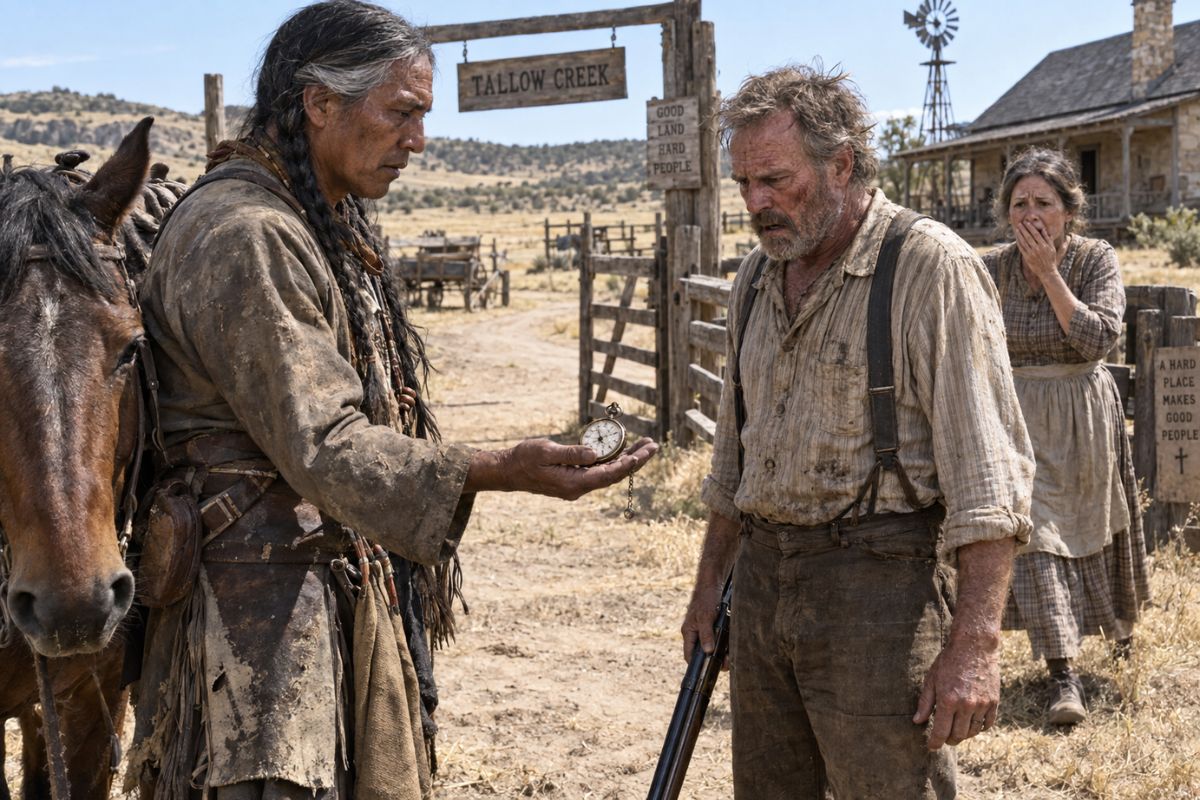
He took something out of his coat pocket and held it out flat on his palm.
A pocket watch. Silver, or it had been. The case was scratched all to nothing and the crystal had a crack running corner to corner like a frozen bolt of lightning. There was no chain.
Amos looked at it and felt the bottom go out of the day.
“That’s Daniel’s,” Nora said.
“Yes, ma’am.”
“You’ve had it twelve years.”
“Yes, ma’am.”
Nora Kittredge put her hand out and took the watch off the man’s palm, and her fingers did not shake, which Amos thought later was the single most extraordinary thing he had ever seen a person do.
She closed her hand around it.
“Amos,” she said, without turning. “Open the gate.”
The county had settled the question of Daniel Kittredge a long time ago, the way counties do—over card tables and church steps and the counter at Dunleavy’s Mercantile, until the settling hardened into something nobody bothered to check.
October of 1871. Daniel Kittredge, thirty-seven, owner of Tallow Creek, riding home alone from the north ridge. Shot. Found the next morning by his own men. There had been raiders along the Willow that fall, everybody said so, and there had been a Comanche rider named Whitehorn working the grass lease country between Quill County and the Sweetgrass Agency, and Whitehorn had been seen on Kittredge land the day before.
That was enough. It was more than enough. Nobody ever brought a charge, because nobody ever found the man, and after a while nobody wanted to.
What people could not settle was the brother.
Amos Kittredge was twenty-nine when Daniel died. He had been a trail boss since he was twenty-two and he had put four thousand head up the Bellwood route without losing more than the weather took. He was not a soft man. He was not a slow one.
And he had never once ridden after Samuel Whitehorn.
He’d buried his brother. He’d taken over the running of a ranch that legally belonged to Daniel’s widow. He’d kept his mouth shut, and in Harmon’s Crossing that silence had turned, over twelve years, into a kind of verdict.
Amos Kittredge never went after the man who killed his brother.
They said it at the livery. They said it at the depot. Once, at a cattlemen’s supper in 1876, a buyer from Kansas had said it loud enough for Amos to hear, and Amos had sat there and finished his coffee and said nothing, and the story of that had outlived the supper by seven years.
There were other things about Tallow Creek that people noticed and put no weight on, because they didn’t fit anywhere.
That Nora Kittredge had turned down three good offers for the north section along Willow Creek—the only reliable water on the place—in years when she plainly needed the money.
That Amos would not ride past the north ridge. Would send anybody, any distance, but that.
That every December, come sleet or short money, somebody from Tallow Creek carried cash east and came back with nothing to show for it.
Twelve years is a long time for a thing to sit in plain sight without anybody picking it up.
They put Samuel Whitehorn at the kitchen table like a neighbor, which no one in the house knew how to do.
Hoyt Ambler, who had cooked for Tallow Creek since before Daniel bought it and was somewhere north of seventy, poured coffee with a hand that rattled the cup and then stood against the dry sink with his arms folded and refused to leave.
Nora set the watch in the middle of the table. It sat there between the four of them like a fifth person.
“Say it,” she said.
Samuel turned his cup a quarter turn. “I didn’t kill your husband.”
“I know that.”
Amos’s head came around.
Nora didn’t look at him. “I’ve known it twelve years,” she said. “I’ve known it since the morning your brother came into my kitchen and couldn’t tell me who did.”
“Nora—”
“You told me raiders. You told me nobody would ever know.” Her voice never rose. That was the worst of it. “Amos, I have been married to a liar and a brother-in-law to one, and I’d sooner talk to the man who was actually there.”
The room was very quiet. Somewhere out past the barn a windmill turned over twice and stopped.
Samuel Whitehorn said, “I was there when he died. I wasn’t there when he was shot. There’s about forty minutes between those two things and I’ve thought about every one of them for twelve years.”
“Tell it,” Nora said.
So he told it.
He’d been riding the Willow bottom that evening, coming up to meet Daniel Kittredge, because the two of them had an appointment they’d been keeping four times a year since 1869. He heard the shot from a half mile off. By the time he got there, the horse was standing over the man, and the man was on his back in the grass with his coat open.
Daniel Kittredge had been conscious for a while. Long enough to say three things.
That he’d seen the rider who did it and knew him.
That the papers were in the ledger, in the book, in the office at the house.
And that Samuel was to keep the north water for the band no matter what happened to Tallow Creek, because Daniel had given his word and a man’s word did not die with him.
Then he’d asked Samuel to take the watch to his brother.
“I didn’t take it to him,” Samuel said. “I took him instead. I carried your husband to within sight of his own gate and left him where his men would find him at first light, and then I rode. Because a Comanche man standing over a dead rancher in Quill County in 1871 does not get asked questions, Mrs. Kittredge. He gets answered.”
Hoyt Ambler made a small sound against the dry sink.
Nora’s hands were flat on the table. “The name,” she said. “He said he knew the rider. Did he say the name?”
“He said it.”
“To you.”
“To me.”
“Then say it here.”
Samuel looked up at Amos for the first time since he’d sat down. “Your brother knows it,” he said. “He’s known it twelve years. Ask him why the town still says it was me.”
Amos walked out.
He got as far as the barn and stood in the shade of the big door with his hat in his hand, and after a while Nora came and stood in the door with him.
“Twelve years,” she said.
“You don’t know what you’re asking.”
“I know exactly what I’m asking. I’ve been asking it since 1871 and you have been handing me a dead man’s coat and telling me to be grateful there was that much.” She waited. “Amos. The note comes due the fourteenth of November. Harlan Crell has offered me forty-one hundred dollars for the north section, which is eleven hundred more than it’s worth to anybody but him, and Roy Teague has told me three separate times this summer that I’d be a fool not to take it, and I have been sitting up nights trying to understand why my husband made me swear I would never sell that water.”
“He made you swear?”
“On the porch. The week before he died.” Her jaw set. “I thought it was sentiment. I have spent twelve years thinking my husband was sentimental about a creek.”
Amos turned his hat in his hands.
“It wasn’t sentiment,” he said.
“No,” she said. “Evidently not.”
Here is what nobody in Quill County knew about Daniel Kittredge, because Daniel had gone to some trouble to see that they didn’t.
In the spring of 1869 he had ridden up to the Sweetgrass Agency in the Territory with a proposition. Tallow Creek’s herd needed summer grass. The agency had grass and hungry people and a beef ration that arrived late when it arrived at all. Daniel offered a lease: grazing rights across the agency’s western range, paid quarterly, in cash, directly to the men who spoke for the band that used that range.
Not through the agency office. Not through the clerk. Hand to hand.
It was, at the time, an entirely legal arrangement and an entirely unusual one. The ordinary way was to pay the agent, and the agent to distribute, and the distribution to be whatever the agent said it was.
The man who spoke for the band was Samuel Whitehorn. He was thirty-two, had spent four years at a mission school he’d run away from at fifteen, and could read a contract better than most of the men who wrote them. That was, in the end, his misfortune.
The arrangement ran two years. It fed people. It fattened cattle.
And in the fall of 1871, Samuel Whitehorn brought Daniel Kittredge a set of figures.
The agency’s books showed grazing fees collected from four outfits on that same western range. Tallow Creek was one of them, listed at a third of what Daniel actually paid. The other three did not exist. And the beef ration, on paper, had been issued in full every month for nineteen months to a population that was eating flour and hope.
The clerk who kept those books was a twenty-eight-year-old man named Harlan Crell.
Daniel Kittredge did what a decent man does. He made copies in his own hand. He wrote a letter to the district superintendent. He told two people what he was doing: his brother, and the man who’d brought him the figures.
Nine days later he was shot on his own land, riding home from the north ridge at dusk.
“I knew inside a week,” Amos said.
They were in the ranch office, the three of them—Amos, Nora, and Samuel Whitehorn, who had not been asked to stay and had not offered to go. The room smelled of leather and cold ash. Daniel’s desk still sat under the window because nobody had ever been able to think of a reason to move it.
“Whitehorn came back,” Amos said. “Ten days after the funeral. Rode in at night. Told me all of it—Crell, the books, the letter, the name Daniel gave him.”
“And you did nothing,” Nora said.
“I did the arithmetic.” Amos looked at the wall. “Nora, in October of 1871 there was no proof. Daniel’s letter never got where it was going. The copies weren’t in the ledger where he said—I looked, I tore that book apart. All I had was the word of a Comanche man that a government clerk had a rancher killed. You know what happens if I ride into Harmon’s Crossing with that? Sheriff Ashbury writes it down. Crell hears about it in a week. And then the story becomes that the Whitehorn band murdered a white rancher and his brother is out of his mind with grief, and the Army rides up the Willow, and it is not Harlan Crell who pays.”
Samuel said, quietly, “I asked him to leave it alone.”
Nora turned. “You asked him.”
“There were two hundred and sixty people on that range, Mrs. Kittredge. Forty of them were children under ten. I did the same arithmetic he did.” Samuel’s hands were flat on his knees. “I told him I’d wear it. I told him let them say it was me. It’s not as if they needed my permission.”
“And you let him,” Nora said to Amos.
“Yes.”
“For twelve years.”
“Yes.”
“And you let this town call you a coward for twelve years rather than tell me.”
Amos said nothing at all.
Nora Kittredge sat down slowly in her husband’s chair.
“The December money,” she said.
“The lease,” Amos said. “Daniel gave his word, and his word didn’t die with him. I couldn’t put it in the books—the bank would have wanted to know why Tallow Creek was paying an obligation that wasn’t on any paper, and there was no paper. So it went through Ada Dunleavy’s store. Credit on the ledger at the mercantile. Flour, coffee, cloth, salt. Every December. Twelve years.”
“Ada Dunleavy.” Nora’s voice was strange.
“Samuel’s sister,” Amos said. “She married Pat Dunleavy in 1866. Pat’s been dead six years and she’s run that store alone ever since, and she has kept her mouth shut about where a third of her December receipts come from, and about a great many other things.”
Nora put her hand over her mouth.
“Ada Dunleavy sold me curtain cloth last spring,” she said. “She asked after you. She always asks after you.”
Harlan Crell came out to Tallow Creek on the second of September, in a buggy, with a bottle of decent whiskey and an offer.
He was fifty now, a heavy, pleasant, well-brushed man who had left the Sweetgrass Agency in 1874 and come back to it in 1881 as acting agent, and who in between had built the North Star Cattle Company out of nothing anybody could point at. He had the best manners in Quill County. People genuinely liked him. That was not an accident; he had worked at it the way other men work at roping.
He sat on the porch and admired the house and got around to it in his own time.
“Forty-one hundred for the north section,” he said. “Nora, I’d take it. I’d take it if I were you and I’d take it quick. You’ve got a hundred and ninety head fewer than you had in June.”
“A hundred and ninety-four,” Nora said.
“There you are.”
“Drought takes some,” she said. “Drought doesn’t drive them off in the night in bunches of thirty.”
Crell’s face did something sympathetic. “No. It doesn’t. And I’ll tell you plain, that’s the other reason I’m out here.” He set his glass down. “There’s trouble on that western range. Whitehorn’s people are off the agency more than they’re on it. I’ve had three outfits complain to me this summer. I’m doing everything I can to keep the Army out of it, but I’m one man with a ledger and there’s only so long I can hold that back.”
Amos was leaning on the porch post. He had not said a word in eleven minutes.
“That’s a hard thing to hold back,” he said.
“It surely is.”
“Must be a strain on you.”
Crell smiled at him. It was a warm smile and it did not reach anywhere. “Amos, I’ve always felt for you. I want you to know that. A man loses a brother and the county decides how he ought to have taken it.” He picked up his hat. “Sell me the water. Pay your note. Let me worry about the Territory.”
He got down the steps and stopped.
“That’s a fine old watch,” he said.
It was lying on the porch table where Nora had set it that morning. Cracked crystal. No chain.
“It was my husband’s,” Nora said.
“Was it. I don’t believe I ever saw it on him.” Crell looked at it a moment longer than a man looks at a watch. “Well. Fourteenth of November.”
The buggy went out the gate. The dust hung and settled.
Hoyt Ambler came out on the porch with a dishtowel over his shoulder and watched it go.
“Mr. Amos,” he said.
“Hoyt.”
“That man asked me a question in May. Out by the smokehouse, real friendly.” The old cook’s jaw worked. “He asked me whether you all ever found Mr. Daniel’s watch.”
Ada Dunleavy was thirty-nine, and she ran the best-stocked mercantile between Harmon’s Crossing and the county line, and she had learned a long time ago how to be exactly as visible as it was safe to be.
Her father had been Comanche and her mother had been Comanche, and she had married an Irish freighter named Pat Dunleavy in 1866 and buried him in 1877, and in between she had raised a son and learned double-entry bookkeeping out of a manual she ordered from St. Louis. In Harmon’s Crossing she was Mrs. Dunleavy, and people were perfectly pleasant to her, and she understood exactly what that pleasantness was made of and how quickly it could be taken back.
When Nora Kittredge walked into the store on a Tuesday morning and asked to see the December ledger, Ada put her hand on the counter to steady herself and said, “Which one?”
“There’s more than one?”
“There’s the one I show the assessor,” Ada said, “and there’s the one that’s true.”
She brought it out of the back. A long gray book with a canvas spine.
Nora opened it on the counter and read.
Dec. 1871 — Kittredge, A. — $310.00 — credit, acct. Whitehorn.
Dec. 1872 — Kittredge, A. — $310.00.
Dec. 1873 — $310.00.
Twelve entries. Twelve years. Three thousand seven hundred and twenty dollars, out of a ranch that had been within sixty days of the sheriff’s door twice.
And below each entry, in Ada’s small upright hand, what the credit had actually bought. Flour. Beans. Coffee. Bolt cloth. Lamp oil. Shoes—children’s, 14 pr.—in the winter of 1875.
Nora read it twice. Then she said, without looking up, “Does he know you wrote down what it bought?”
“He asked me not to.”
“Why?”
“He said if he ever saw the list he’d start thinking of himself as a good man,” Ada said, “and he hasn’t earned that.”
Nora closed the book.
“Mrs. Dunleavy,” she said. “Would you consider having supper at my house?”
Ada Dunleavy looked at her for a long moment.
“No,” she said. “Not yet. Ask me again when you know what you’re asking me to be seen doing.”
The cattle went on disappearing.
They went in the small hours, in bunches, off the far south range where Tallow Creek had two men and eleven miles of nothing. Somebody who knew the country was cutting them out clean and pushing them southeast toward the railhead at Bellwood, and whoever it was had been doing it since the end of June.
Roy Teague, who had been Tallow Creek’s segundo for nineteen years, rode himself gaunt looking for sign and came back every time with the same answer.
“Raiders off the agency,” he said, in the bunkhouse, in front of six men. “Same as ever. Amos, I’ll say it and you can hate me for it—this started up the same month Whitehorn’s bunch drew short rations. You can draw a line between those or you can not draw it.”
“You’re awful quick to that line, Roy.”
“I’ve been quick to it since ‘seventy-one.” Teague was forty-eight, sun-cured, missing the top joint of a finger, and the best judge of a horse Amos had ever ridden beside. “You want me to be sorry about it?”
“I want you to explain to me,” Amos said, “how raiders off the agency know which eleven miles of this outfit are unwatched on which nights.”
Teague’s face didn’t change. But he did a thing Amos had seen him do maybe four times in nineteen years: he reached down and set his coffee cup on the floor, carefully, as though it had gotten heavy.
“Anybody can watch a ranch,” he said.
Later, Amos stood in the dark outside the bunkhouse and thought about a dozen small things that had never fit anywhere.
That Roy Teague had ridden for a freight outfit out of the Territory in 1870 and 1871 before he came to Tallow Creek.
That Roy Teague, who would ride anything, anywhere, had never once in nineteen years gone up past the north ridge, and always had a reason.
That Roy Teague had been the one who found Daniel’s body at first light.
That when Nora Kittredge had set a cracked silver watch on the porch table that morning, Roy Teague had walked around it.
The letter came up from the house at dusk, carried by a boy of seventeen with his mother’s straight back and his uncle’s way of sitting a horse.
Charley Dunleavy had ridden four hours. He handed it down without getting off.
“From my mother,” he said. “She says read it before you do anything.”
Amos broke the seal.
Amos — H.C. came to the store Thursday. He asked whether Tallow Creek had ever run an account here under any name but its own. I told him no. He looked at my ledger shelf while he asked. He will come back with a reason to look. — A.D.
Amos folded it once.
“You’ll stay the night,” he said. “It’s too far back.”
“I’d rather not.”
“I know it. Stay anyway.”
The boy sat his horse another moment. He was very young and very tired and holding himself the way young men hold themselves when they’ve decided to be hard about something.
“My uncle’s been blamed for your brother twelve years,” he said. “My mother’s fed your conscience twelve years. I’ve been called what I’ve been called at the depot since I was six. And now you’ve got a problem, so now there’s supper.”
“Charley—”
“My name’s Charles Dunleavy and I’m not staying in your bunkhouse,” the boy said. “I’ll camp at the creek.”
He turned the horse.
Amos let him get twenty feet.
“Your uncle was coming to meet my brother that night,” he said. “They had an appointment four times a year for two years and neither one of them ever missed it. Whatever else is true, that’s true. Two men rode a long way, four times a year, to keep their word to each other. That’s not nothing to come from, son.”
The boy stopped. He didn’t turn around.
He camped at the creek. But in the morning Hoyt Ambler carried coffee down to him, and the boy drank it.
The ledger pages were the thing.
Daniel had said it with the last of his breath: the papers are in the ledger, in the book, in the office. Amos had torn the office apart in November of 1871 and found the ranch ledger exactly where it lived, and nothing in it but cattle and wages and feed.
Nothing in it, and three pages cut out close to the spine.
He had assumed for twelve years that whoever killed Daniel had come for them. It had never once occurred to him to wonder how a man would know to look, or how he’d have gotten into a house full of grieving people to do it.
It occurred to him now.
He found Nora in the office at nine at night with the lamp turned low and both hands flat on the desk.
“You cut them out,” he said.
She didn’t deny it. She had never in her life denied anything she’d done.
“February of 1872,” she said. “I found them in the back of his Bible, not the ledger. He must have moved them the week he wrote the letter.” She swallowed. “The lease. Two copies of the agreement, signed by Daniel and by Samuel Whitehorn, quarterly payment of three hundred and ten dollars, binding on Tallow Creek and on his heirs. And four pages in Daniel’s hand copying out the agency accounts with the false entries marked.”
“You had the proof.”
“I had a ranch with a dead owner, a nine-thousand-dollar note coming due, and a bank that was going to ask me what else my husband had signed.” Her voice finally cracked, once, and she put it back together. “Mr. Pettibone at Cedar County was looking for a reason to call that note. If he’d seen a contract obligating this outfit to pay twelve hundred and forty dollars a year to a Comanche band in the Territory, he’d have had it. We’d have been off this place by the summer of ‘seventy-two.”
“So you cut them out of the Bible—”
“So I cut them out and I put them where the bank would never look and I told the bank the truth as far as it went, and I kept your brother’s ranch.” Nora stood up. “And I thought—God help me, Amos, I thought the rest of it had died with Daniel. Raiders. You told me raiders. I had no idea I was hiding the name of the man who killed him.”
They stood on opposite sides of the desk.
“You protected the ranch,” Amos said at last.
“I protected the ranch.” She laughed, and it was an awful sound. “And you protected a band of two hundred and sixty people, and Samuel Whitehorn protected all of us by letting himself be called a murderer, and Ada Dunleavy protected every one of the four of us for twelve years for nothing but the privilege of not being asked to supper. And the only man in this whole business who has not had to protect anybody is Harlan Crell, who sleeps fine.”
She pulled open the bottom drawer of her husband’s desk, lifted out the false bottom Daniel had built there for money, and took out an oilcloth packet.
She laid it on the desk between them.
“The fourteenth of November,” she said. “That’s what we’ve got. After that the bank owns the argument.”
They tried, first, to do it the quiet way.
Amos rode to Harmon’s Crossing and sat in Sheriff Tom Ashbury’s office for two hours, and laid out what he had, and watched a sixty-four-year-old man go gray in front of him.
Ashbury had been sheriff in 1871. Ashbury had ridden out to Tallow Creek that October morning, looked at the body, listened to a foreman named Roy Teague describe sign he said he’d cut on the north ridge, and written party or parties unknown, believed raiders.
“I never went up there myself,” Ashbury said. “It was in a hard month. There was trouble up and down the Willow that fall and I had one deputy.” He took his hat off and set it on the desk, and looked at it. “That isn’t why, though. I want you to know I’m not going to sit here and tell you it was the workload.”
“Why, then.”
“Because the answer everybody wanted was already sitting there,” Ashbury said. “And I was forty-two years old and up for election.”
He was quiet a while.
“I can arrest Roy Teague on your say-so and Whitehorn’s, and a county jury will turn him loose in an afternoon and I’ll have shown Harlan Crell exactly what we’ve got,” he said. “Or I can be useful.”
“How?”
“Crell’s fraud is federal. It’s agency money. That’s not my jurisdiction and it’s not this county’s—which means it’s not this county’s to bury.” Ashbury put his hat back on. “There’s a commissioner riding circuit out of Bellwood, and there’s a Major Ewell at the post who has been trying for two years to find out where his beef contracts are going. Get those papers in front of the right man and Crell’s whole arrangement comes apart.”
“And Teague?”
“Teague goes with it or Teague doesn’t.” The old sheriff looked at him. “Amos. You understand that the minute you hand that packet over, every man in this county is going to learn that you sat on it twelve years.”
“Yes.”
“They’ll say worse things about you then than they say now.”
“They can.”
“And your sister-in-law cut evidence out of a Bible and hid it from her banker, which may not be a crime but is going to get talked about like one.” Ashbury rubbed his jaw. “And this outfit’s note comes due the fourteenth, and Harlan Crell’s forty-one hundred dollars is the only money in Quill County that’ll cover it, and the second you go after him that money is gone forever.”
He waited.
“Now,” he said. “Do you want me to be useful, or do you want to go home and think about it?”
Harlan Crell made his last offer on the eleventh of October, and it was a good one, and it was not really about money at all.
He came out at supper time. He’d raised the number to forty-eight hundred for the north section, which was absurd, and then he set his hat on his knee and said the rest of it plainly, because he was a plain man when plainness paid.
“I’m going to say something I’d rather not,” he said. “There’s a report on my desk recommending that I ask for troops on the western range this winter. Rustling, trespass, stock losses. I’ve been sitting on it since August.” He turned the hat a quarter turn. “If Tallow Creek’s losses go into that report, it goes east. If they don’t, I’ve got room to argue the whole thing’s drought and bad luck, and Whitehorn’s people winter where they are.”
Nora Kittredge said, “You’re telling me that whether two hundred and sixty people are moved off their range this winter depends on whether I sell you a creek.”
“I’m telling you it depends on what’s in a report,” Crell said. “I’d like it to be a short report. Ma’am, I’m not the villain in this. I’ve spent my life in the space between what Washington sends and what’s actually needed, and I’ve done more good in that space than the men who write the rules ever did. You’ve been running this ranch with a hole in the books for twelve years. Don’t sit there and tell me you don’t understand a man who takes the practical route.”
That was the sentence Amos thought about afterward. Don’t tell me you don’t understand a man who takes the practical route.
It was the only true thing Harlan Crell had ever said to him, and it was aimed like a rifle.
“I’ll have an answer by the fourteenth of November,” Crell said, and got up.
At the door he stopped and looked at the porch table, where the watch was not.
“You moved it,” he said.
“It’s a watch, Mr. Crell,” Nora said. “It’s in a drawer.”
“Of course it is,” he said, and went out to the buggy.
Amos found Roy Teague in the north pasture two days later, alone, mending a stretch of wire that didn’t need mending, and rode up and got down and stood on the other side of the fence from him.
“I’m going to ask you once,” he said, “and then I’m going to ride to Bellwood on Monday.”
Teague went on twisting wire.
“Nineteen years,” Amos said. “You broke every horse on this place. You pulled me out of the Willow in ‘seventy-six when it was running ice. You sat up with Hoyt when he had the pneumonia. I have trusted you with everything I own and most of what I am.”
“Say it, then.”
“Did you shoot my brother?”
The pliers stopped.
Roy Teague stood there with his hands on the wire and the wind coming across nine hundred acres of dead grass, and he did not look up.
“I was twenty-six,” he said.
Amos put his hand on the fence post. He found he needed it.
“I was freighting for Crell out of the agency,” Teague said. “He was a clerk. He paid me extra to carry things that weren’t on the manifest and I didn’t ask what, because nobody ever asks what. And in October he came to me and said there’s a rancher going to make trouble, and he’ll be on the north ridge road at dusk, and I want him turned back.”
“Turned back.”
“That’s the word he used. That’s the word I let him use.” Teague’s voice was perfectly level and perfectly dead. “I sat that ridge in the dark like a man waiting to turn somebody back. I had a rifle across my knees like a man waiting to turn somebody back. And he came up the road and I called out to him and he didn’t stop, and I—”
He stopped.
“It was fast,” he said. “That’s all I’ll say about it, and I’ve never said that much. It was over before I understood what I’d become.”
“And then you rode to this ranch,” Amos said, “and asked my brother’s widow for a job.”
“Crell sent me. He wanted somebody inside.” Teague finally looked up, and his eyes were wrecked. “I came here to be his man. Amos, I came here to be his man and I stayed nineteen years and I could not do it. I have fed his information in scraps and I have fed him lies twice as often and I have kept this outfit alive with these hands because it was the only—”
He didn’t finish.
“You found the body,” Amos said.
“I went back at four in the morning to move him and he was already moved. Somebody had carried him down to the gate.” Teague wiped his face with his forearm. “I’ve wondered twelve years who was decent enough to do that.”
“It was Samuel Whitehorn.”
Roy Teague laughed once, and it was a terrible sound, and then he was quiet a long time.
“The cattle this summer,” Amos said.
“Crell’s men. I gave him the south rotation in June because he told me he’d take the note off Mrs. Kittredge’s back if I did, and I convinced myself that was a mercy.” Teague set the pliers down on the fence wire. “There’s four hundred and ten head of this outfit’s beef in a holding pasture nine miles the other side of Bellwood under a North Star road brand, and I can take a federal marshal to it, and I can tell him whose hand wrote the tally.”
He straightened up.
“Amos, I’m not asking for anything. I know what I am. I’ve known every morning for twelve years and it never once got easier, and the only reason I never rode off a bluff is that I’d have left this place short a man in calving season.” He said it flatly, without self-pity, as a fact about a life. “Do what you’re going to do. But take me to Bellwood with you. Let me be the one that says it out loud in front of somebody official. It’s the last useful thing in me.”
Amos Kittredge stood there with his hand on a fence post and wanted, for about four seconds, to do the thing every story in Quill County said he should have done in 1871.
He had a rifle on his saddle. The man had confessed. There wasn’t another soul for six miles.
He thought about his brother lying in the grass telling a near-stranger to keep his word about a creek.
He took his hand off the post.
“Put your tools up,” he said. “We leave Monday.”
They did it in Bellwood, in a room over the land office, in front of a circuit commissioner named Vestry and a tired major from the post named Ewell, on the nineteenth of October, and it took nine hours and it was not dramatic in the least.
That was the thing nobody would ever believe afterward. There was no shouting. There was a table, and a great deal of paper, and a man taking notes.
Nora Kittredge put the oilcloth packet on the table and explained, in a voice that never once wavered, what was in it and why it had been in the bottom of her husband’s desk for eleven years and what she had done with a razor and a Bible in February of 1872.
Ada Dunleavy brought the gray canvas ledger and laid twelve December entries under the commissioner’s lamp, and when Vestry asked her why a woman would carry another family’s secret for twelve years for no consideration, she said, “Because the alternative was children without shoes, sir,” and did not elaborate.
Samuel Whitehorn testified for two hours and forty minutes, mostly about numbers, because numbers were what would finish Harlan Crell. Rations issued on paper against rations received. Four outfits billed for one outfit’s grass. He had kept his own tally since 1870 in a leather book, and Major Ewell went through it page by page with his jaw getting tighter.
Roy Teague went last.
He said it out loud in front of somebody official, exactly as he’d asked to, and when he was done he stood up and put his hands out in front of him and Sheriff Ashbury, who had ridden over for it, took him into custody in a room so quiet you could hear the commissioner’s pen.
At the door Teague stopped and looked back at Amos.
“The gray horse favors his off hind in cold weather,” he said. “Don’t let the new man work him past noon.”
“I won’t.”
“All right, then,” Roy Teague said.
It came apart for Harlan Crell over the winter, the way such things actually come apart—slowly, in paper, with no one to applaud.
The federal charges were fraud against the government: false vouchers, false issue returns, collection of grazing fees never entered on the agency books. Four hundred and ten head of Tallow Creek cattle were found in a Bellwood holding pasture and returned in January, thinner than they’d left.
The murder of Daniel Kittredge was a county matter and it went the way county matters go. Roy Teague pled to it and went away to the state penitentiary, and he named Harlan Crell, and Harlan Crell’s attorneys pointed out—accurately—that a confessed killer’s word twelve years after the fact was a thin rope. The county grand jury did not indict Crell for the killing.
He went east under federal escort in March to answer for the money.
Amos Kittredge never saw him again, and never got the thing he’d wanted since he was twenty-nine, and had to learn to live with that, which took him some years.
What Harlan Crell did give him, without meaning to, was a fact that spread across Quill County faster than any court ruling: that Samuel Whitehorn had not killed anybody, and that everyone had spent twelve years being certain he had, and that the certainty had cost them nothing and cost him everything.
Harmon’s Crossing did not apologize. Towns don’t.
But in April, when Ada Dunleavy came into the Methodist church for the first time in eleven years, three women moved down the pew to make room, and one of them was Nora Kittredge.
The note came due on the fourteenth of November, and there was no forty-eight hundred dollars from Harlan Crell, because Harlan Crell was by then explaining himself to a commissioner.
Mr. Pettibone at Cedar County Bank was neither cruel nor kind. He was a banker. He extended sixty days on the strength of the recovered cattle and then he wanted his money.
So Tallow Creek sold the south range.
Four thousand two hundred acres, all the ground below the wagon road, to a homesteading family named Vosberg out of Kansas and a neighboring outfit called Three Pines, in two parcels, in February. It was more than half the ranch. It was the ground Amos had learned to rope on.
They kept the north section. Every acre of it, and the water.
Nora signed the papers at the kitchen table and then went out and stood on the porch for about twenty minutes in the cold, and then came back in and started supper.
They kept four men on out of eleven. Hoyt Ambler, who was seventy-three and had nowhere else and was not going anywhere. Two of the younger hands.
And Charles Dunleavy, seventeen, who had ridden up from Harmon’s Crossing in January with his blankets behind his saddle and announced that he could break horses better than anybody left on the place, which turned out to be true.
He did not sleep in the bunkhouse that first week. He camped at the creek.
By the second week he was in the bunkhouse. Nobody made a speech about it. Hoyt just set a fifth plate and kept setting it.
In March, Samuel Whitehorn and Nora Kittredge sat at the kitchen table at Tallow Creek and did a piece of business that took them four hours and two pots of coffee.
The old lease was dead. The band’s situation had changed; the agency had changed; the man who’d signed it was twelve years in the ground.
What they wrote instead was shorter.
Tallow Creek Ranch held the Willow Creek water in the north section. In dry years—and there would be dry years—the band had the right to water stock there, and to cut hay off the bottom, and to camp on it, for as long as the Kittredge name was on the deed. In return Tallow Creek had summer grass on the western range at three hundred and ten dollars a quarter, paid hand to hand.
It was not charity in either direction, which was the only way either of them would have signed it.
“Your husband offered me this in 1869,” Samuel said, “and I thought he was a fool.”
“He was, some,” Nora said. “He was also right.”
She signed it. Amos signed as witness. Samuel signed, and then sat back and looked at his own name on a piece of paper in a white woman’s kitchen in Quill County, Texas, and said nothing for a while.
“Fourteen years,” he said finally. “I’ve been the man who killed Daniel Kittredge for fourteen years. Two before he died, if you count the ones where people just assumed I would.”
“And now?”
“Now I’m the man who’s going to spend the next fourteen explaining that I wasn’t.” He almost smiled. “It’s better. I want to be clear that it’s better. It’s just not the same as if it hadn’t happened.”
Nora Kittredge said, “No. It isn’t.”
She got up and went to the dresser and came back with something wrapped in a dish towel.
“I want you to take this,” she said.
Samuel unwrapped it. The cracked silver watch lay in his hand for the second time in his life.
He set it back on the table.
“No, ma’am.”
“Samuel—”
“I carried that watch twelve years and it was the heaviest thing I ever owned,” he said. “I don’t want it. I want to be done wanting to hand it to somebody.” He pushed it an inch toward her. “Give it to somebody who’ll just think it’s a watch. That’s what a thing like that is supposed to be.”
Here is the last of it.
In May it rained—a real rain, two days of it, coming off the caprock with thunder in front and the Willow running brown and loud for the first time in three years. Every man on the place went out and stood in it like a fool.
On the second morning Amos Kittredge rode up to the north ridge.
He had not been up there since the twenty-ninth of October, 1871, when he had come up alone to look at a stretch of road and gone home again without getting off his horse.
He got off his horse this time. He walked the ridge road for about a quarter mile, in the wet grass, with his hat in his hand, and he did not find anything, because there was nothing to find, because twelve years is twelve years and grass grows.
He stood there a while.
“I let them say it was him,” he said out loud, to nobody, to a road. “You’d have hated that. But I couldn’t work out another way that didn’t cost more than it bought, and I’ve spent twelve years checking the arithmetic, and Danny, I still can’t.”
The wind came up the ridge.
“Your creek’s still ours,” he said. “Cost us the south range to keep it. Nora signed the papers. Your boy Whitehorn’s got hay rights on it now and I expect you knew he would.”
He put his hat back on.
“That’s all,” he said. “That’s what I came up for.”
He rode down.
The boy was in the round corral when Amos got back, working a green three-year-old in the mud, and he was good—better than good, better than Amos had been at that age, with a quality of patience in him that came from somewhere a long way back.
Amos leaned on the rail and watched him for fifteen minutes without saying anything, which is a thing men of that country do instead of praise.
When Charley finally brought the colt in and turned him loose, he came over to the rail wiping his hands on his thighs.
“He’ll do,” the boy said.
“He will.”
Amos took the watch out of his pocket.
He’d carried it since March. Nora had set it in front of him one night at the table and said you finish it, and he had put it in his coat and not known what finishing it meant until about an hour ago on a wet ridge road.
He held it out over the rail.
Charley Dunleavy looked at it and did not take it.
“That’s your brother’s,” he said.
“It was. Then it was your uncle’s for twelve years, and I don’t guess he ever told you that.” Amos kept his arm out. “It’s a bad watch, Charley. It hasn’t kept time since before you were born. The crystal’s cracked and the chain’s gone and you can’t sell it for two dollars.”
“Then why are you giving it to me?”
Amos thought about how to say it.
“Because everybody who’s held it so far has held it like it was evidence,” he said. “I’d like it to go to somebody who’ll just put it in his pocket.”
The boy took it.
He turned it over once, and rubbed his thumb across the cracked crystal the way every person who had ever held that watch had done, and then he put it in his shirt pocket and buttoned the flap, and that was that.
“I’m going down to my mother’s Saturday,” he said. “You want me to carry anything?”
“Nora’s got a letter for her. And Hoyt wants sixty pounds of coffee, which he does not need.”
“All right.”
Charley climbed the rail and dropped down on the other side and went to get his saddle.
Amos Kittredge walked out toward the road in the last of the light.
The gate stood at the end of the wagon road where it had stood for twenty years—two posts, a crossbar, and the brand burned into the wood above it. Tallow Creek’s mark was an open hand. Daniel had made it up in 1863 because he couldn’t draw anything else, and for twenty years it had meant nothing in particular except this stock is ours.
Amos stopped in front of it.
Twelve years ago he had stood on this spot at four in the morning with a lantern, looking down at what somebody had carried a mile and a half in the dark so that a man’s own hands would find him.
He had never known who until he was fifty-six years old.
He reached up and put his palm flat against the burned mark in the crossbar, the way you’d steady yourself on a fence post, and stood there a minute.
Then he went and unfastened the gate and swung it wide, and hooked it back against the post, and left it that way for the night, because there was a rider expected in the morning from the Territory and the ranch had gotten out of the habit of making people wait at the fence.
Thank you so much for reading this story!
I’d really love to hear your comments and thoughts about this story — your feedback is truly valuable and helps us a lot.
Please leave a comment and share this Facebook post to support the author. Every reaction and review makes a big difference!
This story is a work of fiction created for entertainment and inspirational purposes. While it may draw on real-world themes, all characters, names, and events are imagined. Any resemblance to actual people or situations is purely coincidental.