“Absolutely not.”
Dean Mercer said it so quickly that his daughter thought he had misunderstood the question.
Hannah stood at the end of the kitchen island with a stack of cream-colored wedding invitations tucked against her chest. One had no stamp on it yet.
She had written Raymond Mercer across the front in careful blue ink.
Her father stared at the name as if she had brought something dead into the house.
“Dad.”
“I said no.”
“You didn’t even let me finish.”
“You were going to ask if your grandfather can come to the wedding.”
Hannah lowered the envelope.
“He asked me.”
Dean’s jaw tightened.
Outside the kitchen window, the late-August heat shimmered above the driveway. Two of Dean’s roofing-company trucks sat near the detached workshop, ladders strapped to their racks, white doors marked with the blue mountain-shaped logo of Mercer Ridge Roofing.
Dean had built the company from one truck and three borrowed ladders.
At forty-eight, he employed twenty-six people, owned the modest brick house outright, and could look at a roof from the road and tell you within a year when it would start leaking.
He believed most problems could be fixed if a person was willing to climb high enough, work long enough, and stop making excuses.
Raymond Mercer was the exception.
“He’s dying,” Hannah said.
“Everybody is.”
“His doctor told Aunt Marissa that it could be months.”
Dean turned toward the refrigerator and opened it although he didn’t take anything out.
“Then Marissa can visit him.”
“He wants to see me get married.”
Dean closed the refrigerator.
“Somebody doesn’t get to disappear when his family needs him, come back when the worst part is over, and then ask for a front-row seat because he’s running out of time.”
Hannah had heard pieces of the story all her life.
Her grandmother Joanne had become seriously ill when Dean was young.
Raymond disappeared for long stretches.
Money vanished.
Joanne died.
Raymond returned too late.
And when his thirty-year-old son demanded an explanation, Raymond had given him the closest thing Dean ever received to one:
Maybe I stayed away because being here wasn’t worth coming back to.
Dean had walked out that night.
For nearly eighteen years, father and son had spoken only when funerals, paperwork, or family emergencies made silence impossible.
Hannah had been six.
Most of what she knew about Raymond came from brief birthday cards, Christmas checks for fifty dollars, and the occasional stiff visit arranged by her aunt.
There had never been a screaming feud.
That would almost have been easier.
Instead, there was absence.
A seat nobody mentioned.
A name that changed the temperature in a room.
“Grandpa didn’t ask for the front row,” Hannah said quietly. “He said he’d sit wherever we wanted.”
Dean gave a short, humorless laugh.
“That sounds like him. Humble when humility costs nothing.”
“Dad.”
“No.”
“You always tell me family matters.”
“Family does matter.”
“Then why—”
“Because that’s exactly why.”
His voice rose for the first time.
Hannah stopped.
Dean put both palms flat against the island. His fingers were thick from thirty years of construction work, his left thumbnail permanently ridged from an old hammer injury.
“Your grandmother was sick,” he said. “I was there. Your aunt was a little girl. He wasn’t there. I watched my mother try to pretend she wasn’t scared because she had two kids watching her. I watched bills stack up. I watched her sell jewelry. And while all that was happening, he was gone.”
Hannah swallowed.
Dean pointed at the invitation.
“You don’t know what you’re inviting into that room.”
“Maybe I’m inviting an old man who wants to see his granddaughter get married.”
“You’re inviting my father.”
The distinction sat between them.
Hannah looked down at Raymond’s name.
Then she slowly tore the envelope in half.
Dean’s shoulders relaxed by less than an inch.
She dropped the pieces into the trash.
“Okay,” she said.
He nodded once.
“Thank you.”
Hannah picked up the remaining invitations and left.
Neither of them noticed that Dean kept staring at the trash can long after the back door closed.
The brass key arrived four days later.
There was no note.
No card.
No explanation.
Just a padded envelope addressed to Hannah in Raymond’s shaky handwriting.
Inside was an old brass house key on a faded green string.
Hannah recognized it immediately.
Her grandfather’s house stood twelve miles outside the fictional North Carolina town of Weller’s Crossing, on a two-lane road where soybean fields had slowly been replaced by subdivisions and self-storage buildings.
Dean had grown up there.
Raymond had remained there until worsening heart failure and several falls convinced Marissa to move him into Pine Hollow Assisted Living, a small privately owned residence twenty minutes away.
The house had been empty for seven months.
“What does he expect you to do with that?” Hannah’s fiancé, Caleb, asked.
They were sitting on the floor of their apartment sorting table-number cards.
“I don’t know.”
Caleb turned the key over in his palm.
“He didn’t write anything?”
“Nothing.”
Caleb Miller was twenty-six and taught eighth-grade history. He approached family conflict the way he approached difficult parents at school—with caution, evidence, and a strong preference for not saying anything irreversible before dinner.
“Are you going to ask him?”
Hannah shook her head.
“Dad will think Grandpa is manipulating me.”
“Is he?”
“I don’t know.”
She hated that answer.
For most of her life, the Mercer family story had been simple.
Her grandfather had failed.
Her father had endured.
That was the geometry of it.
Then Raymond had mailed a key without a word, and somehow the silence felt more complicated than an explanation would have.
Two days later, Hannah called her aunt.
Marissa answered on the fourth ring.
“Everything okay?”
“Grandpa mailed me his house key.”
Silence.
Then, “The brass one?”
“Yes.”
Another pause.
“What?”
“Nothing.”
“Aunt Marissa.”
“I don’t know what he wants you to find.”
Hannah sat straighter.
“I didn’t say he wanted me to find something.”
“No. I suppose you didn’t.”
“What is going on?”
Marissa exhaled.
“Your grandfather has spent his whole life communicating like he’s being charged by the word.”
“That is not an answer.”
“No.”
“Do you know why he sent it?”
“I know he asked me last month whether the house was still exactly how he left it.”
“And?”
“And I told him mostly.”
“Mostly?”
“I cleaned the refrigerator.”
Despite herself, Hannah laughed.
Marissa didn’t.
“Hannah, be careful.”
“Of what?”
“Thinking that finding an answer always makes things simpler.”
That sentence bothered Hannah more than the key.
She went to the house the following Saturday.
She told Dean she was looking for photographs of Joanne to display at the wedding.
That part was true.
He hesitated.
Then he said, “Check the hall closet. Mom kept albums on the top shelf.”
He did not ask how Hannah planned to get inside.
The old Mercer house was smaller than she remembered.
A one-story ranch with pale siding, black shutters, and a front porch Raymond had rebuilt twice because he never liked the angle of the steps.
When Hannah unlocked the door, the house smelled faintly of dust, cedar, and the peppermint candies her grandfather had always kept in a glass dish.
The furniture remained.
Raymond’s brown recliner.
Joanne’s china cabinet.
A narrow dining table with four chairs, though there had once been five.
Hannah stood inside for several seconds listening to nothing.
Then she began opening closets.
She found photographs quickly.
Dean in a football uniform, seventeen and impossibly skinny.
Joanne laughing beside a birthday cake.
Raymond holding a toddler Marissa on his shoulders.
Dean at twenty-two, standing beside an old pickup with his arm around Joanne.
Hannah had never seen that photograph.
She studied her father’s face.
He was grinning.
Not politely.
Not cautiously.
He looked happy.
Raymond stood behind him, one hand resting on the truck bed.
They had once been a family that touched one another without thinking.
That seemed almost more startling than the key.
Hannah packed three albums into a cardboard box.
Before leaving, she walked through the attached garage.
She wasn’t looking for anything particular.
The garage had been Raymond’s territory.
Pegboard tools.
Coffee cans of nails sorted by size.
A red metal toolbox.
An ancient radio with masking tape holding the battery cover shut.
A heavy wooden workbench scarred by decades of saws, clamps, paint cans, and repairs.
Hannah ran one finger along the bench.
Then she noticed the wall.
Most of the drywall was yellowed with age.
But a narrow rectangle behind the workbench looked different.
Not new.
Just newer.
The plaster had a pale gray tone, and one edge had cracked.
She crouched.
The lower portion had been damaged, perhaps when someone moved the bench.
A piece shifted beneath her fingers.
Hannah pulled it loose.
Behind it was darkness.
She frowned and shined her phone flashlight into the gap.
Metal reflected back.
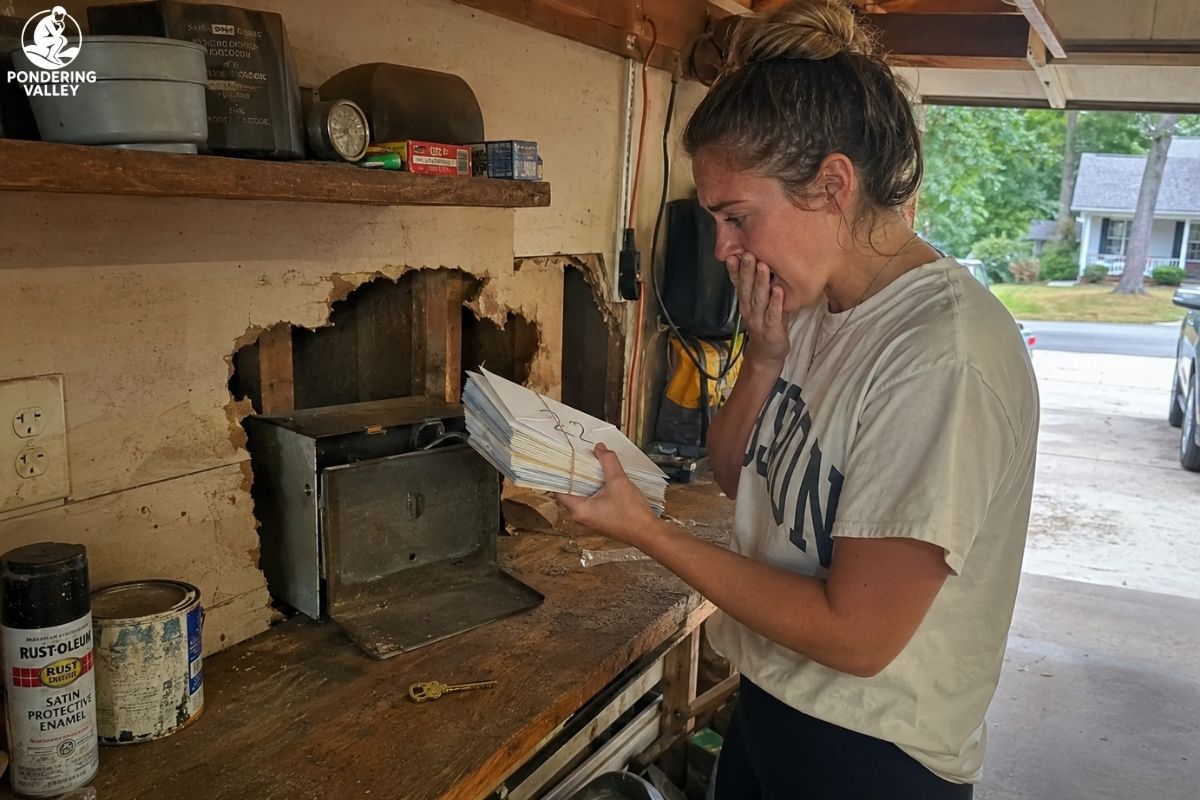
She moved the workbench with considerable effort, removed another already-broken piece of drywall, and reached into the opening.
Her fingertips touched a cold handle.
The box was rectangular, dented at one corner, and heavy enough that she had to use both hands.
An old green cash box.
It had no lock.
Hannah set it on the workbench.
For nearly a minute, she didn’t open it.
Then she lifted the lid.
Inside were letters.
Dozens of yellow and white envelopes stacked in two bundles.
Twenty-two, she would later count.
Every one was addressed to:
Dean Mercer.
Her father.
Some said simply Dean.
Some said Dean Mercer, Mercer Ridge Roofing but had no street address.
One bore an address from an apartment Dean hadn’t lived in since Hannah was in elementary school.
None had stamps.
None had been mailed.
Hannah’s pulse seemed to move into her throat.
She picked up the oldest envelope.
The paper had yellowed.
Across the upper corner Raymond had written:
October 14, 1995.
Hannah did the math.
Her father had been seventeen.
She heard Marissa’s warning in her head.
Be careful thinking that finding an answer always makes things simpler.
Hannah opened the letter.
Dean,
Your mother says writing things down may keep me from saying them wrong.
She may be right. She usually is, though I ask you not to tell her I put that in writing.
Hannah smiled before she meant to.
Then she kept reading.
The smile vanished.
I’m leaving Tuesday for Tennessee.
I told you it was a job. That part is true.
What I didn’t tell you is why I took it.
Your mother’s insurance is not going to cover nearly enough of the treatment they’re discussing. We don’t know yet what will happen, and I don’t want you carrying numbers you can’t do anything about.
The contractor says there’s ten weeks of work if the weather holds. Twelve-hour days, maybe more. Good travel pay.
You have scouts coming Friday.
Go to practice.
Do not quit.
Your mother made me promise not to tell you what this is costing.
Her exact words were: “Let him hate us before you let him give up his future.”
Hannah stopped breathing for a moment.
Then read that sentence again.
And again.
The garage seemed suddenly too small.
Her father’s version of the past had contained several immovable facts.
Raymond disappeared.
Raymond drained their money.
Raymond left Joanne to face treatment without him.
But here, in handwriting Hannah recognized from birthday cards, Raymond claimed he left to earn money for that treatment.
She reached for the second letter.
It was six weeks later.
The motel television has three channels and two of them look like snow.
My foreman says that gives me fewer reasons to stay awake, which is probably true.
Your mother says you ran 118 yards Friday.
I told the men here my son is going to college.
I did not tell them you still leave your wet towels on the floor.
The letter shifted abruptly.
They added another charge this week. I covered it.
Do not ask your mother about money.
I know you think I’m choosing work over being there.
Someday I hope you understand I am trying to choose both.
Hannah sat on Raymond’s old stool.
The next letters came years apart.
Joanne’s first treatment had been more successful than Hannah knew.
She had gone into remission.
Dean had attended college on a partial athletic scholarship but stopped playing after a knee injury. He returned to North Carolina, learned roofing, married Hannah’s mother, Lisa, and started working toward a business of his own.
Raymond’s letters documented the family from the edges.
Some had apparently been written while father and son were still speaking.
They weren’t apologies then.
They were things Raymond could not make himself say aloud.
Then Joanne’s illness returned.
This time, when Dean was thirty and Marissa was nine, there was no long remission.
Raymond again took traveling work.
By then, Dean had a six-year-old daughter and a roofing business hanging together by borrowed equipment and overdue invoices.
Raymond and Joanne kept their financial arrangements hidden from him.
And according to the letters, money had not disappeared from Joanne’s accounts.
Raymond had put money in.
A lot of it.
One envelope contained photocopies of old deposit slips.
Another included handwritten job totals.
$6,420.
$9,880.
$11,100.
$7,350.
Job after job.
State after state.
Tennessee.
West Virginia.
Kentucky.
Virginia.
Georgia.
Raymond had spent months doing industrial roofing, bridge-deck repair, and temporary construction work that paid traveling crews more than he could earn locally.
Across several years of Joanne’s two periods of treatment, the amount exceeded $84,000.
Hannah pressed both hands to her face.
Her father had built eighteen years of anger around the belief that Raymond had emptied the family’s savings.
Where had that belief come from?
The answer was in another letter.
Joanne had used much of the household savings first.
Raymond’s income replaced it quietly.
Dean had seen the dwindling account statements before Raymond’s later deposits began arriving.
Joanne had apparently told him the money was “handled” and refused to explain.
Raymond wrote:
She thinks if you know I’m out here paying those bills, you’ll sell your truck, shut down the business and come home.
She says you already tried to leave college once when she got sick the first time.
Maybe she knows you better than I do.
That sentence is harder for me to write than you’d think.
Hannah leaned back against the workbench.
She could hear her father at seventeen.
I can work.
I can come home.
Football doesn’t matter.
She could hear Joanne answering.
Yes, it does.
Then she remembered another piece of the family story.
Dean had always described his mother as brave.
Selfless.
Almost incapable of making a wrong decision.
Hannah suddenly understood what her aunt had meant.
The truth did not rescue one person without complicating another.
She looked at the remaining letters.
Most were dated after Joanne’s death.
That was when the handwriting changed.
The sentences got shorter.
More uncertain.
Raymond’s anger disappeared from the page.
Shame replaced it.
One letter began:
I have rewritten the first sentence four times.
Another:
Marissa says I should call you.
Another:
I drove past your new shop today. I did not stop.
Then:
Hannah started first grade this week. Your sister sent me a picture.
Then:
Congratulations on the county business award. I saw your photograph in the paper.
Hannah stared at that one.
Dean still had the framed newspaper clipping in his office.
A photograph showed him shaking hands with the local chamber president in front of his original five-man crew.
Raymond had clipped the same article.
It was folded inside the envelope.
Her grandfather had written in the margin:
He looks tired but proud.
Hannah shut her eyes.
This wasn’t proof that Raymond had been a good father.
It wasn’t proof that Dean’s pain was wrong.
It was somehow worse than that.
It was proof that Raymond had loved his son while repeatedly choosing silence.
The last envelope in the box was different.
It had Hannah’s name on it.
She stared at it for a long time.
Then she opened it.
Hannah,
If you found this, then I got cowardly one last time and sent the key instead of explaining.
I am sorry for putting this in your hands.
You do not owe me an invitation.
You do not owe me a reunion with your father.
Do not force him to forgive me.
There are things in those letters he should have known thirty years ago. There are also things I should have told him eighteen years ago when his mother died.
I did not.
Partly because I promised Joanne.
Mostly because I was proud.
There is a difference between keeping a promise and hiding behind one. I understood that too late.
Hannah wiped her thumb across the paper, flattening a crease.
Your father remembers me leaving.
He is right.
He remembers being frightened for his mother while I was gone.
He is right.
He remembers asking where I had been and getting cruelty instead of an answer.
He is right about that too.
The truth does not make me innocent.
I only want him to know I did not leave because I stopped loving them.
Then, near the bottom:
Your father has a daughter getting married.
Maybe soon he will have grandchildren.
I do not want a lie becoming a family heirloom.
That is what the key is for.
Hannah sat in the silent garage with the letter resting on her knees.
She had come looking for photographs.
Instead she had found an inheritance no one had wanted.
Not money.
Not property.
A choice.
And she had no idea what to do with it.
Dean’s truck was in his driveway when she arrived.
He was in the workshop sharpening a scraper blade when Hannah carried the green metal box inside.
He looked at it once.
Then at her.
“What’s that?”
She set it on the workbench.
“Something from Grandpa’s house.”
Dean went still.
“What were you doing there?”
“Looking for pictures.”
“I told you where the albums were.”
“I found them.”
“And that?”
“In the garage wall.”
Dean stared at the box.
Hannah opened the lid.
For the first time in her life, she watched color leave her father’s face.
He didn’t touch the letters.
“What are these?”
“They’re for you.”
His eyes moved across the envelopes.
He recognized the handwriting.
Hannah could tell.
“Did you read them?”
“Yes.”
Dean looked at her.
The hurt in his expression arrived before the anger.
“You opened my mail?”
“They were never mailed.”
“They had my name on them.”
“I know.”
“So you opened twenty-two letters with my name on them?”
“Dad, listen to me.”
“No. Answer me.”
“Yes.”
Dean stepped away from the bench.
He took off his safety glasses and placed them down very carefully.
“You had no right.”
“I know it feels that way.”
“It doesn’t feel that way. It is that way.”
“Grandpa sent me the key.”
“I don’t care.”
“He wanted them found.”
“Then he should’ve mailed them eighteen years ago.”
Hannah flinched.
Dean pointed toward the box.
“Whatever is in there does not change what happened.”
“It changes some of it.”
“No.”
“He didn’t take Grandma’s money.”
Dean’s face hardened.
“You don’t know what you’re talking about.”
“He took traveling construction jobs to pay for her treatment.”
“According to him.”
“There are deposit records.”
“So he kept receipts. Congratulations.”
“Dad, he put more than eighty thousand dollars into—”
“I said stop.”
“He was working.”
“I know he was working. That was always his excuse.”
“He wasn’t abandoning her.”
Dean slammed one palm against the workbench.
The sound made Hannah jump.
“He was not there.”
The workshop fell silent except for the small fan turning near the door.
Dean’s voice dropped.
“I sat beside my mother while she got worse. I picked Marissa up from school. I took her to appointments when Mom couldn’t. I was trying to keep a roofing crew working and raise you and hold my own marriage together.”
“Grandma asked him not to tell you.”
Dean stared at her.
“What?”
Hannah hesitated.
“Dad—”
“What did you say?”
“She made him promise.”
Dean shook his head.
“No.”
“She thought you’d quit school the first time. Later she thought you’d give up your business and come home.”
“No.”
“She told him, ‘Let him hate us before you let him give up his future.’”
Dean’s eyes changed.
For half a second Hannah saw something beneath the anger.
Recognition.
Then it disappeared.
“That doesn’t sound like her.”
“It’s in the letter.”
“He wrote the letter.”
“Yes.”
“After the fact.”
“The first one is dated 1995.”
“He could date it anything he wanted.”
“There are other records.”
Dean grabbed the lid of the box and slammed it shut.
“I don’t want them.”
“Dad.”
“Take them.”
“They belong to you.”
“No, they belong to a man who spent thirty years figuring out what story might make him feel better.”
“That isn’t fair.”
Dean laughed once.
“Fair?”
He looked at his daughter as if the word astonished him.
“You think this is about fairness?”
“No. I think it’s about what actually happened.”
“I know what happened.”
“You know what you saw.”
His expression hardened.
Hannah immediately wished she could pull the sentence back.
But Dean answered quietly.
“And you know what you read.”
Neither spoke.
Finally Dean picked up the box and carried it to the open workshop door.
For one terrible second, Hannah thought he might throw it into the trash bin outside.
Instead, he set it on the floor beside the door.
“Take it with you.”
“I’m leaving it.”
“Hannah.”
“You don’t have to read them.”
She picked up her purse.
“But I’m not helping you pretend they don’t exist.”
She walked toward her car.
“Hannah.”
She turned.
Dean was standing in the doorway.
For all his anger, he suddenly looked older than forty-eight.
“Is this why he sent you the key?”
“Yes.”
“And you think that makes it okay?”
“No.”
That answer surprised him.
Hannah swallowed.
“I think Grandpa made terrible choices. I think Grandma did too. And I think you’ve been angry so long that you need him to be wrong about everything or none of it feels safe anymore.”
Dean said nothing.
Hannah got into her car.
When she backed down the driveway, the green metal box remained beside the workshop door.
Dean left it there until after dark.
At 9:40 p.m., he carried it inside.
He did not open it.
He put it beneath his desk.
For the next five days, he stepped around it.
Sometimes anger is loud.
Dean’s wasn’t.
His anger had spent eighteen years becoming architecture.
It was built into how he spoke about responsibility.
How he judged men who missed work.
How he reacted when employees blamed circumstances.
How he raised Hannah.
How he had built a business around the idea that showing up was the simplest measure of love.
Raymond had not shown up.
Everything after that had been evidence.
At least that was what Dean had believed.
Now the box sat beneath his desk like a crack in the foundation.
He hated it.
He hated Hannah for reading the letters.
He hated Raymond for writing them.
He hated his mother most of all for being dead and therefore impossible to question.
On Thursday evening, Marissa came to his office.
Dean saw her through the glass before she knocked.
At twenty-seven, his younger sister had Joanne’s dark hair and Raymond’s habit of pressing her lips together before delivering bad news.
Dean opened the door.
“You knew.”
Marissa stopped.
Hannah had not told him she planned to speak with Marissa.
She didn’t have to.
Her face answered.
Dean stepped aside.
Marissa entered.
He closed the door.
“How long?”
She looked at the green box beneath his desk.
“Hannah told you.”
“How long, Marissa?”
“I knew pieces.”
“How long?”
She sat down.
“Since Mom died.”
Dean stared at her.
Marissa had been nine.
“No.”
“She told me Dad was working to pay bills.”
“You were a child.”
“Yes.”
“So you misunderstood.”
“No.”
Her voice was gentle.
That made it worse.
Dean paced behind his desk.
“She told me because I kept asking when he was coming home.”
Dean stopped.
Marissa looked down at her hands.
“I thought he’d left us too.”
The last word hung there.
“Too?” Dean said.
“You were angry at him. I copied you.”
“I was raising you half the time.”
“I know.”
“Mom was sick.”
“I know.”
“He was gone.”
“I know, Dean.”
“Stop saying that.”
Marissa looked up.
“I do know.”
His shoulders rose and fell.
She continued.
“Mom told me Dad was away earning money because treatment cost more than they had. She said you weren’t supposed to know.”
Dean laughed bitterly.
“So everybody knew except me.”
“I was nine.”
“Apparently that was old enough.”
“She was scared.”
“So was I.”
“I know.”
“Stop saying that.”
Marissa’s eyes filled, but she did not cry.
Dean turned toward the window.
“Why didn’t you tell me later?”
“Dad asked me not to.”
“Of course he did.”
“He thought you would hate Mom.”
Dean turned.
“That is not his decision.”
“I know.”
“You all keep deciding what I’m allowed to know.”
“I know.”
“Stop—”
“I’m sorry.”
That stopped him.
Marissa removed her glasses and wiped one lens with the hem of her blouse.
“Mom made a choice for you when you were seventeen,” she said. “Maybe she believed it was love. Maybe it was. Dad kept making the same choice after she died because he was afraid the truth would ruin the way you remembered her.”
“It might have.”
“Yes.”
“That still wasn’t his choice.”
“No.”
“And you?”
Marissa looked at him.
“I was afraid telling you would cost me my brother.”
Dean’s anger shifted.
Not gone.
Just redirected.
“You thought I’d blame you?”
“I thought you’d blame everybody.”
He almost denied it.
Then looked at the metal box beneath his desk.
Marissa followed his gaze.
“He wrote me too,” she said.
Dean looked at her sharply.
“Not like those. Birthday notes. Christmas cards. He asked about you sometimes.”
“And what did you tell him?”
“That you were stubborn.”
Dean almost smiled.
Almost.
“He knew that.”
“I told him you were doing well.”
“So he got updates.”
“Yes.”
“And I got nothing.”
“That wasn’t because he didn’t care.”
Dean’s voice went flat.
“Care and courage aren’t the same thing.”
“No.”
Marissa stood.
At the door she paused.
“He’s worse this week.”
Dean looked away.
“I’m not asking you to visit.”
“Good.”
“He knows about the wedding.”
“I’m aware.”
“He bought a suit.”
Dean turned.
Marissa continued.
“Used. From a church resale store. Navy blue.”
Dean said nothing.
“He had one already,” Marissa added. “Mom’s funeral suit. It doesn’t fit anymore.”
Dean’s hand tightened around the edge of his desk.
“Why are you telling me this?”
“Because I’m done deciding which truths you can handle.”
Then she left.
The wedding was nine days away.
Hannah had imagined the final week differently.
Dress fitting.
Flowers.
Seating charts.
Caleb’s mother calling about whether pale gold and champagne were technically the same color.
Instead, Hannah found herself checking her phone for messages from her father and feeling relieved every time there were none.
She loved Dean.
That was the complication.
He had been a good father.
When she was ten, he drove six hours through bad weather because she had forgotten her stuffed rabbit at a motel.
When she was sixteen and wrecked her first car, his first words were not about insurance.
They were, “Are you hurt?”
When she changed majors twice, he complained about tuition and then paid it anyway.
He had taught her to check tire pressure, question estimates, tip breakfast waitresses well, and never hire anyone to do a job you weren’t willing to understand yourself.
But he also carried grudges like tools.
Carefully maintained.
Always within reach.
At the florist, Hannah’s maid of honor, Rachel, watched her rearrange the same centerpiece three times.
“You want to talk about it?”
“No.”
“Okay.”
Hannah moved one flower.
Rachel waited.
“Fine,” Hannah said. “My grandfather might die before my dad reads twenty-two letters that could change his entire understanding of his mother.”
Rachel nodded slowly.
“That is somewhat bigger than the centerpiece.”
“I don’t know what to do.”
“What do you want to do?”
“Invite Grandpa.”
“Then invite him.”
“My dad will be furious.”
“Probably.”
“I don’t want my wedding to become a referendum on my family.”
“Then don’t make it one.”
Hannah looked at her.
Rachel shrugged.
“Your grandfather sits in the back. Your father sits in the front. Everybody behaves like grown adults for six hours.”
“You make that sound simple.”
“It isn’t. But neither is letting a dying man miss his granddaughter’s wedding because two stubborn Mercer men spent eighteen years seeing who could stay silent longer.”
Hannah stared.
Rachel winced.
“Too much?”
“A little.”
“Sorry.”
“No.”
Hannah looked down at the flowers.
“You’re not wrong.”
That evening she drove to Pine Hollow.
Raymond had lost weight since she last saw him.
He sat beside the window in a pale blue button-down shirt, oxygen tubing beneath his nose, a blanket across his knees despite the summer heat.
His white hair had been combed straight back.
On the table beside him was a framed photograph of Joanne on their wedding day.
Not the whole wedding portrait.
Just Joanne.
Twenty-one years old, laughing at someone outside the frame.
Raymond noticed Hannah looking at it.
“She hated that picture.”
“Why?”
“Said her hair looked like a helmet.”
Hannah smiled.
“Looks pretty to me.”
“Was.”
He corrected himself.
“Is.”
Hannah sat.
For a while neither mentioned the letters.
Raymond picked at a loose thread on the blanket.
Finally Hannah said, “I found them.”
He nodded.
“You knew I would.”
“I hoped.”
“Why the wall?”
Raymond looked toward the window.
“That workbench was the only thing in the house I knew Dean wouldn’t throw away if I died.”
Hannah blinked.
“You expected him to find them?”
“Eventually.”
“Why not put them somewhere normal?”
“Normal places get cleaned.”
It was such a practical answer that Hannah almost laughed.
Then Raymond added, “And I wasn’t brave enough to leave them where I had to see them every day.”
Hannah rested her hands in her lap.
“Dad is angry.”
“I figured.”
“At me too.”
“That wasn’t what I wanted.”
“What did you want?”
Raymond was quiet.
“I wanted the truth to reach him without me standing there making excuses.”
“You know how unfair that is?”
“Yes.”
“You gave me the job you were afraid to do.”
“Yes.”
The simple answer took some of Hannah’s anger away.
Raymond didn’t defend himself.
She wished he would, because then she could push back.
“Did Grandma really say that?”
Raymond looked at her.
“About letting Dad hate you?”
His eyes lowered.
“Yes.”
“What kind of mother says that?”
“A scared one.”
Raymond rubbed his thumb over the blanket’s edge.
“She knew your father. Dean was seventeen and already talking about giving up football after the first diagnosis. He had a scout coming down from Virginia. Joanne caught him filling out an application at a lumberyard.”
“So she lied.”
“We both did.”
“You could have told him later.”
“Yes.”
“Why didn’t you?”
Raymond’s mouth tightened.
“When Joanne died, your father came at me with eighteen years of things he’d been saving.”
“Eighteen?”
Raymond nodded.
“The first time I left for traveling work, he decided what kind of man I was. I never gave him enough reason to reconsider.”
“What did he say?”
“That I cared more about jobs than people. That I left his mother alone. That I took money. That I came back once there wasn’t anything hard left to do.”
Raymond stared at his hands.
“I had been sleeping four hours a night for weeks. My wife was dead. My son looked at me like I was dirt.”
“And you said…”
Raymond closed his eyes.
Hannah knew the line.
Still, she needed him to say it.
“I told him maybe I stayed away because being there wasn’t worth coming back to.”
He opened his eyes.
“I knew before I finished saying it that it was the worst thing I’d ever said to him.”
“Why didn’t you take it back?”
“Pride.”
“That’s it?”
“No.”
His voice was rougher now.
“Cowardice.”
Hannah looked at the photograph of Joanne.
“Did you love him?”
Raymond turned toward her.
The question seemed to offend him for half a second.
Then he understood why she had asked.
“I kept the first dollar he ever made.”
Hannah frowned.
“What?”
“Paper route. Summer he was twelve.”
“That doesn’t answer me.”
“It’s the only answer I know how to give.”
Raymond reached into the drawer of his bedside table.
Inside was a small envelope.
He handed it to her.
A worn one-dollar bill lay inside.
Across the paper sleeve, Raymond had written:
Dean — June 1990. First paycheck.
Hannah stared at it.
“He gave you this?”
“He made eight dollars and handed his mother four for groceries. She gave me one later and said, ‘Keep it. Someday he’ll forget he was generous before he learned to be proud.’”
Raymond smiled faintly.
“Joanne could be mean when she was right.”
Hannah returned the envelope.
“You should tell Dad this.”
Raymond shook his head.
“I’ve had plenty of chances to tell him things.”
“Then take one more.”
“He doesn’t want one.”
“He doesn’t know what he wants.”
“That isn’t for me to decide.”
Hannah nearly laughed at the irony.
“No,” she said. “Apparently our family has already done enough of that.”
Raymond looked down.
After a while Hannah reached into her purse.
She placed a cream-colored envelope on the table.
Raymond stared at it.
His name was written across the front.
“I thought your father said no.”
“He did.”
“Hannah.”
“It’s my wedding too.”
“I won’t come if it costs you your father.”
“You don’t get to decide that for me either.”
Raymond looked at the invitation.
He did not touch it.
“I’m asking you to come,” Hannah said. “I’m not promising Dad will speak to you.”
“I understand.”
“You may sit in the back.”
“That’s fine.”
“You may have to leave early.”
“That’s fine.”
“And if Dad tells me he won’t attend if you do…”
She stopped.
Raymond waited.
Hannah could not finish the sentence.
He nodded anyway.
“Then I won’t come.”
She looked at him.
“That’s not fair.”
“Probably not.”
“Why do you keep accepting punishment instead of fixing things?”
Raymond looked again at Joanne’s photograph.
“Because sometimes punishment feels easier than finding out forgiveness isn’t available.”
Hannah had no answer for that.
When she left, the invitation was still lying unopened on the table.
Dean found out two days later.
Hannah told him herself.
They met at the half-finished house she and Caleb were buying after the wedding.
Dean had volunteered his crew to replace the roof before closing.
He was standing on the back deck checking flashing when Hannah said, “I invited Grandpa.”
Dean slowly lowered the tape measure.
“You did what?”
“I invited him.”
“I told you—”
“I know.”
“So my answer meant nothing.”
“Your answer was about my wedding.”
“My father.”
“My grandfather.”
Dean looked away.
Hannah continued before she lost her nerve.
“I’m not asking you to forgive him. I’m not even asking you to sit with him.”
“You are asking me to watch him walk into a room where my mother should be.”
“No.”
Dean faced her.
“I’m asking you not to make me inherit this.”
The words landed harder than she expected.
Dean’s expression changed.
Hannah’s voice softened.
“I don’t want to spend twenty years explaining to my daughter someday why there are people in our family she isn’t allowed to love because someone made a terrible mistake before she was born.”
“You think that’s what I’ve done to you?”
“I think you taught me what happened before I was old enough to understand there might be more than one version.”
Dean looked at the unfinished roof.
Below them, two workers were stacking shingles.
“I didn’t lie to you.”
“I know.”
“I told you what I knew.”
“I know.”
“Then don’t put me in the same category as them.”
“I’m not.”
She stepped closer.
“But you know now that you might not know everything.”
Dean’s face tightened.
“Did you read the letters again?”
“No.”
“I haven’t.”
“I figured.”
“You sound like Marissa.”
“That’s because Aunt Marissa already learned arguing with you doesn’t work.”
Dean gave her a look.
Hannah almost smiled.
Then she said, “He has Mom’s funeral suit.”
Dean froze.
“Aunt Marissa said he kept it.”
“He kept everything.”
“He tried it on.”
Dean said nothing.
“It doesn’t fit.”
“Why are you telling me?”
“Because he bought another suit from a resale store.”
Dean looked out toward the tree line.
“He thinks he’s coming.”
“He wants to.”
Dean clipped the tape measure back onto his belt.
“Do whatever you want.”
“Dad.”
“You’re twenty-four. It’s your wedding.”
“That isn’t the same thing as saying you’ll come.”
He looked at her.
For the first time Hannah realized he might actually refuse.
Her chest tightened.
“Are you coming?”
Dean’s face softened almost imperceptibly.
“You’re my daughter.”
“That isn’t an answer.”
“Yes, it is.”
He stepped off the deck.
The night before the wedding, Dean stayed late at his office.
At 8:15, the last truck left.
At 9:30, the cleaning woman finished and waved through the glass.
At 10:08, Dean turned off every light except the lamp on his desk.
The green metal box remained beneath it.
He pulled it out.
For several minutes, he simply rested his palms on the lid.
Then he opened the first letter.
He expected excuses.
Instead he found weather.
Cold this morning. They say rain Thursday.
He found work.
The foreman is from Roanoke and chews sunflower seeds constantly.
He found annoyance.
Your mother says you’re refusing to wear the knee brace. Wear the brace.
He found money.
Deposit went through yesterday. Do not let Joanne tell you it came from savings.
Then he reached the line.
Let him hate us before you let him give up his future.
Dean stopped.
His mother’s voice was so clear in the sentence that he looked up.
Joanne used to say let him when discussing Dean as if he were not standing in the room.
Let him sulk.
Let him ruin that shirt.
Let him learn.
Dean read the line again.
His throat tightened.
He opened another letter.
Then another.
At midnight, he was still reading.
The letters were nothing like the confession Dean had imagined.
Raymond did not transform into a misunderstood hero.
Sometimes he was impatient.
Sometimes bitter.
In one letter he complained that Joanne had made him promise something “no sensible man would agree to.”
In another he admitted resenting Dean for being able to continue college while Raymond slept in motels and missed his wife’s appointments.
Then, two paragraphs later, he wrote:
That resentment is ugly and I know it. A father is supposed to want his son spared from the things that wore him down. Most days I do.
Dean stopped there.
That sentence hurt because it sounded true.
Not noble.
Not polished.
True.
He kept reading.
Years passed in handwriting.
There was a letter written after Dean married Lisa.
Your mother says you looked terrified before the ceremony.
Good. Means you understood the assignment.
Dean laughed before he could stop himself.
The sound in the empty office startled him.
Another letter had been written after Hannah’s birth.
Marissa brought me the announcement.
Seven pounds, eleven ounces.
Hannah Joanne Mercer.
I saw what you did with the middle name.
Dean pressed his lips together.
His daughter’s middle name was Joanne.
He had forgotten Raymond even knew.
The next lines were shaky.
Your mother would have strutted around town like she personally invented grandchildren.
Dean removed his glasses.
He rubbed his eyes.
He did not cry.
That almost made it worse.
At 1:40 a.m., he opened the newspaper clipping from his business award.
Raymond had circled Dean’s face in pen.
You clean up better than I expected.
Beneath that:
Twenty-three employees, article says.
Then:
I remember when you had one truck that needed a quart of oil every Thursday.
Dean smiled despite himself.
His original truck had leaked oil so predictably he used to joke it belonged on payroll.
He opened another.
Raymond had driven past Mercer Ridge Roofing after Dean moved into the larger building.
Your sign is crooked.
Dean looked through the glass wall of his office.
The sign had been crooked.
He had fixed it two weeks later.
A strange feeling passed through him.
For eighteen years, Dean had believed his father had left his life.
Now the letters showed something harder to understand.
Raymond had remained beside it.
At a distance.
Watching.
Refusing to enter.
Dean was halfway through the stack when he found the letter written three days after Joanne’s funeral.
It began with one sentence.
I failed you before you failed me.
Dean stared at it.
Raymond described their argument.
Not exactly the way Dean remembered it.
But close.
Dean had accused him of abandoning Joanne.
Raymond had told him he didn’t understand.
Dean demanded an explanation.
Raymond refused to break Joanne’s promise.
Dean had shouted that promises to dead people were easier than responsibilities to living ones.
Then Raymond said the sentence that ended them.
Maybe I stayed away because being here wasn’t worth coming back to.
In the letter, Raymond wrote:
There is no explanation that makes saying that acceptable.
I wanted to hurt you.
For about five seconds, I succeeded.
For eighteen years, I have been living inside those five seconds.
Dean set the letter down.
The office clock read 2:17.
He opened the next.
Then another.
At 3:50, he reached the final unfinished letter.
Raymond’s handwriting wandered slightly down the page.
Dean,
Marissa says Hannah is getting married.
I hear you are doing the roof on the house she and Caleb bought. That sounds like you.
I would like to see her wedding.
I know what you would say to that.
Then a crossed-out line.
Then:
I kept waiting until I could explain without asking you to forgive me.
I don’t think that day exists.
The letter ended there.
No signature.
Dean sat back.
Twenty-two letters.
Thirty-one years of things that should have been conversations.
He looked at his mother’s photograph on the corner of his desk.
Joanne in her forties, standing in Dean’s first roofing yard, holding a paper cup and squinting into the sun.
“You had no right,” he said aloud.
He wasn’t sure which parent he meant.
Maybe both.
Then Dean opened his desk drawer.
Inside was the wedding schedule.
Ceremony: 4:00 p.m.
Family photographs: 3:15.
He checked the time.
4:23 a.m.
Dean stood.
Raymond was awake before sunrise.
Heart failure had made sleep unreliable.
Some nights he drifted for hours.
Others he woke feeling as if his body had forgotten how to rest.
At 6:12 a.m., a nurse named Carla knocked lightly.
“You have a visitor.”
Raymond frowned.
“Marissa?”
Carla shook her head.
Then Dean stepped into the room.
Raymond’s hands stopped moving.
Neither spoke.
Carla quietly closed the door behind him.
Dean had changed clothes but not slept.
He wore jeans, work boots, and a gray Mercer Ridge Roofing shirt.
He carried a black garment bag.
Raymond looked at the bag.
Then at his son.
“I know about Hannah,” he said.
Dean’s face gave nothing away.
“If you came to tell me not to go, I understand.”
Dean placed the garment bag on the bed.
Raymond stared at it.
“What’s that?”
“Open it.”
Raymond hesitated.
Then unzipped the bag.
Inside was a navy suit.
Not the used one Marissa had helped him buy.
His old suit.
The one he had worn to Joanne’s funeral.
The shoulders had been taken in.
The waist altered.
The sleeves shortened.
The fabric had been professionally cleaned and pressed.
Raymond touched the lapel.
His fingers shook.
“How…”
“Marissa gave it to me.”
Raymond looked up.
“She said it didn’t fit.”
“It does now.”
Raymond swallowed.
Dean shoved his hands into his pockets.
“Hannah gets married at four.”
Raymond waited.
“If you’re coming,” Dean said, “we’re leaving at two.”
Raymond’s mouth opened.
Nothing came out.
Dean immediately looked uncomfortable.
“This is not me saying everything is fine.”
“I know.”
“I’m still angry.”
“I know.”
“I don’t forgive you for what you said.”
“You shouldn’t.”
Dean’s jaw tightened.
“And I don’t forgive you for letting me believe things you could have corrected.”
Raymond nodded.
“I know.”
“Stop saying that.”
Raymond almost smiled.
Dean noticed.
Against his will, the corner of his own mouth moved.
Then it vanished.
Raymond looked down at the suit.
“Your mother picked this.”
“I remember.”
“She said navy made me look trustworthy.”
Dean gave a soft snort.
“She oversold it.”
Raymond laughed.
It lasted two seconds.
Then they were quiet again.
Dean glanced at Joanne’s photograph.
“Why didn’t you send them?”
Raymond’s fingers remained on the suit.
“Every year I waited, sending them required admitting I should’ve sent them the year before.”
“That’s a terrible reason.”
“Yes.”
“And the wall?”
“I figured you’d eventually have to fix it.”
Dean stared at him.
“After eighteen years, your plan was drywall?”
“It was not my best plan.”
Dean looked away, but Raymond saw it.
His son was trying not to smile.
The moment passed.
Raymond’s voice softened.
“Dean.”
“What?”
“I’m sorry.”
Dean looked at him.
Not for one sentence.
Not for the money.
Not for leaving.
Not for staying away.
Raymond seemed to mean all of it.
Dean rubbed his thumb along the seam of his jeans.
“I know,” he said.
It was not forgiveness.
But it was the first thing they had given each other in eighteen years that didn’t feel like a weapon.
Dean checked his watch.
“Get some sleep.”
Raymond nodded.
Dean reached the door.
“Two o’clock,” Raymond said.
Dean looked back.
“Don’t make me come in here and dress you myself.”
After the door closed, Raymond sat alone with the navy suit across his bed.
Only then did he pick up Joanne’s photograph.
“Well,” he whispered, “he still bosses everybody around.”
At 2:03 that afternoon, Dean rolled a wheelchair through Pine Hollow’s front doors.
Raymond wore the altered navy suit.
It fit.
Not perfectly.
But well enough.
His tie was crooked.
Dean stared at it.
“What?”
“Nothing.”
“What?”
“Your tie.”
Raymond looked down.
“Hands aren’t what they were.”
Dean sighed, stepped forward, and fixed it.
Neither man commented on the fact that Dean’s fingers lingered for half a second at his father’s collar.
On the drive to the wedding venue, they said very little.
Dean asked if Raymond needed the air conditioner lower.
Raymond said no.
Raymond asked if the new roofing supplier on Highway 17 was any good.
Dean said they were overpriced.
At one red light, Raymond looked at the Mercer Ridge logo embroidered on Dean’s sleeve.
“I like the mountain.”
Dean glanced over.
“Marissa designed it.”
“She told me you did.”
“She lies.”
Raymond smiled.
“So did your mother.”
Dean’s hands tightened on the steering wheel.
Raymond immediately looked out the window.
Then Dean said, “That wasn’t funny.”
“No.”
Three blocks later, Dean added, “But she did.”
Raymond nodded.
Something almost like peace entered the truck.
Not peace exactly.
Permission.
Hannah was upstairs at the venue when Rachel rushed in.
“He’s here.”
Hannah stopped fastening her earring.
“Grandpa?”
Rachel nodded.
Hannah stood.
Then Rachel added, “Your dad brought him.”
Hannah sat back down.
For several seconds, she stared at herself in the mirror.
Her eyes filled.
Rachel reached for a tissue.
Hannah shook her head.
“No. Makeup.”
Rachel laughed.
“Right.”
Hannah pressed one fingertip beneath each eye.
“Is Dad okay?”
“He looks like your dad.”
“That could mean anything.”
“He is reorganizing chairs nobody asked him to reorganize.”
Hannah exhaled.
“He’s okay.”
Raymond sat in the last row on the aisle.
He had asked for the back.
Dean did not argue.
When the music began and the guests stood, Raymond struggled to rise from the wheelchair.
Dean, standing near the front, noticed.
For a moment he looked ready to move.
Then Raymond managed with the help of his cane and Caleb’s uncle.
Hannah entered on Dean’s arm.
Halfway down the aisle, she saw Raymond.
He was standing.
Barely.
One hand gripping the cane.
The other pressed against the pew.
His face changed when he saw her.
Hannah squeezed her father’s arm.
Dean glanced at her.
Then followed her eyes.
Father and son looked at each other across the room.
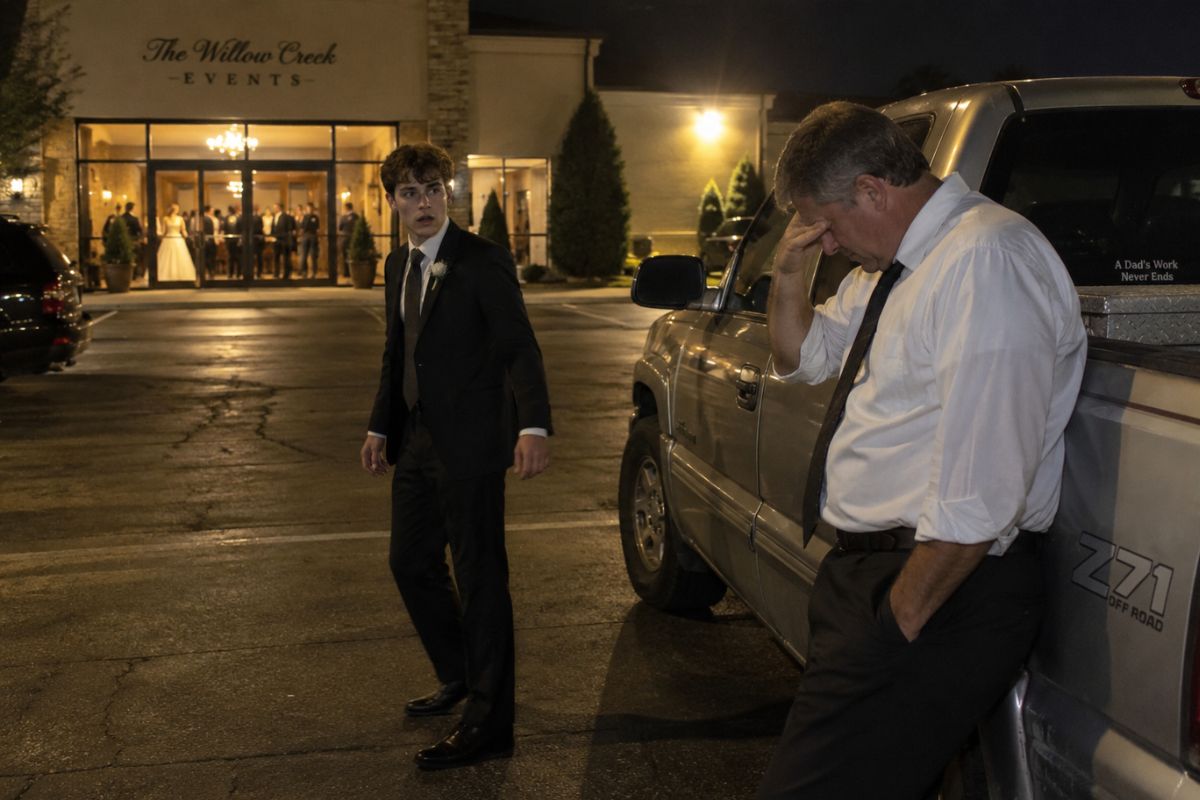
Raymond gave one small nod.
Dean returned it.
Nothing more.
No one applauded.
No one knew what it meant.
That made it better.
At the front, before Dean placed Hannah’s hand in Caleb’s, she whispered, “Thank you.”
Dean’s jaw worked once.
“For what?”
She looked toward the back row.
Dean stared straight ahead.
Then he said, “Don’t ruin your mascara.”
Hannah smiled.
The reception unfolded without a miracle.
Raymond tired quickly.
Dean remained busy.
Marissa cried during the toast and blamed allergies.
Caleb’s grandmother accidentally called him Kevin.
A flower girl spilled lemonade on her dress and spent the next hour proudly showing everyone the stain.
Life refused to arrange itself around the Mercers’ reconciliation.
That helped.
During the father-daughter dance, Dean held Hannah loosely, careful not to step on her dress.
“You look happy,” he said.
“I am.”
“Good.”
“You?”
He glanced toward the edge of the dance floor.
Raymond sat in his wheelchair.
Joanne’s old wedding photograph rested in his lap.
Marissa must have brought it.
Dean watched him for several seconds.
“I don’t know yet,” he said.
Hannah rested her head against her father’s shoulder.
“That’s okay.”
After the dance, Dean disappeared.
Hannah found him twenty minutes later.
He was sitting beside Raymond outside on the covered patio.
Neither was speaking.
Dean had two cups of coffee.
One sat on the small table between them.
Raymond’s hands were wrapped around the other.
Hannah stopped inside the doorway.
She could not hear everything.
Only pieces.
“…roof on the west side…”
“…bad flashing…”
“…you still using three-tab shingles?”
“No one uses those anymore.”
“I did.”
“That explains all the roofs I replace.”
Raymond laughed.
Dean looked at him.
Really looked.
Then he laughed too.
Not loudly.
Not for long.
Hannah backed away before either man saw her.
Some moments became smaller if witnessed.
She decided to let that one belong to them.
Raymond left the reception at eight.
Dean drove him back.
Before Raymond got out of the truck, he unfastened the seat belt slowly.
“Hannah was beautiful.”
“Yes.”
“Caleb seems decent.”
“He is.”
“Teacher.”
“Middle school.”
“Brave man.”
Dean smiled.
Raymond reached for the door handle.
“Dad.”
He stopped.
Dean had not called him that in eighteen years.
Raymond looked forward.
Dean seemed surprised by his own word.
He cleared his throat.
“The deposits.”
Raymond waited.
“Eighty-four thousand?”
“About.”
“How?”
“Work.”
“I know that.”
Dean shook his head.
“You were gone that much?”
“Yes.”
“You could’ve told me.”
“Yes.”
“I would have helped.”
“I know.”
Dean looked at him.
Raymond corrected himself.
“I believed you would.”
“That’s why you didn’t.”
“Yes.”
Dean leaned back.
“I hate that she asked you.”
“I know.”
“I hate that you agreed.”
“I know.”
“I would’ve stayed in school.”
Raymond looked toward him.
Dean’s voice weakened.
“I might have.”
“That was her fear.”
“She didn’t trust me.”
“She trusted you too much.”
Dean frowned.
Raymond continued.
“She knew if you saw someone you loved drowning, you’d jump in even if you couldn’t swim.”
Dean looked down at his hands.
“She thought that was your best quality.”
Raymond opened the truck door.
“And she was afraid it would ruin your life.”
Dean said nothing.
Raymond lowered one foot to the pavement.
“Dad.”
Raymond looked back again.
Dean swallowed.
“I read all of them.”
Raymond’s eyes closed briefly.
“All?”
“Yes.”
“I’m sorry.”
“For the letters?”
“For needing them.”
Dean looked toward Pine Hollow’s entrance.
“Come by the shop sometime.”
Raymond stared at him.
Dean immediately added, “If you’re feeling up to it.”
Raymond nodded.
“I’d like that.”
“Don’t criticize the sign.”
“I make no promises.”
Dean almost laughed.
Then Raymond went inside.
He visited Mercer Ridge Roofing three times.
The first time, Raymond sat in Dean’s office for forty minutes and complained about modern nail guns.
The second time, Dean walked him through the warehouse.
Raymond ran one hand across a stack of synthetic underlayment and said construction materials had become “too fancy for their own good.”
Dean told him that was why houses no longer leaked every six months.
They argued for ten minutes.
Marissa, watching from the office doorway, later told Hannah it was the happiest argument she had heard in years.
The third visit was in November.
Raymond was weaker.
He spent most of the time in Dean’s office.
On the wall was the old newspaper clipping from Dean’s business award.
Dean had placed Raymond’s duplicate clipping beside it.
Not framed.
Just pinned beneath the original.
Raymond noticed.
He said nothing.
Neither did Dean.
They had learned, slowly, that not every important thing required immediate explanation.
By Christmas, Raymond could no longer visit.
Dean went to Pine Hollow every Sunday.
Sometimes Hannah joined him.
Sometimes Marissa.
Sometimes Dean went alone.
He and Raymond did not spend those Sundays excavating the past.
They talked about football.
Roofing.
The price of lumber.
Whether Caleb knew how to change brake pads.
Raymond claimed he did not.
Caleb produced photographic evidence.
Raymond accused him of staging it.
They spoke about Joanne occasionally.
Those conversations remained difficult.
Dean asked questions.
Raymond answered them.
Once Dean asked, “Did she know what you said to me?”
Raymond shook his head.
“She was already gone.”
Dean looked down.
“Good.”
Raymond nodded.
“I’m glad she didn’t know either.”
There were apologies.
But no ceremony.
No moment when Dean declared every debt settled.
Forgiveness, he discovered, was less like opening a gate than taking down a fence board by board.
Some boards came loose easily.
Others had rusted nails.
Some might always remain.
Raymond died in February.
He was seventy-seven by then.
The call came shortly after five on a Monday morning.
Dean answered on the second ring.
Marissa was crying too hard to speak.
He knew.
Dean sat on the edge of his bed after the call ended.
His wife, Lisa, put one hand between his shoulder blades.
For several minutes, he stared at the floor.
Then he said, “I thought we had more Sundays.”
There was nothing anyone could say to that.
The funeral was small.
Raymond was buried beside Joanne.
Dean wore the same suit he had altered for his father to wear to Hannah’s wedding.
It fit Dean badly.
Too loose in the shoulders.
Too short in the sleeves.
Lisa told him he could buy another.
Dean shook his head.
“This one’s fine.”
At the cemetery, after everyone left, Dean remained.
He looked down at the two headstones.
For nearly thirty years, he had divided his parents into roles.
Joanne had been the one who stayed.
Raymond had been the one who left.
The truth was untidier.
Joanne had protected him and deceived him.
Raymond had sacrificed for him and wounded him.
Both had loved him.
Both had made decisions Dean wished they had not made.
Neither could now become better than they had been.
That, Dean realized, might be the hardest part of loving dead people.
You eventually had to stop waiting for revisions.
He crouched and brushed a leaf from Joanne’s headstone.
“You should’ve told me,” he said.
Then he looked at Raymond’s.
“So should you.”
The winter wind moved through the cemetery.
Dean stood.
“And I should’ve asked again.”
Then he went home.
That spring, Dean decided to sell Raymond’s house.
Marissa didn’t want it.
Dean didn’t need it.
Hannah and Caleb had their own place.
The market was good, and an older couple relocating from Ohio made an offer before the house was even formally listed.
Dean agreed to handle several repairs first.
He spent a Saturday replacing loose porch boards.
The next weekend he repaired a leaking faucet and replaced two warped cabinet doors.
Then he entered the garage.
The workbench still stood where Hannah had dragged it months earlier.
Behind it was the ragged opening in the wall.
Dean stared at the cavity.
A sheet of drywall leaned nearby.
He measured the opening.
Cut the patch.
Lifted it into place.
Then stopped.
He lowered the drywall.
For a long time he stood in his father’s garage listening to an old clock tick in the kitchen.
Finally, he carried the patch back outside.
The following weekend Dean returned with oak boards.
He framed the opening instead.
Built a recessed shelf into the wall.
Sanded the edges.
Stained the wood the same dark brown as Raymond’s workbench.
When it dried, Dean brought the green metal box from his truck.
He opened it.
Twenty-two letters remained inside.
He had put them back in chronological order.
Dean arranged them on the shelf.
Beside them he placed Joanne’s wedding photograph.
Then he reached into his pocket.
The old brass key rested in his palm.
Hannah had given it to him after Raymond died.
Dean set it beside the letters.
He stepped back.
The empty wall no longer hid anything.
When the buyers arrived the following week, Dean explained that he would like to remove the shelf and patch the wall before closing.
The husband looked at it.
“Nice little built-in.”
“Family thing.”
“Take it.”
Dean nodded.
He removed the contents that afternoon.
But he left the shelf.
Some spaces, he thought, deserved to remain visible.
Seven years later, Hannah brought her six-year-old daughter, Lucy, to Dean’s house on a Sunday afternoon.
Dean was fifty-five now.
There was more gray in his beard.
Mercer Ridge Roofing had thirty-four employees, though Dean claimed at least seven of them existed solely to send him emails he didn’t understand.
He had built a smaller version of Raymond’s shelf into his own garage.
The letters sat there.
So did the brass key.
Joanne’s photograph.
Raymond’s first-dollar envelope.
And one new object.
A photograph from Hannah’s wedding.
Raymond in his navy suit.
Dean sitting beside him on the patio.
Two cups of coffee between them.
Neither looking at the camera.
Lucy wandered into the garage while Dean was repairing a birdhouse.
She noticed the shelf.
“What’s that key for, Grandpa?”
Dean looked up.
“Old house.”
“Can we go there?”
“Somebody else lives there now.”
“Then why do you have the key?”
Dean wiped sawdust from his hands.
“Because it opened something else.”
Lucy frowned.
“Like what?”
He glanced at Hannah.
She stood in the doorway, watching.
Dean took one of Raymond’s letters from the shelf.
The paper had softened at the folds.
He did not open it.
Lucy pointed.
“Who wrote those?”
“My dad.”
“Great-Grandpa Raymond?”
“Yep.”
“Why are there so many?”
Dean looked at the letters.
Once, they had made him furious simply by existing.
Then they had become evidence.
Then explanation.
Then apology.
Now, after seven years, they were something quieter.
Proof that people could love one another badly.
Proof that silence could feel protective to the person keeping it and cruel to the person receiving it.
Proof that being right about someone’s failure did not necessarily mean you understood their reasons.
Dean returned the letter to the shelf.
Lucy was still waiting.
“What’s inside the wall?” she asked.
Dean looked at Hannah.
His daughter smiled.
Then he looked again at the brass key his father had been too afraid to explain.
“Things our family should’ve said sooner,” he said.
Thank you so much for reading this story!
I’d really love to hear your comments and thoughts about this story — your feedback is truly valuable and helps us a lot.
Please leave a comment and share this Facebook post to support the author. Every reaction and review makes a big difference!
This story is a work of fiction created for entertainment and inspirational purposes. While it may draw on real-world themes, all characters, names, and events are imagined. Any resemblance to actual people or situations is purely coincidental.